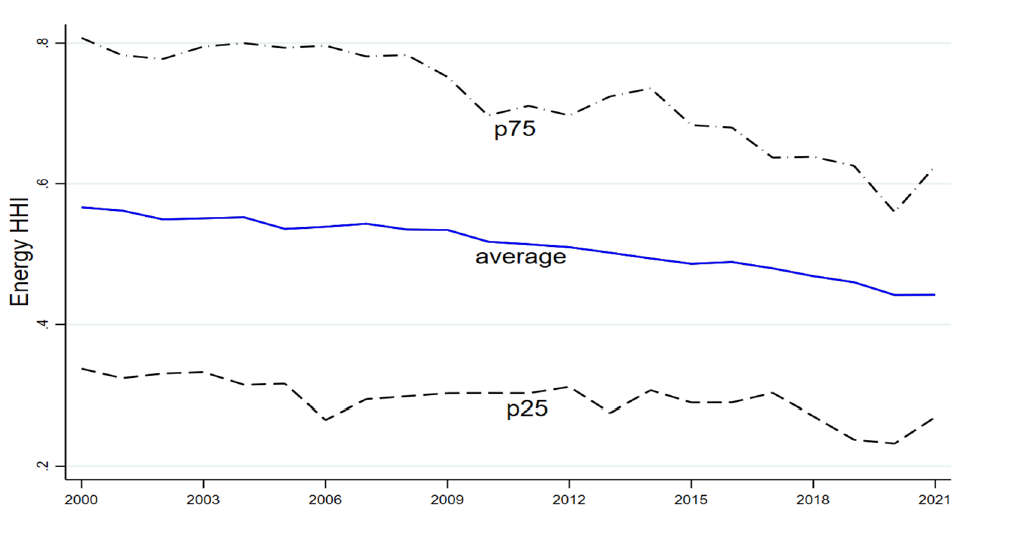
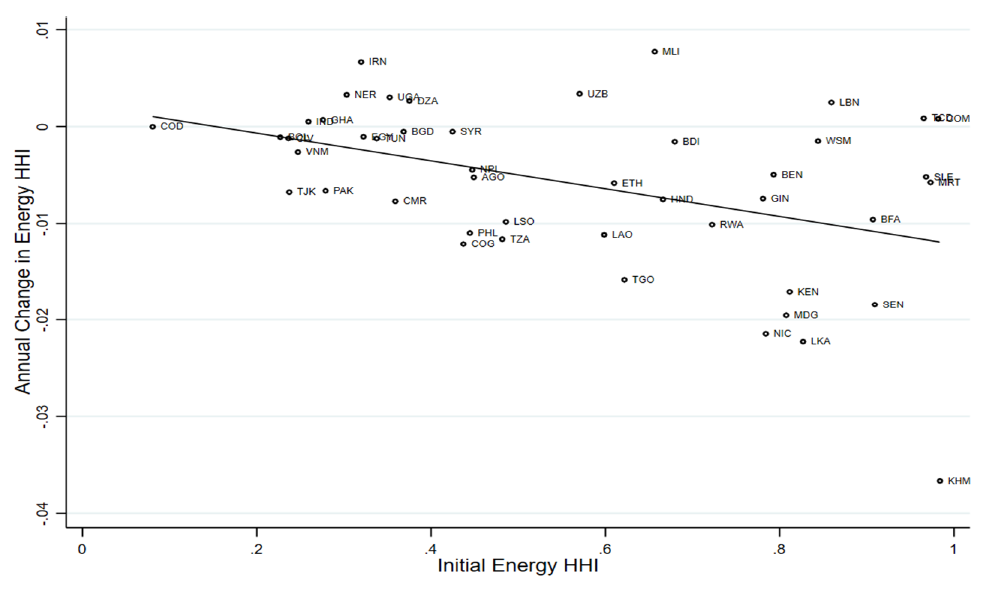
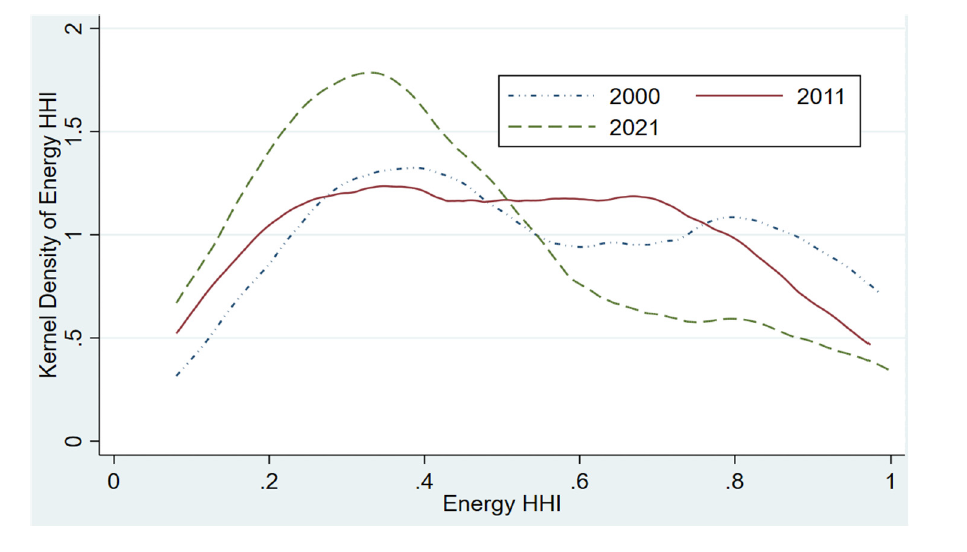
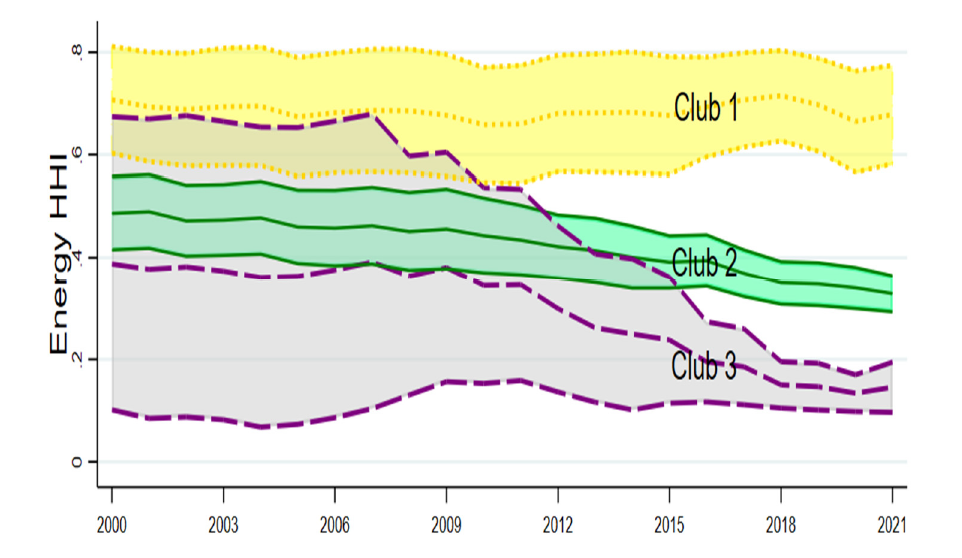
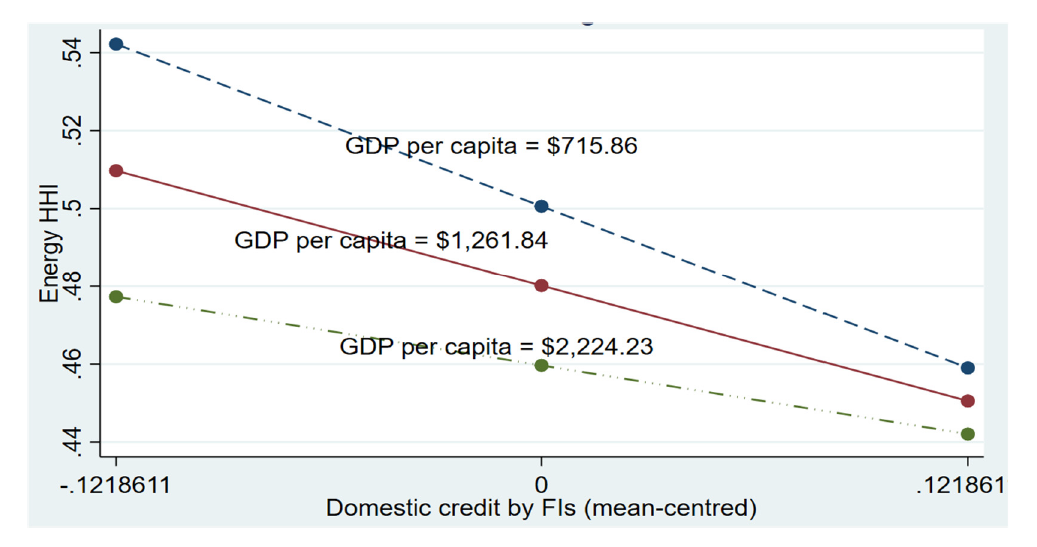
This study examined the long-run dynamics of energy diversification in 46 low- and lower-middle-income countries, with particular emphasis on the roles of domestic credit and income levels. Applying the Phillips–Sul convergence framework to energy concentration as an inverse measure of diversification, we found no evidence of full-sample convergence despite overall diversification gains and reduced cross-country dispersion. Instead, countries form three distinct convergence clubs, differentiated by their initial energy diversification levels and subsequent trajectories. Economies with more diversified starting points continue to broaden their energy mix, while those with highly concentrated systems exhibit slower and more limited diversification. Further regression analysis showed that higher levels of domestic credit are consistently associated with greater energy diversification. The relationship between income and diversification is nonlinear: diversification initially increases with gross domestic product (GDP) per capita but declines beyond an estimated turning point of approximately PPP03, with most observations lying below this threshold. Importantly, interaction results reveal that the diversification effect of domestic credit is income-dependent, with credit expansion exerting a stronger impact at lower income levels. Overall, the findings suggest that effective energy diversification requires a staged and context-sensitive approach, in which financial policies evolve alongside income levels and existing energy structures. Aligning financial conditions with realistic energy transition pathways is likely to be central to achieving sustained diversification outcomes in developing economies.
Citation: Thanh Nguyen, Eric Tham. Club convergence in energy diversification among low- and lower-middle-income countries: The role of domestic credit and income[J]. Green Finance, 2026, 8(3): 501-534. doi: 10.3934/GF.2026018
This study examined the long-run dynamics of energy diversification in 46 low- and lower-middle-income countries, with particular emphasis on the roles of domestic credit and income levels. Applying the Phillips–Sul convergence framework to energy concentration as an inverse measure of diversification, we found no evidence of full-sample convergence despite overall diversification gains and reduced cross-country dispersion. Instead, countries form three distinct convergence clubs, differentiated by their initial energy diversification levels and subsequent trajectories. Economies with more diversified starting points continue to broaden their energy mix, while those with highly concentrated systems exhibit slower and more limited diversification. Further regression analysis showed that higher levels of domestic credit are consistently associated with greater energy diversification. The relationship between income and diversification is nonlinear: diversification initially increases with gross domestic product (GDP) per capita but declines beyond an estimated turning point of approximately PPP03, with most observations lying below this threshold. Importantly, interaction results reveal that the diversification effect of domestic credit is income-dependent, with credit expansion exerting a stronger impact at lower income levels. Overall, the findings suggest that effective energy diversification requires a staged and context-sensitive approach, in which financial policies evolve alongside income levels and existing energy structures. Aligning financial conditions with realistic energy transition pathways is likely to be central to achieving sustained diversification outcomes in developing economies.

| [1] |
Achuo E, Kakeu P, Asongu S (2024) Financial development, human capital and energy transition: a global comparative analysis. Int J Energy Sect Manag 19: 59–80. https://doi.org/10.1108/ijesm-11-2023-0004. doi: 10.1108/ijesm-11-2023-0004

|
| [2] |
Afonso Ó, Fonseca L, Magalhães M, et al. (2020) Directed technical change and environmental quality. Port Econ J 20: 71–97. https://doi.org/10.1007/s10258-020-00174-4 doi: 10.1007/s10258-020-00174-4
|
| [3] |
Ağazade S (2026) Is there a global trend toward better energy structure? Convergence analysis of energy diversification. Int J Green Energy 23: 504–513. https://doi.org/10.1080/15435075.2025.2561202 doi: 10.1080/15435075.2025.2561202
|
| [4] |
Ahmad M, Uddin I (2025) Enhancing energy efficiency in OECD economies: The role of eco-friendly technology, financial development, and clean energy investment. Sustain Futures 10: 101258. https://doi.org/10.1016/j.sftr.2025.101258 doi: 10.1016/j.sftr.2025.101258
|
| [5] |
Akrofi MM (2020) An analysis of energy diversification and transition trends in Africa. Int J Energy Water Resour 5: 1–12. https://doi.org/10.1007/s42108-020-00101-5 doi: 10.1007/s42108-020-00101-5
|
| [6] |
Alharbi SS, Boubaker S, Ngo T, et al. (2025) Shadow economy and energy efficiency: utilising goal programming for sustainability assessment. Ann Oper Res, 1–25. https://doi.org/10.1007/s10479-025-06768-5 doi: 10.1007/s10479-025-06768-5
|
| [7] |
Alsagr N (2023) Financial efficiency and its impact on renewable energy investment: Empirical evidence from advanced and emerging economies. J Clean Prod 401: 136738. https://doi.org/10.1016/j.jclepro.2023.136738 doi: 10.1016/j.jclepro.2023.136738
|
| [8] |
Anton SG, Afloarei Nucu AE (2020) The effect of financial development on renewable energy consumption. A panel data approach. Renew Energy 147: 330–338. https://doi.org/10.1016/j.renene.2019.09.005 doi: 10.1016/j.renene.2019.09.005
|
| [9] |
Arthur WB (1989) Competing Technologies, Increasing Returns, and Lock-In by Historical Events. Econ J 99: 116–131. https://doi.org/10.2307/2234208 doi: 10.2307/2234208
|
| [10] |
Aydin M, Bozatli O (2023) The effects of green innovation, environmental taxes, and financial development on renewable energy consumption in OECD countries. Energy 280: 128105. https://doi.org/10.1016/j.energy.2023.128105 doi: 10.1016/j.energy.2023.128105
|
| [11] |
Babayomi OO, Dahoro DA, Zhang Z (2022) Affordable clean energy transition in developing countries: Pathways and technologies. iScience 25: 104178. https://doi.org/10.1016/j.isci.2022.104178 doi: 10.1016/j.isci.2022.104178
|
| [12] |
Barro RJ, Sala-i-Martin X (1992) Convergence. J Polit Econ 100: 223–251. https://doi.org/10.1086/261816 doi: 10.1086/261816
|
| [13] | Baumol WJ (1986) Productivity growth, convergence, and welfare: what the long-run data show. Am Econ Rev, 1072–1085. |
| [14] |
Baz K, Cheng J, Xu D, et al. (2021) Asymmetric impact of fossil fuel and renewable energy consumption on economic growth: A nonlinear technique. Energy 226: 120357. https://doi.org/10.1016/j.energy.2021.120357 doi: 10.1016/j.energy.2021.120357
|
| [15] |
Beck T, Levine R, Loayza N (2000) Finance and the Sources of Growth. J Financ Econ 58: 261–300. https://doi.org/10.1016/S0304-405X(00)00072-6 doi: 10.1016/S0304-405X(00)00072-6
|
| [16] |
Bello AA, Agabo T, Adedoyin FF (2021) The anthropogenic consequences of energy consumption in Sub-Saharan Africa: Is there a role for education? Environ Chall 5: 100234. https://doi.org/10.1016/j.envc.2021.100234 doi: 10.1016/j.envc.2021.100234
|
| [17] |
Bernard AB, Durlauf SN (1995) Convergence in international output. J Appl Econom 10: 97–108. https://doi.org/10.1002/jae.3950100202 doi: 10.1002/jae.3950100202
|
| [18] |
Bernard AB, Durlauf SN (1996) Interpreting tests of the convergence hypothesis. J Econom 71: 161–173. https://doi.org/10.1016/0304-4076(94)01699-2 doi: 10.1016/0304-4076(94)01699-2
|
| [19] |
Boubaker S, Le TDQ, Manita R, et al. (2025) The trade-off frontier for ESG and Sharpe ratio: a bootstrapped double-frontier data envelopment analysis. Ann Oper Res 347: 717–741. https://doi.org/10.1007/s10479-023-05506-z doi: 10.1007/s10479-023-05506-z
|
| [20] |
Calcaterra M, Aleluia Reis L, Fragkos P, et al. (2024) Reducing the cost of capital to finance the energy transition in developing countries. Nat Energy 9: 1241–1251. https://doi.org/10.1038/s41560-024-01606-7 doi: 10.1038/s41560-024-01606-7
|
| [21] |
Campiglio E (2016) Beyond carbon pricing: The role of banking and monetary policy in financing the transition to a low-carbon economy. Ecol Econ 121: 220–230. https://doi.org/10.1016/j.ecolecon.2015.03.020 doi: 10.1016/j.ecolecon.2015.03.020
|
| [22] |
Cheng J, Jiang Y (2024) How can carbon markets drive the development of renewable energy sector? Empirical evidence from China. Data Sci Financ Econ 4: 249. https://doi.org/10.3934/DSFE.2024010 doi: 10.3934/DSFE.2024010
|
| [23] |
Diallo S, Ouoba Y (2024) Financial development and renewable energy deployment in sub-Saharan African countries. Int J Energy Sect Manag 18: 1305–1327. https://doi.org/10.1108/IJESM-06-2023-0012 doi: 10.1108/IJESM-06-2023-0012
|
| [24] |
Dogan E, Chishti MZ, Karimi Alavijeh N, et al. (2022) The roles of technology and Kyoto Protocol in energy transition towards COP26 targets: Evidence from the novel GMM-PVAR approach for G-7 countries. Technol Forecast Soc Change 181: 121756. https://doi.org/10.1016/j.techfore.2022.121756 doi: 10.1016/j.techfore.2022.121756
|
| [25] |
Dogru T, Assaf A, Josiassen A, et al. (2026) Operationalizing GenAI: a framework protocol for auditable and responsible GenAI use in academic research. Int J Contemp Hosp Manage 38: 791–806. https://doi.org/10.1108/IJCHM-06-2025-0837 doi: 10.1108/IJCHM-06-2025-0837
|
| [26] |
Eren BM, Taspinar N, Gokmenoglu KK (2019) The impact of financial development and economic growth on renewable energy consumption: Empirical analysis of India. Sci Total Environ 663: 189–197. https://doi.org/10.1016/j.scitotenv.2019.01.323 doi: 10.1016/j.scitotenv.2019.01.323
|
| [27] |
Gozgor G, Paramati SR (2022) Does energy diversification cause an economic slowdown? Evidence from a newly constructed energy diversification index. Energy Econ 109: 105970. https://doi.org/10.1016/j.eneco.2022.105970 doi: 10.1016/j.eneco.2022.105970
|
| [28] |
Gyimah J, Yao X, Tachega MA, et al. (2022) Renewable energy consumption and economic growth: New evidence from Ghana. Energy 248: 123559. https://doi.org/10.1016/j.energy.2022.123559 doi: 10.1016/j.energy.2022.123559
|
| [29] |
Habiba U, Xinbang C, Anwar A (2022) Do green technology innovations, financial development, and renewable energy use help to curb carbon emissions? Renew Energy 193: 1082–1093. https://doi.org/10.1016/j.renene.2022.05.084 doi: 10.1016/j.renene.2022.05.084
|
| [30] |
Hajko V, Sebri M, Al-Saidi M, et al. (2018) The energy-growth nexus: history, development, and new challenges. Econ Econom Energy-Growth Nexus, 1–46. https://doi.org/10.1016/B978-0-12-812746-9.00001-8 doi: 10.1016/B978-0-12-812746-9.00001-8
|
| [31] |
Hosier RH, Dowd J (1987) Household fuel choice in Zimbabwe: an empirical test of the energy ladder hypothesis. Resour Energy 9: 347–361. https://doi.org/10.1016/0165-0572(87)90003-X doi: 10.1016/0165-0572(87)90003-X
|
| [32] | Iqbal Z, Noor M (2023) The impact of energy consumption on economic growth in selected emerging economies. J Energy Environ Policy Options 6: 29–35. |
| [33] |
Islam MM, Ali MI, Ceh B, et al. (2022) Renewable and non-renewable energy consumption driven sustainable development in ASEAN countries: do financial development and institutional quality matter? Environ Sci Pollut Res Int 29: 34231–34247. https://doi.org/10.1007/s11356-021-18488-x doi: 10.1007/s11356-021-18488-x
|
| [34] |
Karanfil F, Omgba LD (2023) The energy transition and export diversification in oil-dependent countries: The role of structural factors. Ecol Econ 204: 107681. https://doi.org/10.1016/j.ecolecon.2022.107681 doi: 10.1016/j.ecolecon.2022.107681
|
| [35] |
Kor S, Qamruzzaman M (2023) Nexus between FDI, financial development, capital formation and renewable energy consumption: evidence from Bangladesh. Int J Energy Econ Policy 13: 129–145. https://doi.org/10.32479/ijeep.14863 doi: 10.32479/ijeep.14863
|
| [36] |
Kuziboev B, Ozturk I, Kalandarov F, et al. (2025) Promoting energy sources diversification through ESG performance. Energy 324: 136009. https://doi.org/10.1016/j.energy.2025.136009 doi: 10.1016/j.energy.2025.136009
|
| [37] |
Le T-H, Nguyen CP, Park D (2020) Financing renewable energy development: Insights from 55 countries. Energy Res Soc Sci 68: 101537. https://doi.org/10.1016/j.erss.2020.101537 doi: 10.1016/j.erss.2020.101537
|
| [38] | Levine R (1997) Financial development and economic growth: views and agenda. J Econ Lit 35: 688–726. |
| [39] |
Levine R (2005) Finance and growth: theory and evidence. Handbook Econ Growth 1: 865–934. https://doi.org/10.1016/S1574-0684(05)01012-9 doi: 10.1016/S1574-0684(05)01012-9
|
| [40] |
Li B (2023) The role of financial markets in the energy transition: an analysis of investment trends and opportunities in renewable energy and clean technology. Environ Sci Pollut Res Int 30: 97948–97964. https://doi.org/10.1007/s11356-023-29014-6 doi: 10.1007/s11356-023-29014-6
|
| [41] |
Li Y, Yang X, Ran Q, et al. (2021) Energy structure, digital economy, and carbon emissions: evidence from China. Environ Sci Pollut Res Int 28: 64606–64629. https://doi.org/10.1007/s11356-021-15304-4 doi: 10.1007/s11356-021-15304-4
|
| [42] |
Limi FB (2020) Effect of financial development on energy diversification in Sub-Saharan Africa. J. Energy Res Rev 4: 29–38. https://doi.org/10.9734/jenrr/2020/v4i330129 doi: 10.9734/jenrr/2020/v4i330129
|
| [43] |
Liu W, Shen Y, Razzaq A (2023) How renewable energy investment, environmental regulations, and financial development derive renewable energy transition: Evidence from G7 countries. Renew Energy 206: 1188–1197. https://doi.org/10.1016/j.renene.2023.02.017 doi: 10.1016/j.renene.2023.02.017
|
| [44] |
Ma X, Mao Q (2025) Can Financial Development Promote Renewable Energy Transition? An Empirical Research Based on Global Panel Data. Sustainability 17: 9270. https://doi.org/10.3390/su17209270 doi: 10.3390/su17209270
|
| [45] |
Mahdavi P, Martinez-Alvarez CB, Ross ML (2022) Why do governments tax or subsidize fossil fuels? J Polit 84: 2123–2139. https://doi.org/10.1086/719272 doi: 10.1086/719272
|
| [46] |
Masera OR, Saatkamp BD, Kammen DM (2000) From linear fuel switching to multiple cooking strategies: a critique and alternative to the energy ladder model. World Dev 28: 2083–2103. https://doi.org/10.1016/S0305-750X(00)00076-0 doi: 10.1016/S0305-750X(00)00076-0
|
| [47] |
Mukhtarov S, Yüksel S, Dinçer H (2022) The impact of financial development on renewable energy consumption: Evidence from Turkey. Renew Energy 187: 169–176. https://doi.org/10.1016/j.renene.2022.01.061 doi: 10.1016/j.renene.2022.01.061
|
| [48] |
Murshed M, Tanha MM (2021) Oil price shocks and renewable energy transition: Empirical evidence from net oil-importing South Asian economies. Energy Ecol Environ 6: 183–203. https://doi.org/10.1007/s40974-020-00168-0 doi: 10.1007/s40974-020-00168-0
|
| [49] |
Nawaz A, Rahman MM (2023) Renewable energy consumption in Sub-Saharan Africa: The role of human capital, foreign direct investment, financial development, and institutional quality. Energy Rep 10: 3383–3393. https://doi.org/10.1016/j.egyr.2023.10.025 doi: 10.1016/j.egyr.2023.10.025
|
| [50] |
Nchofoung TN (2024) Oil price shocks and energy transition in Africa. Energy Policy 184: 113855. https://doi.org/10.1016/j.enpol.2023.113855 doi: 10.1016/j.enpol.2023.113855
|
| [51] |
Nguyen T, Nghiem S, Doan A-T (2025) Energy diversification, financial development and economic development: an examination of convergence in OECD countries. China Financ Rev Int 15: 337–362. https://doi.org/10.1108/CFRI-07-2024-0427 doi: 10.1108/CFRI-07-2024-0427
|
| [52] |
Nibedita B, Irfan M (2024) Energy mix diversification in emerging economies: An econometric analysis of determinants. Renew Sustain Energy Rev 189: 114043. https://doi.org/10.1016/j.rser.2023.114043 doi: 10.1016/j.rser.2023.114043
|
| [53] |
Olaniyi CO, Al‐Faryan MAS, Ogbaro EO (2025) Do institutional quality and its threshold matter in the sensitivity of the renewable energy transition to financial development? New empirical perspectives. Int J Financ Econ 30: 5–43. https://doi.org/10.1002/ijfe.2900 doi: 10.1002/ijfe.2900
|
| [54] |
Oluoch S, Lal P, Susaeta A (2021) Investigating factors affecting renewable energy consumption: A panel data analysis in Sub Saharan Africa. Environ Chall 4: 100092. https://doi.org/10.1016/j.envc.2021.100092 doi: 10.1016/j.envc.2021.100092
|
| [55] |
Ozturk I (2010) A literature survey on energy–growth nexus. Energy Policy 38: 340–349. https://doi.org/10.1016/j.enpol.2009.09.024 doi: 10.1016/j.enpol.2009.09.024
|
| [56] | Pablo-Romero MdP, Sánchez-Braza A, Sánchez-Rivas J (2024) A survey of energy-environmental Kuznets curve studies, Handbook on Energy and Economic Growth, 173–198, Edward Elgar Publishing. https://doi.org/10.4337/9781802204803.00016 |
| [57] |
Pasandideh AS, Ezaan G (2025) Governance challenges of renewable energy development in fossil fuel dependent countries with a focus on Iran. Energy Sustain Dev 87: 101759. https://doi.org/10.1016/j.esd.2025.101759 doi: 10.1016/j.esd.2025.101759
|
| [58] |
Pata UK, Alola AA, Erdogan S, et al. (2023) The influence of income, economic policy uncertainty, geopolitical risk, and urbanization on renewable energy investments in G7 countries. Energy Econ 128: 107172. https://doi.org/10.1016/j.eneco.2023.107172 doi: 10.1016/j.eneco.2023.107172
|
| [59] |
Payne JE, Saunoris JW, Nazlioglu S, et al. (2024) Renewable energy production across US states: Convergence or divergence? Energy Econ 140: 108015. https://doi.org/10.1016/j.eneco.2024.108015 doi: 10.1016/j.eneco.2024.108015
|
| [60] |
Phillips PCB, Sul D (2007) Transition modeling and econometric convergence tests. Econometrica 75: 1771–1855. https://doi.org/10.1111/j.1468-0262.2007.00811.x doi: 10.1111/j.1468-0262.2007.00811.x
|
| [61] |
Phillips PCB, Sul D (2009) Economic transition and growth. J Appl Econom 24: 1153–1185. https://doi.org/10.1002/jae.1080 doi: 10.1002/jae.1080
|
| [62] |
Pinar M (2024) Convergence in renewable energy innovation and factors influencing convergence club formation. Renew Energy 220: 119607. https://doi.org/10.1016/j.renene.2023.119607 doi: 10.1016/j.renene.2023.119607
|
| [63] |
Polzin F, Egli F, Steffen B, et al. (2019) How do policies mobilize private finance for renewable energy?—A systematic review with an investor perspective. Appl Energy 236: 1249–1268. https://doi.org/10.1016/j.apenergy.2018.11.098 doi: 10.1016/j.apenergy.2018.11.098
|
| [64] |
Presno MJ, Landajo M (2021) EU-28's progress toward the 2020 renewable energy share: A club convergence analysis. Environ Sci Pollut Res 28: 66830–66844. https://doi.org/10.1007/s11356-021-15084-x doi: 10.1007/s11356-021-15084-x
|
| [65] |
Raifu IA, Nnadozie OO, Adeniyi OA (2021) Infrastructure-structural transformation nexus in Africa: the role of financial sector development. J Afr Dev 22: 124–165. https://doi.org/10.5325/jafrideve.22.1.0124 doi: 10.5325/jafrideve.22.1.0124
|
| [66] | Ranis G, Fei JCH (1961) A theory of economic development. Am Econ Rev 533–565. |
| [67] |
Rubio-Varas M, Munoz-Delgado B (2019) The Energy Mix Concentration Index (EMCI): Methodological considerations for implementation. MethodsX 6: 1228–1237. https://doi.org/10.1016/j.mex.2019.05.023 doi: 10.1016/j.mex.2019.05.023
|
| [68] |
Saadaoui H, Chtourou N (2023) Do institutional quality, financial development, and economic growth improve renewable energy transition? Some evidence from Tunisia. J Knowl Econ 14: 2927–2958. https://doi.org/10.1007/s13132-022-00999-8 doi: 10.1007/s13132-022-00999-8
|
| [69] |
Saba CS, Ngepah N (2022a) Convergence in renewable energy sources and the dynamics of their determinants: An insight from a club clustering algorithm. Energy Rep 8: 3483–3506. https://doi.org/10.1016/j.egyr.2022.01.190 doi: 10.1016/j.egyr.2022.01.190
|
| [70] |
Saba CS, Ngepah N (2022b) Convergence in renewable energy consumption and their influencing factors across regions: evidence from convergence algorithm approach. Environ Sci Pollut Res Int 29: 61412–61445. https://doi.org/10.1007/s11356-022-19731-9 doi: 10.1007/s11356-022-19731-9
|
| [71] |
Seto KC, Davis SJ, Mitchell RB, et al. (2016) Carbon lock-in: types, causes, and policy implications. Annu Rev Environ Resour 41: 425–452. https://doi.org/10.1146/annurev-environ-110615-085934 doi: 10.1146/annurev-environ-110615-085934
|
| [72] |
Shahbaz M, Siddiqui A, Ahmad S, et al. (2023) Financial development as a new determinant of energy diversification: the role of natural capital and structural changes in Australia. Energy Econ 126: 106926. https://doi.org/10.1016/j.eneco.2023.106926 doi: 10.1016/j.eneco.2023.106926
|
| [73] |
Solarin SA, Bello MO, Hammoudeh S (2024) Transiting toward sustainable development: stochastic convergence of energy diversification using a newly constructed index. Environ Sci Pollut Res Int 31: 47611–47629. https://doi.org/10.1007/s11356-024-34341-3 doi: 10.1007/s11356-024-34341-3
|
| [74] |
Tiba S, Omri A (2017) Literature survey on the relationships between energy, environment and economic growth. Renew Sustain Energy Rev 69: 1129–1146. https://doi.org/10.1016/j.rser.2016.09.113 doi: 10.1016/j.rser.2016.09.113
|
| [75] |
Triguero-Ruiz F, Avila-Cano A, Aranda FT (2023) Measuring the diversification of energy sources: The energy mix. Renew Energy 216: 119096. https://doi.org/10.1016/j.renene.2023.119096 doi: 10.1016/j.renene.2023.119096
|
| [76] |
Triguero-Ruiz F, Avila-Cano A, Trujillo Aranda F (2025) The role of energy diversification in the average income and pollution intensity of OECD economies. Energy Sources Part B Econ Plan Policy 20: 2588260. https://doi.org/10.1080/15567249.2025.2588260 doi: 10.1080/15567249.2025.2588260
|
| [77] |
Triguero-Ruiz F, Avila-Cano A (2019) The distance to competitive balance: A cardinal measure. Appl Econ 51: 698–710. https://doi.org/10.1080/00036846.2018.1512743 doi: 10.1080/00036846.2018.1512743
|
| [78] |
Tzeremes P (2024) Sectoral Convergence Trends in per Capita Energy Use Among US States. Stud Microecon, 23210222241275739. https://doi.org/10.1177/23210222241275739 doi: 10.1177/23210222241275739
|
| [79] | Unruh GC (2000) Understanding carbon lock-in. Energy Policy 28: 817–830. https://doi.org/https://doi.org/10.1016/S0301-4215(00)00070-7 |
| [80] |
Vatamanu AF, Zugravu BG (2023) Financial development, institutional quality and renewable energy consumption. A panel data approach. Econ Anal Policy 78: 765–775. https://doi.org/10.1016/j.eap.2023.04.015 doi: 10.1016/j.eap.2023.04.015
|
| [81] |
Wang Q, Dong Z (2021) Does financial development promote renewable energy? Evidence of G20 economies. Environ Sci Pollut Res Int 28: 64461–64474. https://doi.org/10.1007/s11356-021-15597-5 doi: 10.1007/s11356-021-15597-5
|
| [82] |
Zafar MW, Shahbaz M, Hou F, et al. (2019) From nonrenewable to renewable energy and its impact on economic growth: The role of research & development expenditures in Asia-Pacific Economic Cooperation countries. J Clean Prod 212: 1166–1178. https://doi.org/10.1016/j.jclepro.2018.12.081 doi: 10.1016/j.jclepro.2018.12.081
|
 GF-08-03-018-s001.pdf |
 |
Figures(5) / Tables(14)

Thanh Nguyen, Eric Tham. Club convergence in energy diversification among low- and lower-middle-income countries: The role of domestic credit and income[J]. Green Finance, 2026, 8(3): 501-534. doi: 10.3934/GF.2026018





 DownLoad: