Systemic lupus erythematosus (SLE) is a chronic autoimmune disease frequently complicated by renal involvement, known as lupus nephritis (LN). Pentraxin 3 (PTX3) is an acute-phase protein implicated in immune regulation, and autoantibodies against PTX3 (anti-PTX3) have been hypothesized to exert a protective effect against the development of LN in SLE patients. The objective of the current study was to evaluate serum levels of anti-PTX3 IgG and anti-double-stranded DNA (anti-dsDNA) IgG antibodies in SLE patients and to assess their association with disease activity and proteinuria.
This cross-sectional study included 69 participants divided into three groups: SLE patients with proteinuria, SLE patients without proteinuria, and healthy controls. Serum IgG anti-PTX3 and anti-dsDNA levels were measured using enzyme-linked immunosorbent assay (ELISA). Proteinuria was assessed by measuring the albumin-to-creatinine ratio (A/Cr). Associations between antibody levels, proteinuria, and disease activity index were analyzed.
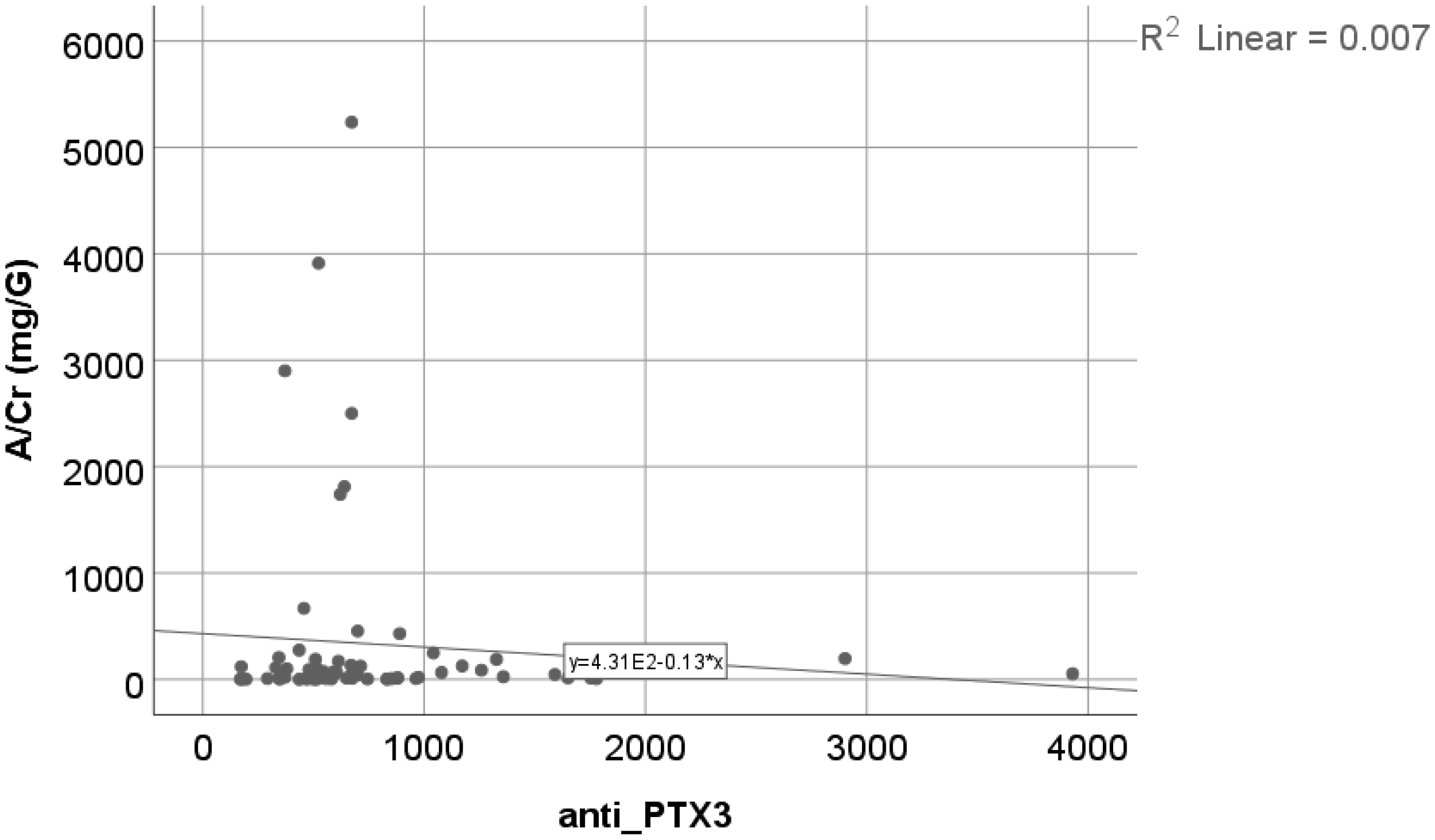
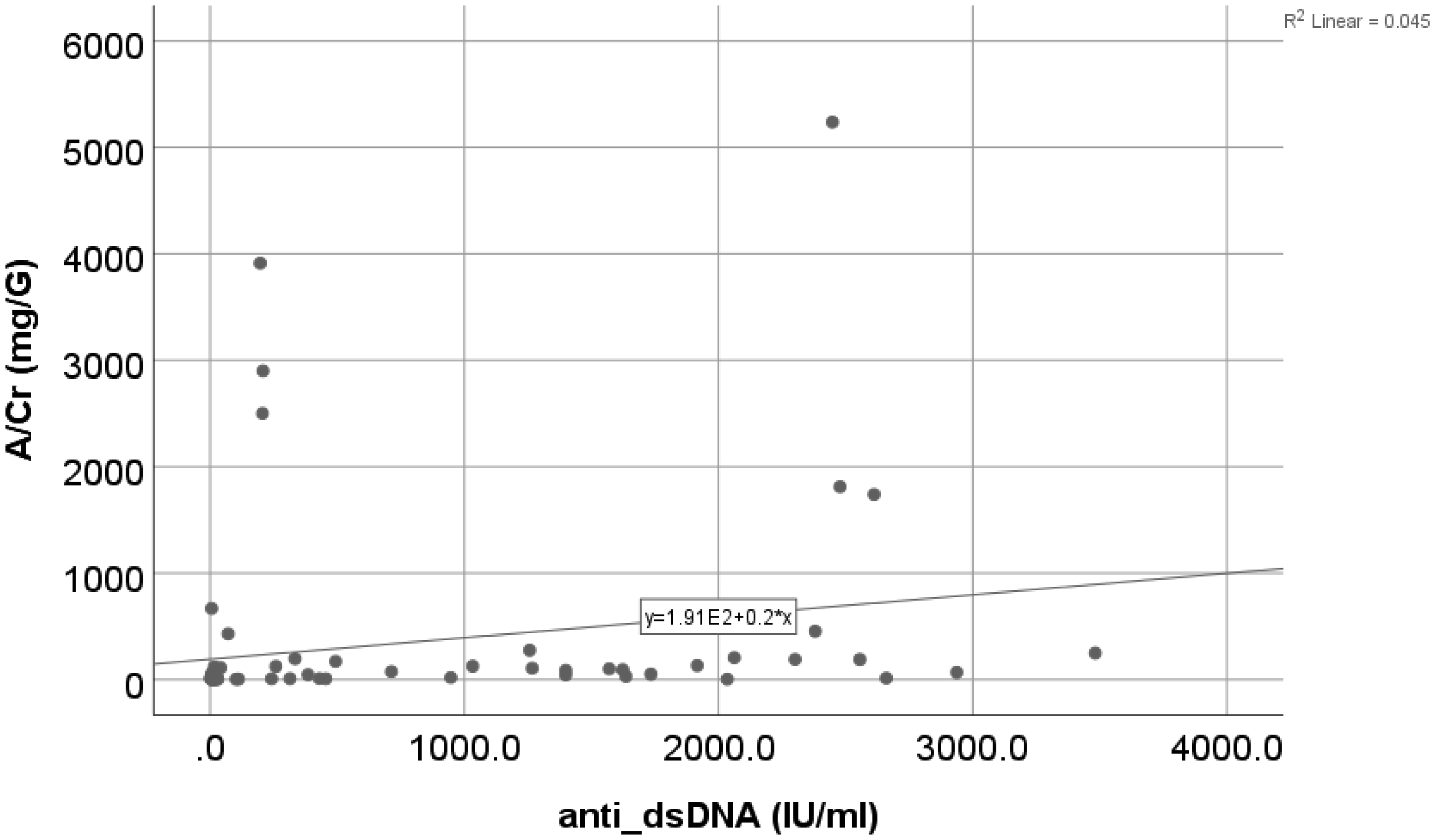
Serum anti-PTX3 levels were highest in SLE patients without proteinuria, with a statistically significant difference among the three groups (p = 0.031). Anti-dsDNA antibodies were detected exclusively in SLE patients; however, no significant difference was observed between patients with and without proteinuria (p = 1.00). Anti-PTX3 levels demonstrated a weak negative correlation with A/Cr (r = −0.082) and with disease activity index (r = −0.142).
Higher anti-PTX3 levels in SLE patients without proteinuria and their inverse relationship with proteinuria and disease activity were observed in this cross-sectional sample; however, these correlations were weak and not statistically significant, and a protective or causal role cannot be established from these data. Anti-PTX3 may represent a candidate marker warranting longitudinal validation in patients with SLE.
Citation: Maria Noor, Khursheed Javaid, Sana Mahmood, Ayesha Nadeem, Saima Pervaiz, Faheem Shahzad, Muhammad Kashif, Nadeem Afzal. Anti-Pentraxin 3 autoantibodies in systemic lupus erythematosus: A comparative study of patients with and without proteinuria[J]. AIMS Allergy and Immunology, 2026, 10(3): 209-221. doi: 10.3934/Allergy.2026015
Systemic lupus erythematosus (SLE) is a chronic autoimmune disease frequently complicated by renal involvement, known as lupus nephritis (LN). Pentraxin 3 (PTX3) is an acute-phase protein implicated in immune regulation, and autoantibodies against PTX3 (anti-PTX3) have been hypothesized to exert a protective effect against the development of LN in SLE patients. The objective of the current study was to evaluate serum levels of anti-PTX3 IgG and anti-double-stranded DNA (anti-dsDNA) IgG antibodies in SLE patients and to assess their association with disease activity and proteinuria.
This cross-sectional study included 69 participants divided into three groups: SLE patients with proteinuria, SLE patients without proteinuria, and healthy controls. Serum IgG anti-PTX3 and anti-dsDNA levels were measured using enzyme-linked immunosorbent assay (ELISA). Proteinuria was assessed by measuring the albumin-to-creatinine ratio (A/Cr). Associations between antibody levels, proteinuria, and disease activity index were analyzed.
Serum anti-PTX3 levels were highest in SLE patients without proteinuria, with a statistically significant difference among the three groups (p = 0.031). Anti-dsDNA antibodies were detected exclusively in SLE patients; however, no significant difference was observed between patients with and without proteinuria (p = 1.00). Anti-PTX3 levels demonstrated a weak negative correlation with A/Cr (r = −0.082) and with disease activity index (r = −0.142).
Higher anti-PTX3 levels in SLE patients without proteinuria and their inverse relationship with proteinuria and disease activity were observed in this cross-sectional sample; however, these correlations were weak and not statistically significant, and a protective or causal role cannot be established from these data. Anti-PTX3 may represent a candidate marker warranting longitudinal validation in patients with SLE.
Systemic lupus erythematosus
Lupus nephritis
Pentraxin 3
Anti-pentraxin 3 IgG autoantibody
Anti-double-stranded DNA IgG antibody
Enzyme-linked immunosorbent assay
Urinary albumin-to-creatinine ratio
American College of Rheumatology
Systemic Lupus International Collaborating Clinics
Systemic Lupus Erythematosus Disease Activity Index—Safety of Estrogens in Lupus National Assessment
Interquartile range
Immune complex
Autoimmune diseases
Statistical Package for the Social Sciences

| [1] |
Lenti MV, Rossiet CM, Melazzini F, et al. (2022) Seronegative autoimmune diseases: A challenging diagnosis. Autoimmun Rev 21: 103143. https://doi.org/10.1016/j.autrev.2022.103143 
|
| [2] |
Nusbaum JS, Mirza I, Shum J, et al. (2020) Sex differences in systemic lupus erythematosus: Epidemiology, clinical considerations, and disease pathogenesis. Mayo Clin Proc 95: 384-394. https://doi.org/10.1016/j.mayocp.2019.09.012
|
| [3] |
Stojan G, Petri M (2018) Epidemiology of systemic lupus erythematosus: An update. Curr Opin Rheumatol 30: 144-150. https://doi.org/10.1097/BOR.0000000000000480
|
| [4] |
Van Drongelen V, Rew J, Billi AC (2025) Sex bias in autoimmunity: New findings and new opportunities. JID Innov 5: 100391. https://doi.org/10.1016/j.xjidi.2025.100391
|
| [5] |
Avar-Aydın PÖ, Brunner HI (2024) Revisiting childhood-onset systemic lupus erythematosus. Turk Arch Pediatr 59: 336-344. https://doi.org/10.5152/TurkArchPediatr.2024.24097
|
| [6] |
Kong J, Li L, Zhimin L, et al. (2019) Potential protein biomarkers for systemic lupus erythematosus determined by bioinformatics analysis. Comput Biol Chem 83: 107135. https://doi.org/10.1016/j.compbiolchem.2019.107135
|
| [7] |
Caster DJ, Powell DW (2019) Utilization of biomarkers in lupus nephritis. Adv Chronic Kidney Dis 26: 351-359. https://doi.org/10.1053/j.ackd.2019.09.001
|
| [8] |
Hahn BH, McMahon MA, Wilkinson A, et al. (2012) American College of Rheumatology guidelines for screening, treatment, and management of lupus nephritis. Arthritis Care Res 64: 797-808. https://doi.org/10.1002/acr.21664
|
| [9] |
Almaani S, Meara A, Rovin BH (2017) Update on lupus nephritis. Clin J Am Soc Nephrol 12: 825-835. https://doi.org/10.2215/CJN.05780616
|
| [10] |
Dumestre-Pérard C, Clavarino G, Colliard S, et al. (2018) Antibodies targeting circulating protective molecules in lupus nephritis: Interest as serological biomarkers. Autoimmun Rev 17: 890-899. https://doi.org/10.1016/j.autrev.2018.03.013
|
| [11] |
Yuan M, Tan Y, Pang Y, et al. (2017) Anti-pentraxin 3 autoantibodies might be protective in lupus nephritis: A large cohort study. Ren Fail 39: 465-473. https://doi.org/10.1080/0886022X.2017.1308258
|
| [12] |
Pang Y, Tan Y, Li Y, et al. (2016) Pentraxin 3 is closely associated with tubulointerstitial injury in lupus nephritis: A large multicenter cross-sectional study. Medicine 95: e2520. https://doi.org/10.1097/MD.0000000000002520
|
| [13] |
Gatto M, Ghirardello A, Luisetto R, et al. (2016) Immunization with pentraxin 3 (PTX3) leads to anti-PTX3 antibody production and delayed lupus-like nephritis in NZB/NZW F1 mice. J Autoimmun 74: 208-216. https://doi.org/10.1016/j.jaut.2016.07.002
|
| [14] |
Gatto M, Radu CM, Luisetto R, et al. (2020) Immunization with pentraxin 3 prevents transition from subclinical to clinical lupus nephritis in lupus-prone mice: Insights from renal ultrastructural findings. J Autoimmun 111: 102443. https://doi.org/10.1016/j.jaut.2020.102443
|
| [15] |
Bassi N, Del Prete D, Ghirardello A, et al. (2015) PTX3, anti-PTX3, and anti-C1q autoantibodies in lupus glomerulonephritis. Clin Rev Allergy Immunol 49: 217-226. https://doi.org/10.1007/s12016-015-8476-9
|
| [16] |
Teng S, Tian Y, Luo N, et al. (2022) Efficacy and safety of an anti-CD20 monoclonal antibody, rituximab, for lupus nephritis: A meta-analysis. Int J Rheum Dis 25: 101-109. https://doi.org/10.1111/1756-185X.14240
|
| [17] |
Kamińska J, Dymicka-Piekarska V, Tomaszewska J, et al. (2020) Diagnostic utility of protein to creatinine ratio (P/C ratio) in spot urine sample within routine clinical practice. Crit Rev Clin Lab Sci 57: 345-364. https://doi.org/10.1080/10408363.2020.1723487
|
| [18] |
Fava A, Fenaroli P, Rosenberg A, et al. (2022) History of proliferative glomerulonephritis predicts end-stage kidney disease in pure membranous lupus nephritis. Rheumatology 61: 2483-2493. https://doi.org/10.1093/rheumatology/keab775
|
| [19] |
Gómez-Bañuelos E, Fava A, Andrade F (2023) An update on autoantibodies in systemic lupus erythematosus. Curr Opin Rheumatol 35: 61-67. https://doi.org/10.1097/BOR.0000000000000922
|
| [20] |
Adeogun G, Camai A, Suh A, et al. (2024) Comparison of late-onset and non-late-onset systemic lupus erythematosus individuals in a real-world electronic health record cohort. Lupus 33: 525-531. https://doi.org/10.1177/09612033241238052
|
| [21] |
Palazzo L, Lindblom J, Mohan C, et al. (2022) Current insights on biomarkers in lupus nephritis: A systematic review of the literature. J Clin Med 11: 5759. https://doi.org/10.3390/jcm11195759
|
| [22] | Padoan R, Felicetti M, Ghirardello A, et al. (2019) Anti-pentraxin-3 autoantibodies in ANCA-associated vasculitis. Rheumatology 58: kez057.038. https://doi.org/10.1093/rheumatology/kez057.038 |
| [23] |
Sahin S, Adrovic A, Barut K, et al. (2017) Pentraxin-3 levels are associated with vasculitis and disease activity in childhood-onset systemic lupus erythematosus. Lupus 26: 1089-1094. https://doi.org/10.1177/0961203317699286
|
| [24] |
Karlsson J, Enocsson H, Duàn H, et al. (2025) Autoantibodies against pentraxin-3 in systemic lupus erythematosus: Mapping of reactivity to linear epitopes and associations with disease variables. Autoimmunity 58: 2579832. https://doi.org/10.1080/08916934.2025.2579832
|
| [25] |
Gatto M, Wiedemann A, Nomovi N, et al. (2019) Circulating pentraxin3-specific B cells are decreased in lupus nephritis. Front Immunol 10: 29. https://doi.org/10.3389/fimmu.2019.00029
|
| [26] |
Lazar S, Kahlenberg JM (2023) Systemic lupus erythematosus: New diagnostic and therapeutic approaches. Annu Rev Med 74: 339-352. https://doi.org/10.1146/annurev-med-043021-032611
|
| [27] | Jia Y, Zhao L, Wang C, et al. (2018) Anti-double-stranded DNA isotypes and anti-C1q antibody improve the diagnostic specificity of systemic lupus erythematosus. Dis Markers 2018: 4528547. https://doi.org/10.1155/2018/4528547 |
| [28] |
Moroni G, Quaglini S, Radice A, et al. (2015) The value of a panel of autoantibodies for predicting the activity of lupus nephritis at time of renal biopsy. J Immunol Res 2015: 106904. https://doi.org/10.1155/2015/106904
|
| [29] |
Shang X, Ren L, Sun G, et al. (2021) Anti-dsDNA, anti-nucleosome, anti-C1q, and anti-histone antibodies as markers of active lupus nephritis and systemic lupus erythematosus disease activity. Immun Inflamm Dis 9: 407-418. https://doi.org/10.1002/iid3.401
|
| [30] |
Augusto JF, Onno C, Blanchard S, et al. (2009) Detection of anti-PTX3 autoantibodies in systemic lupus erythematosus. Rheumatology 48: 442-444. https://doi.org/10.1093/rheumatology/ken507
|
Figures(3) / Tables(3)

Maria Noor, Khursheed Javaid, Sana Mahmood, Ayesha Nadeem, Saima Pervaiz, Faheem Shahzad, Muhammad Kashif, Nadeem Afzal. Anti-Pentraxin 3 autoantibodies in systemic lupus erythematosus: A comparative study of patients with and without proteinuria[J]. AIMS Allergy and Immunology, 2026, 10(3): 209-221. doi: 10.3934/Allergy.2026015





 DownLoad: