Ataxia-telangiectasia (A-T) is a rare, autosomal recessive, multisystem disorder caused by mutations in the ATM gene. Atypical presentations that lack classic ocular telangiectasias or present predominantly with early-onset movement disorders pose significant diagnostic challenges and frequently lead to misdiagnosis during early childhood.
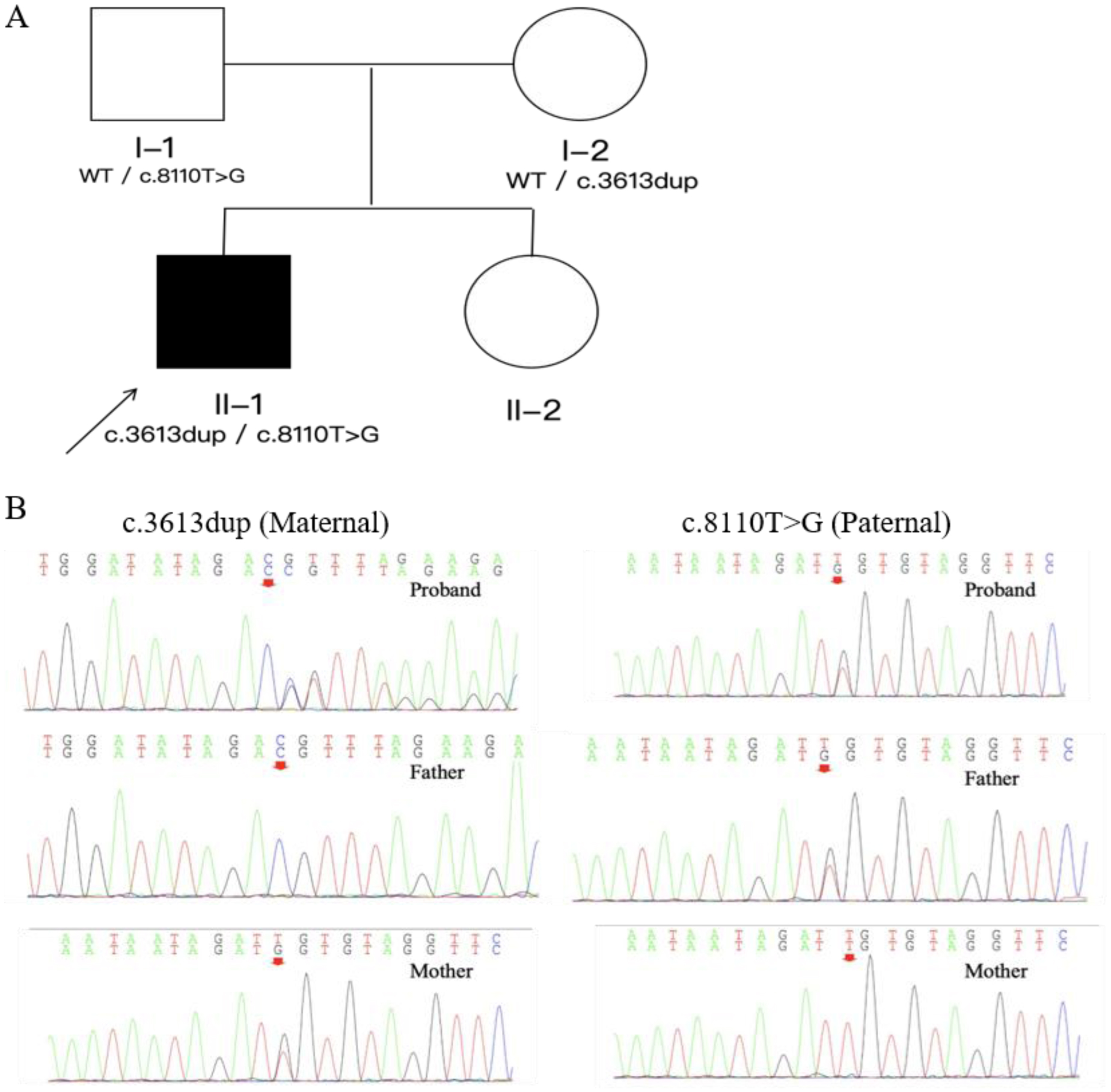
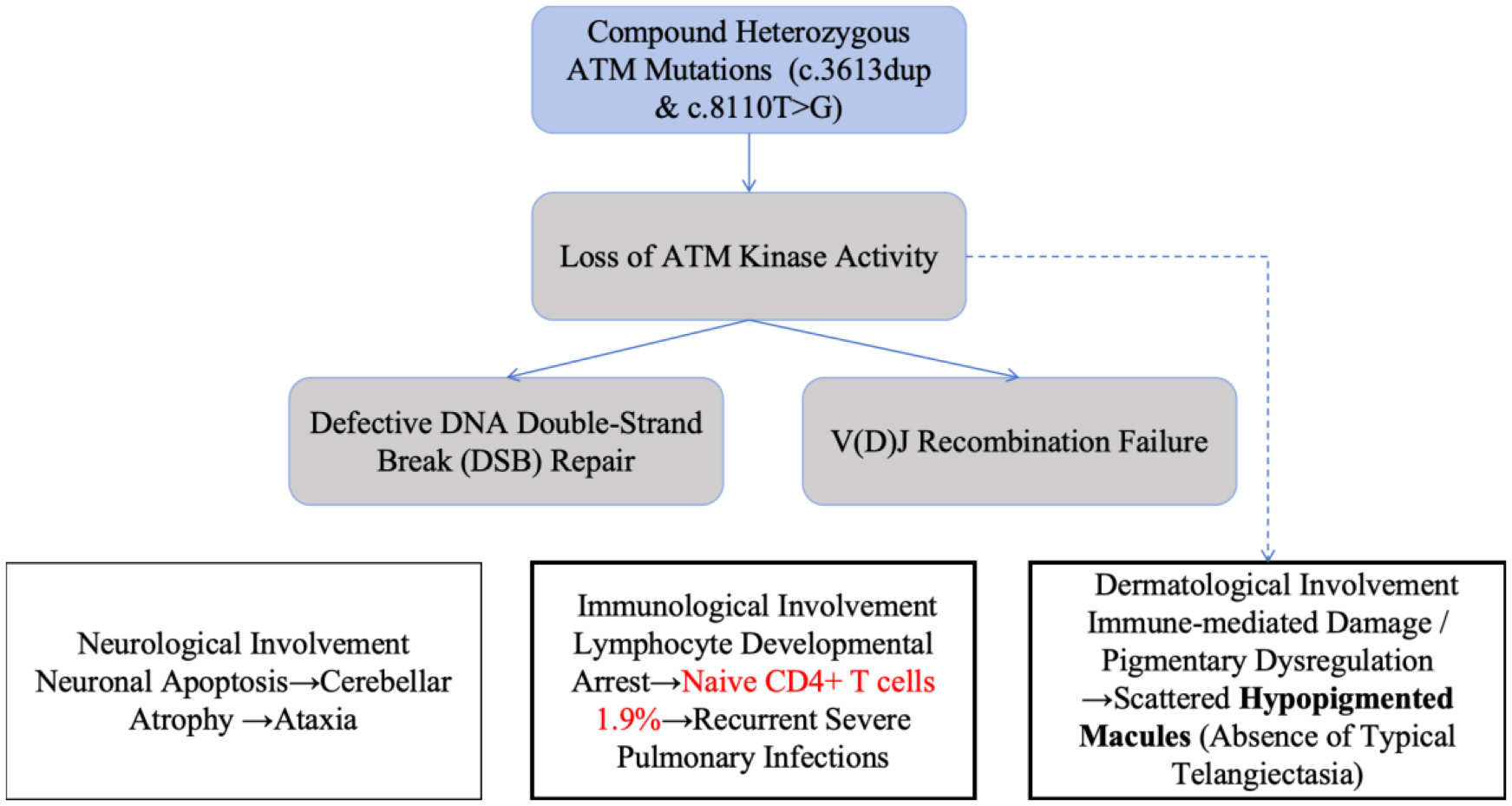
We reported a 6-year-old Chinese boy who was presented with delayed motor milestones and dysarthria since 1 year of age. Brain magnetic resonance imaging (MRI) revealed distinct cerebellar atrophy. Notably, classic oculocutaneous telangiectasias were absent; instead, atypical hypopigmented macules were observed on the skin. Whole-exome sequencing identified compound heterozygous mutations in the ATM gene: A known pathogenic missense variant (c.8110T>G) and a novel, maternally inherited frameshift mutation (c.3613dup, p.Arg1205Profs*24) were found in exon 25. In silico analysis predicted that this novel variant triggers nonsense-mediated mRNA decay (NMD), potentially leading to loss of the ATM protein kinase catalytic domain, which aligns with his mild-to-moderate neurological and severe immunological phenotypes.
This case highlights that progressive cerebellar involvement and profound immunological compromise can manifest in A-T patients even in the absence of classic telangiectasias. The identification of the novel c.3613dup mutation broadens the genotypic spectrum of the ATM gene. Furthermore, it underscores the critical importance of integrating early genetic screening for atypical childhood-onset movement disorders to prevent diagnostic delays and facilitate timely multidisciplinary management.
Citation: Xin-Ru Wang, Rong Lu. A novel ATM frameshift mutation (c.3613dup) leading to ataxia-telangiectasia with early-onset severe immunodeficiency: A case report and literature review[J]. AIMS Allergy and Immunology, 2026, 10(3): 199-208. doi: 10.3934/Allergy.2026014
Ataxia-telangiectasia (A-T) is a rare, autosomal recessive, multisystem disorder caused by mutations in the ATM gene. Atypical presentations that lack classic ocular telangiectasias or present predominantly with early-onset movement disorders pose significant diagnostic challenges and frequently lead to misdiagnosis during early childhood.
We reported a 6-year-old Chinese boy who was presented with delayed motor milestones and dysarthria since 1 year of age. Brain magnetic resonance imaging (MRI) revealed distinct cerebellar atrophy. Notably, classic oculocutaneous telangiectasias were absent; instead, atypical hypopigmented macules were observed on the skin. Whole-exome sequencing identified compound heterozygous mutations in the ATM gene: A known pathogenic missense variant (c.8110T>G) and a novel, maternally inherited frameshift mutation (c.3613dup, p.Arg1205Profs*24) were found in exon 25. In silico analysis predicted that this novel variant triggers nonsense-mediated mRNA decay (NMD), potentially leading to loss of the ATM protein kinase catalytic domain, which aligns with his mild-to-moderate neurological and severe immunological phenotypes.
This case highlights that progressive cerebellar involvement and profound immunological compromise can manifest in A-T patients even in the absence of classic telangiectasias. The identification of the novel c.3613dup mutation broadens the genotypic spectrum of the ATM gene. Furthermore, it underscores the critical importance of integrating early genetic screening for atypical childhood-onset movement disorders to prevent diagnostic delays and facilitate timely multidisciplinary management.

| [1] |
Boder E, Sedgwick RP (1958) Ataxia-telangiectasia; a familial syndrome of progressive cerebellar ataxia, oculocutaneous telangiectasia and frequent pulmonary infection. Pediatrics 21: 526-554. https://doi.org/10.1542/peds.21.4.526 
|
| [2] |
Rothblum-Oviatt C, Wright J, Lefton-Greif MA, et al. (2016) Ataxia telangiectasia: A review. Orphanet J Rare Dis 11: 159. https://doi.org/10.1186/s13023-016-0543-7
|
| [3] |
Amirifar P, Ranjouri MR, Yazdani R, et al. (2019) Ataxia-telangiectasia: A review of clinical features and molecular pathology. Pediatr Allergy Immunol 30: 277-288. https://doi.org/10.1111/pai.13020
|
| [4] |
Taylor AM, Lam Z, Last JI, et al. (2015) Ataxia telangiectasia: More variation at clinical and cellular levels. Clin Genet 87: 199-208. https://doi.org/10.1111/cge.12453
|
| [5] |
Schon K, van Os NJH, Oscroft N, et al. (2019) Genotype, extrapyramidal features, and severity of variant ataxia-telangiectasia. Ann Neurol 85: 170-180. https://doi.org/10.1002/ana.25394
|
| [6] |
Levy A, Lang AE (2018) Ataxia-telangiectasia: A review of movement disorders, clinical features, and genotype correlations. Mov Disord 33: 1238-1247. https://doi.org/10.1002/mds.27319
|
| [7] |
Moeini Shad T, Yazdani R, Amirifar P, et al. (2021) Atypical ataxia presentation in variant ataxia telangiectasia: Iranian case-series and review of the literature. Front Immunol 12: 779502. https://doi.org/10.3389/fimmu.2021.779502
|
| [8] |
Fortuna J, Rodrigues AL, Pires P (2022) Ataxia-telangiectasia syndrome. Pediatr Neonatol 63: 551-552. https://doi.org/10.1016/j.pedneo.2022.01.004
|
| [9] |
Blanchard-Rohner G, Peirolo A, Coulon L, et al. (2022) Childhood-onset movement disorders can mask a primary immunodeficiency: 6 cases of classical ataxia-telangiectasia and variant forms. Front Immunol 13: 791522. https://doi.org/10.3389/fimmu.2022.791522
|
| [10] |
Muneer M, Al-Kubati A, Al-Ghashm A, et al. (2025) A 10-year-old boy with ataxia-telangiectasia: A rare case report from Yemen. Clin Med Insights Case Rep 18. https://doi.org/10.1177/11795476251408138
|
| [11] |
Collyer J, Rajan DS (2024) Ataxia telangiectasia. Semin Pediatr Neurol 52: 101169. https://doi.org/10.1016/j.spen.2024.101169
|
| [12] |
Milanovic B, Vijatov‑Djuric G, Djuretic A, et al. (2025) Sarcoidosis‑like skin lesions as the first manifestation of ataxia‑telangiectasia. Children 12: 672. https://doi.org/10.3390/children12060672
|
| [13] |
Bartsch O, Schindler D, Beyer V, et al. (2012) A girl with an atypical form of ataxia telangiectasia and an additional de novo 3.14 Mb microduplication in region 19q12. Eur J Med Genet 55: 49-55. https://doi.org/10.1016/j.ejmg.2011.08.001
|
| [14] |
De Nardi L, Natale MF, Messia V, et al. (2023) A child with polyarthritis and chronic lung disease: A case report of ataxia‑telangiectasia. Ital J Pediatr 49: 111. https://doi.org/10.1186/s13052‑023‑01509‑5
|
| [15] |
Shiloh Y, Ziv Y (2013) The ATM protein kinase: Regulating the cellular response to genotoxic stress, and more. Nat Rev Mol Cell Biol 14: 197-210. https://doi.org/10.1038/nrm3546
|
| [16] |
Aguado J, Gómez‑Inclán C, Leeson HC, et al. (2022) The hallmarks of aging in Ataxia‑Telangiectasia. Ageing Res Rev 79: 101653. https://doi.org/10.1016/j.arr.2022.101653
|
| [17] |
van Os NJ, Roeleveld N, Weemaes CM, et al. (2017) Ataxia‑telangiectasia: Immunodeficiency and survival. Clin Immunol 178: 45-55. https://doi.org/10.1016/j.clim.2017.01.009
|
| [18] |
Li XL, Wang YL (2020) Ataxia‑telangiectasia complicated with Hodgkin's lymphoma: A case report. World J Clin Cases 8: 2387-2391. https://doi.org/10.12998/wjcc.v8.i11.2387
|
Figures(2) / Tables(1)

Xin-Ru Wang, Rong Lu. A novel ATM frameshift mutation (c.3613dup) leading to ataxia-telangiectasia with early-onset severe immunodeficiency: A case report and literature review[J]. AIMS Allergy and Immunology, 2026, 10(3): 199-208. doi: 10.3934/Allergy.2026014





 DownLoad: