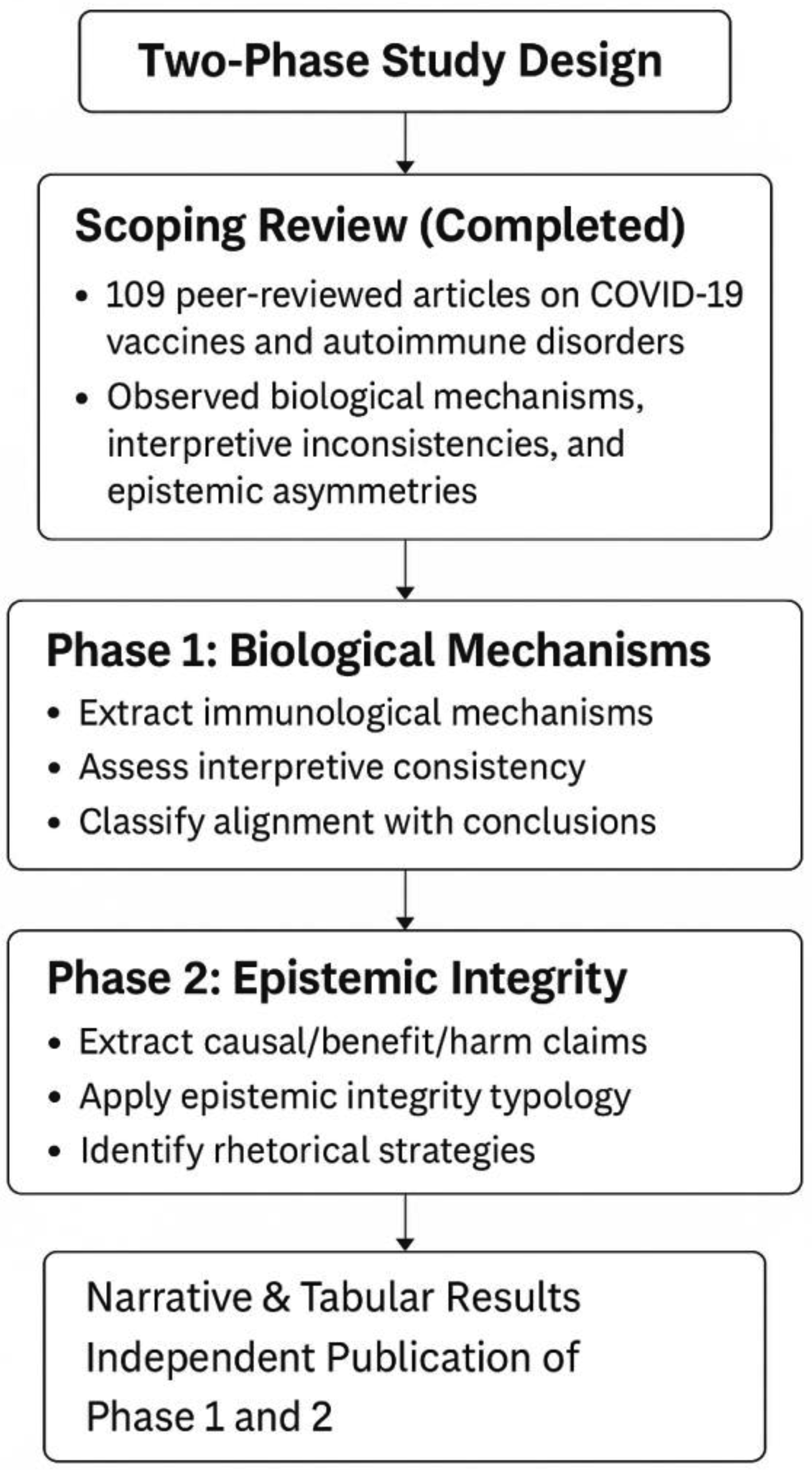
The COVID-19 global vaccination campaign was justified as a necessary exit strategy from an unprecedented public health, social, and economic crisis. However, concerns about adverse effects post-vaccination—particularly autoimmune reactions—have received comparatively less attention in the peer-reviewed literature. This protocol outlines a two-phase qualitative coding study that builds on a completed scoping review of 109 peer-reviewed articles to evaluate how associations between COVID-19 vaccination and autoimmune disorders are interpreted and framed. Accordingly, rather than adjudicating the scientific truth of vaccine-related claims, the study will examine whether interpretations are proportionate to the evidence presented and internally consistent. Phase 1 will focus on biological plausibility by extracting mechanistic explanations, such as molecular mimicry, bystander activation, and cytokine dysregulation, and assessing whether the mechanistic evidence reported aligns with authors' conclusions. Phase 2 will focus on epistemic integrity by applying a typology to analyze the evidentiary consistency between claims about vaccine-related harms and benefits within studies. Quotations will be extracted and analyzed for causal reasoning, rhetorical framing, and evidentiary symmetry. Articles will be double-coded, with inter-rater reliability assessed and adjudicated through discussion. By integrating mechanistic and epistemic analyses, the planned study will provide a framework for evaluating the interpretive standards applied to vaccine safety claims. Rather than reaffirming or rejecting specific biomedical positions, it will document how scientific knowledge is framed, qualified, or selectively emphasized—highlighting interpretive practices that have shaped evidence-based discourse within a climate of perceived urgency and institutional consensus.
Citation: Claudia Chaufan. Interpreting autoimmune risks in the COVID-19 vaccine literature: A two-phase qualitative coding protocol on biological mechanisms and epistemic integrity[J]. AIMS Allergy and Immunology, 2025, 9(3): 190-204. doi: 10.3934/Allergy.2025015
The COVID-19 global vaccination campaign was justified as a necessary exit strategy from an unprecedented public health, social, and economic crisis. However, concerns about adverse effects post-vaccination—particularly autoimmune reactions—have received comparatively less attention in the peer-reviewed literature. This protocol outlines a two-phase qualitative coding study that builds on a completed scoping review of 109 peer-reviewed articles to evaluate how associations between COVID-19 vaccination and autoimmune disorders are interpreted and framed. Accordingly, rather than adjudicating the scientific truth of vaccine-related claims, the study will examine whether interpretations are proportionate to the evidence presented and internally consistent. Phase 1 will focus on biological plausibility by extracting mechanistic explanations, such as molecular mimicry, bystander activation, and cytokine dysregulation, and assessing whether the mechanistic evidence reported aligns with authors' conclusions. Phase 2 will focus on epistemic integrity by applying a typology to analyze the evidentiary consistency between claims about vaccine-related harms and benefits within studies. Quotations will be extracted and analyzed for causal reasoning, rhetorical framing, and evidentiary symmetry. Articles will be double-coded, with inter-rater reliability assessed and adjudicated through discussion. By integrating mechanistic and epistemic analyses, the planned study will provide a framework for evaluating the interpretive standards applied to vaccine safety claims. Rather than reaffirming or rejecting specific biomedical positions, it will document how scientific knowledge is framed, qualified, or selectively emphasized—highlighting interpretive practices that have shaped evidence-based discourse within a climate of perceived urgency and institutional consensus.

| [1] |
Sachs JD, Karim SSA, Aknin L, et al. (2022) The Lancet commission on lessons for the future from the COVID-19 pandemic. Lancet 400: 1224-1280. Available from: https://www.thelancet.com/journals/lancet/article/PIIS0140-6736(22)01585-9/fulltext 
|
| [2] |
Anderson EJ, Creech CB, Berthaud V, et al. (2022) Evaluation of mRNA-1273 vaccine in children 6 months to 5 years of age. N Engl J Med 387: 1673-1687. https://doi.org/10.1056/NEJMoa2209367
|
| [3] |
Walter EB, Talaat KR, Sabharwal C, et al. (2022) Evaluation of the BNT162b2 Covid-19 vaccine in children 5 to 11 years of age. N Engl J Med 386: 35-46. https://doi.org/10.1056/NEJMoa2116298
|
| [4] |
Watson OJ, Barnsley G, Toor J, et al. (2022) Global impact of the first year of COVID-19 vaccination: A mathematical modelling study. Lancet Infect Dis 22: 1293-1302. https://doi.org/10.1016/S1473-3099(22)00320-6
|
| [5] |
Ogden NH, Turgeon P, Fazil A, et al. (2022) Counterfactuals of effects of vaccination and public health measures on COVID-19 cases in Canada: What could have happened?. Can Commun Dis Rep 48: 292-302. https://doi.org/10.14745/ccdr.v48i78a01
|
| [6] | Vickers D, Hardie J, Eberspaecher S, et al. (2023) Opinion: Counterfactuals of effects of vaccination and public health measures on COVID-19 cases in Canada: What could have happened?. Fron Public Health 11. Available from: https://www.frontiersin.org/articles/10.3389/fpubh.2023.1173673 |
| [7] | American College of RheumatologyACR releases updated COVID-19 vaccine clinical guidance (2021). Available from: https://rheumatology.org/press-releases/acr-releases-updated-covid-19-vaccine-clinical-guidance-including-timing-3rd-doses-with-immunomodulatory-drugs |
| [8] | Chaufan C, Manwell L, Heredia C, et al. (2025) COVID-19 vaccination and autoimmune disorders: A scoping review. Preprints . Available from: https://doi.org/10.20944/preprints202506.0831.v1 |
| [9] |
Cohen AD, Shoenfeld Y (1996) Vaccine-induced autoimmunity. J Autoimmun 9: 699-703. https://doi.org/10.1006/jaut.1996.0091
|
| [10] |
Molina V, Shoenfeld Y (2005) Infection, vaccines and other environmental triggers of autoimmunity. Autoimmunity 38: 235-245. https://doi.org/10.1080/08916930500050277
|
| [11] |
Shoenfeld Y, Aron-Maor A (2000) Vaccination and autoimmunity—‘vaccinosis’: A dangerous liaison?. J Autoimmu 14: 1-10. https://doi.org/10.1006/jaut.1999.0346
|
| [12] |
Chen Y, Xu Z, Wang P, et al. (2022) New-onset autoimmune phenomena post-COVID-19 vaccination. Immunology 165: 386-401. https://doi.org/10.1111/imm.13443
|
| [13] |
Aydoğan Bİ, Ünlütürk U, Cesur M (2022) Type 1 diabetes mellitus following SARS-CoV-2 mRNA vaccination. Endocrine 78: 42-46. https://doi.org/10.1007/s12020-022-03130-8
|
| [14] | Head E, van Elsland SL (2022) Vaccinations may have prevented almost 20 million COVID-19 deaths worldwide. Imperial News . Available from: https://www.imperial.ac.uk/news/237591/vaccinations-have-prevented-almost-20-million/. |
| [15] | Mellis C (2025) Lives saved by COVID-19 vaccines. J Paediatr Child Health 58: 2129. https://doi.org/10.1111/jpc.16213 |
| [16] |
Hotez PJ (2023) Vaccine preventable disease and vaccine hesitancy. Med Clin North Am 107: 979-987. https://doi.org/10.1016/j.mcna.2023.05.012
|
| [17] |
Watson OJ, Barnsley G, Toor J, et al. (2022) Global impact of the first year of COVID-19 vaccination: A mathematical modelling study. Lancet Infect Dis 22: 1293-1302. https://doi.org/10.1016/S1473-3099(22)00320-6
|
| [18] |
Guo M, Liu X, Chen X, et al. (2023) Insights into new-onset autoimmune diseases after COVID-19 vaccination. Autoimmun Rev 22: 103340. https://doi.org/10.1016/j.autrev.2023.103340
|
| [19] |
Jara LJ, Vera-Lastra O, Mahroum N, et al. (2022) Autoimmune post-COVID vaccine syndromes: Does the spectrum of autoimmune/inflammatory syndrome expand?. Clin Rheumatol 41: 1603-1609. https://doi.org/10.1007/s10067-022-06149-4
|
| [20] |
Lim E, Kim YH, Jeong NY, et al. (2025) The association between acute transverse myelitis and COVID-19 vaccination in Korea: Self-controlled case series study. Eur J Neurol 32: e70020. https://doi.org/10.1111/ene.70020
|
| [21] |
Mahroum N, Shoenfeld Y (2022) COVID-19 vaccination can occasionally trigger autoimmune phenomena, probably via inducing age-associated B cells. In J Rheum Dis 25: 5-6. https://doi.org/10.1111/1756-185X.14259
|
| [22] |
Watad A, De Marco G, Mahajna H, et al. (2021) Immune-mediated disease flares or new-onset disease in 27 subjects following mRNA/DNA SARS-CoV-2 vaccination. Vaccines 9: 435. https://doi.org/10.3390/vaccines9050435
|
| [23] | Hill AB (1965) The environment and disease: Association or causation?. Proc R Soc Med 58: 295-300. https://doi.org/10.1177/003591576505800503 |
| [24] |
Hsieh HF, Shannon SE (2005) Three approaches to qualitative content analysis. Qual Health Res 15: 1277-1288. https://doi.org/10.1177/1049732305276687
|
| [25] | Miles MB, Huberman AM (1994) Qualitative Data Analysis: An Expanded Sourcebook. California: Sage Publications Inc. |
| [26] |
Malterud K (2001) Qualitative research: Standards, challenges, and guidelines. Lancet 358: 483-488. https://doi.org/10.1016/S0140-6736(01)05627-6
|
| [27] | Chaufan C (2023) Is Covid-19 “vaccine uptake” in postsecondary education a “problem”? A critical policy inquiry. Health 28. https://doi.org/10.1177/13634593231204169 |
| [28] |
Chaufan C, Hemsing N (2024) Is resistance to Covid-19 vaccination a “problem”? A critical policy inquiry of vaccine mandates for healthcare workers. AIMS Public Health 11: 688-714. https://doi.org/10.3934/publichealth.2024035
|
| [29] |
Barry CA, Britten N, Barber N, et al. (1999) Using reflexivity to optimize teamwork in qualitative research. Qual Health Res 9: 26-44. https://doi.org/10.1177/104973299129121677
|
| [30] |
Gøtzsche PC (2011) Why we need easy access to all data from all clinical trials and how to accomplish it. Trials 12: 249. https://doi.org/10.1186/1745-6215-12-249
|
| [31] |
Boros LG, Kyriakopoulos AM, Brogna C, et al. (2024) Long-lasting, biochemically modified mRNA, and its frameshifted recombinant spike proteins in human tissues and circulation after COVID-19 vaccination. Pharmacol Res Perspect 12: e1218. https://doi.org/10.1002/prp2.1218
|
| [32] | Hulscher N, Alexander PE, Amerling R, et al. (2024) A systematic review of autopsy findings in deaths after COVID-19 Vaccination. Sci, Public Health Policy Law . https://doi.org/10.2139/ssrn.4496137 |
| [33] | Hulscher N, Cook MJ, Stricker RB, et al. (2024) Excess cardiopulmonary arrest and mortality after COVID-19 Vaccination in King County, Washington. J Emerg Med 2: 1-11. https://doi.org/10.33140/JEMOA.02.01.12 |
| [34] | ICMJERecommendations for the conduct, reporting, editing, and publication of scholarly work in medical journals (2019). Available from: http://www.icmje.org/recommendations/ |
Figures(1) / Tables(2)

Claudia Chaufan. Interpreting autoimmune risks in the COVID-19 vaccine literature: A two-phase qualitative coding protocol on biological mechanisms and epistemic integrity[J]. AIMS Allergy and Immunology, 2025, 9(3): 190-204. doi: 10.3934/Allergy.2025015




 DownLoad: