Clozapine is an atypical antipsychotic primarily used in cases of treatment-resistant schizophrenia, showing significant clinical efficacy. However, a major challenge in its administration is the requirement for systematic monitoring, which necessitates nurses to possess documented knowledge and skills. In this study, we aimed to synthesize nurses' knowledge and attitudes toward clozapine administration protocols and the importance of education for ensuring safe clinical practice. A literature review spanning the past decade was conducted using PubMed, Google Scholar, and Scopus databases, focusing on English terms related to nurses' understanding of clozapine administration protocols and the associated needs and implications in clinical settings to construct a comprehensive narrative review on this subject matter. Findings revealed that approximately half the nurses surveyed reported inadequate knowledge regarding the side effects of clozapine, leading to significant implications for patient monitoring, treatment, and medication adherence. Nurses with higher levels of education exhibited greater knowledge levels. Factors such as lower education levels, limited clinical experience, high workload, fatigue, and blind adherence to medical instructions were found to influence nurses' knowledge and attitudes. Training programs were shown to reduce stress, enhance nurses' knowledge and confidence, and foster trust in patient care. Nurses were identified as playing a crucial role in the safe administration of clozapine, both within hospital settings and in the community. Education was highlighted as a key factor in improving knowledge levels and shifting attitudes among nurses and patients toward the safe use of clozapine.
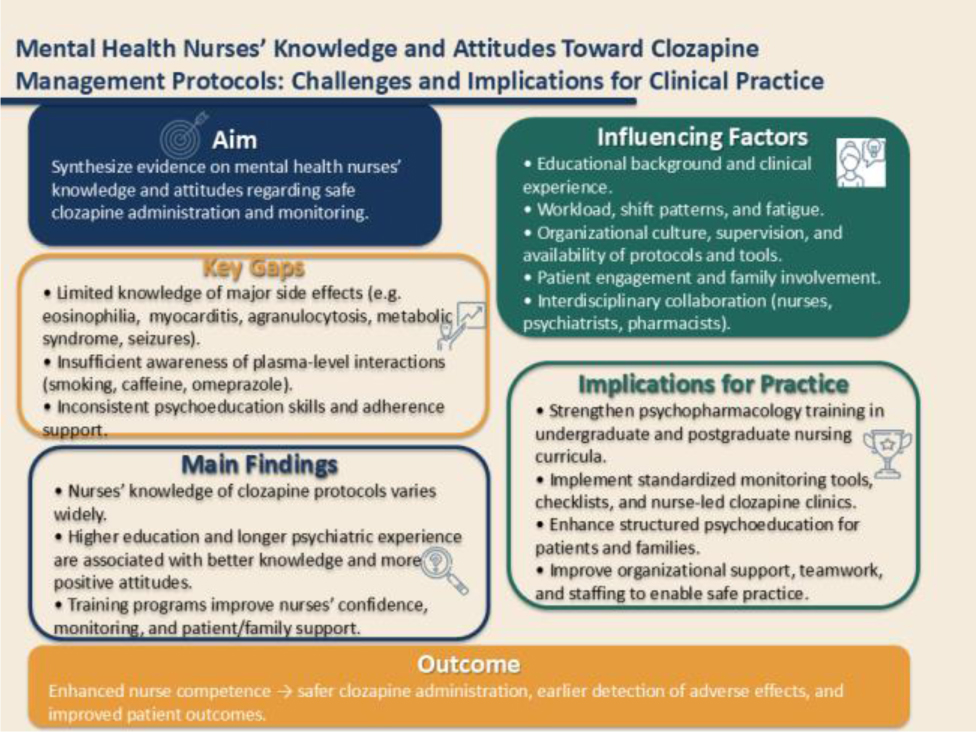
Graphical abstract.
Citation: Polyxeni Mangoulia, Maria Topi. Mental health nurses' knowledge and attitudes toward clozapine management protocols challenges and implications for clinical practice: A narrative review[J]. AIMS Public Health, 2026, 13(1): 50-62. doi: 10.3934/publichealth.2026004
Clozapine is an atypical antipsychotic primarily used in cases of treatment-resistant schizophrenia, showing significant clinical efficacy. However, a major challenge in its administration is the requirement for systematic monitoring, which necessitates nurses to possess documented knowledge and skills. In this study, we aimed to synthesize nurses' knowledge and attitudes toward clozapine administration protocols and the importance of education for ensuring safe clinical practice. A literature review spanning the past decade was conducted using PubMed, Google Scholar, and Scopus databases, focusing on English terms related to nurses' understanding of clozapine administration protocols and the associated needs and implications in clinical settings to construct a comprehensive narrative review on this subject matter. Findings revealed that approximately half the nurses surveyed reported inadequate knowledge regarding the side effects of clozapine, leading to significant implications for patient monitoring, treatment, and medication adherence. Nurses with higher levels of education exhibited greater knowledge levels. Factors such as lower education levels, limited clinical experience, high workload, fatigue, and blind adherence to medical instructions were found to influence nurses' knowledge and attitudes. Training programs were shown to reduce stress, enhance nurses' knowledge and confidence, and foster trust in patient care. Nurses were identified as playing a crucial role in the safe administration of clozapine, both within hospital settings and in the community. Education was highlighted as a key factor in improving knowledge levels and shifting attitudes among nurses and patients toward the safe use of clozapine.
Graphical abstract.

| [1] |
Takeuchi I, Hanya M, Uno J, et al. (2016) A questionnaire-based study of the views of schizophrenia patients and psychiatric healthcare professionals in Japan about the side effects of clozapine. Clin Psychopharmacol Neurosci 14: 286-294. https://doi.org/10.9758/cpn.2016.14.3.286 
|
| [2] |
Vermeulen JM, van Rooijen G, van de Kerkhof MPJ, et al. (2019) Clozapine and long-term mortality risk in patients with schizophrenia: A systematic review and meta-analysis of studies lasting 1.1–12.5 years. Schizophr Bull 45: 315-329. https://doi.org/10.1093/schbul/sby052
|
| [3] |
van der Zalm YC, Schulte PF, Bogers JPAM, et al. (2020) CLOZ-NP study group. Delegating clozapine monitoring to advanced nurse practitioners: An exploratory, randomized study to assess the effect on prescription and its safety. Adm Policy Ment Health 47: 632-640. https://doi.org/10.1007/s10488-020-01031-4
|
| [4] |
Verdoux H, Quiles C, Bachmann CJ, et al. (2018) Prescriber and institutional barriers and facilitators of clozapine use: A systematic review. Schizophrenia Res 201: 10-19. https://doi.org/10.1016/j.schres.2018.05.046
|
| [5] |
De Hert M, De Beugher A, Sweers K, et al. (2016) Knowledge of psychiatric nurses about the potentially lethal side-effects of clozapine. Arch Psychiatr Nurs 30: 79-83. https://doi.org/10.1016/j.apnu.2015.09.003
|
| [6] |
Sanjeevi S, Cocoman A (2021) Mental health nurses' knowledge of clozapine. Issues Ment Health Nurs 42: 291-298. https://doi.org/10.1080/01612840.2020.1789786
|
| [7] |
Gage H, Family H, Murphy F, et al. (2015) Comparison of sole nurse and team-delivered community clozapine services for people with treatment-resistant schizophrenia. J Adv Nurs 71: 547-558. https://doi.org/10.1111/jan.12527
|
| [8] |
Bachmann CJ, Aagaard L, Bernardo M, et al. (2017) International trends in clozapine use: A study in 17 countries. Acta Psychiatr Scand 136: 37-51. https://doi.org/10.1111/acps.12742
|
| [9] |
Siskind D, McCartney L, Goldschlager R, et al. (2016) Clozapine v. first- and second-generation antipsychotics in treatment-refractory schizophrenia: Systematic review and meta-analysis. Br J Psychiatry 209: 385-392. https://doi.org/10.1192/bjp.bp.115.177261
|
| [10] |
Okhuijsen-Pfeifer C, Huijsman EAH, Hasan A, et al. (2018) Clozapine as a first- or second-line treatment in schizophrenia: A systematic review and meta-analysis. Acta Psychiatr Scand 138: 281-288. https://doi.org/10.1111/acps.12954
|
| [11] | Schatzberg AF, Nemeroff CB (2017) The American Psychiatric Association publishing textbook of pychopharmacology. American Psychiatric Publishing 677-700. https://doi.org/10.1176/appi.books.9781615375523 |
| [12] |
Begum F, Mutsatsa S, Thomas B, et al. (2020) Antipsychotic medication side effects knowledge amongst registered mental health nurses in England: A national survey. J Psychiatr Ment Health Nurs 27: 521-532. https://doi.org/10.1111/jpm.12600
|
| [13] |
Agid O, Crespo-Facorro B, de Bartolomeis A, et al. (2024) Overcoming the barriers to identifying and managing treatment-resistant schizophrenia and to improving access to clozapine: A narrative review and recommendation for clinical practice. Eur Neuropsychopharmacol 84: 35-47. https://doi:10.1016/j.euroneuro.2024.04.01238657339
|
| [14] |
Goren JL, Rose AJ, Engle RL, et al. (2016) Organizational characteristics of veterans affairs clinics with high and low utilization of clozapine. Psychiat Serv 67: 1189-1196. https://doi.org/10.1176/appi.ps.201500506
|
| [15] |
Fargaly Y, Saraya O, AbouAbdou SE (2024) Knowledge and practice of psychiatric nurses toward side effects of clozapine drug on co-morbid psychiatric patients. Trends Nurs Health Care J 9: 1-28. https://doi.org/10.21608/tnhcj.2024.255257.1042
|
| [16] |
Perehudoff K, Azermai M, Wauters M, et al. (2016) The psychotropic education and knowledge test for nurses in nursing homes: Striving for PEAK performance. Aging Ment Health 20: 1182-1189. https://doi.org/10.1080/13607863.2015.1068738
|
| [17] |
Farooq S, Choudry A, Cohen D, et al. (2019) Barriers to using clozapine in treatment-resistant schizophrenia: Systematic review. BJPsych Bull 43: 8-16. https://doi.org/10.1192/bjb.2018.67
|
| [18] |
Bellissima BL, Tingle MD, Cicovic A, et al. (2018) A systematic review of clozapine-induced myocarditis. Int J Cardiol 259: 122-129. https://doi.org/10.1016/j.ijcard.2017.12.102
|
| [19] |
Saito T, Ikeda M, Mushiroda T, et al. (2016) Pharmacogenomic study of clozapine-induced agranulocytosis/gran ulocytopenia in a Japanese population. Biol Psychiat 80: 636-642. https://doi.org/10.1016/j.biopsych.2015.12.006
|
| [20] |
Lappin JM, Wijaya M, Watkins A (2018) Cardio-metabolic risk and its management in a cohort of clozapine-treated outpatients. Schizophr Res 199: 367-373. https://doi.org/10.1016/j.schres.2018.02.035
|
| [21] | Lam YWF (2018) Influence of smoking ban on clozapine and nor clozapine concentrations. Brown Univ Psychopharmacol Update 29: 2-3. https://doi.org/10.1002/pu.30311 |
| [22] |
Okhuijsen-Pfeifer C, Cohen D, Bogers JPAM, et al. (2019) Differences between physicians' and nurse practitioners' viewpoints on reasons for clozapine underprescription. Brain Behav 9: e01318. https://doi.org/10.1002/brb3.1318
|
| [23] |
Smessaert S, Detraux J, Desplenter F, et al. (2024) Evaluating monitoring guidelines of clozapine-induced adverse effects: A systematic review. CNS Drugs 38: 105-123. https://doi.org/10.1007/s40263-023-01054-z
|
| [24] | Singh H, Dubin WR, Kaur S (2015) Drug interactions affecting clozapine levels. J Psychiatr Int Care 11: 52-65. https://doi.org/10.1017/S1742646413000332 |
| [25] |
Bulow P, Andersson G, Denhov A, et al. (2016) Experience of psychotropic medication- An interview study of persons with psychosis. Issues Ment Health N 37: 820-828. https://doi.org/10.1080/01612840.2016.1224283
|
| [26] |
Stomski NJ, Morrison P, Meehan T (2016) Assessing clinicians' perspectives about the identification and management of antipsychotic medication side-effects: Psychometric evaluation of a survey questionnaire. Int J Ment Health Nurs 25: 171-179. https://doi.org/10.1111/inm.12216
|
| [27] | Tengile StellaPsychiatric registered nurses' knowledge of and attitudes towards the use and side-effects of antipsychotic medication administered mental health users in the Western Cape, University of the Western Cape: Electronic Thesis and Dissertation Library (2019) 72-86. |
| [28] |
Morrison P, Stomski NJ, McAllister M, et al. (2017) Survey of antipsychotic medication curriculum content in Australian university nursing programmes. Int J Ment Health 26: 56-64. https://doi.org/10.1111/inm.12281
|
| [29] | Newman WJ, Newman BM (2016) Rediscovering clozap ine: Clinically relevant off-label uses. Curr Psychiatr 15: 51-62. |
| [30] |
Taylor V, Ashelford S, Fell P, et al. (2015) Biosciences in nurse education: Is the curriculum fit for practice? Lecturers' views and recommendations from across the UK. J Clin Nurs 4: 2797-2806. https://doi.org/10.1111/jocn.12880
|
| [31] |
Jacob KS (2015) Recovery model of mental illness: A complementary approach to psychiatric care. Ind J Psychol Med 37: 117-119. https://doi.org/10.4103/0253-7176.155605
|
| [32] |
Mahone IH, Maphis CF, Snow DE (2016) Effective strategies for nurses empowering clients with schizophrenia: Medication use as a tool in recovery. Issues Ment Health N 37: 372-379. https://doi.org/10.3109/01612840.2016.1157228
|

Figures(1) / Tables(1)

Polyxeni Mangoulia, Maria Topi. Mental health nurses' knowledge and attitudes toward clozapine management protocols challenges and implications for clinical practice: A narrative review[J]. AIMS Public Health, 2026, 13(1): 50-62. doi: 10.3934/publichealth.2026004





 DownLoad: