PM2.5 is a key air pollutant that contributes to respiratory morbidity, especially in children. In Jakarta, Indonesia, PM2.5 levels often exceed safe thresholds. This study contributes local evidence from Indonesia, where research on the health effects of PM2.5 in children remains limited. To address this gap in the existing literature, particularly within the Indonesian context, this study offers novel insights by specifically investigating the association between ambient PM2.5 exposure and respiratory tract infections (RTIs) in school-aged children and further exploring this association within male and female subgroups, an aspect that has received limited attention in this setting.
This study aims to assess the association between ambient PM2.5 exposure and RTIs in school-aged children, and to explore this association within male and female subgroups.
This cross-sectional study was conducted among 107 children aged 6–12 years from two elementary schools: one in Jakarta (high PM2.5 exposure) and one in Bandung (low PM2.5 exposure). Data on PM2.5 levels were obtained from local air quality monitoring. RTI symptoms were assessed through structured interviews and physical examination. Participants were selected using random sampling. Chi-square tests and effect size calculations (phi coefficient) were used to compare groups. Potential confounders such as age, gender, and household smoke exposure were minimized through inclusion/exclusion criteria and the selection of demographically and environmentally similar school communities. Multiple binary logistic regression adjusting for confounders was also performed to assess the independent association between PM2.5 exposure and RTIs.
The Chi-square test indicated a significant association between PM2.5 levels and the occurrence of RTI (χ² = 22.154, df = 1, p < 0.001, φ = 0.475). Given the potential low expected counts in some cells, the statistical significance was further evaluated using Fisher's Exact Test, which also showed a significant association (p < 0.001). The prevalence of RTI was significantly higher in the high exposure group (71.43%) compared to the low exposure group (25.86%) (p < 0.001). Further analysis did not reveal significant differences in the proportion of each age group between the high and low PM2.5 exposure groups [χ²(1) = 0.093, p = 0.761]. Similarly, no significant differences were found in the proportion of gender between the high and low PM2.5 exposure groups [χ²(1) = 1.611, p = 0.204] in the total sample. Likewise, there were no significant differences in the proportion of RTI across different age groups [χ²(6) = 5.327, p = 0.503] or between genders [χ²(1) = 0.008, p = 0.928] in the total sample. However, further analysis examining the association between PM2.5 exposure and RTI within gender subgroups revealed a significant association in both male [χ²(1) = 10.873, p = 0.001] and female [χ²(1) = 11.755, p = 0.001] children. The estimated prevalence ratio (PR) was 2.76 (95% CI: 1.68–4.54), indicating that children in the high PM2.5 exposure area had approximately 2.76 times higher prevalence of RTI compared to those in the low exposure area. The absolute prevalence difference (PD) was 45.57% (95% CI: 25.9%–65.2%). Binary logistic regression analysis showed that children in the high PM2.5 exposure group had significantly higher odds of having RTI (OR = 7.167, 95% CI: 3.050–16.837, p < 0.001). Further analysis examining the association between maternal socioeconomic factors and both PM2.5 exposure and RTI occurrence revealed no statistically significant relationships. Chi-square tests showed no significant association between maternal education level (low vs. medium) and PM2.5 exposure group [χ²(1) = 0.045, p = 0.833], nor between maternal occupation (blue collar vs. semi-professional) and PM2.5 exposure group [χ²(1) = 0.006, p = 0.937]. Similarly, no significant associations were found between maternal education level and RTI [χ²(1) = 0.233, p = 0.629] or between maternal occupation and RTI [χ²(1) = 0.447, p = 0.504]. Crucially, after adjusting for potential confounders including gender, age, maternal education, and maternal occupation in a multivariate logistic regression model, the odds of having RTI remained significantly higher in children with high PM2.5 exposure (adjusted OR = 7.883, 95% CI: 3.228–19.250, p < 0.001).
Children exposed to higher levels of PM2.5 had significantly more respiratory tract infections. These findings highlight the need for targeted public health interventions in polluted urban areas. This study is among the first to quantify this association in the Indonesian context and provides a newly developed and validated instrument (RAAEC-C instrument) for future research. These findings should be interpreted as preliminary evidence and require replication in future longitudinal studies before firm conclusions can be drawn. Further research using longitudinal designs is needed to understand the long-term impacts of PM2.5 exposure on children's respiratory health and to inform appropriate mitigation strategies.
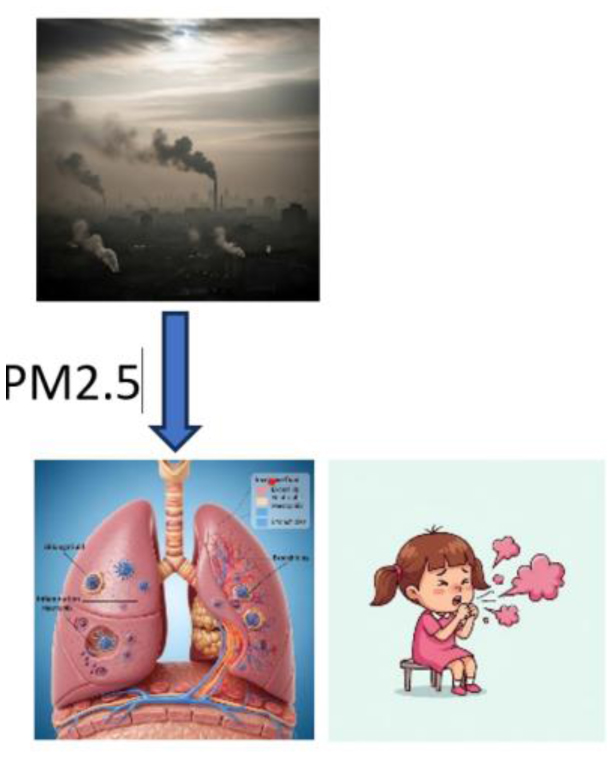
Graphical abstract
This graphical abstract illustrates the conceptual pathway from air pollution exposure to pulmonary inflammation and respiratory tract infections.
Citation: Hari Krismanuel, Purnamawati Tjhin. The association between PM2.5 level and respiratory tract infections among children: A cross-sectional study[J]. AIMS Public Health, 2025, 12(4): 1084-1114. doi: 10.3934/publichealth.2025055
PM2.5 is a key air pollutant that contributes to respiratory morbidity, especially in children. In Jakarta, Indonesia, PM2.5 levels often exceed safe thresholds. This study contributes local evidence from Indonesia, where research on the health effects of PM2.5 in children remains limited. To address this gap in the existing literature, particularly within the Indonesian context, this study offers novel insights by specifically investigating the association between ambient PM2.5 exposure and respiratory tract infections (RTIs) in school-aged children and further exploring this association within male and female subgroups, an aspect that has received limited attention in this setting.
This study aims to assess the association between ambient PM2.5 exposure and RTIs in school-aged children, and to explore this association within male and female subgroups.
This cross-sectional study was conducted among 107 children aged 6–12 years from two elementary schools: one in Jakarta (high PM2.5 exposure) and one in Bandung (low PM2.5 exposure). Data on PM2.5 levels were obtained from local air quality monitoring. RTI symptoms were assessed through structured interviews and physical examination. Participants were selected using random sampling. Chi-square tests and effect size calculations (phi coefficient) were used to compare groups. Potential confounders such as age, gender, and household smoke exposure were minimized through inclusion/exclusion criteria and the selection of demographically and environmentally similar school communities. Multiple binary logistic regression adjusting for confounders was also performed to assess the independent association between PM2.5 exposure and RTIs.
The Chi-square test indicated a significant association between PM2.5 levels and the occurrence of RTI (χ² = 22.154, df = 1, p < 0.001, φ = 0.475). Given the potential low expected counts in some cells, the statistical significance was further evaluated using Fisher's Exact Test, which also showed a significant association (p < 0.001). The prevalence of RTI was significantly higher in the high exposure group (71.43%) compared to the low exposure group (25.86%) (p < 0.001). Further analysis did not reveal significant differences in the proportion of each age group between the high and low PM2.5 exposure groups [χ²(1) = 0.093, p = 0.761]. Similarly, no significant differences were found in the proportion of gender between the high and low PM2.5 exposure groups [χ²(1) = 1.611, p = 0.204] in the total sample. Likewise, there were no significant differences in the proportion of RTI across different age groups [χ²(6) = 5.327, p = 0.503] or between genders [χ²(1) = 0.008, p = 0.928] in the total sample. However, further analysis examining the association between PM2.5 exposure and RTI within gender subgroups revealed a significant association in both male [χ²(1) = 10.873, p = 0.001] and female [χ²(1) = 11.755, p = 0.001] children. The estimated prevalence ratio (PR) was 2.76 (95% CI: 1.68–4.54), indicating that children in the high PM2.5 exposure area had approximately 2.76 times higher prevalence of RTI compared to those in the low exposure area. The absolute prevalence difference (PD) was 45.57% (95% CI: 25.9%–65.2%). Binary logistic regression analysis showed that children in the high PM2.5 exposure group had significantly higher odds of having RTI (OR = 7.167, 95% CI: 3.050–16.837, p < 0.001). Further analysis examining the association between maternal socioeconomic factors and both PM2.5 exposure and RTI occurrence revealed no statistically significant relationships. Chi-square tests showed no significant association between maternal education level (low vs. medium) and PM2.5 exposure group [χ²(1) = 0.045, p = 0.833], nor between maternal occupation (blue collar vs. semi-professional) and PM2.5 exposure group [χ²(1) = 0.006, p = 0.937]. Similarly, no significant associations were found between maternal education level and RTI [χ²(1) = 0.233, p = 0.629] or between maternal occupation and RTI [χ²(1) = 0.447, p = 0.504]. Crucially, after adjusting for potential confounders including gender, age, maternal education, and maternal occupation in a multivariate logistic regression model, the odds of having RTI remained significantly higher in children with high PM2.5 exposure (adjusted OR = 7.883, 95% CI: 3.228–19.250, p < 0.001).
Children exposed to higher levels of PM2.5 had significantly more respiratory tract infections. These findings highlight the need for targeted public health interventions in polluted urban areas. This study is among the first to quantify this association in the Indonesian context and provides a newly developed and validated instrument (RAAEC-C instrument) for future research. These findings should be interpreted as preliminary evidence and require replication in future longitudinal studies before firm conclusions can be drawn. Further research using longitudinal designs is needed to understand the long-term impacts of PM2.5 exposure on children's respiratory health and to inform appropriate mitigation strategies.
Graphical abstract
This graphical abstract illustrates the conceptual pathway from air pollution exposure to pulmonary inflammation and respiratory tract infections.

| [1] | Xing YF, Xu YH, Shi MH, et al. (2016) The impact of PM2.5 on the human respiratory system. J Thorac Dis 8: E69-E74. https://doi.org/10.3978/j.issn.2072-1439.2016.01.19 |
| [2] |
Thangavel P, Park D, Lee YC (2022) Recent insights into particulate matter (PM2.5)-mediated toxicity in humans: an overview. Int J Environ Res Public Health 19: 7511. https://doi.org/10.3390/ijerph19127511 
|
| [3] |
Yang L, Li C, Tang X (2020) The impact of PM2.5 on the host defense of respiratory system. Front Cell Dev Biol 8: 91. https://doi.org/10.3389/fcell.2020.00091
|
| [4] | Kim D, Chen Z, Zhou LF, et al. (2018) Air pollutants and early origins of respiratory diseases. Chronic Dis Transl Med 4: 75-94. https://doi.org/10.1016/j.cdtm.2018.03.003 |
| [5] | United States Environmental Protection AgencyParticulate Matter (PM) Basics [Internet] (2025). [cited 2025 October 14]. Available from: https://www.epa.gov/pm-pollution/particulate-matter-pm-basics |
| [6] |
Amnuaylojaroen T, Parasin N (2024) Pathogenesis of PM2.5-related disorders in different age groups: children, adults, and the elderly. Epigenomes 8: 13. https://doi.org/10.3390/epigenomes 8020013
|
| [7] |
Adhikary M, Mal P, Saikia N (2024) Exploring the link between particulate matter pollution and acute respiratory infection risk in children using generalized estimating equations analysis: a robust statistical approach. Environ Health 23: 12. https://doi.org/10.1186/s12940-024-01049-3
|
| [8] |
Ding G, Gao Y, Kan H, et al. (2024) Environmental exposure and child health in China. Environ Int 187: 108722. https://doi.org/10.1016/j.envint.2024.108722
|
| [9] | Krismanuel H (2025) The impact of air pollution on cardiovascular problems. J Penelit Karya Ilm Lemb Penelit Univ Trisakti 10: 1-15. https://doi.org/10.25105/pdk.v10i1.21590 |
| [10] | Chen H Jakarta is the world's most polluted city. And Indonesia's leader may have the cough to prove it (2023). [cited 2025 October 14]. Available from: https://edition.cnn.com/2023/08/16/asia/indonesia-pollution-jokowi-cough-intl-hnk |
| [11] | Vanzo T (2023) Jakarta Air Quality Index (AQI) and Indonesia Air Pollution. Smart Air [Internet] . [cited 2025 October 14]. Available from: https://smartairfilters.com/en/blog/jakarta-air-quality-aqi-indonesia-air-pollution/ |
| [12] | Walton K (2019) Jakarta's air quality kills its residents–and it's getting worse. The Interpreter [Internet] . [cited 2025 October 14]. Available from: https://www.lowyinstitute.org/the-interpreter/jakarta-s-air-quality-kills-its-residents-it-s-getting-worse |
| [13] |
Syuhada G, Akbar A, Hardiawan D, et al. (2023) Impacts of air pollution on health and cost of illness in Jakarta, Indonesia. Int J Environ Res Public Health 20: 2916. https://doi.org/10.3390/ijerph20042916
|
| [14] | Greenstone M, Fan Q (2019) Indonesia's worsening air quality and its impact on life expectancy. Air Quality Life Index (AQLI) [Internet] . [cited 2025 October 14]. Available from: https://docslib.org/download/7160099/indonesias-worsening-air-quality-and-its-impact-on-life-expectancy |
| [15] | Warih A, Yang A, Kass D (2019) Toward Clean Air Jakarta. Vital Strategies [Internet] . [cited 2025 October 14]. Available from: https://www.vitalstrategies.org/wp-content/uploads/Toward-Clean-Air-Jakarta-White-Paper-English.pdf |
| [16] | Firdaus FM, Elliot B, Malsch J, et al. 7 things to know about Jakarta's air pollution crisis (2023). [cited 2025 October 14]. Available from: https://wri-indonesia.org/en/insights/7-things-know-about-jakartas-air-pollution-crisis |
| [17] |
Sugiyama T, Ueda K, Seposo XT, et al. (2020) Health effects of PM2.5 sources on children's allergic and respiratory symptoms in Fukuoka, Japan. Sci Total Environ 709: 136023. https://doi.org/10.1016/j.scitotenv.2019.136023
|
| [18] |
Xu D, Chen Y, Wu L, et al. (2020) Acute effects of ambient PM2.5 on lung function among schoolchildren. Sci Rep 10: 4061. https://doi.org/10.1038/s41598-020-61003-4
|
| [19] |
Ma Y, Yue L, Liu J, et al. (2020) Association of air pollution with outpatient visits for respiratory diseases of children in an ex-heavily polluted Northwestern city, China. BMC Public Health 20: 816. https://doi.org/10.1186/s12889-020-08933-w
|
| [20] |
Xing M, Cui F, Zheng L, et al. (2025) Association of fine particulate matter constituents with chronic obstructive pulmonary disease and the effect modification of genetic susceptibility. NPJ Clim Atmos Sci 8: 89. https://doi.org/10.1038/s41612-025-00967-4
|
| [21] |
Bouma F, Nyberg F, Olin AC, et al. (2023) Genetic susceptibility to airway inflammation and exposure to short-term outdoor air pollution. Environ Health 22: 50. https://doi.org/10.1186/s12940-023-00996-7
|
| [22] |
Rider CF, Carlsten C (2019) Air pollution and DNA methylation: effects of exposure in humans. Clin Epigenetics 11: 131. https://doi.org/10.1186/s13148-019-0713-2
|
| [23] | STROBE: Strengthening the reporting of observational studies in epidemiologySTROBE Checklists (2025). [cited 2025 October 14]. Available from: https://www.strobe-statement.org/checklists/ |
| [24] |
Cushieri S (2019) The STROBE guidelines. Saudi J Anaesth 13: S31-S34. https://doi.org/10.4103/sja.SJA_543_18
|
| [25] | Marsh J (2019) Sample Size Calculations. Research Skills Seminar Series 2019 CAHS Research Education Program [Internet] . [cited 2025 October 14]. Available from: https://pch.health.wa.gov.au/-/media/Files/Hospitals/PCH/General-documents/Research/Research-Education/Handouts/SampleSizeCalcHandouts.ashx |
| [26] | Bisht R (2024) What is Stratified Sampling? Definition, Types, and Examples. Researcher.Life [Internet] . [cited 2025 October 14]. Available from: https://researcher.life/blog/article/what-is-stratified-sampling-definition-types-examples/ |
| [27] |
Wang X, Cheng Z (2020) Cross-sectional studies: strengths, weaknesses, and recommendations. Chest J 13: S65-S71. https://doi.org/10.1016/j.chest.2020.03.012
|
| [28] | World Health OrganizationIntegrated management of childhood illness (2025). [cited 2025 October 14]. Available from: https://www.who.int/teams/maternal-newborn-child-adolescent-health-and-ageing/child-health/integrated-management-of-childhood-illness |
| [29] | World Health OrganizationReview of Integrated Management of Childhood Illness (IMCI) in Europe (2021). [cited 2025 October 14]. Available from: https://www.who.int/europe/publications/i/item/9789289053068 |
| [30] | ISAAC Tools. [cited 2025 October 14]. Available from: https://isaac.auckland.ac.nz/resources/tools.php |
| [31] |
Campos P, Valle SOR, Cunha AJLA, et al. (2025) Validation and reproducibility of the International Study of Asthma and Allergies in Childhood (ISAAC) Written Allergic Rhinitis Questionnaire for phone survey in children aged 6–7 years. Braz J Otorhinolaryngol 91: 101531. https://doi.org/10.1016/j.bjorl.2024.101531
|
| [32] | World Health OrganizationBody mass index-for-age (BMI-for-age) (2025). [cited 2025 October 14]. Available from: https://www.who.int/toolkits/child-growth-standards/standards/body-mass-index-for-age-bmi-for-age |
| [33] | Shypailo RJ (2020) Age-based Pediatric Growth Reference Charts. Retrieved 10/28/2025 from the Baylor College of Medicine, Children's Nutrition Research Center, Body Composition Laboratory Web Site . [cited 2025 October 14]. Available from: https://www.bcm.edu/bodycomplab/BMIapp/BMI-calculator-kids.html |
| [34] |
Kamruzzaman M, Rahman SA, Akter S, et al. (2021) The anthropometric assessment of body composition and nutritional status in children aged 2–15 years: A cross-sectional study from three districts in Bangladesh. PLoS One 16: e0257055. https://doi.org/10.1371/journal.pone.0257055
|
| [35] | Cassadei K, Kiel J Anthropometric Measurement, StatPearls [Internet] (2022). [cited 2025 October 14]. Available from: https://www.ncbi.nlm.nih.gov/books/NBK537315/ |
| [36] | Kumar R, Choudhary RK, Archana, et al. (2023) Calibration of Medical Devices: Method and Impact on Operation Quality. Int Pharm Sci 16: 16. https://doi.org/10.31531/2231-5896.1000128 |
| [37] | Hayes A How Stratified Random Sampling Works, With Examples (2025). [cited 2025 October 14]. Available from: https://www.investopedia.com/terms/stratified_random_sampling.asp |
| [38] | Poojary R Stratified Random Sampling: A Complete Guide with Definition, Method, and Examples (2024). [cited 2025 October 14]. Available from: https://www.entropik.io/blogs/stratified-random-sampling |
| [39] |
Amorim LD, Ospina R (2021) Prevalence ratio estimation via logistic regression: a tool in R. An Acad Bras Cienc 93: e20190316. https://doi.org/10.1590/0001-3765202120190316
|
| [40] | Siahaan S, Hidayah N, Amalia H, et al. Prevalence Ratio and Prevalence Odds Ratio in Cross-sectional Studies (2024). [cited 2025 October 14]. Available from: https://ina-respond.net/2024/06/06/prevalence-ratio-and-prevalence-odds-ratio-in-cross-sectional-studies/ |
| [41] |
Harris JK (2021) Primer on binary logistic regression. Fam Med Community Health 9: e001290. https://doi.org/10.1136/fmch-2021-001290
|
| [42] | SPSS AnalysisBinary Logistic Regression in SPSS (2024). [cited 2025 October 14]. Available from: https://spssanalysis.com/binary-logistic-regression-in-spss/ |
| [43] | Bobbitt Z Phi Coefficient: Definition & Examples (2020). [cited 2025 October 14]. Available from: https://www.statology.org/phi-coefficient/ |
| [44] | Lawal SA, Okunlola DA, Adegboye OA, et al. (2023) Mother's education and nutritional statusas correlates of child stunting, wasting,underweight, and overweight in Nigeria: Evidence from 2018 Demographic and Health Survey. Nutr Health 30: 1-10. https://doi.org/10.1177/02601060221146320 |
| [45] |
Morales F, de la Lapaz SM, Leon MJ, et al. (2024) Effects of Malnutrition on the Immune System and Infection and the Role of Nutritional Strategies Regarding Improvements in Children's Health Status: A Literature Review. Nutrients 16: 1. https://doi.org/10.3390/nu16010001
|
| [46] | Abdul-Aziz ZM, Ahmed AE, Hasan MD (2024) Impact of Maternal Education, Feeding Practices, and Clinical Symptoms on Duration of Lower Respiratory Tract Infections in Infants and Young Children. Sci Res J Medical Sciences 4: 1-10. https://doi.org/10.47310/srjms.2024.v0i402.003 |
| [47] |
Dolcini J, Landi R, Ponzio E, et al. (2024) Association between TNF-α, cortisol levels, and exposure to PM10 and PM2.5: a pilot study. Environ Sci Eur 36: 141. https://doi.org/10.1186/s12302-024-00961-2
|
| [48] |
Sangkham S, Phairuang W, Sherchan SP, et al. (2024) An update on adverse health effects from exposure to PM2.5. Environ Adv 18: 100603. https://doi.org/10.1016/j.envadv.2024.100603
|
| [49] |
Cho AK, Shinkai Y, Schmidt DA, et al. (2020) Chemical and Biological Characterization of Particulate Matter (PM 2.5) and Volatile Organic Compounds Collected at Different Sites in the Los Angeles Basin. Appl Sci 10: 3245. https://doi.org/10.3390/app10093245
|
| [50] | He S Biological mechanisms behind health effects of air pollution exposure from childhood to adulthood (2024). https://doi.org/10.69622/26893942 |
| [51] |
Li S, Cao S, Duan X, et al. (2020) Long-term exposure to PM2.5 and Children's lung function: a dose-based association analysis. J Thorac Dis 12: 6379-6395. https://doi.org/10.21037/jtd-19-crh-aq-007
|
| [52] |
Aithal SS, Sachdeva I, Kurmi OP (2023) Air quality and respiratory health in children. Breathe (Sheff) 19: 230040. https://doi.org/10.1183/20734735.0040-2023
|
| [53] |
Wu L, Kim SK (2021) Health outcomes of urban green space in China: Evidence from Beijing. Sustain Cities Soc 65: 102604. https://doi.org/10.1016/j.scs.2020.102604
|
| [54] |
Cromar C, Gladson L, Palomera MJ, et al. (2021) Development of a Health-Based Index to Identify the Association between Air Pollution and Health Effects in Mexico City. Atmosphere 12: 372. https://doi.org/10.3390/atmos12030372
|
| [55] |
Comotti A, Alberti I, Spolidoro GCI, et al. (2025) Air pollution and hospitalization risk in infants with bronchiolitis: A systematic review and meta-analysis. Pediatr Allergy Immunol 36: e70102. https://doi.org/10.1111/pai.70102
|
| [56] |
Milani GP, Cafora M, Favero C, et al. (2022) PM2.5, PM10 and bronchiolitis severity: A cohort study. Pediatr Allergy Immunol 33: e13853. https://doi.org/10.1111/pai.13853
|
| [57] |
Brusselen DV, Troeyer KD, van Vliet MP, et al. (2024) Air pollution and bronchiolitis: a case-control study in Antwerp, Belgium. Eur J Pediatr 183: 2431-2442. https://doi.org/10.1007/s00431-024-05493-8
|
| [58] |
Carugno M, Dentali F, Mathieu G, et al. (2018) PM10 exposure is associated with increased hospitalizations for respiratory syncytial virus bronchiolitis among infants in Lombardy, Italy. Environ Res 166: 452-457. https://doi.org/10.1016/j.envres.2018.06.016
|
 publichealth-12-04-055-s001.pdf publichealth-12-04-055-s001.pdf |
 |

Hari Krismanuel, Purnamawati Tjhin. The association between PM2.5 level and respiratory tract infections among children: A cross-sectional study[J]. AIMS Public Health, 2025, 12(4): 1084-1114. doi: 10.3934/publichealth.2025055





 DownLoad: