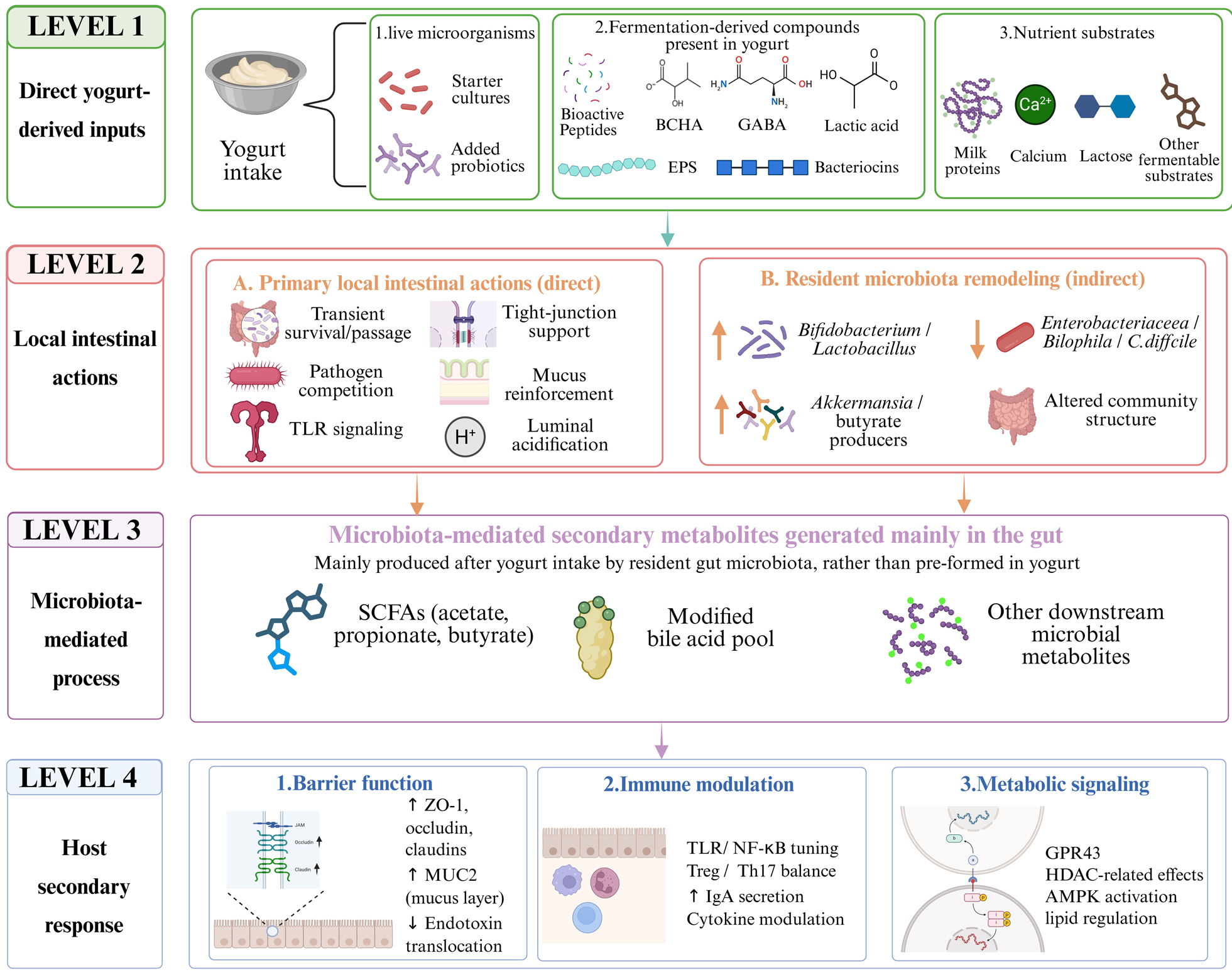
Yogurt, a fermented dairy food, has been increasingly recognized for its potential to modulate gut microbiota and promote host health. Accumulating evidence suggests that yogurt consumption influences gut microbial composition, diversity, and functional activity. In this narrative review, we synthesized the findings on yogurt-related effects on the gut microbiota, intestinal barrier, microbial metabolites, immune responses, and selected extra-intestinal outcomes. We distinguished traditional yogurt, probiotic yogurt, synbiotic yogurt, fortified yogurt, and non-dairy or regional yogurt-like fermented products, and then organized proposed mechanisms into a hierarchical framework that separated direct yogurt-derived inputs, including starter cultures, added probiotic strains, fermentation-derived compounds, and dairy matrix components, from resident microbiota-mediated secondary metabolites and host downstream responses. Importantly, limitations and controversies, such as variability in yogurt formulations, strain-specific effects, and inter-individual responses, were critically evaluated. Finally, we highlighted future research directions that emphasize standardized study designs, defined endpoints, long-term randomized controlled trials, and integrative multi-omics approaches to support the development of personalized dietary strategies. Together, this review provides a structured framework for understanding the complex interactions between yogurt, gut microbiota, and host physiology, while outlining key steps needed to translate evidence into actionable nutritional recommendations.
Citation: Daiyu Yang, Hongwen Zhao, Kun He, Wangyang Chen, Hemiao Xu, Shuai Li, Qiming Xiao, Jinshui Yang, Dong Wu. Yogurt as a modulator of gut and beyond gut: Mechanisms, health effects, and clinical translation[J]. AIMS Microbiology, 2026, 12(2): 393-421. doi: 10.3934/microbiol.2026017
Yogurt, a fermented dairy food, has been increasingly recognized for its potential to modulate gut microbiota and promote host health. Accumulating evidence suggests that yogurt consumption influences gut microbial composition, diversity, and functional activity. In this narrative review, we synthesized the findings on yogurt-related effects on the gut microbiota, intestinal barrier, microbial metabolites, immune responses, and selected extra-intestinal outcomes. We distinguished traditional yogurt, probiotic yogurt, synbiotic yogurt, fortified yogurt, and non-dairy or regional yogurt-like fermented products, and then organized proposed mechanisms into a hierarchical framework that separated direct yogurt-derived inputs, including starter cultures, added probiotic strains, fermentation-derived compounds, and dairy matrix components, from resident microbiota-mediated secondary metabolites and host downstream responses. Importantly, limitations and controversies, such as variability in yogurt formulations, strain-specific effects, and inter-individual responses, were critically evaluated. Finally, we highlighted future research directions that emphasize standardized study designs, defined endpoints, long-term randomized controlled trials, and integrative multi-omics approaches to support the development of personalized dietary strategies. Together, this review provides a structured framework for understanding the complex interactions between yogurt, gut microbiota, and host physiology, while outlining key steps needed to translate evidence into actionable nutritional recommendations.
Strains supplemented beyond starters (e.g.,
Generic term encompassing starters and added probiotics when distinction is not needed
Used when referring to microbes that originate from yogurt (either starters or added probiotics) without specifying colonization status
Inactivated microbial cells or their components
Compounds produced during fermentation (e.g., BCHAs, peptides, EPS, lactic acid)
Compounds produced by resident gut microbes after yogurt consumption (e.g., SCFAs).

| [1] |
Ferreira RDS, Mendonça LABM, Ribeiro CFA, et al. (2022) Relationship between intestinal microbiota, diet and biological systems: An integrated view. Crit Rev Food Sci Nutr 62: 1166-1186. https://doi.org/10.1080/10408398.2020.1836605 
|
| [2] |
Ballini A, Charitos IA, Cantore S, et al. (2023) About functional foods: The probiotics and prebiotics state of art. Antibiotics 12: 635. https://doi.org/10.3390/antibiotics12040635
|
| [3] |
Rizzoli R, Biver E (2024) Role of fermented dairy products in the health benefits of a mediterranean diet. Aging Clin Exp Res 36: 75. https://doi.org/10.1007/s40520-024-02721-x
|
| [4] |
Zaccaria E, Klaassen T, Alleleyn AME, et al. (2023) Endogenous small intestinal microbiome determinants of transient colonisation efficiency by bacteria from fermented dairy products: A randomised controlled trial. Microbiome 11: 43. https://doi.org/10.1186/s40168-023-01491-4
|
| [5] |
Aryana KJ, Olson DW (2017) A 100-Year Review: Yogurt and other cultured dairy products. J Dairy Sci 100: 9987-10013. https://doi.org/10.3168/jds.2017-12981
|
| [6] |
Tremblay A, Drouin-Chartier JP, Marette A, et al. (2026) Yogurt and health: A focus on its matrix. Crit Rev Food Sci Nutr 66: 342-351. https://doi.org/10.1080/10408398.2025.2524472
|
| [7] |
Pei R, Martin DA, DiMarco DM, et al. (2017) Evidence for the effects of yogurt on gut health and obesity. Crit Rev Food Sci Nutr 57: 1569-1583. https://doi.org/10.1080/10408398.2014.883356
|
| [8] |
Kim CE, Yoon LS, Michels KB, et al. (2022) The impact of prebiotic, probiotic, and synbiotic supplements and yogurt consumption on the risk of colorectal neoplasia among adults: A systematic review. Nutrients 14: 4937. https://doi.org/10.3390/nu14224937
|
| [9] |
Gao Y, Liu Y, Ma T, et al. (2025) Fermented dairy products as precision modulators of gut microbiota and host health: Mechanistic insights, clinical evidence, and future directions. Foods 14: 1946. https://doi.org/10.3390/foods14111946
|
| [10] |
Le Roy CI, Kurilshikov A, Leeming ER, et al. (2022) Yoghurt consumption is associated with changes in the composition of the human gut microbiome and metabolome. BMC Microbiol 22: 39. https://doi.org/10.1186/s12866-021-02364-2
|
| [11] |
Adolfsson O, Meydani SN, Russell RM (2004) Yogurt and gut function. Am J Clin Nutr 80: 245-256. https://doi.org/10.1093/ajcn/80.2.245
|
| [12] |
Zang J, Lin T, Shi Y, et al. (2025) Recent advances in exopolysaccharide-protein interactions in fermented dairy- and plant-based yogurts: Mechanisms, influencing factors, health benefits, analytical techniques, and future directions. Compr Rev Food Sci Food Saf 24: e70219. https://doi.org/10.1111/1541-4337.70219
|
| [13] |
Fazilah NF, Ariff AB, Khayat ME, et al. (2018) Influence of probiotics, prebiotics, synbiotics and bioactive phytochemicals on the formulation of functional yogurt. J Funct Foods 48: 387-399. https://doi.org/10.1016/j.jff.2018.07.039
|
| [14] |
Pannerchelvan S, Rios-Solis L, Wasoh H, et al. (2024) Functional yogurt: A comprehensive review of its nutritional composition and health benefits. Food Funct 15: 10927-10955. https://doi.org/10.1039/d4fo03671a
|
| [15] |
Kvakova M, Bertkova I, Stofilova J, et al. (2021) Co-encapsulated synbiotics and immobilized probiotics in human health and gut Microbiota modulation. Foods 10: 1297. https://doi.org/10.3390/foods10061297
|
| [16] |
Gao J, Li X, Zhang G, et al. (2021) Probiotics in the dairy industry-Advances and opportunities. Compr Rev Food Sci Food Saf 20: 3937-3982. https://doi.org/10.1111/1541-4337.12755
|
| [17] |
Hadjimbei E, Botsaris G, Chrysostomou S (2022) Beneficial effects of yoghurts and probiotic fermented milks and their functional food potential. Foods 11: 2691. https://doi.org/10.3390/foods11172691
|
| [18] |
Kok CR, Hutkins R (2018) Yogurt and other fermented foods as sources of health-promoting bacteria. Nutr Rev 76: 4-15. https://doi.org/10.1093/nutrit/nuy056
|
| [19] |
Jungersen M, Wind A, Johansen E, et al. (2014) The science behind the probiotic strain Bifidobacterium animalis subsp. lactis BB-12®. Microorganisms 2: 92-110. https://doi.org/10.3390/microorganisms2020092
|
| [20] |
Zhang C, Yu Z, Zhao J, et al. (2019) Colonization and probiotic function of Bifidobacterium longum. J Funct Foods 53: 157-165. https://doi.org/10.1016/j.jff.2018.12.022
|
| [21] | Gao J, Gu F, Abdella NH, et al. (2012) Investigation on culturable microflora in Tibetan kefir grains from different areas of China. J Food Sci 77: M425-M433. https://doi.org/10.1111/j.1750-3841.2012.02805.x |
| [22] |
Thierry A, Deutsch SM, Falentin H, et al. (2011) New insights into physiology and metabolism of Propionibacterium freudenreichii. Int J Food Microbiol 149: 19-27. https://doi.org/10.1016/j.ijfoodmicro.2011.04.026
|
| [23] | De Vuyst L, Leroy F (2007) Bacteriocins from lactic acid bacteria: Production, purification, and food applications. J Mol Microbiol Biotechnol 13: 194-199. https://doi.org/10.1159/000104752 |
| [24] |
Hughes RL, Alvarado DA, Swanson KS, et al. (2022) The prebiotic potential of inulin-type fructans: A systematic review. Adv Nutr 13: 492-529. https://doi.org/10.1093/advances/nmab119
|
| [25] |
Dou Y, Yu X, Luo Y, et al. (2022) Effect of fructooligosaccharides supplementation on the gut microbiota in human: A systematic review and meta-analysis. Nutrients 14: 3298. https://doi.org/10.3390/nu14163298
|
| [26] |
Louis P, Flint HJ (2017) Formation of propionate and butyrate by the human colonic microbiota. Environ Microbiol 19: 29-41. https://doi.org/10.1111/1462-2920.13589
|
| [27] |
Falah F, Vasiee A, Yazdi FT, et al. (2021) Preparation and functional properties of synbiotic yogurt fermented with Lactobacillus brevis PML1 derived from a fermented cereal-dairy product. BioMed Res Int 2021: 1057531. https://doi.org/10.1155/2021/1057531
|
| [28] |
Aguiar Freire CEC de, Gonçalves SF, de Souza Moreira C, et al. (2024) Yogurt enriched with nanoencapsulated anthocyanins: Effects on the modulation of the gut microbiota and its infuence on health. Curr Res Food Sci 9: 100857. https://doi.org/10.1016/j.crfs.2024.100857
|
| [29] |
Rodríguez-Daza MC, Pulido-Mateos EC, Lupien-Meilleur J, et al. (2021) Polyphenol-mediated gut microbiota modulation: Toward prebiotics and further. Front Nutr 8: 689456. https://doi.org/10.3389/fnut.2021.689456
|
| [30] |
Cardona F, Andrés-Lacueva C, Tulipani S, et al. (2013) Benefits of polyphenols on gut microbiota and implications in human health. J Nutr Biochem 24: 1415-1422. https://doi.org/10.1016/j.jnutbio.2013.05.001
|
| [31] |
Daglia M (2012) Polyphenols as antimicrobial agents. Curr Opin Biotechnol 23: 174-181. https://doi.org/10.1016/j.copbio.2011.08.007
|
| [32] |
Scalbert A, Johnson IT, Saltmarsh M (2005) Polyphenols: Antioxidants and beyond. Am J Clin Nutr 81: 215S-217S. https://doi.org/10.1093/ajcn/81.1.215S
|
| [33] |
Sun J, Gu X, Wang J, et al. (2025) Yogurt in combination with inactivated Pediococcus lactis modulated feline lipid metabolism, anti-inflammation and fecal microbiota. Animals 15: 1531. https://doi.org/10.3390/ani15111531
|
| [34] |
Weng BBC, Yuan HD, Chen LG, et al. (2023) Soy yoghurts produced with efficient GABA (γ-aminobutyric acid)-producing Lactiplantibacillus plantarum ameliorate hyperglycaemia and re-establish gut microbiota in streptozotocin (STZ)-induced diabetic mice. Food Funct 14: 1699-1709. https://doi.org/10.1039/d2fo02708a
|
| [35] |
Takada T, Chinda D, Mikami T, et al. (2020) Dynamic analysis of human small intestinal microbiota after an ingestion of fermented milk by small-intestinal fluid perfusion using an endoscopic retrograde bowel insertion technique. Gut Microbes 11: 1662-1676. https://doi.org/10.1080/19490976.2020.1766942
|
| [36] |
Lebeer S, Vanderleyden J, De Keersmaecker SCJ (2010) Host interactions of probiotic bacterial surface molecules: Comparison with commensals and pathogens. Nat Rev Microbiol 8: 171-184. https://doi.org/10.1038/nrmicro2297
|
| [37] |
Almada-Érix CN, Almada CN, Cabral L, et al. (2021) Orange juice and yogurt carrying probiotic Bacillus coagulans GBI-30 6086: Impact of intake on Wistar male rats health parameters and gut bacterial diversity. Front Microbiol 12: 623951. https://doi.org/10.3389/fmicb.2021.623951
|
| [38] |
Lu X, Zhang M, Ma Y, et al. (2023) Protective effect of Limosilactobacillus reuteri-fermented yogurt on mouse intestinal barrier injury induced by enterotoxigenic Escherichia coli. J Sci Food Agric 103: 7494-7505. https://doi.org/10.1002/jsfa.12836
|
| [39] |
Rose EC, Odle J, Blikslager AT, et al. (2021) Probiotics, prebiotics and epithelial tight junctions: A promising approach to modulate intestinal barrier function. Int J Mol Sci 22: 6729. https://doi.org/10.3390/ijms22136729
|
| [40] |
Cario E, Gerken G, Podolsky DK (2004) Toll-like receptor 2 enhances ZO-1-associated intestinal epithelial barrier integrity via protein kinase C. Gastroenterology 127: 224-238. https://doi.org/10.1053/j.gastro.2004.04.015
|
| [41] |
Guigas C, Faulhaber K, Duerbeck D, et al. (2016) Prophage-mediated modulation of interaction of Streptococcus thermophilus J34 with human intestinal epithelial cells and its competition against human pathogens. Benef Microbes 7: 289-297. https://doi.org/10.3920/BM2015.0108
|
| [42] |
Fu L, Fu S, Wang C, et al. (2019) Yogurt-sourced probiotic bacteria alleviate shrimp tropomyosin-induced allergic mucosal disorders, potentially through microbiota and metabolism modifications. Allergol Int Off J Jpn Soc Allergol 68: 506-514. https://doi.org/10.1016/j.alit.2019.05.013
|
| [43] |
Kok CR, Hutkins R (2018) Yogurt and other fermented foods as sources of health-promoting bacteria. Nutr Rev 76: 4-15. https://doi.org/10.1093/nutrit/nuy056
|
| [44] |
Aslam H, Marx W, Rocks T, et al. (2020) The effects of dairy and dairy derivatives on the gut microbiota: A systematic literature review. Gut Microbes 12: 1799533. https://doi.org/10.1080/19490976.2020.1799533
|
| [45] |
Chen X, Zhu Z, Zhang X, et al. (2024) Lactobacillus paracasei ZFM54 alters the metabolomic profiles of yogurt and the co-fermented yogurt improves the gut microecology of human adults. J Dairy Sci 107: 5280-5300. https://doi.org/10.3168/jds.2023-24332
|
| [46] |
Alvaro E, Andrieux C, Rochet V, et al. (2007) Composition and metabolism of the intestinal microbiota in consumers and non-consumers of yogurt. Br J Nutr 97: 126-133. https://doi.org/10.1017/S0007114507243065
|
| [47] |
Vizioli C, Jaime-Lara R, Daniel SG, et al. (2023) Administration of Bifidobacterium animalis subsp. lactis strain BB-12® in healthy children: Characterization, functional composition, and metabolism of the gut microbiome. Front Microbiol 14: 1165771. https://doi.org/10.3389/fmicb.2023.1165771
|
| [48] |
Rettedal EA, Altermann E, Roy NC, et al. (2019) The effects of unfermented and fermented cow and sheep milk on the gut microbiota. Front Microbiol 10: 458. https://doi.org/10.3389/fmicb.2019.00458
|
| [49] |
Li X, Jiang L, Xia Q, et al. (2021) Effects of novel flavonoid-enriched yogurt on the diversity of intestinal microbiota in mice. Braz J Microbiol 52: 2287-2298. https://doi.org/10.1007/s42770-021-00598-w
|
| [50] |
Merenstein D, Fraser CM, Roberts RF, et al. (2021) Bifidobacterium animalis subsp. lactis BB-12 protects against antibiotic-induced functional and compositional changes in human fecal microbiome. Nutrients 13: 2814. https://doi.org/10.3390/nu13082814
|
| [51] |
Feng P, Ye Z, Han H, et al. (2020) Tibet plateau probiotic mitigates chromate toxicity in mice by alleviating oxidative stress in gut microbiota. Commun Biol 3: 242. https://doi.org/10.1038/s42003-020-0968-3
|
| [52] |
Daniel N, Nachbar RT, Tran TTT, et al. (2022) Gut microbiota and fermentation-derived branched chain hydroxy acids mediate health benefits of yogurt consumption in obese mice. Nat Commun 13: 1343. https://doi.org/10.1038/s41467-022-29005-0
|
| [53] |
Daniloski D, Fan N, Stokes JR, et al. (2026) High-protein bovine yogurt: Where do traditional structure-function principles need to adapt or apply?. Compr Rev Food Sci Food Saf 25: e70337. https://doi.org/10.1111/1541-4337.70337
|
| [54] |
Giacometti Cavalheiro F, Parra Baptista D, Domingues Galli B, et al. (2020) High protein yogurt with addition of Lactobacillus helveticus: Peptide profile and angiotensin-converting enzyme ACE-inhibitory activity. Food Chem 333: 127482. https://doi.org/10.1016/j.foodchem.2020.127482
|
| [55] |
You X, Li Z, Ma K, et al. (2020) Structural characterization and immunomodulatory activity of an exopolysaccharide produced by Lactobacillus helveticus LZ-R-5. Carbohydr Polym 235: 115977. https://doi.org/10.1016/j.carbpol.2020.115977
|
| [56] |
Yue Y, Han J, Shen X, et al. (2024) Structural characteristics, immune-activating mechanisms in vitro, and immunomodulatory effects in vivo of the exopolysaccharide EPS53 from Streptococcus thermophilus XJ53. Carbohydr Polym 340: 122259. https://doi.org/10.1016/j.carbpol.2024.122259
|
| [57] |
Zhao C, Xie L, Shen J, et al. (2025) Lactobacillus acidophilus YL01 and its exopolysaccharides ameliorate obesity and insulin resistance in obese mice via modulating intestinal specific bacterial groups and AMPK/ACC signaling pathway. Int J Biol Macromol 300: 140287. https://doi.org/10.1016/j.ijbiomac.2025.140287
|
| [58] |
LeBlanc JG, Laiño JE, del Valle MJ, et al. (2011) B-group vitamin production by lactic acid bacteria—current knowledge and potential applications. J Appl Microbiol 111: 1297-1309. https://doi.org/10.1111/j.1365-2672.2011.05157.x
|
| [59] |
Martens JH, Barg H, Warren M, et al. (2002) Microbial production of vitamin B12. Appl Microbiol Biotechnol 58: 275-285. https://doi.org/10.1007/s00253-001-0902-7
|
| [60] |
Cotter PD, Ross RP, Hill C (2013) Bacteriocins—a viable alternative to antibiotics?. Nat Rev Microbiol 11: 95-105. https://doi.org/10.1038/nrmicro2937
|
| [61] |
Li S, Duan Y, Luo S, et al. (2025) Short-chain fatty acids and cancer. Trends Cancer 11: 154-168. https://doi.org/10.1016/j.trecan.2024.11.003
|
| [62] |
Mann ER, Lam YK, Uhlig HH (2024) Short-chain fatty acids: Linking diet, the microbiome and immunity. Nat Rev Immunol 24: 577-595. https://doi.org/10.1038/s41577-024-01014-8
|
| [63] |
Ba Z, Lee Y, Meng H, et al. (2021) Matrix effects on the delivery efficacy of Bifidobacterium animalis subsp. lactis BB-12 on fecal microbiota, gut transit time, and short-chain fatty acids in healthy young adults. Msphere 6: e0008421. https://doi.org/10.1128/mSphere.00084-21
|
| [64] |
Xiong RG, Zhou DD, Wu SX, et al. (2022) Health benefits and side effects of short-chain fatty acids. Foods 11: 2863. https://doi.org/10.3390/foods11182863
|
| [65] |
Ridlon JM, Kang DJ, Hylemon PB (2006) Bile salt biotransformations by human intestinal bacteria. J Lipid Res 47: 241-259. https://doi.org/10.1194/jlr.R500013-JLR200
|
| [66] |
Wahlström A, Sayin SI, Marschall HU, et al. (2016) Intestinal crosstalk between bile acids and microbiota and its impact on host metabolism. Cell Metab 24: 41-50. https://doi.org/10.1016/j.cmet.2016.05.005
|
| [67] |
Du X, Yan Y, Dai Y, et al. (2024) Yogurt alleviates cyclophosphamide-induced immunosuppression in mice through D-lactate. Nutrients 16: 1395. https://doi.org/10.3390/nu16091395
|
| [68] |
Yun L, Zhang J, Zhao T, et al. (2025) Highly active probiotic yogurt against cyclophosphamide-induced immunosuppression in mice by regulating immune response and gut microbiota. Probiotics Antimicro Prot 18: 1811-1825. https://doi.org/10.1007/s12602-025-10623-1
|
| [69] |
Han F, Wu G, Zhang Y, et al. (2020) Streptococcus thermophilus attenuates inflammation in septic mice mediated by gut microbiota. Front Microbiol 11: 598010. https://doi.org/10.3389/fmicb.2020.598010
|
| [70] |
Nakashima Y, Onuki K, Hibi T, et al. (2024) Soymilk yogurt fermented using Pediococcus pentosaceus TOKAI 759 m improves mice gut microbiota and reduces pro-inflammatory cytokine production. Biosci Biotechnol Biochem 88: 1349-1361. https://doi.org/10.1093/bbb/zbae112
|
| [71] |
Illikoud N, Mantel M, Rolli-Derkinderen M, et al. (2022) Dairy starters and fermented dairy products modulate gut mucosal immunity. Immunol Lett 251–252: 91-102. https://doi.org/10.1016/j.imlet.2022.11.002
|
| [72] |
Lin YK, Lin YH, Chiang CF, et al. (2022) Lactobacillus delbrueckii subsp. bulgaricus strain TCI904 reduces body weight gain, modulates immune response, improves metabolism and anxiety in high fat diet-induced obese mice. 3 Biotech 12: 341. https://doi.org/10.1007/s13205-022-03356-3
|
| [73] |
Wasilewska E, Zlotkowska D, Wroblewska B (2019) Yogurt starter cultures of Streptococcus thermophilus and Lactobacillus bulgaricus ameliorate symptoms and modulate the immune response in a mouse model of dextran sulfate sodium-induced colitis. J Dairy Sci 102: 37-53. https://doi.org/10.3168/jds.2018-14520
|
| [74] |
de Moreno de LeBlanc A, Dogi CA, Galdeano CM, et al. (2008) Effect of the administration of a fermented milk containing Lactobacillus casei DN-114001 on intestinal microbiota and gut associated immune cells of nursing mice and after weaning until immune maturity. BMC Immunol 9: 27. https://doi.org/10.1186/1471-2172-9-27
|
| [75] |
Rivero-Pino F, Casquete M, Castro MJ, et al. (2024) Prospective, randomized, double-blind parallel group nutritional study to evaluate the effects of routine intake of fresh vs. pasteurized yogurt on the immune system in healthy adults. Nutrients 16: 1969. https://doi.org/10.3390/nu16121969
|
| [76] |
Newgard CB, An J, Bain JR, et al. (2009) A branched-chain amino acid-related metabolic signature that differentiates obese and lean humans and contributes to insulin resistance. Cell Metab 9: 311-326. https://doi.org/10.1016/j.cmet.2009.02.002
|
| [77] |
Salazar N, Gueimonde M, Hernández-Barranco AM, et al. (2008) Exopolysaccharides produced by intestinal Bifidobacterium strains act as fermentable substrates for human intestinal bacteria. Appl Environ Microbiol 74: 4737-4745. https://doi.org/10.1128/AEM.00325-08
|
| [78] |
Brown AJ, Goldsworthy SM, Barnes AA, et al. (2003) The Orphan G protein-coupled receptors GPR41 and GPR43 are activated by propionate and other short chain carboxylic acids. J Biol Chem 278: 11312-11319. https://doi.org/10.1074/jbc.M211609200
|
| [79] |
Davie JR (2003) Inhibition of histone deacetylase activity by butyrate. J Nutr 133: 2485S-2493S. https://doi.org/10.1093/jn/133.7.2485S
|
| [80] |
Adeghate E, Ponery AS (2002) GABA in the endocrine pancreas: Cellular localization and function in normal and diabetic rats. Tissue Cell 34: 1-6. https://doi.org/10.1054/tice.2002.0217
|
| [81] |
Companys J, Pla-Pagà L, Calderón-Pérez L, et al. (2020) Fermented dairy products, probiotic supplementation, and cardiometabolic diseases: A systematic review and meta-analysis. Adv Nutr 11: 834-863. https://doi.org/10.1093/advances/nmaa030
|
| [82] |
Baspinar B, Güldaş M (2021) Traditional plain yogurt: A therapeutic food for metabolic syndrome?. Crit Rev Food Sci Nutr 61: 3129-3143. https://doi.org/10.1080/10408398.2020.1799931
|
| [83] |
Yang JJ, Yu D, Xiang YB, et al. (2020) Association of dietary fiber and yogurt consumption with lung cancer risk: A pooled analysis. JAMA Oncol 6: e194107. https://doi.org/10.1001/jamaoncol.2019.4107
|
| [84] |
Shuai M, Zuo LSY, Miao Z, et al. (2021) Multi-omics analyses reveal relationships among dairy consumption, gut microbiota and cardiometabolic health. EBioMedicine 66: 103284. https://doi.org/10.1016/j.ebiom.2021.103284
|
| [85] |
Torres-Gonzalez M, Bradley BHR (2023) Whole-milk dairy foods: Biological mechanisms underlying beneficial effects on risk markers for cardiometabolic health. Adv Nutr Bethesda Md 14: 1523-1537. https://doi.org/10.1016/j.advnut.2023.09.001
|
| [86] |
Zhang K, Chen X, Zhang L, et al. (2020) Fermented dairy foods intake and risk of cardiovascular diseases: A meta-analysis of cohort studies. Crit Rev Food Sci Nutr 60: 1189-1194. https://doi.org/10.1080/10408398.2018.1564019
|
| [87] |
van de Wouw M, Walsh AM, Crispie F, et al. (2020) Distinct actions of the fermented beverage kefir on host behaviour, immunity and microbiome gut-brain modules in the mouse. Microbiome 8: 67. https://doi.org/10.1186/s40168-020-00846-5
|
| [88] |
He W, Song H, Yang Z, et al. (2024) Beneficial effect of GABA-rich fermented milk whey on nervous system and intestinal microenvironment of aging mice induced by D-galactose. Microbiol Res 278: 127547. https://doi.org/10.1016/j.micres.2023.127547
|
| [89] |
Liu J, Yu C, Li R, et al. (2020) High-altitude Tibetan fermented milk ameliorated cognitive dysfunction by modified gut microbiota in Alzheimer's disease transgenic mice. Food Funct 11: 5308-5319. https://doi.org/10.1039/c9fo03007g
|
| [90] |
Nakashima Y, Hibi T, Urakami M, et al. (2025) Soymilk yogurt prepared using Pediococcus pentosaceus TOKAI 759m ameliorates cognitive function through gut microbiota modulation in high-fat diet mice. Curr Res Food Sci 10: 100993. https://doi.org/10.1016/j.crfs.2025.100993
|
| [91] |
Ye Z, Yu S, Yang Y, et al. (2025) Association of probiotics, prebiotics, synbiotics or yogurt supplement with prevalence and all-cause mortality of depression: NHANES 2005-2016. J Affect Disord 368: 547-554. https://doi.org/10.1016/j.jad.2024.09.034
|
| [92] |
Zhu J, Zhu Y, Song G (2023) Effect of probiotic yogurt supplementation (Bifidobacterium animalis ssp. lactis BB-12) on gut microbiota of female taekwondo athletes and its relationship with exercise-related psychological fatigue. Microorganisms 11: 1403. https://doi.org/10.3390/microorganisms11061403
|
| [93] |
Oh NS, Lee JY, Kim YT, et al. (2020) Cancer-protective effect of a synbiotic combination between Lactobacillus gasseri 505 and a Cudrania tricuspidata leaf extract on colitis-associated colorectal cancer. Gut Microbes 12: 1785803. https://doi.org/10.1080/19490976.2020.1785803
|
| [94] |
Dahiya D, Nigam PS (2022) The gut microbiota influenced by the intake of probiotics and functional foods with prebiotics can sustain wellness and alleviate certain ailments like gut-inflammation and colon-cancer. Microorganisms 10: 665. https://doi.org/10.3390/microorganisms10030665
|
| [95] |
Li X, Qian J, Liu Q, et al. (2024) Yogurt prevents colorectal tumorigenesis in ApcMin/+ mice. Mol Nutr Food Res 68: e2300737. https://doi.org/10.1002/mnfr.202300737
|
| [96] |
Rivai MI, Lusikooy RE, Putra AE, et al. (2024) Effects of Lactococcus lactis on colorectal cancer in various terms: A narrative review. Ann Med Surg 2012 86: 3503-3507. https://doi.org/10.1097/MS9.0000000000002030
|
| [97] |
Xu F, Li Q, Wang S, et al. (2023) The efficacy of prevention for colon cancer based on the microbiota therapy and the antitumor mechanisms with intervention of dietary Lactobacillus. Microbiol Spectr 11: e0018923. https://doi.org/10.1128/spectrum.00189-23
|
| [98] |
Wang L, Du M, Wang K, et al. (2022) Association of ultra-processed food consumption with colorectal cancer risk among men and women: Results from three prospective US cohort studies. BMJ 378: e068921. https://doi.org/10.1136/bmj-2021-068921
|
| [99] |
Michels KB, Willett WC, Vaidya R, et al. (2020) Yogurt consumption and colorectal cancer incidence and mortality in the Nurses' Health Study and the Health Professionals Follow-Up Study. Am J Clin Nutr 112: 1566-1575. https://doi.org/10.1093/ajcn/nqaa244
|
| [100] |
Ugai S, Liu L, Kosumi K, et al. (2025) Long-term yogurt intake and colorectal cancer incidence subclassified by Bifidobacterium abundance in tumor. Gut Microbes 17: 2452237. https://doi.org/10.1080/19490976.2025.2452237
|
| [101] |
Cai JA, Zhang YZ, Yu ED, et al. (2023) Gut microbiota enterotypes mediate the effects of dietary patterns on colorectal neoplasm risk in a Chinese population. Nutrients 15: 2940. https://doi.org/10.3390/nu15132940
|
| [102] |
Teofani A, Marafini I, Laudisi F, et al. (2022) Intestinal taxa abundance and diversity in inflammatory bowel disease patients: An analysis including covariates and confounders. Nutrients 14: 260. https://doi.org/10.3390/nu14020260
|
| [103] |
Jiang YH, Li YY, Xin WG, et al. (2025) Protective effect of yak yogurt derived Lactiplantibacillus plantarum DACNJS22 fermented milk on DSS-induced colitis: Insights from in vitro and in vivo studies. Food Res Int Ott Ont 217: 116826. https://doi.org/10.1016/j.foodres.2025.116826
|
| [104] |
Lao J, Chen M, Yan S, et al. (2025) Lacticaseibacillus rhamnosus G7 alleviates DSS-induced ulcerative colitis by regulating the intestinal microbiota. BMC Microbiol 25: 168. https://doi.org/10.1186/s12866-025-03904-w
|
| [105] |
Shadnoush M, Hosseini RS, Khalilnezhad A, et al. (2015) Effects of probiotics on gut microbiota in patients with inflammatory bowel disease: A double-blind, placebo-controlled clinical trial. Kor J Gastroenterol 65: 215-221. https://doi.org/10.4166/kjg.2015.65.4.215
|
| [106] |
Ottria R, Xynomilakis O, Casati S, et al. (2024) Pre-to postbiotics: The beneficial roles of pediatric dysbiosis associated with inflammatory bowel diseases. Microorganisms 12: 1582. https://doi.org/10.3390/microorganisms12081582
|
| [107] |
Sheikhi A, Shakerian M, Giti H, et al. (2016) Probiotic yogurt culture Bifidobacterium animalis subsp. lactis BB-12 and Lactobacillus acidophilus LA-5 modulate the cytokine secretion by peripheral blood mononuclear cells from patients with ulcerative colitis. Drug Res 66: 300-305. https://doi.org/10.1055/s-0035-1569414
|
| [108] |
Li T, Yan Q, Wen Y, et al. (2021) Synbiotic yogurt containing konjac mannan oligosaccharides and Bifidobacterium animalis ssp. lactis BB12 alleviates constipation in mice by modulating the stem cell factor (SCF)/c-Kit pathway and gut microbiota. J Dairy Sci 104: 5239-5255. https://doi.org/10.3168/jds.2020-19449
|
| [109] |
Wang R, Sun J, Li G, et al. (2021) Effect of Bifidobacterium animalis subsp. lactis MN-Gup on constipation and the composition of gut microbiota. Benef Microbes 12: 31-42. https://doi.org/10.3920/BM2020.0023
|
| [110] | Li XR, Liu CJ, Tang XD, et al. (2020) Gut microbiota alterations from three-strain yogurt formulation treatments in slow-transit constipation. Can J Infect Dis Med Microbiol J Can Mal Infect Microbiol Medicale 2020: 4583973. https://doi.org/10.1155/2020/4583973 |
| [111] | Li Y, Yu Y, Wu X, et al. (2022) Specially designed yogurt supplemented with combination of pro-and prebiotics relieved constipation in mice and humans. Nutr Burbank Los Angel Cty Calif 103–104: 111802. https://doi.org/10.1016/j.nut.2022.111802 |
| [112] |
Yu J, Guo H, Sun M, et al. (2023) Milk fermented by combined starter cultures comprising three Lactobacillus strains exerts an alleviating effect on loperamide-induced constipation in BALB/c mice. Food Funct 14: 5264-5276. https://doi.org/10.1039/d3fo00222e
|
| [113] |
Noorbakhsh H, Yavarmanesh M, Mortazavi SA, et al. (2019) Metabolomics analysis revealed metabolic changes in patients with diarrhea-predominant irritable bowel syndrome and metabolic responses to a synbiotic yogurt intervention. Eur J Nutr 58: 3109-3119. https://doi.org/10.1007/s00394-018-1855-2
|
| [114] |
Egea MB, Santos DCD, Oliveira Filho JG de, et al. (2022) A review of nondairy kefir products: Their characteristics and potential human health benefits. Crit Rev Food Sci Nutr 62: 1536-1552. https://doi.org/10.1080/10408398.2020.1844140
|
| [115] |
Cui Y, Zhu J, Xi J, et al. (2026) Kefiran, a polysaccharide from kefir grain, modulates gut microbiota and hepatic metabolism to mitigate metabolic dysfunction-associated steatotic liver disease. Int J Biol Macromol 341: 150147. https://doi.org/10.1016/j.ijbiomac.2026.150147
|
| [116] |
Zhu L, Ying N, Hao L, et al. (2024) Probiotic yogurt regulates gut microbiota homeostasis and alleviates hepatic steatosis and liver injury induced by high-fat diet in golden hamsters. Food Sci Nutr 12: 2488-2501. https://doi.org/10.1002/fsn3.3930
|
| [117] |
Shi L, Tianqi F, Zhang C, et al. (2023) High-protein compound yogurt with quinoa improved clinical features and metabolism of high-fat diet-induced nonalcoholic fatty liver disease in mice. J Dairy Sci 106: 5309-5327. https://doi.org/10.3168/jds.2022-23045
|
| [118] |
Kong CY, Li ZM, Han B, et al. (2019) Diet consisting of balanced yogurt, fruit, and vegetables modifies the gut microbiota and protects mice against nonalcoholic fatty liver disease. Mol Nutr Food Res 63: e1900249. https://doi.org/10.1002/mnfr.201900249
|
| [119] |
Sun Y, Liu X, Wang R, et al. (2024) Lacticaseibacillus rhamnosus HF01 fermented yogurt alleviated high-fat diet-induced obesity and hepatic steatosis via the gut microbiota-butyric acid-hepatic lipid metabolism axis. Food Funct 15: 4475-4489. https://doi.org/10.1039/d3fo04985j
|
| [120] |
Jiao Q, Liu J, Zhou L, et al. (2025) Lactobacillus extracellular vesicles alleviate alcohol-induced liver injury in mice by regulating gut microbiota and activating the Nrf-2 signaling pathway. Food Funct 16: 1284-1298. https://doi.org/10.1039/d4fo04364b
|
| [121] |
Chen Y, Feng R, Yang X, et al. (2019) Yogurt improves insulin resistance and liver fat in obese women with nonalcoholic fatty liver disease and metabolic syndrome: A randomized controlled trial. Am J Clin Nutr 109: 1611-1619. https://doi.org/10.1093/ajcn/nqy358
|
| [122] |
Suzuki Y, Ikeda K, Sakuma K, et al. (2017) Association between yogurt consumption and intestinal microbiota in healthy young adults differs by host gender. Front Microbiol 8: 847. https://doi.org/10.3389/fmicb.2017.00847
|
| [123] |
Rausch P, Rehman A, Künzel S, et al. (2011) Colonic mucosa-associated microbiota is influenced by an interaction of Crohn disease and FUT2 (Secretor) genotype. Proc Natl Acad Sci U S A 108: 19030-19035. https://doi.org/10.1073/pnas.1106408108
|
| [124] |
Mofid V, Izadi A, Mojtahedi SY, et al. (2020) Therapeutic and nutritional effects of synbiotic yogurts in children and adults: A clinical review. Probiotics Antimicrob Proteins 12: 851-859. https://doi.org/10.1007/s12602-019-09594-x
|
| [125] |
Donovan SM, Rao G (2019) Health benefits of yogurt among infants and toddlers aged 4 to 24 months: A systematic review. Nutr Rev 77: 478-486. https://doi.org/10.1093/nutrit/nuz009
|
| [126] |
Hirai H, Tanaka T, Matsumura K, et al. (2024) Relationship between frequency of yogurt consumption at 1 year of age and development at 3 years of age: The Japan Environment and Children's Study. PloS One 19: e0308703. https://doi.org/10.1371/journal.pone.0308703
|
| [127] |
Tan TP, Ba Z, Sanders ME, et al. (2017) Safety of Bifidobacterium animalis subsp. lactis (B. lactis) strain BB-12-supplemented yogurt in healthy children. J Pediatr Gastroenterol Nutr 64: 302-309. https://doi.org/10.1097/MPG.0000000000001272
|
| [128] |
Heyman MB (2006) Lactose intolerance in infants, children, and adolescents. Pediatrics 118: 1279-1286. https://doi.org/10.1542/peds.2006-1721
|
| [129] |
El-Abbadi NH, Dao MC, Meydani SN (2014) Yogurt: Role in healthy and active aging. Am J Clin Nutr 99: 1263S-1270S. https://doi.org/10.3945/ajcn.113.073957
|
| [130] |
Matsumoto M, Sakamoto M, Benno Y (2009) Dynamics of fecal microbiota in hospitalized elderly fed probiotic LKM512 yogurt. Microbiol Immunol 53: 421-432. https://doi.org/10.1111/j.1348-0421.2009.00140.x
|
| [131] |
Tanaka Y, Takami K, Nishijima T, et al. (2015) Short- and long-term dynamics in the intestinal microbiota following ingestion of Bifidobacterium animalis subsp. lactis GCL2505. Biosci Microbiota Food Health 34: 77-85. https://doi.org/10.12938/bmfh.2015-001
|
| [132] |
Costa RL, Moreira J, Lorenzo A, et al. (2018) Infectious complications following probiotic ingestion: A potentially underestimated problem? A systematic review of reports and case series. BMC Complement Altern Med 18: 329. https://doi.org/10.1186/s12906-018-2394-3
|
 microbiol-12-02-017-s001.pdf microbiol-12-02-017-s001.pdf |
 |


Figures(3) / Tables(2)

Daiyu Yang, Hongwen Zhao, Kun He, Wangyang Chen, Hemiao Xu, Shuai Li, Qiming Xiao, Jinshui Yang, Dong Wu. Yogurt as a modulator of gut and beyond gut: Mechanisms, health effects, and clinical translation[J]. AIMS Microbiology, 2026, 12(2): 393-421. doi: 10.3934/microbiol.2026017




 DownLoad: