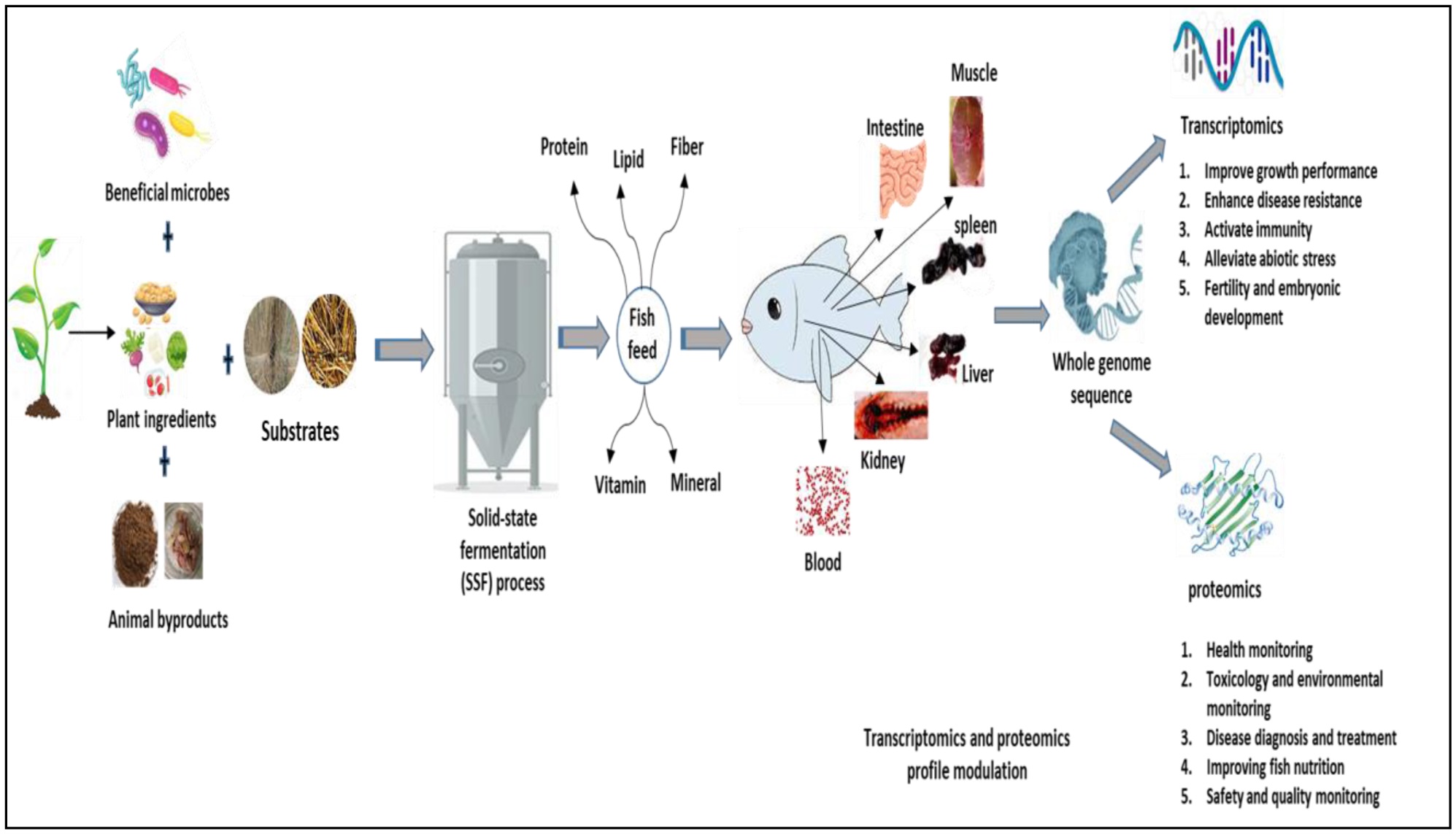
Fish meal (FM) has long been used as a staple protein source in aquafeed owing to its balanced amino acids, excellent feed conversion, and improved palatability and digestibility. However, the use of FM in aquafeed formulation is facing difficulties due to concerns regarding availability, price, overfishing, and sustainability. Thus, there is a growing interest in seeking alternative protein sources from plant and animal by-products to partially or fully replace FM in aquafeed. Challenges such as lower nutrient bioavailability, high antinutritional factors, indigestible materials, microbial contaminants, and lower palatability issues have limited the incorporation of these protein sources into aquafeed. The application of solid-state fermentation (SSF) strategy represents a sustainable method to address these problems by improving aquafeed quality and introducing health-promoting beneficial microbes. Moreover, numerous studies have shown that SSF enhances growth, feed utilization, health status, immune system, and disease resistance in aquaculture species. At present, molecular approaches such as transcriptomics and proteomics techniques are widely used tools for evaluating the impacts of SSF on fish and shrimp. They provide valuable insights into the mRNA transcripts and proteomes related gene expressions associated with growth, immunity, and stress response. In this article, we outline the requirements for SSF and discussed its role in ameliorating growth, health, immunity, and disease resistance in farmed species. We also provide up-to-date information about the utilization of SSF technology to modulate the transcriptomics and proteomics profiles in fish and shrimp. The complied evidence aims to support future research efforts and encourage the development of fermented feed as a functional dietary option for promoting sustainable aquaculture practices.
Citation: Shishir Kumar Nandi, Sanchita Sarkar, Md. Toasin Hossain Aunkor, Zulhisyam Abdul Kari, Tanwi Dey, Hien Van Doan, El-Sayed Hemdan Eissa, Mohamad Nor Azra, Muhammad A.B. Siddik, Muhammad Anamul Kabir. Applications of solid-state fermented (SSF) diets to improve the growth, organ health, immunity and disease resistance through modulating the transcriptomics and proteomics profile in fish and shrimp[J]. AIMS Microbiology, 2025, 11(3): 699-719. doi: 10.3934/microbiol.2025029
Fish meal (FM) has long been used as a staple protein source in aquafeed owing to its balanced amino acids, excellent feed conversion, and improved palatability and digestibility. However, the use of FM in aquafeed formulation is facing difficulties due to concerns regarding availability, price, overfishing, and sustainability. Thus, there is a growing interest in seeking alternative protein sources from plant and animal by-products to partially or fully replace FM in aquafeed. Challenges such as lower nutrient bioavailability, high antinutritional factors, indigestible materials, microbial contaminants, and lower palatability issues have limited the incorporation of these protein sources into aquafeed. The application of solid-state fermentation (SSF) strategy represents a sustainable method to address these problems by improving aquafeed quality and introducing health-promoting beneficial microbes. Moreover, numerous studies have shown that SSF enhances growth, feed utilization, health status, immune system, and disease resistance in aquaculture species. At present, molecular approaches such as transcriptomics and proteomics techniques are widely used tools for evaluating the impacts of SSF on fish and shrimp. They provide valuable insights into the mRNA transcripts and proteomes related gene expressions associated with growth, immunity, and stress response. In this article, we outline the requirements for SSF and discussed its role in ameliorating growth, health, immunity, and disease resistance in farmed species. We also provide up-to-date information about the utilization of SSF technology to modulate the transcriptomics and proteomics profiles in fish and shrimp. The complied evidence aims to support future research efforts and encourage the development of fermented feed as a functional dietary option for promoting sustainable aquaculture practices.

| [1] |
Suma AY, Nandi SK, Abdul Kari Z, et al. (2023) Beneficial effects of graded levels of fish protein hydrolysate (FPH) on the growth performance, blood biochemistry, liver and intestinal health, economics efficiency, and disease resistance to Aeromonas hydrophila of Pabda (Ompok pabda) fingerling. Fishes 8: 147. https://doi.org/10.3390/fishes8030147 
|
| [2] | Muhammad Anamul K, Shishir Kumar N, Afrina Yeasmin S, et al. (2023) Aquatic weeds as functional ingredients for aquaculture feed industry: Recent advances, challenges, opportunities, new product development (NPD) and sustainability. Agric Rep 2: 1-16. |
| [3] |
Dawood MAO, Koshio S (2020) Application of fermentation strategy in aquafeed for sustainable aquaculture. Rev Aquacult 12: 987-1002. https://doi.org/10.1111/raq.12368
|
| [4] | Dawood MAO, Kari ZA (2024) Editorial special issue: Friendly nutritional strategies for sustainable aquaculture. Aquacult Fish 9: 1-2. https://doi.org/10.1016/j.aaf.2023.01.003 |
| [5] |
Dawood MAO, Habotta OAE, Elsabagh M, et al. (2022) Fruit processing by-products in the aquafeed industry: A feasible strategy for aquaculture sustainability. Rev Aquacult 14: 1945-1965. https://doi.org/10.1111/raq.12680
|
| [6] |
Ribeiro Cardoso dos Santos DM, Victor dos Santos CW, Barros de Souza C, et al. (2020) Trypsin purified from Coryphaena hippurus (common dolphinfish): Purification, characterization, and application in commercial detergents. Biocata Agric Biotechnol 25: 101584. https://doi.org/10.1016/j.bcab.2020.101584
|
| [7] | Afrin S, Shimul TJT, Sezu NH, et al. (2023) Attractability and palatability of formulated diets incorporated with fermented aquatic weeds meal (FAWM) for Asian catfish Clarias batrachus fingerling. Agric Rep 2: 25-40. |
| [8] | Rahman M, Mamun MAA, Rathore SS, et al. (2023) Effects of dietary supplementation of natural Spirulina on growth performance, hemato-biochemical indices, gut health, and disease resistance to Aeromonas hydrophila of Stinging catfish (Heteropneustes fossilis) fingerling. Aquacult Rep 32: 101727. https://doi.org/10.1016/j.aqrep.2023.101727 |
| [9] |
Kari ZA, Kabir MA, Dawood MAO, et al. (2022) Effect of fish meal substitution with fermented soy pulp on growth performance, digestive enzyme, amino acid profile, and immune-related gene expression of African catfish (Clarias gariepinus). Aquaculture 546: 737418. https://doi.org/10.1016/j.aquaculture.2021.737418
|
| [10] |
Mehrinakhi Z, Ahmadifar E, Sheikhzadeh N, et al. (2021) Extract of grape seed enhances the growth performance, humoral and mucosal immunity, and resistance of common carp (Cyprinus carpio) against Aeromonas hydrophila. Ann Anim Sci 21: 217-232. https://doi.org/10.2478/aoas-2020-0049
|
| [11] |
Sadeghi F, Ahmadifar E, Shahriari Moghadam M, et al. (2021) Lemon, Citrus aurantifolia, peel and Bacillus licheniformis protected common carp, Cyprinus carpio, from Aeromonas hydrophila infection by improving the humoral and skin mucosal immunity, and antioxidative responses. J World Aquacult Soc 52: 124-137. https://doi.org/10.1111/jwas.12750
|
| [12] |
Ahmadifar E, Mohammadzadeh S, Kalhor N, et al. (2022) Cornelian cherry (Cornus mas L.) fruit extract improves growth performance, disease resistance, and serum immune-and antioxidant-related gene expression of common carp (Cyprinus carpio). Aquaculture 558: 738372. https://doi.org/10.1016/j.aquaculture.2022.738372
|
| [13] | Kari ZA, Téllez-Isaías G, Hamid NKA, et al. (2023) Effect of fish meal substitution with black soldier fly (Hermetia illucens) on growth performance, feed stability, blood biochemistry, and liver and gut morphology of siamese fighting fish (Betta splendens). Aquacul Nutr 2023: 6676953. https://doi.org/10.1155/2023/6676953 |
| [14] |
Sezu NH, Nandi SK, Suma AY, et al. (2024) Ameliorative effects of different dietary levels of fish protein hydrolysate (FPH) on growth and reproductive performance, feed stability, tissues biochemical composition, haematobiochemical profile, liver histology, and economic analysis of Pabda Broodstock. Aquacult Res 2024: 6044920. https://doi.org/10.1155/2024/6044920
|
| [15] | Dawood MAO, Magouz FI, Mansour M, et al. (2020) Evaluation of yeast fermented poultry by-product meal in Nile Tilapia (Oreochromis niloticus) feed: Effects on growth performance, digestive enzymes activity, innate immunity, and antioxidant capacity. Front Vet Sci 6. https://doi.org/10.3389/fvets.2019.00516 |
| [16] |
Abdul Kari Z (2025) Abiotic and biotic factors affecting the immune system of aquatic species: A review. Comp Immunol Rep 9: 200230. https://doi.org/10.1016/j.cirep.2025.200230
|
| [17] |
Nandi SK, Suma AY, Rashid A, et al. (2023) The potential of fermented water spinach meal as a fish meal replacement and the impacts on growth performance, reproduction, blood biochemistry and gut morphology of female Stinging Catfish (Heteropneustes fossilis). Life 13: 176. https://doi.org/10.3390/life13010176
|
| [18] | Kabir MA, Nandi SK, Suma AY, et al. (2023) Aquatic weeds as functional ingredients for aquaculture feed industry: Recent advances, challenges, opportunities, new product development (NPD) and sustainability. Agric Rep 2: 1-16. |
| [19] | Abdul Kari Z, Kabir MA, Mat K, et al. (2021) The possibility of replacing fish meal with fermented soy pulp on the growth performance, blood biochemistry, liver, and intestinal morphology of African catfish (Clarias gariepinus). Aquacult Rep 21: 100815. https://doi.org/10.1016/j.aqrep.2021.100815 |
| [20] |
dos Santos DMRC, Albuquerque F, Silva TP, et al. (2023) Production, purification, characterization, and application of halotolerant and thermostable endoglucanase isolated from Pycnoporus sanguineus. Waste Biomass Valorization 14: 3211-3222. https://doi.org/10.1007/s12649-023-02175-8
|
| [21] |
Ferreira AN, Da Silva AT, Nascimento JSd, et al. (2024) Production, characterization, and application of a new chymotrypsin-like protease from Pycnoporus sanguineus. Biocatal Biotransform 42: 324-333. https://doi.org/10.1080/10242422.2023.2196362
|
| [22] | Siddik MAB, Fotedar R, Chaklader MR, et al. (2020) Fermented animal source protein as substitution of fishmeal on intestinal microbiota, immune-related cytokines and resistance to Vibrio mimicus in Freshwater Crayfish (Cherax cainii). Front Physiol 10. https://doi.org/10.3389/fphys.2019.01635 |
| [23] |
Santos Gomes MMOd, Nicodemos IS, Costa Silva Md, et al. (2024) Optimization of enzymatic saccharification of industrial wastes using a thermostable and halotolerant endoglucanase through Box-Behnken experimental design. Prep Biochem Biotechnol 54: 1-11. https://doi.org/10.1080/10826068.2023.2201936
|
| [24] |
Zhang D, Zhang Y, Liu B, et al. (2017) Effect of replacing fish meal with fermented mushroom bran hydrolysate on the growth, digestive enzyme activity, and antioxidant capacity of allogynogenetic crucian carp (Carassius auratus gibelio). Turk J Fish Aquat Sci 17: 1039-1048. https://doi.org/10.4194/1303-2712-v17_5_20
|
| [25] |
Abdul Kari Z (2025) Nutritional immunomodulation in aquaculture: Functional nutrients, stress resilience, and sustainable health strategies. Aquacult Int 33: 441. https://doi.org/10.1007/s10499-025-02122-5
|
| [26] |
Siddik MAB, Julien BB, Islam SMM, et al. (2024) Fermentation in aquafeed processing: Achieving sustainability in feeds for global aquaculture production. Rev Aquacult 16: 1244-1265. https://doi.org/10.1111/raq.12894
|
| [27] |
Siddik MAB, Francis DS, Islam SMM, et al. (2025) Fermentation and fortification of Sargassum linearifolium with multi-strain probiotics improves mucosal barrier status, inflammatory response and resistance to Vibrio harveyi infection in barramundi Lates calcarifer. Aquaculture 595: 741502. https://doi.org/10.1016/j.aquaculture.2024.741502
|
| [28] |
Weng L, Wang Z, Zhuang W, et al. (2023) Effect of replacing fish meal using fermented soybean meal on growth performance, intestine bacterial diversity, and key gene expression of Largemouth Bass (Micropterus salmoides). Fermentation 9: 520. https://doi.org/10.3390/fermentation9060520
|
| [29] |
Meng X, Cai H, Li H, et al. (2023) Clostridium butyricum-fermented Chinese herbal medicine enhances the immunity by modulating the intestinal microflora of largemouth bass (Micropterus salmoides). Aquaculture 562: 738768. https://doi.org/10.1016/j.aquaculture.2022.738768
|
| [30] |
Zhang X, Sun Z, Cai J, et al. (2020) Effects of dietary fish meal replacement by fermented moringa (Moringa oleifera Lam.) leaves on growth performance, nonspecific immunity and disease resistance against Aeromonas hydrophila in juvenile gibel carp (Carassius auratus gibelio var. CAS III). Fish Shellfish Immunol 102: 430-439. https://doi.org/10.1016/j.fsi.2020.04.051
|
| [31] |
Hamid NH, Daud HM, Kayansamruaj P, et al. (2021) Short- and long-term probiotic effects of Enterococcus hirae isolated from fermented vegetable wastes on the growth, immune responses, and disease resistance of hybrid catfish (Clarias gariepinus × Clarias macrocephalus). Fish Shellfish Immunol 114: 1-19. https://doi.org/10.1016/j.fsi.2021.04.012
|
| [32] |
Lee MC, Lo CT, Ho TH, et al. (2023) Assessment of Bacillus subtilis fermented Caulerpa microphysa byproduct as feed additive on the growth performance, immune regulation and disease resistance of white shrimp (Litopenaeus vannamei). Fish Shellfish Immunol 142: 109134. https://doi.org/10.1016/j.fsi.2023.109134
|
| [33] |
Ding Z, Zhang Y, Ye J, et al. (2015) An evaluation of replacing fish meal with fermented soybean meal in the diet of Macrobrachium nipponense: Growth, nonspecific immunity, and resistance to Aeromonas hydrophila. Fish Shellfish Immunol 44: 295-301. https://doi.org/10.1016/j.fsi.2015.02.024
|
| [34] | Manan M, Webb C (2017) Design aspects of solid state fermentation as applied to microbial bioprocessing. J Appl Biotechnol Bioen 4: 511-532. https://doi.org/10.15406/jabb.2017.04.00094 |
| [35] |
Oiza N, Moral-Vico J, Sánchez A, et al. (2022) Solid-state fermentation from organic Wastes: A new generation of bioproducts. Processes 10: 2675. https://doi.org/10.3390/pr10122675
|
| [36] |
Barrios-González J, Tarragó-Castellanos MR (2017) Solid-state fermentation: Special Physiology of Fungi. Fungal Metabolites . Cham: Springer International Publishing 319-347. https://doi.org/10.1007/978-3-319-25001-4_6
|
| [37] |
Lindgren SE, Dobrogosz WJ (1990) Antagonistic activities of lactic acid bacteria in food and feed fermentations. FEMS Microbiol Rev 7: 149-163. https://doi.org/10.1016/0378-1097(90)90703-S
|
| [38] | Subramaniyam R, Vimala R (2012) Solid state and submerged fermentation for the production of bioactive substances: A comparative study. Int J Sci Nat 3: 480-486. |
| [39] |
Srivastava N, Srivastava M, Ramteke PW, et al. (2019) Solid-state fermentation strategy for microbial metabolites production: An overview. New and Future Developments in Microbial Biotechnology and Bioengineering . Amsterdam: Elsevier 345-354. https://doi.org/10.1016/B978-0-444-63504-4.00023-2
|
| [40] |
Fang X, Yano S, Inoue H, et al. (2008) Lactose enhances cellulase production by the filamentous fungus Acremonium cellulolyticus. J Biosc Bioeng 106: 115-120. https://doi.org/10.1263/jbb.106.115
|
| [41] | Pinto C, Melo-Miranda R, Gordo I, et al. (2021) The selective advantage of the lac operon for Escherichia coli is conditional on diet and microbiota composition. Front Microbiol 12. https://doi.org/10.3389/fmicb.2021.709259 |
| [42] |
Dhillon GS, Brar SK, Kaur S, et al. (2012) Lactoserum as a moistening medium and crude inducer for fungal cellulase and hemicellulase induction through solid-state fermentation of apple pomace. Biomass Bioenergy 41: 165-174. https://doi.org/10.1016/j.biombioe.2012.02.021
|
| [43] |
Wang Z, Li Y, Tang H, et al. (2025) Novel fermentation strategy utilizing a probiotic complex to improve the feeding value of distillers' grains. Ind Crops Prod 226: 120748. https://doi.org/10.1016/j.indcrop.2025.120748
|
| [44] |
Oriol E, Raimbault M, Roussos S, et al. (1988) Water and water activity in the solid state fermentation of cassava starch by Aspergillus niger. Appl Microbiol Biotechnol 27: 498-503. https://doi.org/10.1007/BF00451620
|
| [45] |
Ridder ER, Nokes SE, Knutson BL (1999) Optimization of solid-state fermentation parameters for the production of xylanase by Trichoderma longibrachiatum on wheat bran in a forced aeration system. Trans ASAE 42: 1785-1790. https://doi.org/10.13031/2013.13342
|
| [46] | Zhou X, Wang Y, Yu J, et al. (2022) Effects of dietary fermented Chinese herbal medicines on growth performance, digestive enzyme activity, liver antioxidant capacity, and intestinal inflammatory gene expression of juvenile largemouth bass (Micropterus salmoides). Aquacult Rep 25: 101269. https://doi.org/10.1016/j.aqrep.2022.101269 |
| [47] |
Zhang Q, Wang J, Yang Q, et al. (2024) Effect of replacing a portion of fish meal with unfermented and/or fermented soybean meal on the growth performance, antioxidant and immunity capacity and related gene expression in juvenile Coho Salmon, Oncorhynchus kisutch. J World Aquacult Soc 55: 223-239. https://doi.org/10.1111/jwas.12998
|
| [48] | Tang T, Tong F, Zhao S, et al. (2021) Effects of fermented Broussonetia papyrifera on growth, intestinal antioxidant, inflammation and microbiota of grass carp (Ctenopharyngodon idella). Aquacult Rep 20: 100673. https://doi.org/10.1016/j.aqrep.2021.100673 |
| [49] | Cao S, Mo P, Xiao Y, et al. (2021) Dietary supplementation with fermented plant meal enhances growth, antioxidant capacity and expression of TOR signaling pathway genes in gibel carp (Carassius auratus gibelio var. CAS V). Aquacult Rep 19: 100559. https://doi.org/10.1016/j.aqrep.2020.100559 |
| [50] |
Ismail T, Hegazi E, Nassef E, et al. (2021) Gut immune-related gene expression, histomorphometry and hematoimmunological assays in Nile tilapia (Oreochromis niloticus) fed Aspergillus oryzae fermented olive cake. Fish Shellfish Immunol 117: 299-310. https://doi.org/10.1016/j.fsi.2021.07.006
|
| [51] |
Abu-Elala NM, Younis NA, AbuBakr HO, et al. (2020) Influence of dietary fermented Saccharomyces cerevisiae on growth performance, oxidative stress parameters, and immune response of cultured Oreochromis niloticus. Fish Physiol Biochem 46: 533-545. https://doi.org/10.1007/s10695-019-00711-9
|
| [52] |
Rahimnejad S, Lu K, Wang L, et al. (2019) Replacement of fish meal with Bacillus pumillus SE5 and Pseudozyma aphidis ZR1 fermented soybean meal in diets for Japanese seabass (Lateolabrax japonicus). Fish Shellfish Immunol 84: 987-997. https://doi.org/10.1016/j.fsi.2018.11.009
|
| [53] | He Y, Guo X, Tan B, et al. (2021) Replacing fish meal with fermented rice protein in diets for hybrid groupers (Epinephelus fuscoguttatus♀× Epinephelus lanceolatus♂): Effects on growth, digestive and absorption capacities, inflammatory-related gene expression, and intestinal microbiota. Aquacult Rep 19: 100603. https://doi.org/10.1016/j.aqrep.2021.100603 |
| [54] |
Zhang W, Tan B, Deng J, et al. (2021) Effects of high level of fermented soybean meal substitution for fish meal on the growth, enzyme activity, intestinal structure protein and immune-related gene expression and intestinal flora in juvenile pearl gentian grouper. Aquacult Nutr 27: 1433-1447. https://doi.org/10.1111/anu.13281
|
| [55] | Dawood MAO, Magouz FI, Mansour M, et al. (2020) Evaluation of yeast fermented poultry by-product meal in Nile Tilapia (Oreochromis niloticus) feed: Effects on growth performance, digestive enzymes activity, innate immunity, and antioxidant capacity. Front Ve Sci 6. https://doi.org/10.3389/fvets.2019.00516 |
| [56] |
Elshopakey GE, Risha EF, Abdalla OA, et al. (2018) Efficacy of dietary fermented vegetable product on immune response, up-regulation of immune-related genes and protection of kuruma shrimp (Marsupenaeus japonicus) against Vibrio parahaemolyticus. Aquaculture 497: 431-439. https://doi.org/10.1016/j.aquaculture.2018.08.013
|
| [57] |
Flores-Miranda MdC, Luna-González A, Cortés-Espinosa DV, et al. (2015) Effects of diets with fermented duckweed (Lemna sp.) on growth performance and gene expression in the Pacific white shrimp, Litopenaeus vannamei. Aquacult Int 23: 547-561. https://doi.org/10.1007/s10499-014-9835-x
|
| [58] |
Shao J, Zhao W, Han S, et al. (2019) Partial replacement of fishmeal by fermented soybean meal in diets for juvenile white shrimp (Litopenaeus vannamei). Aquacult Nutr 25: 145-153. https://doi.org/10.1111/anu.12838
|
| [59] |
Abdel-Tawwab M, Khalil RH, Nour AM, et al. (2022) Effects of Bacillus subtilis-fermented rice bran on water quality, performance, antioxidants/oxidants, and immunity biomarkers of White leg shrimp (Litopenaeus vannamei) reared at different salinities with zero water exchange. J Appl Aquacult 34: 332-357. https://doi.org/10.1080/10454438.2020.1844110
|
| [60] |
Wang Z, Liao S, Wang J, et al. (2023) Effects of fermented cottonseed meal substitution for fish meal on intestinal enzymatic activity, inflammatory and physical-barrier-related gene expression, and intestinal microflora of Juvenile Golden Pompano (Trachinotus ovatus). Fishes 8: 466. https://doi.org/10.3390/fishes8090466
|
| [61] |
Dan Z, Zhang W, Zheng J, et al. (2022) Effects of fishmeal substitution by four fermented soybean meals on growth, antioxidant capacity and inflammation responses of turbot juveniles (Scophthalmus maximus L.). Aquaculture 560: 738414. https://doi.org/10.1016/j.aquaculture.2022.738414
|
| [62] |
Li C, Zhang B, Wang X, et al. (2019) Improved utilization of soybean meal through fermentation with commensal Shewanella sp. MR-7 in turbot (Scophthalmus maximus L.). Microb Cell Fact 18: 214. https://doi.org/10.1186/s12934-019-1265-z
|
| [63] |
Sharawy Z, Goda AMAS, Hassaan MS (2016) Partial or total replacement of fish meal by solid state fermented soybean meal with Saccharomyces cerevisiae in diets for Indian prawn shrimp, Fenneropenaeus indicus, Postlarvae. Anim Feed Sci Technol 212: 90-99. https://doi.org/10.1016/j.anifeedsci.2015.12.009
|
| [64] | Das K, Mohanty S, Sahoo P, et al. (2021) Effect of solid-state fermented aquafeed on growth performance, digestive enzymes and innate immunity of Rohu, Labeo rohita. Agricultural Science Digest 41: 484-491. https://doi.org/10.18805/ag.D-5254 |
| [65] |
Bowyer PH, El-Haroun ER, Salim HS, et al. (2020) Benefits of a commercial solid-state fermentation (SSF) product on growth performance, feed efficiency and gut morphology of juvenile Nile tilapia (Oreochromis niloticus) fed different UK lupin meal cultivars. Aquaculture 523: 735192. https://doi.org/10.1016/j.aquaculture.2020.735192
|
| [66] |
Neves NODS, De Dea Lindner J, Stockhausen L, et al. (2024) Fermentation of plant-based feeds with Lactobacillus acidophilus improves the survival and intestinal health of Juvenile Nile Tilapia (Oreochromis niloticus) reared in a biofloc system. Animals 14: 332. https://doi.org/10.3390/ani14020332
|
| [67] | Anwar A, Wan AHL, Omar S, et al. (2020) The potential of a solid-state fermentation supplement to augment white lupin (Lupinus albus) meal incorporation in diets for farmed common carp (Cyprinus carpio). Aquacult Rep 17: 100348. https://doi.org/10.1016/j.aqrep.2020.100348 |
| [68] |
Abiri SA, Chitsaz H, Najdegerami EH, et al. (2022) Influence of wheat and rice bran fermentation on water quality, growth performance, and health status of Common carp (Cyprinus carpio L.) juveniles in a biofloc-based system. Aquaculture 555: 738168. https://doi.org/10.1016/j.aquaculture.2022.738168
|
| [69] |
Mohammady EY, Aboseif AM, Soaudy MR, et al. (2023) Appraisal of fermented wheat bran by Saccharomyces cerevisiae on growth, feed utilization, blood indices, intestinal and liver histology of Nile tilapia, Oreochromis niloticus. Aquaculture 575: 739755. https://doi.org/10.1016/j.aquaculture.2023.739755
|
| [70] |
Novriadi R, Rhodes M, Powell M, et al. (2018) Effects of soybean meal replacement with fermented soybean meal on growth, serum biochemistry and morphological condition of liver and distal intestine of Florida pompano Trachinotus carolinus. Aquacult Nutr 24: 1066-1075. https://doi.org/10.1111/anu.12645
|
| [71] |
Estevão-Rodrigues T, Fernandes H, Moutinho S, et al. (2025) Effect of solid-fermented brewer's spent grain on growth, metabolism, and oxidative status of European Seabass (Dicentrarchus labrax). Fishes 10: 49. https://doi.org/10.3390/fishes10020049
|
| [72] |
Li Y, Lu X, Dong L, et al. (2024) Replacing soybean meal with fermented rapeseed meal in diets: Potential effects on growth performance, antioxidant capacity, and liver and intestinal health of juvenile tilapia (Oreochromis niloticus). Fish Physiol Biochem 50: 1683-1699. https://doi.org/10.1007/s10695-024-01363-0
|
| [73] |
Wang P, Wang S, Zhu C, et al. (2024) Monascus purpureus M-32 fermented soybean meal improves the growth, immunity parameters, intestinal morphology, disease resistance, intestinal microbiota and metabolome in Pacific white shrimp (Litopenaeus vannamei). Anim Nutr 17: 283-296. https://doi.org/10.1016/j.aninu.2024.03.009
|
| [74] |
Wang A, Meng D, Hao Q, et al. (2022) Effect of supplementation of solid-state fermentation product of Bacillus subtilis HGcc-1 to high-fat diet on growth, hepatic lipid metabolism, epidermal mucus, gut and liver health and gut microbiota of zebrafish. Aquaculture 560: 738542. https://doi.org/10.1016/j.aquaculture.2022.738542
|
| [75] |
Zakaria MK, Kari ZA, Van Doan H, et al. (2022) Fermented soybean meal (FSBM) in African Catfish (Clarias gariepinus) diets: Effects on growth performance, fish gut microbiota analysis, blood haematology, and liver morphology. Life 12: 1851. https://doi.org/10.3390/life12111851
|
| [76] |
Siddik MA, Howieson J, Ilham I, et al. (2018) Growth, biochemical response and liver health of juvenile barramundi (Lates calcarifer) fed fermented and non-fermented tuna hydrolysate as fishmeal protein replacement ingredients. PeerJ 6: e4870. https://doi.org/10.7717/peerj.4870
|
| [77] |
Li Z, Luo W, Zhou Q, et al. (2024) Investigation of the fermentation process of Moringa oleifera leaves and its effects on the growth performance, antioxidant capacity, and intestinal microbiome of Procambarus clarkii. Antioxidants 13: 1355. https://doi.org/10.3390/antiox13111355
|
| [78] |
Wang M, Xia D, Yu L, et al. (2024) Effects of solid-state fermentation product of yeast supplementation on liver and intestinal health, and resistance of common carp (Cyprinus carpio) against spring viraemia carp virus. Anim Nutr 18: 408-418. https://doi.org/10.1016/j.aninu.2024.04.017
|
| [79] |
Ferreira M, Ramos-Oliveira C, Magalhães R, et al. (2025) Effects of solid-state fermentation of Gelidium corneum by-product on immune status and gut microbiota in European seabass. Anim Feed Sci Technol 324: 116332. https://doi.org/10.1016/j.anifeedsci.2025.116332
|
| [80] |
Abd El-Naby AS, Eid AE, Gaafar AY, et al. (2024) Overall evaluation of the replacement of fermented soybean to fish meal in juvenile white shrimp, Litopenaeus vannamei diet: Growth, health status, and hepatopancreas histomorphology. Aquacult Int 32: 1665-1683. https://doi.org/10.1007/s10499-023-01234-0
|
| [81] |
Achmad H, Chaklader MR, Fotedar R, et al. (2023) From waste to feed: Microbial fermented abalone waste improves the digestibility, gut health, and immunity in marron, Cherax cainii. Fish Shellfish Immunol 137: 108748. https://doi.org/10.1016/j.fsi.2023.108748
|
| [82] | Cherdkeattipol K, Chuchird N, Chonudomkul D, et al. (2021) Effect of partial replacement of fish meal by Bacillus sp-fermented soybean meal on growth performance, immunity, hepatopancreas microbiota and disease resistance in pacific White Shrimp (Litopenaeus vannamei). J Fish Environ 45: 32-42. |
| [83] | Xu C, Liu W, Zhang D, et al. (2020) Effects of partial fish meal replacement with two fermented soybean meals on the growth of and protein metabolism in the Chinese mitten crab (Eriocheir sinensis). Aquacult Rep 17: 100328. https://doi.org/10.1016/j.aqrep.2020.100328 |
| [84] |
Dai J, Chen S, Chen Q, et al. (2025) Effects of glycine supplementation on growth performance, antioxidant activity, immunity, and muscle tissue structure of Whiteleg Shrimp (Litopenaeus vannamei) under fermented soybean meal substitution. Aquacult Res 2025: 3107866. https://doi.org/10.1155/are/3107866
|
| [85] |
Lin H, He S, Tan B, et al. (2022) Effect of rice protein meal replacement of fish meal on growth, anti-oxidation capacity, and non-specific immunity for Juvenile Shrimp Litopenaeus vannamei. Animals 12: 3579. https://doi.org/10.3390/ani12243579
|
| [86] |
Omarini AB, Labuckas D, Zunino MP, et al. (2019) Upgrading the nutritional value of rice bran by solid-state fermentation with Pleurotus sapidus. Fermentation 5: 44. https://doi.org/10.3390/fermentation5020044
|
| [87] | Yue S, Huang Y, Wu T, et al. (2025) Proteomic insights into the effects of fermented and unfermented sweet potato residues as fishmeal substitute on the growth and immunity of Litopenaeus vannamei. SSRN . https://dx.doi.org/10.2139/ssrn.5203413 |
| [88] | Yue S, Xiao H, Huang Y, et al. Impact of substituting fishmeal with varying levels of fermented sweet potato residue on growth, enzyme activity, gut microbiota, and liver metabolism in Litopenaeus Vannamei. (2025). https://dx.doi.org/10.2139/ssrn.5170336 |
| [89] |
Maturana M, Castillejos L, Martin-Orue SM, et al. (2023) Potential benefits of yeast Saccharomyces and their derivatives in dogs and cats: A review. Front Vet Sci 10. https://doi.org/10.3389/fvets.2023.1279506
|
| [90] |
Abdallah M, Ben Aoun R, Ben Amor M, et al. (2023) Useful bioactive compounds from olive tree by-products (leaves, branches, fruits). Agricultural Waste: Environmental Impact, Useful Metabolites and Energy Production . Singapore: Springer Nature Singapore 331-358. https://doi.org/10.1007/978-981-19-8774-8_13
|
Figures(1) / Tables(2)

Shishir Kumar Nandi, Sanchita Sarkar, Md. Toasin Hossain Aunkor, Zulhisyam Abdul Kari, Tanwi Dey, Hien Van Doan, El-Sayed Hemdan Eissa, Mohamad Nor Azra, Muhammad A.B. Siddik, Muhammad Anamul Kabir. Applications of solid-state fermented (SSF) diets to improve the growth, organ health, immunity and disease resistance through modulating the transcriptomics and proteomics profile in fish and shrimp[J]. AIMS Microbiology, 2025, 11(3): 699-719. doi: 10.3934/microbiol.2025029




 DownLoad: