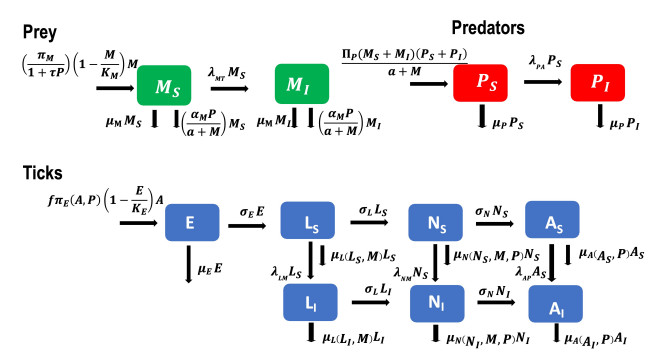
Tick-borne illnesses are transmitted to mammals like rodents and deer by infected ticks. These illnesses have shown dramatic increase in recent times, thereby increasing public health risk in the United States. Additionally, these mammals can be impacted by predation and the fear of their predators. In this study, we modeled the lethal and non-lethal effect of predation of the mammals on the dynamics of tick-borne disease using ehrlichiosis as our model disease system. Results of the theoretical analysis of reduced form of the model indicate that the model equilibria are stable when the tick fecundity and mortality rates are not host dependent. Furthermore, predator-induced fear and predator attack rates are two of the significant parameters of the model outputs from the sensitivity analysis carried out. Numerical simulation of the model shows that the combined impact of both lethal and non-lethal predation sets off a cascading chain reaction leading to a corresponding reduction in the prey and tick populations; in particular there are more infected larvae when infected prey population are low and few infected larvae when there are more infected prey. Similar dynamics was observed for the infected nymphs and adult ticks and infected predator population. Furthermore as the fear of the predator increases, the prey population reduces which subsequently lead to a decrease in the tick populations and subsequently disease in the community.
Citation: Kwadwo Antwi-Fordjour, Folashade B. Agusto, Isabella Kemajou-Brown. Modeling the effects of lethal and non-lethal predation on the dynamics of tick-borne disease[J]. Mathematical Biosciences and Engineering, 2025, 22(6): 1428-1463. doi: 10.3934/mbe.2025054
Tick-borne illnesses are transmitted to mammals like rodents and deer by infected ticks. These illnesses have shown dramatic increase in recent times, thereby increasing public health risk in the United States. Additionally, these mammals can be impacted by predation and the fear of their predators. In this study, we modeled the lethal and non-lethal effect of predation of the mammals on the dynamics of tick-borne disease using ehrlichiosis as our model disease system. Results of the theoretical analysis of reduced form of the model indicate that the model equilibria are stable when the tick fecundity and mortality rates are not host dependent. Furthermore, predator-induced fear and predator attack rates are two of the significant parameters of the model outputs from the sensitivity analysis carried out. Numerical simulation of the model shows that the combined impact of both lethal and non-lethal predation sets off a cascading chain reaction leading to a corresponding reduction in the prey and tick populations; in particular there are more infected larvae when infected prey population are low and few infected larvae when there are more infected prey. Similar dynamics was observed for the infected nymphs and adult ticks and infected predator population. Furthermore as the fear of the predator increases, the prey population reduces which subsequently lead to a decrease in the tick populations and subsequently disease in the community.

| [1] |
J. S. Bakken, The discovery of human granulocytotropic ehrlichiosis, J. Labor. Clin. Med., 132 (1988), 175–180. https://doi.org/10.1016/S0022-2143(98)90165-2V doi: 10.1016/S0022-2143(98)90165-2V

|
| [2] | Centers for Disease Control and Prevention (CDC), Ehrlichiosis, 2022. Available from: https://www.cdc.gov/ehrlichiosis/ |
| [3] |
J. Goddard, A. S. Varela-Stokes, Role of the lone star tick, amblyomma americanum (l.), in human and animal diseases, Vet. Parasitol., 160 (2009), 1–12. https://doi.org/10.1016/j.vetpar.2008.10.089 doi: 10.1016/j.vetpar.2008.10.089
|
| [4] |
L. Eisen, Tick species infesting humans in the united states, Ticks Tick-borne Diseases, 13 (2022), 102025. https://doi.org/10.1016/j.ttbdis.2022.102025 doi: 10.1016/j.ttbdis.2022.102025
|
| [5] | H. A. Merten, L. A. Durden, A state-by-state survey of ticks recorded from humans in the united states, J. Vector Ecol. J. Soc. Vector Ecol., 25 (2000), 102–113. |
| [6] | D. E. Sonenshine, R. M. Roe, Biology of ticks volume 2, Oxford University Press, 2014. |
| [7] |
B. F. Allan, F. Keesing, R. S. Ostfeld, Effect of forest fragmentation on lyme disease risk, Conserv. Biol., 17 (2003), 267–272. https://doi.org/10.1046/j.1523-1739.2003.01260.x doi: 10.1046/j.1523-1739.2003.01260.x
|
| [8] |
J. E. Childs, C. D. Paddock, The ascendancy of amblyomma americanum as a vector of pathogens affecting humans in the united states, Ann. Rev. Entomol., 48 (2003), 307–337. https://doi.org/10.1146/annurev.ento.48.091801.112728 doi: 10.1146/annurev.ento.48.091801.112728
|
| [9] |
R. S. Ostfeld, R. D. Holt, Are predators good for your health? evaluating evidence for top-down regulation of zoonotic disease reservoirs, Front. Ecol. Environ., 2 (2004), 13–20. https://doi.org/10.1890/1540-9295(2004)002[0013:APGFYH]2.0.CO;2 doi: 10.1890/1540-9295(2004)002[0013:APGFYH]2.0.CO;2
|
| [10] |
A. Bourdin, S. Bord, J. Durand, C. Galon, S. Moutailler, M. Scherer-Lorenzen, et al., Forest diversity reduces the prevalence of pathogens transmitted by the tick ixodes ricinus, Front. Ecol. Evolut., 10 (2022), 891908. https://doi.org/10.3389/fevo.2022.891908 doi: 10.3389/fevo.2022.891908
|
| [11] |
L. K. Lindsø, H. Viljugrein, A. Mysterud, Temporal increase in ticks and pathogen prevalence in the small mammal part of the lyme disease cycle in northern europe, Ecosphere, 15 (2024), e70063. https://doi.org/10.1002/ecs2.70063 doi: 10.1002/ecs2.70063
|
| [12] |
K. LoGiudice, R. S. Ostfeld, K. A. Schmidt, F. Keesing, The ecology of infectious disease: Effects of host diversity and community composition on lyme disease risk, Proceed. Nat. Acad. Sci., 100 (2003), 567–571. https://doi.org/10.1073/pnas.0233733100 doi: 10.1073/pnas.0233733100
|
| [13] |
K. D. McCoy, E. Léger, M. Dietrich, Host specialization in ticks and transmission of tick-borne diseases: A review, Front. Cellular Infect. Microbiol., 3 (2013), 57. https://doi.org/10.3389/fcimb.2013.00057 doi: 10.3389/fcimb.2013.00057
|
| [14] |
E. L. Preisser, D. I. Bolnick, M. F. Benard, Scared to death? the effects of intimidation and consumption in predator–prey interactions, Ecology, 86 (2005), 501–509. https://doi.org/10.1890/04-0719 doi: 10.1890/04-0719
|
| [15] |
A. Fritzsche, B. F. Allan, The ecology of fear: Host foraging behavior varies with the spatio-temporal abundance of a dominant ectoparasite, EcoHealth, 9 (2012), 70–74. https://doi.org/10.1007/s10393-012-0744-z doi: 10.1007/s10393-012-0744-z
|
| [16] |
D. W. Thieltges, P. T. Johnson, A. van Leeuwen, J. Koprivnikar, Effects of predation risk on parasite–host interactions and wildlife diseases, Ecology, 105 (2024), e4315. https://doi.org/10.1002/ecy.4315 doi: 10.1002/ecy.4315
|
| [17] |
S. A. Adamo, R. H. Easy, I. Kovalko, J. MacDonald, A. McKeen, T. Swanburg, et al., Predator exposure-induced immunosuppression: Trade-off, immune redistribution or immune reconfiguration?, J. Exper. Biol., 220 (2017), 868–875. https://doi.org/10.1242/jeb.153320 doi: 10.1242/jeb.153320
|
| [18] |
T. R. Hofmeester, P. A. Jansen, H. J. Wijnen, E. C. Coipan, M. Fonville, H. H. Prins, et al., Cascading effects of predator activity on tick-borne disease risk, Proceed. Royal Soc. B Biol. Sci., 284 (2017), 20170453. https://doi.org/10.1098/rspb.2017.0453 doi: 10.1098/rspb.2017.0453
|
| [19] |
T. Levi, A. M. Kilpatrick, M. Mangel, C. C. Wilmers, Deer, predators, and the emergence of lyme disease, Proceed. Nat. Acad. Sci., 109 (2012), 10942–10947. https://doi.org/10.1073/pnas.1204536109 doi: 10.1073/pnas.1204536109
|
| [20] |
X. Wang, L. Zanette, X. Zou, Modelling the fear effect in predator–prey interactions, J. Math. Biol., 73 (2016), 1179–1204. https://doi.org/10.1007/s00285-016-0989-1 doi: 10.1007/s00285-016-0989-1
|
| [21] |
M. Hossain, N. Pal, S. Samanta, Impact of fear on an eco-epidemiological model, Chaos Solit. Fract., 134 (2020), 109718. https://doi.org/10.1016/j.chaos.2020.109718 doi: 10.1016/j.chaos.2020.109718
|
| [22] |
C. Zhang, The effect of the fear factor on the dynamics of an eco-epidemiological system with standard incidence rate, Infect. Disease Model., 9 (2024), 128–141. https://doi.org/10.1016/j.idm.2023.12.002 doi: 10.1016/j.idm.2023.12.002
|
| [23] |
A. K. Pribadi, S. H. Chalasani, Fear conditioning in invertebrates, Front. Behav. Neurosci., 16 (2022), 1008818. https://doi.org/10.3389/fnbeh.2022.1008818 doi: 10.3389/fnbeh.2022.1008818
|
| [24] | F. Alexander, F. B. Agusto, Effects of rising temperature and prescribed fire on Amblyomma Americanum with ehrlichiosis, in Mathematical and Computational Modeling of Phenomena Arising in Population Biology and Nonlinear Oscillations(Ed. Abba Gumel), American Mathematical Society, 2023. |
| [25] |
A. Ludwig, H. S. Ginsberg, G. J. Hickling, N. H. Ogden, A dynamic population model to investigate effects of climate and climate-independent factors on the lifecycle of amblyomma americanum (acari: Ixodidae), J. Med. Entomol., 53 (2016), 99–115. https://doi.org/10.1093/jme/tjv150 doi: 10.1093/jme/tjv150
|
| [26] |
D. Wallace, V. Ratti, A. Kodali, J. M. Winter, M. P. Ayres, J. W. Chipman, et al., Effect of rising temperature on lyme disease: Ixodes scapularis population dynamics and borrelia burgdorferi transmission and prevalence, Canadian J. Infect. Diseases Med. Microbiol., 2019 (2019), 9817930. https://doi.org/10.1155/2019/9817930 doi: 10.1155/2019/9817930
|
| [27] |
R. Rosà, A. Pugliese, Effects of tick population dynamics and host densities on the persistence of tick-borne infections, Math. Biosci., 208 (2007), 216–240. https://doi.org/10.1016/j.mbs.2006.10.002 doi: 10.1016/j.mbs.2006.10.002
|
| [28] |
X. Zhang, B. Sun, Y. Lou, Dynamics of a periodic tick-borne disease model with co-feeding and multiple patches, J. Math. Biol., 82 (2021), 27. https://doi.org/10.1007/s00285-021-01582-6 doi: 10.1007/s00285-021-01582-6
|
| [29] |
E. Guo, F. B. Agusto, Baptism of fire: Modeling the effects of prescribed fire on lyme disease, Canadian J. Infect. Diseases Med. Microbiol., 2022 (2022), 5300887. https://doi.org/10.1155/2022/5300887 doi: 10.1155/2022/5300887
|
| [30] |
P. Van den Driessche, J. Watmough, Reproduction numbers and sub-threshold endemic equilibria for compartmental models of disease transmission, Math. Biosci., 180 (2002), 29–48. https://doi.org/10.1016/S0025-5564(02)00108-6 doi: 10.1016/S0025-5564(02)00108-6
|
| [31] | R. M. Anderson, R. M. May, Infectious diseases of humans: dynamics and control, Oxford university press, 1991. https://doi.org/10.1093/oso/9780198545996.001.0001 |
| [32] |
O. Diekmann, J. A. P. Heesterbeek, J. A. J. Metz, On the definition and the computation of the basic reproduction ratio r 0 in models for infectious diseases in heterogeneous populations, J. Math. Biol., 28 (1990), 365–382. https://doi.org/10.1007/BF00178324 doi: 10.1007/BF00178324
|
| [33] |
H. W. Hethcote, The mathematics of infectious diseases, SIAM Rev., 42 (2000), 599–653. https://doi.org/10.1137/S0036144500371907 doi: 10.1137/S0036144500371907
|
| [34] |
S. Chen, F. Chen, V. Srivastava, R. D. Parshad, Dynamical analysis of an allelopathic phytoplankton model with fear effect, Qualit. Theory Dynam. Syst., 23 (2024), 189. https://doi.org/10.1007/s12346-024-01047-3 doi: 10.1007/s12346-024-01047-3
|
| [35] |
H. Zhang, Y. Cai, S. Fu, W. Wang, Impact of the fear effect in a prey-predator model incorporating a prey refuge, Appl. Math. Comput., 356 (2019), 328–337. https://doi.org/10.1016/j.cam.2019.01.034 doi: 10.1016/j.cam.2019.01.034
|
| [36] |
K. Antwi-Fordjour, S. P. Westmoreland, K. H. Bearden, Dual fear phenomenon in an eco-epidemiological model with prey aggregation, European Phys. J. Plus, 139 (2024), 518. https://doi.org/10.1140/epjp/s13360-024-05324-7 doi: 10.1140/epjp/s13360-024-05324-7
|
| [37] |
S. Pal, N. Pal, S. Samanta, J. Chattopadhyay, Effect of hunting cooperation and fear in a predator-prey model, Ecol. Complex., 39 (2019), 100770. https://doi.org/10.1016/j.ecocom.2019.100770 doi: 10.1016/j.ecocom.2019.100770
|
| [38] |
V. Srivastava, K. Antwi-Fordjour, R. D. Parshad, Exploring unique dynamics in a predator–prey model with generalist predator and group defense in prey, Chaos, 34 (2024). https://doi.org/10.1063/5.0171950 doi: 10.1063/5.0171950
|
| [39] |
S. K. Sasmal, Y. Takeuchi, Dynamics of a predator-prey system with fear and group defense, J. Math. Anal. Appl., 481 (2020), 123471. https://doi.org/10.1016/j.jmaa.2019.123471 doi: 10.1016/j.jmaa.2019.123471
|
| [40] | Centers for Disease Control and Prevention (CDC), How ticks spread disease, Accessed August 7 2023. Available from: https://www.cdc.gov/ticks/life_cycle_and_hosts.html |
| [41] |
S. M. Blower, H. Dowlatabadi, Sensitivity and uncertainty analysis of complex models of disease transmission: An HIV model, as an example, Int. Stat. Rev., (1994), 229–243. https://doi.org/10.2307/1403510 doi: 10.2307/1403510
|
| [42] |
S. Marino, I. B. Hogue, C. J. Ray, D. E. Kirschner, A methodology for performing global uncertainty and sensitivity analysis in systems biology, J. Theor. Biol., 254 (2008), 178–196. https://doi.org/10.1016/j.jtbi.2008.04.011 doi: 10.1016/j.jtbi.2008.04.011
|
| [43] |
M. D. McKay, R. J. Beckman, W. J. Conover, A comparison of three methods for selecting values of input variables in the analysis of output from a computer code, Technometrics, 42 (2000), 55–61. https://doi.org/10.1080/00401706.2000.10485979 doi: 10.1080/00401706.2000.10485979
|
| [44] |
M. A. Sanchez, S. M. Blower, Uncertainty and sensitivity analysis of the basic reproductive rate: Tuberculosis as an example, Am. J. Epidemiol., 145 (1997), 1127–1137. https://doi.org/10.1093/oxfordjournals.aje.a009076 doi: 10.1093/oxfordjournals.aje.a009076
|
| [45] |
D. Mukherjee, Study of fear mechanism in predator-prey system in the presence of competitor for the prey, Ecol. Genet. Genom., 15 (2020), 100052. https://doi.org/10.1016/j.egg.2020.100052 doi: 10.1016/j.egg.2020.100052
|
| [46] |
K. B. Altendorf, J. W. Laundré, C. A. López González, J. S. Brown, Assessing effects of predation risk on foraging behavior of mule deer, J. Mammal., 82 (2001), 430–439. https://doi.org/10.1644/1545-1542(2001)082<0430:AEOPRO>2.0.CO;2 doi: 10.1644/1545-1542(2001)082<0430:AEOPRO>2.0.CO;2
|
| [47] |
K. Sarkar, S. Khajanchi, Spatiotemporal dynamics of a predator-prey system with fear effect, J. Franklin Institute, 360 (2023), 7380–7414. https://doi.org/10.1016/j.jfranklin.2023.05.034 doi: 10.1016/j.jfranklin.2023.05.034
|
| [48] |
A. Hall, M. Kingsford, Predators exacerbate competitive interactions and dominance hierarchies between two coral reef fishes, PLoS One, 11 (2016), e0151778. https://doi.org/10.1371/journal.pone.0151778 doi: 10.1371/journal.pone.0151778
|
| [49] |
P. Panday, N. Pal, S. Samanta, P. Tryjanowski, J. Chattopadhyay, Dynamics of a stage-structured predator-prey model: Cost and benefit of fear-induced group defense, J. Theor. Biol., 528 (2021), 110846. https://doi.org/10.1016/j.jtbi.2021.110846 doi: 10.1016/j.jtbi.2021.110846
|
| [50] |
S. L. Hermann, D. A. Landis, Scaling up our understanding of non-consumptive effects in insect systems, Current Opinion Insect Sci., 20 (2017), 54–60. https://doi.org/10.1016/j.cois.2017.03.010 doi: 10.1016/j.cois.2017.03.010
|
| [51] |
R. D. Parshad, S. Wickramasooriya, K. Antwi-Fordjour, A. Banerjee, Additional food causes predators to explode—unless the predators compete, Int. J. Bifurc. Chaos, 33 (2023), 2350034. https://doi.org/10.1142/S0218127423500347 doi: 10.1142/S0218127423500347
|


Figures(11) / Tables(3)

Kwadwo Antwi-Fordjour, Folashade B. Agusto, Isabella Kemajou-Brown. Modeling the effects of lethal and non-lethal predation on the dynamics of tick-borne disease[J]. Mathematical Biosciences and Engineering, 2025, 22(6): 1428-1463. doi: 10.3934/mbe.2025054





 DownLoad: