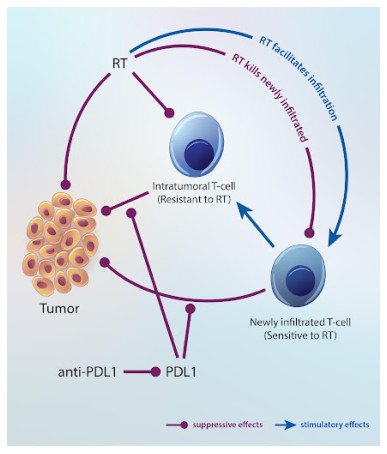
The synergy between radiotherapy and immunotherapy plays a pivotal role in enhancing tumor control and treatment outcomes. To explore the underlying mechanisms of synergy, we investigated a novel treatment approach known as personalized ultra-fractionated stereotactic adaptive radiation (PULSAR) therapy, which emphasizes the impact of radiation timing. Unlike conventional daily treatments, PULSAR delivers high-dose radiation in spaced intervals over weeks or months, enabling tumors to adapt and potentially enhancing synergy with immunotherapy. Drawing on insights from small-animal radiation studies, we developed a discrete-time model based on multiple difference equations to elucidate the temporal dynamics of tumor control driven by both radiation and the adaptive immune response. By accounting for the migration and infiltration of T cells within the tumor microenvironment, we established a quantitative link between radiation therapy and immunotherapy. Model parameters were estimated using a simulated annealing algorithm applied to training data, and our model achieved high accuracy for the test data with a root mean square error of 287 mm3. Notably, our framework replicated the PULSAR effect observed in animal studies, revealing that longer intervals between radiation treatments in the context of immunotherapy yielded enhanced tumor control. Specifically, mice receiving immunotherapy alongside radiation pulses delivered at extended intervals, ten days, showed markedly improved tumor responses, whereas those treated with shorter intervals did not achieve comparable benefits. Moreover, our model offers an in-silico tool for designing future personalized ultra-fractionated stereotactic adaptive radiation trials. Overall, these findings underscore the critical importance of treatment timing in harnessing the synergy between radiotherapy and immunotherapy and highlight the potential of our model to optimize and individualize treatment protocols.
Citation: Yixun Xing, Casey Moore, Debabrata Saha, Dan Nguyen, MaryLena Bleile, Xun Jia, Robert Timmerman, Hao Peng, Steve Jiang. Mathematical modeling of the synergetic effect between radiotherapy and immunotherapy[J]. Mathematical Biosciences and Engineering, 2025, 22(5): 1206-1225. doi: 10.3934/mbe.2025044
The synergy between radiotherapy and immunotherapy plays a pivotal role in enhancing tumor control and treatment outcomes. To explore the underlying mechanisms of synergy, we investigated a novel treatment approach known as personalized ultra-fractionated stereotactic adaptive radiation (PULSAR) therapy, which emphasizes the impact of radiation timing. Unlike conventional daily treatments, PULSAR delivers high-dose radiation in spaced intervals over weeks or months, enabling tumors to adapt and potentially enhancing synergy with immunotherapy. Drawing on insights from small-animal radiation studies, we developed a discrete-time model based on multiple difference equations to elucidate the temporal dynamics of tumor control driven by both radiation and the adaptive immune response. By accounting for the migration and infiltration of T cells within the tumor microenvironment, we established a quantitative link between radiation therapy and immunotherapy. Model parameters were estimated using a simulated annealing algorithm applied to training data, and our model achieved high accuracy for the test data with a root mean square error of 287 mm3. Notably, our framework replicated the PULSAR effect observed in animal studies, revealing that longer intervals between radiation treatments in the context of immunotherapy yielded enhanced tumor control. Specifically, mice receiving immunotherapy alongside radiation pulses delivered at extended intervals, ten days, showed markedly improved tumor responses, whereas those treated with shorter intervals did not achieve comparable benefits. Moreover, our model offers an in-silico tool for designing future personalized ultra-fractionated stereotactic adaptive radiation trials. Overall, these findings underscore the critical importance of treatment timing in harnessing the synergy between radiotherapy and immunotherapy and highlight the potential of our model to optimize and individualize treatment protocols.

| [1] |
F. Agustoni, F. R. Hirsch, PACIFIC trial: New perspectives for immunotherapy in lung cancer, Transl. Lung Cancer Res., 7 (2018), S19–S24. https://doi.org/10.21037/tlcr.2017.12.12 doi: 10.21037/tlcr.2017.12.12

|
| [2] |
A. Bulbul, E. Araujo-Mino, Reasoning the effect of immunotherapy after chemoradiation in the PACIFIC trial, Future Oncol., 15 (2019), 81–94. https://doi.org/10.2217/fon-2018-0464 doi: 10.2217/fon-2018-0464
|
| [3] |
W. G. Breen, K. Leventakos, H. Dong, K. W. Merrell, Radiation and immunotherapy: Emerging mechanisms of synergy, J. Thorac. Dis., 12 (2020), 7011–7023. https://doi.org/10.21037/jtd-2019-cptn-07 doi: 10.21037/jtd-2019-cptn-07
|
| [4] |
C. Moore, C. C. Hsu, W. M. Chen, B. P. C. Chen, C. Han, M. Story, et al., Personalized Ultrafractionated Stereotactic Adaptive Radiotherapy (PULSAR) in preclinical models enhances single-agent immune checkpoint blockade, Int. J. Radiat. Oncol. Biol. Phys., 110 (2021), 1306–1316. https://doi.org/10.1016/j.ijrobp.2021.03.047 doi: 10.1016/j.ijrobp.2021.03.047
|
| [5] |
A. Arina, M. Beckett, C. Fernandez, W. Zheng, S. Pitroda, S. J. Chmura, et al., Tumor-reprogrammed resident T cells resist radiation to control tumors, Nat. Commun., 10 (2019), 3959. https://doi.org/10.1038/s41467-019-11906-2 doi: 10.1038/s41467-019-11906-2
|
| [6] |
R. Serre, S. Benzekry, L. Padovani, C. Meille, N. André, J. Ciccolini, et al., Mathematical modeling of cancer immunotherapy and its synergy with radiotherapy, Cancer Res., 76 (2016), 4931–4940. https://doi.org/10.1158/0008-5472.CAN-15-3567 doi: 10.1158/0008-5472.CAN-15-3567
|
| [7] |
A. Chakwizira, J. Ahlstedt, H. N. Redebrandt, C. Ceberg, Mathematical modelling of the synergistic combination of radiotherapy and indoleamine-2, 3-dioxygenase (IDO) inhibitory immunotherapy against glioblastoma, Br. J. Radiol., 91 (2018), 20170857. https://doi.org/10.1259/bjr.20170857 doi: 10.1259/bjr.20170857
|
| [8] |
Y. B. Cho, N. Yoon, J. H. Suh, J. G. Scott, Radio-immune response modelling for spatially fractionated radiotherapy, Phys. Med. Biol., 68 (2023), 165010. https://doi.org/10.1088/1361-6560/ace819 doi: 10.1088/1361-6560/ace819
|
| [9] |
P. Castorina, F. Castiglione, G. Ferini, S. Forte, E. Martorana, D. Giuffrida, Mathematical modeling of the synergistic interplay of radiotherapy and immunotherapy in anti-cancer treatments, Front. Immunol., 15 (2024), 1–10. https://doi.org/10.3389/fimmu.2024.1373738 doi: 10.3389/fimmu.2024.1373738
|
| [10] |
O. Nave, A mathematical model for treatment using chemo-immunotherapy, Heliyon, 8 (2022), e09288. https://doi.org/10.1016/j.heliyon.2022.e09288 doi: 10.1016/j.heliyon.2022.e09288
|
| [11] |
C. Geng, H. Paganetti, C. Grassberger, Prediction of treatment response for combined chemo- and radiation therapy for non-small cell lung cancer patients using a bio-mathematical model, Sci. Rep., 7 (2017), 13542. https://doi.org/10.1038/s41598-017-13646-z doi: 10.1038/s41598-017-13646-z
|
| [12] |
J. C. L. Alfonso, J. Poleszczuk, R. Walker, S. Kim, S. Pilon-Thomas, J. J. Conejo-Garcia, et al., Immunologic consequences of sequencing cancer radiotherapy and surgery, JCO Clin. Cancer Inf., 3 (2019), 1–16. https://doi.org/10.1200/CCI.18.00075 doi: 10.1200/CCI.18.00075
|
| [13] |
J. C. L. Alfonso, G. D. Grass, E. Welsh, K. A. Ahmed, J. K. Teer, S. Pilon-Thomas, et al., Tumor-immune ecosystem dynamics define an individual radiation immune score to predict pan-cancer radiocurability, Neoplasia, 23 (2021), 1110–1122. https://doi.org/10.1016/j.neo.2021.09.003 doi: 10.1016/j.neo.2021.09.003
|
| [14] |
J. Poleszczuk, H. Enderling, The optimal radiation dose to induce robust systemic anti-tumor immunity, Int. J. Mol. Sci., 19 (2018), 3377. https://doi.org/10.3390/ijms19113377 doi: 10.3390/ijms19113377
|
| [15] |
Y. Kosinsky, S. J. Dovedi, K. Peskov, V. Voronova, L. Chu, H. Tomkinson, et al., Radiation and PD-(L)1 treatment combinations: Immune response and dose optimization via a predictive systems model, J. Immunother. Cancer, 6 (2018), 17. https://doi.org/10.1186/s40425-018-0327-9 doi: 10.1186/s40425-018-0327-9
|
| [16] |
O. Milberg, C. Gong, M. Jafarnejad, I. H. Bartelink, B. Wang, P. Vicini, et al., A QSP model for predicting clinical responses to monotherapy, combination and sequential therapy following CTLA-4, PD-1, and PD-L1 checkpoint blockade, Sci. Rep., 9 (2019), 11286. https://doi.org/10.1038/s41598-019-47802-4 doi: 10.1038/s41598-019-47802-4
|
| [17] |
D. Valentinuzzi, U. Simončič, K. Uršič, M. Vrankar, M. Turk, R. Jeraj, Predicting tumour response to anti-PD-1 immunotherapy with computational modelling, Phys. Med. Biol., 64 (2019), 025017. https://doi.org/10.1088/1361-6560/aaf96c doi: 10.1088/1361-6560/aaf96c
|
| [18] |
W. Sung, C. Grassberger, A. L. McNamara, L. Basler, S. Ehrbar, S. Tanadini-Lang, et al., A tumor-immune interaction model for hepatocellular carcinoma based on measured lymphocyte counts in patients undergoing radiotherapy, Radiother. Oncol., 151 (2020), 73–81. https://doi.org/10.1016/j.radonc.2020.07.025 doi: 10.1016/j.radonc.2020.07.025
|
| [19] |
W. Sung, T. S. Hong, M. C. Poznansky, H. Paganetti, C. Grassberger, Mathematical modeling to simulate the effect of adding radiation therapy to immunotherapy and application to hepatocellular carcinoma, Int. J. Radiat. Oncol. Biol. Phys., 112 (2022), 1055–1062. https://doi.org/10.1016/j.ijrobp.2021.11.008 doi: 10.1016/j.ijrobp.2021.11.008
|
| [20] |
H. Peng, C. Moore, D. Saha, S. Jiang, R. Timmerman, Understanding the PULSAR effect in combined radiotherapy and immunotherapy using transformer-based attention mechanisms, Front. Oncol., 14 (2024), 1–12. https://doi.org/10.3389/fonc.2024.1497351 doi: 10.3389/fonc.2024.1497351
|
| [21] |
S. Rouf, C. Moore, D. Saha, D. Nguyen, M. Bleile, R. Timmerman, et al., PULSAR effect: Revealing potential synergies in combined radiation therapy and immunotherapy via differential equations, J. Theor. Biol., 596 (2025), 111974. https://doi.org/10.1016/j.jtbi.2024.111974 doi: 10.1016/j.jtbi.2024.111974
|
| [22] |
J. L. Schafer, Multiple imputation: A primer, Stat. Methods Med. Res., 8 (1999), 3–15. https://doi.org/10.1177/096228029900800102 doi: 10.1177/096228029900800102
|
| [23] |
D. B. Rubin, The calculation of posterior distributions by data augmentation: Comment: A noniterative sampling/importance resampling alternative to the data augmentation algorithm for creating a few imputations when fractions of missing information are modest: The SIR, J. Am. Stat. Assoc., 82 (1987), 543–546. https://doi.org/10.2307/2289460 doi: 10.2307/2289460
|
| [24] |
S. Kirkpatrick, Optimization by simulated annealing: Quantitative studies, J. Stat. Phys., 34 (1984), 975–986. https://doi.org/10.1007/BF01009452 doi: 10.1007/BF01009452
|


Figures(5) / Tables(2)

Yixun Xing, Casey Moore, Debabrata Saha, Dan Nguyen, MaryLena Bleile, Xun Jia, Robert Timmerman, Hao Peng, Steve Jiang. Mathematical modeling of the synergetic effect between radiotherapy and immunotherapy[J]. Mathematical Biosciences and Engineering, 2025, 22(5): 1206-1225. doi: 10.3934/mbe.2025044





 DownLoad: