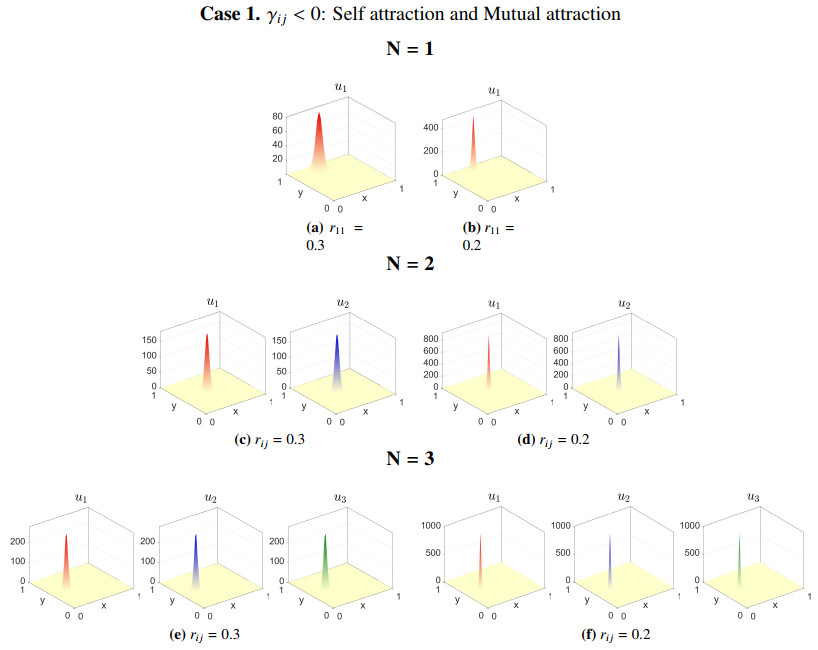
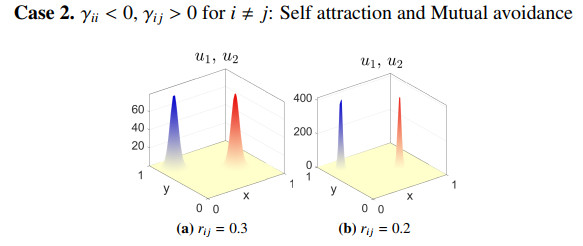
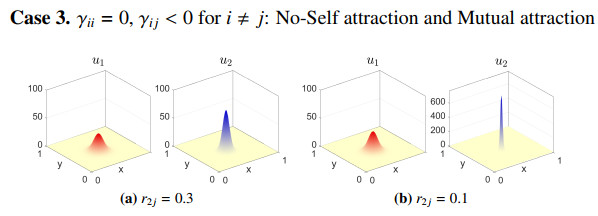
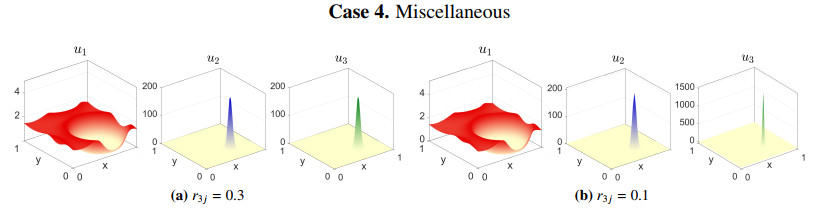
We study a broad class of nonlocal advection-diffusion models describing the behaviour of an arbitrary number of interacting species, each moving in response to the nonlocal presence of others. Our model allows for different nonlocal interaction kernels for each species and arbitrarily many spatial dimensions. We prove the global existence of both non-negative weak solutions in any spatial dimension and positive classical solutions in one spatial dimension. These results generalise and unify various existing results regarding existence of nonlocal advection-diffusion equations. We demonstrate that solutions can blow up in finite time when the detection radius becomes zero, i.e. when the system is local, thus showing that nonlocality is essential for the global existence of solutions. We verify our results with numerical simulations on 2D spatial domains.
Citation: Valeria Giunta, Thomas Hillen, Mark A. Lewis, Jonathan R. Potts. Positivity and global existence for nonlocal advection-diffusion models of interacting populations[J]. AIMS Mathematics, 2025, 10(9): 21254-21272. doi: 10.3934/math.2025949
We study a broad class of nonlocal advection-diffusion models describing the behaviour of an arbitrary number of interacting species, each moving in response to the nonlocal presence of others. Our model allows for different nonlocal interaction kernels for each species and arbitrarily many spatial dimensions. We prove the global existence of both non-negative weak solutions in any spatial dimension and positive classical solutions in one spatial dimension. These results generalise and unify various existing results regarding existence of nonlocal advection-diffusion equations. We demonstrate that solutions can blow up in finite time when the detection radius becomes zero, i.e. when the system is local, thus showing that nonlocality is essential for the global existence of solutions. We verify our results with numerical simulations on 2D spatial domains.

| [1] |
N. Bellomo, A. Bellouquid, Y. Tao, M. Winkler, Toward a mathematical theory of Keller–Segel models of pattern formation in biological tissues, Math. Mod. Meth. Appl. Sci., 25 (2015), 1663–1763. https://doi.org/10.1142/S021820251550044X doi: 10.1142/S021820251550044X

|
| [2] |
B. K. Briscoe, M. A. Lewis, S. E. Parrish, Home range formation in wolves due to scent marking, B. Math. Biol., 64 (2002), 261–284. https://doi.org/10.1006/bulm.2001.0273 doi: 10.1006/bulm.2001.0273
|
| [3] |
M. Burger, M. D. Francesco, S. Fagioli, A. Stevens, Sorting phenomena in a mathematical model for two mutually attracting/repelling species, SIAM J. Math. Anal., 50 (2018), 3210–3250. https://doi.org/10.1137/17M1125716 doi: 10.1137/17M1125716
|
| [4] | A. Buttenschön, T. Hillen, Non-Local Cell Adhesion Models, Springer, 2021. https://doi.org/10.1007/978-3-030-67111-2 |
| [5] | J. Carrillo, Y. Choi, M. Hauray. The derivation of swarming models: Mean filed limit and Wasserstein distances, In Collective Dynamics from Bacteria to Crowds, (2014), 1–46. Springer. https://doi.org/10.1007/978-3-7091-1785-9_1 |
| [6] |
J. Carrillo, R. Galvani, G. Pavliotis, A. Schlichting, Long-time behavior and phase transitions for the McKean-Vlasov equation on a torus, Archives Rational Mechanics and Analysis, 235 (2020), 635–690. https://doi.org/10.1007/s00205-019-01430-4 doi: 10.1007/s00205-019-01430-4
|
| [7] |
J. A. Carrillo, A. Colombi, M. Scianna, Adhesion and volume constraints via nonlocal interactions determine cell organisation and migration profiles, J. Theor. Biol., 445 (2018), 75–91. https://doi.org/10.1016/j.jtbi.2018.02.022 doi: 10.1016/j.jtbi.2018.02.022
|
| [8] |
J. A. Carrillo, R. S. Gvalani, Phase transitions for nonlinear nonlocal aggregation-diffusion equations, Commun. Math. Phys., 382 (2021), 485–545. https://doi.org/10.1007/s00220-021-03977-4 doi: 10.1007/s00220-021-03977-4
|
| [9] |
B. Chazelle, Q. Jiu, Q. Li, C. Wang, Well-posedness of the limiting equation of a noisy consensus model in opinion dynamics, J. Differ. Equations, 263 (2017), 365–397. https://doi.org/10.1016/j.jde.2017.02.036 doi: 10.1016/j.jde.2017.02.036
|
| [10] | D. Gilbarg, N. Trudinger Elliptic Partial Differential Equations of Second Order, Springer, Heidelberg, 1977. https://doi.org/10.1007/978-3-642-96379-7 |
| [11] | R. Eftimie, Hyperbolic and kinetic models for self-organised biological aggregations, Springer, 2018. https://doi.org/10.1007/978-3-030-02586-1 |
| [12] |
R. Eftimie, G. de Vries, M. A. Lewis, Complex spatial group patterns result from different animal communication mechanisms, Proceedings of the National Academy of Sciences, 104 (2007), 6974–6979. https://doi.org/10.1073/pnas.0611483104 doi: 10.1073/pnas.0611483104
|
| [13] | L. C. Evans, Partial differential equations, volume 19, American Mathematical Society, 2022. |
| [14] |
W. F. Fagan, E. Gurarie, S. Bewick, A. Howard, R. S. Cantrell, C. Cosner, Perceptual ranges, information gathering, and foraging success in dynamic landscapes, The American Naturalist, 189 (2017), 474–489. https://doi.org/10.1086/691099 doi: 10.1086/691099
|
| [15] |
R. C. Fetecau, Y. Huang, T. Kolokolnikov, Swarm dynamics and equilibria for a nonlocal aggregation model, Nonlinearity, 24 (2011), 2681. https://doi.org/10.1088/0951-7715/24/10/002 doi: 10.1088/0951-7715/24/10/002
|
| [16] |
S. Genieys, V. Volpert, P. Auger, Pattern and waves for a model in population dynamics with nonlocal consumption of resources, Math. Model. Nat. Pheno., 1 (2006), 63–80. https://doi.org/10.1051/mmnp:2006004 doi: 10.1051/mmnp:2006004
|
| [17] |
V. Giunta, T. Hillen, M. Lewis, J. R. Potts, Local and global existence for nonlocal multispecies advection-diffusion models, SIAM J. Appl. Dyn. Syst., 21 (2022), 1686–1708. https://doi.org/10.1137/21M1425992 doi: 10.1137/21M1425992
|
| [18] |
V. Giunta, T. Hillen, M. A. Lewis, J. R. Potts, Detecting minimum energy states and multi-stability in nonlocal advection–diffusion models for interacting species, J. Math. Biol., 85 (2022), 1–44. https://doi.org/10.1007/s00285-022-01824-1 doi: 10.1007/s00285-022-01824-1
|
| [19] |
V. Giunta, T. Hillen, M. A. Lewis, J. R. Potts, Weakly nonlinear analysis of a two-species non-local advection-diffusion system, Nonlinear Analysis: Real World Applications, 78 (2024), 104086. https://doi.org/10.1016/j.nonrwa.2024.104086 doi: 10.1016/j.nonrwa.2024.104086
|
| [20] |
T. Glimm, J. Zhang, Numerical approach to a nonlocal advection-reaction-diffusion model of cartilage pattern formation, Math. Comput. Appl., 25 (2020), 36. https://doi.org/10.3390/mca25020036 doi: 10.3390/mca25020036
|
| [21] |
T. Hillen, K. Painter, Global existence for a parabolic chemotaxis model with prevention of overcrowding, Adv. Appl. Math., 26 (2001), 280–301. https://doi.org/10.1006/aama.2001.0721 doi: 10.1006/aama.2001.0721
|
| [22] |
T. Hillen, K. Painter, A user's guide to PDE models for chemotaxis, J. Math. Biol., 58 (2009), 183–217. https://doi.org/10.1007/s00285-008-0201-3 doi: 10.1007/s00285-008-0201-3
|
| [23] |
T. Hillen, K. Painter, C. Schmeiser, Global existence for chemotaxis with finite sampling radius, Discr. Cont. Dyn. Syst. B (DCDS-B), 7 (2007), 125–144. https://doi.org/10.3934/dcdsb.2007.7.125 doi: 10.3934/dcdsb.2007.7.125
|
| [24] |
T. Hillen, K. J. Painter, M. Winkler, Global solvability and explicit bounds for non-local adhesion models, Eur. J. Appl. Math., 29 (2018), 645–684. https://doi.org/10.1017/S0956792517000328 doi: 10.1017/S0956792517000328
|
| [25] | D. Horstmann, From 1970 until present: The Keller-Segel model in chemotaxis and its consequences I, Jahresberichte der DMV, 105 (2003), 103–165. |
| [26] |
D. Horstmann, K. J. Painter, H. G. Othmer, Aggregation under local reinforcement: From lattice to continuum, Eur. J. Appl. Math., 15 (2004), 545–576. https://doi.org/10.1017/S0956792504005571 doi: 10.1017/S0956792504005571
|
| [27] |
T. J. Jewell, A. L. Krause, P. K. Maini, E. A. Gaffney, Patterning of nonlocal transport models in biology: the impact of spatial dimension, Math. Biosci., 366 (2023), 109093. https://doi.org/10.1016/j.mbs.2023.109093 doi: 10.1016/j.mbs.2023.109093
|
| [28] |
A. Jüngel, S. Portisch, A. Zurek, Nonlocal cross-diffusion systems for multi-species populations and networks, Nonlinear Analysis, 219 (2022), 112800. https://doi.org/10.1016/j.na.2022.112800 doi: 10.1016/j.na.2022.112800
|
| [29] | M. A. Lewis, S. V. Petrovskii, J. R. Potts, The mathematics behind biological invasions, volume 44, Springer, 2016. https://doi.org/10.1007/978-3-319-32043-4 |
| [30] | G. Lieberman, Second Order Parabolic Differential Equations, World Scientific, London, 1996. https://doi.org/10.1142/3302 |
| [31] |
K. Mokross, J. R. Potts, C. L. Rutt, P. C. Stouffer, What can mixed-species flock movement tell us about the value of amazonian secondary forests? Insights from spatial behavior, Biotropica, 50 (2018), 664–673. https://doi.org/10.1111/btp.12557 doi: 10.1111/btp.12557
|
| [32] |
K. Painter, J. Potts, T. Hillen, Biological modelling with nonlocal advection diffusion equations, Math. Mod. Meth. Appl. Sci. (M3AS), 34 (2024), 57–107. https://doi.org/10.1142/S0218202524400025 doi: 10.1142/S0218202524400025
|
| [33] | B. Perthame, Transport Equations in Biology, Birkhäuser, 2007. https://doi.org/10.1007/978-3-7643-7842-4 |
| [34] | J. R. Potts, V. Giunta, M. A. Lewis, Beyond resource selection: emergent spatio–temporal distributions from animal movements and stigmergent interactions, Oikos, (2022), e09188. https://doi.org/10.1101/2022.02.28.482253 |
| [35] |
J. R. Potts, M. A. Lewis, How memory of direct animal interactions can lead to territorial pattern formation, J. R. Soc. Interface, 13 (2016), 20160059. https://doi.org/10.1098/rsif.2016.0059 doi: 10.1098/rsif.2016.0059
|
| [36] |
J. R. Potts, M. A. Lewis, Territorial pattern formation in the absence of an attractive potential, J. Math. Biol., 72 (2016), 25–46. https://doi.org/10.1007/s00285-015-0881-4 doi: 10.1007/s00285-015-0881-4
|
| [37] |
J. R. Potts, M. A. Lewis, Spatial memory and taxis-driven pattern formation in model ecosystems, B. Math. Biol., 81 (2019), 2725–2747. https://doi.org/10.1007/s11538-019-00626-9 doi: 10.1007/s11538-019-00626-9
|
| [38] | T. Suzuki, Free Energy and Self-Interacting Particles, Birkhaeuser, Basel, 2008. |
| [39] |
D. Tilman, F. Isbell, J. M. Cowles, Biodiversity and ecosystem functioning, Annu. Rev. Ecol. Evol. Syst., 45 (2014), 471–493. https://doi.org/10.1146/annurev-ecolsys-120213-091917 doi: 10.1146/annurev-ecolsys-120213-091917
|
| [40] |
H. Wang, Y. Salmaniw, Open problems in pde models for knowledge-based animal movement via nonlocal perception and cognitive mapping, J. Math. Biol., 86 (2023), 71. https://doi.org/10.1007/s00285-023-01905-9 doi: 10.1007/s00285-023-01905-9
|
Figures(6)

Valeria Giunta, Thomas Hillen, Mark A. Lewis, Jonathan R. Potts. Positivity and global existence for nonlocal advection-diffusion models of interacting populations[J]. AIMS Mathematics, 2025, 10(9): 21254-21272. doi: 10.3934/math.2025949





 DownLoad: