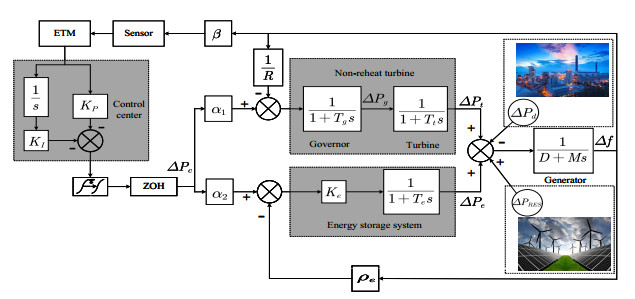
This study focused on the load frequency control problem of power systems by integrating the event-triggered mechanism (ETM) and the improved grey wolf optimization (IGWO) algorithm. First, a nonlinear power system (NPS) model incorporating an energy storage system (ESS) and renewable energy sources (RESs) was constructed. The model considers the nonlinear characteristics of governors and turbines, and the takagi-sugeno (T-S) fuzzy theory is introduced to handle the nonlinear terms in the model. Subsequently, during the sampling process, an ETM is introduced, and the improved grey wolf algorithm is used to find the optimal event-triggered parameters to reduce unnecessary information transmission. Second, based on the Lyapunov functional, the stability criterion of the system under disturbance conditions was derived, a controller was designed, and the control gain was determined by solving linear matrix inequalities (LMIs). Finally, the performance differences between the traditional ETM and the ETM combined with IGWO were compared. The results show that the optimization method can further reduce the bandwidth resource consumption while ensuring system stability and control effectiveness.
Citation: Yan Chen, Xingyue Liu, Fengying Zeng, Kaibo Shi, Fanglu Yang. Load frequency control with an event-triggered mechanism for nonlinear power systems based on the improved grey wolf optimization algorithm[J]. AIMS Mathematics, 2025, 10(8): 18887-18912. doi: 10.3934/math.2025844
This study focused on the load frequency control problem of power systems by integrating the event-triggered mechanism (ETM) and the improved grey wolf optimization (IGWO) algorithm. First, a nonlinear power system (NPS) model incorporating an energy storage system (ESS) and renewable energy sources (RESs) was constructed. The model considers the nonlinear characteristics of governors and turbines, and the takagi-sugeno (T-S) fuzzy theory is introduced to handle the nonlinear terms in the model. Subsequently, during the sampling process, an ETM is introduced, and the improved grey wolf algorithm is used to find the optimal event-triggered parameters to reduce unnecessary information transmission. Second, based on the Lyapunov functional, the stability criterion of the system under disturbance conditions was derived, a controller was designed, and the control gain was determined by solving linear matrix inequalities (LMIs). Finally, the performance differences between the traditional ETM and the ETM combined with IGWO were compared. The results show that the optimization method can further reduce the bandwidth resource consumption while ensuring system stability and control effectiveness.

| [1] |
A. Oshnoei, M. Kheradmandi, S. M. Muyeen, Robust control scheme for distributed battery energy storage systems in load frequency control, IEEE Trans. Power Syst., 35 (2020), 4781–4791. https://doi.org/10.1109/TPWRS.2020.2997950 doi: 10.1109/TPWRS.2020.2997950

|
| [2] |
S. Zhang, Y. Mishra, M. Shahidehpour, Fuzzy-logic based frequency controller for wind farms augmented with energy storage systems, IEEE Trans. Power Syst., 31 (2016), 1595–1603. https://doi.org/10.1109/TPWRS.2015.2432113 doi: 10.1109/TPWRS.2015.2432113
|
| [3] |
C. T. Pan, C. M. Liaw, An adaptive controller for power system load-frequency control, IEEE Trans. Power Syst., 4 (1989), 122–128. https://doi.org/10.1109/59.32469 doi: 10.1109/59.32469
|
| [4] |
Z. Cheng, S. Hu, D. Yue, C. Dou, S. Shen, Resilient distributed coordination control of multiarea power systems under hybrid attacks, IEEE Trans. Syst. Man Cybernet. Syst., 52 (2022), 7–18. https://doi.org/10.1109/TSMC.2021.3049373 doi: 10.1109/TSMC.2021.3049373
|
| [5] |
X. C. Shangguan, C. K. Zhang, Y. He, L. Jin, L. Jiang, J. W. Spencer, et al., Robust load frequency control for power system considering transmission delay and sampling period, IEEE Trans. Ind. Inform., 17 (2021), 5292–5303. https://doi.org/10.1109/TII.2020.3026336 doi: 10.1109/TII.2020.3026336
|
| [6] |
K. Liao, Y. Xu, A robust load frequency control scheme for power systems based on second-order sliding mode and extended disturbance observer, IEEE Trans. Ind. Inform., 14 (2017), 3076–3086. https://doi.org/10.1109/TII.2017.2771487 doi: 10.1109/TII.2017.2771487
|
| [7] |
X. C. Shangguan, Y. He, C. K. Zhang, L. Jiang, M. Wu, Adjustable event-triggered load frequency control of power systems using control-performance-standard-based fuzzy logic, IEEE Trans. Fuzzy Syst., 30 (2022), 3297–3311. https://doi.org/10.1109/TFUZZ.2021.3112232 doi: 10.1109/TFUZZ.2021.3112232
|
| [8] |
X. Chen, S. Hu, Y. Li, D. Yue, C. Dou, L. Ding, Co-estimation of state and FDI attacks and attack compensation control for multi-area load frequency control systems under FDI and DoS attacks, IEEE Trans. Smart Grid, 13 (2022), 2357–2368. https://doi.org/10.1109/TSG.2022.3147693 doi: 10.1109/TSG.2022.3147693
|
| [9] |
W. Huimin, Z. S. Li, Multi-area load frequency control in power system integrated with wind farms using fuzzy generalized predictive control method, IEEE Trans. Reliability, 72 (2022), 737–747. https://doi.org/10.1109/TR.2022.3177045 doi: 10.1109/TR.2022.3177045
|
| [10] |
C. Peng, J. Li, M. Fei, Resilient event-triggering $H_{\infty}$ load frequency control for multi-area power systems with energy-limited DoS attacks, IEEE Trans. Power Syst., 32 (2017), 4110–4118. https://doi.org/10.1109/TPWRS.2016.2634122 doi: 10.1109/TPWRS.2016.2634122
|
| [11] |
Q. Zhong, J. Yang, K. Shi, S. Zhong, Z. Li, M. A. Sotelo, Event-triggered ${H}_{\infty}$ load frequency control for multi-area nonlinear power systems based on non-fragile proportional integral control strategy, IEEE Trans. Intell. Transp. Syst., 23 (2022), 12191–12201. https://doi.org/10.1109/TITS.2021.3110759 doi: 10.1109/TITS.2021.3110759
|
| [12] |
X. Li, D. Ye, Event-based distributed fuzzy load frequency control for multiarea nonlinear power systems with switching topology, IEEE Trans. Fuzzy Syst., 30 (2022), 4262–4272. https://doi.org/10.1109/TFUZZ.2022.3146981 doi: 10.1109/TFUZZ.2022.3146981
|
| [13] |
Z. Wang, J. Wang, M. La Scala, A novel distributed-decentralized fixed-time optimal frequency and excitation control framework in a nonlinear network-preserving power system, IEEE Trans. Power Syst., 36 (2021), 1285–1297. https://doi.org/10.1109/TPWRS.2020.3011156 doi: 10.1109/TPWRS.2020.3011156
|
| [14] |
Z. Hu, S. Liu, W. Luo, L. Wu, Resilient distributed fuzzy load frequency regulation for power systems under cross-layer random denial-of-service attacks, IEEE Trans. Cybernet., 52 (2022), 2396–2406. https://doi.org/10.1109/TCYB.2020.3005283 doi: 10.1109/TCYB.2020.3005283
|
| [15] |
K. Tanaka, M. Sugeno, Stability analysis and design of fuzzy control systems, Fuzzy Sets Syst., 45 (1992), 135–156. https://doi.org/10.1016/0165-0114(92)90113-I doi: 10.1016/0165-0114(92)90113-I
|
| [16] |
S. Sui, C. L. P. Chen, S. Tong, Command filter-based predefined time adaptive control for nonlinear systems, IEEE Trans. Automat. Control, 69 (2024), 7863–7870. https://doi.org/10.1109/TAC.2024.3399998 doi: 10.1109/TAC.2024.3399998
|
| [17] |
S. Tong, S. Sui, Y. Li, Fuzzy adaptive output feedback control of MIMO nonlinear systems with partial tracking errors constrained, IEEE Trans. Fuzzy Syst., 23 (2015), 729–742. https://doi.org/10.1109/TFUZZ.2014.2327987 doi: 10.1109/TFUZZ.2014.2327987
|
| [18] |
Z. J. Wang, F. Liu, J. Z. F. Pang, S. H. Low, S. W. Mei, Distributed optimal frequency control considering a nonlinear network-preserving model, IEEE Trans. Power Syst., 34 (2019), 76–86. https://doi.org/10.1109/TPWRS.2018.2861941 doi: 10.1109/TPWRS.2018.2861941
|
| [19] |
Y. Dong, Y. Song, G. Wei, Efficient model-predictive control for nonlinear systems in interval type-2 T-S fuzzy form under round-robin protocol, IEEE Trans. Fuzzy Syst., 30 (2022), 63–74. https://doi.org/10.1109/TFUZZ.2020.3031394 doi: 10.1109/TFUZZ.2020.3031394
|
| [20] |
M. C. Valentino, F. A. Faria, V. A. Oliveira, L. F. C. Alberto, Ultimate boundedness sufficient conditions for nonlinear systems using T-S fuzzy modelling, Fuzzy Sets Syst., 361 (2019), 88–100. https://doi.org/10.1016/j.fss.2018.03.010 doi: 10.1016/j.fss.2018.03.010
|
| [21] |
Y. Li, K. Yu, Adaptive fuzzy decentralized sampled-data control for large-scale nonlinear systems, IEEE Trans. Fuzzy Syst., 30 (2022), 1809–1822. https://doi.org/10.1109/TFUZZ.2021.3069321 doi: 10.1109/TFUZZ.2021.3069321
|
| [22] |
A. Seuret, A novel stability analysis of linear systems under asynchronous samplings, Automatica, 48 (2012), 177–182. https://doi.org/10.1016/j.automatica.2011.09.033 doi: 10.1016/j.automatica.2011.09.033
|
| [23] |
L. Dong, Y. Tang, H. He, C. Sun, An event-triggered approach for load frequency control with supplementary ADP, IEEE Trans. Power Syst., 32 (2017), 581–589. https://doi.org/10.1109/TPWRS.2016.2537984 doi: 10.1109/TPWRS.2016.2537984
|
| [24] |
X. C. Shangguan, S. Shi, Y. He, C. K. Zhang, Optimal digital load frequency control of smart grid considering sampling and time delay based on warm-up gray wolf algorithm, IEEE Trans. Ind. Inform., 21 (2025), 1773–1782. https://doi.org/10.1109/TII.2024.3485821 doi: 10.1109/TII.2024.3485821
|
| [25] |
X. Sun, C. Hu, G. Lei, Y. Guo, J. Zhu, State feedback control for a PM hub motor based on grey wolf optimization algorithm, IEEE Trans. Power Electron., 35 (2020), 1136–1146. https://doi.org/10.1109/TPEL.2019.2923726 doi: 10.1109/TPEL.2019.2923726
|
| [26] |
Y. He, Q. G. Wang, C. Lin, M. Wu, Augmented Lyapunov functional and delay-dependent stability criteria for neutral systems, Int. J. Robust Nonlinear Control, 15 (2005), 923–933. https://doi.org/10.1002/rnc.1039 doi: 10.1002/rnc.1039
|
| [27] |
J. Chen, J. H. Park, S. Xu, B. Zhang, A survey of inequality techniques for stability analysis of time-delay systems, Int. J. Robust Nonlinear Control, 32 (2022), 6412–6440. https://doi.org/10.1002/rnc.6151 doi: 10.1002/rnc.6151
|
| [28] |
J. H. Kim, Further improvement of Jensen inequality and application to stability of time-delayed systems, Automatica, 64 (2016), 121–125. https://doi.org/10.1016/j.automatica.2015.08.025 doi: 10.1016/j.automatica.2015.08.025
|
| [29] |
A. Seuret, F. Gouaisbaut, Wirtinger-based integral inequality: Application to time-delay systems, Automatica, 49 (2013), 2860–2866. https://doi.org/10.1016/j.automatica.2013.05.030 doi: 10.1016/j.automatica.2013.05.030
|
| [30] |
Z. Cheng, S. Hu, D. Yue, C. Dou, S. Shen, Resilient distributed coordination control of multiarea power systems under hybrid attacks, IEEE Trans. Syst. Man Cybern. Syst., 52 (2021), 7–18. https://doi.org/10.1109/TSMC.2021.3049373 doi: 10.1109/TSMC.2021.3049373
|
| [31] |
L. Jin, Y. He, C. Ke. Zhang, X. C. Shangguan, L. Jiang, M. Wu, Robust delay-dependent load frequency control of wind power system based on a novel reconstructed model, IEEE Trans. Cybernet., 52 (2022), 7825–7836. https://doi.org/10.1109/TCYB.2021.3051160 doi: 10.1109/TCYB.2021.3051160
|
| [32] |
H. B. Zeng, S. J. Zhou, X. M. Zhang, W. Wang, Delay-dependent stability analysis of load frequency control systems with electric vehicles, IEEE Trans. Cybernet., 52 (2022), 13645–13653. https://doi.org/10.1109/TCYB.2022.3140463 doi: 10.1109/TCYB.2022.3140463
|
| [33] |
C. Peng, J. Zhang, H. Yan, Adaptive event-triggering ${H}_{\infty}$ load frequency control for network-based power systems, IEEE Trans. Ind. Electron., 65 (2018), 1685–1694. https://doi.org/10.1109/TIE.2017.2726965 doi: 10.1109/TIE.2017.2726965
|
| [34] |
J. Yang, Q. Zhong, K. Shi, Y. Yu, S. Zhong, Stability and stabilization for T-S fuzzy load frequency control power system with energy storage system, IEEE Trans. Fuzzy Syst., 32 (2023), 893–905. https://doi.org/10.1109/TFUZZ.2023.3311925 doi: 10.1109/TFUZZ.2023.3311925
|
| [35] |
P. G. Park, J. W. Ko, C. Jeong, Reciprocally convex approach to stability of systems with time-varying delays, Automatica, 47 (2011), 235–238. https://doi.org/10.1016/j.automatica.2010.10.014 doi: 10.1016/j.automatica.2010.10.014
|
| [36] |
H. B. Zeng, Y. He, M. Wu, J. She, Free-matrix-based integral inequality for stability analysis of systems with time-varying delay, IEEE Trans. Automat. Control, 60 (2015), 2768–2772. https://doi.org/10.1109/TAC.2015.2404271 doi: 10.1109/TAC.2015.2404271
|
| [37] |
T. H. Lee, J. H. Park, A novel Lyapunov functional for stability of time-varying delay systems via matrix-refined-function, Automatica, 80 (2017), 239–242. https://doi.org/10.1016/j.automatica.2017.02.004 doi: 10.1016/j.automatica.2017.02.004
|
| [38] |
E. Tian, C. Peng, Memory-based event-triggering ${H}_{\infty}$ load frequency control for power systems under deception attacks, IEEE Trans. Cybernet., 50 (2020), 4610–4618. https://doi.org/10.1109/TCYB.2020.2972384 doi: 10.1109/TCYB.2020.2972384
|
| [39] |
D. Xiong, C. K. Zhang, L. Jin, Y. L. Fan, Y. He, Stability and stabilization of T-S fuzzy systems with sampled-data controller: A fuzzy-related matrix injection method, IEEE Trans. Fuzzy Syst., 33 (2025), 2549–2560. https://doi.org/10.1109/TFUZZ.2025.3568518 doi: 10.1109/TFUZZ.2025.3568518
|
| [40] |
G. Velmurugan, Y. H. Joo, Sampled-data control design for T-S fuzzy system via quadratic function negative-determination approach, IEEE Trans. Fuzzy Syst., 32 (2024), 979–988. https://doi.org/10.1109/TFUZZ.2023.3316351 doi: 10.1109/TFUZZ.2023.3316351
|
| [41] |
L. Shanmugam, Y. H. Joo, Stability and stabilization for T-S fuzzy large-scale interconnected power system with wind farm via sampled-data control, IEEE Trans. Syst. Man Cybern. Syst., 51 (2021), 2134–2144. https://doi.org/10.1109/TSMC.2020.2965577 doi: 10.1109/TSMC.2020.2965577
|
| [42] |
F. Yang, S. Guan, D. Wang, Quadratically convex combination approach to stability of T-S fuzzy systems with time-varying delay, J. Franklin Inst., 351 (2014), 3752–3765. https://doi.org/10.1016/j.jfranklin.2013.01.025 doi: 10.1016/j.jfranklin.2013.01.025
|
| [43] |
H. Zhang, J. Yang, C. Su, T-S fuzzy-model-based robust ${H}_{\infty}$ design for networked control systems with uncertainties, IEEE Trans. Ind. Informat., 3 (2007), 289–301. https://doi.org/10.1109/TII.2007.911895 doi: 10.1109/TII.2007.911895
|


Figures(8) / Tables(5)

Yan Chen, Xingyue Liu, Fengying Zeng, Kaibo Shi, Fanglu Yang. Load frequency control with an event-triggered mechanism for nonlinear power systems based on the improved grey wolf optimization algorithm[J]. AIMS Mathematics, 2025, 10(8): 18887-18912. doi: 10.3934/math.2025844





 DownLoad: