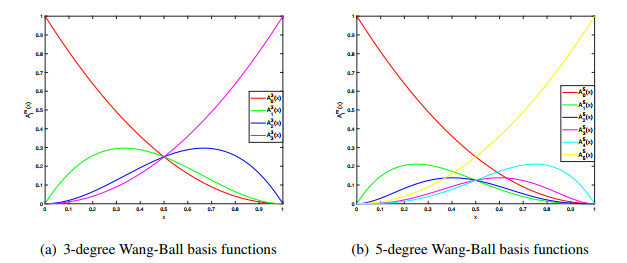
In electrostatic field research, the Poisson equation is the core equation describing the relationship between electric potential and charge distribution. The finite element method (FEM) is an analytical engineering tool for accurately calculating various physical quantities in the electrostatic field. In this paper, we employ the Wang-Ball basis functions to construct the trial and test function spaces of FEM for solving the Poisson equation. In addition, we provide an error analysis based on the Wang-Ball operator. Several examples with different electrostatics backgrounds are also given to substantiate the effectiveness of this method. Furthermore, numerical results show that Wang-Ball elements work well for degree $ k > 3 $.
Citation: Lanyin Sun, Ziwei Dong. Finite element method for Poisson equations with the Wang-Ball element[J]. AIMS Mathematics, 2025, 10(7): 15867-15892. doi: 10.3934/math.2025711
In electrostatic field research, the Poisson equation is the core equation describing the relationship between electric potential and charge distribution. The finite element method (FEM) is an analytical engineering tool for accurately calculating various physical quantities in the electrostatic field. In this paper, we employ the Wang-Ball basis functions to construct the trial and test function spaces of FEM for solving the Poisson equation. In addition, we provide an error analysis based on the Wang-Ball operator. Several examples with different electrostatics backgrounds are also given to substantiate the effectiveness of this method. Furthermore, numerical results show that Wang-Ball elements work well for degree $ k > 3 $.

| [1] |
P. Koehl, Electrostatics calculations: Latest methodological advances, Curr. Opin. Struct. Biol., 16 (2006), 142–151. https://doi.org/10.1016/j.sbi.2006.03.001 doi: 10.1016/j.sbi.2006.03.001

|
| [2] |
B. D. Storey, M. Z. Bazant, Effects of electrostatic correlations on electrokinetic phenomena, Phys. Rev. E, 86 (2012), 056303. https://doi.org/10.1103/PhysRevE.86.056303 doi: 10.1103/PhysRevE.86.056303
|
| [3] |
C. Berti, D. Gillespie, J. P. Bardhan, R. S. Eisenberg, C. Fiegna, Comparison of three-dimensional Poisson solution methods for particle-based simulation and inhomogeneous dielectrics, Phys. Rev. E, 86 (2012), 011912. https://dx.doi.org/10.1103/PhysRevE.86.011912 doi: 10.1103/PhysRevE.86.011912
|
| [4] |
S. Srebrenik, H. Weinstein, R. Pauncz, Analytical calculation of atomic and molecular electrostatic potentials from the Poisson equation, Chem. Phys. Lett., 20 (1973), 419–423. https://doi.org/10.1016/0009-2614(73)85188-7 doi: 10.1016/0009-2614(73)85188-7
|
| [5] |
J. E. Schnitzer, K. C. Lambrakis, Electrostatic potential and born energy of charged molecules interacting with phosholipid membranes: Calculation via 3-D numerical solution of the full poisson equation, J. Theor. Biol., 152 (1991), 203–222. https://doi.org/10.1016/S0022-5193(05)80453-9 doi: 10.1016/S0022-5193(05)80453-9
|
| [6] | V. P. H. Hu, Y. S. Wu, P. Su, Investigation of electrostatic integrity for ultra-thin-body GeOI MOSFET using analytical solution of Poisson's equation, In: 2008 IEEE international conference on electron devices and solid-state circuits, 2008, 1–4. http://dx.doi.org/10.1109/EDSSC.2008.4760684 |
| [7] |
M. Salem, O. Aldabbagh, Numerical solution to Poisson's equation for estimating electrostatic properties resulting from an axially symmetric gaussian charge density distribution: Charge in free space, Mathematics, 12 (2024), 1948. http://dx.doi.org/10.3390/math12131948 doi: 10.3390/math12131948
|
| [8] |
I. H. Tan, G. L. Snider, L. D. Chang, E. L. Hu, A self-consistent solution of Schrödinger-Poisson equations using a nonuniform mesh, J. Appl. Phys., 68 (1990), 4071–4076. https://doi.org/10.1063/1.346245 doi: 10.1063/1.346245
|
| [9] |
F. Dou, Y. Liu, C. S. Chen, The method of particular solutions for solving nonlinear Poisson problems, Comput. Math. Appl., 77 (2019), 501–513. https://doi.org/10.1016/j.camwa.2018.09.053 doi: 10.1016/j.camwa.2018.09.053
|
| [10] |
D. N. Arnold, An interior penalty finite element method with discontinuous elements, SIAM J. Numer. Anal., 19 (1982), 742–760. https://doi.org/10.1137/0719052 doi: 10.1137/0719052
|
| [11] |
J. M. Guedes, N. Kikuchi, Preprocessing and postprocessing for materials based on the homogenization method with adaptive finite element methods, Comput. Methods Appl. Mech. Eng., 83 (1990), 143–198. https://doi.org/10.1016/0045-7825(90)90148-F doi: 10.1016/0045-7825(90)90148-F
|
| [12] |
T. Strouboulis, I. Babuška, K. Copps, The design and analysis of the generalized finite element method, Comput. Methods Appl. Mech. Eng., 181 (2000), 43–69. https://doi.org/10.1016/S0045-7825(99)00072-9 doi: 10.1016/S0045-7825(99)00072-9
|
| [13] |
A. Logg, Automating the finite element method, Arch. Comput. Methods Eng., 14 (2007), 93–138. https://doi.org/10.1007/s11831-007-9003-9 doi: 10.1007/s11831-007-9003-9
|
| [14] |
A. Baghbani, H. Baghbani, M. M. Shalchiyan, K.Kiany, Utilizing artificial intelligence and finite element method to simulate the effects of new tunnels on existing tunnel deformation, J. Comput. Cogn. Eng., 3 (2024), 166–175. https://doi.org/10.47852/bonviewJCCE2202307 doi: 10.47852/bonviewJCCE2202307
|
| [15] |
C. M. Cortis, R. A. Friesner, Numerical solution of the Poisson-Boltzmann equation using tetrahedral finite-element meshes, J. Comput. Chem., 18 (1997), 1591–1608. https://doi.org/10.1002/(SICI)1096-987X(199710)18:13<1591::AID-JCC3>3.0.CO;2-M doi: 10.1002/(SICI)1096-987X(199710)18:13<1591::AID-JCC3>3.0.CO;2-M
|
| [16] |
K. H. Hsu, P. Y. Chen, C. T. Hung, L. H. Chen, J. S. Wu, Development of a parallel Poisson's equation solver with adaptive mesh refinement and its application in field emission prediction, Comput. Phys. Commun., 174 (2006), 948–960. https://doi.org/10.1016/j.cpc.2006.01.006 doi: 10.1016/j.cpc.2006.01.006
|
| [17] |
M. Holst, J. A. Mccammon, Z. Yu, Y. C. Zhou, Y. Zhu, Adaptive finite element modeling techniques for the Poisson-Boltzmann equation, Commun. Comput. Phys., 11 (2012), 179–214. https://doi.org/10.4208/cicp.081009.130611a doi: 10.4208/cicp.081009.130611a
|
| [18] |
H. Gao, P. Sun, A linearized local conservative mixed finite element method for Poisson-Nernst-Planck equations, J. Sci. Comput., 77 (2018), 793–817. https://doi.org/10.1007/s10915-018-0727-5 doi: 10.1007/s10915-018-0727-5
|
| [19] |
Z. Guo, F. Lan, H. Lai, X. Yang, F. Xiao, Z. Wang, et al., A finite element analysis for vacuum amplifier electron gun of fine pencil beam, IEEE Trans. Electron Devices, 71 (2024), 3201–3208. http://dx.doi.org/10.1109/TED.2024.3377196 doi: 10.1109/TED.2024.3377196
|
| [20] |
C. de Boor, On calculating with B-splines, J. Approx. Theory, 6 (1972), 50–62. https://doi.org/10.1016/0021-9045(72)90080-9 doi: 10.1016/0021-9045(72)90080-9
|
| [21] |
M. G. Cox, The numerical evaluation of B-splines, IMA J. Appl. Math., 10 (1972), 134–149. https://doi.org/10.1093/imamat/10.2.134 doi: 10.1093/imamat/10.2.134
|
| [22] |
P. Kagan, A. Fischer, P. Z. Bar-Yoseph, New B-spline finite element approach for geometrical design and mechanical analysis, Int. J. Numer. Methods Eng., 41 (1998), 435–458. https://doi.org/10.1002/(SICI)1097-0207(19980215)41:3<435::AID-NME292>3.0.CO;2-U doi: 10.1002/(SICI)1097-0207(19980215)41:3<435::AID-NME292>3.0.CO;2-U
|
| [23] |
T. J. R. Hughes, J. A. Cottrell, Y. Bazilevs, Isogeometric analysis: CAD, finite elements, NURBS, exact geometry and mesh refinement, Comput. Methods Appl. Mech. Eng., 194 (2005), 4135–4195. https://doi.org/10.1016/j.cma.2004.10.008 doi: 10.1016/j.cma.2004.10.008
|
| [24] |
T. N. T. Goodman, H. B. Said, Shape preserving properties of the generalised Ball basis, Comput. Aided Geom. D., 8 (1991), 115–121. https://doi.org/10.1016/0167-8396(91)90037-C doi: 10.1016/0167-8396(91)90037-C
|
| [25] |
H. B. Said, A generalized Ball curve and its recursive algorithm, ACM Trans. Graph., 8 (1989), 360–371. https://doi.org/10.1145/77269.77275 doi: 10.1145/77269.77275
|
| [26] |
T. N. T. Goodman, H. B. Said, Properties of generalized Ball curves and surfaces, Comput. Aided Des., 23 (1991), 554–560. https://doi.org/10.1016/0010-4485(91)90056-3 doi: 10.1016/0010-4485(91)90056-3
|
| [27] |
S. M. Hu, G. Z. Wang, T. G. Jin, Properties of two types of generalized Ball curves, Comput. Aided Des., 28 (1996), 125–133. https://doi.org/10.1016/0010-4485(95)00047-X doi: 10.1016/0010-4485(95)00047-X
|
| [28] |
L. Zhang, J. Tan, H. Wu, Z. Liu, The weighted dual functions for Wang-Bézier type generalized Ball bases and their applications, Appl. Math. Comput., 215 (2009), 22–36. https://doi.org/10.1016/j.amc.2009.04.026 doi: 10.1016/j.amc.2009.04.026
|
| [29] |
Y. F. Hamza, M. F. Hamza, A. Rababah, S. Ibrahim, Geometric degree reduction of Wang-Ball curves, Appl. Comput. Intell. Soft Comput., 2023 (2023), 5483111. https://doi.org/10.1155/2023/5483111 doi: 10.1155/2023/5483111
|
| [30] | S. C. Brenner, L. R. Scott, The mathematical theory of finite element methods, 3 Eds., New York: Springer, 2008. https://doi.org/10.1007/978-0-387-75934-0 |
| [31] | P. G. Ciarlet, The finite element method for elliptic problems, Philadelphia: SIAM Publications, 2002. https://doi.org/10.1137/1.9780898719208 |
| [32] |
G. Wu, F. Wang, L. Qiu, Physics-informed neural network for solving Hausdorff derivative Poisson equations, Fractals, 31 (2023), 2340103. https://doi.org/10.1142/S0218348X23401035 doi: 10.1142/S0218348X23401035
|
| [33] |
R. Scott, Optimal ${L}^{\infty}$ estimates for the finite element method on irregular meshes, Math. Comput., 30 (1976), 681–697. https://doi.org/10.2307/2005390 doi: 10.2307/2005390
|
| [34] | J. A. Nitsche, ${L}_{\infty}$-convergence of finite element approximation, Publ. Sém. Math. Inf., S3 (1975), 1–17. |


Figures(7) / Tables(3)

Lanyin Sun, Ziwei Dong. Finite element method for Poisson equations with the Wang-Ball element[J]. AIMS Mathematics, 2025, 10(7): 15867-15892. doi: 10.3934/math.2025711





 DownLoad: