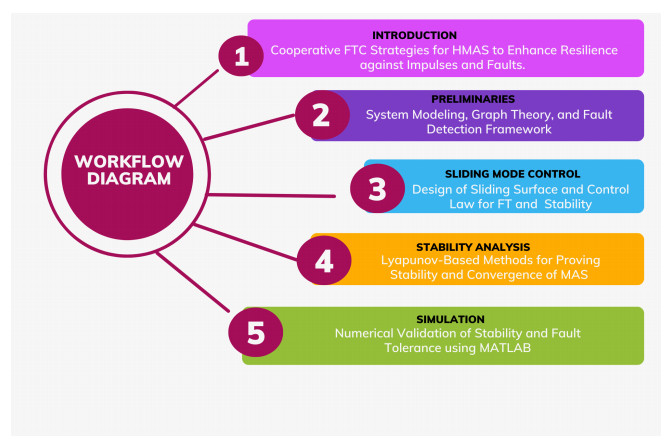
This study dealt with the problem of fault-tolerant control in multi-agent systems impacted also by factor stochastic impulsive disturbances together with actuator and sensor malfunctions. It is known that impulsive events can cause the agents to become unsynchronized and controlled coordination using given fault-tolerant methods is difficult. To enhance the robustness and safety of fault models, this research presented an impulsive fault-tolerant control. This controller aims to eliminate the effect of actuator faults, sensor faults, and impulsive disturbances. We also provided an overview of the sliding mode control technique, which is necessary for managing nonlinear uncertainties in impulses and faults in actuators and sensors. To describe the characteristics of the sliding mode controller, the Lyapunov function was employed to analyze its stability. The stability effect demonstrated in our paper is asymptotic stability rather than semi-global uniform ultimate boundedness because the function derivative of the Lyapunov function and its included term ensures it is negative semi-definite except for the bounded switching control terms, confirming asymptotic convergence to zero. Numerical examples were included to demonstrate the effectiveness and benefits of the proposed approach.
Citation: Meraa Arab, Aasma Zaman, Azmat Ullah Khan Niazi, Marwa Balti. Impulsive fault-tolerant control for multi-agent systems with stochastic disturbances[J]. AIMS Mathematics, 2025, 10(3): 7414-7429. doi: 10.3934/math.2025340
This study dealt with the problem of fault-tolerant control in multi-agent systems impacted also by factor stochastic impulsive disturbances together with actuator and sensor malfunctions. It is known that impulsive events can cause the agents to become unsynchronized and controlled coordination using given fault-tolerant methods is difficult. To enhance the robustness and safety of fault models, this research presented an impulsive fault-tolerant control. This controller aims to eliminate the effect of actuator faults, sensor faults, and impulsive disturbances. We also provided an overview of the sliding mode control technique, which is necessary for managing nonlinear uncertainties in impulses and faults in actuators and sensors. To describe the characteristics of the sliding mode controller, the Lyapunov function was employed to analyze its stability. The stability effect demonstrated in our paper is asymptotic stability rather than semi-global uniform ultimate boundedness because the function derivative of the Lyapunov function and its included term ensures it is negative semi-definite except for the bounded switching control terms, confirming asymptotic convergence to zero. Numerical examples were included to demonstrate the effectiveness and benefits of the proposed approach.

| [1] |
G. K. Fourlas, G. C. Karras, A survey on fault diagnosis and fault-tolerant control methods for unmanned aerial vehicles, Machines, 9 (2021), 197. https://doi.org/10.3390/machines9090197 doi: 10.3390/machines9090197

|
| [2] |
J. Lv, X. Ju, C. Wang, Neural network prescribed-time observer-based output-feedback control for uncertain pure-feedback nonlinear systems, Expert Syst. Appl., 264 (2025), 125813. https://doi.org/10.1016/j.eswa.2024.125813 doi: 10.1016/j.eswa.2024.125813
|
| [3] |
A. Tong, J. Zhang, L. Xie, Intelligent fault diagnosis of rolling bearing based on Gramian angular difference field and improved dual attention residual network, Sensors, 24 (2024), 2156. https://doi.org/10.3390/s24072156 doi: 10.3390/s24072156
|
| [4] |
X. Ju, Y. Jiang, L. Jing, P. Liu, Quantized predefined-time control for heavy-lift launch vehicles under actuator faults and rate gyro malfunctions, ISA Trans., 138 (2023), 133–150. https://doi.org/10.1016/j.isatra.2023.02.022 doi: 10.1016/j.isatra.2023.02.022
|
| [5] |
Q. Wang, Q. Chen, G. Xiao, P. Wang, P. Gu, J. Lu, Elevator fault diagnosis based on digital twin and PINNs-e-RGCN, Sci. Rep., 14 (2024), 30713. https://doi.org/10.1038/s41598-024-78784-7 doi: 10.1038/s41598-024-78784-7
|
| [6] |
T. Guan, B. Li, Y. Song, G. R. Duan, Fixed-time spacecraft attitude control with unwinding-free performance, IEEE Trans. Automat. Control, 70 (2024), 1898–1904. https://doi.org/10.1109/TAC.2024.3471333 doi: 10.1109/TAC.2024.3471333
|
| [7] |
X. Xu, B. Li, PDE-based observation and predictor-based control for linear systems with distributed infinite input and output delays, Automatica, 170 (2024), 111845. https://doi.org/10.1016/j.automatica.2024.111845 doi: 10.1016/j.automatica.2024.111845
|
| [8] |
Y. H. Lan, J. Y. Zhao, Improving track performance by combining padé-approximation-based preview repetitive control and equivalent-input-disturbance, J. Electr. Eng. Technol., 19 (2024), 3781–3794. https://doi.org/10.1007/s42835-024-01830-x doi: 10.1007/s42835-024-01830-x
|
| [9] |
X. Hu, T. Tang, L. Tan, H. Zhang, Fault detection for point machines: a review, challenges, and perspectives, Actuators, 12 (2023), 391. https://doi.org/10.3390/act12100391 doi: 10.3390/act12100391
|
| [10] |
L. Lin, J. Liu, N. Huang, S. Li, Y. Zhang, Multiscale spatio-temporal feature fusion based non-intrusive appliance load monitoring for multiple industrial industries, Appl. Soft Comput., 167 (2024), 112445. https://doi.org/10.1016/j.asoc.2024.112445 doi: 10.1016/j.asoc.2024.112445
|
| [11] |
L. Lin, X. Ma, C. Chen, J. Xu, N. Huang, Imbalanced industrial load identification based on optimized CatBoost with entropy features, J. Electr. Eng. Technol., 19 (2024), 4817–4832. https://doi.org/10.1007/s42835-024-01933-5 doi: 10.1007/s42835-024-01933-5
|
| [12] |
T. Li, H. Shi, X. Bai, N. Li, K. Zhang, Rolling bearing performance assessment with degradation twin modeling considering interdependent fault evolution, Mech. Syst. Signal Process., 224 (2025), 112194. https://doi.org/10.1016/j.ymssp.2024.112194 doi: 10.1016/j.ymssp.2024.112194
|
| [13] |
G. Du, H. Zhang, H. Yu, P. Hou, J. He, S. Cao, Study on automatic tracking system of microwave deicing device for railway contact wire, IEEE Trans. Instrum. Meas., 73 (2024), 1–11. https://doi.org/10.1109/TIM.2024.3446638 doi: 10.1109/TIM.2024.3446638
|
| [14] |
Y. Yin, Z. Wang, L. Zheng, Q. Su, Y. Guo, Autonomous UAV navigation with adaptive control based on deep reinforcement learning, Electronics, 13 (2024), 2432. https://doi.org/10.3390/electronics13132432 doi: 10.3390/electronics13132432
|
| [15] |
F. Ding, K. Zhu, J. Liu, C. Peng, Y. Wang, J. Lu, Adaptive memory event-triggered output feedback finite-time lane-keeping control for autonomous heavy truck with roll prevention, IEEE Trans. Fuzzy Syst., 32 (2024), 6607–6621. https://doi.org/10.1109/TFUZZ.2024.3454344 doi: 10.1109/TFUZZ.2024.3454344
|
| [16] |
L. Zhang, C. Ma, J. Liu, Enhancing four-axis machining center accuracy through interactive fusion of spatiotemporal graph convolutional networks and an error-controlled digital twin system, J. Manuf. Process., 112 (2024), 14–31. https://doi.org/10.1016/j.jmapro.2024.01.024 doi: 10.1016/j.jmapro.2024.01.024
|
| [17] |
X. Zhang, Y. Liu, X. Chen, Z. Li, C. Y. Su, Adaptive pseudoinverse control for constrained hysteretic nonlinear systems and its application on dielectric elastomer actuator, IEEE/ASME Trans. Mech., 28 (2023), 2142–2154. https://doi.org/10.1109/TMECH.2022.3231263 doi: 10.1109/TMECH.2022.3231263
|
| [18] |
L. Ji, Z. Lin, C. Zhang, S. Yang, J. Li, H. Li, Data-based optimal consensus control for multiagent systems with time delays: using prioritized experience replay, IEEE Trans. Syst., Man, Cybern.: Syst., 54 (2024), 3244–3256. https://doi.org/10.1109/TSMC.2024.3358293 doi: 10.1109/TSMC.2024.3358293
|
| [19] |
F. Wang, K. Chen, S. Zhen, X. Chen, H. Zheng, Z. Wang, Prescribed performance adaptive robust control for robotic manipulators with fuzzy uncertainty, IEEE Trans. Fuzzy Syst., 32 (2024), 1318–1330. https://doi.org/10.1109/TFUZZ.2023.3323090 doi: 10.1109/TFUZZ.2023.3323090
|
| [20] |
J. Hao, P. Chen, J. Chen, X. Li, Effectively detecting and diagnosing distributed multivariate time series anomalies via Unsupervised Federated Hypernetwork, Inform. Process. Manag., 62 (2025), 104107. https://doi.org/10.1016/j.ipm.2025.104107 doi: 10.1016/j.ipm.2025.104107
|
| [21] |
Z. Zou, S. Yang, L. Zhao, Dual-loop control and state prediction analysis of QUAV trajectory tracking based on biological swarm intelligent optimization algorithm, Sci. Rep., 14 (2024), 19091. https://doi.org/10.1038/s41598-024-69911-5 doi: 10.1038/s41598-024-69911-5
|
| [22] |
H. B. Zeng, Z. J. Zhu, T. S. Peng, W. Wang, X. M. Zhang, Robust tracking control design for a class of nonlinear networked control systems considering bounded package dropouts and external disturbance, IEEE Trans. Fuzzy Syst., 32 (2024), 3608–3617. https://doi.org/10.1109/TFUZZ.2024.3377799 doi: 10.1109/TFUZZ.2024.3377799
|
| [23] |
Y. Liu, Q. Hu, G. Feng, Navigation functions on 3-manifold with boundary as a disjoint union of hopf tori, IEEE Trans. Automat. Control, 70 (2024), 219–234. https://doi.org/10.1109/TAC.2024.3419817 doi: 10.1109/TAC.2024.3419817
|
| [24] |
Y. Zhao, H. Wu, Fixed/prescribed stability criterions of stochastic system with time-delay, AIMS Math., 9 (2024), 14425–14453. https://doi.org/10.3934/math.2024701 doi: 10.3934/math.2024701
|
| [25] |
X. Zhao, H. Wu, J. Cao, L. Wang, Prescribed-time synchronization for complex dynamic networks of piecewise smooth systems: a hybrid event-triggering control approach, Qual. Theory Dyn. Syst., 24 (2025), 11. https://doi.org/10.1007/s12346-024-01166-x doi: 10.1007/s12346-024-01166-x
|
| [26] |
X. Hou, H. Wu, J. Cao, Practical finite-time synchronization for Lur'e systems with performance constraint and actuator faults: a memory-based quantized dynamic event-triggered control strategy, Appl. Math. Comput., 487 (2025), 129108. https://doi.org/10.1016/j.amc.2024.129108 doi: 10.1016/j.amc.2024.129108
|
| [27] |
D. Cai, P. Fan, Q. Zou, Y. Xu, Z. Ding, Z. Liu, Active device detection and performance analysis of massive non-orthogonal transmissions in cellular internet of things, Sci. China Inf. Sci., 65 (2022), 182301. https://doi.org/10.1007/s11432-021-3328-y doi: 10.1007/s11432-021-3328-y
|
| [28] |
S. Zheng, C. Shen, X. Chen, Design and analysis of uplink and downlink communications for federated learning, IEEE J. Sel. Areas Commun., 39 (2020), 2150–2167. https://doi.org/10.1109/JSAC.2020.3041388 doi: 10.1109/JSAC.2020.3041388
|
| [29] |
Y. Guo, R. Zhao, S. Lai, L. Fan, X. Lei, G. K. Karagiannidis, Distributed machine learning for multiuser mobile edge computing systems, IEEE J. Sel. Top. Signal Process., 16 (2022), 460–473. https://doi.org/10.1109/JSTSP.2022.3140660 doi: 10.1109/JSTSP.2022.3140660
|
| [30] |
C. Tan, D. Cai, F. Fang, Z. Ding, P. Fan, Federated unfolding learning for CSI feedback in distributed edge networks, IEEE Trans. Commun., 73 (2025), 410–424. https://doi.org/10.1109/TCOMM.2024.3429170 doi: 10.1109/TCOMM.2024.3429170
|
| [31] |
A. Polyakov, Nonlinear feedback design for fixed-time stabilization of linear control systems, IEEE Trans. Automat. Control, 57 (2011), 2106–2110. https://doi.org/10.1109/TAC.2011.2179869 doi: 10.1109/TAC.2011.2179869
|
| [32] |
N. Ali, I. Tawiah, W. Zhang, Finite-time extended state observer-based nonsingular fast terminal sliding mode control of autonomous underwater vehicles, Ocean Eng., 218 (2020), 108179. https://doi.org/10.1016/j.oceaneng.2020.108179 doi: 10.1016/j.oceaneng.2020.108179
|
| [33] |
Y. Liu, G. H. Yang, Fixed-time fault-tolerant consensus control for multi-agent systems with mismatched disturbances, Neurocomputing, 366 (2019), 154–160. https://doi.org/10.1016/j.neucom.2019.07.093 doi: 10.1016/j.neucom.2019.07.093
|
| [34] |
S. T. Venkataraman, S. Gulati, Control of nonlinear systems using terminal sliding modes, J. Dyn. Syst., Meas., Control, 115 (1993), 554–560. https://doi.org/10.1115/1.2899138 doi: 10.1115/1.2899138
|


Figures(5) / Tables(1)

Meraa Arab, Aasma Zaman, Azmat Ullah Khan Niazi, Marwa Balti. Impulsive fault-tolerant control for multi-agent systems with stochastic disturbances[J]. AIMS Mathematics, 2025, 10(3): 7414-7429. doi: 10.3934/math.2025340





 DownLoad: