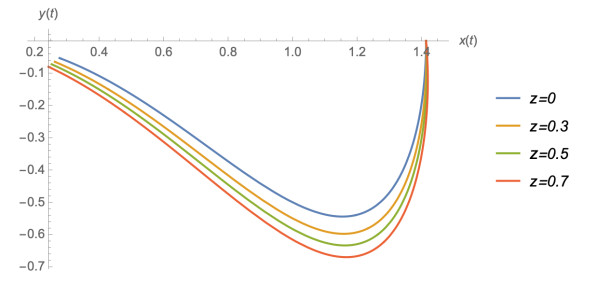
We revisit the nonlinear second-order differential equations $ \ddot{x}(t) = a (x)\dot{x}(t)^2+b(t)\dot{x}(t), $ where $ a(x) $ and $ b(t) $ are arbitrary functions on their argument from the perspective of Lie–Hamilton systems. For the particular choice $ a(x) = 3/x $ and $ b(t) = 1/t $, these equations reduce to the Buchdahl equation considered in the context of general relativity. It is shown that these equations are associated with the "book" Lie algebra $ \mathfrak{b}_2 $ by determining a Lie–Hamilton system for which the corresponding $ t $-dependent Hamiltonian and the general solution of the equations are given. The procedure is illustrated considering several particular cases. We also make use of the quantum deformation of $ \mathfrak{b}_2 $ with the quantum deformation parameter $ z $ (where $ q = {{{\rm{e}}}}^z $), leading to a deformed generalized Buchdahl equation. Applying the formalism of Poisson–Hopf deformations of Lie–Hamilton systems, we derive the corresponding deformed $ t $-dependent Hamiltonian, as well as its general solution. The generalized Buchdahl equation is further extended to the oscillator Lie–Hamilton algebra $ \mathfrak{h}_4\supset \mathfrak{b}_2 $, together with its quantum deformation, and the corresponding (deformed) equations are also analyzed for their exact solutions. The presence of the quantum deformation parameter $ z $ is interpreted as the introduction of an integrable perturbation of the (initial) generalized Buchdahl equation, which is described in detail in its linear approximation. Finally, it is also shown that, under quantum deformations, the higher-dimensional deformed generalized Buchdahl equations from either the book or the oscillator algebras do not reduce to a sum of copies of the initial system but to intrinsic coupled systems governed by $ z $.
Citation: Rutwig Campoamor-Stursberg, Eduardo Fernández-Saiz, Francisco J. Herranz. Generalized Buchdahl equations as Lie–Hamilton systems from the "book" and oscillator algebras: quantum deformations and their general solution[J]. AIMS Mathematics, 2025, 10(3): 6873-6909. doi: 10.3934/math.2025315
We revisit the nonlinear second-order differential equations $ \ddot{x}(t) = a (x)\dot{x}(t)^2+b(t)\dot{x}(t), $ where $ a(x) $ and $ b(t) $ are arbitrary functions on their argument from the perspective of Lie–Hamilton systems. For the particular choice $ a(x) = 3/x $ and $ b(t) = 1/t $, these equations reduce to the Buchdahl equation considered in the context of general relativity. It is shown that these equations are associated with the "book" Lie algebra $ \mathfrak{b}_2 $ by determining a Lie–Hamilton system for which the corresponding $ t $-dependent Hamiltonian and the general solution of the equations are given. The procedure is illustrated considering several particular cases. We also make use of the quantum deformation of $ \mathfrak{b}_2 $ with the quantum deformation parameter $ z $ (where $ q = {{{\rm{e}}}}^z $), leading to a deformed generalized Buchdahl equation. Applying the formalism of Poisson–Hopf deformations of Lie–Hamilton systems, we derive the corresponding deformed $ t $-dependent Hamiltonian, as well as its general solution. The generalized Buchdahl equation is further extended to the oscillator Lie–Hamilton algebra $ \mathfrak{h}_4\supset \mathfrak{b}_2 $, together with its quantum deformation, and the corresponding (deformed) equations are also analyzed for their exact solutions. The presence of the quantum deformation parameter $ z $ is interpreted as the introduction of an integrable perturbation of the (initial) generalized Buchdahl equation, which is described in detail in its linear approximation. Finally, it is also shown that, under quantum deformations, the higher-dimensional deformed generalized Buchdahl equations from either the book or the oscillator algebras do not reduce to a sum of copies of the initial system but to intrinsic coupled systems governed by $ z $.

| [1] |
H. A. Buchdahl, A relativistic fluid sphere resembling the Emden polytrope of index 5, Astrophys. J., 140 (1964), 1512–1516. https://doi.org/10.1086/148055 doi: 10.1086/148055

|
| [2] | H. Stephani, D. Kramer, M. Maccallum, C. Hoenselears, E. Herldt, Exact solutions to Einstein's fields equations, Cambridge University Press, 1995. |
| [3] |
L. G. S. Duarte, S. E. S. Duarte, L. A. C. P. da Mota, J. E. F. Skea, Solving second-order ordinary differential equations by extending the Prelle-Singer method, J. Phys. A, 34 (2001), 3015–3024. https://doi.org/10.1088/0305-4470/34/14/308 doi: 10.1088/0305-4470/34/14/308
|
| [4] |
L. G. S. Duarte, L. A. C. P. da Mota, Finding elementary first integrals for rational second order ordinary differential equations, J. Math. Phys., 50 (2009), 013514. https://doi.org/10.1063/1.3050281 doi: 10.1063/1.3050281
|
| [5] |
V. K. Chandrasekar, M. Senthilvelan, M. Lakshmanan, On the complete integrability and linearization of certain second-order nonlinear ordinary differential equations, Proc. R. Soc. A, 461 (2005), 2451–2477. https://doi.org/10.1098/rspa.2005.1465 doi: 10.1098/rspa.2005.1465
|
| [6] |
J. L. Cieśliński, T. Nikiciuk, A direct approach to the construction of standard and non-standard Lagrangians for dissipative-like dynamical systems with variable coefficients, J. Phys. A, 43 (2010), 175205. https://doi.org/10.1088/1751-8113/43/17/175205 doi: 10.1088/1751-8113/43/17/175205
|
| [7] | E. L. Ince, Integration of ordinary differential equations, Oliver and Boyd, 1939. |
| [8] | E. Kamke. Differentialgleichungen–Lösungsmethoden und Methoden. Band 1, Geest und Portig, 1959. |
| [9] |
R. Campoamor-Stursberg, Low dimensional Vessiot-Guldberg-Lie algebras of second-order ordinary differential equations, Symmetry, 8 (2016), 15. https://doi.org/10.3390/sym8030015 doi: 10.3390/sym8030015
|
| [10] |
F. M. Mahomed, Symmetry group classification of ordinary differential equations: survey of some results, Math. Meth. Appl. Sci., 30 (2007), 1995–2012. https://doi.org/10.1002/mma.934 doi: 10.1002/mma.934
|
| [11] |
A. Ballesteros, A. Blasco, F. J. Herranz, J. de Lucas, C. Sardón, Lie–Hamilton systems on the plane: properties, classification and applications, J. Differ. Equations, 258 (2015), 2873–2907. https://doi.org/10.1016/j.jde.2014.12.031 doi: 10.1016/j.jde.2014.12.031
|
| [12] |
A. Blasco, F. J. Herranz, J. de Lucas, C. Sardón, Lie–Hamilton systems on the plane: applications and superposition rules, J. Phys. A, 48 (2015), 345202. https://doi.org/10.1088/1751-8113/48/34/345202 doi: 10.1088/1751-8113/48/34/345202
|
| [13] | J. de Lucas, C. Sardón, A guide to Lie systems with compatible geometric structures, World Scientific, 2020. https://doi.org/10.1142/q0208 |
| [14] |
R. Campoamor-Stursberg, E. Fernández-Saiz, F. J. Herranz, Solutions by quadratures of complex Bernoulli differential equations and their quantum deformation, Axioms, 13 (2024), 26. https://doi.org/10.3390/axioms13010026 doi: 10.3390/axioms13010026
|
| [15] |
E. Fernández-Saiz, R. Campoamor-Stursberg, F. J. Herranz. Generalized time-dependent SIS Hamiltonian models: exact solutions and quantum deformations, J. Phys., 2667 (2023), 012083. https://doi.org/10.1088/1742-6596/2667/1/012083 doi: 10.1088/1742-6596/2667/1/012083
|
| [16] | S. Lie, G. Scheffers. Vorlesungen über continuierliche Gruppen mit geometrischen und anderen Anwendungen, Teubner, 1883. |
| [17] | P. Winternitz, Lie groups and solutions of nonlinear differential equations, In: K. B. Wolf, Nonlinear phenomena, Springer, 1983,263–305. https://doi.org/10.1007/3-540-12730-5_12 |
| [18] | J. F. Cariñena, J. Grabowski, G. Marmo, Lie–Scheffers systems: a geometric approach, Bibliopolis, 2000. |
| [19] |
R. Campoamor-Stursberg, E. Fernández-Saiz, F. J. Herranz, Exact solutions and superposition rules for Hamiltonian systems generalizing time-dependent SIS epidemic models with stochastic fluctuations, AIMS Math., 8 (2023), 24025–24052. https://doi.org/10.3934/math.20231225 doi: 10.3934/math.20231225
|
| [20] |
A. Ballesteros, R. Campoamor-Stursberg, E. Fernández-Saiz, F. J. Herranz, J. de Lucas, Poisson–Hopf deformations of Lie-Hamilton systems revisited: deformed superposition rules and applications to the oscillator algebra, J. Phys. A, 54 (2021), 205202. https://doi.org/10.1088/1751-8121/abf1db doi: 10.1088/1751-8121/abf1db
|
| [21] | M. Abramowitz, I. A. Stegun, Handbook of mathematical functions with formulas, graphs and mathematical tables, Department of Commerce, 1964. |
| [22] | W. Gröbner, H. Knapp, Contributions to the method of Lie series, Bibliographisches Institut, 1967. |
| [23] | V. Chari, A. Pressley, A guide to quantum groups, Cambridge University Press, 1994. |
| [24] | E. Abe, Hopf algebras, Cambridge University Press, 2004. |
| [25] |
A. Ballesteros, R. Campoamor-Stursberg, E. Fernández-Saiz, F. J. Herranz, J. de Lucas, Poisson–Hopf algebra deformations of Lie-Hamilton systems, J. Phys. A, 51 (2018), 065202. https://doi.org/10.1088/1751-8121/aaa090 doi: 10.1088/1751-8121/aaa090
|
| [26] | I. Vaisman, Lectures on the geometry of Poisson manifolds, Birkhäuser Verlag, 1994. |
| [27] |
R. S. Palais, A global formulation of the Lie theory of transformation groups, Memoirs Amer. Math. Soc., 1957. https://doi.org/10.1090/memo/0022 doi: 10.1090/memo/0022
|
| [28] |
H. J. Sussmann, Orbits of families of vector fields and integrability of distributions, Trans. Amer. Math. Soc., 180 (1973), 171–188. https://doi.org/10.2307/1996660 doi: 10.2307/1996660
|
| [29] |
A. Ballesteros, F. J. Herranz, Lie bialgebra quantizations of the oscillator algebra and their universal $R$-matrices, J. Phys. A, 29 (1996), 4307–4320. https://doi.org/10.1088/0305-4470/29/15/006 doi: 10.1088/0305-4470/29/15/006
|
| [30] |
A. Ballesteros, F. J. Herranz, M. A. del Olmo, C. M. Pereña, M. Santander, Non-standard quantum (1+1) Poincaré group: a $T$-matrix approach, J. Phys. A, 28 (1995), 7113–7125. https://doi.org/10.1088/0305-4470/28/24/012 doi: 10.1088/0305-4470/28/24/012
|
| [31] |
A. Ballesteros, F. J. Herranz, J. Negro, Boson representations, non-standard quantum algebras and contractions, J. Phys. A, 30 (1997), 6797–6809. https://doi.org/10.1088/0305-4470/30/19/018 doi: 10.1088/0305-4470/30/19/018
|
| [32] |
A. Ballesteros, S. M. Chumakov, On the spectrum of a Hamiltonian defined on $su_q(2)$ and quantum optical models, J. Phys. A, 32 (1999), 6261–6269. https://doi.org/10.1088/0305-4470/32/35/305 doi: 10.1088/0305-4470/32/35/305
|
| [33] |
A. Ballesteros, O. Civitarese, F. J. Herranz, M. Reboiro, Fermion-boson interactions and quantum algebras, Phys. Rev. C, 66 (2002), 064317. https://doi.org/10.1103/PhysRevC.66.064317 doi: 10.1103/PhysRevC.66.064317
|
| [34] | R. M. Santilli, Foundations of theoretical mechanics I. The inverse problem in Newtonian mechanics, Springer, 1978. |
| [35] |
M. C. Nucci, P. G. L. Leach, Jacobi's last multiplier and Lagrangians for multidimensional systems, J. Math. Phys., 49 (2008), 073517. https://doi.org/10.1063/1.2956486 doi: 10.1063/1.2956486
|
| [36] |
K. Rosquist, C. Uggla, Killing tensors in two-dimensional space-times with applications to cosmology, J. Math. Phys., 32 (1991), 3412–3422. https://doi.org/10.1063/1.529455 doi: 10.1063/1.529455
|
| [37] | P. J. Olver, Applications of Lie groups to differential equations, Springer, 1986. |


Figures(3) / Tables(2)

Rutwig Campoamor-Stursberg, Eduardo Fernández-Saiz, Francisco J. Herranz. Generalized Buchdahl equations as Lie–Hamilton systems from the "book" and oscillator algebras: quantum deformations and their general solution[J]. AIMS Mathematics, 2025, 10(3): 6873-6909. doi: 10.3934/math.2025315





 DownLoad: