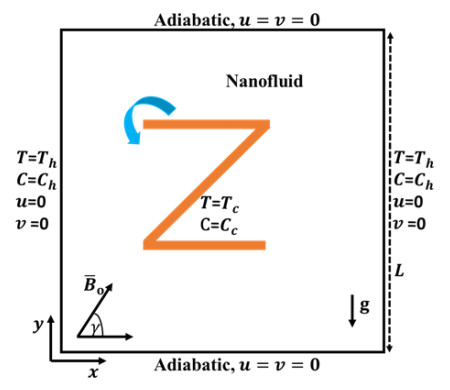
This study explores the combined effects of exothermic chemical reactions and Cattaneo–Christov heat flux on thermosolutal convection within a nanofluid-filled square cavity containing a rotating Z-shaped fin. The incompressible smoothed particle hydrodynamics (ISPH) approach was employed, utilizing boundary particle renormalization to accurately model boundary conditions. An artificial neural network (ANN) model, trained on ISPH simulation data, predicted the average Nusselt number ($ {\text{Nu}}_{\text{avg}} $) and average Sherwood number ($ {\text{Sh}}_{\text{avg}} $) with high accuracy. A dataset comprising 56 data points was used, from which 40 data points were used for training, 8 for validation, and 8 for testing. The Z-shaped fin, centrally positioned, rotates at a fixed angular velocity, maintaining lower temperature and concentration levels, while the cavity's vertical walls exhibit elevated thermal and solutal conditions. Results indicate that the Z-shaped fin's geometry, exothermic reaction rates, and magnetic field strength significantly influence heat and mass transfer and fluid dynamics. For instance, increasing the Hartmann number ($ \text{Ha} $) from 0 to 50 decreased nanofluid velocity by 61.99%, while $ {\text{Nu}}_{\text{avg}} $ and $ {\text{Sh}}_{\text{avg}} $ were reduced by 16.87% and 11.81%, respectively. Additionally, increasing the nanoparticle volume fraction from 0 to 0.15 enhanced $ {\text{Nu}}_{\text{avg}} $ by 22.43% and $ {\text{Sh}}_{\text{avg}} $ by 116.3%. The ANN model, employing the Levenberg–Marquardt algorithm, achieved a coefficient of determination $ R = 0.99994 $ and a mean squared error $ \text{MSE} = 4.21\times {10}^{-6} $, demonstrating its reliability in predicting thermal performance. These findings underscore the study's relevance to applications such as energy systems, refrigeration, and heat exchangers.
Citation: Kuiyu Cheng, Abdelraheem M. Aly, Nghia Nguyen Ho, Sang-Wook Lee, Andaç Batur Çolak, Weaam Alhejaili. Exothermic thermosolutal convection in a nanofluid-filled square cavity with a rotating Z-Fin: ISPH and AI integration[J]. AIMS Mathematics, 2025, 10(3): 5830-5858. doi: 10.3934/math.2025268
This study explores the combined effects of exothermic chemical reactions and Cattaneo–Christov heat flux on thermosolutal convection within a nanofluid-filled square cavity containing a rotating Z-shaped fin. The incompressible smoothed particle hydrodynamics (ISPH) approach was employed, utilizing boundary particle renormalization to accurately model boundary conditions. An artificial neural network (ANN) model, trained on ISPH simulation data, predicted the average Nusselt number ($ {\text{Nu}}_{\text{avg}} $) and average Sherwood number ($ {\text{Sh}}_{\text{avg}} $) with high accuracy. A dataset comprising 56 data points was used, from which 40 data points were used for training, 8 for validation, and 8 for testing. The Z-shaped fin, centrally positioned, rotates at a fixed angular velocity, maintaining lower temperature and concentration levels, while the cavity's vertical walls exhibit elevated thermal and solutal conditions. Results indicate that the Z-shaped fin's geometry, exothermic reaction rates, and magnetic field strength significantly influence heat and mass transfer and fluid dynamics. For instance, increasing the Hartmann number ($ \text{Ha} $) from 0 to 50 decreased nanofluid velocity by 61.99%, while $ {\text{Nu}}_{\text{avg}} $ and $ {\text{Sh}}_{\text{avg}} $ were reduced by 16.87% and 11.81%, respectively. Additionally, increasing the nanoparticle volume fraction from 0 to 0.15 enhanced $ {\text{Nu}}_{\text{avg}} $ by 22.43% and $ {\text{Sh}}_{\text{avg}} $ by 116.3%. The ANN model, employing the Levenberg–Marquardt algorithm, achieved a coefficient of determination $ R = 0.99994 $ and a mean squared error $ \text{MSE} = 4.21\times {10}^{-6} $, demonstrating its reliability in predicting thermal performance. These findings underscore the study's relevance to applications such as energy systems, refrigeration, and heat exchangers.

| [1] |
S. M. Saeidi, J. M. Khodadadi, Forced convection in a square cavity with inlet and outlet ports, Int. J. Heat Mass Tran., 49 (2006), 1896-1906. https://doi.org/10.1016/j.ijheatmasstransfer.2005.10.033 doi: 10.1016/j.ijheatmasstransfer.2005.10.033

|
| [2] |
M. A. Ismael, H. F. Jasim, Role of the fluid-structure interaction in mixed convection in a vented cavity, Int. J. Mech. Sci., 135 (2018), 190-202. https://doi.org/10.1016/j.ijmecsci.2017.11.001 doi: 10.1016/j.ijmecsci.2017.11.001
|
| [3] | S. U. Choi, J. A. Eastman, Enhancing thermal conductivity of fluids with nanoparticles, Argonne National Lab.(ANL), Argonne, IL (United States), 1995. |
| [4] | S. K. Das, S. U. Choi, W. Yu, T. Pradeep, Nanofluids: Science and technology, John Wiley & Sons, 2007. |
| [5] |
Y. Yang, Z. G. Zhang, E. A. Grulke, W. B. Anderson, G. Wu, Heat transfer properties of nanoparticle-in-fluid dispersions (nanofluids) in laminar flow, Int. J. Heat Mass Tran., 48 (2005), 1107-1116. https://doi.org/10.1016/j.ijheatmasstransfer.2004.09.038 doi: 10.1016/j.ijheatmasstransfer.2004.09.038
|
| [6] |
N. Putra, F. N. Iskandar, Application of nanofluids to a heat pipe liquid-block and the thermoelectric cooling of electronic equipment, Exp. Therm. Fluid Sci., 35 (2011), 1274-1281. https://doi.org/10.1016/j.expthermflusci.2011.04.015 doi: 10.1016/j.expthermflusci.2011.04.015
|
| [7] |
O. Mahian, A. Kianifar, S. A. Kalogirou, I. Pop, S. Wongwises, A review of the applications of nanofluids in solar energy, Int. J. Heat Mass Tran., 57 (2013), 582-594. https://doi.org/10.1016/j.ijheatmasstransfer.2012.10.037 doi: 10.1016/j.ijheatmasstransfer.2012.10.037
|
| [8] |
S. Rashidi, O. Mahian, E. M. Languri, Applications of nanofluids in condensing and evaporating systems, J. Therm. Anal. Calorim., 131 (2018), 2027-2039. https://doi.org/10.1007/s10973-017-6773-7 doi: 10.1007/s10973-017-6773-7
|
| [9] |
K. Khanafer, K. Vafai, Applications of nanofluids in porous medium, J. Therm. Anal. Calorim., 135 (2019), 1479-1492. https://doi.org/10.1007/s10973-018-7565-4 doi: 10.1007/s10973-018-7565-4
|
| [10] |
M. A. Nazari, M. H. Ahmadi, M. Sadeghzadeh, M. B. Shafii, M. Goodarzi, A review on application of nanofluid in various types of heat pipes, J. Cent. South Univ., 26 (2019), 1021-1041. https://doi.org/10.1007/s11771-019-4068-9 doi: 10.1007/s11771-019-4068-9
|
| [11] |
M. U. Sajid, H. M. Ali, Recent advances in application of nanofluids in heat transfer devices: A critical review, Renew. Sust. Energ. Rev., 103 (2019), 556-592. https://doi.org/10.1016/j.rser.2018.12.057 doi: 10.1016/j.rser.2018.12.057
|
| [12] |
A. Wahab, A. Hassan, M. A. Qasim, H. M. Ali, H. Babar, M. U. Sajid, Solar energy systems—Potential of nanofluids, J. Mol. Liq., 289 (2019), 111049. https://doi.org/10.1016/j.molliq.2019.111049 doi: 10.1016/j.molliq.2019.111049
|
| [13] |
D. S. Saidina, M. Z. Abdullah, M. Hussin, Metal oxide nanofluids in electronic cooling: A review, J. Mater. Sci.-Mater. El., 31 (2020), 4381-4398. https://doi.org/10.1007/s10854-020-03020-7 doi: 10.1007/s10854-020-03020-7
|
| [14] |
J. Li, X. Zhang, B. Xu, M. Yuan, Nanofluid research and applications: A review, Int. Commun. Heat Mass, 127 (2021), 105543. https://doi.org/10.1016/j.icheatmasstransfer.2021.105543 doi: 10.1016/j.icheatmasstransfer.2021.105543
|
| [15] | M. A. Sheremet, Applications of nanofluids, Nanomaterials (Basel), 11 (2021). https://doi.org/10.3390/nano11071716 |
| [16] | A. Lazarovici, V. Volpert, J. H. Merkin, Steady states, oscillations and heat explosion in a combustion problem with convection, Eur. J. Mech. B-Fl., 24 (2005), 189-203. https://doi.org/10.1016/j.euromechflu.2004.06.007 |
| [17] |
J. H. Merkin, I. Pop, Stagnation point flow past a stretching/shrinking sheet driven by Arrhenius kinetics, Appl. Math. Comput., 337 (2018), 583-590. https://doi.org/10.1016/j.amc.2018.05.024 doi: 10.1016/j.amc.2018.05.024
|
| [18] |
M. M. Rahman, I. Pop, M. Z. Saghir, Steady free convection flow within a titled nanofluid saturated porous cavity in the presence of a sloping magnetic field energized by an exothermic chemical reaction administered by Arrhenius kinetics, Int. J. Heat Mass Tran., 129 (2019), 198-211. https://doi.org/10.1016/j.ijheatmasstransfer.2018.09.105 doi: 10.1016/j.ijheatmasstransfer.2018.09.105
|
| [19] |
R. H. Muhammad, Analysis of heat transfer in a triangular enclosure filled with a porous medium saturated with magnetized nanofluid charged by an exothermic chemical reaction, Math. Probl. Eng., 2019 (2019), 7451967. https://doi.org/10.1155/2019/7451967 doi: 10.1155/2019/7451967
|
| [20] |
M. M. Hasan, M. J. Uddin, R. Nasrin, Exothermic chemical reaction of magneto-convective nanofluid flow in a square cavity, Int. J. Thermofluids, 16 (2022), 100236. https://doi.org/10.1016/j.ijft.2022.100236 doi: 10.1016/j.ijft.2022.100236
|
| [21] |
A. Kasaeipoor, B. Ghasemi, S. M. Aminossadati, Convection of Cu-water nanofluid in a vented T-shaped cavity in the presence of magnetic field, Int. J. Therm. Sci., 94 (2015), 50-60. https://doi.org/10.1016/j.ijthermalsci.2015.02.014 doi: 10.1016/j.ijthermalsci.2015.02.014
|
| [22] |
S. Parvin, A. Akter, Effect of magnetic field on natural convection flow in a prism shaped cavity filled with nanofluid, Proc. Eng., 194 (2017), 421-427. https://doi.org/10.1016/j.proeng.2017.08.166 doi: 10.1016/j.proeng.2017.08.166
|
| [23] | B. P. Geridönmez, H. F. Öztop, Effects of partial magnetic field in a vented square cavity with aiding and opposing of MWCNT—water nanofluid flows, Eng. Anal. Bound. Elem., 133 (2021), 84-94. https://doi.org/10.1016/j.enganabound.2021.08.024 |
| [24] |
A. M. Aly, S. E. Ahmed, Z. Raizah, Impacts of variable magnetic field on a ferrofluid flow inside a cavity including a helix using ISPH method, Int. J. Numer. Method. H., 31 (2021), 2150-2171. https://doi.org/10.1108/HFF-08-2020-0501 doi: 10.1108/HFF-08-2020-0501
|
| [25] |
A. M. Aly, ISPH method for MHD convective flow from grooves inside a nanofluid-filled cavity under the effects of Soret and Dufour numbers, Physica A, 546 (2020), 124087. https://doi.org/10.1016/j.physa.2019.124087 doi: 10.1016/j.physa.2019.124087
|
| [26] |
R. A. Gingold, J. J. Monaghan, Smoothed particle hydrodynamics: theory and application to non-spherical stars, Mon. Not. R. Astron. Soc., 181 (1977), 375-389. https://doi.org/10.1093/mnras/181.3.375 doi: 10.1093/mnras/181.3.375
|
| [27] |
L. B. Lucy, A numerical approach to the testing of the fission hypothesis, The Astron. J., 82 (1977), 1013-1024. https://doi.org/10.1086/112164 doi: 10.1086/112164
|
| [28] |
D. Violeau, R. Issa, Numerical modelling of complex turbulent free‐surface flows with the SPH method: an overview, Int. J. Numer. Method. Fl., 53 (2007), 277-304. https://doi.org/10.1002/fld.1292 doi: 10.1002/fld.1292
|
| [29] |
H. F. Qiang, C. Shi, F. Z. Chen, Y. W. Han, Simulation of two-dimensional droplet collisions based on SPH method of multi-phase flows with large density differences, Acta Phys. Sin., 62 (2013), 214701. https://doi.org/10.7498/aps.62.214701 doi: 10.7498/aps.62.214701
|
| [30] | A. M. Aly, A. J. Chamkha, S. W. Lee, A. F. Al-Mudhaf, On mixed convection in an inclined lid-driven cavity with sinusoidal heated walls using the ISPH method, Comput. Therm. Sci. Int. J., 8 (2016), 337-354. https://doi.org/10.1615/ComputThermalScien.2016016527 |
| [31] |
F. Garoosi, A. Shakibaeinia, An improved high-order ISPH method for simulation of free-surface flows and convection heat transfer, Powder Technol., 376 (2020), 668-696. https://doi.org/10.1016/j.powtec.2020.08.074 doi: 10.1016/j.powtec.2020.08.074
|
| [32] |
Y. Shimizu, H. Gotoh, A. Khayyer, K. Kita, Fundamental investigation on the applicability of higher-order consistent ISPH method, Int. J. Offshore Polar Eng., 2022. https://doi.org/10.17736/ijope.2022.jc868 doi: 10.17736/ijope.2022.jc868
|
| [33] |
N. H. Saeid, Natural convection in a square cavity with discrete heating at the bottom with different fin shapes, Heat Transfer Eng., 39 (2018), 154-161. https://doi.org/10.1080/01457632.2017.1288053 doi: 10.1080/01457632.2017.1288053
|
| [34] | A. M. Aly, S. El-Sapa, Effects of Soret and Dufour numbers on MHD thermosolutal convection of a nanofluid in a finned cavity including rotating circular cylinder and cross shapes, Int. Commun. Heat Mass, 130 (2022), 105819. https://doi.org/10.1016/j.icheatmasstransfer.2021.105819 |
| [35] |
L. El Moutaouakil, M. Boukendil, Z. Zrikem, A. Abdelbaki, Natural convection and surface radiation heat transfer in a cavity with vertically oriented fins, Mater. Today Proc., 27 (2020), 3051-3057. https://doi.org/10.1016/j.matpr.2020.03.526 doi: 10.1016/j.matpr.2020.03.526
|
| [36] | M. M. Tafarroj, O. Mahian, A. Kasaeian, K. Sakamatapan, A. S. Dalkilic, S, Wongwises, Artificial neural network modeling of nanofluid flow in a microchannel heat sink using experimental data, Int. Commun. Heat Mass, 86 (2017), 25-31. https://doi.org/10.1016/j.icheatmasstransfer.2017.05.020 |
| [37] | H. M. Elshehabey, A. M. Aly, S. W. Lee, A. B. Çolak, Integrating artificial intelligence with numerical simulations of Cattaneo-Christov heat flux on thermosolutal convection of nano-enhanced phase change materials in Bézier-annulus, J. Energy Storage, 82 (2024), 110496. https://doi.org/10.1016/j.est.2024.110496 |
| [38] |
A. M. Aly, S. W. Lee, N. N. Ho, Z. Raizah, Thermosolutal convection of NEPCM inside a curved rectangular annulus: Hybrid ISPH method and machine learning, Comput. Part. Mech., 11 (2024), 2655-2675. https://doi.org/10.1007/s40571-024-00744-9 doi: 10.1007/s40571-024-00744-9
|
| [39] |
I. E. Lagaris, A. Likas, D. I. Fotiadis, Artificial neural networks for solving ordinary and partial differential equations, IEEE T. Neural Networ., 9 (1998), 987-1000. https://doi.org/10.1109/72.712178 doi: 10.1109/72.712178
|
| [40] |
G. Diaz, M. Sen, K. T. Yang, R. L. McClain, Simulation of heat exchanger performance by artificial neural networks, HVAC & R Res., 5 (1999), 195-208. https://doi.org/10.1080/10789669.1999.10391233 doi: 10.1080/10789669.1999.10391233
|
| [41] |
Y. Varol, E. Avci, A. Koca, H. F. Oztop, Prediction of flow fields and temperature distributions due to natural convection in a triangular enclosure using Adaptive-Network-Based Fuzzy Inference System (ANFIS) and Artificial Neural Network (ANN), Int. Commun. Heat Mass, 34 (2007), 887-896. https://doi.org/10.1016/j.icheatmasstransfer.2007.03.004 doi: 10.1016/j.icheatmasstransfer.2007.03.004
|
| [42] |
S. Motahar, A neural network approach to estimate non-Newtonian behavior of nanofluid phase change material containing mesoporous silica particles, Int. J. Eng., 34 (2021), 1974-1981. https://doi.org/10.5829/ije.2021.34.08b.18 doi: 10.5829/ije.2021.34.08b.18
|
| [43] |
W. Alhejaili, S. W. Lee, C. Q. Hat, A. M. Aly, Heat and mass transport of nano-encapsulated phase change materials in a complex cavity: An artificial neural network coupled with incompressible smoothed particle hydrodynamics simulations, AIMS Math., 9 (2024), 5609-5632. https://doi.org/10.3934/math.2024271 doi: 10.3934/math.2024271
|
| [44] |
H. M. Elshehabey, A. B. Çolak, A. Aly, Adjoined ISPH method and artificial intelligence for thermal radiation on double diffusion inside a porous L-shaped cavity with fins, Int. J. Numer. Method. H., 34 (2024), 1832-1857. https://doi.org/10.1108/HFF-11-2023-0677 doi: 10.1108/HFF-11-2023-0677
|
| [45] |
S. I. Abdelsalam, N. Alsedais, A. M. Aly, Revolutionizing bioconvection: Artificial intelligence-powered nano-encapsulation with oxytactic microorganisms, Eng. Appl. Artif. Intel., 137 (2024), 109128. https://doi.org/10.1016/j.engappai.2024.109128 doi: 10.1016/j.engappai.2024.109128
|
| [46] |
M. T. Nguyen, A. M. Aly, S. W. Lee, Effect of a wavy interface on the natural convection of a nanofluid in a cavity with a partially layered porous medium using the ISPH method, Numer. Heat Tr. A-Appl., 72 (2017), 68-88. https://doi.org/10.1080/10407782.2017.1353385 doi: 10.1080/10407782.2017.1353385
|
| [47] |
M. T. Nguyen, A. M. Aly, S. W. Lee, ISPH modeling of natural convection heat transfer with an analytical kernel renormalization factor, Meccanica, 53 (2018), 2299-2318. https://doi.org/10.1007/s11012-018-0825-3 doi: 10.1007/s11012-018-0825-3
|
| [48] |
A. M. Aly, E. M. Mohamed, N. Alsedais, The magnetic field on a nanofluid flow within a finned cavity containing solid particles, Case Stud. Therm. Eng., 25 (2021), 100945. https://doi.org/10.1016/j.csite.2021.100945 doi: 10.1016/j.csite.2021.100945
|
| [49] |
G. R. Kefayati, FDLBM simulation of mixed convection in a lid-driven cavity filled with non-Newtonian nanofluid in the presence of magnetic field, Int. J. Therm. Sci., 95 (2015), 29-46. https://doi.org/10.1016/j.ijthermalsci.2015.03.018 doi: 10.1016/j.ijthermalsci.2015.03.018
|
| [50] |
Y. Xuan, W. Roetzel, Conceptions for heat transfer correlation of nanofluids, Int. J. Heat Mass Tran., 43 (2000), 3701-3707. https://doi.org/10.1016/S0017-9310(99)00369-5 doi: 10.1016/S0017-9310(99)00369-5
|
| [51] |
T. Mahapatra, B. C. Saha, D. Pal, Magnetohydrodynamic double-diffusive natural convection for nanofluid within a trapezoidal enclosure, Comput. Appl. Math., 37 (2018), 6132-6151. https://doi.org/10.1007/s40314-018-0676-5 doi: 10.1007/s40314-018-0676-5
|
| [52] | T. M. Nguyen, A. M. Aly, S. W. Lee, ISPH modeling of natural convection heat transfer with an analytical kernel renormalization factor, Meccanica, 53 (2018), 2299–2318. https://doi.org/10.1007/s11012-018-0825-3 |
| [53] |
T. M. Nguyen, A. M. Aly, S. W. Lee, Improved wall boundary conditions in the incompressible smoothed particle hydrodynamics method, Int. J. Numer. Method. H. F. F., 28 (2018), 704-725. https://doi.org/10.1108/HFF-02-2017-0056 doi: 10.1108/HFF-02-2017-0056
|
| [54] |
A. M. Aly, Z. A. S. Raizah, Mixed convection in an inclined nanofluid filled-cavity saturated with a partially layered porous medium, J. Therm. Sci. Eng. Appl., 11 (2019), 041002-041011. https://doi.org/10.1115/1.4042352 doi: 10.1115/1.4042352
|
| [55] |
S. J. Lind, R. Xu, P. K. Stansby, B. D. Rogers, Incompressible smoothed particle hydrodynamics for free-surface flows: A generalised diffusion-based algorithm for stability and validations for impulsive flows and propagating waves, J. Comput. Phys., 231 (2012), 1499-1523. https://doi.org/10.1016/j.jcp.2011.10.027 doi: 10.1016/j.jcp.2011.10.027
|
| [56] |
A. Skillen, S. Lind, P. K. Stansby, B. D. Rogers, Incompressible smoothed particle hydrodynamics (SPH) with reduced temporal noise and generalised Fickian smoothing applied to body-water slam and efficient wave-body interaction, Comput. Method. Appl. M., 265 (2013), 163-173. https://doi.org/10.1016/j.cma.2013.05.017 doi: 10.1016/j.cma.2013.05.017
|
| [57] |
M. T. Nguyen, A. M. Aly, S. W. Lee, Natural convection in a non-Darcy porous cavity filled with Cu-water nanofluid using the characteristic-based split procedure in finite-element method, Numer. Heat Tr. A-Appl., 67 (2015), 224-247. https://doi.org/10.1080/10407782.2014.923225 doi: 10.1080/10407782.2014.923225
|
| [58] |
G. V. Davis, Natural convection of air in a square cavity: A bench mark numerical solution, Int. J. Numer. Meth. Fl., 3 (1983), 249-264. https://doi.org/10.1002/fld.1650030305 doi: 10.1002/fld.1650030305
|
| [59] | A. B. Çolak, A new study on the prediction of the effects of road gradient and coolant flow on electric vehicle battery power electronics components using machine learning approach, J. Energy Storage, 70 (2023), 108101. https://doi.org/10.1016/j.est.2023.108101 |
| [60] |
A. B. Çolak, O. Yıldız, M. Bayrak, B. S. Tezekici, Experimental study for predicting the specific heat of water based Cu-Al2O3 hybrid nanofluid using artificial neural network and proposing new correlation, Int. J. Energ. Res., 44 (2020), 7198-7215. https://doi.org/10.1002/er.5417 doi: 10.1002/er.5417
|


Figures(26) / Tables(1)

Kuiyu Cheng, Abdelraheem M. Aly, Nghia Nguyen Ho, Sang-Wook Lee, Andaç Batur Çolak, Weaam Alhejaili. Exothermic thermosolutal convection in a nanofluid-filled square cavity with a rotating Z-Fin: ISPH and AI integration[J]. AIMS Mathematics, 2025, 10(3): 5830-5858. doi: 10.3934/math.2025268





 DownLoad: