This study examined the integration of Industry 4.0 technologies with environmental, social, and governance (ESG) strategies to improve organizational sustainability and competitiveness. Industry 4.0 technologies, including blockchain, artificial intelligence (AI), the Internet of Things (IoT), and big data analytics, offer transformative capabilities for ESG reporting, resource optimization, and operational efficiency. By addressing sustainability challenges and advancing governance practices, these technologies enable businesses to meet their environmental and governance responsibilities while achieving economic growth. However, implementing Industry 4.0 in ESG frameworks presents challenges, such as high costs, poor data quality, and resistance to change. This paper analyzed existing literature to identify opportunities and barriers to aligning ESG with Industry 4.0, providing insights for managers, researchers, and policymakers. The report adds to the body of knowledge on sustainable innovation by pointing out the advantages and disadvantages of this integration. It also provides a roadmap for achieving sustainability-implementing goals over the long run in a rapidly evolving digital landscape.
Citation: Muhammad Yahya Hammad, Syed Radzi Rahamaddulla, Muhammad Ashraf Fauzi. Environmental and governance strategies in ESG for industry 4.0: a systematic review[J]. AIMS Environmental Science, 2025, 12(4): 557-575. doi: 10.3934/environsci.2025025
This study examined the integration of Industry 4.0 technologies with environmental, social, and governance (ESG) strategies to improve organizational sustainability and competitiveness. Industry 4.0 technologies, including blockchain, artificial intelligence (AI), the Internet of Things (IoT), and big data analytics, offer transformative capabilities for ESG reporting, resource optimization, and operational efficiency. By addressing sustainability challenges and advancing governance practices, these technologies enable businesses to meet their environmental and governance responsibilities while achieving economic growth. However, implementing Industry 4.0 in ESG frameworks presents challenges, such as high costs, poor data quality, and resistance to change. This paper analyzed existing literature to identify opportunities and barriers to aligning ESG with Industry 4.0, providing insights for managers, researchers, and policymakers. The report adds to the body of knowledge on sustainable innovation by pointing out the advantages and disadvantages of this integration. It also provides a roadmap for achieving sustainability-implementing goals over the long run in a rapidly evolving digital landscape.

| [1] |
Taddeo S, Agnese P, Busato F (2024) Rethinking the effect of ESG practices on profitability through cross-dimensional substitutability. J Environ Manage 352: 120115. https://doi.org/10.1016/j.jenvman.2024.120115 doi: 10.1016/j.jenvman.2024.120115

|
| [2] | Dorofeev M, Tamashiro K (2023) Evolution of Pension System Financial Models for Sustainable Economic Growth. 165–178. https://doi.org/10.1007/978-3-031-26596-9_14 |
| [3] | Leong WY, Leong YZ, Leong WS (2023) Smart Manufacturing Technology for Environmental, Social, and Governance (ESG) Sustainability. 2023 IEEE 5th Eurasia Conference on IOT, Communication and Engineering, ECICE 2023 965–970. https://doi.org/10.1109/ECICE59523.2023.10383150 |
| [4] |
Liu Y, Han T, Ma S, et al. (2023) Summary of ChatGPT-Related research and perspective towards the future of large language models. Meta-Radiology 1: 100017. https://doi.org/10.1016/j.metrad.2023.100017 doi: 10.1016/j.metrad.2023.100017
|
| [5] |
Saxena A, Singh R, Gehlot A, et al. (2022) Technologies Empowered Environmental, Social, and Governance (ESG): An Industry 4.0 Landscape. Sustainability 15: 309. https://doi.org/10.3390/su15010309 doi: 10.3390/su15010309
|
| [6] |
Kim H, Quan Y-J, Jung G, et al. (2023) Smart Factory Transformation Using Industry 4.0 toward ESG Perspective: A Critical Review and Future Direction. Int J Precis Eng Man-Smart Technology 1: 165–185. https://doi.org/10.57062/ijpem-st.2022.0073 doi: 10.57062/ijpem-st.2022.0073
|
| [7] |
Wolniak R, Grebski W (2023) Environmental sustainability – the business analytics usage in Industry 4.0 conditions. Sci Pap Silesian U Technol Organ Manage Series 2023. https://doi.org/10.29119/1641-3466.2023.180.36 doi: 10.29119/1641-3466.2023.180.36
|
| [8] |
Martiny A, Taglialatela J, Testa F, et al. (2024) Determinants of environmental social and governance (ESG) performance: A systematic literature review. J Clean Prod 456: 142213. https://doi.org/10.1016/j.jclepro.2024.142213 doi: 10.1016/j.jclepro.2024.142213
|
| [9] |
Nitlarp T, Mayakul T (2023) The Implications of Triple Transformation on ESG in the Energy Sector: Fuzzy-Set Qualitative Comparative Analysis (fsQCA) and Structural Equation Modeling (SEM) Findings. Energies (Basel) 16: 2090. https://doi.org/10.3390/en16052090 doi: 10.3390/en16052090
|
| [10] |
Cronin M, Doyle-Kent M (2022) Creating Value with Environmental, Social, Governance (ESG) in Irish Manufacturing SMEs': A Focus on Disclosure of Climate Change Risks and Opportunities. IFAC-PapersOnLine 55: 48–53. https://doi.org/10.1016/j.ifacol.2022.12.009 doi: 10.1016/j.ifacol.2022.12.009
|
| [11] |
Zhironkina O, Zhironkin S (2023) Technological and Intellectual Transition to Mining 4.0: A Review. Energies (Basel) 16. https://doi.org/10.3390/en16031427 doi: 10.3390/en16031427
|
| [12] |
Yu W, Gu Y, Dai J (2022) Industry 4.0-Enabled ESG Reporting: A Case from a Chinese Energy Company. SSRN Electron J https://doi.org/10.2139/ssrn.4063071 doi: 10.2139/ssrn.4063071
|
| [13] |
Yoon J, Han S, Lee Y, et al. (2023) Text Mining Analysis of ESG Management Reports in South Korea: Comparison With Sustainable Development Goals. Sage Open 13: 1–17. https://doi.org/10.1177/21582440231202896 doi: 10.1177/21582440231202896
|
| [14] |
El Hazbi F, Mounir Y (2023) Environmental, social, and governance (ESG) practices and Environmental performance: The mediation role of Technology Innovation. E3S Web of Conferences 412: 01009. https://doi.org/10.1051/e3sconf/202341201009 doi: 10.1051/e3sconf/202341201009
|
| [15] |
Li Q, Li M, Zhang L (2024) Revisiting the relationship between ESG, institutional ownership, and corporate innovation: An efficiency perspective. Corp Soc Responsib Environ Manag 6504–6525. https://doi.org/10.1002/csr.2937 doi: 10.1002/csr.2937
|
| [16] |
Alkaraan F, Elmarzouky M, Hussainey K, et al. (2023) Sustainable strategic investment decision-making practices in UK companies: The influence of governance mechanisms on synergy between industry 4.0 and circular economy. Technol Forecast Soc Change 187: 122187. https://doi.org/10.1016/j.techfore.2022.122187 doi: 10.1016/j.techfore.2022.122187
|
| [17] |
Alkaraan F, Elmarzouky M, Lopes de Sousa Jabbour AB, et al. (2025) Maximising sustainable performance: Integrating servitisation innovation into green sustainable supply chain management under the influence of governance and Industry 4.0. J Bus Res 186: 115029. https://doi.org/10.1016/j.jbusres.2024.115029 doi: 10.1016/j.jbusres.2024.115029
|
| [18] |
Alkaraan F, Elmarzouky M, Hussainey K, et al. (2024) Reinforcing green business strategies with Industry 4.0 and governance towards sustainability: Natural‐resource‐based view and dynamic capability. Bus Strategy Environ 33: 3588–3606. https://doi.org/10.1002/bse.3665 doi: 10.1002/bse.3665
|
| [19] | Chauhan S, Singh R, Gehlot A, et al. (2023) Enabling Technologies : A Sustainable Perspective. |
| [20] | Iddrisu IMA, Nee AYH, Senadjki A (2024) Technology For Good ESG Practices? Investigating the Direct Effect of IR4.0 Technology Adoption on Sustainability and Competitiveness. 15th International Conference on Advances in Computing, Control, and Telecommunication Technologies ACT 2: 2219–2231. |
| [21] |
Barykin SE, Strimovskaya AV, Sergeev SM, et al. (2023) Smart City Logistics on the Basis of Digital Tools for ESG Goals Achievement. Sustainability (Switzerland) 15. https://doi.org/10.3390/su15065507 doi: 10.3390/su15065507
|
| [22] |
Linares-Espinós E, Hernández V, Domínguez-Escrig JL, et al. (2018) Metodología de una revisión sistemática. Actas Urol Esp 42: 499–506. https://doi.org/10.1016/j.acuro.2018.01.010 doi: 10.1016/j.acuro.2018.01.010
|
| [23] |
Furlan JC, Singh J, Hsieh J, et al. (2011) Methodology of systematic reviews and recommendations. J Neurotrauma 28: 1335–1339. https://doi.org/10.1089/neu.2009.1146 doi: 10.1089/neu.2009.1146
|
| [24] |
Sun Y, Liao C, Chen Y, et al. (2024) The impacts of ESG policy on clean technology innovation: a gateway to promote renewable energy transition. Clean Technol Environ Policy https://doi.org/10.1007/s10098-024-02978-w doi: 10.1007/s10098-024-02978-w
|
| [25] |
Yu P, Xu H, Chen J (2024) Can ESG Integration Enhance the Stability of Disruptive Technology Stock Investments? Evidence from Copula-Based Approaches. J Risk Financ Manag 17. https://doi.org/10.3390/jrfm17050197 doi: 10.3390/jrfm17050197
|
| [26] |
Alkaraan F, Albitar K, Hussainey K, et al. (2022) Corporate transformation toward Industry 4.0 and financial performance: The influence of environmental, social, and governance (ESG). Technol Forecast Soc Change 175: 121423. https://doi.org/10.1016/j.techfore.2021.121423 doi: 10.1016/j.techfore.2021.121423
|
| [27] |
Zheng M, Li T, Ye J (2024) The Confluence of AI and Big Data Analytics in Industry 4.0: Fostering Sustainable Strategic Development. J Knowl Econ https://doi.org/10.1007/s13132-024-02120-7 doi: 10.1007/s13132-024-02120-7
|
| [28] |
Yu W, Gu Y, Dai J (2023) Industry 4.0-Enabled Environment, Social, and Governance Reporting: A Case from a Chinese Energy Company. J Emerg Technol Acco 20: 245–258. https://doi.org/10.2308/JETA-2022-014 doi: 10.2308/JETA-2022-014
|
| [29] |
Kumar M, Raut RD, Mangla SK, et al. (2024) Moderating ESG compliance between industry 4.0 and green practices with green servitization: Examining its impact on green supply chain performance. Technovation 129: 102898. https://doi.org/10.1016/j.technovation.2023.102898 doi: 10.1016/j.technovation.2023.102898
|
| [30] | Sung Une Lee HPYLBXQLLZ (2024) INTEGRATING ESG AND AI: A COMPREHENSIVE RESPONSIBLE AI ASSESSMENT FRAMEWORK. |
| [31] |
Ding X, Sheng Z, Appolloni A, et al. (2024) Digital transformation, ESG practice, and total factor productivity. Bus Strategy Environ 33: 4547–4561. https://doi.org/10.1002/bse.3718 doi: 10.1002/bse.3718
|
| [32] |
Wang S, Zhang H (2024) Inter-organizational cooperation in digital green supply chains: A catalyst for eco-innovations and sustainable business practices. J Clean Prod 472: 143383. https://doi.org/10.1016/j.jclepro.2024.143383 doi: 10.1016/j.jclepro.2024.143383
|
| [33] |
Bezerra RRR, Martins VWB, Macedo AN (2024) Validation of Challenges for Implementing ESG in the Construction Industry Considering the Context of an Emerging Economy Country. Appl Sci 14: 6024. https://doi.org/10.3390/app14146024 doi: 10.3390/app14146024
|
| [34] | Qing C, Jin S (2023) Does ESG and Digital Transformation affects Corporate Sustainability? The Moderating role of Green Innovation. arXiv. org 1–24. |
| [35] | Kache F, Seuring S (2017) Challenges and opportunities of digital information at the intersection of Big Data Analytics and supply chain management. Int J Oper Prod Manage 37: 10–36. ttps: //doi. org/10.1108/IJOPM-02-2015-0078 |
| [36] |
Leng J, Sha W, Wang B, et al. (2022) Industry 5.0: Prospect and retrospect. J Manuf Syst 65: 279–295. https://doi.org/10.1016/j.jmsy.2022.09.017 doi: 10.1016/j.jmsy.2022.09.017
|
| [37] |
Al-Khawaldah RA, Al-Zoubi WK, Alshaer SA, et al. (2022) Green supply chain management and competitive advantage: The mediating role of organizational ambidexterity. Uncertain Supply Chain Management 10: 961–972. https://doi.org/10.5267/j.uscm.2022.2.017 doi: 10.5267/j.uscm.2022.2.017
|
| [38] |
Benuzzi M, Klaser K, Bax K (2024) Which ESG+F dimension matters most to retail investors? An experimental study on financial decisions and future generations. J Behav Exp Finance 41: 100882. https://doi.org/10.1016/j.jbef.2023.100882 doi: 10.1016/j.jbef.2023.100882
|
| [39] |
Edwards MG (2021) The growth paradox, sustainable development, and business strategy. Bus Strategy Environ 30: 3079–3094. https://doi.org/10.1002/bse.2790 doi: 10.1002/bse.2790
|
| [40] |
Khan MI, Yasmeen T, Khan M, et al. (2025) Integrating industry 4.0 for enhanced sustainability: Pathways and prospects. Sustain Prod Consum 54: 149–189. https://doi.org/10.1016/j.spc.2024.12.012 doi: 10.1016/j.spc.2024.12.012
|
| [41] |
Wang S, Zhang H (2024) Green entrepreneurship success in the age of generative artificial intelligence: The interplay of technology adoption, knowledge management, and government support. Technol Soc 79: 102744. https://doi.org/10.1016/j.techsoc.2024.102744 doi: 10.1016/j.techsoc.2024.102744
|
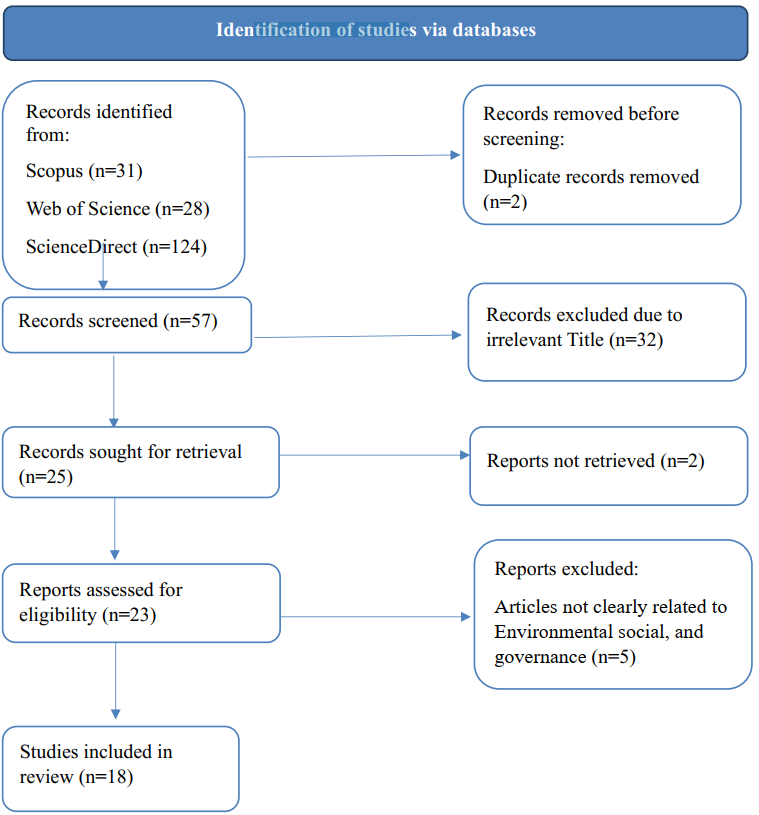
Figures(1) / Tables(6)

Muhammad Yahya Hammad, Syed Radzi Rahamaddulla, Muhammad Ashraf Fauzi. Environmental and governance strategies in ESG for industry 4.0: a systematic review[J]. AIMS Environmental Science, 2025, 12(4): 557-575. doi: 10.3934/environsci.2025025





 DownLoad: