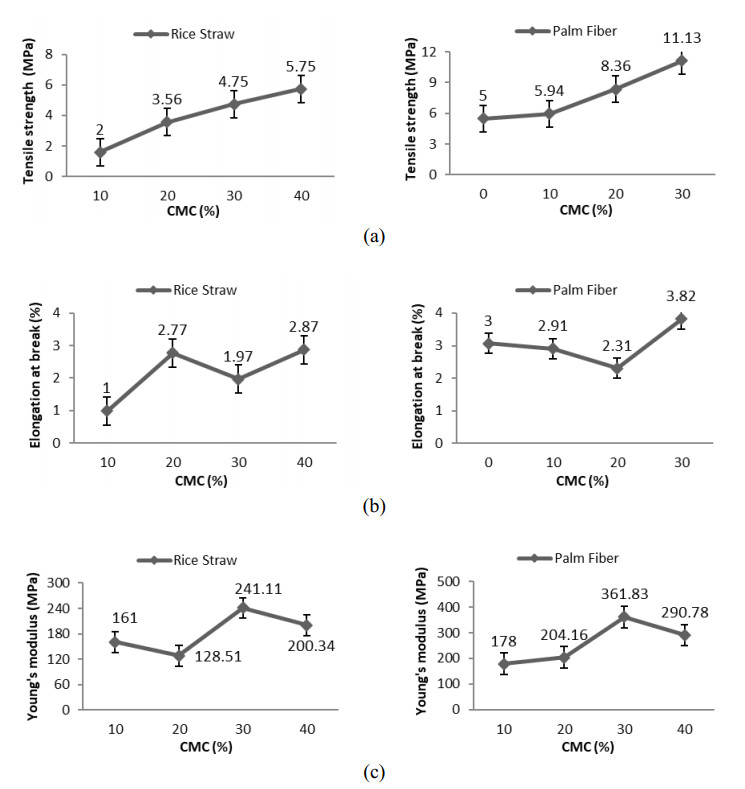
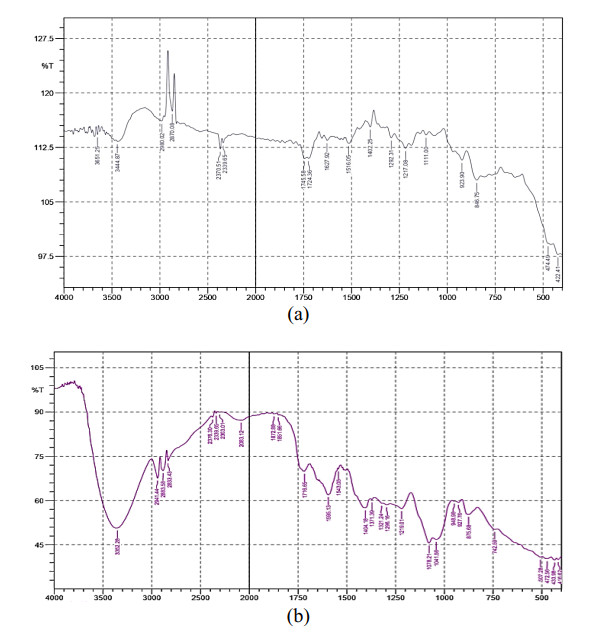
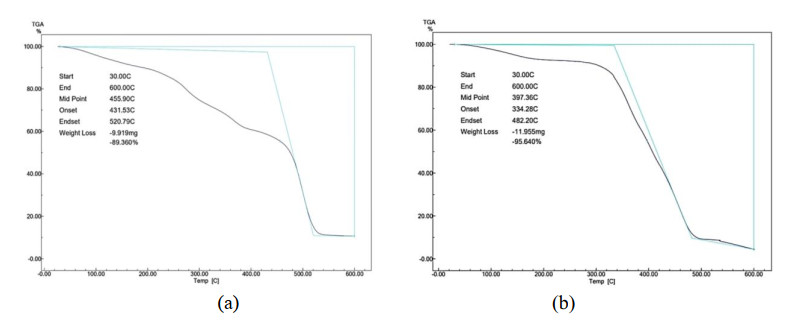
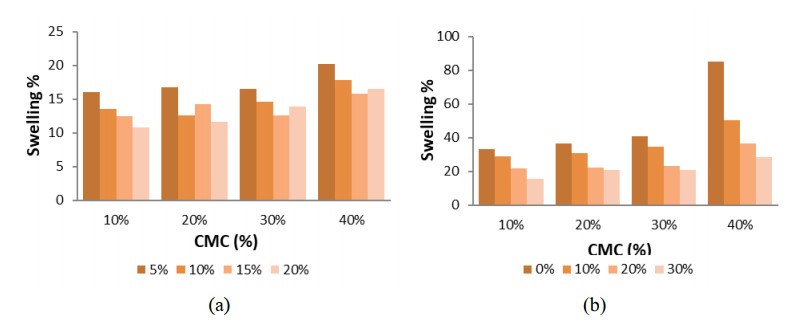
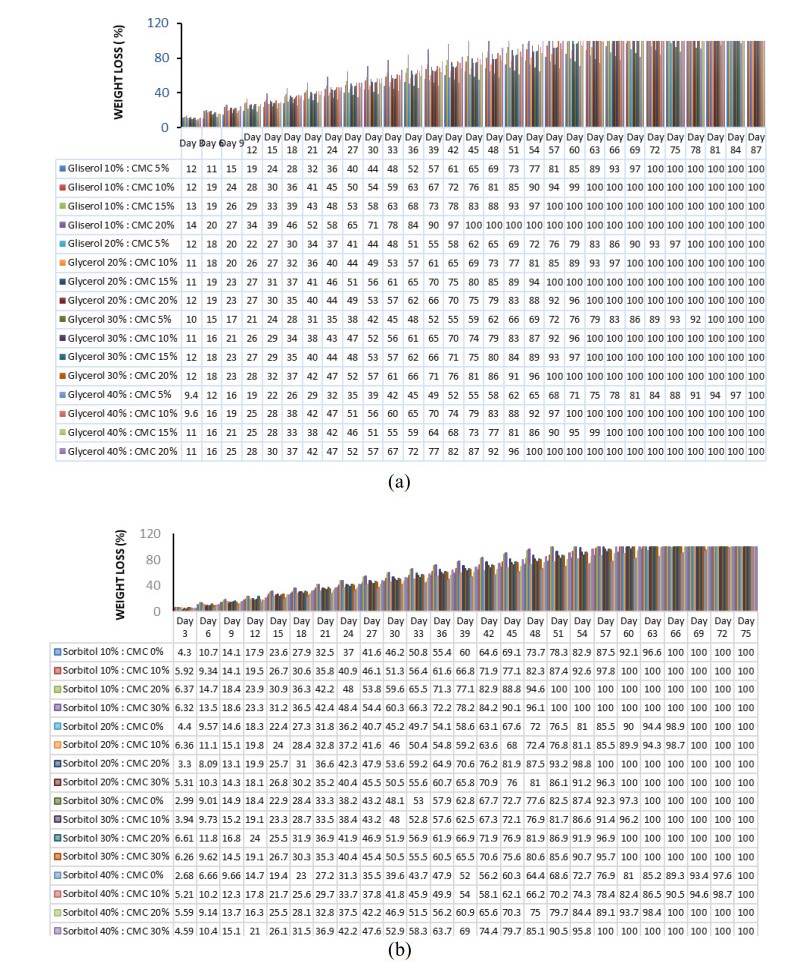
This study used rice straw-based and palm fiber-based degradable plastics with glycerol and sorbitol. The strength of rice straw cellulose-based degradable plastics using 20% glycerol ranged from 2 to 5.75 MPa. Similarly, the strength of palm fiber cellulose-based degradable plastics using 40% sorbitol ranged from 5 to 11.13 MPa. In a chemical analysis, the peaks between 3444.87 cm-1 and 3651.25 cm-1 represented the O–H stretching of the alcohol group. This is shown by the C–O–H hydroxyl group at the wave numbers of 1627.92, 1724.36, and 1745.58 cm-1. Moreover, these groups are hydrophilic, binding water, so they can be degraded by microbial activity in the soil. In the thermal analysis, degradable plastics from rice straw lost a lot of weight between 431.53 and 520.79 ℃. Plastics derived from palm fibers as green products also showed extreme weight loss between 334.28 and 482.20 ℃. Most of the material was decomposed at 600 ℃. Both types of samples lost a lot of hydrogen groups and started to decompose and depolymerize. Rice straw plastic absorbed 10.73%–20.23% of water, while palm fiber plastic absorbed 15.34%–85.01%. The lowest water absorption rates were observed in rice straw and palm fiber degradable plastics. Rice straw and palm fiber cellulose plastics broke down in 45–48 days, in line with the American Standard Testing and Materials (ASTM) D-20.96 standard, which says that degradable plastic should take no more than 180 days to break down.
Citation: Tezara Cionita, Rozanna Dewi, Novi Sylvia, Januar Parlaungan Siregar, Deni Fajar Fitriyana, Al Ichlas Imran. Effect of plasticizer and carboxyl methyl cellulose (CMC) on degradable plastics from rice straw and palm fiber[J]. AIMS Environmental Science, 2025, 12(3): 478-494. doi: 10.3934/environsci.2025022
This study used rice straw-based and palm fiber-based degradable plastics with glycerol and sorbitol. The strength of rice straw cellulose-based degradable plastics using 20% glycerol ranged from 2 to 5.75 MPa. Similarly, the strength of palm fiber cellulose-based degradable plastics using 40% sorbitol ranged from 5 to 11.13 MPa. In a chemical analysis, the peaks between 3444.87 cm-1 and 3651.25 cm-1 represented the O–H stretching of the alcohol group. This is shown by the C–O–H hydroxyl group at the wave numbers of 1627.92, 1724.36, and 1745.58 cm-1. Moreover, these groups are hydrophilic, binding water, so they can be degraded by microbial activity in the soil. In the thermal analysis, degradable plastics from rice straw lost a lot of weight between 431.53 and 520.79 ℃. Plastics derived from palm fibers as green products also showed extreme weight loss between 334.28 and 482.20 ℃. Most of the material was decomposed at 600 ℃. Both types of samples lost a lot of hydrogen groups and started to decompose and depolymerize. Rice straw plastic absorbed 10.73%–20.23% of water, while palm fiber plastic absorbed 15.34%–85.01%. The lowest water absorption rates were observed in rice straw and palm fiber degradable plastics. Rice straw and palm fiber cellulose plastics broke down in 45–48 days, in line with the American Standard Testing and Materials (ASTM) D-20.96 standard, which says that degradable plastic should take no more than 180 days to break down.

| [1] |
Chia WY, Tang DYY, Khoo KS, et al. (2020) Nature's fight against plastic pollution: Algae for plastic biodegradation and bioplastics production. Environ Sci Ecotech 4: 100065. https://doi.org/10.1016/j.ese.2020.100065 doi: 10.1016/j.ese.2020.100065

|
| [2] |
Adhitama R, Setiawan JV, Sukweenadhi J, et al. (2023) Utilization of Breadfruit (Artocarpus altilis) peel waste and blood clam shell waste (Anadara granosa) as raw materials for glycerol-plasticized degradable bioplastic production. Indones J Biotechnol Biodivers 7: 12–21. https://doi.org/10.47007/ijobb.v7i1.167 doi: 10.47007/ijobb.v7i1.167
|
| [3] |
Gu F, Guo J, Zhang W, et al. (2017) From waste plastics to industrial raw materials: A life cycle assessment of mechanical plastic recycling practice based on a real-world case study. Sci Total Environ 601–602: 1192–1207. https://doi.org/10.1016/j.scitotenv.2017.05.278 doi: 10.1016/j.scitotenv.2017.05.278
|
| [4] |
Shaghaleh H, Xu X, Wang S (2018) Current progress in production of biopolymeric materials based on cellulose, cellulose nanofibers, and cellulose derivatives. RSC Adv 8: 825–842. https://doi.org/10.1039/c7ra11157f doi: 10.1039/c7ra11157f
|
| [5] |
Khan MZH, Sarkar MAR, Al Imam FI, et al. (2014) Paper making from banana pseudo-stem: Characterization and comparison. J Nat Fibers 11: 199–211. https://doi.org/10.1080/15440478.2013.874962 doi: 10.1080/15440478.2013.874962
|
| [6] |
Abera WG, Kasirajan R, Majamo SL (2024) Synthesis and characterization of bioplastic film from banana (Musa Cavendish species) peel starch blending with banana pseudo-stem cellulosic fiber. Biomass Convers Bior 14: 20419–20440. https://doi.org/10.1007/s13399-023-04207-8 doi: 10.1007/s13399-023-04207-8
|
| [7] | Arbanah M, Rashidi AR, Muhammad M, et al. (2018) Effect of coconut fiber reinforcement on mechanical properties of corn starch bioplastics. Int J Eng Technol 7: 267–270. Available from: https://www.researchgate.net/publication/328880010. |
| [8] |
Demirci S, Sutekin SD, Sahiner N (2020) Polymeric composites based on carboxymethyl cellulose cryogel and conductive polymers: Synthesis and characterization. J Compos Sci 4: 1–12. https://doi.org/10.3390/jcs4020033 doi: 10.3390/jcs4020033
|
| [9] |
Jumaidin R, Shafie S, Ilyas RA, et al. (2023) Effect of coconut fiber loading on the morphological, thermal, and mechanical properties of coconut fiber reinforced thermoplastic starch/beeswax composites. Pertanika J Sci Techn 31: 157–173. https://doi.org/10.47836/pjst.31.S1.09 doi: 10.47836/pjst.31.S1.09
|
| [10] |
Wang S, Xie Y, Su H, et al. (2023) Delivery of curcumin in a carboxymethyl cellulose and hydroxypropyl methyl cellulose carrier: Physicochemical properties and biological activity. Int J Biol Macromol 239: 124203. https://doi.org/10.1016/j.ijbiomac.2023.124203 doi: 10.1016/j.ijbiomac.2023.124203
|
| [11] |
Caicedo C, Cruz CAD, Regalado EJJ, et al. (2022) Effect of plasticizer content on mechanical and water vapor permeability of maize Starch/PVOH/Chitosan composite films. Materials 5: 4. https://doi.org/10.3390/ma15041274 doi: 10.3390/ma15041274
|
| [12] |
Singh A, Himanshu M, Verma B, et al. (2024) Evaluation of sustainability of fabrication process and characterization studies of activated carbon nanocatalyst from waste chestnut peels. J Mol Struct 1321: 139810. https://doi.org/10.1016/j.molstruc.2024.139810 doi: 10.1016/j.molstruc.2024.139810
|
| [13] | Rowell RM, Han JS, Rowell JS (2000) Characterization and factors effecting fiberproperties. Nat Polym Agrofibers Compos 115–134. |
| [14] |
Koba Y, Ishizaki A (1990) Chemical composition of palm fiber and its feasibility as cellulosic raw material· for sugar production. Agric Biol Chem 54: 1183–1187. https://doi.org/10.1080/00021369.1990.10870116 doi: 10.1080/00021369.1990.10870116
|
| [15] |
Sasimowski E, Majewski L, Grochowicz M (2019) Influence of the conditions of corotating twin-screw extrusion for talc-filled polypropylene on selected properties of the extrudate. Polymers 9. https://doi.org/10.3390/polym11091460 doi: 10.3390/polym11091460
|
| [16] |
Melo PMA, MacÊ do OB, Barbosa GP, et al. (2019) High-density polyethylene/mollusk shell-waste composites: Effects of particle size and coupling agent on morphology, mechanical and thermal properties. J Mater Res Technol 8: 1915–1925. https://doi.org/10.1016/j.jmrt.2019.01.008 doi: 10.1016/j.jmrt.2019.01.008
|
| [17] |
Ismail H, Zaaba NF (2014) Effect of unmodified and modified sago starch on properties of (sago starch)/silica/PVA plastic films. J Vinyl Addit Technol 20: 185–192. https://doi.org/10.1002/vnl.21344 doi: 10.1002/vnl.21344
|
| [18] |
Shi SC, Liu F, Wang CY, et al. (2024) Rice straw-derived chitosan-enhanced plasticizers as biologically and environmentally friendly alternatives for sustainable materials. Int J Biol Macromol 264. https://doi.org/10.1016/j.ijbiomac.2024.130547 doi: 10.1016/j.ijbiomac.2024.130547
|
| [19] |
Hernando H, Julianti E, Nuryawan A, et al. (2024) Impact of glycerol on oil palm trunk starch bioplastics enhanced with citric-acid epoxidized palm oil oligomers. Case Stud Chem Environ Eng 10: 100839. https://doi.org/10.1016/j.cscee.2024.100839 doi: 10.1016/j.cscee.2024.100839
|
| [20] |
Kim HY, Jane JL, Lamsal B (2017) Hydroxypropylation improves film properties of high amylose corn starch. Ind Crops Prod 95: 175–183. https://doi.org/10.1016/j.indcrop.2016.10.025 doi: 10.1016/j.indcrop.2016.10.025
|
| [21] |
Putranti LN, Nugraheni PS (2023) Effect of carboxymethyl cellulose addition on the characteristic of chitosan-based bioplastic. IOP Conf Ser Earth Environ Sci 1289. https://doi.org/10.1088/1755-1315/1289/1/012038 doi: 10.1088/1755-1315/1289/1/012038
|
| [22] |
Tavares KM, de Campos A, Luchesi BR, et al. (2020) Effect of carboxymethyl cellulose concentration on mechanical and water vapor barrier properties of corn starch films. Carbohyd Polym 246: 116521. https://doi.org/10.1016/j.carbpol.2020.116521 doi: 10.1016/j.carbpol.2020.116521
|
| [23] |
Kubík L, Zeman S (2014) Mechanické vlastnosti polyetylénový ch fólií. J Cent Eur Agric 15: 138–145. https://doi.org/10.5513/JCEA01/15.1.1425 doi: 10.5513/JCEA01/15.1.1425
|
| [24] | Amirah N, Sohaimi RM, Nor R, et al. (2022) Using infrared spectroscopy, the vibration characteristics of the chemical functional. Polymers 14: 387. |
| [25] |
Łopusiewicz L, Kwiatkowski P, Drozłowska E, et al. (2021) Preparation and characterization of carboxymethyl cellulose-based bioactive composite films modified with fungal melanin and carvacrol. Polymers 13: 1–17. https://doi.org/10.3390/polym13040499 doi: 10.3390/polym13040499
|
| [26] |
Navasingh RJH, Gurunathan MK, Nikolova MP, et al. (2023) Sustainable bioplastics for food packaging produced from renewable natural sources. Polymers 15. https://doi.org/10.3390/polym15183760 doi: 10.3390/polym15183760
|
| [27] |
Sanyang ML, Sapuan SM, Jawaid M, et al. (2015) Effect of plasticizer type and concentration on tensile, thermal and barrier properties of biodegradable films based on sugar palm (Arenga pinnata) starch. Polymers 7: 1106–1124. https://doi.org/10.3390/polym7061106 doi: 10.3390/polym7061106
|
| [28] |
Prisacariu C, Scortanu E (2011) Influence of the type of chain extender and urethane group content on the mechanical properties of polyurethane elastomers with flexible hard segments. High Perform Polym 23: 308–313. https://doi.org/10.1177/0954008311405696 doi: 10.1177/0954008311405696
|
| [29] |
Marichelvam MK, Jawaid M, Asim M (2019) Corn and rice starch-based bio-plastics as alternative packaging materials. Fibers 7: 1–14. https://doi.org/10.3390/fib7040032 doi: 10.3390/fib7040032
|
| [30] |
Terán JLL, Maldonado EVC, Rangel JCA, et al. (2024) Development of antibacterial thermoplastic starch with natural oils and extracts: Structural, mechanical and thermal properties. Polymers 16: 1–20. https://doi.org/10.3390/polym16020180 doi: 10.3390/polym16020180
|
| [31] |
Babalola OA, Olorunnisola AO (2019) Evaluation of coconut (cocos nucifera) husk fiber as a potential reinforcing material for bioplastic production. Mater Res Proc 11: 195–200. https://doi.org/10.21741/9781644900178-14 doi: 10.21741/9781644900178-14
|
| [32] |
Sahu P, Gupta MK (2022) Water absorption behavior of cellulosic fibers polymer composites: A review on its effects and remedies. J Ind Text 51: 7480S–7512S. https://doi.org/10.1177/1528083720974424 doi: 10.1177/1528083720974424
|
| [33] |
Akil HM, Santulli C, Sarasini F, et al. (2014) Environmental effects on the mechanical behaviour of pultruded jute/glass fiber-reinforced polyester hybrid composites. Compos Sci Technol 94: 62–70. https://doi.org/10.1016/j.compscitech.2014.01.017 doi: 10.1016/j.compscitech.2014.01.017
|
| [34] |
Azwa ZN, Yousif BF, Manalo AC, et al. (2013) A review on the degradability of polymeric composites based on natural fibres. Mater Des 47: 424–442. https://doi.org/10.1016/j.matdes.2012.11.025 doi: 10.1016/j.matdes.2012.11.025
|
| [35] |
Tessanan W, Phinyocheep P, Amornsakchai T (2024) Sustainable materials with improved biodegradability and toughness from blends of poly(lactic acid), pineapple stem starch and modified natural rubber. Polymers 16. https://doi.org/10.3390/polym16020232 doi: 10.3390/polym16020232
|
| [36] | Obasi HC, Igwe IO (2012) Cassava starch-mixed polypropylene bidegradable polymer: Preparation, characterization, and effect biodegradable products on growth of plants. Int J Sci Res 3: 802–807. |
| [37] |
Shrestha B, Chapain K, Shah S, et al. (2023) Starch/Polyvinyl Alcohol (PVA) blend bioplastics: Synthesis and physicochemical properties. J Nepal Chem Soc 43: 103–109. https://doi.org/10.3126/jncs.v43i2.53349 doi: 10.3126/jncs.v43i2.53349
|
| [38] |
Putri RDA, Setiawan A, Anggraini PD (2013) Effect of carboxymethyl cellulose (CMC) as biopolymers to the edible film sorghum starch hydrophobicity characteristics. AIP Conf Proc 1818. https://doi.org/10.1063/1.4976908 doi: 10.1063/1.4976908
|
| [39] |
Hidayati S, Maulidia U, Satyajaya W, et al. (2021) Effect of glycerol concentration and carboxy methyl cellulose on biodegradable film characteristics of seaweed waste. Heliyon 7: e07799. https://doi.org/10.1016/j.heliyon.2021.e07799 doi: 10.1016/j.heliyon.2021.e07799
|
| [40] |
Jung W, Savithri D, Shivappa RS, et al. (2020) Effect of sodium hydroxide pretreatment on lignin monomeric components of Miscanthus×giganteus and enzymatic hydrolysis. Waste Biomass Valori 11: 5891–5900. https://doi.org/10.1007/s12649-019-00859-8 doi: 10.1007/s12649-019-00859-8
|
| [41] | Subramanian N, Kumar BV, Geetha M, et al. (2021) Biodegradable plastic from mixed starch. Int J Mech Eng 6: 1009–1019. |
| [42] | American Society for Testing and Materials and ASTM Subcommittee D20.96 on Environmentally Degradable Plastics, ASTM standards pertaining to the biodegradability and compostability of plastics, 1999. |
| [43] |
Coppola G, Gaudio MT, Lopresto CG, et al. (2021) Bioplastic from renewable biomass: A facile solution for a greener environment. Earth Syst Environ 5: 231–251. https://doi.org/10.1007/s41748-021-00208-7 doi: 10.1007/s41748-021-00208-7
|
| [44] |
Elgharbawy AS, El Demerdash AGM, Sadik WA, et al. (2024) Synthetic degradable Polyvinyl Alcohol polymer and its blends with starch and cellulose—A comprehensive overview. Polymers 16. https://doi.org/10.3390/polym16101356 doi: 10.3390/polym16101356
|
Figures(5)

Tezara Cionita, Rozanna Dewi, Novi Sylvia, Januar Parlaungan Siregar, Deni Fajar Fitriyana, Al Ichlas Imran. Effect of plasticizer and carboxyl methyl cellulose (CMC) on degradable plastics from rice straw and palm fiber[J]. AIMS Environmental Science, 2025, 12(3): 478-494. doi: 10.3934/environsci.2025022





 DownLoad: