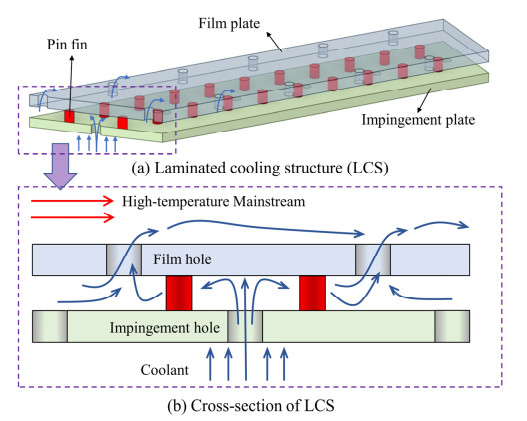
Against the background of increasing gas turbine inlet temperature and decreasing amount of cooling air, laminated cooling structure (LCS) is a highly efficient composite cooling structure with the advantages of lower cooling air consumption and higher cooling efficiency, which is a promising development direction for future wall cooling technology. In this review, we provide an overview of LCS's structural optimization research. The experimental and simulation studies therein were reviewed, and the major influencing parameters in the structure were analyzed in detail. The characteristics of various optimization methods were investigated, and the research methodology and optimization process of multi-objective optimization of laminated cooling structure were summarized. The review shows that laminated cooling structure, as a kind of composite cooling structure, has numerous geometrical and flow factors affecting its cooling efficiency. Multi-objective optimization techniques have effective application prospects in this field. In the future, researchers should focus on enhancing the efficiency and accuracy of multi-objective optimization algorithms. They should also explore the application of machine learning and artificial intelligence in LCS optimization, thereby promoting the intelligence and automation of design optimization.
Citation: Xiaojing Tian, Weiqi Ye, Liang Xu, Anjian Yang, Langming Huang, Shenglong Jin. Optimization research on laminated cooling structure for gas turbines: A review[J]. AIMS Energy, 2025, 13(2): 354-401. doi: 10.3934/energy.2025014
Against the background of increasing gas turbine inlet temperature and decreasing amount of cooling air, laminated cooling structure (LCS) is a highly efficient composite cooling structure with the advantages of lower cooling air consumption and higher cooling efficiency, which is a promising development direction for future wall cooling technology. In this review, we provide an overview of LCS's structural optimization research. The experimental and simulation studies therein were reviewed, and the major influencing parameters in the structure were analyzed in detail. The characteristics of various optimization methods were investigated, and the research methodology and optimization process of multi-objective optimization of laminated cooling structure were summarized. The review shows that laminated cooling structure, as a kind of composite cooling structure, has numerous geometrical and flow factors affecting its cooling efficiency. Multi-objective optimization techniques have effective application prospects in this field. In the future, researchers should focus on enhancing the efficiency and accuracy of multi-objective optimization algorithms. They should also explore the application of machine learning and artificial intelligence in LCS optimization, thereby promoting the intelligence and automation of design optimization.

| [1] | Han JC, Dutta S, Ekkad S (2013) Gas turbine heat transfer and cooling technology. 2nd Edition, CRC press, 887. https://doi.org/10.1201/b13616 |
| [2] |
Xu L, Sun Z, Ruan Q, et al. (2023) Development trend of cooling technology for turbine blades at super-high temperature of above 2000 K. Energies 16: 668. https://doi.org/10.3390/en16020668 doi: 10.3390/en16020668

|
| [3] |
Fujita D, Miyazaki T (2024) Techno-economic analysis on the balance of plant (BOP) equipment due to switching fuel from natural gas to hydrogen in gas turbine power plants. AIMS Energy 12: 464–480. https://doi.org/10.3934/energy.2024021 doi: 10.3934/energy.2024021
|
| [4] |
Han JC (2018) Advanced cooling in gas turbines 2016 Max jakob memorial award paper. J Heat Transfer, 140. https://doi.org/10.1115/1.4039644 doi: 10.1115/1.4039644
|
| [5] |
Zhang T, Zhang Y, Katterbauer K, et al. (2024) Deep learning-assisted phase equilibrium analysis for producing natural hydrogen. Int J Hydrogen Energy 50: 473–486. https://doi.org/10.1016/j.ijhydene.2023.09.097 doi: 10.1016/j.ijhydene.2023.09.097
|
| [6] |
Qian X, Yan P, Wang X, et al. (2023) Effect of thermal barrier coatings and integrated cooling on the conjugate heat transfer and thermal stress distribution of nickel-based superalloy turbine vanes. Energy 277: 127774. https://doi.org/10.1016/j.energy.2023.127774 doi: 10.1016/j.energy.2023.127774
|
| [7] |
Niu JJ, Liu CL, Fu S, et al. (2022) Experiment investigation of impingement/effusion cooling on overall cooling effectiveness and temperature gradients of afterburner heat shields in a high-performance aircraft engine. Exp Therm Fluid Sci 139: 110698. https://doi.org/10.1016/j.expthermflusci.2022.110698 doi: 10.1016/j.expthermflusci.2022.110698
|
| [8] |
Denton JD (1993) The 1993 IGTI scholar lecture: Loss mechanisms in turbomachines. J Turbomach 115: 621–656. https://doi.org/10.1115/1.2929299 doi: 10.1115/1.2929299
|
| [9] | Wassell AB, Bhangu JK (2015) The development and application of improved combustor wall cooling techniques. Proceedings of the ASME 1980 International Gas Turbine Conference and Products Show, 1A: General. New Orleans, Louisiana, USA. March 10–13, 1980. https://doi.org/10.1115/80-GT-66 |
| [10] |
Liu Y, Sun X, Sethi V, et al. (2017) Review of modern low emissions combustion technologies for aero gas turbine engines. Progress Aerospace Sci 94: 12–45. https://doi.org/10.1016/j.paerosci.2017.08.001 doi: 10.1016/j.paerosci.2017.08.001
|
| [11] |
Azad GS, Huang Y, Han JC (2000) Impingement heat transfer on dimpled surfaces using a transient liquid crystal technique. J Therm Heat Transfer 14: 186–193. https://doi.org/10.2514/2.6530 doi: 10.2514/2.6530
|
| [12] |
Chyu MK, Siw SC (2013) Recent Advances of internal cooling techniques for gas turbine airfoils. J Therm Sci Eng Appl 5: 021008. https://doi.org/10.1115/1.4023829 doi: 10.1115/1.4023829
|
| [13] |
Wei C, Vasquez Diaz GA, Wang K, et al. (2020) 3D-printed tubes with complex internal fins for heat transfer enhancement—CFD analysis and performance evaluation. AIMS Energy 8: 27–47. https://doi.org/10.3934/energy.2020.1.27 doi: 10.3934/energy.2020.1.27
|
| [14] |
Yeranee K, Rao Y (2021) A review of recent studies on rotating internal cooling for gas turbine blades. Chinese J Aeronaut 34: 85–113. https://doi.org/10.1016/j.cja.2020.12.035 doi: 10.1016/j.cja.2020.12.035
|
| [15] |
Bunker RS (2010) Film cooling: Breaking the limits of diffusion shaped holes. Heat Transfer Res 41: 627–650. http://dx.doi.org/10.1615/HeatTransRes.v41.i6.40 doi: 10.1615/HeatTransRes.v41.i6.40
|
| [16] |
Zhang J, Zhang S, Wang C, et al. (2020) Recent advances in film cooling enhancement: A review. Chinese J Aeronaut 33: 1119–1136. https://doi.org/10.1016/j.cja.2019.12.023 doi: 10.1016/j.cja.2019.12.023
|
| [17] |
He Z, Huang T, Bao Z, et al. (2024) Research on optimization of combustor liner structure based on arc-shaped slot hole. Open Physic 22: 20240072. https://doi.org/10.1515/phys-2024-0072 doi: 10.1515/phys-2024-0072
|
| [18] |
Dutta S, Kaur I, Singh P (2022) Review of film cooling in gas turbines with an emphasis on additive manufacturing-based design evolutions. Energies 15: 6968. https://doi.org/10.3390/en15196968 doi: 10.3390/en15196968
|
| [19] |
Panda RK, Pujari AK, Gudla B (2024) Flow structure comparison of film cooling versus hybrid cooling: A CFD study. Int J Turbo Jet-Engines 41: 227–240. https://doi.org/10.1515/tjj-2022-0058 doi: 10.1515/tjj-2022-0058
|
| [20] |
Wang L, Lv C, Mao J, et al. (2024) Influence mechanism of impingement and film on the flow and heat transfer of turbine outer ring with composite cooling structure under different operating parameters. Appl Therm Eng 246: 122883. https://doi.org/10.1016/j.applthermaleng.2024.122883 doi: 10.1016/j.applthermaleng.2024.122883
|
| [21] |
Li W, Lu X, Li X, et al. (2019) On improving full-coverage effusion cooling efficiency by varying cooling arrangements and wall thickness in double wall cooling application. J Heat Transfer 141: 042201. https://doi.org/10.1115/1.4042772 doi: 10.1115/1.4042772
|
| [22] | Colladay RS (1972) Analysis and comparison of wall cooling schemes for advanced gas turbine applications. Washington, D.C., National Aeronautics and Space Administration. http://catalog.hathitrust.org/Record/011445003 |
| [23] |
Nealy DA, Reider SB (1980) Evaluation of laminated porous wall materials for combustor liner cooling. J Eng Power 102: 268–276. https://doi.org/10.1115/1.3230247 doi: 10.1115/1.3230247
|
| [24] | Hess WG (1979) Laminated turbine vane design and fabrication. No. FR-11662. Available from: https://ntrs.nasa.gov/citations/19790025033. |
| [25] |
Ashmole P (1983) Introducing the Rolls-Royce tay. 19th Joint Propulsion Conference, 1377. https://doi.org/10.2514/6.1983-1377 doi: 10.2514/6.1983-1377
|
| [26] | Mongia H, Reider S (1985) Allison combustion research and development activities. AIAA/SAE/ASME/ASEE 21st Joint Propulsion Conference. Available from: https://jglobal.jst.go.jp/en/detail?JGLOBAL_ID = 200902092009449055. |
| [27] |
Bunker RS (2013) Gas turbine cooling: Moving from macro to micro cooling. ASME Turbo Expo 2013: Turbine Technical Conference and Exposition: V03CT14A002. https://doi.org/10.1115/GT2013-94277 doi: 10.1115/GT2013-94277
|
| [28] |
Bunker RS (2017) Evolution of turbine cooling. ASME Turbo Expo 2017: Turbomachinery Technical Conference and Exposition: V001T51A001. https://doi.org/10.1115/GT2017-63205 doi: 10.1115/GT2017-63205
|
| [29] |
Kim I, Jin H, Ri K, et al. (2024) Design methodology for combustor in advanced gas turbine engines: A review. Aircr Eng Aerosp Technol 96: 285–296. https://doi.org/10.1108/aeat-12-2022-0351 doi: 10.1108/aeat-12-2022-0351
|
| [30] |
Zhang G, Zhu R, Xie G, et al. (2022) Optimization of cooling structures in gas turbines: A review. Chinese J Aeronaut 35: 18–46. https://doi.org/10.1016/j.cja.2021.08.029 doi: 10.1016/j.cja.2021.08.029
|
| [31] |
Xu L, Jin S, Ye W, et al. (2024) A review of machine learning methods in turbine cooling optimization. Energies 17: 3177. https://doi.org/10.3390/en17133177 doi: 10.3390/en17133177
|
| [32] |
Zhu XD, Zhang JZ, Tan XM (2019) Numerical assessment of round-to-slot film cooling performances on a turbine blade under engine representative conditions. Int Commun Heat Mass Transfer 100: 98–110. https://doi.org/10.1016/j.icheatmasstransfer.2018.12.008 doi: 10.1016/j.icheatmasstransfer.2018.12.008
|
| [33] |
Wang J, Lv X, Liu Q, et al. (2009) An experimental investigation on cooling performance of a laminated configuration using infrared thermal image technique. ASME Turbo Expo 2009: Power Land Sea Air, 765–771. https://doi.org/10.1115/GT2009-59838 doi: 10.1115/GT2009-59838
|
| [34] |
Wang W, Pu J, Wang JH, et al. (2019) An experimental investigation on cooling characteristics of a vane laminated end-wall with axial-row layout of film-holes. Appl Therm Eng 148: 953–962. https://doi.org/10.1016/j.applthermaleng.2018.11.104 doi: 10.1016/j.applthermaleng.2018.11.104
|
| [35] |
Aga V, Mansour M, Abhari RS (2009) Aerothermal performance of streamwise and compound angled pulsating film cooling jets. J Turbomach 131: 041015. https://doi.org/10.1115/1.3072489 doi: 10.1115/1.3072489
|
| [36] |
Zhang R, Luo C, Zhou L, et al. (2022) Impingement/film cooling of C3X vane with double-wall cooling structure using air/mist mixture. Int J Heat Mass Transfer 188: 122594. https://doi.org/10.1016/j.ijheatmasstransfer.2022.122594 doi: 10.1016/j.ijheatmasstransfer.2022.122594
|
| [37] |
Bunker RS, Bailey JC (2001) Film cooling discharge coefficient measurements in a turbulated passage with internal crossflow. J Turbomach 123: 774–780. https://doi.org/10.1115/1.1397307 doi: 10.1115/1.1397307
|
| [38] |
Ji Y, Singh P, Ekkad SV, et al. (2017) Effect of crossflow regulation by varying jet diameters in streamwise direction on jet impingement heat transfer under maximum crossflow condition. Numer Heat Transfer Part A 72: 579–599. https://doi.org/10.1080/10407782.2017.1394136 doi: 10.1080/10407782.2017.1394136
|
| [39] |
Zhou J, Tian J, Lv H, et al. (2022) Numerical investigation on flow and heat transfer characteristics of single row jet impingement cooling with varying jet diameter. Int J Therm Sci 179: 107710. https://doi.org/10.1016/j.ijthermalsci.2022.107710 doi: 10.1016/j.ijthermalsci.2022.107710
|
| [40] |
Yao R, Liu T, Huang X, et al. (2023) Multi-objective design of laminated cooling configuration applied in gas turbine based on fuzzy grey relational analysis. Int J Heat Mass Transfer 207: 124035. https://doi.org/10.1016/j.ijheatmasstransfer.2023.124035 doi: 10.1016/j.ijheatmasstransfer.2023.124035
|
| [41] |
Sweeney PC, Rhodes JF (1999) An infrared technique for evaluating turbine airfoil cooling designs. J Turbomach 122: 170–177. https://doi.org/10.1115/1.555438 doi: 10.1115/1.555438
|
| [42] |
Nakamata C, Mimura F, Matsushita M, et al. (2007) Local cooling effectiveness distribution of an integrated impingement and pin fin cooling configuration. Proc ASME Turbo Expo 2007: Power Land Sea Air 4: 23–34. https://doi.org/10.1115/GT2007-27020 doi: 10.1115/GT2007-27020
|
| [43] |
Wang JH, Xu HZ, Liu YL, et al. (2008) Experimental and numerical investigations on turbine airfoil cooling designs: Part Ⅰ—An investigation on flow features by particle image velocimetry. ASME Turbo Expo 2008: Power Land Sea Air 4: 635–641. https://doi.org/10.1115/GT2008-50673 doi: 10.1115/GT2008-50673
|
| [44] |
Kim SH, Ahn KH, Jung EY, et al. (2014) Total cooling effectiveness on laminated multilayer for impingement/effusion cooling system. ASME Turbo Expo 2014: Turbine Tech Conf Exposition 5B: V05BT13A050. https://doi.org/10.1115/GT2014-26692 doi: 10.1115/GT2014-26692
|
| [45] |
Wang W, Pu J, Yuan RM, et al. (2017) An experimental investigation on the overall cooling performances of two turbine end-wall structures. Proc ASME Turbo Expo 2017: Turbomachinery Tech Conf Exposition 5C: V05CT19A005. https://doi.org/10.1115/GT2017-63226 doi: 10.1115/GT2017-63226
|
| [46] |
Pu J, Wang W, Wang JH, et al. (2020) Experimental study of free-stream turbulence intensity effect on overall cooling performances and solid thermal deformations of vane laminated end-walls with various internal pin–fin configurations. Appl Therm Eng 173: 115232. https://doi.org/10.1016/j.applthermaleng.2020.115232 doi: 10.1016/j.applthermaleng.2020.115232
|
| [47] |
Pu J, Zhang T, Wang JH (2022) Experimental study of cooling air effect on overall cooling of laminated configuration at a turbine vane end-wall. Case Studies Therm Eng 32: 101890. https://doi.org/10.1016/j.csite.2022.101890 doi: 10.1016/j.csite.2022.101890
|
| [48] |
Bai N, Fan W, Zhu J, et al. (2023) Experimental investigations into the effusion plate wall temperature of impingement/effusion cooling systems for gas turbine combustors. Aerosp Sci Technol 132: 108052. https://doi.org/10.1016/j.ast.2022.108052 doi: 10.1016/j.ast.2022.108052
|
| [49] |
Funazaki K, Tarukawa Y, Kudo T, et al. (2001) Heat transfer characteristics of an integrated cooling configuration for ultra-high temperature turbine blades: Experimental and numerical investigations. Proc ASME Turbo Expo 2001: Power Land Sea Air 3: V003T01A031. https://doi.org/10.1115/2001-GT-0148 doi: 10.1115/2001-GT-0148
|
| [50] |
Manzhao K, Huiren Z, Songling L, et al. (2008) Internal heat transfer characteristics of lamilloy configurations. Chinese J Aeronaut 21: 28–34. https://doi.org/10.1016/S1000-9361(08)60004-7 doi: 10.1016/S1000-9361(08)60004-7
|
| [51] |
Terzis A, Ott P, Cochet M, et al. (2014) Effect of varying jet diameter on the heat transfer distributions of narrow impingement channels. J Turbomach 137: 021004. https://doi.org/10.1115/1.4028294 doi: 10.1115/1.4028294
|
| [52] |
Zhang W, Zhu H, Li G, et al. (2016) Experimental investigation on flow resistance and heat transfer coefficient of internal lamilloy. ASME Turbo Expo 2016: Turbomachinery Technical Conference and Exposition V05BT16A001. https://doi.org/10.1115/GT2016-56105 doi: 10.1115/GT2016-56105
|
| [53] | Batchelor GK (2000) An introduction to fluid dynamics. Cambridge University Press, 131–173. https://doi.org/10.1017/CBO9780511800955 |
| [54] |
Moin P, Mahesh K (1998) Direct numerical simulation: a tool in turbulence research. Annu Rev Fluid Mech 30: 539–578. https://doi.org/10.1146/annurev.fluid.30.1.539 doi: 10.1146/annurev.fluid.30.1.539
|
| [55] | Wilcox DC (2006) Turbulence modeling for CFD. La Canada, CA: DCW industries, (third edition), 73–135. Avaiable from: https://www.amazon.com/Turbulence-Modeling-CFD-ThirdEdition/dp/1928729088. |
| [56] |
Fureby C, Grinstein FF (2002) Large eddy simulation of high-reynolds-number free and wall-bounded flows. J Comput Phys 181: 68–97. https://doi.org/10.1006/jcph.2002.7119 doi: 10.1006/jcph.2002.7119
|
| [57] |
Chaouat B (2017) The state of the art of hybrid rans/les modeling for the simulation of turbulent flows. Flow Turbul Combust 99: 279–327. https://doi.org/10.1007/s10494-017-9828-8 doi: 10.1007/s10494-017-9828-8
|
| [58] |
Gong C, Zhao S, Chen W, et al. (2023) Numerical study on the combustion process in a gas turbine combustor with different reference velocities. Adv Aerodyn 5: 24. https://doi.org/10.1186/s42774-023-00154-0 doi: 10.1186/s42774-023-00154-0
|
| [59] |
Funazaki K, Hachiya K (2003) Systematic numerical studies on heat transfer and aerodynamic characteristics of impingement cooling devices combined with pins. ASME Turbo Expo 2003, collocated with the 2003 International Joint Power Generation Conference 5: 185–192. https://doi.org/10.1115/GT2003-38256 doi: 10.1115/GT2003-38256
|
| [60] |
Funazaki KI, Bin Salleh H (2008) Extensive studies on internal and external heat transfer characteristics of integrated impingement cooling structures for hp turbines. ASME Turbo Expo 2008: Power Land Sea Air 4: 167–176. https://doi.org/10.1115/GT2008-50202 doi: 10.1115/GT2008-50202
|
| [61] |
Panda RK, Prasad BVSSS (2012) Conjugate heat transfer from a flat plate with combined impingement and film cooling. ASME Turbo Expo 2012: Turbine Technical Conference and Exposition. 4: 347–356. https://doi.org/10.1115/GT2012-68830 doi: 10.1115/GT2012-68830
|
| [62] |
Gao W, Li H, Li L, et al. (2021) Numerical simulation of broken pin effects on the flow field and cooling performance of a double-wall cooling configuration. Chinese J Aeronaut 34: 358–375. https://doi.org/10.1016/j.cja.2020.09.014 doi: 10.1016/j.cja.2020.09.014
|
| [63] |
Nakamata C, Okita Y, Matsuno S, et al. (2005) Spatial arrangement dependance of cooling performance of an integrated impingement and pin fin cooling configuration. ASME Turbo Expo 2005: Power Land Sea Air 3: 385–395. https://doi.org/10.1115/GT2005-68348 doi: 10.1115/GT2005-68348
|
| [64] |
Rao Y, Liu Y, Wan C (2018) Multiple-jet impingement heat transfer in double-wall cooling structures with pin fins and effusion holes. Int J Therm Sci 133: 106–119. https://doi.org/10.1016/j.ijthermalsci.2018.07.021 doi: 10.1016/j.ijthermalsci.2018.07.021
|
| [65] |
Bohn DE, Tu¨mmers C (2003) Numerical 3-D conjugate flow and heat transfer investigation of a transonic convection-cooled thermal barrier coated turbine guide vane with reduced cooling fluid mass flow. Proc ASME Turbo Expo 2003, Collocated 2003 Int Joint Power Gener Conf 5: 279–286. https://doi.org/10.1115/GT2003-38431 doi: 10.1115/GT2003-38431
|
| [66] |
Zhou W, Deng Q, Feng Z (2016) Conjugate heat transfer analysis for laminated cooling effectiveness: Part A—Effects of surface curvature. ASME Turbo Expo 2016: Turbomachinery Technical Conference and Exposition 5A: V05AT10A008. https://doi.org/10.1115/GT2016-57243 doi: 10.1115/GT2016-57243
|
| [67] |
Deng Q, Zhou W, Feng Z (2016) Conjugate heat transfer analysis for laminated cooling effectiveness: Part B—Effects of film hole incline angle. ASME Turbo Expo 2016: Turbomachinery Technical Conference and Exposition 5A: V05AT10A009. https://doi.org/10.1115/GT2016-57256 doi: 10.1115/GT2016-57256
|
| [68] |
Yang X, Liu Z, Zhao Q, et al. (2019) Conjugate heat transfer measurements and predictions for the vane endwall of a high-pressure turbine with upstream purge flow. Int J Heat Mass Transfer 140: 634–647. https://doi.org/10.1016/j.ijheatmasstransfer.2019.06.030 doi: 10.1016/j.ijheatmasstransfer.2019.06.030
|
| [69] |
He J, Deng Q, Feng Z (2021) Conjugate heat transfer characteristics of double wall cooling with gradient diameter of film and impingement holes. Proceedings of the ASME Turbo Expo 2021: Turbomachinery Technical Conference and Exposition 5A: V05AT12A017. https://doi.org/10.1115/GT2021-59423 doi: 10.1115/GT2021-59423
|
| [70] |
Skamniotis C, Courtis M, Cocks ACF (2021) Multiscale analysis of thermomechanical stresses in double wall transpiration cooling systems for gas turbine blades. Int J Mech Sci 207: 106657. https://doi.org/10.1016/j.ijmecsci.2021.106657 doi: 10.1016/j.ijmecsci.2021.106657
|
| [71] |
Zhang D, Liu H, Chen P, et al. (2024) Numerical analysis on multiple parameters for overall cooling effectiveness of impingement effusion cooling with low Reynolds number. Int Commun Heat Mass Transfer 153: 107366. https://doi.org/10.1016/j.icheatmasstransfer.2024.107366 doi: 10.1016/j.icheatmasstransfer.2024.107366
|
| [72] |
Yeranee K, Rao Y, Xu C, et al. (2024) Conjugate heat transfer and fluid flow analysis on printable double-wall effusion cooling with internal topology-optimized TPMS structures. Therm Sci Eng Progress 55: 102939. https://doi.org/10.1016/j.tsep.2024.102939 doi: 10.1016/j.tsep.2024.102939
|
| [73] |
Yeranee K, Rao Y, Zuo Q, et al. (2024) Thermal performance enhancement for gas turbine blade trailing edge cooling with topology-optimized printable diamond TPMS lattice. Int J Heat Fluid Flow 110: 109649. https://doi.org/10.1016/j.ijheatfluidflow.2024.109649 doi: 10.1016/j.ijheatfluidflow.2024.109649
|
| [74] |
Zhang XD, Liu JJ, An BT (2016) The influences of element layout and coolant ejection angle on overall cooling effectiveness of laminated cooling configuration. Int J Heat Mass Transfer 101: 988–991. https://doi.org/10.1016/j.ijheatmasstransfer.2016.04.104 doi: 10.1016/j.ijheatmasstransfer.2016.04.104
|
| [75] |
Song W, Xu H, Cheng X, et al. (2019) Numerical investigation on cooling air flow and resistance characteristics inner laminated cooling structures. Proceedings of the ASME Turbo Expo 2019: Turbomachinery Technical Conference and Exposition 5A: V05AT10A012. https://doi.org/10.1115/GT2019-92025 doi: 10.1115/GT2019-92025
|
| [76] |
Liu R, Li H, You R, et al. (2022) Multi-parameters sensitivity analysis of overall cooling effectiveness on turbine blade and numerical investigation of internal cooling structures on heat transfer. Proc ASME Turbo Expo 2022: Turbomachinery Tech Conf Exposition 6A: V06AT12A026. https://doi.org/10.1115/GT2022-82372 doi: 10.1115/GT2022-82372
|
| [77] |
Song W, Yao R, Wang J, et al. (2023) Transient film outflow performances of laminated cooling configurations in leading edges of turbine vane. Appl Therm Eng 233: 121209. https://doi.org/10.1016/j.applthermaleng.2023.121209 doi: 10.1016/j.applthermaleng.2023.121209
|
| [78] |
Tagawa GBS, Morency F, Beaugendre H (2021) CFD investigation on the maximum lift coefficient degradation of rough airfoils. AIMS Energy 9: 305–325. https://doi.org/10.3934/energy.2021016 doi: 10.3934/energy.2021016
|
| [79] |
Lei L, Wang C, Wang L, et al. (2015) Computational investigation of dimple effects on heat transfer and friction factor in a Lamilloy cooling structure. J Enhanced Heat Transfer 22: 147–175. https://doi.org/10.1615/JENHHEATTRANSF.2015013956 doi: 10.1615/JENHHEATTRANSF.2015013956
|
| [80] |
Luo L, Wang C, Wang L, et al. (2016) A numerical investigation of dimple effects on internal heat transfer enhancement of a double wall cooling structure with jet impingement. Int J Numer Methods Heat Fluid Flow 26: 2175–2197. https://doi.org/10.1108/HFF-02-2015-0081 doi: 10.1108/HFF-02-2015-0081
|
| [81] |
Wang XY, Liu CL, Zhu HR, et al. (2024) Investigation on cooling characteristic of the novel double-wall with the hollow pin fin. Int J Therm Sci 195: 108647. https://doi.org/10.1016/j.ijthermalsci.2023.108647 doi: 10.1016/j.ijthermalsci.2023.108647
|
| [82] |
Li H, Xie F, Wang Y, et al. (2022) Numerical investigation on the cooling effectiveness and pressure loss of a novel laminated cooling configuration with cellular partition. J Therm Sci Eng Appl 15: 011015. https://doi.org/10.1115/1.4055744 doi: 10.1115/1.4055744
|
| [83] |
Chen Z, Chen X, Yang X, et al. (2024) Numerical study on cooling characteristics of turbine blade based on laminated cooling configuration with clapboards. Energy 299: 131372. https://doi.org/10.1016/j.energy.2024.131372 doi: 10.1016/j.energy.2024.131372
|
| [84] |
Gu H, Liang D, Duan P, et al. (2023) Aerothermal characteristics of thin double-wall effusion cooling systems with novel slot holes and cellular architectures for gas turbines. Aerospace Sci Technol 140: 108441. https://doi.org/10.1016/j.ast.2023.108441 doi: 10.1016/j.ast.2023.108441
|
| [85] |
Bang M, Kim S, Park HS, et al. (2021) Impingement/effusion cooling with a hollow cylinder structure for additive manufacturing: Effect of channel gap height. Int J Heat Mass Transfer 175: 121420. https://doi.org/10.1016/j.ijheatmasstransfer.2021.121420 doi: 10.1016/j.ijheatmasstransfer.2021.121420
|
| [86] |
Skamniotis C, Cocks ACF (2021) 2D and 3D thermoelastic phenomena in double wall transpiration cooling systems for gas turbine blades and hypersonic flight. Aerospace Sci Technol 113: 106610. https://doi.org/10.1016/j.ast.2021.106610 doi: 10.1016/j.ast.2021.106610
|
| [87] |
Lv Y, Liu T, Huang X, et al. (2022) Numerical investigation and optimization of flat plate transpiration-film combined cooling structure. Int J Therm Sci 179: 107673. https://doi.org/10.1016/j.ijthermalsci.2022.107673 doi: 10.1016/j.ijthermalsci.2022.107673
|
| [88] |
Haven BA, Kurosaka M (1997) Kidney and anti-kidney vortices in crossflow jets. J Fluid Mechanics 352: 27–64. https://doi.org/10.1017/S0022112097007271 doi: 10.1017/S0022112097007271
|
| [89] |
Baldauf S, Scheurlen M, Schulz A, et al. (2002) Correlation of film-cooling effectiveness from thermographic measurements at enginelike conditions. J Turbomach 124: 686–698. https://doi.org/10.1115/1.1504443 doi: 10.1115/1.1504443
|
| [90] |
Li W, Li X, Ren J, et al. (2018) Length to diameter ratio effect on heat transfer performance of simple and compound angle holes in thin-wall airfoil cooling. Int J Heat Mass Transfer 127: 867–879. https://doi.org/10.1016/j.ijheatmasstransfer.2018.08.086 doi: 10.1016/j.ijheatmasstransfer.2018.08.086
|
| [91] |
Li W, Lu X, Li X, et al. (2018) High resolution measurements of film cooling performance of simple and compound angle cylindrical holes with varying hole length-to-diameter ratio—Part Ⅰ: Adiabatic film effectiveness. Int J Therm Sci 124: 146–161. https://doi.org/10.1016/j.ijthermalsci.2017.10.013 doi: 10.1016/j.ijthermalsci.2017.10.013
|
| [92] |
Ignatious I, Janardanan Sarasamma J (2015) Numerical analysis of impingement/effusion cooling effectiveness on flat plates. Proceedings of the ASME 2015 Gas Turbine India Conference. ASME 2015 Gas Turbine India Conference: V001T04A004. https://doi.org/10.1115/GTINDIA2015-1319 doi: 10.1115/GTINDIA2015-1319
|
| [93] |
Burd SW, Kaszeta RW, Simon TW (1998) Measurements in film cooling flows: Hole L/D and turbulence intensity effects. J Turbomach 120: 791–798. https://doi.org/10.1115/1.2841791 doi: 10.1115/1.2841791
|
| [94] |
Lutum E, Johnson BV (1999) Influence of the hole length-to-diameter ratio on film cooling with cylindrical holes. J Turbomach 121: 209–216. https://doi.org/10.1115/1.2841303 doi: 10.1115/1.2841303
|
| [95] |
Li X, He Y, Mao R, et al. (2014) Experimental investigations on cooling hole diameters of an impingement-effusion cooling system. Proceedings of the ASME Turbo Expo 2014: Turbine Technical Conference and Exposition 5B: V05BT14A016. https://doi.org/10.1115/GT2014-26521 doi: 10.1115/GT2014-26521
|
| [96] |
Zhou W, Deng Q, He W, et al. (2017) Effects of hole pitch to diameter ratio P/D of impingement and film hole on laminated cooling effectiveness. Proceedings of the ASME Turbo Expo 2017: Turbomachinery Technical Conference and Exposition. 5A: V05AT10A005. https://doi.org/10.1115/GT2017-64566 doi: 10.1115/GT2017-64566
|
| [97] |
Liu Y, Rao Y, Yang L (2020) Numerical simulations of a double-wall cooling with internal jet impingement and external hexagonal arrangement of film cooling holes. Int J Therm Sci 153: 106337. https://doi.org/10.1016/j.ijthermalsci.2020.106337 doi: 10.1016/j.ijthermalsci.2020.106337
|
| [98] |
Li H, Li L, Li Q, et al. (2023) Coupling characteristics and simplification analysis method of laminated cooling configuration between external and internal cooling. Int J Therm Sci 187: 108159. https://doi.org/10.1016/j.ijthermalsci.2023.108159 doi: 10.1016/j.ijthermalsci.2023.108159
|
| [99] |
Viskanta R (1993) Heat transfer to impinging isothermal gas and flame jets. Exp Therm Fluid Sci 6: 111–134. https://doi.org/10.1016/0894-1777(93)90022-B doi: 10.1016/0894-1777(93)90022-B
|
| [100] |
Wang C, Wang C, Zhang J (2021) Parametric studies of laminated cooling configurations: Overall cooling effectiveness. Int J Aerosp Eng 2021: 6656804. https://doi.org/10.1155/2021/6656804 doi: 10.1155/2021/6656804
|
| [101] |
Wang C, Zhang X, Hu K, et al. (2023) Geometric-parameter influence and orthogonal evaluation on the thermal environment for an impinging jet ventilation system inlet. Case Stud Therm Eng 51: 103573. https://doi.org/10.1016/j.csite.2023.103573 doi: 10.1016/j.csite.2023.103573
|
| [102] |
Xu F, Pan Z, Wu H (2017) Experimental investigation on the flow transition in different pin-fin arranged microchannels. Microfluid Nanofluid 22: 11. https://doi.org/10.1007/s10404-017-2030-4 doi: 10.1007/s10404-017-2030-4
|
| [103] |
Bianchini C, Facchini B, Simonetti F, et al. (2010) Numerical and experimental investigation of turning flow effects on innovative pin fin arrangements for trailing edge cooling configurations. Proc ASME Turbo Expo 2010: Power Land Sea Air 4: 593–604. https://doi.org/10.1115/GT2010-23536 doi: 10.1115/GT2010-23536
|
| [104] |
Abuşka M, Çorumlu V (2023) A comparative experimental thermal performance analysis of conical pin fin heat sink with staggered and modified staggered layout under forced convection. Therm Sci Eng Prog 37: 101560. https://doi.org/10.1016/j.tsep.2022.101560 doi: 10.1016/j.tsep.2022.101560
|
| [105] |
Bahiraei M, Mazaheri N, Daneshyar MR (2021) Employing elliptical pin-fins and nanofluid within a heat sink for cooling of electronic chips regarding energy efficiency perspective. Appl Therm Eng 183: 116159. https://doi.org/10.1016/j.applthermaleng.2020.116159 doi: 10.1016/j.applthermaleng.2020.116159
|
| [106] |
Ostanek JK, Thole KA (2013) Effects of non-uniform streamwise spacing in low aspect ratio pin fin arrays. Proceedings of the ASME Turbo Expo 2013: Turbine Technical Conference and Exposition 3A: V03AT12A050. https://doi.org/10.1115/GT2013-95889 doi: 10.1115/GT2013-95889
|
| [107] |
Metzger DE, Berry RA, Bronson JP (1982) Developing heat transfer in rectangular ducts with staggered arrays of short pin fins. J Heat Transfer 104: 700–706. https://doi.org/10.1115/1.3245188 doi: 10.1115/1.3245188
|
| [108] |
VanFossen GJ (1982) Heat-transfer coefficients for staggered arrays of short pin fins. J Eng Power 104: 268–274. https://doi.org/10.1115/1.3227275 doi: 10.1115/1.3227275
|
| [109] |
Zhang J, Han HZ, Li ZR, et al. (2021) Effect of pin-fin forms on flow and cooling characteristics of three-layer porous laminate. Appl Therm Eng 194: 117084. https://doi.org/10.1016/j.applthermaleng.2021.117084 doi: 10.1016/j.applthermaleng.2021.117084
|
| [110] |
Luo L, Yan H, Du W, et al. (2022) Numerical study of a novel curved pin fin for heat transfer enhancement within aeroengine turbine blade. Aerosp Sci Technol 123: 107436. https://doi.org/10.1016/j.ast.2022.107436 doi: 10.1016/j.ast.2022.107436
|
| [111] |
Zeng L, Deng D, Zhong N, et al. (2021) Thermal and flow performance in microchannel heat sink with open-ring pin fins. Int J Mech Sci 200: 106445. https://doi.org/10.1016/j.ijmecsci.2021.106445 doi: 10.1016/j.ijmecsci.2021.106445
|
| [112] |
Ruan Q, Xu L, Xi L, et al. (2023) Cooling performance of droplet-shaped Kagome truss structure combined with jet array impingement composite cooling structure. Case Stud Therm Eng 51: 103558. https://doi.org/10.1016/j.csite.2023.103558 doi: 10.1016/j.csite.2023.103558
|
| [113] |
Almansour AS, Morscher GN (2020) Tensile creep behavior of SiCf/SiC ceramic matrix minicomposites. J Eur Ceram Soc 40: 5132–5146. https://doi.org/10.1016/j.jeurceramsoc.2020.07.012 doi: 10.1016/j.jeurceramsoc.2020.07.012
|
| [114] |
Vedula V, Shi J, Liu S, et al. (2006) Sector rig test of a ceramic matrix composite (CMC) combustor liner. Proc ASME Turbo Expo 2006: Power Land Sea Air 2: 255–259. https://doi.org/10.1115/GT2006-90341 doi: 10.1115/GT2006-90341
|
| [115] |
Sun J (2007) Evaluation of ceramic matrix composites by thermal diffusivity imaging. Int J Appl Ceram Technol 4: 75–87. https://doi.org/10.1111/J.1744-7402.2007.02121.X doi: 10.1111/J.1744-7402.2007.02121.X
|
| [116] |
Mensch A, Thole KA, Craven BA (2014) Conjugate heat transfer measurements and predictions of a blade endwall with a thermal barrier coating. J Turbomach 136: 121003. https://doi.org/10.1115/1.4028233 doi: 10.1115/1.4028233
|
| [117] |
Pu J, Zhang T, Huang X, et al. (2022) Overall thermal performances of double-wall effusion cooling covered by simulated thermal barrier coatings. J Therm Sci 31: 224–238. https://doi.org/10.1007/s11630-022-1561-5 doi: 10.1007/s11630-022-1561-5
|
| [118] |
Huang X, Pu J, Wang JH, et al. (2020) Sensitivity analysis of internal layout and coating thickness to overall cooling performances of laminated cooling configurations with surface thermal barrier coatings. Appl Therm Eng 181: 116020. https://doi.org/10.1016/j.applthermaleng.2020.116020 doi: 10.1016/j.applthermaleng.2020.116020
|
| [119] |
Kim KM, Moon H, Park JS, et al. (2014) Optimal design of impinging jets in an impingement/effusion cooling system. Energy 66: 839–848. https://doi.org/10.1016/j.energy.2013.12.024 doi: 10.1016/j.energy.2013.12.024
|
| [120] |
Lee KD, Kim KY (2009) Optimization of a cylindrical film cooling hole using surrogate modeling. Numer Heat Transfer Part A 55: 362–380. https://doi.org/10.1080/10407780902720858 doi: 10.1080/10407780902720858
|
| [121] |
Mostofizadeh AR, Adami M, Shahdad MH (2018) Multi-objective optimization of 3D film cooling configuration with thermal barrier coating in a high pressure vane based on CFD-ANN-GA loop. J Braz Soc Mech Sci Eng 40: 211. https://doi.org/10.1007/s40430-018-1145-1 doi: 10.1007/s40430-018-1145-1
|
| [122] |
Liu R, Li H, You R, et al. (2025) Multi-objective optimization methodology on cooling performance for a novel laminated cooling structure with pin-fins and slot hole. Appl Therm Eng 265: 125621. https://doi.org/10.1016/j.applthermaleng.2025.125621 doi: 10.1016/j.applthermaleng.2025.125621
|
| [123] |
Li W, Tan X, Xiao X, et al. (2023) Multiobjective optimization of double-wall cooling structure of integrated strut flame stabilizer and sensitivity analysis of parameters. J Aerosp Eng 36: 04023040. https://doi.org/10.1061/JAEEEZ.ASENG-4525 doi: 10.1061/JAEEEZ.ASENG-4525
|
| [124] |
Wang Y, Zhu J, Cheng Z, et al. (2024) Intelligent optimization method for real-time decision-making in laminated cooling configurations through reinforcement learning. Energy 291: 130434. https://doi.org/10.1016/j.energy.2024.130434 doi: 10.1016/j.energy.2024.130434
|
| [125] |
Yang L, Min Z, Yue T, et al. (2019) High resolution cooling effectiveness reconstruction of transpiration cooling using convolution modeling method. Int J Heat Mass Transfer 133: 1134–1144. https://doi.org/10.1016/j.ijheatmasstransfer.2019.01.010 doi: 10.1016/j.ijheatmasstransfer.2019.01.010
|
| [126] |
Yang L, Wang Q, Huang K, et al. (2020) Establishment of a long-short-term-memory model to predict film cooling effectiveness under superposition conditions. Int J Heat Mass Transfer 160: 120231. https://doi.org/10.1016/j.ijheatmasstransfer.2020.120231 doi: 10.1016/j.ijheatmasstransfer.2020.120231
|
| [127] |
Chouchen M, Ouni A, Mkaouer MW, et al. (2020) Recommending peer reviewers in modern code review: a multi-objective search-based approach. Proceedings of the 2020 Genetic and Evolutionary Computation Conference Companion, 307–308. https://doi.org/10.1145/3377929.3390057 doi: 10.1145/3377929.3390057
|
| [128] |
Newman MEJ (2005) Power laws, Pareto distributions and Zipf's law. Contemp Physic 46: 323–351. https://doi.org/10.1080/00107510500052444 doi: 10.1080/00107510500052444
|
| [129] | Narukawa K (2013) Effect of dominance balance in many-objective optimization. In: Purshouse, R.C., Fleming, P.J., Fonseca, C.M., Greco, S., Shaw, J. (eds) Evolutionary Multi-Criterion Optimization. EMO 2013. Lecture Notes Comput Sci 7811: 276–290. https://doi.org/10.1007/978-3-642-37140-0_23 |
| [130] |
Balaji V, Narendranath S (2023) MOGA and TOPSIS-based multi-objective optimization of wire EDM process parameters for Ni50.3-Ti29.7-Hf20 alloy. CIRP J Manuf Sci Technol 47: 158–167. https://doi.org/10.1016/j.cirpj.2023.09.005 doi: 10.1016/j.cirpj.2023.09.005
|
| [131] |
Liu X, Zhao J, Yu Y, et al. (2024) BIM-based multi-objective optimization of clash resolution: A NSGA-Ⅱ approach. J Build Eng 89: 109228. https://doi.org/10.1016/j.jobe.2024.109228 doi: 10.1016/j.jobe.2024.109228
|
| [132] |
Iweh CD, Akupan ER (2023) Control and optimization of a hybrid solar PV-Hydro power system for off-grid applications using particle swarm optimization (PSO) and differential evolution (DE). Energy Rep 10: 4253–4270. https://doi.org/10.1016/j.egyr.2023.10.080 doi: 10.1016/j.egyr.2023.10.080
|
| [133] |
Konak A, Coit DW, Smith AE (2006) Multi-objective optimization using genetic algorithms: A tutorial. Reliab Eng Syst Saf 91: 992–1007. https://doi.org/10.1016/j.ress.2005.11.018 doi: 10.1016/j.ress.2005.11.018
|
| [134] |
Wang C, Zhang JZ, Wang C, et al. (2020) Multi-optimization of a specific laminated cooling structure for overall cooling effectiveness and pressure drop. Numer Heat Transfer Part A 79: 195–221. https://doi.org/10.1080/10407782.2020.1835105 doi: 10.1080/10407782.2020.1835105
|
| [135] |
Ismayilov F, Akturk A, Peles Y (2021) Systematic micro heat sink optimization based on hydrofoil shape pin fins. Case Stud Therm Eng 26: 101028. https://doi.org/10.1016/j.csite.2021.101028 doi: 10.1016/j.csite.2021.101028
|
| [136] |
Deb K, Agrawal S, Pratap A, et al. (2002) A fast and elitist multiobjective genetic algorithm: NSGA-Ⅱ. IEEE Trans Evol Comput 6: 182–197. https://doi.org/10.1109/4235.996017 doi: 10.1109/4235.996017
|
| [137] |
Moon MA, Kim KY (2014) Analysis and optimization of fan-shaped pin-fin in a rectangular cooling channel. Int J Heat Mass Transfer 72: 148–162. https://doi.org/10.1016/j.ijheatmasstransfer.2013.12.085 doi: 10.1016/j.ijheatmasstransfer.2013.12.085
|
| [138] |
Li P, Kim KY (2008) Multiobjective optimization of staggered elliptical pin-fin arrays. Numer Heat Transfer Part A 53: 418–431. https://doi.org/10.1080/10407780701632759 doi: 10.1080/10407780701632759
|
| [139] |
Nguyen NP, Maghsoudi E, Roberts SN, et al. (2023) Shape optimization of pin fin array in a cooling channel using genetic algorithm and machine learning. Int J Heat Mass Transfer 202: 123769. https://doi.org/10.1016/j.ijheatmasstransfer.2022.123769 doi: 10.1016/j.ijheatmasstransfer.2022.123769
|
| [140] |
Bahman Jahromi H, Kowsary F (2024) A comprehensive parametric study and multi-objective optimization of turbulent jet array impingement for uniform cooling of gas turbine blades with minimized compression power. Int J Therm Sci 201: 109035. https://doi.org/10.1016/j.ijthermalsci.2024.109035 doi: 10.1016/j.ijthermalsci.2024.109035
|
| [141] |
Kusterer K, Tekin N, Bohn D, et al. (2012) Experimental and numerical investigations of the nekomimi film cooling technology. Proceedings of the ASME Turbo Expo 2012: Turbine Technical Conference and Exposition 4: 1299–1310. https://doi.org/10.1115/GT2012-68400 doi: 10.1115/GT2012-68400
|
| [142] |
Kusterer K, Bohn D, Sugimoto T, et al. (2007) Influence of blowing ratio on the double-jet ejection of cooling air. Proc ASME Turbo Expo 2007: Power Land Sea Air 4: 305–315. https://doi.org/10.1115/GT2007-27301 doi: 10.1115/GT2007-27301
|


Figures(12) / Tables(6)

Xiaojing Tian, Weiqi Ye, Liang Xu, Anjian Yang, Langming Huang, Shenglong Jin. Optimization research on laminated cooling structure for gas turbines: A review[J]. AIMS Energy, 2025, 13(2): 354-401. doi: 10.3934/energy.2025014





 DownLoad: