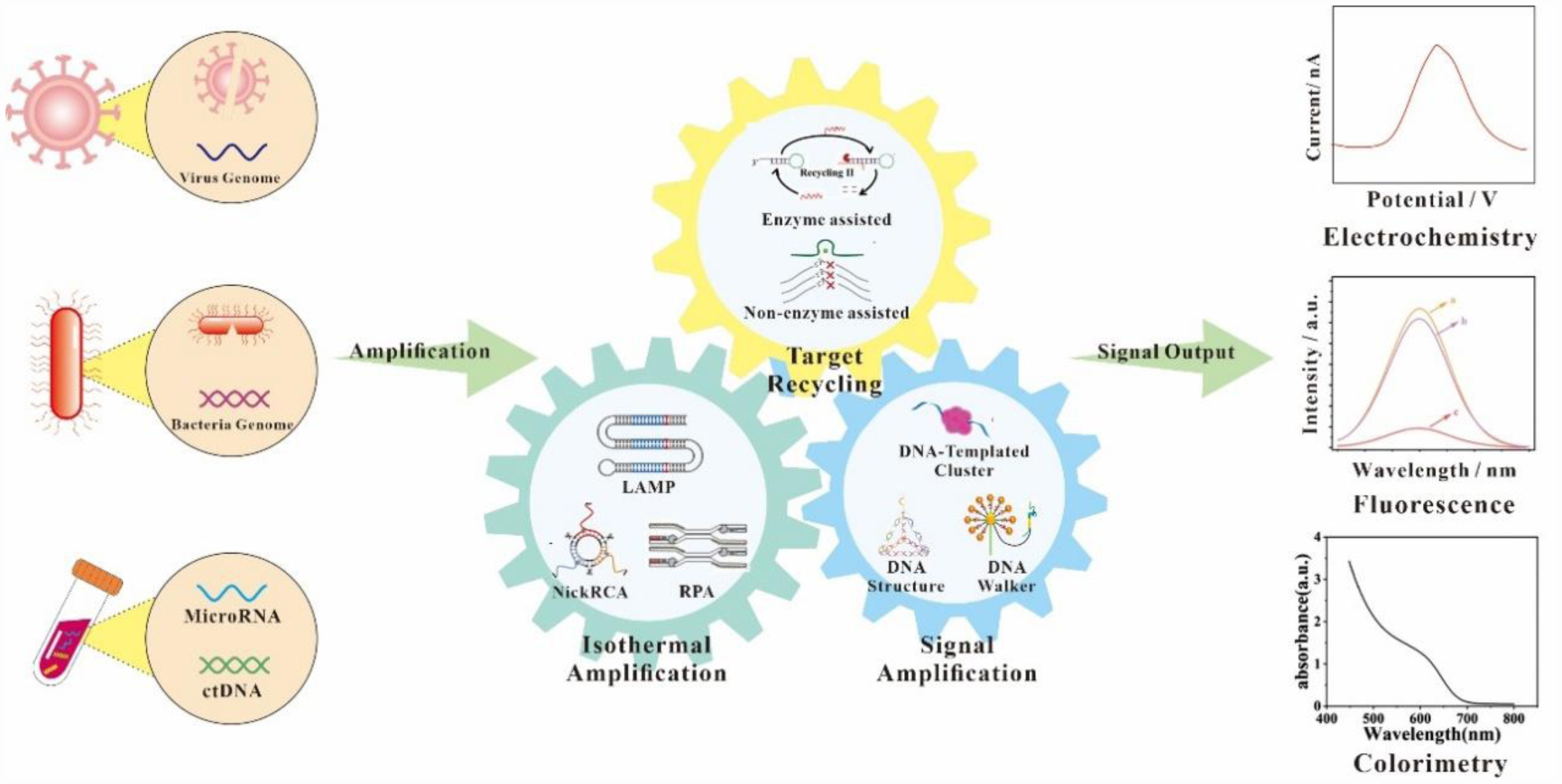
Nucleic acid testing (NAT) is widely used in disease screening and diagnosis due to its high sensitivity and strong specificity. In addition, whole blood circulation analysis has become a promising non-invasive strategy for cancer diagnosis and surveillance. With the growing testing demand and the advancement of new amplification technologies, nucleic acid detection methods are evolving toward simplicity, speed, and cost-effectiveness. As the gold standard in nucleic acid detection, real-time fluorescence quantitative PCR (qPCR) relies on expensive fluorescence reading equipment and professional operators and is not suitable for the rapid diagnosis of infectious diseases and other diseases. Biosensors have attracted the attention of scientists due to their advantages of rapidity, reliability, and cost-effectiveness. They have been widely applied in medical diagnosis, including point-of-care testing, forensic science, and biomedical research. This paper reviews the recent research progress of NAT methods for pathogenic microorganisms and disease markers and points out future prospects of point-of-care testing, with great significance in improving health care and disease surveillance in resource-constrained areas.
Citation: Zuanguang Chen, Zhixian Liang, Yiting Huang, Yifei Sun. Recent advances in nucleic acid biosensing for the detection of pathogenic microorganisms and disease biomarkers[J]. AIMS Biophysics, 2025, 12(3): 375-411. doi: 10.3934/biophy.2025019
Nucleic acid testing (NAT) is widely used in disease screening and diagnosis due to its high sensitivity and strong specificity. In addition, whole blood circulation analysis has become a promising non-invasive strategy for cancer diagnosis and surveillance. With the growing testing demand and the advancement of new amplification technologies, nucleic acid detection methods are evolving toward simplicity, speed, and cost-effectiveness. As the gold standard in nucleic acid detection, real-time fluorescence quantitative PCR (qPCR) relies on expensive fluorescence reading equipment and professional operators and is not suitable for the rapid diagnosis of infectious diseases and other diseases. Biosensors have attracted the attention of scientists due to their advantages of rapidity, reliability, and cost-effectiveness. They have been widely applied in medical diagnosis, including point-of-care testing, forensic science, and biomedical research. This paper reviews the recent research progress of NAT methods for pathogenic microorganisms and disease markers and points out future prospects of point-of-care testing, with great significance in improving health care and disease surveillance in resource-constrained areas.

| [1] |
Liu X, Sun Y, Song H, et al. (2024) Nanomaterials-based electrochemical biosensors for diagnosis of COVID-19. Talanta 274: 125994. https://doi.org/10.1016/j.talanta.2024.125994 
|
| [2] |
Yan Y, Shang G, Xie J, et al. (2024) Rapid and sensitive detection of SARS-CoV-2 based on a phage-displayed scFv antibody fusion with alkaline phosphatase and NanoLuc luciferase. Anal Chim Acta 1322: 343057. https://doi.org/10.1016/j.aca.2024.343057
|
| [3] |
Bai H, Wang Y, Li X, et al. (2023) Electrochemical nucleic acid sensors: competent pathways for mobile molecular diagnostics. Biosens Bioelectron 237: 115407. https://doi.org/10.1016/j.bios.2023.115407
|
| [4] |
Wang X, Sun K, Wang H (2024) Point-of-care nucleic acid testing with a one-step branched-DNA-based functional carbon biosensor. Cell Reports Phys Sci 5: 101753. https://doi.org/10.1016/j.xcrp.2023.101753
|
| [5] |
Shang Y, Xing G, Lin H, et al. (2024) Development of nucleic acid extraction and real-time recombinase polymerase amplification (RPA) assay integrated microfluidic biosensor for multiplex detection of foodborne bacteria. Food Control 155: 110047. https://doi.org/10.1016/j.foodcont.2023.110047
|
| [6] |
Ma C, Zou M, Xu N, et al. (2024) Portable, and ultrasensitive HR-HPV tests based on nucleic acid biosensors. Front Cell Infect Mi 14: 1357090. https://doi.org/10.3389/fcimb.2024.1357090
|
| [7] |
Vogelstein B, Kinzler KW (1999) Digital PCR. PNAS 96: 9236-9241. https://doi.org/10.1073/pnas.96.16.9236
|
| [8] |
Guo W, Li Q, Yang X, et al. (2024) Research progress in fluorescent biosensor technology for detecting Escherichia coli based on PCR. Sensor Rev 44: 682-695. https://doi.org/10.1108/sr-04-2024-0384
|
| [9] |
Yin J, Zou Z, Yin F, et al. (2020) A Self-priming digital polymerase chain reaction chip for multiplex genetic analysis. ACS Nano 14: 10385-10393. https://doi.org/10.1021/acsnano.0c04177
|
| [10] |
Tang Z, Reynolds D E, Lv C, et al. (2024) A versatile microchannel array device for portable and parallel droplet generation. Small Sci 4: 2400005. https://doi.org/10.1002/smsc.202400005
|
| [11] |
Jiang K, Zhang T, Liu C, et al. (2025) An integrated droplet microfluidic chip for digital polymerase chain reaction with a fountain-like structure capable of removing bubble. Sensor Actuat B-Chem 433: 137540. https://doi.org/10.1016/j.snb.2025.137540
|
| [12] |
Su LD, Chiu CY, Gaston D, et al. (2024) Clinical metagenomic next-generation sequencing for diagnosis of central nervous system infections: advances and challenges. Mol Diagn Ther 28: 513-523. https://doi.org/10.1007/s40291-024-00727-9
|
| [13] |
Lim L, Ab Majid AH (2024) Draft genome datasets for Cimex hemipterus from 454 Roche shotgun sequencings and Illumina HiSeq. Data Brief 56: 110811. https://doi.org/10.1016/j.dib.2024.110811
|
| [14] |
Singh RR, Patel KP, Routbort MJ, et al. (2013) Clinical validation of a next-generation sequencing screen for mutational hotspots in 46 cancer-related genes. J Mol Diagn 15: 607-622. https://doi.org/10.1016/j.jmoldx.2013.05.003
|
| [15] |
Freitas I, Velo-Antón G, Lopes S, et al. (2024) Isolation and characterization of polymorphic microsatellite loci for the three Iberian vipers, Vipera aspis, V. Latastei and V. seoanei by Illumina MiSeq sequencing. Mol Biol Rep 51: 294. https://doi.org/10.1007/s11033-024-09263-5
|
| [16] |
Cao G, Qiu Y, Long K, et al. (2022) Carbon nanodots combined with loop-mediated isothermal amplification (LAMP) for detection of African swine fever virus (ASFV). Microchim Acta 189: 342. https://doi.org/10.1007/s00604-022-05390-7
|
| [17] |
Lalli MA, Langmade JS, Chen X, et al. (2021) Rapid and extraction-free detection of SARS-CoV-2 from saliva by colorimetric reverse-transcription loop-mediated isothermal amplification. Clin Chem 67: 415-424. https://doi.org/10.1093/clinchem/hvaa267
|
| [18] |
Xu Z, Chen D, Li T, et al. (2022) Microfluidic space coding for multiplexed nucleic acid detection via CRISPR-Cas12a and recombinase polymerase amplification. Nat Commun 13: 6480. https://doi.org/10.1038/s41467-022-34086-y
|
| [19] |
Ying N, Wang Y, Qin B, et al. (2025) Lateral flow nucleic acid assay for Ecytonucleospora hepatopenaei based on recombinase polymerase amplification and strand displacement reaction. Dis Aquat Organ 162: 17-26. https://doi.org/10.3354/dao03847
|
| [20] |
Li J, Huang H, Song Z, et al. (2025) Palm-sized CRISPR sensing platform for on-site Mycoplasma pneumoniae detection. Biosens Bioelectron 281: 117458. https://doi.org/10.1016/j.bios.2025.117458
|
| [21] |
Fang Y, Nie L, Wang S, et al. (2024) A universal fluorescence biosensor based on rolling circle amplification and locking probe for DNA detection. Microchim Acta 191: 437. https://doi.org/10.1007/s00604-024-06501-2
|
| [22] |
Ju C, Li X, Wang D, et al. (2025) Ultrasensitive detection of microRNAs based on cascade amplification strategy of RCA-PER and Cas12a. Analyst 150: 692-699. https://doi.org/10.1039/d4an01463d
|
| [23] |
Yu L, Tang Y, Sun Y, et al. (2025) DMSO enhanced one-pot HDA-CRISPR/Cas12a biosensor for ultrasensitive detection of Monkeypox virus. Talanta 287: 127660. https://doi.org/10.1016/j.talanta.2025.127660
|
| [24] |
Zhu Z, Pei Q, Li J, et al. (2022) Two-stage nicking enzyme signal amplification (NESA)-based biosensing platform for the ultrasensitive electrochemical detection of pathogenic bacteria. Anal Methods 14: 1490-1497. https://doi.org/10.1039/d1ay02103f
|
| [25] |
Wan L, Zhou J, Yu L, et al. (2025) Rapid, highly specific and sensitive detection of human adenovirus using multiple cross displacement amplification coupled with CRISPR-Cas12a-based detection. Talanta Open 11: 100462. https://doi.org/10.1016/j.talo.2025.100462
|
| [26] |
Chen Y, Xia W, Pan Z, et al. (2025) Development of a cell-free, toehold switch-based biosensor for rapid and sensitive Zika Virus detection. Anal Chem 97: 3486-3494. https://doi.org/10.1021/acs.analchem.4c05808
|
| [27] |
Zhang J, Xie B, He H, et al. (2024) Target-assisted self-cleavage DNAzyme electrochemical biosensor for MicroRNA detection with signal amplification. Chem Commun 60: 12904-12907. https://doi.org/10.1039/d4cc04190a
|
| [28] |
Wang Q, Yu L, Peng Y, et al. (2024) Electrochemiluminescence biosensor based on a duplex-specific nuclease and dual-output toehold-mediated strand displacement cascade amplification strategy for sensitive detection of microRNA-499. Anal Chem 96: 15624-15630. https://doi.org/10.1021/acs.analchem.4c02515
|
| [29] |
Tian S, Ding F, Wang HY, et al. (2025) Multivalent DNAzyme nanomachine generated by exonuclease III-assisted recycling for fabricating ultrasensitive electrochemical biosensor. Sensor Actuat B-Chem 428: 137260. https://doi.org/10.1016/j.snb.2025.137260
|
| [30] |
Liu ZJ, Yang LY, Lu TC, et al. (2022) A zero-background electrochemical DNA sensor coupling ligase chain reaction with lambda exonuclease digestion for CYP2C19*2 allele genotyping in clinical samples. Sensor Actuat B-Chem 368: 132096. https://doi.org/10.1016/j.snb.2022.132096
|
| [31] |
Lu TC, Xu YQ, Li JY, et al. (2024) Inverted sandwich-type e-LCR aided by Lambda Exonuclease-RecJf combination enables ultrasensitive detection of low-frequency EGFR-L858R mutation in NSCLC. Anal Chem 96: 13379-13388. https://doi.org/10.1021/acs.analchem.4c00300
|
| [32] |
Li S, Zhu L, Lin S, et al. (2023) Toehold-mediated biosensors: Types, mechanisms and biosensing strategies. Biosens Bioelectron 220: 114922. https://doi.org/10.1016/j.bios.2022.114922
|
| [33] |
Zhang Y, Xu G, Lian G, et al. (2020) Electrochemiluminescence biosensor for miRNA-21 based on toehold-mediated strand displacement amplification with Ru(phen)32+ loaded DNA nanoclews as signal tags. Biosens Bioelectron 147: 111789. https://doi.org/10.1016/j.bios.2019.111789
|
| [34] |
Liu W, Chen A, Li S, et al. (2019) Perylene derivative/luminol nanocomposite as a strong electrochemiluminescence emitter for construction of an ultrasensitive microRNA biosensor. Anal Chem 91: 1516-1523. https://doi.org/10.1021/acs.analchem.8b04638
|
| [35] |
Bai D, Zhou X, Luo W, et al. (2022) Cooperative strand displacement circuit with dual-toehold and bulge-loop structure for single-nucleotide variations discrimination. Biosens Bioelectron 216: 114677. https://doi.org/10.1016/j.bios.2022.114677
|
| [36] |
Zhang Y, Yang C, He J, et al. (2022) Target DNA-activating proximity-localized catalytic hairpin assembly enables forming split-DNA Ag nanoclusters for robust and sensitive fluorescence biosensing. Anal Chem 94: 14947-14955. https://doi.org/10.1021/acs.analchem.2c02733
|
| [37] |
Hou Y, Huang Y, Du Y, et al. (2025) DNA nanoframework-confined well-organized catalytic hairpin assembly for highly sensitive and specific detection of MiRNA. Talanta 290: 127788. https://doi.org/10.1016/j.talanta.2025.127788
|
| [38] |
Li W, Wang W, Luo S, et al. (2023) A sensitive and rapid electrochemical biosensor for sEV-miRNA detection based on domino-type localized catalytic hairpin assembly. J Nanobiotechnol 21: 328. https://doi.org/10.1186/s12951-023-02092-x
|
| [39] |
Hu X, Tan W, Cheng S, et al. (2023) Nucleic acid and nanomaterial-assisted signal-amplified strategies in fluorescent analysis of circulating tumor cells and small extracellular vesicles. Anal Bioanal Chem 415: 3769-3787. https://doi.org/10.1007/s00216-022-04509-2
|
| [40] |
Yu J, Liu Q, Qi L, et al. (2024) Fluorophore and nanozyme-functionalized DNA walking: A dual-mode DNA logic biocomputing platform for microRNA sensing in clinical samples. Biosens Bioelectron 252: 116137. https://doi.org/10.1016/j.bios.2024.116137
|
| [41] |
Tsai TT, Chen CA, Yi-Ju Ho N, et al. (2019) Fluorescent double-stranded DNA-templated copper nanoprobes for rapid diagnosis of Tuberculosis. Acs Sens 4: 2885-2892. https://doi.org/10.1021/acssensors.9b01163
|
| [42] |
Bai L, Chen Y, Liu X, et al. (2019) Ultrasensitive electrochemical detection of Mycobacterium tuberculosis IS6110 fragment using gold nanoparticles decorated fullerene nanoparticles/nitrogen-doped graphene nanosheet as signal tags. Anal Chim Acta 1080: 75-83. https://doi.org/10.1016/j.aca.2019.06.043
|
| [43] |
Chu M, Zhang Y, Ji C, et al. (2024) DNA nanomaterial-based electrochemical biosensors for clinical diagnosis. ACS Nano 18: 31713-31736. https://doi.org/10.1021/acsnano.4c11857
|
| [44] |
Zhao Y, Zuo X, Li Q, et al. (2021) Nucleic acids analysis. Sci China-Chem 64: 171-203. https://doi.org/10.1007/s11426-020-9864-7
|
| [45] |
Tian R, Ma W, Liang L, et al. (2024) Covalent organic frameworks-based bimetal nanomaterials and three-enzymes reaction for ultrasensitively electrochemical detection of circRNA. Microchem J 206: 111631. https://doi.org/10.1016/j.microc.2024.111631
|
| [46] |
Jia YL, Li XQ, Wang ZX, et al. (2024) Logic signal amplification system for sensitive electrochemiluminescence detection and subtype identification of cancer cells. Anal Chem 96: 7172-7178. https://doi.org/10.1021/acs.analchem.4c00754
|
| [47] |
Wang W, Yu S, Huang S, et al. (2019) Bioapplications of DNA nanotechnology at the solid-liquid interface. Chem Soc Rev 48: 4892-4920. https://doi.org/10.1039/c8cs00402a
|
| [48] |
Miao P, Chai H, Tang Y (2022) DNA hairpins and dumbbell-wheel tansitions amplified walking nanomachine for ultrasensitive nucleic acid detection. ACS Nano 16: 4726-4733. https://doi.org/10.1021/acsnano.1c11582
|
| [49] |
Cui YB, Yan H, Sun Z, et al. (2023) A photoelectrochemical biosensor based on ZnIn2S4@AuNPs coupled with circular bipedal DNA walker for signal-on detection of circulating tumor DNA. Biosens Bioelectron 231: 115295. https://doi.org/10.1016/j.bios.2023.115295
|
| [50] |
Hou TL, Zhu L, Zhang XL, et al. (2022) Multiregion linear DNA walker-mediated ultrasensitive electrochemical biosensor for miRNA detection. Anal Chem 94: 10524-10530. https://doi.org/10.1021/acs.analchem.2c02004
|
| [51] |
Razzaq A, Saleem F, Kanwal M, et al. (2019) Modern trends in plant genome editing: an inclusive review of the CRISPR/Cas9 toolbox. Int J Mol Sci 20: 4045. https://doi.org/10.3390/ijms20164045
|
| [52] |
Dai Y, Wu Y, Liu G, et al. (2020) CRISPR mediated biosensing toward understanding cellular biology and point-of-care diagnosis. Angew Chem Int Ed Engl 59: 20754-20766. https://doi.org/10.1002/anie.202005398
|
| [53] |
Zhong JL, Chen Y, Dong YY, et al. (2025) SPARC: An orthogonal Cas12a/Cas13a dual-channel CRISPR platform for reliable SNV identification and mutation confirmation. Anal Chem 97: 14629-14636. https://doi.org/10.1021/acs.analchem.5c02141
|
| [54] |
Deng AN, Mao ZY, Jin XY, et al. (2025) ID-CRISPR: A CRISPR/Cas12a platform for label-free and sensitive detection of rare mutant alleles using self-interference DNA hydrogel reporter. Biosens Bioelectron 278: 117309. https://doi.org/10.1016/j.bios.2025.117309
|
| [55] | Li SY, Cheng QX, Wang JM, et al. (2018) CRISPR-Cas12a-assisted nucleic acid detection. Cell Discov 4: 20. https://doi.org/10.1038/s41421-018-0028-z |
| [56] |
Li LX, Li SY, Wu N, et al. (2019) HOLMESv2: a CRISPR-Cas12b-assisted platform for nucleic acid detection and DNA methylation quantitation. ACS Synth Biol 8: 2228-2237. https://doi.org/10.1021/acssynbio.9b00209
|
| [57] |
Gootenberg JS, Abudayyeh OO, Lee JW, et al. (2017) Nucleic acid detection with CRISPR-Cas13a/C2c2. Science 356: 438-442. https://doi.org/10.1126/science.aam9321
|
| [58] |
Gootenberg JS, Abudayyeh OO, Kellner MJ, et al. (2018) Multiplexed and portable nucleic acid detection platform with Cas13, Cas12a, and Csm6. Science 360: 439. https://doi.org/10.1126/science.aaq0179
|
| [59] | Yang Y, Yi W, Gong F, et al. (2022) CRISPR/Cas13a trans-cleavage-triggered catalytic hairpin assembly assay for specific and ultrasensitive SARS-CoV-2 RNA detection. Anal Chem 95: 1343-1349. https://doi.org/10.1021/acs.analchem.2c04306 |
| [60] | Xue Y, Luo X, Xu W, et al. (2022) PddCas: a polydisperse droplet digital CRISPR/Cas-based assay for the rapid and ultrasensitive amplification-free detection of viral DNA/RNA. Anal Chem 95: 966-975. https://doi.org/10.1021/acs.analchem.2c03590 |
| [61] |
Sen A, Masetty M, Weerakoon S, et al. (2024) Paper-based loop-mediated isothermal amplification and CRISPR integrated platform for on-site nucleic acid testing of pathogens. Biosens Bioelectron 257: 116292. https://doi.org/10.1016/j.bios.2024.116292
|
| [62] |
Hu O, Li Z, Wu J, et al. (2023) A multicomponent nucleic acid enzyme-cleavable quantum dot nanobeacon for highly sensitive diagnosis of Tuberculosis with the naked eye. Acs Sens 8: 254-262. https://doi.org/10.1021/acssensors.2c02114
|
| [63] |
Hu O, Gong Y, Chang Y, et al. (2024) Fluorescent and colorimetric dual-readout platform for tuberculosis point-of-care detection based on dual signal amplification strategy and quantum dot nanoprobe. Biosens Bioelectron 264: 116641. https://doi.org/10.1016/j.bios.2024.116641
|
| [64] |
Bai Y, Xu P, Li S, et al. (2024) Signal amplification strategy of DNA self-assembled biosensor and typical applications in pathogenic microorganism detection. Talanta 272: 125759. https://doi.org/10.1016/j.talanta.2024.125759
|
| [65] |
Zhu H, Zhao S, Luo J, et al. (2025) Differential detection of ovine Theileria species using loop-mediated isothermal amplification combined with nanoparticle-based lateral flow biosensor. Vet Parasitol 336: 110443. https://doi.org/10.1016/j.vetpar.2025.110443
|
| [66] |
Chen M, He Q, Tong Y, et al. (2021) A universal fluorescent sensing system for pathogen determination based on loop-mediated isothermal amplification triggering dual-primer rolling circle extension. Sensor Actuat B-Chem 331: 129436. https://doi.org/10.1016/j.snb.2021.129436
|
| [67] |
Tang R, Yang J, Shao C, et al. (2025) Two-dimensional nanomaterials-based optical biosensors empowered by machine learning for intelligent diagnosis. Trac-Trend Anal Chem 185: 118162. https://doi.org/10.1016/j.trac.2025.118162
|
| [68] |
Wang R, Qian C, Pang Y, et al. (2021) opvCRISPR: One-pot visual RT-LAMP-CRISPR platform for SARS-cov-2 detection. Biosens Bioelectron 172: 112766. https://doi.org/10.1016/j.bios.2020.112766
|
| [69] |
Dong J, Ma W, Zhou S, et al. (2025) Tri-mode CRISPR-based biosensor for miRNA detection: enhancing clinical diagnostics with cross-validation. Anal Chem 97: 10938-10946. https://doi.org/10.1021/acs.analchem.5c02348
|
| [70] |
Xiong E, Jiang L, Tian T, et al. (2021) Simultaneous dual-gene diagnosis of SARS-CoV-2 based on CRISPR/Cas9-mediated lateral flow assay. Angew Chem Int Edit 60: 5307-5315. https://doi.org/10.1002/anie.202014506
|
| [71] |
Zhou B, Fan T, Chen H, et al. (2025) Development of a multi-miRNA detection platform for enhanced diagnostics of colorectal cancer. Biosens Bioelectron 287: 117639. https://doi.org/10.1016/j.bios.2025.117639
|
| [72] |
Wang C, Wang Q, Jin Y, et al. (2025) Lambda exonuclease assisted helicase-dependent amplification CRISPR/Cas12a detection of Listeria monocytogenes. Biochimie 235: 106-112. https://doi.org/10.1016/j.biochi.2025.06.002
|
| [73] |
Xing X, Gao M, Lei M, et al. (2024) MOF-mediated dual energy transfer nanoprobe integrated with exonuclease III amplification strategy for highly sensitive detection of DNA. Anal Methods 16: 1916-1922. https://doi.org/10.1039/d4ay00127c
|
| [74] |
Shi C, Yang D, Ma X, et al. (2024) A programmable DNAzyme for the sensitive detection of nucleic acids. Angew Chem Int Edit 63: 202320179. https://doi.org/10.1002/anie.202320179
|
| [75] |
Qi Y, Chen Y, Huang Y, et al. (2025) Construction of an efficient microRNA sensing platform based on terminal deoxynucleotidyl transferase-mediated synthesis of copper nanoclusters. Sensor Actuat B-Chem 424: 136892. https://doi.org/10.1016/j.snb.2024.136892
|
| [76] |
Liang G, Ye S, Yu H, et al. (2022) A potent fluorescent biosensor integrating 3D DNA walker with localized catalytic hairpin assembly for highly sensitive and enzyme-free Zika virus detection. Sensor Actuat B-CHEM 354: 131199. https://doi.org/10.1016/j.snb.2021.131199
|
| [77] |
Tan X, Yang X, Qiao Y, et al. (2023) Ligation-dependent Cas14a1-Activated biosensor for one-pot pathogen diagnostic. Anal Chim Acta 1271: 341470. https://doi.org/10.1016/j.aca.2023.341470
|
| [78] |
Sadanandan S, Meenakshi V, Ramkumar K, et al. (2023) Biorecognition elements appended gold nanoparticle biosensors for the detection of food-borne pathogens-A review. Food Control 148: 109510. https://doi.org/10.1016/j.foodcont.2022.109510
|
| [79] |
Zhou B, Ye Q, Li F, et al. (2022) CRISPR/Cas12a based fluorescence-enhanced lateral flow biosensor for detection of Staphylococcus aureus. Sensor Actuat B-Chem 351: 130906. https://doi.org/10.1016/j.snb.2021.130906
|
| [80] |
Wang H, Chen S, Liu J, et al. (2024) A novel sensitization strategy for uncertain single stranded probe on electrode surface based on terminal deoxynucleotidyl transferase and G-rich spherical nucleic acids. Chem Eng J 498: 155899. https://doi.org/10.1016/j.cej.2024.155899
|
| [81] |
Sun H, Zhang X, Ma H, et al. (2024) A programmable sensitive platform for pathogen detection based on CRISPR/Cas12a -hybridization chain reaction-poly T-Cu. Anal Chim Acta 1317: 342888. https://doi.org/10.1016/j.aca.2024.342888
|
| [82] |
Bai Z, Xu X, Wang C, et al. (2022) A comprehensive review of detection methods for Escherichia coli O157:H7. Trac-Trend Anal Chem 152: 116646. https://doi.org/10.1016/j.trac.2022.116646
|
| [83] |
Shi F, Wang B, Yan L, et al. (2022) In-situ growth of nitrogen-doped carbonized polymer dots on black phosphorus for electrochemical DNA biosensor of Escherichia coli O157: H7. Bioelectrochemistry 148: 108226. https://doi.org/10.1016/j.bioelechem.2022.108226
|
| [84] |
Shang Y, Xing G, Liu X, et al. (2022) Fully integrated microfluidic biosensor with finger actuation for the ultrasensitive detection of Escherichia coli O157:H7. Anal Chem 94: 16787-16795. https://doi.org/10.1021/acs.analchem.2c03686
|
| [85] |
Hasan M, Anzar N, Sharma P, et al. (2024) Mycobacterium tuberculosis diagnosis from conventional to biosensor-a systematic review. Int J Environ Anal Chem 104: 6519-6534. https://doi.org/10.1080/03067319.2022.2147427
|
| [86] | Zhang H, Dai X, Hu P, et al. (2024) Comparison of targeted next-generation sequencing and the Xpert MTB/RIF assay for detection of Mycobacterium tuberculosis in clinical isolates and sputum specimens. Microbiol Spectr 12: e04098-23. https://doi.org/10.1128/spectrum.04098-23 |
| [87] |
Zhang J, He F (2022) Mycobacterium tuberculosis piezoelectric sensor based on AuNPs-mediated enzyme assisted signal amplification. Talanta 236: 122902. https://doi.org/10.1016/j.talanta.2021.122902
|
| [88] |
Xiao J, Li J, Quan S, et al. (2023) Development and preliminary assessment of a CRISPR-Cas12a-based multiplex detection of Mycobacterium tuberculosis complex. Front Bioeng Biotechnol 11: 1233353. https://doi.org/10.3389/fbioe.2023.1233353
|
| [89] |
Tian B, Fock J, Minero G, et al. (2019) Ultrasensitive real-time rolling circle amplification detection enhanced by nicking-induced tandem-acting polymerases. Anal Chem 91: 10102-10109. https://doi.org/10.1021/acs.analchem.9b02073
|
| [90] |
Liang L, Chen M, Hu O, et al. (2023) A novel fluorescence method based on loop-mediated isothermal amplification and universal molecular beacon in Mycobacterium tuberculosis detection. Talanta 253: 123996. https://doi.org/10.1016/j.talanta.2022.123996
|
| [91] |
Oslan S, Yusof N, Lim S, et al. (2024) Rapid and sensitive detection of Salmonella in agro-Food and environmental samples: A review of advances in rapid tests and biosensors. J Microbiol Meth 219: 106897. https://doi.org/10.1016/j.mimet.2024.106897
|
| [92] |
Shen Y, Jia F, He Y, et al. (2024) A CRISPR-Cas12a-powered, quantum dot-based and magnetic nanoparticle-assisted (QD-CRISPR-MNP) biosensor for the screening of Salmonella. Microchem J 200: 110438. https://doi.org/10.1016/j.microc.2024.110438
|
| [93] |
Huang Y, Zhang Y, Yan X, et al. (2025) A novel dual fluorescence and visual method based on a DNA hydrogel-CRISPR biosensor for precise quantitative detection of Salmonella Typhimurium. Food Biosci 63: 105606. https://doi.org/10.1016/j.fbio.2024.105606
|
| [94] |
Kim T, Zhu X, Kim S, et al. (2023) A review of nucleic acid-based detection methods for foodborne viruses: Sample pretreatment and detection techniques. Food Res Int 174: 113502. https://doi.org/10.1016/j.foodres.2023.113502
|
| [95] |
Elgazar A, Sabouni R, Ghommem M (2024) Metal-organic framework-based composites for rapid and sensitive virus detection: current status and future prospective. Chembioeng Rev 11: 457-482. https://doi.org/10.1002/cben.202300061
|
| [96] |
Zhuo C, Song Z, Cui J, et al. (2023) Electrochemical biosensor strategy combining DNA entropy-driven technology to activate CRISPR-Cas13a activity and triple-stranded nucleic acids to detect SARS-CoV-2 RdRp gene. Microchim Acta 190: 272. https://doi.org/10.1007/s00604-023-05848-2
|
| [97] |
Zhang K, Fan Z, Huang Y, et al. (2022) Hybridization chain reaction circuit-based electrochemiluminescent biosensor for SARS-cov-2 RdRp gene assay. Talanta 240: 123207. https://doi.org/10.1016/j.talanta.2022.123207
|
| [98] |
Li H, Yang J, Wu G, et al. (2022) Amplification-free detection of SARS-CoV-2 and respiratory syncytial virus using CRISPR Cas13a and graphene field-effect transistors. Angew Chem Int Edit 61: e202203826. https://doi.org/10.1002/anie.202203826
|
| [99] |
Zhu X, Wang X, Han L, et al. (2020) Multiplex reverse transcription loop-mediated isothermal amplification combined with nanoparticle-based lateral flow biosensor for the diagnosis of COVID-19. Biosens Bioelectron 166: 112437. https://doi.org/10.1016/j.bios.2020.112437
|
| [100] |
Zhang Y, Huang X, Li W, et al. (2023) Dual-target nucleic acid sequences responsive electrochemiluminescence biosensor using single type carbon dots as probe for SARS-CoV-2 detection based on series catalytic hairpin assembly amplification. Sensor Actuat B-Chem 379: 133223. https://doi.org/10.1016/j.snb.2022.133223
|
| [101] |
Shi W, Li K, Zhang Y (2023) The advancement of nanomaterials for the detection of Hepatitis B Virus and Hepatitis C Virus. Molecules 28: 7201. https://doi.org/10.3390/molecules28207201
|
| [102] |
Huang S, Li H, Yang M, et al. (2025) MX/MWCNTs composite material aids new strategy for HBV-DNA electrochemical biosensor: achieving multi-level signal amplification and unlabeled detection. Adv Compos Hybrid Ma 8: 127. https://doi.org/10.1007/s42114-025-01215-2
|
| [103] |
Tao Y, Yi K, Wang H, et al. (2022) Metal nanoclusters combined with CRISPR-Cas12a for hepatitis B virus DNA detection. Sensor Actuat B-Chem 361: 131711. https://doi.org/10.1016/j.snb.2022.131711
|
| [104] | Zhang H, Shi Y, Wu Z, et al. (2025) Nanoparticle-based biosensor integrated with multiple cross-displacement amplification for visual and rapid identification of hepatitis B virus and hepatitis C virus. Microbiol Spectr 13: e01738-24. https://doi.org/10.1128/spectrum.01738-24 |
| [105] |
El Merhebi O, Ojeda J, Torres-Salvador F, et al. (2024) Sequence-independent assay for viral load quantification of HIV subtypes. Sensor Actuat B-Chem 417: 136202. https://doi.org/10.1016/j.snb.2024.136202
|
| [106] |
Liu J, Zhang Y, Yuan R, et al. (2023) Fluorine-nitrogen co-doped carbon dots with stable and strong electrochemiluminescence as an emitter for ultrasensitive detection of HIV-DNA fragment. Sensor Actuat B-Chem 379: 133260. https://doi.org/10.1016/j.snb.2022.133260
|
| [107] |
Shi R, Fu S, Xu Y, et al. (2023) Cell membranes cloaked magnetic nanoparticles for target recycling detection of nucleic acid. Chem Eng J 475: 146170. https://doi.org/10.1016/j.cej.2023.146170
|
| [108] |
Li Z, Uno N, Ding X, et al. (2023) Bioinspired CRISPR-mediated cascade reaction biosensor for molecular detection of HIV using a glucose meter. ACS Nano 17: 3966-3975. https://doi.org/10.1021/acsnano.2c12754
|
| [109] |
Le L, Nguyen A, Phan L, et al. (2024) Current smartphone-assisted point-of-care cancer detection: Towards supporting personalized cancer monitoring. Trac-Trend Anal Chem 174: 117681. https://doi.org/10.1016/j.trac.2024.117681
|
| [110] |
Jayanthi V, Das A, Saxena U (2017) Recent advances in biosensor development for the detection of cancer biomarkers. Biosens Bioelectron 91: 15-23. https://doi.org/10.1016/j.bios.2016.12.014
|
| [111] |
Chiorcea-Paquim A (2023) Advances in electrochemical biosensor technologies for the detection of nucleic acid breast cancer biomarkers. Sensors-Basel 23: 4128. https://doi.org/10.3390/s23084128
|
| [112] |
Friedman R, Farh K, Burge C, et al. (2009) Most mammalian mRNAs are conserved targets of microRNAs. Genome Res 19: 92-105. https://doi.org/10.1101/gr.082701.108
|
| [113] | Zhang J, Zhao H, Gao Y, et al. (2012) Secretory miRNAs as novel cancer biomarkers. BBA-Rev Cancer 1826: 32-43. https://doi.org/10.1016/j.bbcan.2012.03.001 |
| [114] |
Peng J, Liu T, Guan L, et al. (2024) A highly sensitive Lock-Cas12a biosensor for detection and imaging of miRNA-21 in breast cancer cells. Talanta 273: 125938. https://doi.org/10.1016/j.talanta.2024.125938
|
| [115] |
Zhao Y, Cheng L, Xu M, et al. (2025) Ultra-sensitive detection of microRNAs using an electrochemical biosensor based on a PNA-DNA2 three-way junction nanostructure and dual cascade isothermal amplification. Anal Chim Acta 1345: 343755. https://doi.org/10.1016/j.aca.2025.343755
|
| [116] |
Liang Z, Ou D, Sun D, et al. (2019) Ultrasensitive biosensor for microRNA-155 using synergistically catalytic nanoprobe coupled with improved cascade strand displacement reaction. Biosens Bioelectron 146: 111744. https://doi.org/10.1016/j.bios.2019.111744
|
| [117] |
Liang Z, Huang X, Tong Y, et al. (2022) Engineering an endonuclease-assisted rolling circle amplification synergistically catalyzing hairpin assembly mediated fluorescence platform for miR-21 detection. Talanta 247: 123568. https://doi.org/10.1016/j.talanta.2022.123568
|
| [118] |
Long Y, Zhao J, Ma W, et al. (2024) Fe single-atom carbon dots nanozyme collaborated with nucleic acid exonuclease III-driven DNA walker cascade amplification strategy for circulating tumor DNA detection. Anal Chem 96: 4774-4782. https://doi.org/10.1021/acs.analchem.3c04202
|
| [119] |
Wu Z, Zheng H, Bian Y, et al. (2024) A quadratic isothermal amplification fluorescent biosensor without intermediate purification for ultrasensitive detection of circulating tumor DNA. Analyst 149: 3396-3404. https://doi.org/10.1039/d4an00460d
|
| [120] |
Wu S, Liu Y, Zeng T, et al. (2025) Enhanced the trans-cleavage activity of CRISPR-Cas12a using metal-organic frameworks as stimulants for efficient electrochemical sensing of circulating tumor DNA. Adv Sci : 2417206. https://doi.org/10.1002/advs.202417206
|
| [121] |
Akkas T, Reshadsedghi M, Sen M, et al. (2025) The role of artificial intelligence in advancing biosensor technology: past, present, and future perspectives. Adv Mater : 2504796. https://doi.org/10.1002/adma.202504796
|


Figures(15) / Tables(3)

Zuanguang Chen, Zhixian Liang, Yiting Huang, Yifei Sun. Recent advances in nucleic acid biosensing for the detection of pathogenic microorganisms and disease biomarkers[J]. AIMS Biophysics, 2025, 12(3): 375-411. doi: 10.3934/biophy.2025019





 DownLoad: