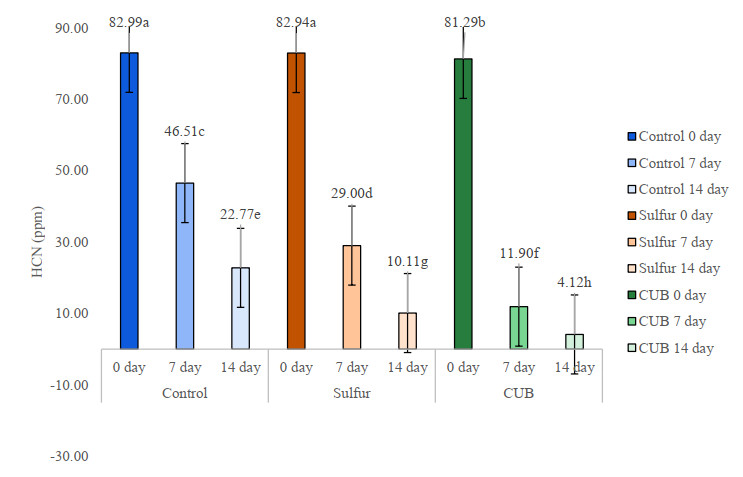
This study aimed to evaluate the effects of sulfur and cyanide-utilizing bacteria (CUB) supplementation, along with varying fermentation durations, on the nutritional quality, gas production kinetics, digestibility, and ruminal fermentation characteristics of fermented total mixed rations (FTMR) based on fresh cassava tubers. A completely randomized design (CRD) was applied in a 3 × 3 factorial arrangement consisting of three additive treatments (no additive, 1.5% sulfur, and CUB at 108 CFU/g) and three fermentation periods (0, 7, and 14 days), resulting in nine dietary treatments. The CUB strain used was Enterococcus faecium KKU-BF7, previously isolated from rumen fluid for its cyanide-degrading capability. Results revealed that both additives and fermentation time significantly (p < 0.01) affected feed chemical composition, particularly crude protein (CP), either extract (EE), acid detergent fiber (ADF), and acid detergent lignin (ADL). The highest NH3-N concentration (22.43 mg/dL; p < 0.01) was observed in the CUB group fermented for 14 days. In vitro dry matter digestibility (IVDMD) was highest in the CUB group, similar to the control, while sulfur reduced it (p < 0.01). In vitro organic matter digestibility (IVOMD) is highest on day 14 of fermentation, regardless of additive (p < 0.05). Sulfur supplementation, particularly after 14 days of fermentation, markedly reduced cumulative gas production over the 96-hour incubation period. As the fermentation time increased, acetate decreased, while propionate and butyrate increased. At the onset of fermentation (day 0), HCN concentrations were similar among treatments (≈81–83 ppm). After 7 days, CUB reduced HCN to 11.9 ppm, compared with 29.0 ppm for sulfur and 46.51 ppm for the control (p < 0.01). By day 14, HCN in the CUB group further declined to 4.12 ppm, the lowest among treatments, compared with 10.11 ppm for sulfur and 22.77 ppm for the control (p < 0.01). These findings demonstrate that CUB is a promising additive for improving cassava-based FTMR through enhanced detoxification, fermentation efficiency, and nutrient utilization. Optimization of additive type and fermentation duration can significantly enhance feed safety and energy availability in ruminant diets.
Citation: Kannika Saisombut, Suphakon Pramotchit, Molthida Rungchaicharoenphai, Anusorn Cherdthong, Chanon Suntara. Detoxification and fermentation of fresh cassava roots using sulfur and cyanide-utilizing bacteria for FTMR: An in vitro study[J]. AIMS Agriculture and Food, 2025, 10(3): 618-637. doi: 10.3934/agrfood.2025031
This study aimed to evaluate the effects of sulfur and cyanide-utilizing bacteria (CUB) supplementation, along with varying fermentation durations, on the nutritional quality, gas production kinetics, digestibility, and ruminal fermentation characteristics of fermented total mixed rations (FTMR) based on fresh cassava tubers. A completely randomized design (CRD) was applied in a 3 × 3 factorial arrangement consisting of three additive treatments (no additive, 1.5% sulfur, and CUB at 108 CFU/g) and three fermentation periods (0, 7, and 14 days), resulting in nine dietary treatments. The CUB strain used was Enterococcus faecium KKU-BF7, previously isolated from rumen fluid for its cyanide-degrading capability. Results revealed that both additives and fermentation time significantly (p < 0.01) affected feed chemical composition, particularly crude protein (CP), either extract (EE), acid detergent fiber (ADF), and acid detergent lignin (ADL). The highest NH3-N concentration (22.43 mg/dL; p < 0.01) was observed in the CUB group fermented for 14 days. In vitro dry matter digestibility (IVDMD) was highest in the CUB group, similar to the control, while sulfur reduced it (p < 0.01). In vitro organic matter digestibility (IVOMD) is highest on day 14 of fermentation, regardless of additive (p < 0.05). Sulfur supplementation, particularly after 14 days of fermentation, markedly reduced cumulative gas production over the 96-hour incubation period. As the fermentation time increased, acetate decreased, while propionate and butyrate increased. At the onset of fermentation (day 0), HCN concentrations were similar among treatments (≈81–83 ppm). After 7 days, CUB reduced HCN to 11.9 ppm, compared with 29.0 ppm for sulfur and 46.51 ppm for the control (p < 0.01). By day 14, HCN in the CUB group further declined to 4.12 ppm, the lowest among treatments, compared with 10.11 ppm for sulfur and 22.77 ppm for the control (p < 0.01). These findings demonstrate that CUB is a promising additive for improving cassava-based FTMR through enhanced detoxification, fermentation efficiency, and nutrient utilization. Optimization of additive type and fermentation duration can significantly enhance feed safety and energy availability in ruminant diets.

| [1] |
Somendrika D, Wickramasinghe I, Wansapala MAJ, et al. (2017) Nutritional composition of cassava cultivar "CARI‑555". Pak J Nutr 16: 216–220. https://doi.org/10.3923/pjn.2017.216.220 doi: 10.3923/pjn.2017.216.220

|
| [2] |
Okechukwu RU, Dixon AGO (2008) Genetic gains from 30 years of cassava breeding in Nigeria for storage root yield and disease resistance in elite cassava genotypes. J Crop Improv 22: 181–208. https://doi.org/10.1080/15427520802212506 doi: 10.1080/15427520802212506
|
| [3] | Bolarinwa I, Olaniyan SA, Olatunde S, et al. (2016) Effect of processing on amygdalin and cyanide contents of some Nigerian foods. J Chem Pharm Res 8: 106–113. |
| [4] |
Burns AE, Bradbury JH, Cavagnaro TR, et al. (2012) Total cyanide content of cassava food products in Australia. J Food Compos Anal 25: 79–82. https://doi.org/10.1016/j.jfca.2011.06.005 doi: 10.1016/j.jfca.2011.06.005
|
| [5] | Ameny MA (1990) Traditional post‑harvest technology of cassava in Uganda. Trop Sci 17: 41–50. |
| [6] | Yooyen A (2019) Cyanide poisoning from cassava leaves in livestock. NIAH Newslett 18: 1–4. |
| [7] |
Ospina MA, Tran T, Pizarro M, et al. (2024) Content and distribution of cyanogenic compounds in cassava roots and leaves in association with physiological age. J Sci Food Agric 104: 4851–4859. https://doi.org/10.1002/jsfa.13123 doi: 10.1002/jsfa.13123
|
| [8] |
Uchechukwu‑Agua AD, Caleb OJ, Opara UL (2015) Postharvest handling and storage of fresh cassava root and products: A review. Food Bioprocess Technol 8: 729–748. https://doi.org/10.1007/s11947-015-1478-z doi: 10.1007/s11947-015-1478-z
|
| [9] |
Watson AG, MA S, TB N, et al. (2024) A simple solar crop drying and pasteurizing system appropriate for smallholder and subsistence farmers in tropical and subtropical regions. Drying Technol 42: 407–422. https://doi.org/10.1080/07373937.2023.2182316 doi: 10.1080/07373937.2023.2182316
|
| [10] |
Li M, Zhang L, Zhang Q, et al. (2020) Impacts of citric acid and malic acid on fermentation quality and bacterial community of cassava foliage silage. Front Microbiol 11: 595622. https://doi.org/10.3389/fmicb.2020.595622 doi: 10.3389/fmicb.2020.595622
|
| [11] |
Pongsub S, Suntara C, Khota W, et al. (2022) The chemical composition, fermentation end‑product of silage, and aerobic stability of cassava pulp fermented with Lactobacillus casei TH14 and additives. Vet Sci 9: 617. https://doi.org/10.3390/vetsci9110617 doi: 10.3390/vetsci9110617
|
| [12] |
Lambri M, Fumi MD, Roda A, et al. (2013) Improved processing methods to reduce the total cyanide content of cassava roots from Burundi. Afr J Biotechnol 12: 2685–2691. https://doi.org/10.5897/AJB2012.2899 doi: 10.5897/AJB2012.2899
|
| [13] |
Khota W, Kaewpila C, Kimprasit T, et al. (2023) The isolation of rumen Enterococci strains along with high potential utilizing cyanide. Sci Rep 13: 13176. https://doi.org/10.1038/s41598-023-40488-9 doi: 10.1038/s41598-023-40488-9
|
| [14] | Sriwicha P, Piboonkunsamlit S, Phowang N, et al. (2024) The influence of two cyanide‑utilizing bacteria species on kinetics of gas production and rumen digestibility using in vitro gas techniques. Khon Kaen Agric J 2: 243–244. |
| [15] |
Lukbun S, Suntara C, Prachumchai R, et al. (2024) Exploring the in vitro effects of cassava diets and Enterococcus strains on rumen fermentation, gas production, and cyanide concentrations. Animals 14: 3269. https://doi.org/10.3390/ani14223269 doi: 10.3390/ani14223269
|
| [16] |
Supapong C, Sommai S, Khonkhaeng B, et al. (2022) Effect of rhodanese enzyme addition on rumen fermentation, cyanide concentration, and feed utilization in beef cattle receiving various levels of fresh cassava root. Fermentation 8: 146. https://doi.org/10.3390/fermentation8040146 doi: 10.3390/fermentation8040146
|
| [17] |
Sumadong P, Cherdthong A, So S, et al. (2021) Sulfur, fresh cassava root, and urea independently enhanced gas production, ruminal characteristics, and in vitro degradability. BMC Vet Res 17: 304. https://doi.org/10.1186/s12917-021-02999-3 doi: 10.1186/s12917-021-02999-3
|
| [18] |
Wu H, Li Y, Meng Q, et al. (2021) Effect of high sulfur diet on rumen fermentation, microflora, and epithelial barrier function in steers. Animals 11: 2545. https://doi.org/10.3390/ani11092545 doi: 10.3390/ani11092545
|
| [19] |
Supapong C, Cherdthong A, Wanapat M, et al. (2019) Effects of sulfur levels in fermented total mixed ration containing fresh cassava root on feed utilization, rumen characteristics, microbial protein synthesis, and blood metabolites in Thai native beef cattle. Animals 9: 261. https://doi.org/10.3390/ani9050261 doi: 10.3390/ani9050261
|
| [20] |
Bureenok S, Yuangklang C, Vasupen K, et al. (2012) The effects of additives in Napier grass silages on chemical composition, feed intake, nutrient digestibility, and rumen fermentation. Asian-Australas J Anim Sci 25: 1248–1254. https://doi.org/10.5713/ajas.2012.12081. doi: 10.5713/ajas.2012.12081
|
| [21] | The Working Committee of Thai Feeding Standard for Ruminant (WTRS) (2010) Nutrient requirements of beef cattle in Indochinese Peninsula, 1st Ed., Khon Kaen: Klungnanavithaya Press. |
| [22] | AOAC (1990) Official methods of analysis of the Association of the official Analytical Chemists, Washington: Association of official Analytical Chemists. Available from: https://law.resource.org/pub/us/cfr/ibr/002/aoac.methods.1.1990.pdf. |
| [23] |
Van Soest PJ, Robertson JB, Lewis BA (1991) Methods for dietary fiber, neutral detergent fiber, and non-starch polysaccharides in relation to animal nutrition. J Dairy Sci 74: 3583–3597. https://doi.org/10.3168/jds.S0022-0302(91)78551-2 doi: 10.3168/jds.S0022-0302(91)78551-2
|
| [24] |
Sommart K, Parker DS, Rowlinson P, et al. (2000) Fermentation characteristics and microbial protein synthesis in an in vitro system using cassava, rice straw, and dried ruzi grass as substrates. Asian-Australas J Anim Sci 13: 1084–1093. https://doi.org/10.5713/ajas.2000.1084 doi: 10.5713/ajas.2000.1084
|
| [25] |
Ørskov ER, McDonald I (1979) The estimation of protein degradability in the rumen from incubation measurements weighted according to rate of passage. J Agric Sci 92: 499–503. https://doi.org/10.1017/S0021859600063048 doi: 10.1017/S0021859600063048
|
| [26] |
Fawcett JK, Scott JE (1960) A rapid and precise method for the determination of urea. J Clin Pathol 13: 156–159. https://doi.org/10.1136/jcp.13.2.156 doi: 10.1136/jcp.13.2.156
|
| [27] | Samuel M, Sagathewan S, Thomas J, et al. (1997) An HPLC method for estimation of volatile fatty acids of ruminal fluid. Indian J Anim Sci 67: 805–807. |
| [28] | Sommart K, Jaikhan W, Wongtungthinthan S, et al. (2022) Applied Animal Nutrition Laboratory: Laboratory manual. Khon Kaen: Faculty of Agriculture, Khon Kaen University. |
| [29] |
Yitbarek M, Tamir B (2013) Silage additives: Review. Open J Appl Sci 4. https://doi.org/10.4236/ojapps.2014.45026 doi: 10.4236/ojapps.2014.45026
|
| [30] |
Shi R, Dong S, Mao J, et al. (2023) Dietary neutral detergent fiber levels impacting dairy cows' feeding behavior, rumen fermentation, and production performance during peak‑lactation. Animals 13: 2876. https://doi.org/10.3390/ani13182876 doi: 10.3390/ani13182876
|
| [31] |
Yan Y, Zhao M, Sun P, et al. (2025) Effects of different additives on fermentation characteristics, nutrient composition, and microbial communities of Leymus chinensis silage. BMC Microbiol 25: 296. https://doi.org/10.1186/s12866-025-04023-2 doi: 10.1186/s12866-025-04023-2
|
| [32] |
Su W, Wang C, Hao L, et al. (2020) Solid‑state fermentation of corn by‑products mixture feed with Saccharomyces cerevisiae, Lactobacillus plantarum, and protease for improving protein quality and nutrient utilization. Res Square. https://doi.org/10.21203/rs.3.rs-21430/v1 doi: 10.21203/rs.3.rs-21430/v1
|
| [33] |
Cerrato‑Sánchez M, Calsamiglia S, Ferret A (2008) Effect of the magnitude of the decrease of rumen pH on rumen fermentation in a dual‑flow continuous culture system. J Anim Sci 86: 378–383. https://doi.org/10.2527/jas.2007-0180 doi: 10.2527/jas.2007-0180
|
| [34] |
Terry RA, Tilley JMA, Outen GE (1969) Effect of pH on cellulose digestion under in vitro conditions. J Sci Food Agric 20: 317–320. https://doi.org/10.1002/jsfa.2740200514 doi: 10.1002/jsfa.2740200514
|
| [35] |
Slyter LL (1986) Ability of pH‑selected mixed ruminal microbial populations to digest fiber at various pHs. Appl Environ Microbiol 52: 390–391. https://doi.org/10.1128/aem.52.2.390-391.1986 doi: 10.1128/aem.52.2.390-391.1986
|
| [36] |
Cao Y, Takahashi T, Horiguchi K‑i, et al. (2010) Methane emissions from sheep fed fermented or non‑fermented total mixed ration containing whole‑crop rice and rice bran. Anim Feed Sci Technol 157: 72–78. https://doi.org/10.1016/j.anifeedsci.2010.02.004 doi: 10.1016/j.anifeedsci.2010.02.004
|
| [37] |
Song J, Ma Y, Zhang H, et al. (2023) Fermented total mixed ration alters rumen fermentation parameters and microbiota in dairy cows. Animals 13: 1062. https://doi.org/10.3390/ani13061062 doi: 10.3390/ani13061062
|
| [38] |
Jadav C, Makwana R, Parikh SS, et al. (2019) Hydrocyanic acid (HCN) estimation during different stages of growth in Gundrijowar (Sorghum vulgare) fodder crop. Int J Curr Microbiol Appl Sci 8: 1328–1333. https://doi.org/10.20546/ijcmas.2019.809.152 doi: 10.20546/ijcmas.2019.809.152
|
| [39] | Chanangam C, and Narongwanichgarn, W. (2021) Toxicity of cyanide in cassava leaves for beef cattle health in Na Noi district, Nan province. Nan Province, Thailand: Nanoi District Livestock Office and National Institute of Animal Health, Department of Livestock (In Thai). Available from: https://pvlo-nan.dld.go.th/webnew/images/stories/doc_download/wijai/wijai2564.pdf. |
| [40] |
Uniyal S, Chaudary L, Kala A, et al. (2020) Effect of sulphur supplementation on methane emission, energy partitioning and nutrient utilization in goats. Anim Nutr Feed Technol 20: 111. https://doi.org/10.5958/0974-181X.2020.00011.6 doi: 10.5958/0974-181X.2020.00011.6
|
| [41] |
Uniyal S, Chaudhary LC, Kala A, et al. (2022) Effect of supplementing sulphate‑reducing bacteria along with sulphur on growth performance, nutrient utilization and methane emission in goats. Trop Anim Health Prod 55: 3. https://doi.org/10.1007/s11250-022-03419-w doi: 10.1007/s11250-022-03419-w
|
| [42] |
Uniyal S, Chaudary L, Kala A, et al. (2022) Isolation and characterization of sulphate reducing bacteria from goat rumen and its inclusion to improve in vitro feed fermentation. Indian J Anim Sci 92: 96–100. https://doi.org/10.56093/ijans.v92i1.120932 doi: 10.56093/ijans.v92i1.120932
|
| [43] |
Zhao Y, Zhao G (2022) Decreasing ruminal methane production through enhancing the sulfate reduction pathway. Anim Nutr 9: 320–326. https://doi.org/10.1016/j.aninu.2022.01.006 doi: 10.1016/j.aninu.2022.01.006
|
| [44] |
Wang L (2025) Advances in nutritional manipulation of rumen fermentation. Animals 15: 833. https://doi.org/10.3390/ani15060833 doi: 10.3390/ani15060833
|
| [45] |
Sombuddee N, Prachumchai R, Khota W, et al. (2023) Effect of cyanide‑utilizing bacteria and sulfur on feed utilization, microbiomes, and cyanide degradation in cattle supplemented with fresh cassava root. Sci Rep 13: 18689. https://doi.org/10.1038/s41598-023-45993-5 doi: 10.1038/s41598-023-45993-5
|
| [46] |
Prachumchai R, Cherdthong A, Wanapat M (2021) Screening of cyanide‑utilizing bacteria from rumen and in vitro evaluation of fresh cassava root utilization with pellet containing high sulfur diet. Vet Sci 8: 10. https://doi.org/10.3390/vetsci8010010 doi: 10.3390/vetsci8010010
|
| [47] |
Paul O, Urmi S, Biswas A (2023) Effect of TMR and fermented TMR on ruminal in vitro digestion and gas production. Adv Anim Vet Sci 11: 586–594. https://doi.org/10.17582/journal.aavs/2023/11.4.586.594 doi: 10.17582/journal.aavs/2023/11.4.586.594
|
| [48] |
Liu S, Xie B, Ji H, et al. (2024) Effects of dietary supplementation with alkaline mineral complex on in vitro ruminal fermentation and bacterial composition. Front Vet Sci 11. https://doi.org/10.3389/fvets.2024.1357738 doi: 10.3389/fvets.2024.1357738
|
| [49] |
Firkins JL, Yu Z, Morrison M (2007) Ruminal nitrogen metabolism: Perspectives for integration of microbiology and nutrition for dairy. J Dairy Sci 90: E1–E16. https://doi.org/10.3168/jds.2006-518 doi: 10.3168/jds.2006-518
|
| [50] |
Niazifar M, Besharati M, Jabbar M, et al. (2024) Slow‑release non‑protein nitrogen sources in animal nutrition: A review. Heliyon 10: e33752. https://doi.org/10.1016/j.heliyon.2024.e33752 doi: 10.1016/j.heliyon.2024.e33752
|
| [51] |
Martinez‑Fernandez G, Jiao J, Padmanabha J, et al. (2020) Seasonal and nutrient supplement responses in rumen microbiota structure and metabolites of tropical rangeland cattle. Microorganisms 8: 1550. https://doi.org/10.3390/microorganisms8101550 doi: 10.3390/microorganisms8101550
|
| [52] |
Suntara C, Sombuddee N, Lukbun S, et al. (2023) In vitro evaluation of winged bean (Psophocarpus tetragonolobus) tubers as an alternative feed for ruminants. Animals 13: 677. https://doi.org/10.3390/ani13040677 doi: 10.3390/ani13040677
|
| [53] |
Wang L, Zhang G, Li Y, et al. (2020) Effects of high forage/concentrate diet on volatile fatty acid production and the microorganisms involved in VFA production in cow rumen. Animals 10: https://doi.org/10.3390/ani10020223 doi: 10.3390/ani10020223
|
| [54] |
Li MM, Ghimire S, Wenner BA, et al. (2022) Effects of acetate, propionate, and pH on volatile fatty acid thermodynamics in continuous cultures of ruminal contents. J Dairy Sci 105: 8879–8897. https://doi.org/10.3168/jds.2022-22084 doi: 10.3168/jds.2022-22084
|
Figures(1) / Tables(6)

Kannika Saisombut, Suphakon Pramotchit, Molthida Rungchaicharoenphai, Anusorn Cherdthong, Chanon Suntara. Detoxification and fermentation of fresh cassava roots using sulfur and cyanide-utilizing bacteria for FTMR: An in vitro study[J]. AIMS Agriculture and Food, 2025, 10(3): 618-637. doi: 10.3934/agrfood.2025031





 DownLoad: