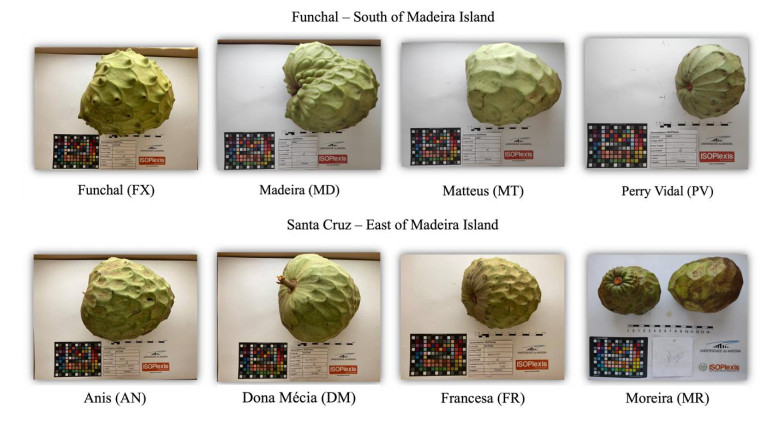
The food industry plays a critical role in waste production, and new studies that propose innovative uses to bio-residue are of high importance. Annona cherimola Mill., also known as custard apple and cherimoya, has been described as a powerful source of bioactive compounds with various applications, such as antifungal applications. Fungal infection can lead to crop productivity limitation, product contamination, and food loss. This work evaluates the antifungal action of Annona cherimola Mill. oils against Fusarium oxysporum and Aspergillus niger. The oils were extracted from peel and seeds of 8 different A. cherimola varieties exclusive to Madeira Island (Portugal) and tested for their antifungal potential. This fruit waste was tested, using two different growth measurement methods. The extracted oils restricted the fungi growth, providing the first insights on antifungal properties of the varieties waste. Between the tested tissues, peel oils exhibited a slight better action over F. oxysporum than seed oils. Overall colony expansion of F. oxysporum was better controlled by custard apple oils than A. niger. Anis exhibited distinctive action against A. niger and Funchal, Perry Vidal, Matteus, and Dona Mécia controlled better F. oxysporum growth, suggesting phytochemical differences between them. There is no previous research on the biowaste oil extracts from Annona varieties found in Madeira Island and their properties against pathogens. This study successfully opened new insights on these varieties and the results exposed interesting properties that deserve further research.
Citation: Clarissa Trindade, Carla S.S. Gouveia, Maria Cristina O. Oliveira, Humberto Nóbrega, José G.R. de Freitas, Miguel A.A. Pinheiro de Carvalho. Inhibitory activity of the peel and seed of Annona cherimola Mill. against Fusarium and Aspergillus pathogens[J]. AIMS Agriculture and Food, 2025, 10(1): 155-176. doi: 10.3934/agrfood.2025009
The food industry plays a critical role in waste production, and new studies that propose innovative uses to bio-residue are of high importance. Annona cherimola Mill., also known as custard apple and cherimoya, has been described as a powerful source of bioactive compounds with various applications, such as antifungal applications. Fungal infection can lead to crop productivity limitation, product contamination, and food loss. This work evaluates the antifungal action of Annona cherimola Mill. oils against Fusarium oxysporum and Aspergillus niger. The oils were extracted from peel and seeds of 8 different A. cherimola varieties exclusive to Madeira Island (Portugal) and tested for their antifungal potential. This fruit waste was tested, using two different growth measurement methods. The extracted oils restricted the fungi growth, providing the first insights on antifungal properties of the varieties waste. Between the tested tissues, peel oils exhibited a slight better action over F. oxysporum than seed oils. Overall colony expansion of F. oxysporum was better controlled by custard apple oils than A. niger. Anis exhibited distinctive action against A. niger and Funchal, Perry Vidal, Matteus, and Dona Mécia controlled better F. oxysporum growth, suggesting phytochemical differences between them. There is no previous research on the biowaste oil extracts from Annona varieties found in Madeira Island and their properties against pathogens. This study successfully opened new insights on these varieties and the results exposed interesting properties that deserve further research.

| [1] |
Larranaga N, Fontecha G, Albertazzi FJ, et al. (2022) Amplification of cherimoya (Annona cherimola Mill.) with chloroplast-specific markers: geographical implications on diversity and dispersion studies. Horticulturae 8: 807. https://doi.org/10.3390/horticulturae8090807 doi: 10.3390/horticulturae8090807

|
| [2] |
Durán AG, Gutiérrez MT, Mejías FJR, et al. (2021) An overview of the chemical characteristics, bioactivity and achievements regarding the therapeutic usage of acetogenins from Annona cherimola Mill. Molecules 26: 2926. https://doi.org/10.3390/molecules26102926 doi: 10.3390/molecules26102926
|
| [3] |
Varadharaj AP, Varadharaj V (2017) Phytochemical and pharmacological potential of annona species: a review. Asian J Pharm Clin Res 10: 68. https://doi.org/10.22159/ajpcr.2017.v10i7.18073 doi: 10.22159/ajpcr.2017.v10i7.18073
|
| [4] |
Jamkhande PG, Ajgunde BR, Jadge DR (2017) Annona cherimola Mill. (custard apple): a review on its plant profile, nutritional values, traditional claims and ethnomedicinal properties. Orient. Pharm Exp Med 17: 189–201. https://doi.org/10.1007/s13596-017-0263-0 doi: 10.1007/s13596-017-0263-0
|
| [5] | Datiles MJ, Acevedo-Rodríguez P (2014) Annona cherimola (cherimoya). CABI Compendium. Available from: https://www.cabidigitallibrary.org/doi/10.1079/cabicompendium.5806. |
| [6] |
Perfectti, F, Pascual, L (2005) Geographic variation for isozymes in cherimoya (Annona cherimola Mill.). Genet Resour Crop Evol 51: 837–843. https://doi.org/10.1007/s10722-005-0925-5 doi: 10.1007/s10722-005-0925-5
|
| [7] | Protected Designation of Origin 'Anona da Madeira' N.o (EU) PDO-PT-0082-AM01-5.4.2019 (2019) Official Journal of the European Union. Available from: https://eur-lex.europa.eu/legal-content/EN/TXT/HTML/?uri = CELEX: 52019XC1205(02). |
| [8] |
Caldeira C, Vlysidis A, Fiore G, et al. (2020) Sustainability of food waste biorefinery: A review on valorisation pathways, techno-economic constraints, and environmental assessment. Bioresour Technol 312: 123575. https://doi.org/10.1016/j.biortech.2020.123575 doi: 10.1016/j.biortech.2020.123575
|
| [9] |
Souza TFC, Santos ER, Silva JC, et al. (2018) Production of nutritious flour from residue custard apple (Annona squamosa L.) for the development of new products. J Food Qual 2018: 5281035. https://doi.org/10.1155/2018/5281035 doi: 10.1155/2018/5281035
|
| [10] |
Albuquerque TG, Santos F, Sanches-Silva A, et al. (2016) Nutritional and phytochemical composition of Annona cherimola Mill. fruits and by-products: Potential health benefits. Food Chem 193: 187–195. https://doi.org/10.1016/j.foodchem.2014.06.044 doi: 10.1016/j.foodchem.2014.06.044
|
| [11] |
Santos IL, Rodrigues AM da C, Amante ER, et al. (2023) Soursop (Annona muricata) properties and perspectives for integral valorization. Foods 12: 1448. https://doi.org/10.3390/foods12071448 doi: 10.3390/foods12071448
|
| [12] |
de Lemos EEP (2014) A produção de anonáceas no Brasil. Rev Bras Frutic 36: 86–93. https://doi.org/10.1590/S0100-29452014000500010 doi: 10.1590/S0100-29452014000500010
|
| [13] |
Méndez-Chávez M, Ledesma-Escobar, CA, Hidalgo-Morales M, et al. (2022) Antifungal activity screening of fractions from Annona cherimola Mill. leaf extract against Fusarium oxysporum. Arch Microbiol 204: 330. https://doi.org/10.1007/s00203-022-02944-4 doi: 10.1007/s00203-022-02944-4
|
| [14] |
Rabêlo SV, da Costa MM, Libório RC, et al. (2014) Antioxidant and antimicrobial activity of extracts from atemoia (Annona cherimola Mill. x A. squamosa L.). Rev Bras Frutic 36: 265–271. https://doi.org/10.1590/S0100-29452014000500031 doi: 10.1590/S0100-29452014000500031
|
| [15] |
Edel-Hermann V, Lecomte C (2019) Current status of Fusarium oxysporum formae speciales and races. Phytopathology 109: 512–530. https://doi.org/10.1094/PHYTO-08-18-0320-RVW doi: 10.1094/PHYTO-08-18-0320-RVW
|
| [16] |
Gordon TR (2017) Fusarium oxysporum and the Fusarium Wilt Syndrome. Annu Rev Phytopathol 55: 23–39. https://doi.org/10.1146/annurev-phyto-080615-095919 doi: 10.1146/annurev-phyto-080615-095919
|
| [17] |
Chang TH, Lin YH, Wan YL, et al. (2020) Degenerated virulence and irregular development of Fusarium oxysporum f. sp. niveum induced by successive subculture. J Fungi 6: 382. https://doi.org/10.3390/jof6040382 doi: 10.3390/jof6040382
|
| [18] |
Chakrapani K, Chanu W, Sinha B, et al. (2023) Deciphering growth abilities of Fusarium oxysporum f. sp. pisi under variable temperature, pH and nitrogen. Front Microbiol 14: 1228442. https://doi.org/10.3389/fmicb.2023.1228442 doi: 10.3389/fmicb.2023.1228442
|
| [19] |
Olszak-Przybyś H, Korbecka-Glinka G, and Patkowska E (2023) Identification and pathogenicity of Fusarium isolated from soybean in Poland. Pathogens 12: 1162. https://doi.org/10.3390/pathogens12091162 doi: 10.3390/pathogens12091162
|
| [20] |
Gautam AK, Sharma S, Avasthi S, et al. (2011) Diversity, pathogenicity and toxicology of A. niger: An important spoilage fungi. Res J Microbiol. 6: 270–280. https://doi.org/10.3923/jm.2011.270.280 doi: 10.3923/jm.2011.270.280
|
| [21] |
Perrone G, Susca A, Cozzi, G, et al. (2007) Biodiversity of Aspergillus species in some important agricultural products. Stud Mycol 59: 53–66. https://doi.org/10.3114/sim.2007.59.07 doi: 10.3114/sim.2007.59.07
|
| [22] |
Nielsen KF, Mogensen JM, Johansen M, et al. (2009) Review of secondary metabolites and mycotoxins from the Aspergillus niger group. Anal Bioanal Chem 395: 1225–1242. https://doi.org/10.1007/s00216-009-3081-5 doi: 10.1007/s00216-009-3081-5
|
| [23] |
Frisvad JC, Smedsgaard J, Samson RA, et al. (2007) Fumonisin B2 production by Aspergillus niger. J Agric Food Chem 55: 9727–9732. https://doi.org/10.1021/jf0718906 doi: 10.1021/jf0718906
|
| [24] |
Malir F, Ostry V, Pfohl-Leszkowicz A, et al. (2016) Ochratoxin A: 50 years of research. Toxins (Basel) 8: 191. https://doi.org/10.3390/toxins8070191 doi: 10.3390/toxins8070191
|
| [25] |
Taniwaki MH, Pitt JI, Magan N (2018) Aspergillus species and mycotoxins: occurrence and importance in major food commodities. Curr Opin Food Sci 23: 38–43. https://doi.org/10.1016/j.cofs.2018.05.008 doi: 10.1016/j.cofs.2018.05.008
|
| [26] |
Yeates C, Gillings MR, Davison AD, et al. (1998) Methods for microbial DNA extraction from soil for PCR amplification. Biol Proced Online 1: 40–47. https://doi.org/10.1251/bpo6 doi: 10.1251/bpo6
|
| [27] |
Hendricks KE, Christman MC, and Roberts PD (2017) A statistical evaluation of methods of in-vitro growth assessment for Phyllosticta citricarpa: Average colony diameter vs. area. PLoS One 12: e0170755. https://doi.org/10.1371/journal.pone.0170755 doi: 10.1371/journal.pone.0170755
|
| [28] |
Perrone A, Yousefi S, Salami A, et al. (2022) Botanical, genetic, phytochemical and pharmaceutical aspects of Annona cherimola Mill. Sci Hortic (Amsterdam) 296: 110896. https://doi.org/10.1016/j.scienta.2022.110896 doi: 10.1016/j.scienta.2022.110896
|
| [29] |
Puccio S, Perrone A, Sortino G, et al. (2019) Yield, pomological characteristics, bioactive compounds and antioxidant activity of Annona cherimola Mill. grown in mediterranean climate. AIMS Agric Food 4: 592–603. https://doi.org/10.3934/agrfood.2019.3.592 doi: 10.3934/agrfood.2019.3.592
|
| [30] |
Gentile C, Mannino D, Palazzolo E, et al. (2021) Pomological, sensorial, nutritional and nutraceutical profile of seven cultivars of cherimoya (Annona cherimola Mill). Foods 10: 35. https://doi.org/10.3390/foods10010035 doi: 10.3390/foods10010035
|
| [31] |
Guerrero-Álvarez GE, Giraldo-Rivera AI (2023) Antibacterial activity of seed extracts of various species of the Annonaceae family cultivated in Colombia. Rev Colomb Ciencias Hortic 17: e15689. https://doi.org/10.17584/rcch.2023v17i1.15689 doi: 10.17584/rcch.2023v17i1.15689
|
| [32] |
Miyashira CH, Tanigushi DG, Gugliotta AM, et al. (2010) Comparison of radial growth rate of the mutualistic fungus of Atta sexdens rubropilosa forel in two culture media. Brazilian J Microbiol 41: 506–511. https://doi.org/10.1590/S1517-83822010000200035 doi: 10.1590/S1517-83822010000200035
|
| [33] |
Leontopoulos S, Skenderidis P, Petrotos K, et al. (2022) Preliminary studies on suppression of important plant pathogens by using pomegranate and avocado residual peel and seed extracts. Horticulturae 8: 283. https://doi.org/10.3390/horticulturae8040283 doi: 10.3390/horticulturae8040283
|
| [34] |
Orosz E, Van de Wiele N, Emri T, et al. (2018) Fungal stress database (FSD)—A repository of fungal stress physiological data. Database 2018: bay009. https://doi.org/10.1093/database/bay009 doi: 10.1093/database/bay009
|
| [35] | Salazar S, Bayas-Morejón F, Niño Z, et al. (2018) Morphological and biochemical indicators of Fusarium oxysporum f sp. fragariae in strawberry crops (Fragaria x ananassa Duch) in the province of Pichincha, Ecuador. Agron Res 16: 1854–1861. |
| [36] |
Branco S, Schauster A, Liao HL, et al. (2022) Mechanisms of stress tolerance and their effects on the ecology and evolution of mycorrhizal fungi. New Phytol 235: 2158–2175. https://doi.org/10.1111/nph.18308 doi: 10.1111/nph.18308
|
| [37] |
Thomas TA, Tirumale S (2022) Production of a polyketide pigment by Fusarium chlamydosporum. J Pure Appl Microbiol 16: 1318–1329. https://doi.org/10.22207/JPAM.16.2.60 doi: 10.22207/JPAM.16.2.60
|
| [38] |
Hernández-Martínez MA, Suárez-Rodríguez L, López-Meza J, et al. (2022) Antifungal activity of avocado seed recombinant GASA/Snakin PaSn. Antibiotics 11: 1558. https://doi.org/10.3390/antibiotics11111558 doi: 10.3390/antibiotics11111558
|
| [39] |
Abdul-Hammed M, Olaide I, Adegoke H, et al. (2022) Antifungal activities of phytochemicals from Annona muricate (sour sop): Molecular docking and chemoinformatics approach. Maj Obat Tradis 27: 218–230. https://doi.org/10.22146/mot.77380 doi: 10.22146/mot.77380
|
| [40] |
Abdel-Rahman T, Hussein AS, Beshir S, et al. (2019) Antimicrobial activity of terpenoids extracted from Annona muricata seeds and its endophytic Aspergillus niger strain SH3 either singly or in combination. Open Access Maced J Med Sci 7: 3127–3131. https://doi.org/10.3889/oamjms.2019.793 doi: 10.3889/oamjms.2019.793
|
| [41] |
Valarezo E, Ludeña J, Echeverria E, et al. (2022) Enantiomeric composition, antioxidant capacity and anticholinesterase activity of essential oil from leaves of Chirimoya (Annona cherimola Mill.). Plants 11: 367. https://doi.org/10.3390/plants11030367 doi: 10.3390/plants11030367
|
| [42] |
López-Romero BA, Luna-Bárcenas G, García-Magaña MD, et al. (2022) Extraction of acetogenins using thermosonication-assisted extraction from Annona muricata seeds and their antifungal activity. Molecules 27: 6045. https://doi.org/10.3390/molecules27186045 doi: 10.3390/molecules27186045
|
| [43] |
Fallon Adido HE, Silva Chagas CK, Ferreira GG, et al. (2023) In silico studies on cytotoxicity and antitumoral activity of acetogenins from Annona muricata L. Front Chem 11: 1316779. https://doi.org/10.3389/fchem.2023.1316779 doi: 10.3389/fchem.2023.1316779
|
| [44] |
Aguilar-Villalva R, Molina G, España-Sánchez B, et al. (2021) Antioxidant capacity and antibacterial activity from Annona cherimola phytochemicals by ultrasound-assisted extraction and its comparison to conventional methods. Arab J Chem 14: 103239. https://doi.org/10.1016/j.arabjc.2021.103239 doi: 10.1016/j.arabjc.2021.103239
|


Figures(11)

Clarissa Trindade, Carla S.S. Gouveia, Maria Cristina O. Oliveira, Humberto Nóbrega, José G.R. de Freitas, Miguel A.A. Pinheiro de Carvalho. Inhibitory activity of the peel and seed of Annona cherimola Mill. against Fusarium and Aspergillus pathogens[J]. AIMS Agriculture and Food, 2025, 10(1): 155-176. doi: 10.3934/agrfood.2025009




 DownLoad: