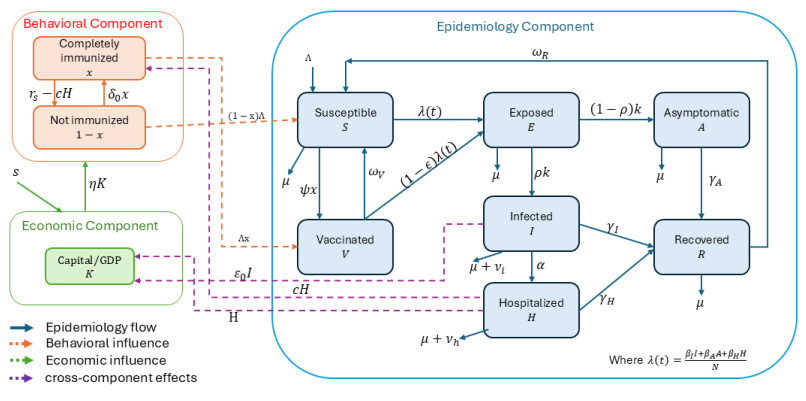
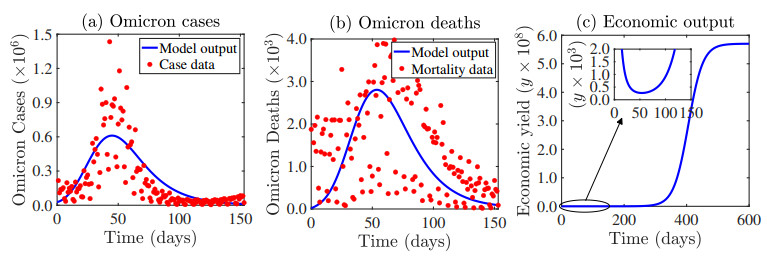
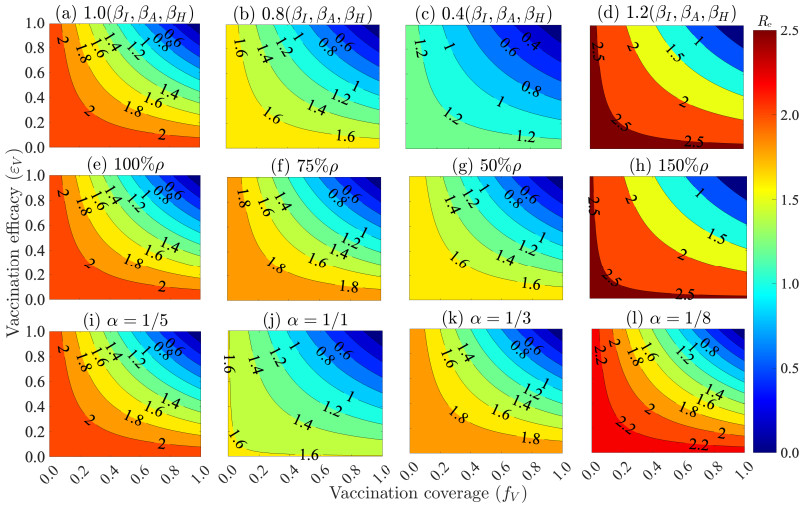
COVID-19 is a highly transmissible respiratory disease that has significantly impacted global health and economies. In this study, we investigated the impact of immunity duration, vaccination behavior, transmission reduction measures, and healthcare timing and duration on COVID-19 dynamics and economic outcomes. Using a mathematical model that integrates epidemiological, human behavioral, and economic factors, we analyzed the effectiveness of interventions based on real-world data. Analytical results revealed up to six disease-free equilibria, with stability determined by reproduction number thresholds. Results from numerical simulations of the model indicated that prolonged immunity and high vaccination rates can reduce peak infections and deaths, whereas delayed hospitalizations and increased transmission can exacerbate outbreaks. Sensitivity analysis highlights vaccine efficacy and uptake as key determinants of disease control. These findings underscore the need for sustained vaccination, timely healthcare interventions, and strategic public health measures.
Citation: Abdallah Alsammani, Calistus N. Ngonghala, Maia Martcheva. Impact of vaccination behavior on COVID-19 dynamics and economic outcomes[J]. Mathematical Biosciences and Engineering, 2025, 22(9): 2300-2338. doi: 10.3934/mbe.2025084
COVID-19 is a highly transmissible respiratory disease that has significantly impacted global health and economies. In this study, we investigated the impact of immunity duration, vaccination behavior, transmission reduction measures, and healthcare timing and duration on COVID-19 dynamics and economic outcomes. Using a mathematical model that integrates epidemiological, human behavioral, and economic factors, we analyzed the effectiveness of interventions based on real-world data. Analytical results revealed up to six disease-free equilibria, with stability determined by reproduction number thresholds. Results from numerical simulations of the model indicated that prolonged immunity and high vaccination rates can reduce peak infections and deaths, whereas delayed hospitalizations and increased transmission can exacerbate outbreaks. Sensitivity analysis highlights vaccine efficacy and uptake as key determinants of disease control. These findings underscore the need for sustained vaccination, timely healthcare interventions, and strategic public health measures.

| [1] | U.S. deaths from COVID-19, Worldometer, 2025. Available from: https://www.worldometers.info/coronavirus/country/us/#google_vignette. |
| [2] |
L. L. O'Mahoney, A. Routen, C. Gillies, W. Ekezie, A. Welford, A. Zhang, et al., The prevalence and long-term health effects of long covid among hospitalised and non-hospitalised populations: A systematic review and meta-analysis, eClinicalMedicine, 55 (2023), 101762. https://doi.org/10.1016/j.eclinm.2022.101762 doi: 10.1016/j.eclinm.2022.101762

|
| [3] |
R. Filip, R. G. Puscaselu, L. Anchidin-Norocel, M. Dimian, W. K. Savage, Global challenges to public health care systems during the COVID-19 pandemic: A review of pandemic measures and problems, J. Pers. Med., 12 (2022), 1295. https://doi.org/10.3390/jpm12081295 doi: 10.3390/jpm12081295
|
| [4] |
E. A. Andraska, O. Alabi, C. Dorsey, Y. Erben, G. Velazquez, C. Franco-Mesa, et al., Health care disparities during the COVID-19 pandemic, Semin. Vasc. Surg., 34 (2021), 82–88. https://doi.org/10.1053/j.semvascsurg.2021.08.002 doi: 10.1053/j.semvascsurg.2021.08.002
|
| [5] |
S. Naseer, S. Khalid, S. Parveen, K. Abbass, H. Song, M. V. Achim, COVID-19 outbreak: Impact on global economy, Front. Public Health, 10 (2023), 1009393. https://doi.org/10.3389/fpubh.2022.1009393 doi: 10.3389/fpubh.2022.1009393
|
| [6] |
Z. Xu, A. Elomri, L. Kerbache, A. El Omri, Impacts of COVID-19 on global supply chains: Facts and perspectives, IEEE Eng. Manage. Rev., 48 (2020), 153–166. https://doi.org/10.1109/EMR.2020.3018420 doi: 10.1109/EMR.2020.3018420
|
| [7] |
D. Vasireddy, P. Atluri, S. V. Malayala, R. Vanaparthy, G. Mohan, Review of COVID-19 vaccines approved in the United States of America for emergency use, J. Clin. Med. Res., 13 (2021), 204–213. https://doi.org/10.14740/jocmr4490 doi: 10.14740/jocmr4490
|
| [8] |
A. L. Beatty, N. D. Peyser, X. E. Butcher, J. M. Cocohoba, F. Lin, J. E. Olgin, et al., Analysis of COVID-19 vaccine type and adverse effects following vaccination, JAMA Netw. Open, 4 (2021), e2140364. https://doi.org/10.1001/jamanetworkopen.2021.40364 doi: 10.1001/jamanetworkopen.2021.40364
|
| [9] |
F. P. Polack, S. J. Thomas, N. Kitchin, J. Absalon, A. Gurtman, S. Lockhart, et al., Safety and efficacy of the BNT162b2 mRNA COVID-19 vaccine, N. Engl. J. Med., 383 (2020), 2603–2615. https://doi.org/10.1056/NEJMoa2034577 doi: 10.1056/NEJMoa2034577
|
| [10] |
S. M. Moghadas, T. N. Vilches, K. Zhang, C. R. Wells, A. Shoukat, B. H. Singer, et al., The impact of vaccination on coronavirus disease 2019 (COVID-19) outbreaks in the United States, Clin. Infect. Dis., 73 (2021), 2257–2264. https://doi.org/10.1093/cid/ciab079 doi: 10.1093/cid/ciab079
|
| [11] | P. B. Gilbert, D. C. Montefiori, A. B. McDermott, Y. Fong, D. Benkeser, W. Deng, et al., Immune correlates analysis of the mRNA-1273 COVID-19 vaccine efficacy clinical trial, Science, 375 (2022), 43–50. https://doi.org/10.1126/science.abm3425 |
| [12] | H. J. Larson, E. Gakidou, C. J. L. Murray, The vaccine-hesitant moment, N. Engl. J. Med., 387 (2022), 58–65. https://doi.org/10.1056/NEJMra2106441 |
| [13] | Communicating with patients about COVID-19 vaccination, World Health Organization, 2021. Available from: https://iris.who.int/bitstream/handle/10665/340751/WHO-EURO-2021-2281-42036-57837-eng.pdf. |
| [14] |
J. Khubchandani, S. Sharma, J. H. Price, M. J. Wiblishauser, M. Sharma, F. J. Webb, COVID-19 vaccination hesitancy in the United States: A rapid national assessment, J. Community Health, 46 (2021), 270–277. https://doi.org/10.1007/s10900-020-00958-x doi: 10.1007/s10900-020-00958-x
|
| [15] |
G. Troiano, A. Nardi, Vaccine hesitancy in the era of COVID-19, Public Health, 194 (2021), 245–251. https://doi.org/10.1016/j.puhe.2021.02.025 doi: 10.1016/j.puhe.2021.02.025
|
| [16] | D. Danelski, COVID-19 lockdowns reduced disease spread but with costs, in UCR School of Business News, 2023. Available from: https://business.ucr.edu/news/2023/03/07/covid-lockdowns-reduced-disease-spread. |
| [17] |
J. J. V. Bavel, K. Baicker, P. S. Boggio, V. Capraro, A. Cichocka, M. Cikara, et al., Using social and behavioural science to support COVID-19 pandemic response, Nat. Hum. Behav., 4 (2020), 460–471. https://doi.org/10.1038/s41562-020-0884-z doi: 10.1038/s41562-020-0884-z
|
| [18] | N. M. Ferguson, D. Laydon, G. Nedjati-Gilani, N. Imai, K. Ainslie, M. Baguelin, et al., Report 9: Impact of non-pharmaceutical interventions (NPIs) to reduce COVID-19 mortality and healthcare demand, in Imperial College COVID-19 Response Team, 2020 (2020), 1–20. https://doi.org/10.25561/77482 |
| [19] |
C. N. Ngonghala, E. Iboi, S. Eikenberry, M. Scotch, C. R. MacIntyre, M. H. Bonds, et al., Mathematical assessment of the impact of non-pharmaceutical interventions on curtailing the 2019 novel coronavirus, Math. Biosci., 325 (2020), 108364. https://doi.org/10.1016/j.mbs.2020.108364 doi: 10.1016/j.mbs.2020.108364
|
| [20] |
C. N. Ngonghala, E. Iboi, A. B. Gumel, Could masks curtail the post-lockdown resurgence of COVID-19 in the US?, Math. Biosci., 329 (2020), 108452. https://doi.org/10.1016/j.mbs.2020.108452 doi: 10.1016/j.mbs.2020.108452
|
| [21] |
C. N. Ngonghala, J. R. Knitter, L. Marinacci, M. H. Bonds, A. B. Gumel, Assessing the impact of widespread respirator use in curtailing COVID-19 transmission in the USA, R. Soc. Open Sci., 8 (2021), 210699. https://doi.org/10.1098/rsos.210699 doi: 10.1098/rsos.210699
|
| [22] |
A. B. Gumel, E. A. Iboi, C. N. Ngonghala, E. H. Elbasha, A primer on using mathematics to understand COVID-19 dynamics: Modeling, analysis and simulations, Infect. Dis. Modell., 6 (2021), 148–168. https://doi.org/10.1016/j.idm.2020.11.005 doi: 10.1016/j.idm.2020.11.005
|
| [23] |
E. A. Iboi, C. N. Ngonghala, A. B. Gumel, Will an imperfect vaccine curtail the COVID-19 pandemic in the U.S.?, Infect. Dis. Modell., 5 (2020), 510–524. https://doi.org/10.1016/j.idm.2020.07.006 doi: 10.1016/j.idm.2020.07.006
|
| [24] |
A. B. Gumel, E. A. Iboi, C. N. Ngonghala, G. A. Ngwa, Toward achieving a vaccine-derived herd immunity threshold for COVID-19 in the U.S., Front. Public Health, 9 (2021), 709369. https://doi.org/10.3389/fpubh.2021.709369 doi: 10.3389/fpubh.2021.709369
|
| [25] |
C. N. Ngonghala, H. B. Taboe, S. Safdar, A. B. Gumel, Unraveling the dynamics of the Omicron and Delta variants of the 2019 coronavirus in the presence of vaccination, mask usage, and antiviral treatment, Appl. Math. Modell., 114 (2023), 447–465. https://doi.org/10.1016/j.apm.2022.09.017 doi: 10.1016/j.apm.2022.09.017
|
| [26] | A. Alsammani, Mathematical analysis of autonomous and nonautonomous hepatitis B virus transmission models, in International Conference on Computational Science and Its Applications, Springer, (2023), 327–343. https://doi.org/10.1007/978-3-031-37108-0_21 |
| [27] |
C. N. Ngonghala, P. Goel, D. Kutor, S. Bhattacharyya, Human choice to self-isolate in the face of the COVID-19 pandemic: A game dynamic modelling approach, J. Theor. Biol., 521 (2021), 110692. https://doi.org/10.1016/j.jtbi.2021.110692 doi: 10.1016/j.jtbi.2021.110692
|
| [28] |
M. Martcheva, N. Tuncer, C. N. Ngonghala, Effects of social-distancing on infectious disease dynamics: An evolutionary game theory and economic perspective, J. Biol. Dyn., 15 (2021), 342–366. https://doi.org/10.1080/17513758.2021.1946177 doi: 10.1080/17513758.2021.1946177
|
| [29] |
N. Banholzer, E. Van Weenen, A. Lison, A. Cenedese, A. Seeliger, B. Kratzwald, et al., Estimating the effects of non-pharmaceutical interventions on the number of new infections with COVID-19 during the first epidemic wave, PLoS One, 16 (2021), e0252827. https://doi.org/10.1371/journal.pone.0252827 doi: 10.1371/journal.pone.0252827
|
| [30] |
M. L. Diagne, H. Rwezaura, S. Y. Tchoumi, J. M. Tchuenche, A mathematical model of COVID-19 with vaccination and treatment, Comput. Math. Methods Med., 2021 (2021), 1250129. https://doi.org/10.1155/2021/1250129 doi: 10.1155/2021/1250129
|
| [31] |
R. M. Solow, A contribution to the theory of economic growth, Q. J. Econ., 70 (1956), 65–94. https://doi.org/10.2307/1884513 doi: 10.2307/1884513
|
| [32] |
T. W. Swan, Economic growth and capital accumulation, Econ. Rec., 32 (1956), 334–361. https://doi.org/10.1111/j.1475-4932.1956.tb00434.x doi: 10.1111/j.1475-4932.1956.tb00434.x
|
| [33] | C. W. Cobb, P. H. Douglas, A theory of production, Am. Econ. Rev., 18 (1928), 139–165. Available from: https://www.jstor.org/stable/1811556. |
| [34] |
A. L. Lloyd, Realistic distributions of infectious periods in epidemic models: changing patterns of persistence and dynamics, Theor. Popul. Biol., 60 (2001), 59–71. https://doi.org/10.1006/tpbi.2001.1525 doi: 10.1006/tpbi.2001.1525
|
| [35] |
A. L. Lloyd, Destabilization of epidemic models with the inclusion of realistic distributions of infectious periods, Proc. Roy. Soc. Lond. B, 268 (2001), 985–993. https://doi.org/10.1098/rspb.2001.1599 doi: 10.1098/rspb.2001.1599
|
| [36] |
P. J. Lu, T. Zhou, T. A. Santibanez, A. Jain, C. L. Black, A. Srivastav, et al., COVID-19 bivalent booster vaccination coverage and intent to receive booster vaccination among adolescents and adults—United States, November–December 2022, Morb. Mortal. Wkly. Rep., 72 (2023), 190–198. https://doi.org/10.15585/mmwr.mm7207a5 doi: 10.15585/mmwr.mm7207a5
|
| [37] |
C. Willyard, How quickly does COVID immunity fade? What scientists know, Nature, 614 (2023), 395–396. https://doi.org/10.1038/d41586-023-00124-y doi: 10.1038/d41586-023-00124-y
|
| [38] | N. Prasad, G. Derado, S. A. Nanduri, H. E. Reses, H. Dubendris, E. Wong, et al., Effectiveness of a COVID-19 additional primary or booster vaccine dose in preventing SARS-CoV-2 infection among nursing home residents during widespread circulation of the Omicron variant, United States, February 14 March 27, 2022, Morb. Mortal. Wkly. Rep., 71 (2022), 633–637. https://doi.org/10.15585/mmwr.mm7118a4 |
| [39] |
S. Safdar, C. N. Ngonghala, A. B. Gumel, Mathematical assessment of the role of waning and boosting immunity against the BA.1 Omicron variant in the United States, Math. Biosci. Eng., 20 (2023), 179–212. https://doi.org/10.3934/mbe.2023009 doi: 10.3934/mbe.2023009
|
| [40] |
N. Tuncer, A. Timsina, M. Nuno, G. Chowell, M. Martcheva, Parameter identifiability and optimal control of an SARS-CoV-2 model early in the pandemic, J. Biol. Dyn., 16 (2022), 412–438. https://doi.org/10.1080/17513758.2022.2078899 doi: 10.1080/17513758.2022.2078899
|
| [41] | Centers for Disease Control and Prevention, U.S. life expectancy declined to 77.0 years in 2020, 2022. Available from: https://www.cdc.gov/nchs/pressroom/nchs_press_releases/2022/20220831.htm. |
| [42] | A. Saltelli, M. Ratto, T. Andres, F. Campolongo, J. Cariboni, D. Gatelli, et al., Global Sensitivity Analysis: The primer, John Wiley & Sons, 2008. https://doi.org/10.1002/9780470725184 |
| [43] | R. M. Anderson, Infectious Diseases of Humans: Dynamics and Control, Oxford University Press, 1991. https://doi.org/10.1093/oso/9780198545996.001.0001 |
| [44] |
S. Moore, E. M. Hill, M. J. Tildesley, L. Dyson, M. J. Keeling, Vaccination and non-pharmaceutical interventions for COVID-19: A mathematical modelling study, Lancet Infect. Dis., 21 (2021), 793–802. https://doi.org/10.1016/S1473-3099(21)00143-2 doi: 10.1016/S1473-3099(21)00143-2
|
| [45] |
A. D. Paltiel, J. L. Schwartz, A. Zheng, R. P. Walensky, Clinical outcomes of a COVID-19 vaccine: Implementation over efficacy, Health Aff., 40 (2021), 42–52. https://doi.org/10.1377/hlthaff.2020.02054 doi: 10.1377/hlthaff.2020.02054
|
| [46] |
M. E. Kretzschmar, G. Rozhnova, M. C. J. Bootsma, M. van Boven, J. H. H. M. van de Wijgert, M. J. M. Bonten, Impact of delays on effectiveness of contact tracing strategies for COVID-19: A modelling study, Lancet Public Health, 5 (2020), e452–e459. https://doi.org/10.1016/S2468-2667(20)30157-2 doi: 10.1016/S2468-2667(20)30157-2
|
| [47] |
N. C. Grassly, C. Fraser, Mathematical models of infectious disease transmission, Nat. Rev. Microbiol., 6 (2008), 477–487. https://doi.org/10.1038/nrmicro1845 doi: 10.1038/nrmicro1845
|
| [48] |
T. Zimmerman, K. Shiroma, K. R. Fleischmann, B. Xie, C. Jia, N. Verma, et al., Misinformation and COVID-19 vaccine hesitancy, Vaccine, 41 (2023), 136–144. https://doi.org/10.1016/j.vaccine.2022.11.014 doi: 10.1016/j.vaccine.2022.11.014
|
| [49] |
S. Loomba, A. De Figueiredo, S. J. Piatek, K. De Graaf, H. J. Larson, Measuring the impact of COVID-19 vaccine misinformation on vaccination intent in the UK and USA, Nat. Hum. Behav., 5 (2021), 337–348. https://doi.org/10.1038/s41562-021-01056-1 doi: 10.1038/s41562-021-01056-1
|
| [50] |
F. Menegale, M. Manica, A. Zardini, G. Guzzetta, V. Marziano, V. d'Andrea, et al., Evaluation of waning of SARS-CoV-2 vaccine-induced immunity: A systematic review and meta-analysis, JAMA Netw. Open, 6 (2023), e2310650. https://doi.org/10.1001/jamanetworkopen.2023.10650 doi: 10.1001/jamanetworkopen.2023.10650
|
| [51] |
C. Caetano, M. L. Morgado, P. Patrício, A. Leite, A. Machado, A. Torres, et al., Measuring the impact of COVID-19 vaccination and immunity waning: A modelling study for Portugal, Vaccine, 40 (2022), 7115–7121. https://doi.org/10.1016/j.vaccine.2022.10.007 doi: 10.1016/j.vaccine.2022.10.007
|
| [52] |
J. G. Lu, Two large-scale global studies on COVID-19 vaccine hesitancy over time: Culture, uncertainty avoidance, and vaccine side-effect concerns, J. Pers. Social Psychol., 124 (2023), 683–706. https://doi.org/10.1037/pspa0000320 doi: 10.1037/pspa0000320
|
| [53] |
M. Sallam, COVID-19 vaccine hesitancy worldwide: A concise systematic review of vaccine acceptance rates, Vaccines, 9 (2021), 160. https://doi.org/10.3390/vaccines9020160 doi: 10.3390/vaccines9020160
|
| [54] |
J. M. Brauner, S. Mindermann, M. Sharma, D. Johnston, J. Salvatier, T. Gavenčiak, et al., Inferring the effectiveness of government interventions against COVID-19, Science, 371 (2021), eabd9338. https://doi.org/10.1126/science.abd9338 doi: 10.1126/science.abd9338
|
| [55] |
N. Andrews, J. Stowe, F. Kirsebom, S. Toffa, T. Rickeard, E. Gallagher, et al., COVID-19 vaccine effectiveness against the Omicron (B.1.1.529) variant, N. Engl. J. Med., 386 (2022), 1532–1546. https://doi.org/10.1056/NEJMoa2119451 doi: 10.1056/NEJMoa2119451
|
| [56] |
A. B. Hogan, B. L. Jewell, E. Sherrard-Smith, J. F. Vesga, O. J. Watson, C. Whittaker, et al., Potential impact of the COVID-19 pandemic on HIV, tuberculosis, and malaria in low-income and middle-income countries: A modelling study, Lancet Global Health, 8 (2020), E1132–E1141. https://doi.org/10.1016/S2214-109X(20)30288-6 doi: 10.1016/S2214-109X(20)30288-6
|
| [57] |
M. A. Johansson, T. M. Quandelacy, S. Kada, P. V. Prasad, M. Steele, J. T. Brooks, et al., SARS-CoV-2 transmission from people without COVID-19 symptoms, JAMA Netw. Open, 4 (2021), e2035057. https://doi.org/10.1001/jamanetworkopen.2020.35057 doi: 10.1001/jamanetworkopen.2020.35057
|
Figures(7) / Tables(4)

Abdallah Alsammani, Calistus N. Ngonghala, Maia Martcheva. Impact of vaccination behavior on COVID-19 dynamics and economic outcomes[J]. Mathematical Biosciences and Engineering, 2025, 22(9): 2300-2338. doi: 10.3934/mbe.2025084





 DownLoad: