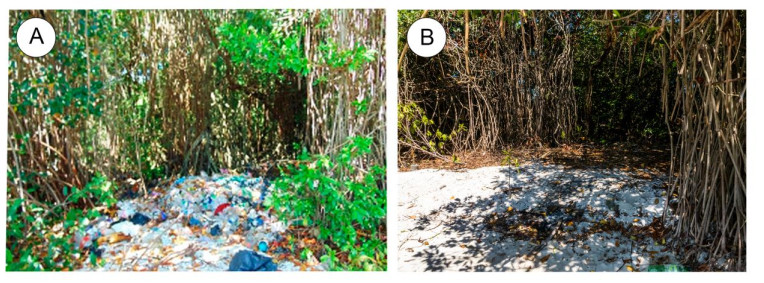
Mangrove ecosystems serve as critical natural filters and retention points for continental waste entering the sea, making them primary accumulation sites for solid waste, such as plastics. These plastics undergo transformation from macroplastics to microplastics through weathering. We investigated the resistance and degradation process of plastic waste in the mangrove swamp of the Botanical Garden at the Autonomous University of Carmen, focusing specifically on its transformation into microplastics over time. By quantifying the collected waste and identifying by-products, we evaluated the degradation process of these materials, which impact the environment and become microplastics. Our analysis provided a detailed approximation of this transformation process through the quantification and examination of collected waste and its by-products. We explored the degradation dynamics and their environmental ramifications. Using data derived from collected waste samples, we estimated an annual generation of 12,300 kg of plastic waste and 1,351 kg of microplastics. This latter figure represents 11% of the total annual plastic waste, posing a significant threat to the biodiversity and ecological balance of mangroves. Our findings underscore the urgent need for more effective and sustainable waste management practices within these critical ecosystems. Furthermore, this research emphasizes the importance of continuous monitoring and investigation of degradation processes to better understand the long-term effects of plastic pollution on mangrove environments and to develop effective strategies to mitigate its adverse impacts.
Citation: Laines Canepa José Ramón, Sosa Olivier José Aurelio, Padilla-Rivera Alejandro, Hernández Barajas José Roberto, Morales-Rodríguez Neil Ebeth Meled, Burelo Ramos Carlos Manuel, Espinosa de los Monteros Alejandra Elvira, Núñez-Nogueira Gabriel. Transformation of plastic debris to microplastics: An approximate analysis of mangrove environments[J]. Urban Resilience and Sustainability, 2024, 2(4): 348-364. doi: 10.3934/urs.2024018
Mangrove ecosystems serve as critical natural filters and retention points for continental waste entering the sea, making them primary accumulation sites for solid waste, such as plastics. These plastics undergo transformation from macroplastics to microplastics through weathering. We investigated the resistance and degradation process of plastic waste in the mangrove swamp of the Botanical Garden at the Autonomous University of Carmen, focusing specifically on its transformation into microplastics over time. By quantifying the collected waste and identifying by-products, we evaluated the degradation process of these materials, which impact the environment and become microplastics. Our analysis provided a detailed approximation of this transformation process through the quantification and examination of collected waste and its by-products. We explored the degradation dynamics and their environmental ramifications. Using data derived from collected waste samples, we estimated an annual generation of 12,300 kg of plastic waste and 1,351 kg of microplastics. This latter figure represents 11% of the total annual plastic waste, posing a significant threat to the biodiversity and ecological balance of mangroves. Our findings underscore the urgent need for more effective and sustainable waste management practices within these critical ecosystems. Furthermore, this research emphasizes the importance of continuous monitoring and investigation of degradation processes to better understand the long-term effects of plastic pollution on mangrove environments and to develop effective strategies to mitigate its adverse impacts.

| [1] |
Cappa P, Walton MEM, Paler MKO, et al. (2023) Impact of mangrove forest structure and landscape on macroplastics capture. Mar Pollut Bull 194: 115434. https://doi.org/10.1016/j.marpolbul.2023.115434 doi: 10.1016/j.marpolbul.2023.115434

|
| [2] |
Al-Tarshi M, Dobretsov S, Gallardo W (2024) Marine litter and microplastic pollution in mangrove sediments in the Sea of Oman. Mar Pollut Bull 201: 116132. https://doi.org/10.1016/j.marpolbul.2024.116132 doi: 10.1016/j.marpolbul.2024.116132
|
| [3] |
Ordóñez OG, Arenas MRB (2019) Impacts of marine debris contamination in the mangrove ecosystem of the Ciénaga Grande de Santa Marta, Colombian Caribbean. Rev Cienc Mar Y Costeras 11: 134–154. https://doi.org/10.15359/revmar.11-2.8 doi: 10.15359/revmar.11-2.8
|
| [4] |
Kumar R, Verma A, Shome A, et al. (2021) Impacts of plastic pollution on ecosystem services, sustainable development goals, and need to focus on circular economy and policy interventions. Sustainability 13: 9963. https://doi.org/10.3390/su13179963 doi: 10.3390/su13179963
|
| [5] | Tekman MB, Walther B, Peter C, et al. (2022) Impacts of Plastic Pollution in the Oceans on Marine Species, Biodiversity and Ecosystems, Berlin: WWW Germany. https://doi.org/10.5281/zenodo.5898684 |
| [6] |
George M, Nallet F, Fabre P (2024) A threshold model of plastic waste fragmentation: New insights into the distribution of microplastics in the ocean and its evolution over time. Mar Pollut Bull 199: 116012. https://doi.org/10.1016/j.marpolbul.2023.116012 doi: 10.1016/j.marpolbul.2023.116012
|
| [7] |
Zhang K, Hamidian AH, Tubić A, et al. (2021) Understanding plastic degradation and microplastic formation in the environment: A review. Environ Pollut 274: 116554. https://doi.org/10.1016/j.envpol.2021.116554 doi: 10.1016/j.envpol.2021.116554
|
| [8] |
Talukdar A, Kundu P, Bhattacharjee S, et al. (2023) Microplastics in mangroves with special reference to Asia: Occurrence, distribution, bioaccumulation and remediation options. Sci Total Environ 904: 166165. https://doi.org/10.1016/j.scitotenv.2023.166165 doi: 10.1016/j.scitotenv.2023.166165
|
| [9] |
Andrady AL (2022) Weathering and fragmentation of plastic debris in the ocean environment. Mar Pollut Bull 180: 113761. https://doi.org/10.1016/j.marpolbul.2022.113761 doi: 10.1016/j.marpolbul.2022.113761
|
| [10] |
Born MP, Brüll C (2022) From model to nature—A review on the transferability of marine (micro-) plastic fragmentation studies. Sci Total Environ 811: 151389. https://doi.org/10.1016/j.scitotenv.2021.151389 doi: 10.1016/j.scitotenv.2021.151389
|
| [11] |
Dimassi SN, Hahladakis JN, Yahia MND, et al. (2022) Degradation-fragmentation of marine plastic waste and their environmental implications: A critical review. Arab J Chem 15: 104262. https://doi.org/10.1016/j.arabjc.2022.104262 doi: 10.1016/j.arabjc.2022.104262
|
| [12] |
Lv S, Cui K, Zhao S, et al. (2024) Continuous generation and release of microplastics and nanoplastics from polystyrene by plastic-degrading marine bacteria. J Hazard Mater 465: 133339. https://doi.org/10.1016/j.jhazmat.2023.133339 doi: 10.1016/j.jhazmat.2023.133339
|
| [13] |
Reddy CN, Kallem P, Mounika K, et al. (2023) Review of microplastic degradation: Understanding metagenomic approaches for microplastic degrading organisms. Polym Test 128: 108223. https://doi.org/10.1016/j.polymertesting.2023.108223 doi: 10.1016/j.polymertesting.2023.108223
|
| [14] |
Shruti VC, Kutralam-Muniasamy G (2023) Migration testing of microplastics in plastic food-contact materials: Release, characterization, pollution level, and influencing factors. Trends Anal Chem 170: 117421. https://doi.org/10.1016/j.trac.2023.117421 doi: 10.1016/j.trac.2023.117421
|
| [15] |
Shin H, Jeong CB (2022) Metabolism deficiency and oxidative stress induced by plastic particles in the rotifer Brachionus plicatilis: Common and distinct phenotypic and transcriptomic responses to nano- and microplastics. Mar Pollut Bull 182: 113981. https://doi.org/10.1016/j.marpolbul.2022.113981 doi: 10.1016/j.marpolbul.2022.113981
|
| [16] |
Peng BY, Xu Y, Sun Y, et al. (2023) Biodegradation of polyethylene (PE) microplastics by mealworm larvae: Physiological responses, oxidative stress, and residual plastic particles. J Clean Prod 402: 136831. https://doi.org/10.1016/j.jclepro.2023.136831 doi: 10.1016/j.jclepro.2023.136831
|
| [17] | Instituto Nacional de Ecología (1997) Programa de Manejo de la Zona de Protección de Flora y Fauna Laguna de Términos. Available from: cpaot.org.mx/centro/ine-semarnat/anp/AN19.pdf. |
| [18] | Geofolio 2024. Available from: https://geofolio.org/. |
| [19] | Secretaria de Comercio y Fomento Industrial, NMX-AA-015-1985. Available from: biblioteca.semarnat.gob.mx/janium/Documentos/Ciga/agenda/DOFsr/NMX-AA-015-1985.pdf. |
| [20] | Secretaria de Comercio y Fomento Industrial, NMX-AA-022-1985. Available from: biblioteca.semarnat.gob.mx/janium/Documentos/Ciga/agenda/DOFsr/NMX-AA-022-1985.pdf. |
| [21] |
Munno K, De Frond H, O'Donnell B, et al. (2020) Increasing the accessibility for characterizing microplastics: Introducing new application-based and spectral libraries of plastic particles (SLoPP and SLoPP-E). Anal Chem 92: 2443–2451. https://doi.org/10.1021/acs.analchem.9b03626 doi: 10.1021/acs.analchem.9b03626
|
| [22] |
Hidalgo-Ruz V, Gutow L, Thompson RC, et al. (2012) Microplastics in the marine environment: A review of the methods used for identification and quantification. Environ Sci Technol 46: 3060–3075. https://doi.org/10.1021/es2031505 doi: 10.1021/es2031505
|
| [23] |
Ragusa A, Svelato A, Santacroce C, et al. (2021) Plasticenta: First evidence of microplastics in human placenta. Environ Int 146: 106274. https://doi.org/10.1016/j.envint.2020.106274 doi: 10.1016/j.envint.2020.106274
|
| [24] | Boucher J, Zgola M, Liao X, et al. (2020) National Guidance for Plastic Pollution Hotspotting and Shaping Action—Introduction to the Methodology, Nairobi: United Nations Environment Programme. Available from: wedocs.unep.org/bitstream/handle/20.500.11822/33166/NGP.pdf. |
| [25] | Aguirre Santos JA, Álvarez Zeferino JC, Cruz Salas A (2023) Caracterización de residuos plásticos en la estación de transferencia de Iztapalapa, México, in X Simposio Iberoamericano de Ingeniería de Residuos At: Castelló de la Plana, España. https://doi.org/10.13140/RG.2.2.34687.79525 |
| [26] |
Gani A, Irham M, Windari W (2022) An overview of the potential risks, sources, and analytical methods for microplastics in soil. AIMS Environ Sci 9: 185–216. https://doi.org/10.3934/environsci.2022013 doi: 10.3934/environsci.2022013
|
| [27] |
van Bijsterveldt CEJ, van Wesenbeeck BK, Ramadhani S, et al. (2021) Does plastic waste kill mangroves? A field experiment to assess the impact of macro plastics on mangrove growth, stress response and survival. Sci Total Environ 756: 143826. https://doi.org/10.1016/j.scitotenv.2020.143826 doi: 10.1016/j.scitotenv.2020.143826
|
| [28] |
De K, Sautya S, Dora GU, et al. (2023) Mangroves in the "Plasticene": High exposure of coastal mangroves to anthropogenic litter pollution along the Central-West coast of India. Sci Total Environ 858: 160071. https://doi.org/10.1016/j.scitotenv.2022.160071 doi: 10.1016/j.scitotenv.2022.160071
|
| [29] |
Carugati L, Gatto B, Rastelli E, et al. (2018) Impact of mangrove forests degradation on biodiversity and ecosystem functioning. Sci Rep 8: 13298. https://doi.org/10.1038/s41598-018-31683-0 doi: 10.1038/s41598-018-31683-0
|
| [30] |
Mendes DS, Beasley CR, Silva DNN, et al. (2023) Microplastic in mangroves: A worldwide review of contamination in biotic and abiotic matrices. Mar Pollut Bull 195: 115552. https://doi.org/10.1016/j.marpolbul.2023.115552 doi: 10.1016/j.marpolbul.2023.115552
|


Figures(5) / Tables(2)
Laines Canepa José Ramón, Sosa Olivier José Aurelio, Padilla-Rivera Alejandro, Hernández Barajas José Roberto, Morales-Rodríguez Neil Ebeth Meled, Burelo Ramos Carlos Manuel, Espinosa de los Monteros Alejandra Elvira, Núñez-Nogueira Gabriel. Transformation of plastic debris to microplastics: An approximate analysis of mangrove environments[J]. Urban Resilience and Sustainability, 2024, 2(4): 348-364. doi: 10.3934/urs.2024018




 DownLoad: