During epidemic outbreaks, individuals often reduce their risk of infection by breaking connections with infected individuals in order to stay in a relatively safe environment. Motivated by these observations, this paper incorporates adaptive thresholds into a multiplex network $U A_{1} A_{2} U-S I S$ (unaware–positive–negative–unaware–susceptible–infected–susceptible) model with adaptive mechanisms. In this framework, the effectiveness of adaptive behavior is governed by individual sensitivity threshold functions, enabling the exploration of how adaptive thresholds influence the coupled propagation of information and epidemics. Using the microscopic Markov chain approach (MMCA), we derived the state transition equations and the epidemic transmission threshold. Extensive numerical simulations validate the theoretical analysis and demonstrate that adaptive thresholds play a significant role in shaping both information diffusion and epidemic propagation. Specifically, enhancing individuals' ability to distinguish between positive and negative information, as well as promoting the active adoption of positive information beneficial for epidemic prevention, can effectively suppress epidemic outbreaks. Furthermore, increasing individuals' risk sensitivity promotes more frequent adaptive behaviors, reduces opportunities for infection, and ultimately mitigates the overall epidemic scale.
Citation: Liang'an Huo, Xingyu Wan, Xu Xu, Minghua Liu. Modeling the impact of adaptive thresholds on information-epidemic co-evolution in multiplex network[J]. Networks and Heterogeneous Media, 2026, 21(6): 2383-2411. doi: 10.3934/nhm.2026089
During epidemic outbreaks, individuals often reduce their risk of infection by breaking connections with infected individuals in order to stay in a relatively safe environment. Motivated by these observations, this paper incorporates adaptive thresholds into a multiplex network $U A_{1} A_{2} U-S I S$ (unaware–positive–negative–unaware–susceptible–infected–susceptible) model with adaptive mechanisms. In this framework, the effectiveness of adaptive behavior is governed by individual sensitivity threshold functions, enabling the exploration of how adaptive thresholds influence the coupled propagation of information and epidemics. Using the microscopic Markov chain approach (MMCA), we derived the state transition equations and the epidemic transmission threshold. Extensive numerical simulations validate the theoretical analysis and demonstrate that adaptive thresholds play a significant role in shaping both information diffusion and epidemic propagation. Specifically, enhancing individuals' ability to distinguish between positive and negative information, as well as promoting the active adoption of positive information beneficial for epidemic prevention, can effectively suppress epidemic outbreaks. Furthermore, increasing individuals' risk sensitivity promotes more frequent adaptive behaviors, reduces opportunities for infection, and ultimately mitigates the overall epidemic scale.

| [1] |
A. M. Alotaibi, Explainable long-sequence time-series forecasting for infectious diseases using optimised transformer models, Int. J. Data Sci. Anal., 21 (2026), 8. https://doi.org/10.1007/s41060-025-00930-9 doi: 10.1007/s41060-025-00930-9
|
| [2] |
J. Wang, X. Yan, X. Chang, Dynamics analysis and optimal control of SIR-w infectious disease model under the influence of multidimensional information, J. Math. Anal. Appl., 553 (2026), 129855. https://doi.org/10.1016/j.jmaa.2025.129855 doi: 10.1016/j.jmaa.2025.129855
|
| [3] |
C. Zheng, C. Xia, Q. Guo, M. Dehmer, Interplay between SIR-based disease spreading and awareness diffusion on multiplex networks, J. Parallel Distrib. Comput., 115 (2018), 20–28. https://doi.org/10.1016/j.jpdc.2018.01.001 doi: 10.1016/j.jpdc.2018.01.001
|
| [4] |
H. Wang, H. Huang, H. Liu, Competition or cooperation? Multiple information diffusion against epidemic spreading in a multiplex network, Chaos Solitons Fractals, 203 (2026), 117585. https://doi.org/10.1016/j.chaos.2025.117585 doi: 10.1016/j.chaos.2025.117585
|
| [5] |
Y. Liu, M. Tang, Y. Zhou, The impact of high-order multi-source information verification mechanisms on propagation dynamics in multilayer high-order networks, Chaos Solitons Fractals, 203 (2026), 117715. https://doi.org/10.1016/j.chaos.2025.117715 doi: 10.1016/j.chaos.2025.117715
|
| [6] |
Q. Yin, Z. Wang, K. Wang, Z. Hong, Coupled dynamics of information-epidemic spreading with resource allocation and transmission on multi-layer networks, Entropy, 27 (2025), 1080. https://doi.org/10.3390/e27101080 doi: 10.3390/e27101080
|
| [7] |
W. O. Kermack, A. G. McKendrick, A contribution to the mathematical theory of epidemics, Proc. R. Soc. A, 115 (1927), 700–721. https://doi.org/10.1098/rspa.1927.0118 doi: 10.1098/rspa.1927.0118
|
| [8] |
T. Su, Y. Kao, D. Jiang, Dynamical behaviors of a stochastic SIR epidemic model with reaction-diffusion and spatially heterogeneous transmission rate, Chaos Solitons Fractals, 195 (2025), 116283. https://doi.org/10.1016/j.chaos.2025.116283 doi: 10.1016/j.chaos.2025.116283
|
| [9] |
H. Bao, Y. He, Epidemic dynamics with awareness cascade of positive and negative information on delayed multiplex networks, Chaos, 35 (2025), 023135. https://doi.org/10.1063/5.0247513 doi: 10.1063/5.0247513
|
| [10] |
H. Shi, Z. Duan, G. Chen, An SIS model with infective medium on complex networks, Phys. A, 387 (2008), 2133–2144. https://doi.org/10.1016/j.physa.2007.11.048 doi: 10.1016/j.physa.2007.11.048
|
| [11] |
D. Han, X. Wang, Impact of positive and negative information on epidemic spread in a three-layer network, Chaos Solitons Fractals, 186 (2024), 115264. https://doi.org/10.1016/j.chaos.2024.115264 doi: 10.1016/j.chaos.2024.115264
|
| [12] |
Y. Zhang, X. Gou, W. Zhou, J. Ma, The role of information dissemination in suppressing epidemic spreading in multiplex networks, Phys. Lett. A, 560 (2025), 130950. https://doi.org/10.1016/j.physleta.2025.130950 doi: 10.1016/j.physleta.2025.130950
|
| [13] |
M. Nekovee, Y. Moreno, G. Bianconi, M. Marsili, Theory of rumour spreading in complex social networks, Phys. A, 374 (2007), 457–470. https://doi.org/10.1016/j.physa.2006.07.017 doi: 10.1016/j.physa.2006.07.017
|
| [14] |
Z. Huang, X. Shu, Q. Xuan, Z. Ruan, Epidemic spreading under game-based self-quarantine behaviors: The different effects of local and global information, Chaos, 34 (2024), 013112. https://doi.org/10.1063/5.0180484 doi: 10.1063/5.0180484
|
| [15] |
H. Bao, X. Wu, Epidemic propagation with competitive information in multiplex networks with simplicial complexes, Chaos Solitons Fractals, 201 (2025), 117254. https://doi.org/10.1016/j.chaos.2025.117254 doi: 10.1016/j.chaos.2025.117254
|
| [16] |
J. Ma, P. Wang, Impact of community networks with higher-order interaction on epidemic dynamics, Chaos Solitons Fractals, 180 (2024), 114471. https://doi.org/10.1016/j.chaos.2024.114471 doi: 10.1016/j.chaos.2024.114471
|
| [17] |
S. Funk, E. Gilad, C. Watkins, V. A. A. Jansen, The spread of awareness and its impact on epidemic outbreaks, Proc. Natl. Acad. Sci. U. S. A., 106 (2009), 6872–6877. https://doi.org/10.1073/pnas.0810762106 doi: 10.1073/pnas.0810762106
|
| [18] |
C. Granell, S. Gómez, A. Arenas, Dynamical interplay between awareness and epidemic spreading in multiplex networks, Phys. Rev. Lett., 111 (2013), 128701. https://doi.org/10.1103/PhysRevLett.111.128701 doi: 10.1103/PhysRevLett.111.128701
|
| [19] |
C. Granell, S. Gómez, A. Arenas, Competing spreading processes on multiplex networks: Awareness and epidemics, Phys. Rev. E, 90 (2014), 012808. https://doi.org/10.1103/PhysRevE.90.012808 doi: 10.1103/PhysRevE.90.012808
|
| [20] |
Z. Zhang, K. Zhu, F. Wang, Indirect information propagation model with time-delay effect on multiplex networks, Chaos Solitons Fractals, 192 (2025), 115936. https://doi.org/10.1016/j.chaos.2024.115936 doi: 10.1016/j.chaos.2024.115936
|
| [21] |
L. Liu, S. Geng, L. Wei, Z. Lu, Y. Ma, Dynamics of two-strain disease transmission with negative vaccine information and vaccination on multiplex networks, Appl. Math. Comput., 510 (2026), 129701. https://doi.org/10.1016/j.amc.2025.129701 doi: 10.1016/j.amc.2025.129701
|
| [22] |
J. Song, W. Li, Y. Xiao, L. Chen, C. Yang, L. Qi, et al., Optimal information spreading strategy for containing epidemic spreading on higher order multiplex networks, Appl. Math. Comput., 511 (2026), 129725. https://doi.org/10.1016/j.amc.2025.129725 doi: 10.1016/j.amc.2025.129725
|
| [23] |
D. Yang, W. Zhang, Z. Li, Z. Lin, N. Meng, J. Xian, et al., Coupled awareness-epidemic spreading incorporating the impact of self-media, Chaos Solitons Fractals, 205 (2026), 117824. https://doi.org/10.1016/j.chaos.2025.117824 doi: 10.1016/j.chaos.2025.117824
|
| [24] |
X. Sun, L. Zhang, P. Zheng, Coevolution of information and epidemics in multiplex networks under risk-perception and higher-order interactions, Appl. Math. Comput., 522 (2026), 129936. https://doi.org/10.1016/j.amc.2025.129936 doi: 10.1016/j.amc.2025.129936
|
| [25] |
L. Y. Liu, C. R. Cai, S. P. Zhang, B. Q. Li, Coexistence of positive and negative information in information-epidemic dynamics on multiplex networks, Phys. A, 666 (2025), 130534. https://doi.org/10.1016/j.physa.2025.130534 doi: 10.1016/j.physa.2025.130534
|
| [26] |
D. Guo, S. Trajanovski, R. van de Bovenkamp, H. Wang, P. Van Mieghem, Epidemic threshold and topological structure of susceptible-infectious-susceptible epidemics in adaptive networks, Phys. Rev. E, 88 (2013), 042802. https://doi.org/10.1103/PhysRevE.88.042802 doi: 10.1103/PhysRevE.88.042802
|
| [27] |
Y. R. Song, G. P. Jiang, Y. W. Gong, Epidemic propagation on adaptive coevolutionary networks with preferential local-world reconnecting strategy, Chin. Phys. B, 22 (2013), 040205. https://doi.org/10.1088/1674-1056/22/4/040205 doi: 10.1088/1674-1056/22/4/040205
|
| [28] |
P. Zhu, Q. Zhi, Y. Guo, Z. Wang, Analysis of epidemic spreading process in adaptive networks, IEEE Trans. Circuits Syst. Ⅱ Express Briefs, 66 (2019), 1252–1256. https://doi.org/10.1109/TCSII.2018.2877406 doi: 10.1109/TCSII.2018.2877406
|
| [29] |
M. Mancastroppa, R. Burioni, V. Colizza, A. Vezzani, Active and inactive quarantine in epidemic spreading on adaptive activity-driven networks, Phys. Rev. E, 102 (2020), 020301. https://doi.org/10.1103/PhysRevE.102.020301 doi: 10.1103/PhysRevE.102.020301
|
| [30] |
X. Hong, G. Zhang, Z. Tian, B. Wang, D. Lu, Integrating adaptive rewiring and compulsory regulating: Co-evolutionary epidemic dynamics driven by multi-source information, IEEE Trans. Networks Sci. Eng., 13 (2026), 6622–6639. https://doi.org/10.1109/TNSE.2026.3657856 doi: 10.1109/TNSE.2026.3657856
|
| [31] |
X. L. Peng, Y. D. Zhang, Contagion dynamics on adaptive multiplex networks with awareness-dependent rewiring, Chin. Phys. B, 30 (2021), 058901. https://doi.org/10.1088/1674-1056/abe1ab doi: 10.1088/1674-1056/abe1ab
|
| [32] |
Y. Guo, L. Tu, X. Wang, The coupled dynamics of awareness and disease: Based on the adaptive mechanism and the surroundings reinforcement, Phys. A, 649 (2024), 129949. https://doi.org/10.1016/j.physa.2024.129949 doi: 10.1016/j.physa.2024.129949
|
| [33] |
W. Xiong, C. Zhou, Epidemic spreading with an awareness-based adaptive mechanism in temporal multiplex networks, Front. Phys., 11 (2023), 1285480. https://doi.org/10.3389/fphy.2023.1285480 doi: 10.3389/fphy.2023.1285480
|
| [34] |
M. Li, L. Huo, Y. Dong, X. Xie, Y. Cheng, Effect of individual heterogeneity on the coupled spread of information and disease in higher-order multiplex networks, Nonlinear Dyn., 113 (2025), 10659–10679. https://doi.org/10.1007/s11071-024-10633-8 doi: 10.1007/s11071-024-10633-8
|
| [35] |
Y. Qian, D. Zhao, C. Xia, M. Perc, Information flow in psychological evolutionary decision-making on multiplex networks: A survey and beyond, IEEE Trans. Networks Sci. Eng., 13 (2026), 1128–1146. https://doi.org/10.1109/TNSE.2025.3591446 doi: 10.1109/TNSE.2025.3591446
|
| [36] |
Y. Pan, Z. Yan, The impact of individual heterogeneity on the coupled awareness-epidemic dynamics in multiplex networks, Chaos, 28 (2018), 063123. https://doi.org/10.1063/1.5000280 doi: 10.1063/1.5000280
|
| [37] |
C. Liu, L. X. Zhou, C. J. Fan, L. A. Huo, Z. W. Tian, Activity of nodes reshapes the critical threshold of spreading dynamics in complex networks, Phys. A, 432 (2015), 269–278. https://doi.org/10.1016/j.physa.2015.03.054 doi: 10.1016/j.physa.2015.03.054
|
| [38] |
X. Zhang, H. Deng, Z. Ruan, X. Zhang, Coevolution of epidemic spread and protective behavior in populations with heterogeneous behavioral tendencies, Phys. A, 687 (2026), 131376. https://doi.org/10.1016/j.physa.2026.131376. doi: 10.1016/j.physa.2026.131376
|
| [39] |
J. Shi, L. Zhu, Epidemic spreading on heterogeneous probabilistic activity driven network model, Nonlinear Dyn., 114 (2026), 161. https://doi.org/10.1007/s11071-025-12206-9 doi: 10.1007/s11071-025-12206-9
|
| [40] |
M. Li, L. Huo, Effect of time-varying validity of individual interaction on co-evolution of awareness and epidemics in a multiplex high-order network, Appl. Math. Comput., 499 (2025), 129396. https://doi.org/10.1016/j.amc.2025.129396 doi: 10.1016/j.amc.2025.129396
|
| [41] |
M. Gao, L. Zhu, S. Shen, Epidemic propagation dynamic on the higher-order multilayer network, Chaos Solitons Fractals, 200 (2025), 116922. https://doi.org/10.1016/j.chaos.2025.116922 doi: 10.1016/j.chaos.2025.116922
|
| [42] |
M. Wang, L. Peng, B. Jia, L. Hong, Epidemic dynamics in physical-information-social multilayer networks, Phys. A, 678 (2025), 130944. https://doi.org/10.1016/j.physa.2025.130944 doi: 10.1016/j.physa.2025.130944
|
| [43] |
Z. Zhang, K. Zhu, F. Wang, L. Liu, L. Wang, Effects of isolation and information dissemination on epidemic dynamics in multiplex networks, Chaos Solitons Fractals, 199 (2025), 116889. https://doi.org/10.1016/j.chaos.2025.116889 doi: 10.1016/j.chaos.2025.116889
|
| [44] |
S. Mongolian, Y. Kao, C. Wang, H. Xia, Robust mean square stability of delayed stochastic generalized uncertain impulsive reaction-diffusion neural networks, J. Frankl. Inst., 358 (2021), 877–894. https://doi.org/10.1016/j.jfranklin.2020.04.011 doi: 10.1016/j.jfranklin.2020.04.011
|
| [45] |
F. Zhang, M. Hua, F. Deng, J. Fei, H. Chen, Quantized output feedback tracking control for discrete-time periodic Markov jump systems with packet loss compensation, IEEE Trans. Autom. Sci. Eng., 22 (2025), 8480–8491. https://doi.org/10.1109/TASE.2024.3486067 doi: 10.1109/TASE.2024.3486067
|
Figures(12) / Tables(2)
Liang'an Huo, Xingyu Wan, Xu Xu, Minghua Liu. Modeling the impact of adaptive thresholds on information-epidemic co-evolution in multiplex network[J]. Networks and Heterogeneous Media, 2026, 21(6): 2383-2411. doi: 10.3934/nhm.2026089

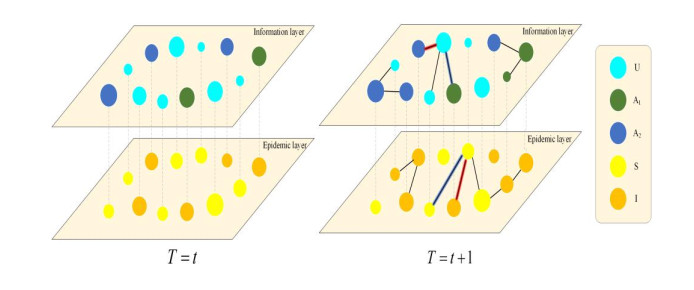
Schematic diagram of a time-varying adaptive network. Different node sizes represent varying sensitivity levels; the larger the node size, the higher the sensitivity level. A red-growing line indicates that the edge that was connected at time $ t $ has been disconnected at time $ t+1 $, while a blue-growing line indicates that an edge that was not connected at time $ t $ has been established at time $ t+1 $
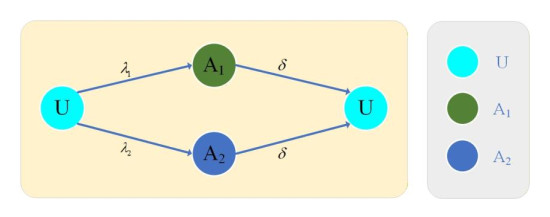
Schematic diagram of information transmission
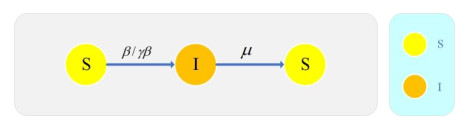
Schematic diagram of epidemic spreading
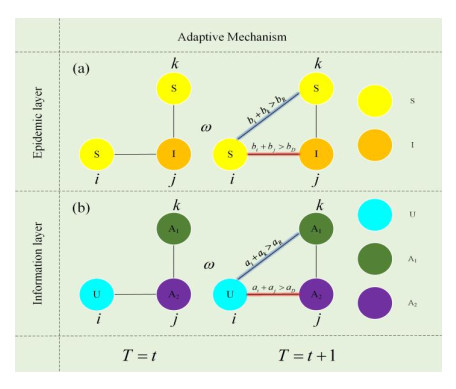
The operational mechanism of adaptive thresholds. (a) and (b) depict the progression of adaptive behavior within the epidemic layer and information layer, respectively. The red-glowing line indicates the disconnection between nodes $i$ and $j$, followed by the formation of a new blue-glowing link between nodes $i$ and $k$
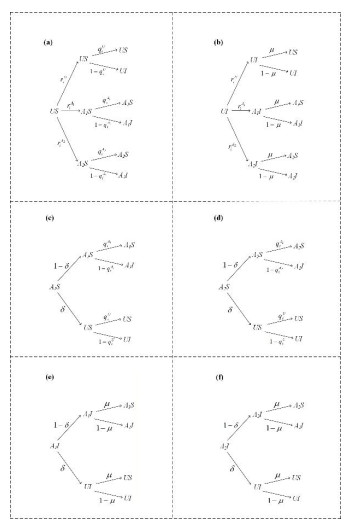
Probability tree of state transfers for node $i$
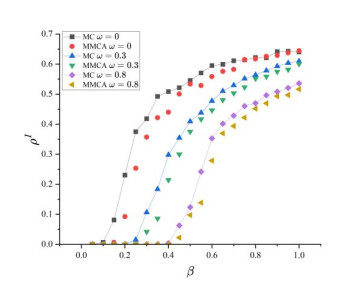
The MC simulation result and MMCA result. Both methods are shown as the final scale of epidemic $\rho^{I}$ as a function of infection rate $\beta$ under different adaptive behavior probability $\omega$. Other paraments are set as $a_{D} = a_{R} = b_{D} = b_{R} = 0.5, \lambda = 0.5$, $\varphi = 0.8$
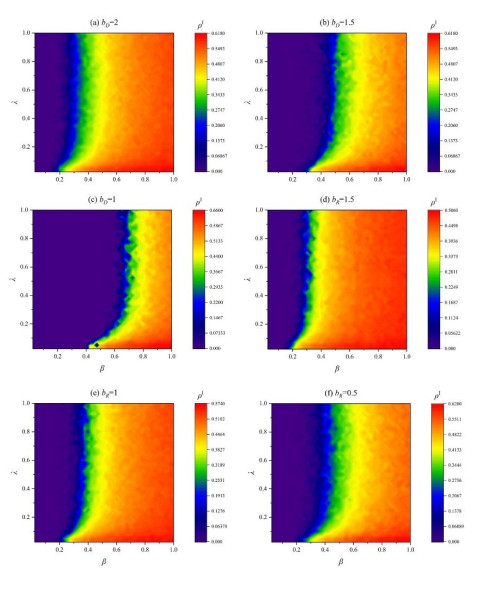
Functional relationship of the infection probability $\beta$, information transmission probability $\lambda$, and final epidemic scale $\rho^{I}$ under different epidemic adaptive reconnection thresholds $b_{R}$. All MC simulations were conducted with 50 independent iterations. The reconnection thresholds were set to (a) $b_{D} = 2$, (b) $b_{D} = 1.5$, and (c) $b_{D} = 1$. Other parameters were $\omega = 0.8, a_{D} = 1.3, a_{R} = b_{R} = 1$. The disconnection thresholds were set to (d) $b_{R} = 1.5$, (e) $b_{R} = 1$, and (f) $b_{R} = 0.5$. Other parameters were $\omega = 0.8, \quad a_{R} = 1$, and $a_{D} = b_{D} = 0.7$
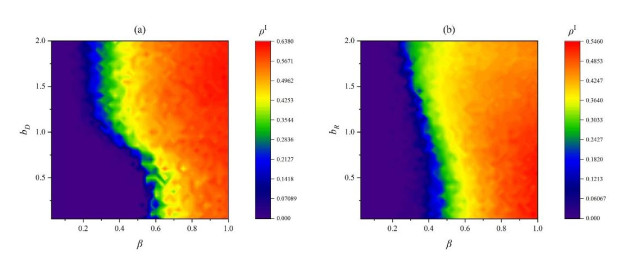
Effect of $b_{D}$ and $b_{R}$ on the model dynamics. (a) illustrates $\rho^{I}$ as a function of $\beta$ and the disconnection threshold $b_{D}$. Other paraments are set to $\omega = 0.8$, $a_{R} = b_{R} = 1$, and $\varphi = 0.8$. (b) illustrates $\rho^{I}$ as a function of $\beta$ and the reconnection threshold $b_{R}$. Other paraments are set to $\omega = 0.8, a_{D} = b_{D} = 1.3$, and $\varphi = 0.8$
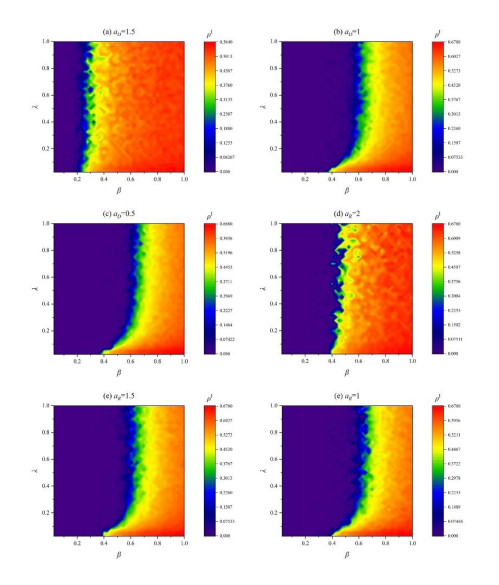
Illustrates $\rho^{I}$ as a function of $\beta$ and $\lambda$ under different information disconnection and reconnection thresholds. The reconnection thresholds were set to (a) $a_{D} = 1.5$, (b) $a_{D} = 1$, and (c) $a_{D} = 0.5$. Other parameters were $\omega = 0.8, a_{R} = b_{R} = 1$, $b_{D} = 0.7$. The disconnection thresholds were set to (d) $a_{R} = 2$, (e) $a_{R} = 1.5$, and (f) $a_{R} = 1$. Other parameters were $\omega = 0.8, a_{D} = b_{D} = 0.7, b_{R} = 1$
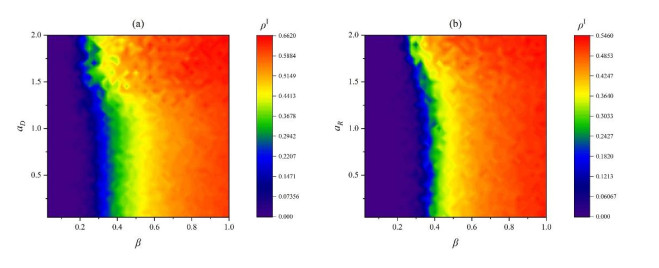
Effect of $a_{D}$ and $a_{R}$ on the model dynamics. (a) illustrates $\rho^{I}$ as a function of $\beta$ and the disconnection threshold $a_{D}$. Other paraments are set to $\omega = 0.8$, $a_{R} = b_{R} = 1, b_{D} = 1.3, \varphi = 0.8$. (b) illustrates $\rho^{I}$ as a function of $\beta$ and the reconnection threshold $a_{R}$. Other paraments are set to $\omega = 0.8, a_{D} = b_{D} = 1.3$, and $\varphi = 0.8$
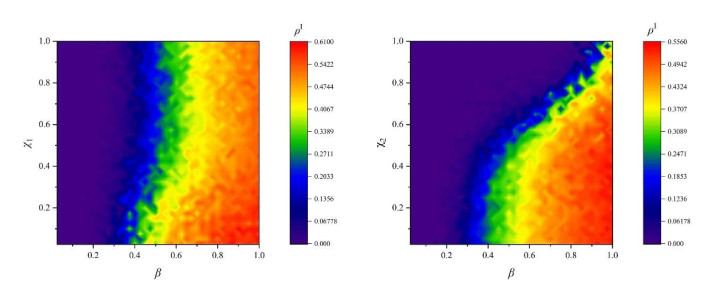
Effect of average information sensitivity $\chi_{1}$ and average epidemic sensitivity $\chi_{2}$ on model dynamics. Other parameters are $a_{R} = b_{R} = 1, a_{D} = b_{D} = 1, \omega = 0.8$, and $\varphi = 0.8$
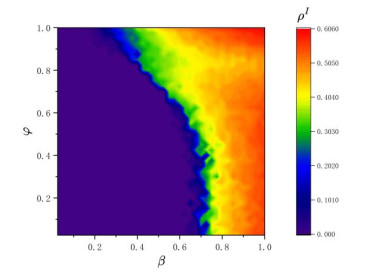
Effect of $\varphi$ on the model dynamics. Other parameters are $a_{R} = b_{R} = 1$, $a_{D} = b_{D} = 0.7, \chi_{1} = \chi_{2} = 0.5$, and $\omega = 0.8$



 DownLoad: