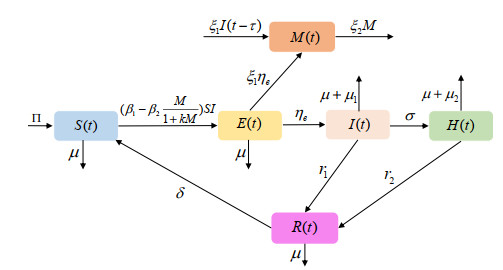
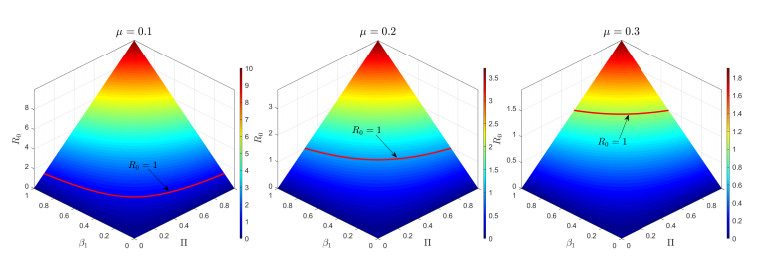
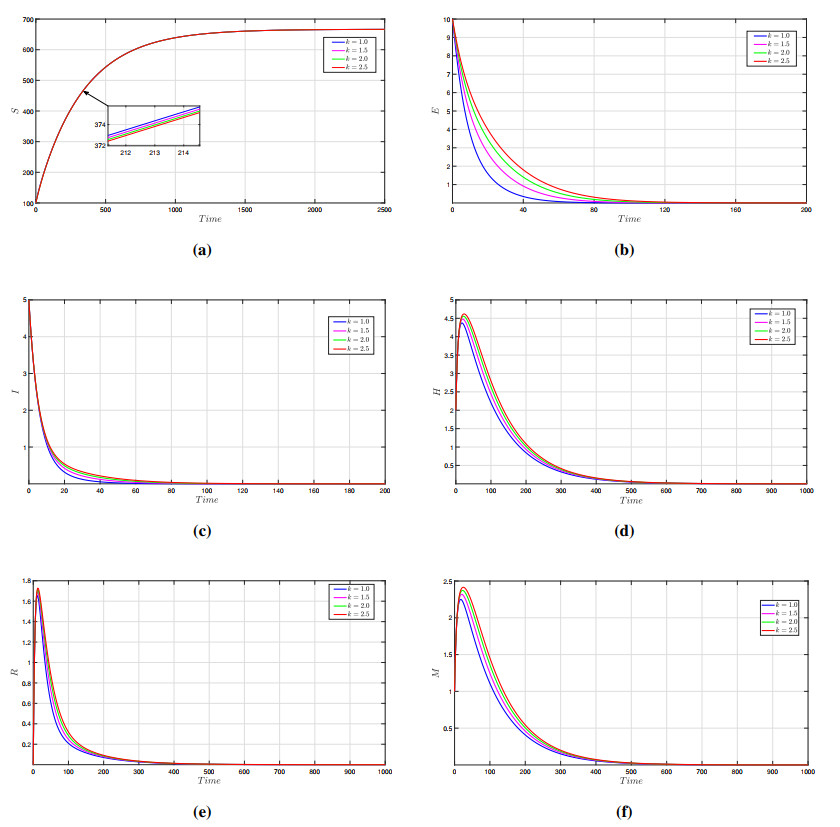
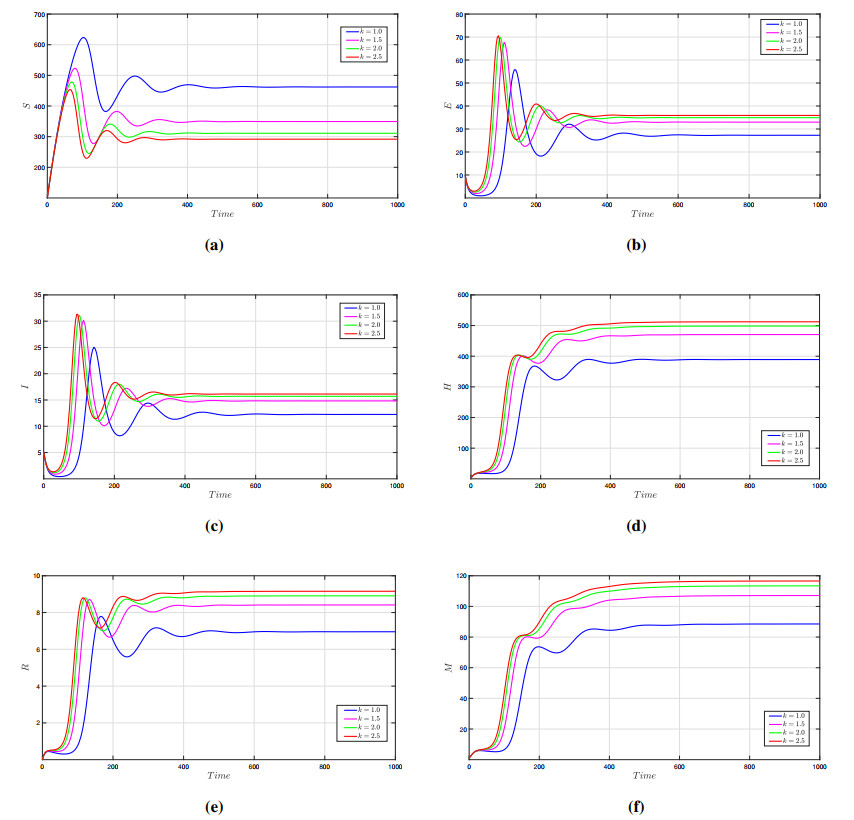
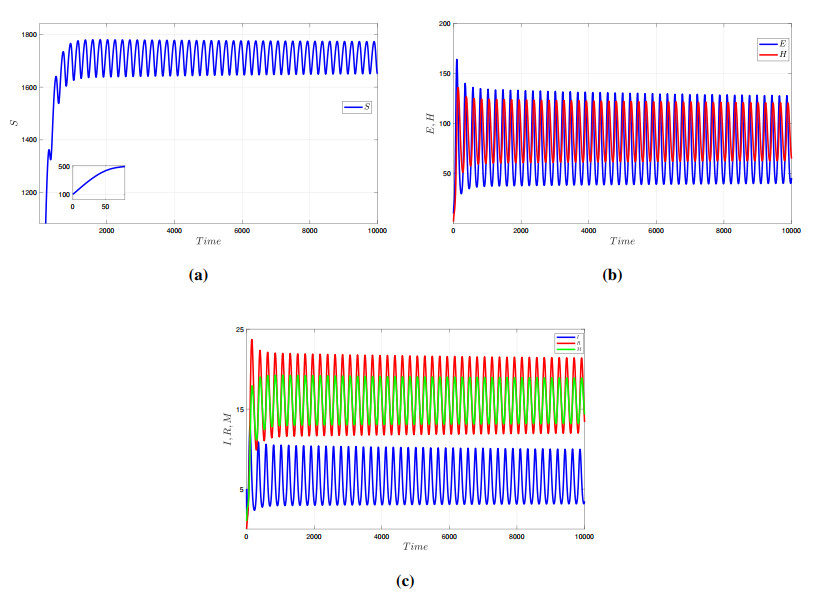
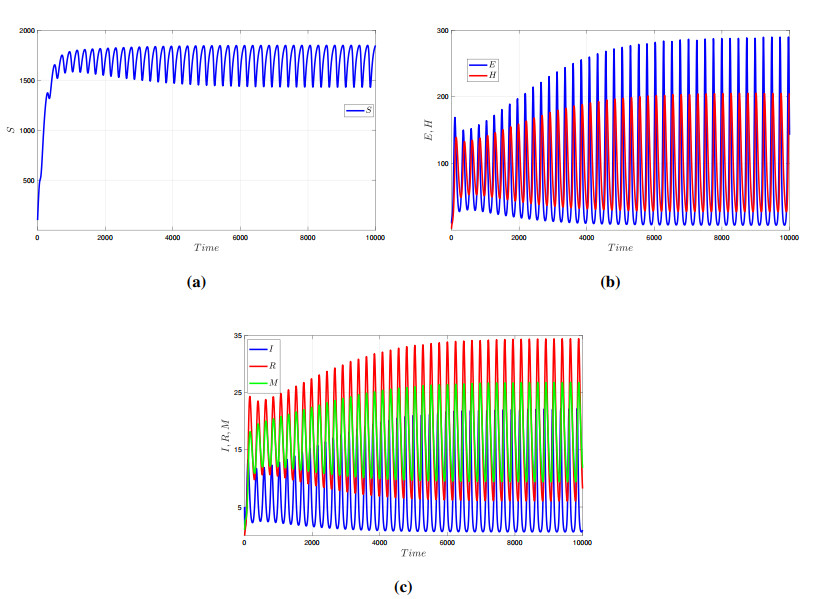
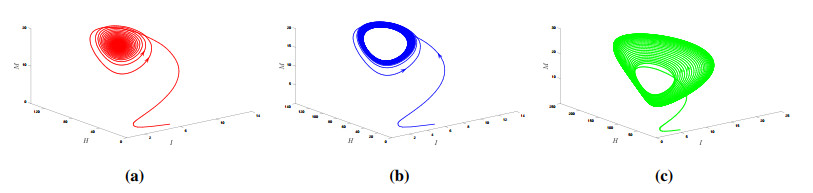
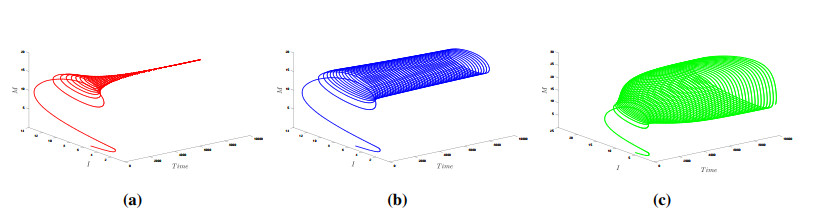
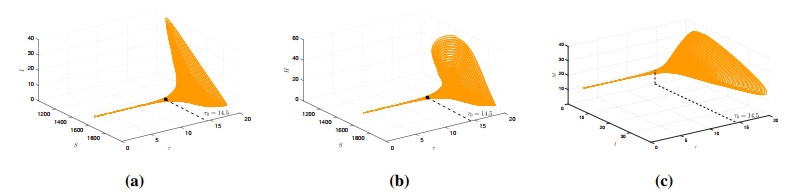
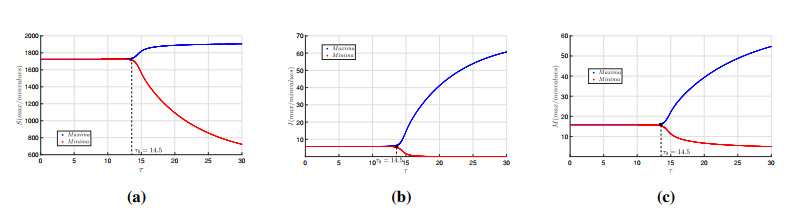
During infectious disease outbreaks, media dissemination, and time delays critically influence the transmission dynamics. To capture the coupled interactions among media influence, time delay, and hospitalization resources, we propose a delayed $ \mathit{susceptible} $–$ \mathit{exposed} $–$ \mathit{infected} $–$ \mathit{hospitalized} $–$ \mathit{recovered} $–$ \mathit{media} $ ($ \mathit{SEIHRM} $) epidemic model incorporating media feedback and systematically investigate its dynamic behavior both theoretically and numerically. The model is shown to be well-posed in terms of the existence, uniqueness, positivity, and boundedness of solutions. The basic reproduction number $ R_0 $ is derived, thereby determining the stability of the disease-free equilibria and serving as a threshold for the existence of endemic equilibria. Bifurcation analysis with the time delay $ \tau $ as the bifurcation parameter reveals that once $ \tau $ exceeds a critical threshold $ \tau_0 $, a Hopf bifurcation emerges, giving rise to sustained periodic oscillations and thereby recurrent epidemic outbreaks. Numerical simulations substantiate the theoretical results and reveal the distribution of stable equilibria, periodic oscillations, and unstable dynamics across parameter regimes. The results demonstrate that the coupling between media dissemination and time delay can drive complex oscillatory dynamics via delayed feedback, providing a mechanistic explanation for both endemic persistence and recurrent epidemic outbreaks. This study offers a novel theoretical perspective on information-feedback-driven epidemic dynamics and provides a quantitative basis for delay-based targeted intervention strategies.
Citation: Chan Ma, Yun Zhao, Xunwen Tan, Wenjie Shi. Dynamical analysis and bifurcation study of an epidemic model with media coverage and time delay[J]. Networks and Heterogeneous Media, 2026, 21(5): 1600-1640. doi: 10.3934/nhm.2026061
During infectious disease outbreaks, media dissemination, and time delays critically influence the transmission dynamics. To capture the coupled interactions among media influence, time delay, and hospitalization resources, we propose a delayed $ \mathit{susceptible} $–$ \mathit{exposed} $–$ \mathit{infected} $–$ \mathit{hospitalized} $–$ \mathit{recovered} $–$ \mathit{media} $ ($ \mathit{SEIHRM} $) epidemic model incorporating media feedback and systematically investigate its dynamic behavior both theoretically and numerically. The model is shown to be well-posed in terms of the existence, uniqueness, positivity, and boundedness of solutions. The basic reproduction number $ R_0 $ is derived, thereby determining the stability of the disease-free equilibria and serving as a threshold for the existence of endemic equilibria. Bifurcation analysis with the time delay $ \tau $ as the bifurcation parameter reveals that once $ \tau $ exceeds a critical threshold $ \tau_0 $, a Hopf bifurcation emerges, giving rise to sustained periodic oscillations and thereby recurrent epidemic outbreaks. Numerical simulations substantiate the theoretical results and reveal the distribution of stable equilibria, periodic oscillations, and unstable dynamics across parameter regimes. The results demonstrate that the coupling between media dissemination and time delay can drive complex oscillatory dynamics via delayed feedback, providing a mechanistic explanation for both endemic persistence and recurrent epidemic outbreaks. This study offers a novel theoretical perspective on information-feedback-driven epidemic dynamics and provides a quantitative basis for delay-based targeted intervention strategies.

| [1] |
Y. Wu, Z. Zhang, L. Song, C. Xia, Global stability analysis of two strains epidemic model with imperfect vaccination and immunity waning in a complex network, Chaos, Solitons Fractals, 179 (2024), 114414. https://doi.org/10.1016/j.chaos.2023.114414 doi: 10.1016/j.chaos.2023.114414

|
| [2] |
S. Saleem, M. Rafiq, N. Ahmed, M. S. Arif, A. Raza, Z. Iqbal, et al., Fractional epidemic model of coronavirus disease with vaccination and crowding effects, Sci. Rep., 14 (2024), 8157. https://doi.org/10.1038/s41598-024-58192-7 doi: 10.1038/s41598-024-58192-7
|
| [3] |
D. Legros, Global cholera epidemiology: Opportunities to reduce the burden of cholera by 2030, J. Infect. Dis., 218 (2018), S137–S140. https://doi.org/10.1093/infdis/jiy486 doi: 10.1093/infdis/jiy486
|
| [4] |
C. E. Mills, J. M. Robins, M. Lipsitch, Transmissibility of 1918 pandemic influenza, Nature, 432 (2004), 904–906. https://doi.org/10.1038/nature03063 doi: 10.1038/nature03063
|
| [5] |
T. Khan, Z. Ullah, N. Ali, G. Zaman, Modeling and control of the hepatitis B virus spreading using an epidemic model, Chaos, Solitons Fractals, 124 (2019), 1–9. https://doi.org/10.1016/j.chaos.2019.04.033 doi: 10.1016/j.chaos.2019.04.033
|
| [6] |
F. Nill, Endemic oscillations for SARS-CoV-2 Omicron–A SIRS model analysis, Chaos, Solitons Fractals, 173 (2023), 113678. https://doi.org/10.1016/j.chaos.2023.113678 doi: 10.1016/j.chaos.2023.113678
|
| [7] |
N. M. Ferguson, D. A. T. Cummings, C. Fraser, J. C. Cajka, P. C. Cooley, D. S. Burke, Strategies for mitigating an influenza pandemic, Nature, 442 (2006), 448–452. https://doi.org/10.1038/nature04795 doi: 10.1038/nature04795
|
| [8] |
Z. Memon, S. Qureshi, B. R. Memon, Assessing the role of quarantine and isolation as control strategies for COVID-19 outbreak: A case study, Chaos, Solitons Fractals, 144 (2021), 110655. https://doi.org/10.1016/j.chaos.2021.110655 doi: 10.1016/j.chaos.2021.110655
|
| [9] |
G. Zhang, Z. Li, A. Din, T. Chen, Dynamic analysis and optimal control of a stochastic COVID-19 model, Math. Comput. Simul., 215 (2024), 498–517. https://doi.org/10.1016/j.matcom.2023.08.005 doi: 10.1016/j.matcom.2023.08.005
|
| [10] |
R. K. Rai, P. K. Tiwari, Y. Kang, A. K. Misra, Modeling the effect of literacy and social media advertisements on the dynamics of infectious diseases, Math. Biosci. Eng., 17 (2020), 5812–5848. https://doi.org/10.3934/mbe.2020311 doi: 10.3934/mbe.2020311
|
| [11] |
R. Pitman, D. Fisman, G. S. Zaric, M. Postma, M. Kretzschmar, J. Edmunds, et al., Dynamic transmission modeling: A report of the ISPOR-SMDM modeling good research practices task force-5, Value Health, 15 (2012), 828–834. https://doi.org/10.1016/j.jval.2012.06.011 doi: 10.1016/j.jval.2012.06.011
|
| [12] |
S. K. Biswas, U. Ghosh, S. Sarkar, A mathematical model of Zika virus transmission with saturated incidence and optimal control: A case study of 2016 zika outbreak in Puerto Rico, Int. J. Model. Simul., 44 (2024), 172–189. https://doi.org/10.1080/02286203.2022.2163834 doi: 10.1080/02286203.2022.2163834
|
| [13] |
A. K. Misra, R. K. Rai, Impacts of TV and radio advertisements on the dynamics of an infectious disease: A modeling study, Math. Methods Appl. Sci., 42 (2019), 1262–1282. https://doi.org/10.1002/mma.5438 doi: 10.1002/mma.5438
|
| [14] |
A. K. Misra, R. K. Rai, A mathematical model for the control of infectious diseases: Effects of TV and radio advertisements, Int. J. Bifurcat. Chaos, 28 (2018), 1850037. https://doi.org/10.1142/S0218127418500372 doi: 10.1142/S0218127418500372
|
| [15] |
J. Li, Y. Kuang, Analysis of a model of the glucose-insulin regulatory system with two delays, SIAM J. Appl. Math., 67 (2007), 757–776. https://doi.org/10.1137/050634001 doi: 10.1137/050634001
|
| [16] |
Y. Li, J. Cui, The effect of constant and pulse vaccination on SIS epidemic models incorporating media coverage, Commun. Nonlinear Sci. Numer. Simul., 14 (2009), 2353–2365. https://doi.org/10.1016/j.cnsns.2008.06.024 doi: 10.1016/j.cnsns.2008.06.024
|
| [17] |
S. Collinson, K. Khan, J. M. Heffernan, The effects of media reports on disease spread and important public health measurements, PLoS One, 10 (2015), e0141423. https://doi.org/10.1371/journal.pone.0141423 doi: 10.1371/journal.pone.0141423
|
| [18] |
S. Funk, E. Gilad, V. A. A. Jansen, Endemic disease, awareness, and local behavioural response, J. Theor. Biol., 264 (2010), 501–509. https://doi.org/10.1016/j.jtbi.2010.02.032 doi: 10.1016/j.jtbi.2010.02.032
|
| [19] |
W. Gao, H. M. Mehmet-Baskonus, Deeper investigation of modified epidemiological computer virus model containing the Caputo operator, Chaos, Solitons Fractals, 158 (2022), 112050. https://doi.org/10.1016/j.chaos.2022.112050 doi: 10.1016/j.chaos.2022.112050
|
| [20] |
D. Greenhalgh, S. Rana, S. Samanta, T. Sardar, S. Bhattacharya, J. Chattopadhyay, Awareness programs control infectious disease–-Multiple delay induced mathematical model, Appl. Math. Comput., 251 (2015), 539–563. https://doi.org/10.1016/j.amc.2014.11.091 doi: 10.1016/j.amc.2014.11.091
|
| [21] |
M. L. Diagne, F. B. Agusto, H. Rwezaura, J. M. Tchuenche, S. Lenhart, Optimal control of an epidemic model with treatment in the presence of media coverage, Sci. Afr., 24 (2024), e02138. https://doi.org/10.1016/j.sciaf.2024.e02138 doi: 10.1016/j.sciaf.2024.e02138
|
| [22] |
Z. Jiang, X. Li, Y. Li, X. Luo, A two-stage control strategy for sheep brucellosis with discontinuous changes in vaccination rate, Nonlinear Dyn., 114 (2026), 319. https://doi.org/10.1007/s11071-025-12198-6 doi: 10.1007/s11071-025-12198-6
|
| [23] |
Y. Liu, J. A. Cui, The impact of media coverage on the dynamics of infectious disease, Int. J. Biomath., 1 (2008), 65–74. https://doi.org/10.1142/S1793524508000023 doi: 10.1142/S1793524508000023
|
| [24] |
R. Liu, J. Wu, H. Zhu, Media/psychological impact on multiple outbreaks of emerging infectious diseases, Comput. Math. Methods Med., 8 (2007), 153–164. https://doi.org/10.1080/17486700701425870 doi: 10.1080/17486700701425870
|
| [25] |
Y. Xiao, T. Zhao, S. Tang, Dynamics of an infectious diseases with media/psychology induced non-smooth incidence, Math. Biosci. Eng., 10 (2013), 445–461. https://doi.org/10.3934/mbe.2013.10.445 doi: 10.3934/mbe.2013.10.445
|
| [26] |
Q. Yan, S. Tang, S. Gabriele, J. Wu, Media coverage and hospital notifications: Correlation analysis and optimal media impact duration to manage a pandemic, J. Theor. Biol., 390 (2016), 1–13. https://doi.org/10.1016/j.jtbi.2015.11.002 doi: 10.1016/j.jtbi.2015.11.002
|
| [27] |
P. Song, Y. Xiao, Analysis of an epidemic system with two response delays in media impact function, Bull. Math. Biol., 81 (2019), 1582–1612. https://doi.org/10.1007/s11538-019-00586-0 doi: 10.1007/s11538-019-00586-0
|
| [28] |
W. Zhou, A. Wang, F. Xia, Y. Xiao, S. Tang, Effects of media reporting on mitigating spread of COVID-19 in the early phase of the outbreak, Math. Biosci. Eng., 17 (2020), 2693–2707. https://doi.org/10.3934/mbe.2020147 doi: 10.3934/mbe.2020147
|
| [29] |
W. Zhou, Y. Xiao, J. M. Heffernan, Optimal media reporting intensity on mitigating spread of an emerging infectious disease, PLOS ONE, 14 (2019), e0213898. https://doi.org/10.1371/journal.pone.0213898 doi: 10.1371/journal.pone.0213898
|
| [30] |
G. Ilhem, M. Kouche, B. Ainseba, Stability analysis of a fractional-order SEIR epidemic model with general incidence rate and time delay, Math. Methods Appl. Sci., 46 (2023), 10947–10969. https://doi.org/10.1002/mma.9161 doi: 10.1002/mma.9161
|
| [31] |
X. Cui, D. Xue, F. Pan, Dynamic analysis and optimal control for a fractional-order delayed SIR epidemic model with saturated treatment, Eur. Phys. J. Plus, 137 (2022), 586. https://doi.org/10.1140/epjp/s13360-022-02810-8 doi: 10.1140/epjp/s13360-022-02810-8
|
| [32] |
A. Din, Bifurcation analysis of a delayed stochastic HBV epidemic model: Cell-to-cell transmission, Chaos, Solitons Fractals, 181 (2024), 114714. https://doi.org/10.1016/j.chaos.2024.114714 doi: 10.1016/j.chaos.2024.114714
|
| [33] |
W. Wang, G. Chen, E. W. M. Wong, Delay-driven phase transitions in an epidemic model on time-varying networks, Chaos, 34 (2024), 043146. https://doi.org/10.1063/5.0179068 doi: 10.1063/5.0179068
|
| [34] |
M. Bestehorn, T. M. Michelitsch, Periodic solutions and chaotic attractors of a modified epidemiological SEIS model, Chaos, 35 (2025), 023104. https://doi.org/10.1063/5.0241314 doi: 10.1063/5.0241314
|
| [35] |
N. Wang, L. Qi, M. Bessane, M. Hao, Global Hopf bifurcation of a two-delay epidemic model with media coverage and asymptomatic infection, J. Differ. Equ., 369 (2023), 1–40. https://doi.org/10.1016/j.jde.2023.05.036 doi: 10.1016/j.jde.2023.05.036
|
| [36] |
L. Zhu, G. Guan, Y. Li, Nonlinear dynamical analysis and control strategies of a network-based SIS epidemic model with time delay, Appl. Math. Model., 70 (2019), 512–531. https://doi.org/10.1016/j.apm.2019.01.037 doi: 10.1016/j.apm.2019.01.037
|
| [37] |
M. Barman, N. Mishra, Hopf bifurcation analysis for a delayed nonlinear-SEIR epidemic model on networks, Chaos, Solitons Fractals, 178 (2024), 114351. https://doi.org/10.1016/j.chaos.2023.114351 doi: 10.1016/j.chaos.2023.114351
|
| [38] |
J. Zhou, Y. Zhao, Y. Ye, Y. Bao, Bifurcation analysis of a fractional-order simplicial SIRS system induced by double delays, Int. J. Bifurcat. Chaos, 32 (2022), 2250068. https://doi.org/10.1142/S0218127422500687 doi: 10.1142/S0218127422500687
|
| [39] |
X. Liu, Z. Lv, Y. Ding, Mathematical modeling and stability analysis of the time-delayed SAIM model for COVID-19 vaccination and media coverage, Math. Biosci. Eng., 19 (2022), 6296–6316. https://doi.org/10.3934/mbe.2022294 doi: 10.3934/mbe.2022294
|
| [40] |
Z. Han, Y. Wang, S. Gao, G. Sun, H. Wang, Final epidemic size of a two-community SIR model with asymmetric coupling, J. Math. Biol., 88 (2024), 51. https://doi.org/10.1007/s00285-024-02073-0 doi: 10.1007/s00285-024-02073-0
|
| [41] |
H. W. Hethcote, The mathematics of infectious diseases, SIAM Rev., 42 (2000), 599–653. https://doi.org/10.1137/S0036144500371907 doi: 10.1137/S0036144500371907
|
| [42] |
T. J. Irving, K. B. Blyuss, C. Colijn, C. L. Trotter, Modelling meningococcal meningitis in the African meningitis belt, Epidemiol. Infect., 140 (2012), 897–905. https://doi.org/10.1017/S0950268811001385 doi: 10.1017/S0950268811001385
|
| [43] |
W. Wu, J. Zhou, Z. Li, X. Tan, The effect of time delay on the dynamics of a fractional-order epidemic model, Adv. Contin. Discrete Models, 2025 (2025), 9. https://doi.org/10.1186/s13662-025-03868-1 doi: 10.1186/s13662-025-03868-1
|
| [44] |
S. Ghosh, J. Mondal, S. Khajanchi, Effect of media awareness in the spread of infectious diseases, J. Appl. Math. Comput., 71 (2025), 3833–3860. https://doi.org/10.1007/s12190-025-02387-2 doi: 10.1007/s12190-025-02387-2
|
| [45] |
R. Hu, M. H. N. Aziz, E. Aruchunan, N. A. Mohamed, Modeling and analysis of a delayed fractional order COVID-19 SEIHRM model with media coverage in Malaysia, Sci. Rep., 15 (2025), 25305. https://doi.org/10.1038/s41598-025-99389-8 doi: 10.1038/s41598-025-99389-8
|
| [46] | J. K. Hale, S. M. Verduyn-Lunel, Introduction to Functional Differential Equations, Springer New York, NY, 1993. https://doi.org/10.1007/978-1-4612-4342-7 |
| [47] | H. L. Smith, An Introduction to Delay Differential Equations with Applications to the Life Sciences, Springer New York, NY, 2010. https://doi.org/10.1007/978-1-4419-7646-8 |
| [48] |
H. Delavari, D. Baleanu, J. Sadati, Stability analysis of Caputo fractional-order nonlinear systems revisited, Nonlinear Dyn., 67 (2012), 2433–2439. https://doi.org/10.1007/s11071-011-0157-5 doi: 10.1007/s11071-011-0157-5
|
| [49] |
E. Ahmed, A. S. Elgazzar, On fractional order differential equations model for nonlocal epidemics, Phys. A Stat. Mech. Appl., 379 (2007), 607–614. https://doi.org/10.1016/j.physa.2007.01.010 doi: 10.1016/j.physa.2007.01.010
|
| [50] |
W. Deng, C. Li, J. Lü, Stability analysis of linear fractional differential system with multiple time delays, Nonlinear Dyn., 48 (2007), 409–416. https://doi.org/10.1007/s11071-006-9094-0 doi: 10.1007/s11071-006-9094-0
|
| [51] |
S. Li, I. Bukhsh, I. U. Khan, M. I. Asjad, S. M. Eldin, M. A. El-Rahman, et al., The impact of standard and nonstandard finite difference schemes on HIV nonlinear dynamical model, Chaos, Solitons Fractals, 173 (2023), 113755. https://doi.org/10.1016/j.chaos.2023.113755 doi: 10.1016/j.chaos.2023.113755
|
| [52] |
K. Gatermann, M. Eiswirth, A. Sensse, Toric ideals and graph theory to analyze Hopf bifurcations in mass action systems, J. Symb. Comput., 40 (2005), 1361–1382. https://doi.org/10.1016/j.jsc.2005.07.002 doi: 10.1016/j.jsc.2005.07.002
|
| [53] |
S. Al-Shanfari, D. A. Sunny, I. M. Elmojtaba, N. Al-Salti, S. Pushpan, A delay mathematical model for cholera transmission: Stability, chaos and bifurcation, Chaos, Solitons Fractals, 198 (2025), 116464. https://doi.org/10.1016/j.chaos.2025.116464 doi: 10.1016/j.chaos.2025.116464
|
Figures(14) / Tables(1)
Chan Ma, Yun Zhao, Xunwen Tan, Wenjie Shi. Dynamical analysis and bifurcation study of an epidemic model with media coverage and time delay[J]. Networks and Heterogeneous Media, 2026, 21(5): 1600-1640. doi: 10.3934/nhm.2026061




 DownLoad: