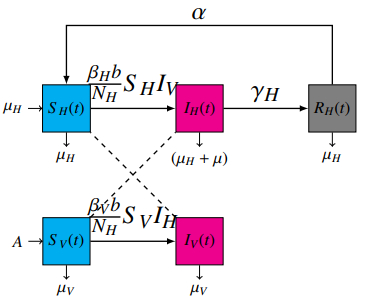
Dengue fever is caused by the dengue virus transmitted by female Aedes Aegypti. The spread of dengue fever remains a critical public health issue. Dengue fever is a cycle between humans and mosquitoes. A high number of infected humans causes a high number of infected mosquitoes, and vice versa. Therefore, in this study, we develop a new mathematical model that considers the host for the human population and the vector for the mosquito population. This study focuses on capturing the fundamental dynamics of dengue virus transmission using a widely understandable host-vector model. The analysis is divided into two models: one without control and one with control. In the mathematical model without control, we obtain the basic reproduction number, which is determined using the next-generation matrix. We use the basic reproduction number to analyze the local stability of the disease-free equilibrium and the Routh-Hurwitz criterion for the endemic equilibrium. Additionally, we employ LaSalle's invariance principle and Lyapunov functions to analyze the global stability of both equilibriums. Moreover, we predict the virus spread through a sensitivity analysis of the key parameters that influence the basic reproduction number. We extend the model with control, which promotes for a thorough understanding of the effects of a single-control strategy in depth. Following this analysis, a preventive control strategy using Pontryagin's Maximum Principle is developed to minimize contact between the host and vector, ultimately reducing the spread of the dengue virus. Then, these strategies are numerically solved to investigate the control efforts required to reduce the number of infected classes.
Citation: Eminugroho Ratna Sari, Nikken Prima Puspita, R. N. Farah. Prevention of dengue virus transmission: insights from host-vector mathematical model[J]. Mathematical Modelling and Control, 2025, 5(2): 131-146. doi: 10.3934/mmc.2025010
Dengue fever is caused by the dengue virus transmitted by female Aedes Aegypti. The spread of dengue fever remains a critical public health issue. Dengue fever is a cycle between humans and mosquitoes. A high number of infected humans causes a high number of infected mosquitoes, and vice versa. Therefore, in this study, we develop a new mathematical model that considers the host for the human population and the vector for the mosquito population. This study focuses on capturing the fundamental dynamics of dengue virus transmission using a widely understandable host-vector model. The analysis is divided into two models: one without control and one with control. In the mathematical model without control, we obtain the basic reproduction number, which is determined using the next-generation matrix. We use the basic reproduction number to analyze the local stability of the disease-free equilibrium and the Routh-Hurwitz criterion for the endemic equilibrium. Additionally, we employ LaSalle's invariance principle and Lyapunov functions to analyze the global stability of both equilibriums. Moreover, we predict the virus spread through a sensitivity analysis of the key parameters that influence the basic reproduction number. We extend the model with control, which promotes for a thorough understanding of the effects of a single-control strategy in depth. Following this analysis, a preventive control strategy using Pontryagin's Maximum Principle is developed to minimize contact between the host and vector, ultimately reducing the spread of the dengue virus. Then, these strategies are numerically solved to investigate the control efforts required to reduce the number of infected classes.

| [1] | D. J. Gubler, E. E. Ooi, S. Vasudevan, J. Farrar, Dengue and dengue hemorrhagic fever, 2 Eds., CABI, 2014. http://dx.doi.org/10.1079/9781845939649.0000 |
| [2] |
M. G. Guzman, D. J. Gubler, A. Izquierdo, E. Martinez, S. B. Halstead, Dengue infection, Nat. Rev. Dis. Primers, 2 (2016), 1–25. http://dx.doi.org/10.1038/nrdp.2016.5 doi: 10.1038/nrdp.2016.5

|
| [3] | World Health Organization, Dengue and severe dengue. Available from: https://www.who.int/news-room/fact-sheets/detail/dengue-and-severe-dengue. |
| [4] | World Health Organization, Dengue in the South-East Asia. Available from: https://www.who.int/southeastasia/health-topics/dengue-and-severe-dengue. |
| [5] |
W. Jia, K. He, Y. Song, W. Cao, S. Wang, S. Yang, et al., Extended SIR prediction of the epidemics trend of COVID-19 in Italy and compared with Hunan, China, Front. Med., 7 (2020), 1–7. http://dx.doi.org/10.3389/fmed.2020.00169 doi: 10.3389/fmed.2020.00169
|
| [6] |
W. Sanusi, N. Badwi, A. Zaki, S. Sidjara, N. Sari, M. I. Pratama, et al., Analysis and simulation of SIRS model for dengue fever transmission in South Sulawesi, Indonesia, J. Appl. Math., 2021 (2021), 1–8. http://dx.doi.org/10.1155/2021/2918080 doi: 10.1155/2021/2918080
|
| [7] |
H. R. Pandey, G. R. Phaijoo, D. B. Gurung, Fractional-order dengue disease epidemic model in Nepal, Int. J. Appl. Comput. Math., 8 (2022), 259. http://dx.doi.org/10.1007/s40819-022-01459-2 doi: 10.1007/s40819-022-01459-2
|
| [8] |
H. R. Pandey, G. R. Phaijoo, D. B. Gurung, Dengue dynamics in Nepal: a Caputo fractional model with optimal control strategies, Heliyon, 10 (2024), e33822. http://dx.doi.org/10.1016/j.heliyon.2024.e33822 doi: 10.1016/j.heliyon.2024.e33822
|
| [9] |
L. Esteva, C. Vargas, Analysis of a dengue disease transmission model, Math. Biosci., 150 (1998), 131–151. http://dx.doi.org/10.1016/S0025-5564(98)10003-2 doi: 10.1016/S0025-5564(98)10003-2
|
| [10] | E. R. Sari, Stability analysis of dengue disease using host–vector model, In: A. Kılıçman, H. Srivastava, M. Mursaleen, Z. Abdul Majid, Recent advances in mathematical sciences, Singapore: Springer, 2016, 83–98. http://dx.doi.org/10.1007/978-981-10-0519-0_8 |
| [11] |
E. R. Sari, N. Insani, D. Lestari, The preventive control of a dengue disease using Pontryagin minimum principal, J. Phys.: Conf. Ser., 855 (2017), 012045. http://dx.doi.org/10.1088/1742-6596/855/1/012045 doi: 10.1088/1742-6596/855/1/012045
|
| [12] |
S. Saha, G. Samanta, Analysis of a host–vector dynamics of a dengue disease model with optimal vector control strategy, Math. Comput. Simul., 195 (2022), 31–55. http://dx.doi.org/10.1016/j.matcom.2021.12.021 doi: 10.1016/j.matcom.2021.12.021
|
| [13] | M. R. Hasan, A. Hobiny, A. Alshehri, Dynamic vector-host dengue epidemic model with vector control and sensitivity analysis, Adv. Dyn. Syst. Appl., 18 (2023), 1–21. |
| [14] |
A. Abidemi, O. J. Peter, Host-vector dynamics of dengue with asymptomatic, isolation and vigilant compartments: insights from modelling, Eur. Phys. J. Plus, 138 (2023), 1–22. http://dx.doi.org/10.1140/epjp/s13360-023-03823-7 doi: 10.1140/epjp/s13360-023-03823-7
|
| [15] |
H. R. Pandey, G. R. Phaijoo, D. B. Gurung, Vaccination effect on the dynamics of dengue disease transmission models in Nepal: a fractional derivative approach, Partial Differ. Equ. Appl. Math., 7 (2023), 100476. http://dx.doi.org/10.1016/j.padiff.2022.100476 doi: 10.1016/j.padiff.2022.100476
|
| [16] |
A. K. Srivastav, V. Steindorf, N. Stollenwerk, M. Aguiar, The effects of public health measures on severe dengue cases: an optimal control approach, Chaos Solit. Fract., 172 (2023), 113577. http://dx.doi.org/10.1016/j.chaos.2023.113577 doi: 10.1016/j.chaos.2023.113577
|
| [17] | L. Cesari, Optimization—theory and applications: problems with ordinary differential equations, Vol. 17, New York: Springer, 2012. http://dx.doi.org/10.1007/978-1-4613-8165-5 |
| [18] | L. S. Pontryagin, Mathematical theory of optimal processes, New York: Routledge, 2018. http://dx.doi.org/10.1201/9780203749319 |
| [19] |
A. Fall, A. Iggidr, G. Sallet, J. J. Tewa, Epidemiological models and Lyapunov functions, Math. Model. Nat. Phenom., 2 (2007), 62–83. http://dx.doi.org/10.1051/mmnp:2008011 doi: 10.1051/mmnp:2008011
|
| [20] |
S. Ottaviano, M. Sensi, S. Sottile, Global stability of SAIRS epidemic models, Nonlinear Anal.-Real World Appl., 65 (2022), 103501. http://dx.doi.org/10.1016/j.nonrwa.2021.103501 doi: 10.1016/j.nonrwa.2021.103501
|
| [21] |
O. Diekmann, J. A. P. Heesterbeek, J. A. Metz, On the definition and the computation of the basic reproduction ratio $R_0$ in models for infectious diseases in heterogeneous populations, J. Math. Biol., 28 (1990), 365–382. http://dx.doi.org/10.1007/BF00178324 doi: 10.1007/BF00178324
|
| [22] | J.K. Hale, Functional differential equations, Analytic Theory of Differential Equations: The Proceedings of the Conference at Western Michigan University, Kalamazoo, from 30 April to 2 May 1970, Berlin, Heidelberg: Springer Berlin Heidelberg, 2006. |
| [23] |
N. Chitnis, J. M. Hyman, J. M. Cushing, Determining important parameters in the spread of malaria through the sensitivity analysis of a mathematical model, Bull. Math. Biol., 70 (2008), 1272–1296. http://dx.doi.org/10.1007/s11538-008-9299-0 doi: 10.1007/s11538-008-9299-0
|
| [24] |
W. Yang, Dynamical behaviors and optimal control problem of an SEIRS epidemic model with interventions, Bull. Malays. Math. Sci. Soc., 44 (2021), 2737–2752. http://dx.doi.org/10.1007/s40840-021-01087-x doi: 10.1007/s40840-021-01087-x
|
| [25] |
S. Y. Tchoumi, Y. Kouakep-Tchaptchie, D. J. Fotsa-Mbogne, J. C. Kamgang, J. M. Tchuenche, Optimal control of a malaria model with long-lasting insecticide-treated nets, Math. Model. Control, 1 (2021), 188–207. http://dx.doi.org/10.3934/mmc.2021018 doi: 10.3934/mmc.2021018
|
| [26] |
S. A. Carvalho, S. O. da Silva, I. D. C. Charret, Mathematical modeling of dengue epidemic: control methods and vaccination strategies, Theory Biosci., 138 (2019), 223–239. http://dx.doi.org/10.1007/s12064-019-00273-7 doi: 10.1007/s12064-019-00273-7
|
| [27] |
M. Usman, M. Abbas, S. H. Khan, A. Omame, Analysis of a fractional-order model for dengue transmission dynamics with quarantine and vaccination measures, Sci. Rep., 14 (2024), 11954. http://dx.doi.org/10.1038/s41598-024-62767-9 doi: 10.1038/s41598-024-62767-9
|
| [28] |
B. Z. Naaly, T. Marijani, A. Isdory, J. Z. Ndendya, Mathematical modeling of the effects of vector control, treatment and mass awareness on the transmission dynamics of dengue fever, Comput. Methods Programs Biomed. Update, 6 (2024), 100159. http://dx.doi.org/10.1016/j.cmpbup.2024.100159 doi: 10.1016/j.cmpbup.2024.100159
|
| [29] |
J. Zhang, L. Liu, Y. Li, Y. Wang, An optimal control problem for dengue transmission model with Wolbachia and vaccination Commun. Nonlinear Sci. Numer. Simul., 116 (2023), 106856. http://dx.doi.org/10.1016/j.cnsns.2022.106856 doi: 10.1016/j.cnsns.2022.106856
|


Figures(9)
Eminugroho Ratna Sari, Nikken Prima Puspita, R. N. Farah. Prevention of dengue virus transmission: insights from host-vector mathematical model[J]. Mathematical Modelling and Control, 2025, 5(2): 131-146. doi: 10.3934/mmc.2025010




 DownLoad: