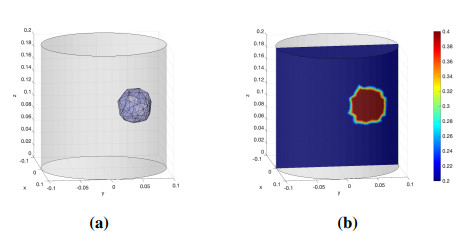
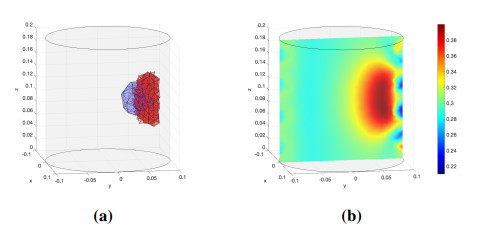
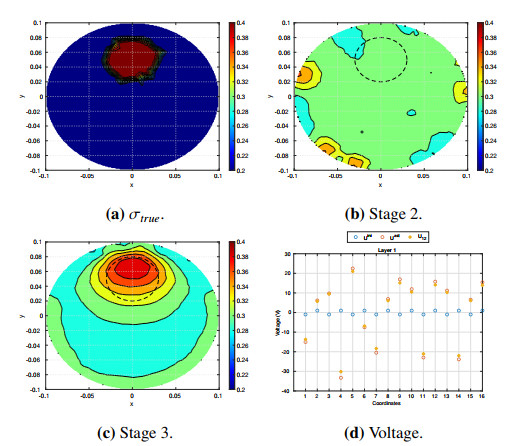
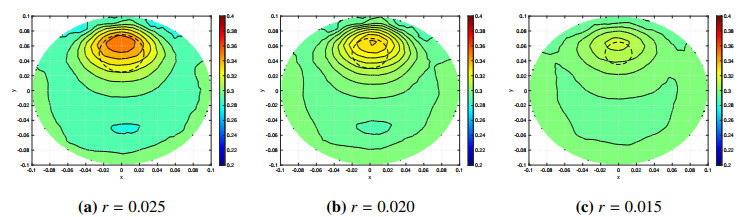
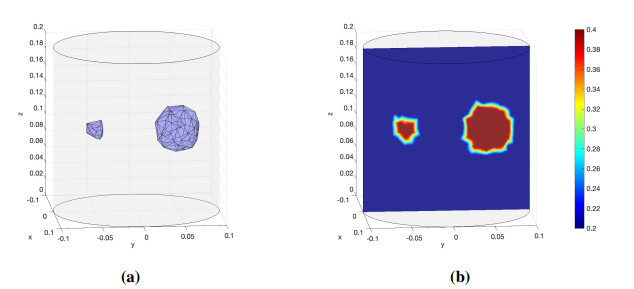
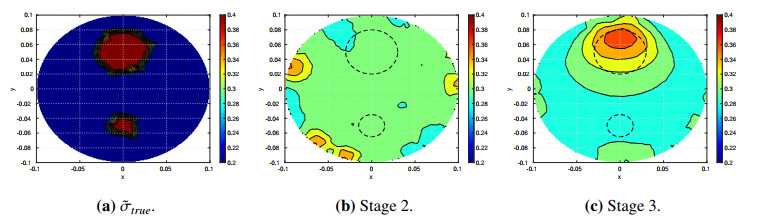
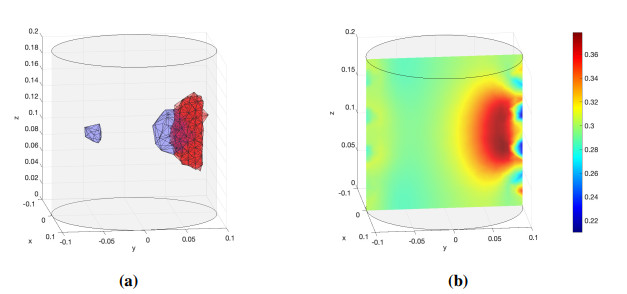
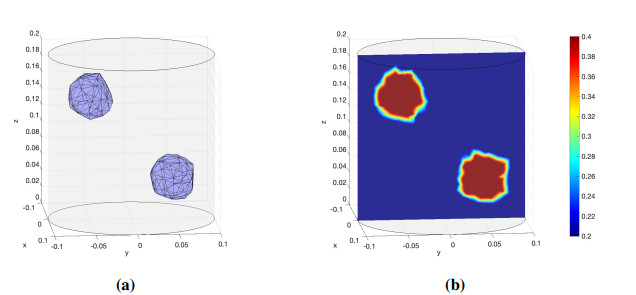
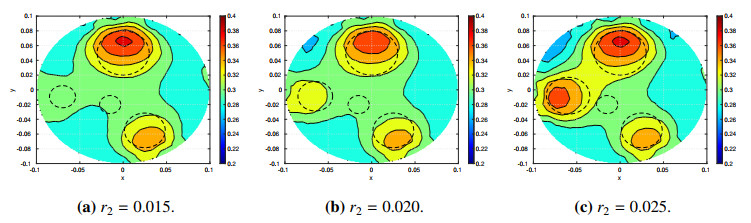
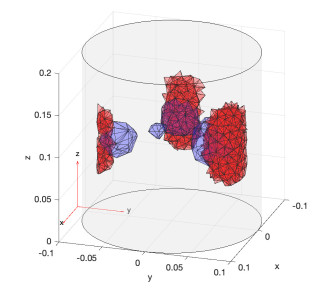
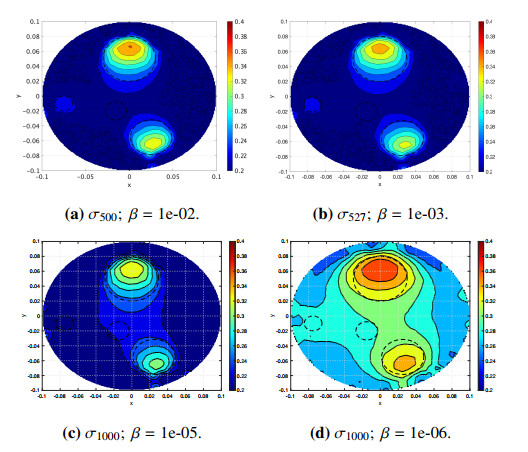
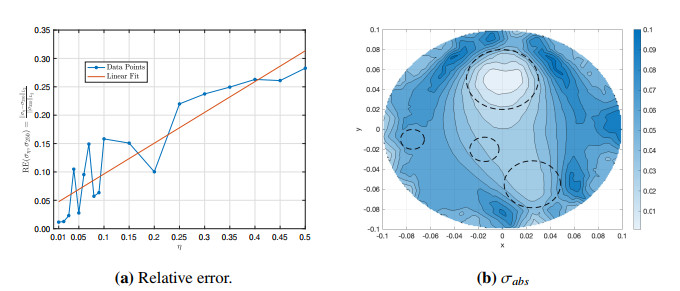
We pursue a computational analysis of the biomedical problem on the identification of cancerous tumors at an early stage of development based on the Electrical Impedance Tomography (EIT) and optimal control of elliptic partial differential equations. Relying on the fact that the electrical conductivity of the cancerous tumor is significantly higher than that of healthy tissue, we consider an inverse EIT problem for identifying the conductivity map in the complete electrode model based on $ m $ current-to-voltage measurements on the boundary electrodes. A variational formulation as a PDE-constrained optimal control problem is introduced based on the novel idea of increasing the size of the input data by adding "voltage-to-current" measurements through various permutations of the single "current-to-voltage" measurement. The idea of permutation preserves the size of the unknown parameters at the expense of an increase in the number of PDE constraints. We apply a gradient projection method (GPM) based on the Fréchet differentiability in Besov-Hilbert spaces. Numerical simulations of 2D and 3D model examples demonstrate the sharp increase in the resolution of the cancerous tumor by increasing the number of measurements from $ m $ to $ m^2 $.
Citation: Ugur G. Abdulla, José H. Rodrigues. Cancer detection via electrical impedance tomography and optimal control of elliptic PDEs[J]. Mathematics in Engineering, 2026, 8(2): 308-339. doi: 10.3934/mine.2026010
We pursue a computational analysis of the biomedical problem on the identification of cancerous tumors at an early stage of development based on the Electrical Impedance Tomography (EIT) and optimal control of elliptic partial differential equations. Relying on the fact that the electrical conductivity of the cancerous tumor is significantly higher than that of healthy tissue, we consider an inverse EIT problem for identifying the conductivity map in the complete electrode model based on $ m $ current-to-voltage measurements on the boundary electrodes. A variational formulation as a PDE-constrained optimal control problem is introduced based on the novel idea of increasing the size of the input data by adding "voltage-to-current" measurements through various permutations of the single "current-to-voltage" measurement. The idea of permutation preserves the size of the unknown parameters at the expense of an increase in the number of PDE constraints. We apply a gradient projection method (GPM) based on the Fréchet differentiability in Besov-Hilbert spaces. Numerical simulations of 2D and 3D model examples demonstrate the sharp increase in the resolution of the cancerous tumor by increasing the number of measurements from $ m $ to $ m^2 $.

| [1] |
U. G. Abdulla, V. Bukshtynov, S. Seif, Cancer detection through Electrical Impedance Tomography and optimal control theory: theoretical and computational analysis, Math. Biosci. Eng., 18 (2021), 4834–4859. https://doi.org/10.3934/mbe.2021246 doi: 10.3934/mbe.2021246

|
| [2] |
U. G. Abdulla, S. Seif, Discretization and convergence of the eit optimal control problem in sobolev spaces with dominating mixed smoothness, Contemp. Math., 784 (2023). https://doi.org/10.1090/conm/784/15750 doi: 10.1090/conm/784/15750
|
| [3] |
G. S. Alberti, H. Ammari, B. Jin, J. K. Seo, W. Zhang, The linearized inverse problem in multifrequency electrical impedance tomography, SIAM J. Imaging Sci., 9 (2016), 1525–1551. https://doi.org/10.1137/16M1061564 doi: 10.1137/16M1061564
|
| [4] |
M. Alsaker, J. L. Mueller, A D-bar algorithm with a priori information for 2-dimensional electrical impedance tomography, SIAM J. Imaging Sci., 9 (2016), 1619–1654. https://doi.org/10.1137/15M1020137 doi: 10.1137/15M1020137
|
| [5] | H. Ammari, H. Kang, Reconstruction of small inhomogeneities from boundary measurements, Lecture Notes in Mathematics, Vol. 1846, Springer, 2004. https://doi.org/10.1007/b98245 |
| [6] |
J. Barzilai, J. M. Borwein, Two-point step size gradient methods, IMA J. Numer. Anal., 8 (1988), 141–148. https://doi.org/10.1093/imanum/8.1.141 doi: 10.1093/imanum/8.1.141
|
| [7] |
R. S. Blue, D. Isaacson, J. C. Newell, Real-time three-dimensional electrical impedance imaging, Physiol. Meas., 21 (2000), 15. https://doi.org/10.1088/0967-3334/21/1/303 doi: 10.1088/0967-3334/21/1/303
|
| [8] | A. P. Calderón, On an inverse boundary value problem, Seminar on Numerical Analysis and Its Application to Continuum Physics, Brazilian Mathematical Society (SBM), 1980, 65–73. |
| [9] |
M. Dodd, J. L. Mueller, A real-time D-bar algorithm for 2-D electrical impedance tomography data, Inverse Probl. Imaging, 8 (2014), 1013–1031. https://doi.org/10.3934/ipi.2014.8.1013 doi: 10.3934/ipi.2014.8.1013
|
| [10] |
M. Gehre, B. Jin, X. Lu, An analysis of finite element approximation in electrical impedance tomography, Inverse Probl., 30 (2014), 045013. https://doi.org/10.1088/0266-5611/30/4/045013 doi: 10.1088/0266-5611/30/4/045013
|
| [11] |
R. J. Halter, T. Zhou, P. M. Meaney, A. Hartov, R. J. B. Jr, K. M. Rosenkranz, et al., The correlation of in vivo and ex vivo tissue dielectric properties to validate electromagnetic breast imaging: initial clinical experience, Physiol. Meas., 30 (2009), S121. https://doi.org/10.1088/0967-3334/30/6/S08 doi: 10.1088/0967-3334/30/6/S08
|
| [12] |
S. J. Hamilton, J. M. R. S. Siltanen, X. Zhang, A hybrid segmentation and D-bar method for electrical impedance tomography, SIAM J. Imaging Sci., 9 (2016), 770–793. https://doi.org/10.1137/15M1025992 doi: 10.1137/15M1025992
|
| [13] | D. S. Holder, Electrical impedance tomography: methods, history and applications, 1 Ed., CRC Press, 2005. https://doi.org/10.1201/9780367801595 |
| [14] |
N. Hyvönen, L. Päivärinta, J. P. Tamminen, Enhancing D-bar reconstructions for electrical impedance tomography with conformal maps, Inverse Probl. Imaging, 12 (2018), 373–400. https://doi.org/10.3934/ipi.2018017 doi: 10.3934/ipi.2018017
|
| [15] |
B. Jin, Y. Xu, J. Zou, A convergent adaptive finite element method for electrical impedance tomography, IMA J. Numer. Anal., 37 (2017), 1520–1550. https://doi.org/10.1093/imanum/drw045 doi: 10.1093/imanum/drw045
|
| [16] |
C. E. Kenig, J. Sjöstrand, G. Uhlmann, The Calderón problem with partial data, Ann. Math., 165 (2007), 567–591. https://doi.org/10.4007/annals.2007.165.567 doi: 10.4007/annals.2007.165.567
|
| [17] |
F. Kleinermann, N. J. Avis, S. K. Judah, D. C. Barber, Three-dimensional image reconstruction for electrical impedance tomography, Physiol. Meas., 17 (1996), A77. https://doi.org/10.1088/0967-3334/17/4A/011 doi: 10.1088/0967-3334/17/4A/011
|
| [18] |
K. Knudsen, M. Lassas, J. L. Mueller, S. Siltanen, Reconstructions of piecewise constant conductivities by the D-bar method for electrical impedance tomography, J. Phys.: Conf. Ser., 124 (2008), 012029. https://doi.org/10.1088/1742-6596/124/1/012029 doi: 10.1088/1742-6596/124/1/012029
|
| [19] |
O. Kwon, J. K. Seo, J. R. Yoon, A real-time algorithm for the location search of discontinuous conductivities with one measurement, Commun. Pure Appl. Math., 55 (2002), 1–29. https://doi.org/10.1002/cpa.3009 doi: 10.1002/cpa.3009
|
| [20] |
S. Laufer, A. Ivorra, V. E. Reuter, B. Rubinsky, S. B. Solomon, Electrical impedance characterization of normal and cancerous human hepatic tissue, Physiol. Meas., 30 (2010), 995–1009. https://doi.org/10.1088/0967-3334/31/7/009 doi: 10.1088/0967-3334/31/7/009
|
| [21] |
A. I. Nachman, Reconstructions from boundary measurements, Ann. Math., 128 (1988), 531–576. https://doi.org/10.2307/1971435 doi: 10.2307/1971435
|
| [22] |
A. I. Nachman, Global uniqueness for a two-dimensional inverse boundary value problem, Ann. Math., 142 (1995), 71–96. https://doi.org/10.2307/2118653 doi: 10.2307/2118653
|
| [23] |
J. K. Seo, E. J. Woo, Magnetic resonance electrical impedance tomography (MREIT), SIAM Rev., 53 (2011), 40–68. https://doi.org/10.1137/080742932 doi: 10.1137/080742932
|
| [24] |
S. Siltanen, J. Mueller, D. Isaacson, An implementation of the reconstruction algorithm of A Nachman for the 2D inverse conductivity problem, Inverse Probl., 17 (2001), 1561. https://doi.org/10.1088/0266-5611/17/5/501 doi: 10.1088/0266-5611/17/5/501
|
| [25] |
E. Somersalo, M. Cheney, D. Isaacson, Existence and uniqueness for electrode models for electric current computed tomography, SIAM J. Appl. Math., 52 (1992), 1023–1040. https://doi.org/10.1137/0152060 doi: 10.1137/0152060
|
| [26] |
J. Sylvester, G. Uhlman, A global uniqueness theorem for an inverse boundary value problem, Ann. Math., 125 (1987), 153–169. https://doi.org/10.2307/1971291 doi: 10.2307/1971291
|
| [27] |
T. Widlak, O. Scherzer, Hybrid tomography for conductivity imaging, Inverse Probl., 28 (2012), 084008. https://doi.org/10.1088/0266-5611/28/8/084008 doi: 10.1088/0266-5611/28/8/084008
|
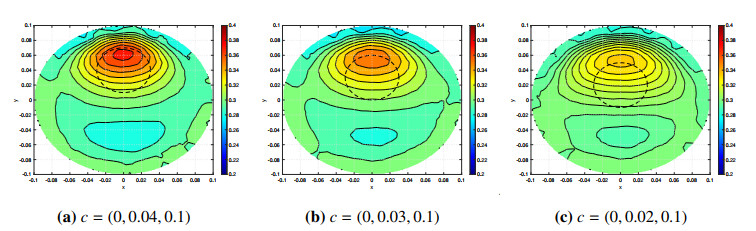
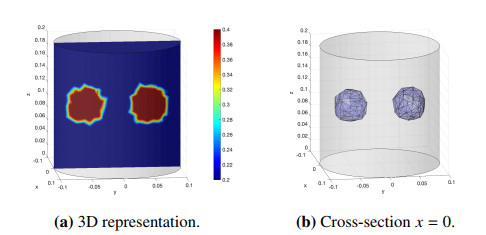
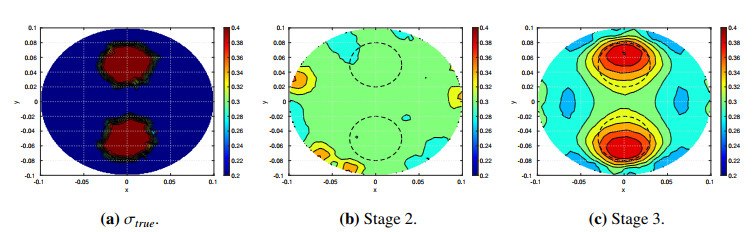
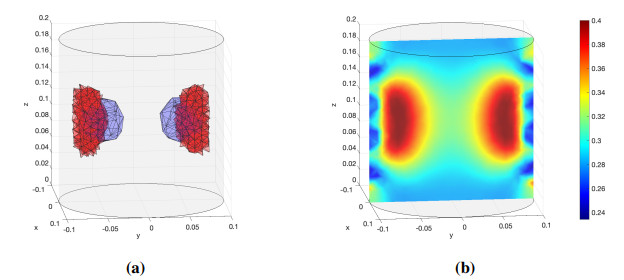
Figures(32) / Tables(7)

Ugur G. Abdulla, José H. Rodrigues. Cancer detection via electrical impedance tomography and optimal control of elliptic PDEs[J]. Mathematics in Engineering, 2026, 8(2): 308-339. doi: 10.3934/mine.2026010





 DownLoad: