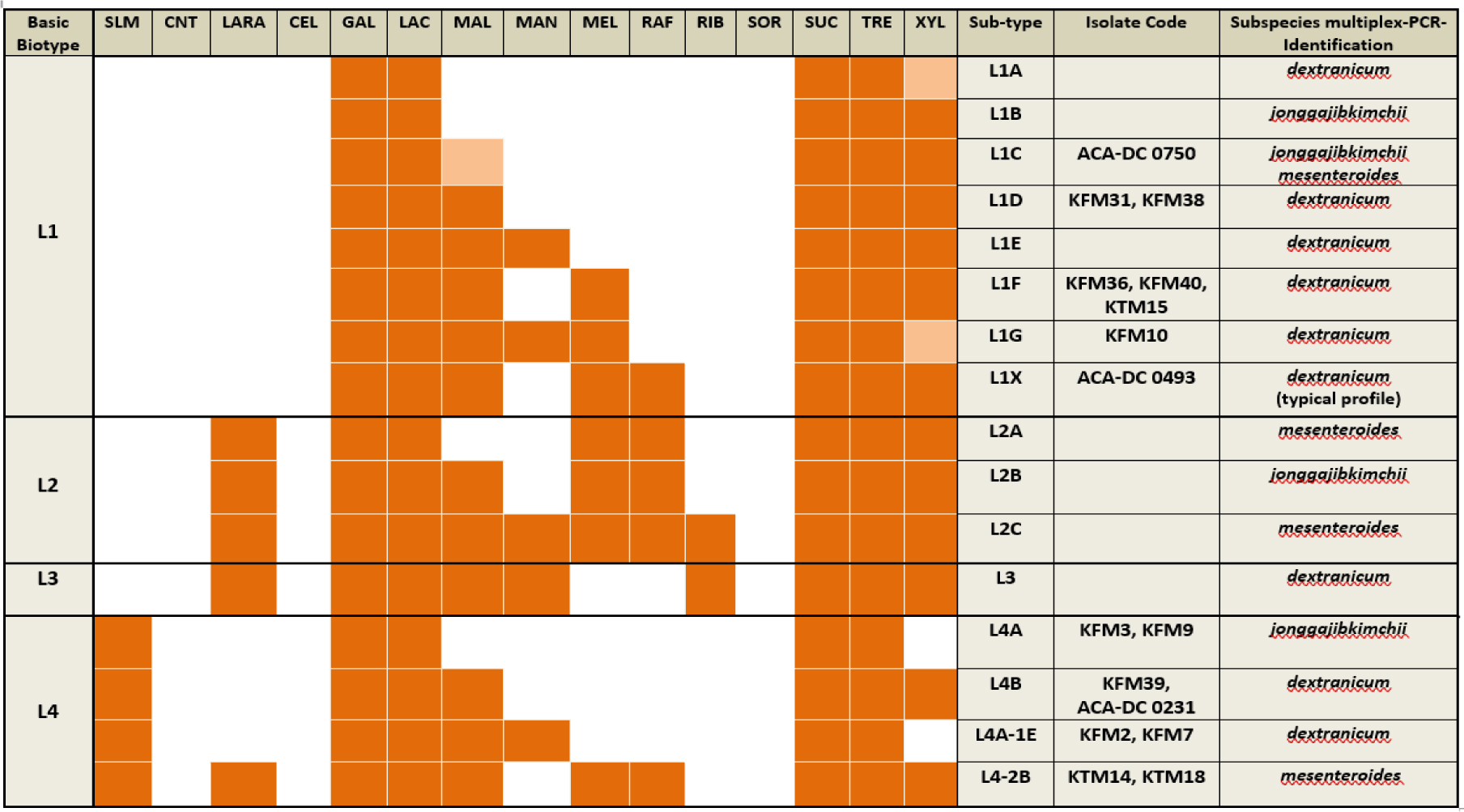
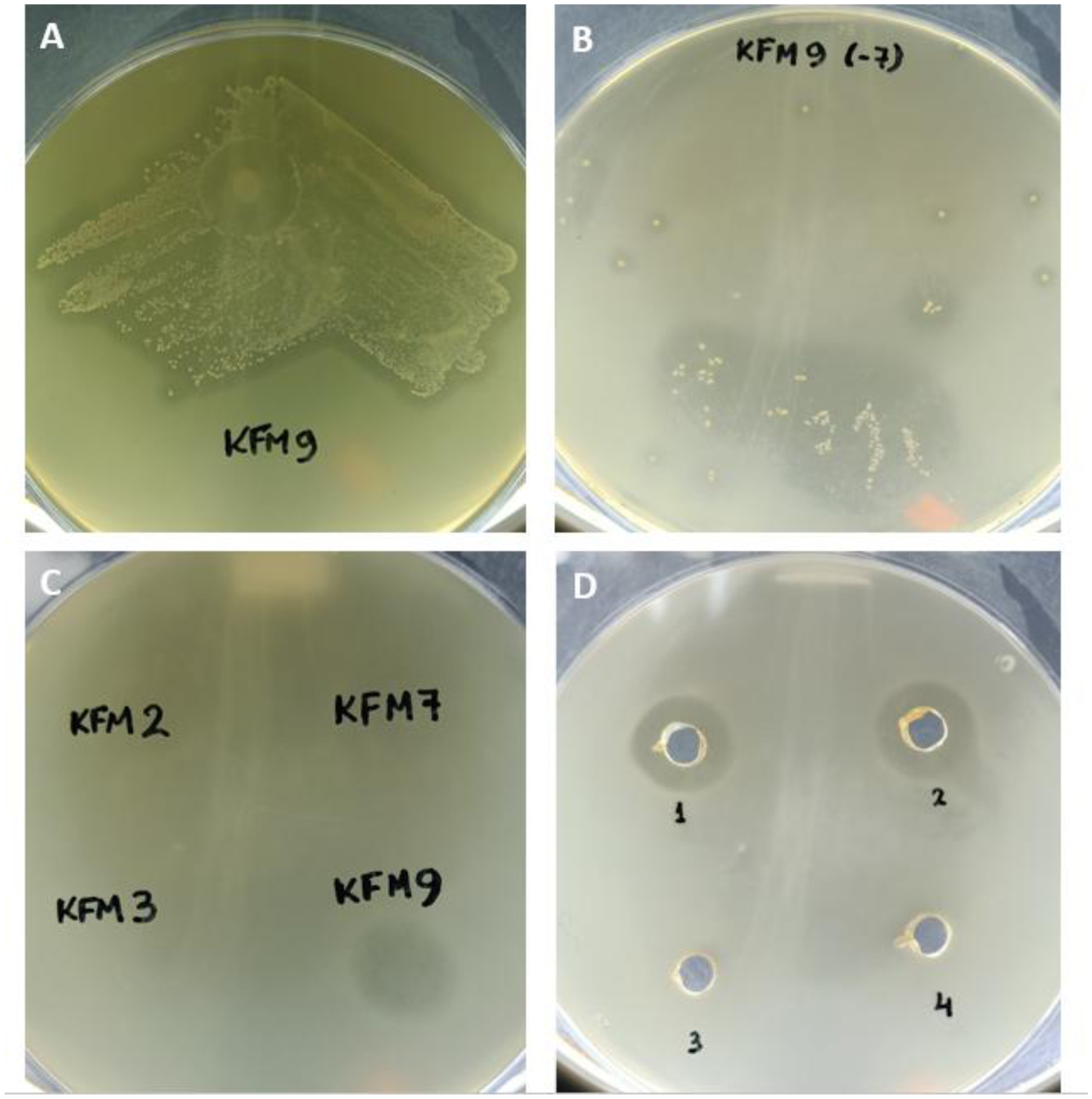
Thermization widely used to improve the microbiological quality of raw milk intended for traditional cheese making also inactivates a major part of the beneficial mesophilic LAB biota, particularly wild Leuconostoc spp. In this study, thirteen Leuconostoc mesenteroides isolates from counterpart raw/thermized (65 °C; 30 sec) milks of native Epirus sheep breeds, previously identified by 16S rRNA gene sequencing and at the subspecies according to their multiplex-PCR (rpoB, araA, dsr, sorA) profiles, were biochemically characterized. The isolates formed seven biotypes, with only one assigned to the subspecies mesenteroides and none to cremoris. Five biotypes shared an atypical dextranicum (dsr/sorA) genotype and one biotype seemed novel as it was genomically assignable to the subspecies jonggajibkimchii (araA/dsr). Six biotypes comprised strains with a strong-positive or positive leucine arylamidase activity, but their valine and cystine arylamidase activities were weak or absent. All except two isolates were β-galactosidase-positive whereas only two typical mesenteroides isolates from thermized milk were α-galactosidase-positive. All isolates fermented lactose, but were weak acidifiers in skimmed milk; 46% were dextran-negative. None was β-hemolytic, or possessed β-glucoronidase, trypsin or α-chymotrypsin activity, or formed histamine or tyramine. Excluding their inherent resistance to vancomycin, all biotypes comprised antibiotic susceptible strains. Only one strain was resistant to ampicillin, and five strains were partially susceptible to ciprofloxacin. Two raw sheep milk strains, KFM7 (atypical dextranicum; relatively more aciduric and proteolytic in vitro) and KFM9 (jonggajibkimchii; bacteriocinogenic in milk) previously selected and applied as adjuncts to produce a novel semi-industrial Kefalotyri cheese type from thermized Epirus sheep milk were confirmed to be the most promising biotypes for onsite commercial use in cheese production.
Citation: John Samelis, Athanasia Kakouri. Biotype-based validation of wild Leuconostoc mesenteroides strain genotypes from raw/thermized milks of native Epirus sheep breeds selected and preliminarily applied as cheese adjuncts[J]. AIMS Microbiology, 2026, 12(4): 865-901. doi: 10.3934/microbiol.2026037
Thermization widely used to improve the microbiological quality of raw milk intended for traditional cheese making also inactivates a major part of the beneficial mesophilic LAB biota, particularly wild Leuconostoc spp. In this study, thirteen Leuconostoc mesenteroides isolates from counterpart raw/thermized (65 °C; 30 sec) milks of native Epirus sheep breeds, previously identified by 16S rRNA gene sequencing and at the subspecies according to their multiplex-PCR (rpoB, araA, dsr, sorA) profiles, were biochemically characterized. The isolates formed seven biotypes, with only one assigned to the subspecies mesenteroides and none to cremoris. Five biotypes shared an atypical dextranicum (dsr/sorA) genotype and one biotype seemed novel as it was genomically assignable to the subspecies jonggajibkimchii (araA/dsr). Six biotypes comprised strains with a strong-positive or positive leucine arylamidase activity, but their valine and cystine arylamidase activities were weak or absent. All except two isolates were β-galactosidase-positive whereas only two typical mesenteroides isolates from thermized milk were α-galactosidase-positive. All isolates fermented lactose, but were weak acidifiers in skimmed milk; 46% were dextran-negative. None was β-hemolytic, or possessed β-glucoronidase, trypsin or α-chymotrypsin activity, or formed histamine or tyramine. Excluding their inherent resistance to vancomycin, all biotypes comprised antibiotic susceptible strains. Only one strain was resistant to ampicillin, and five strains were partially susceptible to ciprofloxacin. Two raw sheep milk strains, KFM7 (atypical dextranicum; relatively more aciduric and proteolytic in vitro) and KFM9 (jonggajibkimchii; bacteriocinogenic in milk) previously selected and applied as adjuncts to produce a novel semi-industrial Kefalotyri cheese type from thermized Epirus sheep milk were confirmed to be the most promising biotypes for onsite commercial use in cheese production.

This research received no external funding. All the consumables used in this study were leftover stock materials from the research projects BIOTRUST (T1EDK-00968) and ProMedFoods (ARIMNet 2, ID 9028; Grant No 618127) previously conducted in our laboratory. Dr John Samelis, the present corresponding and submitting author, was the scientific responsible researcher coordinating both previous projects above.
The authors declare no conflict of interest.
Dr John Samelis—Conceptualization, Investigation, Corresponding—Supervision, Compilation, Preparation of first draft, Reviewing, Editing; Athanasia Kakouri—Investigation, Reviewing, Editing.
| [1] | Eugster E, Jakob E (2019) Pre-treatments of milk and their effect on the food safety of cheese. Milk Sci Int 72: 45-52. |
| [2] |
Lindsay D, Robertson R, Fraser R, et al. (2021) Heat induced inactivation of microorganisms in milk and dairy products. Int Dairy J 121: 105096. https://doi.org/10.1016/j.idairyj.2021.105096 
|
| [3] |
Samelis J, Lianou A, Kakouri A, et al. (2009) Changes in the microbial composition of raw milk induced by thermization treatments applied prior to traditional Greek hard cheese processing. J Food Prot 72: 783-790. https://doi.org/10.4315/0362-028X-72.4.783
|
| [4] |
Quigley L, O'Sullivan O, Stanton C, et al. (2013) The complex microbiota of raw milk. FEMS Microbiol Rev 37: 664-698. https://doi.org/10.1111/1574-6976.12030
|
| [5] |
Smid EJ, Erkus O, Spus M, et al. (2014) Functional implications of the microbial community structure of undefined mesophilic starter cultures. Microb Cell Fact 13: S2. https://doi.org/10.1186/1475-2859-13-S1-S2
|
| [6] |
Frantzen CA, Kot W, Pedersen TB, et al. (2017) Genomic characterization of dairy associated Leuconostoc species and diversity of leuconostocs in undefined mixed mesophilic starter cultures. Front Microbiol 8: 132. https://doi.org/10.3389/fmicb.2017.00132
|
| [7] |
Cibik R, Lepage E, Tailliez P (2000) Molecular diversity of Leuconostoc mesenteroides and Leuconostoc citreum isolated from traditional French cheeses as revealed by RAPD fingerprinting, 16S rDNA sequencing and 16S rDNA fragment amplification. Syst Appl Microbiol 23: 267-278.
|
| [8] |
Morandi S, Cremonesi P, Silvetti T, et al. (2013) Technological characterisation, antibiotic susceptibility and antimicrobial activity of wild-type Leuconostoc strains isolated from north Italian traditional cheeses. J Dairy Res 80: 457-466. https://doi.org/10.1017/S0022029913000447
|
| [9] |
Coelho MC, Malcata FX, Silva CCG (2022) Lactic acid bacteria in raw-milk cheeses: From starter cultures to probiotic functions. Foods 11: 2276. https://doi.org/10.3390/foods11152276
|
| [10] |
Bozoudi D, Pavlidou S, Kotzamanidis C, et al. (2016) Graviera Naxou and Graviera Kritis Greek PDO cheeses: Discrimination based on microbiological and physiochemical criteria and volatile organic compounds profile. Small Rum Res 136: 161-172. http://dx.doi.org/10.1016/j.smallrumres.2016.01.022
|
| [11] | Silva BN, Fernandes N, Carvalho L, et al. (2023) Lactic acid bacteria from artisanal raw goat milk cheeses: Technological properties and antimicrobial potential. Ital J Food Saf 12: 11559. https://doi.org/10.4081/ijfs.2023.11559 |
| [12] |
Sadvari VY, Shevchenko LV, Slobodyanyuk NM, et al. (2024) Microbiome of craft hard cheeses from raw goat milk during ripening. Regulat Mech Biosystems 15: 483-489. https://doi.org/10.15421/022468
|
| [13] |
Hemme D, Foucaud-Scheunemann C (2004) Leuconostoc, characteristics, use in dairy technology and prospects in functional foods. Int Dairy J 14: 467-494. https://doi.org/10.1016/j.idairyj.2003.10.005
|
| [14] |
Bintsis T (2018) Lactic acid bacteria as starter cultures: An update of their metabolism and genetics. AIMS Microbiol 4: 665-684. https://doi.org/10.3934/microbiol.2018.4.665
|
| [15] |
Litopoulou-Tzanetaki E, Tzanetakis N (2014) The microfloras of traditional Greek cheeses. Microbiol Spectr 2. https://doi.org/10.1128/microbiolspec.CM-0009-2012
|
| [16] |
Gantzias C, Lappa IK, Aerts M, et al. (2020) MALDI-TOF MS profiling of non-starter lactic acid bacteria from artisanal cheeses of the Greek island of Naxos. Int J Food Microbiol 323: 108586. https://doi.org/10.1016/j.ijfoodmicro.2020.108586
|
| [17] |
Campedelli I, Flórez AB, Salvetti E, et al. (2015) Draft genome sequence of three antibiotic-resistant Leuconostoc mesenteroides strains of dairy origin. Genome Announc 3: e01018-15. https://doi.org/10.1128/genomeA.01018-15
|
| [18] |
Abriouel H, Martín-Platero A, Maqueda M, et al. (2008) Biodiversity of the microbial community in a Spanish farmhouse cheese as revealed by culture-dependent and culture-independent methods. Int J Food Microbiol 127: 200-208. https://doi.org/10.1016/j.ijfoodmicro.2008.07.004
|
| [19] |
Benmechernene Z, Chentouf HF, Yahia B, et al. (2013) Technological aptitude and applications of Leuconostoc mesenteroides bioactive strains isolated from Algerian raw camel milk. BioMed Res Int 2013: 418132. http://dx.doi.org/10.1155/2013/418132
|
| [20] |
Alhejaili M, Farrag E, Mahmoud S, et al. (2025) Isolation of lactic acid bacteria from raw camel milk in Saudi Arabia and evaluation of their probiotic potential. Microbiol Res 16: 248. https://doi.org/10.3390/microbiolres16120248
|
| [21] |
Shanan I, Kyle W (2023) Leuconostoc mesenteroides bacteremia in a patient with exposure to unpasteurized raw milk. BMJ Case Reports 16: 252034. https://doi.org/10.1136/bcr-2022-252034
|
| [22] |
Akpinar A, Yerlikaya O (2021) Some potential beneficial properties of Lacticaseibacillus paracasei subsp. paracasei and Leuconostoc mesenteroides strains originating from raw milk and kefir grains. J Food Proc Preserv 45: e15986. https://doi.org/10.1111/jfpp.15986
|
| [23] |
Rai R, Tamang JP (2022) In vitro and genetic screening of probiotic properties of lactic acid bacteria isolated from naturally fermented cow-milk and yak-milk products of Sikkim, India. World J Microbiol Biotechnol 38: 25. https://doi.org/10.1007/s11274-021-03215-y
|
| [24] |
Hamdaoui N, Rokni Y, Asehraou A, et al. (2023) Technological aptitude and sensitivity of lactic acid bacteria Leuconostoc isolated from raw milk of cows: From step-by-step experimental procedure to the results. Indonesian J Sci Technol 8: 157-170. https://doi.org/10.17509/ijost.v8i2.53730
|
| [25] |
Alegria A, Delgado S, Florez AB, et al. (2013) Identification, typing, and functional characterization of Leuconostoc spp. strains from traditional, starter-free cheeses. Dairy Sci Technol 93: 657-673. https://doi.org/10.1007/s13594-013-0128-3
|
| [26] |
Seixas FN, Rios EA, Martinez de Oliveira AL, et al. (2018) Selection of Leuconostoc strains isolated from artisanal Serrano Catarinense cheese for use as adjuncts in cheese manufacture. J Sci Food Agric 98: 3899-3906. https://doi.org/10.1002/jsfa.8907
|
| [27] |
Samelis J, Bosnea L, Kakouri A (2025) Microbiological quality and safety of raw sheep milks from native Epirus breeds: Selective effects of thermization on the microbiota surviving in resultant thermized milks intended for traditional Greek hard cheese production. Appl Microbiol 5: 11. https://doi.org/10.3390/applmicrobiol5010011
|
| [28] |
Sioziou E, Kakouri A, Bosnea L, et al. (2024) Antilisterial activity of raw sheep milk from two native Epirus breeds: Culture-dependent identification, bacteriocin gene detection and primary safety evaluation of the antagonistic LAB biota. Curr Res Microbial Sci 6: 100209. https://doi.org/10.1016/j.crmicr.2023.100209
|
| [29] |
Chessa L, Paba A, Dupré I, et al. (2023) A strategy for the recovery of raw ewe's milk microbiodiversity to develop natural starter cultures for traditional foods. Microorganisms 11: 823. https://doi.org/10.3390/microorganisms11040823
|
| [30] |
Chessa L, Daga E, Dupré I, et al. (2024) Biodiversity and safety: Combination experimentation in undefined starter cultures for traditional dairy products. Fermentation 10: 29. https://doi.org/10.3390/fermentation10010029
|
| [31] |
Bosnea L, Kosma I, Kakouri A, et al. (2025) Development of a semi-industrial Kefalotyri-type cheese using thermized milk from native Epirus sheep breeds and autochthonous starter and adjunct cultures. Fermentation 11: 673. https://doi.org/10.3390/fermentation11120673
|
| [32] |
Ricciardi A, Storti LV, Zotta T, et al. (2020) Analysis of rpoB polymorphism and PCR-based approaches for the identification of Leuconostoc mesenteroides at the species and subspecies level. Int J Food Microbiol 318: 108474. https://doi.org/10.1016/j.ijfoodmicro.2019.108474
|
| [33] |
Tsanasidou C, Asimakoula S, Sameli N, et al. (2021) Safety evaluation, biogenic amine formation, and enzymatic activity profiles of autochthonous enterocin-producing Greek cheese isolates of the Enterococcus faecium/durans group. Microorganisms 9: 777. https://doi.org/10.3390/microorganisms9040777
|
| [34] |
Samelis J, Tsanasidou C, Bosnea L, et al. (2023) Pilot-scale production of traditional Galotyri PDO cheese from boiled ewes' milk fermented with the aid of Greek indigenous Lactococcus lactis subsp. cremoris starter and Lactiplantibacillus plantarum adjunct strains. Fermentation 9: 345. https://doi.org/10.3390/fermentation9040345
|
| [35] | Holzapfel WH, Björkroth JA, Dicks LMT (2009) Genus I Leuconostoc van Tieghem 1878, 198AL. Bergey's Manual of Systematic Bacteriology . New York: Springer 624-635. |
| [36] |
Jeon HH, Kim KH, Chun BH, et al. (2017) A proposal of Leuconostoc mesenteroides subsp. jonggajibkimchii subsp. nov. and reclassification of Leuconostoc mesenteroides subsp. suionicum (Gu et al., 2012) as Leuconostoc suionicum sp. nov. based on complete genome sequences. Int J Syst Evol Microbiol 67: 2225-2230. https://doi.org/10.1099/ijsem.0.001930
|
| [37] |
Sameli N, Sioziou E, Bosnea L, et al. (2024) Multiplex-PCR detection of an atypical Leuconostoc mesenteroides subsp. jonggajibkimchii phenotype dominating the terminal spoilage microbial association of a fresh Greek whey cheese stored at 4 °C in vacuum. Appl Microbiol 4: 1124-1141. https://doi.org/10.3390/applmicrobiol4030076
|
| [38] |
Bover-Cid S, Holzapfel WH (1999) Improved screening procedure for biogenic amine production by lactic acid bacteria. Int J Food Microbiol 53: 33-41. https://doi.org/10.1016/S0168-1605(99)00152-X
|
| [39] | (2016) CLSIPerformance Standards for Antimicrobial Susceptibility Testing. Supplement M100S . Wayne, PA: Clinical and Laboratory Standards Institute. |
| [40] |
Sánchez-Juanes F, Teixeira-Martín V, González-Buitrago JM, et al. (2020) Identification of species and subspecies of lactic acid bacteria present in Spanish cheeses type “Torta” by MALDI-TOF MS and pheS gene analyses. Microorganisms 8: 301. https://doi.org/10.3390/microorganisms8020301
|
| [41] |
Ruppitsch W, Nisic A, Hyden P, et al. (2021) Genetic diversity of Leuconostoc mesenteroides isolates from traditional Montenegrin brine cheese. Microorganisms 9: 1612. https://doi.org/10.3390/microorganisms9081612
|
| [42] |
Villani F, Moschetti G, Blaiotta G, et al. (1997) Characterization of strains of Leuconostoc mesenteroides by analysis of soluble whole-cell protein pattern, DNA fingerprinting and restriction of ribosomal DNA. J Appl Microbiol 82: 578-588. https://doi.org/10.1111/j.1365-2672.1997.tb03588.x
|
| [43] |
Chun BH, Kim KH, Jeon HH, et al. (2017) Pan-genomic and transcriptomic analyses of Leuconostoc mesenteroides provide insights into its genomic and metabolic features and roles in kimchi fermentation. Sci Rep 7: 11504. https://doi.org/10.1038/s41598-017-12016-z
|
| [44] |
Chentouf HF, Rahli F, Benmechernene Z, et al. (2023) 16S rRNA gene sequencing and MALDI TOF mass spectrometry identification of Leuconostoc mesenteroides isolated from Algerian raw camel milk. J Genet Engin Biotechnol 21: 51. https://doi.org/10.1186/s43141-023-00500-1
|
| [45] |
Zeller-Peronnet V, Brockmann E, Pavlovic M, et al. (2013) Potential and limitations of MALDI-TOF MS for discrimination within the species Leuconostoc mesenteroides and Leuconostoc pseudomesenteroides. J Consum Prot Food Saf 8: 205-214. https://doi.org/10.1007/s00003-013-0826-z
|
| [46] |
Moschetti G, Blaiotta G, Villani F, et al. (2000) Specific detection of Leuconostoc mesenteroides subsp. mesenteroides with DNA primers identified by randomly amplified polymorphic DNA analysis. Appl Environ Microbiol 66: 422-424. https://doi.org/10.1128/AEM.66.1.422-424.2000
|
| [47] |
Kamarinou CS, Papadopoulou OS, Doulgeraki AI, et al. (2022) Mapping the key technological and functional characteristics of indigenous lactic acid bacteria isolated from Greek traditional dairy products. Microorganisms 10: 246. https://doi.org/10.3390/microorganisms10020246
|
| [48] |
Zeid AF, Zarour K, Mohedano ML, et al. (2025) Biotechnological potential and genomic analysis of the Leuconostoc mesenteroides F17 and F18 strains isolated from camel milk. BMC Microbiol 25: 763. https://doi.org/10.1186/s12866-025-04349-x
|
| [49] |
Morandi S, Silvetti T, Miranda Lopez JM, et al. (2015) Antimicrobial activity, antibiotic resistance and the safety of lactic acid bacteria in raw milk Valtellina Casera cheese. J Food Saf 35: 193-205. https://doi.org/10.1111/jfs.12171
|
| [50] |
Yilmaz N, Ozogul Y, Coşkun Dağgeçen E, et al. (2025) Isolation, characterization and antibiotic resistance of lactic acid bacteria from dairy and seafood sources. Food Biosci 64: 105895. https://doi.org/10.1016/j.fbio.2025.105895
|
| [51] |
Humphries R, Bobenchik AM, Hindler JA, et al. (2021) Overview of changes to the clinical and laboratory standards institute performance standards for antimicrobial susceptibility testing, M100, 31st edition. J Clin Microbiol 59: e00213-21. https://doi.org.10.1128/JCM.00213-21
|
| [52] |
Samelis J, Kakouri A (2025) Antibiotic susceptibility of autochthonous Enterococcus strain biotypes prevailing in sheep milk from native Epirus breeds before and after mild thermization in view of their inclusion in a complex natural cheese starter culture. Appl Microbiol 5: 125. https://doi.org/10.3390/applmicrobiol5040125
|
| [53] |
Samelis J, Kakouri A (2026) Biotyping and antibiotic susceptibility of animal streptococci from raw/thermized milks of native Epirus sheep breeds. Explor Foods Foodomics 4: 1010187. https://doi.org/10.37349/eff.2026.1010187
|
| [54] |
Domingos-Lopes MFP, Stanton C, Ross PR, et al. (2017) Genetic diversity, safety and technological characterization of lactic acid bacteria isolated from artisanal Pico cheese. Food Microbiol 63: 178-190. http://dx.doi.org/10.1016/j.fm.2016.11.014
|
| [55] |
De Paula AT, Jeronymo-Ceneviva AB, Todorov SD, et al. (2015) The two faces of Leuconostoc mesenteroides in food systems. Food Rev Int 31: 147-171. https://doi.org/10.1080/87559129.2014.981825
|
| [56] |
Vandera E, Lianou A, Kakouri A, et al. (2017) Enhanced control of Listeria monocytogenes by Enterococcus faecium KE82, a multiple enterocin-producing strain, in different milk environments. J Food Prot 80: 74-85. https://doi.org/10.4315/0362-028X.JFP-16-082
|
| [57] | Xu KZ, Vinothkanna A, Wang D, et al. (2026) Bacterial quorum-sensing systems in cell-cell communication. FEMS Microbiol Rev 50: fuago20. https://doi.org/10.1093/femsre/fuago20 |
| [58] |
Paventi G, Di Martino C, Coppola F, et al. (2025) β-glucosidase activity of Lactiplantibacillus plantarum: A key player in food fermentation and human health. Foods 14: 1451. https://doi.org/10.3390/foods14091451
|
| [59] |
Rampanti G, Ferrocino I, Harasym J, et al. (2023) Queijo Serra da Estrela PDO cheese: Investigation into its morpho-textural traits, microbiota, and volatilome. Foods 12: 169. https://doi.org/10.3390/foods12010169
|
Figures(2) / Tables(6)

John Samelis, Athanasia Kakouri. Biotype-based validation of wild Leuconostoc mesenteroides strain genotypes from raw/thermized milks of native Epirus sheep breeds selected and preliminarily applied as cheese adjuncts[J]. AIMS Microbiology, 2026, 12(4): 865-901. doi: 10.3934/microbiol.2026037





 DownLoad: