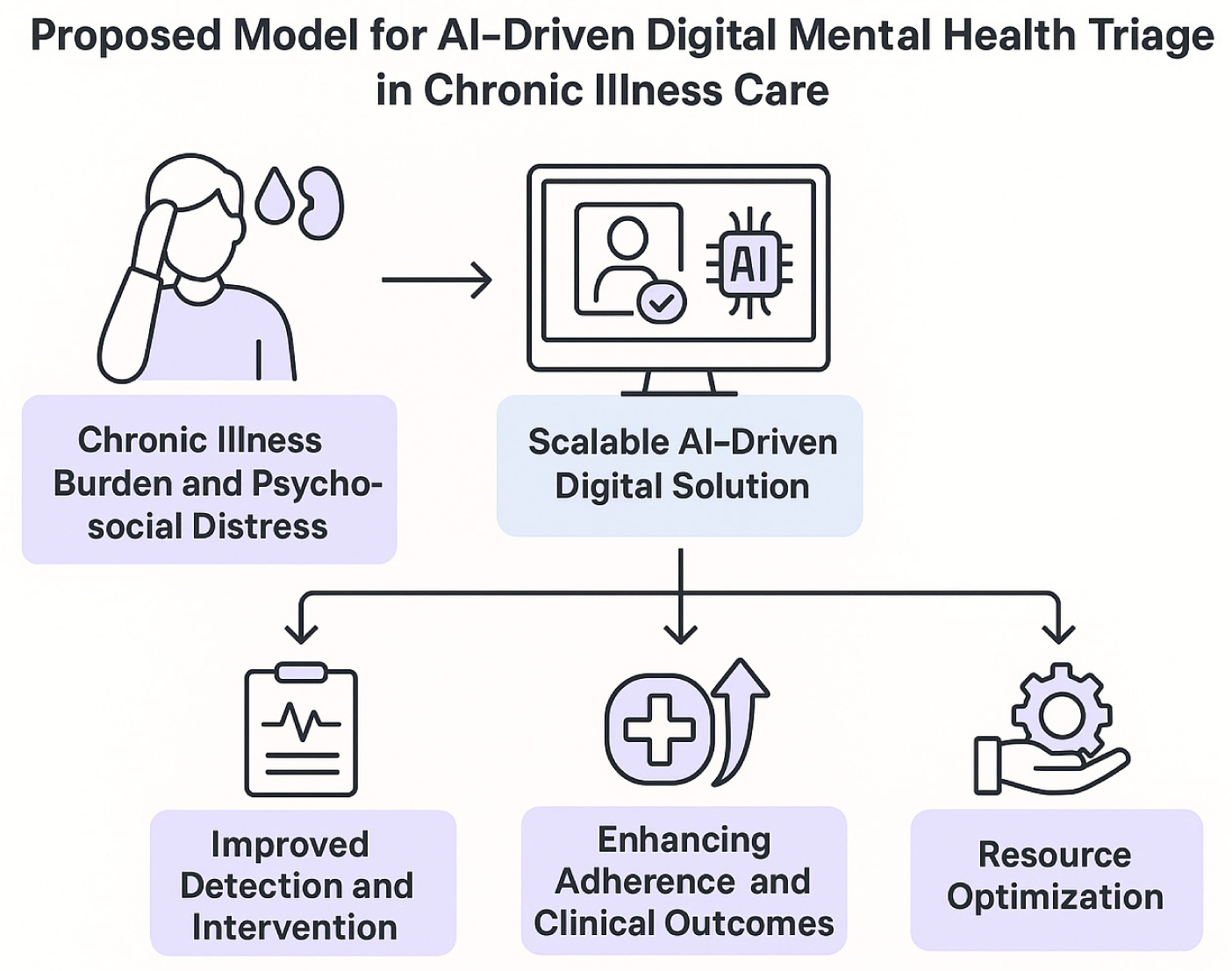
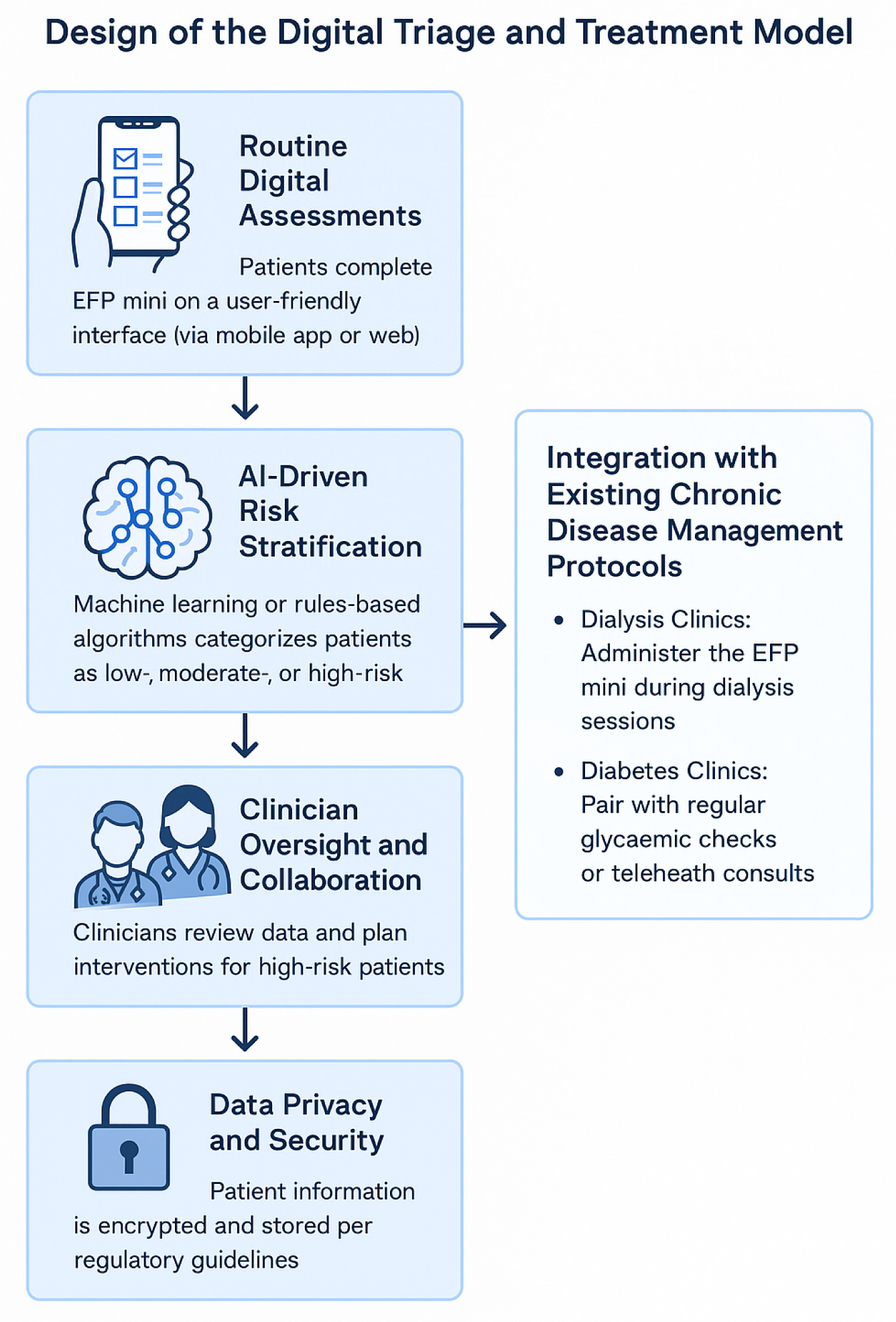
Chronic illnesses, such as diabetes and chronic kidney disease (CKD), impose a substantial global burden, affecting hundreds of millions of people and straining healthcare systems. Managing these conditions involves not only physical challenges but also considerable psychosocial distress. Patients with complex treatment regimens—frequent medical appointments, dietary restrictions, and potential complications—often experience depression, anxiety, and reduced quality of life, all of which can impede treatment adherence and worsen clinical outcomes. Research, including meta-analyses in dialysis and diabetes populations, indicates that psychosocial interventions and integrated mental health support can improve quality of life, glycaemic control, and emotional well-being. Despite the clear value of mental health integration, current in-person care models face significant limitations. Scarcity of trained mental-health professionals, geographical barriers, financial constraints, and social stigma frequently preclude timely psychosocial support. Consequently, many patients with chronic conditions receive inadequate mental-health care, compromising overall treatment success. This perspective outlines how a digital mental-health triage solution—supported by platforms like My-E-Health—could leverage artificial intelligence (AI). By embedding routine assessments, such as the Empowerment for Participation (EFP) mini, into chronic-disease management, patients can be screened more frequently for emotional distress. AI algorithms would then stratify patients into low-, moderate-, or high-risk categories and deliver tailored interventions. Moderate-risk patients could receive AI-guided coaching and self-management tools, while high-risk patients would be promptly linked to clinicians for intensive therapy. This approach optimises resource allocation, directing professional attention to the most vulnerable patients. Integrating AI-driven digital platforms—including telehealth portals and culturally sensitive, multilingual interfaces—may enable real-time monitoring, early intervention, and sustained patient engagement. Recent studies suggest that expanding telehealth options can reduce access barriers and stigma, encouraging patients to seek help. Further investigations—particularly longitudinal studies—are warranted to confirm sustained clinical benefits, cost-effectiveness, and scalability across diverse healthcare contexts. With continued improvements in AI-driven screening tools and patient-centred design, a well-implemented digital mental-health triage solution could make chronic disease care more holistic, sustainable, and effective.
Citation: Clive Michelsen, Anette Kjellgren. A perspective on developing an AI-driven digital triage platform for chronic disease mental health: insights and potential from My-E-Health[J]. AIMS Medical Science, 2025, 12(4): 312-324. doi: 10.3934/medsci.2025022
Chronic illnesses, such as diabetes and chronic kidney disease (CKD), impose a substantial global burden, affecting hundreds of millions of people and straining healthcare systems. Managing these conditions involves not only physical challenges but also considerable psychosocial distress. Patients with complex treatment regimens—frequent medical appointments, dietary restrictions, and potential complications—often experience depression, anxiety, and reduced quality of life, all of which can impede treatment adherence and worsen clinical outcomes. Research, including meta-analyses in dialysis and diabetes populations, indicates that psychosocial interventions and integrated mental health support can improve quality of life, glycaemic control, and emotional well-being. Despite the clear value of mental health integration, current in-person care models face significant limitations. Scarcity of trained mental-health professionals, geographical barriers, financial constraints, and social stigma frequently preclude timely psychosocial support. Consequently, many patients with chronic conditions receive inadequate mental-health care, compromising overall treatment success. This perspective outlines how a digital mental-health triage solution—supported by platforms like My-E-Health—could leverage artificial intelligence (AI). By embedding routine assessments, such as the Empowerment for Participation (EFP) mini, into chronic-disease management, patients can be screened more frequently for emotional distress. AI algorithms would then stratify patients into low-, moderate-, or high-risk categories and deliver tailored interventions. Moderate-risk patients could receive AI-guided coaching and self-management tools, while high-risk patients would be promptly linked to clinicians for intensive therapy. This approach optimises resource allocation, directing professional attention to the most vulnerable patients. Integrating AI-driven digital platforms—including telehealth portals and culturally sensitive, multilingual interfaces—may enable real-time monitoring, early intervention, and sustained patient engagement. Recent studies suggest that expanding telehealth options can reduce access barriers and stigma, encouraging patients to seek help. Further investigations—particularly longitudinal studies—are warranted to confirm sustained clinical benefits, cost-effectiveness, and scalability across diverse healthcare contexts. With continued improvements in AI-driven screening tools and patient-centred design, a well-implemented digital mental-health triage solution could make chronic disease care more holistic, sustainable, and effective.

| [1] |
Bikbov B, Purcell CA, Levey AS, et al. (2020) Global, regional, and national burden of chronic kidney disease, 1990–2017: a systematic analysis for the Global Burden of Disease Study 2017. Lancet 395: 709-733. https://doi.org/10.1016/S0140-6736(20)30045-3 
|
| [2] | International Diabetes Federation (IDF), IDF diabetes atlas (11th ed.). Belgium International Diabetes Federation, 2025. Available from: https://diabetesatlas.org/resources/idf-diabetes-atlas-2025/ |
| [3] |
Lew SQ, Ronco C (2024) Use of eHealth and remote patient monitoring: a tool to support home dialysis patients, with an emphasis on peritoneal dialysis. Clin Kidney J 17: i53-i61. https://doi.org/10.1093/ckj/sfae081
|
| [4] |
Michelsen C (2021) Measuring employee risk for burnout. Psychology 12: 624-642. https://doi.org/10.4236/psych.2021.124039
|
| [5] |
Palmer SC, Vecchio M, Craig JC, et al. (2013) Prevalence of depression in chronic kidney disease: systematic review and meta-analysis of observational studies. Kidney Int 84: 179-191. https://doi.org/10.1038/ki.2013.77
|
| [6] |
Cukor D, Coplan J, Brown C, et al. (2007) Depression and anxiety in urban haemodialysis patients. Clin J Am Soc Nephrol 2: 484-490. https://doi.org/10.2215/CJN.00040107
|
| [7] |
Gonzalez JS, Peyrot M, McCarl LA, et al. (2008) Depression and diabetes treatment nonadherence: a meta-analysis. Diabetes Care 31: 2398-2403. https://doi.org/10.2337/dc08-1341
|
| [8] |
Winkley K, Upsher R, Stahl D, et al. (2020) Psychological interventions to improve glycemic control in adults with type 2 diabetes: a systematic review and meta- analysis. BMJ Open Diabetes Res Care 8: e001150. https://doi.org/10.1136/bmjdrc-2019-001150
|
| [9] |
Young-Hyman D, de Groot M, Hill-Briggs F, et al. (2016) Psychosocial care for people with diabetes: a position statement of the American Diabetes Association. Diabetes Care 39: 2126-2140. https://doi.org/10.2337/dc16-2053
|
| [10] | Garcia SF, Hahn EA, Jacobs EA (2010) Addressing low literacy and health literacy in clinical oncology practice. J Support Oncol 8: 64-69. |
| [11] | World Health Organization (2010) Mental Health and Development: Targeting People with Mental Health Conditions as a Vulnerable Group. Available from: https://wkc.who.int/resources/publications/i/item/9789241563949 |
| [12] |
Holt RI, Nicolucci A, Kovacs Burns K, et al. (2013) Diabetes Attitudes, Wishes and Needs second study (DAWN2™): cross-national comparisons on barriers and resources for optimal care—healthcare professional perspective. Diabet Med 30: 789-798. https://doi.org/10.1111/dme.12242
|
| [13] | Lake J, Turner MS (2017) Urgent need for improved mental health care and a more collaborative model of care. Perm J 21: 17-024. https://doi.org/10.7812/TPP/17-024 |
| [14] |
Egede LE, Ellis C (2010) Diabetes and depression: global perspectives. Diabetes Res Clin Pract 87: 302-312. https://doi.org/10.1016/j.diabres.2010.01.024
|
| [15] |
Vogel DL, Wade NG, Hackler AH (2007) Perceived public stigma and the willingness to seek counselling: the mediating roles of self-stigma and attitudes toward counselling. J Couns Psychol 54: 40-50. https://doi.org/10.1037/0022-0167.54.1.40
|
| [16] |
Hwang M, Zheng Y, Cho Y, et al. (2025) AI applications for chronic condition self-management: scoping review. J Med Internet Res 27: e59632. https://doi.org/10.2196/59632
|
| [17] |
Pan M, Li R, Wei J, et al. (2025) Application of artificial intelligence in the health management of chronic disease: bibliometric analysis. Front Med 11: 1506641. https://doi.org/10.3389/fmed.2024.1506641
|
| [18] |
Michelsen C, Kjellgren A (2022) The effectiveness of web-based psychotherapy to treat and prevent burnout: controlled trial. JMIR Form Res 6: e39129. https://doi.org/10.2196/39129
|
| [19] |
Rollwage M, Habicht J, Juechems K, et al. (2024) Correction: Using conversational AI to facilitate mental health assessments and improve clinical efficiency within psychotherapy services: real-world observational study. JMIR AI 3: e57869. https://doi.org/10.2196/57869
|
| [20] |
Habicht J, Viswanathan S, Carrington B, et al. (2024) Closing the accessibility gap to mental health treatment with a personalized self-referral chatbot. Nat Med 30: 595-602. https://doi.org/10.1038/s41591-023-02766-x
|
| [21] |
Vogel DL, Bitman RL, Hammer JH, et al. (2013) Is stigma internalized? The longitudinal impact of public stigma on self-stigma. J Couns Psychol 60: 311-316. https://doi.org/10.1037/a0031889
|
| [22] | FHIR (Fast Healthcare Interoperability Resources). Available from: https://www.hl7.org/fhir/index.html, Online resource. (Accessed 10 June 2025) |
| [23] | SHAP-style. Available from: https://shap.readthedocs.io/en/latest/, Online resource. (Accessed 11 June 2025) |
| [24] | Intersoft Consulting, General Data Protection Regulation (GDPR). Available from: https://gdpr-info.eu/ |
| [25] |
Fluss R, Faraggi D, Reiser B (2005) Estimation of the Youden Index and its associated cutoff point. Biom J 47: 458-472. https://doi.org/10.1002/bimj.200410135
|
| [26] |
Kroenke K, Spitzer RL, Williams JB (2001) The PHQ-9: validity of a brief depression severity measure. J Gen Intern Med 16: 606-613. https://doi.org/10.1046/j.1525-1497.2001.016009606.x
|
| [27] |
Spitzer RL, Kroenke K, Williams JB, et al. (2006) A brief measure for assessing generalized anxiety disorder: the GAD-7. Arch Intern Med 166: 1092-1097. https://doi.org/10.1001/archinte.166.10.1092
|
| [28] |
Olesen K, Hempler NF, Drejer S, et al. (2020) Impact of patient-centred diabetes self-management education targeting people with type 2 diabetes: an integrative review. Diabet Med 37: 909-923. https://doi.org/10.1111/dme.14284
|
| [29] |
Hyzy M, Bond R, Mulvenna M, et al. (2022) System usability scale benchmarking for digital health apps: meta-analysis. JMIR Mhealth Uhealth 10: e37290. https://doi.org/10.2196/37290
|
| [30] |
Ni Y, Jia F (2025) A scoping review of AI-driven digital interventions in mental health care: mapping applications across screening, support, monitoring, prevention, and clinical education. Healthcare 13: 1205. https://doi.org/10.3390/healthcare13101205
|
| [31] |
MacNeill AL, Doucet S, Luke A (2024) Effectiveness of a mental health Chatbot for people with chronic diseases: randomized controlled trial. JMIR Form Res 8: e50025. https://doi.org/10.2196/50025
|
| [32] |
Du C, Zhou J, Yu Y (2025) Research trends in the application of artificial intelligence in nursing of chronic disease: a bibliometric and network visualization study. Front Digit Health 7: 1608266. https://doi.org/10.3389/fdgth.2025.1608266
|
| [33] |
van der Schyff EL, Ridout B, Amon KL, et al. (2023) Providing self-led mental health support through an artificial intelligence-powered Chat Bot (Leora) to meet the demand of mental health care. J Med Internet Res 25: e46448. https://doi.org/10.2196/46448
|
| [34] |
Michelsen C (2021) Empowerment for participation: measuring motivation, stress, defence routines and engagement. Psychology 12: 511-535. https://doi.org/10.4236/psych.2021.124032
|
| [35] |
Tomašev N, Glorot X, Rae JW, et al. (2019) A clinically applicable approach to continuous prediction of future acute kidney injury. Nature 572: 116-119. https://doi.org/10.1038/s41586-019-1390-1
|
| [36] |
Luxton DD, Nelson EL, Maheu MM (2016) A Practitioner's Guide to Telemental Health: How to Conduct Legal, Ethical, and Evidence-Based Telepractice. American Psychological Association JSTOR. Available from: http://www.jstor.org/stable/j.ctv1chrvss. (Accessed 22 Oct. 2025)
|
Figures(2)

Clive Michelsen, Anette Kjellgren. A perspective on developing an AI-driven digital triage platform for chronic disease mental health: insights and potential from My-E-Health[J]. AIMS Medical Science, 2025, 12(4): 312-324. doi: 10.3934/medsci.2025022





 DownLoad: