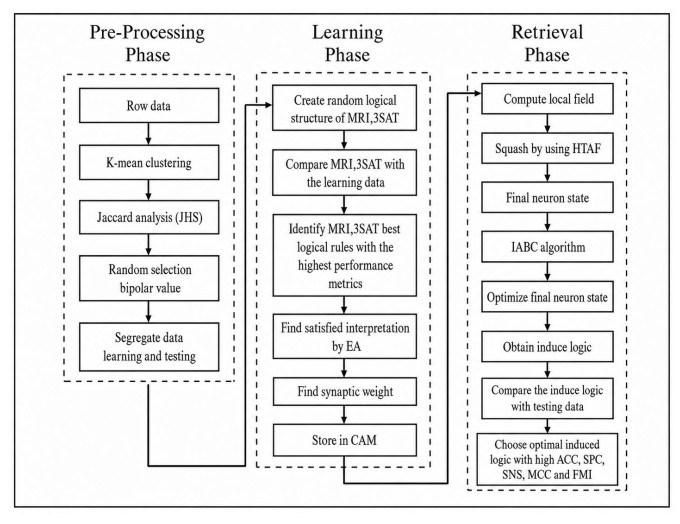
Logic mining in neural networks enables the extracting of interpretable symbolic knowledge from complex datasets. This study proposes a logic mining approach in discrete Hopfield neural networks based on a non-systematic major random 1,3-satisfiability (MR1,3SAT) logical structure for adverse event analysis in Alzheimer's disease datasets. The proposed model incorporates first- and third-order logical clauses to enhance representational flexibility while maintaining computational tractability. A feature selection mechanism based on Jaccard analysis is incorporated to identify relevant attributes, while the intelligent artificial bee colony algorithm is applied during the retrieval phase to refine the final neuron states. Experimental evaluation on Alzheimer's disease neuroimaging initiative datasets demonstrate that the proposed model achieves superior performance compared with existing logic mining approaches, obtaining 90.23% accuracy, 98% sensitivity, 99% specificity, and a Fowlkes-Mallows index of 93.46%. These results indicate that the MR1,3SAT-based logic mining model improves both interpretability and classification reliability for adverse event symptoms analysis in Alzheimer's disease neuroimaging initiative datasets.
Citation: Gaeithry Manoharam, Nur 'Afifah Rusdi, Nurshazneem Roslan, Nurul Atiqah Romli, Mohd Shareduwan Mohd Kasihmuddin, Nur Ezlin Zamri, Suad Abdeen, Mohd. Asyraf Mansor, Xiaoyan Liu. A major random 1,3-satisfiability logic mining model in discrete Hopfield neural networks for adverse event analysis[J]. AIMS Mathematics, 2026, 11(6): 18081-18121. doi: 10.3934/math.2026736
Logic mining in neural networks enables the extracting of interpretable symbolic knowledge from complex datasets. This study proposes a logic mining approach in discrete Hopfield neural networks based on a non-systematic major random 1,3-satisfiability (MR1,3SAT) logical structure for adverse event analysis in Alzheimer's disease datasets. The proposed model incorporates first- and third-order logical clauses to enhance representational flexibility while maintaining computational tractability. A feature selection mechanism based on Jaccard analysis is incorporated to identify relevant attributes, while the intelligent artificial bee colony algorithm is applied during the retrieval phase to refine the final neuron states. Experimental evaluation on Alzheimer's disease neuroimaging initiative datasets demonstrate that the proposed model achieves superior performance compared with existing logic mining approaches, obtaining 90.23% accuracy, 98% sensitivity, 99% specificity, and a Fowlkes-Mallows index of 93.46%. These results indicate that the MR1,3SAT-based logic mining model improves both interpretability and classification reliability for adverse event symptoms analysis in Alzheimer's disease neuroimaging initiative datasets.

| [1] |
S. E. Sorour, A. A. A. El-Mageed, K. M. Albarrak, A. K. Alnaim, A. A. Wafa, E. El-Shafeiy, Classification of Alzheimer's disease using MRI data based on deep learning techniques, J. King Saud Univ. Comput. Inform. Sci., 36 (2024), 101940. https://doi.org/10.1016/j.jksuci.2024.101940 doi: 10.1016/j.jksuci.2024.101940

|
| [2] |
M. T. Heneka, W. M. Van der Flier, F. Jessen, J. Hoozemanns, D. R. Thal, D. Boche, et al., Neuroinflammation in Alzheimer disease, Nat. Rev. Immunol., 25 (2025), 321–352. https://doi.org/10.1038/s41577-024-01104-7 doi: 10.1038/s41577-024-01104-7
|
| [3] |
M. Odusami, R. Maskeliūnas, R. Damaševičius, Pareto optimized adaptive learning with transposed convolution for image fusion Alzheimer's disease classification, Brain Sci., 13 (2023), 1045. https://doi.org/10.3390/brainsci13071045 doi: 10.3390/brainsci13071045
|
| [4] |
T. Prasath, V. Sumathi, Pipelined deep learning architecture for the detection of Alzheimer's disease, Biomed. Signal Process. Control, 87 (2024), 105442. https://doi.org/10.1016/j.bspc.2023.105442 doi: 10.1016/j.bspc.2023.105442
|
| [5] |
S. L. Burke, T. Cadet, A. Alcide, J. O'Driscoll, P. Maramaldi, Psychosocial risk factors and Alzheimer's disease: the associative effect of depression, sleep disturbance, and anxiety, Aging Mental Health, 22 (2018), 1577–1584. https://doi.org/10.1080/13607863.2017.1387760 doi: 10.1080/13607863.2017.1387760
|
| [6] |
A. Hammar, E. H. Ronold, G. Å. Rekkedal, Cognitive impairment and neurocognitive profiles in major depression–a clinical perspective, Front. Psychiatry, 13 (2022), 764374. https://doi.org/10.3389/fpsyt.2022.764374 doi: 10.3389/fpsyt.2022.764374
|
| [7] |
S. G. Potkin, The ABC of Alzheimer's disease: ADL and improving day-to-day functioning of patients, Int. Psychogeriatrics, 14 (2002), 7–26. https://doi.org/10.1017/S1041610203008640 doi: 10.1017/S1041610203008640
|
| [8] |
S. A. Alowais, S. S. Alghamdi, N. Alsuhebany, T. Alqahtani, A. I. Alshaya, S. N. Almohareb, et al., Revolutionizing healthcare: the role of artificial intelligence in clinical practice, BMC Med. Educ., 23 (2023), 689. https://doi.org/10.1186/s12909-023-04698-z doi: 10.1186/s12909-023-04698-z
|
| [9] |
A. Baba, Neural networks from biological to artificial and vice versa, Biosystems, 235 (2024), 105110. https://doi.org/10.1016/j.biosystems.2023.105110 doi: 10.1016/j.biosystems.2023.105110
|
| [10] | A. Krenker, J. Bešter, A. Kos, Introduction to the artificial neural networks, In: Artificial neural networks: Methodological advances and biomedical applications, London, UK: IntechOpen, 2011, 1–18. |
| [11] |
J. J. Hopfield, D. W. Tank, "Neural" computation of decisions in optimization problems, Biol. Cybernet., 52 (1985), 141–152. https://doi.org/10.1007/BF00339943 doi: 10.1007/BF00339943
|
| [12] |
C. P. He, M. R. Jiang, K. Y. Shan, S. H. Yang, Z. F. Li, S. B. Wang, et al., A hardware-adaptive learning algorithm for superlinear-capacity associative memory on memristor crossbars, Nat Commun., 17 (2026), 3096. https://doi.org/10.1038/s41467-026-69958-0 doi: 10.1038/s41467-026-69958-0
|
| [13] |
Z. Q. Yu, A. M. Abdulghani, A. Zahid, H. Heidari, M. A. AImran, Q. H. Abbasi, An overview of neuromorphic computing for artificial intelligence enabled hardware-based Hopfield neural network, IEEE Access, 8 (2020), 67085–67099. https://doi.org/10.1109/ACCESS.2020.2985839 doi: 10.1109/ACCESS.2020.2985839
|
| [14] |
H. Taherdoost, Deep learning and neural networks: decision-making implications, Symmetry, 15 (2023), 1723. https://doi.org/10.3390/sym15091723 doi: 10.3390/sym15091723
|
| [15] |
V. L. Kalmykov, L. V. Kalmykov, Towards explicitly explainable artificial intelligence, Inform. Fusion, 123 (2025), 103352. https://doi.org/10.1016/j.inffus.2025.103352 doi: 10.1016/j.inffus.2025.103352
|
| [16] |
M. G. Shankar, C. G. Babu, H. Rajaguru, Classification of cardiac diseases from ECG signals through bio inspired classifiers with Adam and R-Adam approaches for hyperparameters updation, Measurement, 194 (2022), 111048. https://doi.org/10.1016/j.measurement.2022.111048 doi: 10.1016/j.measurement.2022.111048
|
| [17] |
A. Chinnaraju, Explainable AI (XAI) for trustworthy and transparent decision-making: a theoretical framework for AI interpretability, World J. Adv. Eng. Technol. Sci., 14 (2025), 170–207. https://doi.org/10.30574/wjaets.2025.14.3.0106 doi: 10.30574/wjaets.2025.14.3.0106
|
| [18] |
X. F. Jiang, M. S. M. Kasihmuddin, Y. L. Guo, Y. Gao, M. A. Mansor, N. E. Zamri, et al., J-type random 2, 3 satisfiability: a higher-order logical rule in discrete Hopfield neural network, Evol. Intell., 17 (2024), 3317–3336. https://doi.org/10.1007/s12065-024-00936-5 doi: 10.1007/s12065-024-00936-5
|
| [19] |
W. A. T. W. Abdullah, Logic programming on a neural network, Int. J. Intell. Syst., 7 (1992), 513–519. https://doi.org/10.1002/int.4550070604 doi: 10.1002/int.4550070604
|
| [20] | S. Sathasivam, Upgrading logic programming in Hopfield network, Sains Malaysiana, 39 (2010), 115–118. |
| [21] | M. S. M. Kasihmuddin, M. A. Mansor, S. Sathasivam, Hybrid genetic algorithm in the Hopfield network for logic satisfiability problem, Pertanika J. Sci. Technol., 25 (2017), 139–152. |
| [22] | M. A. Mansor, M. S. M. Kasihmuddin, S. Sathasivam, Artificial immune system paradigm in the Hopfield network for 3-satisfiability problem, Pertanika J. Sci. Technol, 25 (2017), 1173–1188. |
| [23] |
S. Sathasivam, M. A. Mansor, A. I. M. Ismail, S. Z. M. Jamaludin, M. S. M. Kasihmuddin, M. Mamat, Novel random k satisfiability for k≤2 in Hopfield neural network, Sains Malaysiana, 49 (2020), 2847–2857. https://doi.org/10.17576/jsm-2020-4911-23 doi: 10.17576/jsm-2020-4911-23
|
| [24] |
S. A. Karim, N. E. Zamri, A. Always, M. S. M. Kasihmuddin, A. I. M. Ismail, M. A. Mansor, Random satisfiability: a higher-order logical approach in discrete Hopfield neural network, IEEE Access, 9 (2021), 50831–50845. https://doi.org/10.1109/ACCESS.2021.3068998 doi: 10.1109/ACCESS.2021.3068998
|
| [25] |
A. Alway, N. E. Zamri, S. A. Karim, M. A. Mansor, M. S. M. Kasihmuddin, M. M. Bazuhair, Major 2 satisfiability logic in discrete Hopfield neural network, Int. J. Comput. Math., 99 (2022), 924–948. https://doi.org/10.1080/00207160.2021.1939870 doi: 10.1080/00207160.2021.1939870
|
| [26] |
S. Sathasivam, W. A. T. W. Abdullah, Logic mining in neural network: reverse analysis method, Computing, 91 (2011), 119–133. https://doi.org/10.1007/s00607-010-0117-9 doi: 10.1007/s00607-010-0117-9
|
| [27] | L. C. Kho, M. S. M. Kasihmuddin, M. A. Mansor, S. Sathasivam, Logic mining in league of legends, Pertanika J. Sci. Technol., 28 (2020), 211–225. |
| [28] | A. Alway, N. E. Zamri, M. S. M. Kasihmuddin, M. A. Mansor, S. Sathasivam, Palm oil trend analysis via logic mining with discrete Hopfield neural network, Pertanika J. Sci. Technol., 28 (2020), 967–981. |
| [29] |
N. E. Zamri, M. A. Mansor, M. S. M. Kasihmuddin, A. Always, S. Z. M. Jamaludin, S. A. Alzaeemi, Amazon employees resources access data extraction via clonal selection algorithm and logic mining approach, Entropy, 22 (2020), 596. https://doi.org/10.3390/e22060596 doi: 10.3390/e22060596
|
| [30] |
S. Z. M. Jamaludin, M. S. M. Kasihmuddin, A. I. M. Ismail, M. A. Mansor, M. F. M. Basir, Energy based logic mining analysis with Hopfield neural network for recruitment evaluation, Entropy, 23 (2021), 40. https://doi.org/10.3390/e23010040 doi: 10.3390/e23010040
|
| [31] |
S. Z. M. Jamaludin, M. A. Mansor, A. Baharum, M. S. M. Kasihmuddin, H. A. Wahab, M. F. Marsani, Modified 2 satisfiability reverse analysis method via logical permutation operator, Comput. Mater. Continua, 74 (2023), 2853–2870. https://doi.org/10.32604/cmc.2023.032654 doi: 10.32604/cmc.2023.032654
|
| [32] |
M. S. M. Kasihmuddin, S. Z. M. Jamaludin, M. A. Mansor, H. A. Wahab, S. M. S. Ghadzi, Supervised learning perspective in logic mining, Mathematics, 10 (2022), 915. https://doi.org/10.3390/math10060915 doi: 10.3390/math10060915
|
| [33] |
S. Z. M. Jamaludin, N. A. Romli, M. S. M. Kasihmuddin, A. Baharum, M. A. Mansor, M. F. Marsani, Novel logic mining incorporating log linear approach, J. King Saud Univ. Comput. Inform. Sci., 34 (2022), 9011–9027. https://doi.org/10.1016/j.jksuci.2022.08.026 doi: 10.1016/j.jksuci.2022.08.026
|
| [34] |
A. Alway, N. E. Zamri, M. A. Mansor, M. S. M. Kasihmuddin, S. Z. M. Jamaludin, M. F. Marsani, A novel hybrid exhaustive search and data preparation technique with multi-objective discrete Hopfield neural network, Decision Anal. J., 9 (2023), 100354. https://doi.org/10.1016/j.dajour.2023.100354 doi: 10.1016/j.dajour.2023.100354
|
| [35] |
N. E. Zamri, M. A. Mansor, M. S. M. Kasihmuddin, S. S. Sidik, A. Alway, N. A. Romli, et al., A modified reverse-based analysis logic mining model with weighted random 2 satisfiability logic in discrete Hopfield neural network and multi-objective training of modified niched genetic algorithm, Expert Syst. Appl., 240 (2024), 122307. https://doi.org/10.1016/j.eswa.2023.122307 doi: 10.1016/j.eswa.2023.122307
|
| [36] |
L. Rizzo, D. Verda, S. Berretta, L. Longo, A novel integration of data-driven rule generation and computational argumentation for enhanced explainable AI, Mach. Learn. Knowl. Extr., 6 (2024), 2049–2073. https://doi.org/10.3390/make6030101 doi: 10.3390/make6030101
|
| [37] |
A. Q. Tian, F. F. Liu, H. X. Lv, Snow Geese algorithm: a novel migration-inspired meta-heuristic algorithm for constrained engineering optimization problems, Appl. Math. Model., 126 (2024), 327–347. https://doi.org/10.1016/j.apm.2023.10.045 doi: 10.1016/j.apm.2023.10.045
|
| [38] |
M. L. Zhao, S. Q. Ni, Z. G. Du, X. Y. Wang, A. Q. Tian, X. L. Ma, Multi-objective gannet optimization algorithm for dynamic passenger flow allocation in train operation plan optimization, IEEE Access, 11 (2023), 103693–103711. https://doi.org/10.1109/ACCESS.2023.3318262 doi: 10.1109/ACCESS.2023.3318262
|
| [39] |
A. Q. Tian, J. S. Pan, H. X. Lv, Optimizing train scheduling in heavy-haul railways using diversified cooperative deep reinforcement learning, Transport. Res. Record, 2680 (2026), 286–312. https://doi.org/10.1177/03611981251364832 doi: 10.1177/03611981251364832
|
| [40] |
Q. Lai, M. H. Qin, Universal method for enhancing dynamics in neural networks via memristor and application in IoT-based robot navigation, IEEE Trans. Cybernet., 56 (2026), 557–566, https://doi.org/10.1109/TCYB.2025.3607140 doi: 10.1109/TCYB.2025.3607140
|
| [41] |
Q. Lai, Y. D. Xu, L. Fortuna, Generating simple cyclic memristive neural network circuit with controllable multiscroll attractors and multivariable amplitude control, IEEE Trans. Neural Networks Learn. Syst., 36 (2025), 18805–18814. https://doi.org/10.1109/TNNLS.2025.3581229 doi: 10.1109/TNNLS.2025.3581229
|
| [42] |
H. Zhou, D. C. Ren, H. X. Xia, M. Y. Fan, X. Yang, H. Huang, Ast-gnn: an attention-based spatio-temporal graph neural network for interaction-aware pedestrian trajectory prediction, Neurocomputing, 445 (2021), 298–308. https://doi.org/10.1016/j.neucom.2021.03.024 doi: 10.1016/j.neucom.2021.03.024
|
| [43] |
M. Y. Fan, X. Q. Zhang, J. Hu, N. N. Gu, D. C. Tao, Adaptive data structure regularized multiclass discriminative feature selection, IEEE Trans. Neural Networks Learn. Syst., 33 (2022), 5859–5872. https://doi.org/10.1109/TNNLS.2021.3071603 doi: 10.1109/TNNLS.2021.3071603
|
| [44] |
X. J. Li, H. Huang, H. L. Zhao, Y. D. Wang, M. X. Hu, Learning a convolutional neural network for propagation-based stereo image segmentation, Vis. Comput., 36 (2020), 39–52. https://doi.org/10.1007/s00371-018-1582-y doi: 10.1007/s00371-018-1582-y
|
| [45] |
S. Z. M. Jamaludin, N. A. Romli, M. S. M. Kasihmuddin, A. Baharum, M. A. Mansor, M. F. Marsani, Novel logic mining incorporating log linear approach, J. King Saud Univ. Comput. Inform. Sci., 34 (2022), 9011–9027. https://doi.org/10.1016/j.jksuci.2022.08.026 doi: 10.1016/j.jksuci.2022.08.026
|
| [46] |
G. Manoharam, A. M. Kassim, S. Abdeen, M. S. M. Kasihmuddin, N. A. Rusdi, N. A. Romli, et al., Special major 1,3 satisfiability logic in discrete Hopfield neural networks, AIMS Math., 9 (2024), 12090–12127. https://doi.org/10.3934/math.2024591 doi: 10.3934/math.2024591
|
| [47] |
P. Foldiak, Forming sparse representations by local anti-Hebbian learning, Biol. Cybernet., 64 (1990), 165–170. https://doi.org/10.1007/BF02331346 doi: 10.1007/BF02331346
|
| [48] |
W. A. T. W. Abdullah, The logic of neural networks, Phys. Lett. A, 176 (1993), 202–206. https://doi.org/10.1016/0375-9601(93)91035-4 doi: 10.1016/0375-9601(93)91035-4
|
| [49] |
M. B. Muhammad, M. Yeasin, Eigen-CAM: visual explanations for deep convolutional neural networks, SN Comput. Sci., 2 (2021), 47. https://doi.org/10.1007/s42979-021-00449-3 doi: 10.1007/s42979-021-00449-3
|
| [50] |
M. S. M. Kasihmuddin, M. A. Mansor, M. D. Basir, S. Sathasivam, Discrete mutation Hopfield neural network in propositional satisfiability, Mathematics, 7 (2019), 1133. https://doi.org/10.3390/math7111133 doi: 10.3390/math7111133
|
| [51] |
S. Sathasivam, M. A. Mansor, M. S. M. Kasihmuddin, H. Abubakar, Election algorithm for random k satisfiability in the Hopfield neural network, Processes, 8 (2020), 568. https://doi.org/10.3390/PR8050568 doi: 10.3390/PR8050568
|
| [52] |
J. Choi, O. M. Dekkers, S. le Cessie, Comparison of different methods to handle missing data in the context of propensity score analysis, Eur. J. Epidemiology, 34 (2019), 23–36. https://doi.org/10.1007/s10654-018-0447-z doi: 10.1007/s10654-018-0447-z
|
| [53] |
H. L. Vu, K. T. W. Ng, A. Richter, C. J. An, Analysis of input set characteristics and variances on k-fold cross validation for a recurrent neural network model on waste disposal rate estimation, J. Environ. Manag., 311 (2022), 114869. https://doi.org/10.1016/j.jenvman.2022.114869 doi: 10.1016/j.jenvman.2022.114869
|
| [54] |
Z. A. Sejuti, M. S. Islam, A hybrid CNN-KNN approach for identification of COVID-19 with 5-fold cross validation, Sensors Int., 4 (2023), 100229. https://doi.org/10.1016/j.sintl.2023.100229 doi: 10.1016/j.sintl.2023.100229
|
| [55] |
D. Chicco, G. Jurman, The advantages of the Matthews correlation coefficient (MCC) over F1 score and accuracy in binary classification evaluation, BMC Genomics, 21 (2020), 6. https://doi.org/10.1186/s12864-019-6413-7 doi: 10.1186/s12864-019-6413-7
|
| [56] |
A. L. Teixeira, A. Carrasco, A. Martín, A. de Las Heras, The impact of class imbalance in classification performance metrics based on the binary confusion matrix, Pattern Recogn., 91 (2019), 216–231. https://doi.org/10.1016/j.patcog.2019.02.023 doi: 10.1016/j.patcog.2019.02.023
|
| [57] |
K. Riehl, M. Neunteufel, M. Hemberg, Hierarchical confusion matrix for classification performance evaluation, J. Roy. Statist. Soc. Ser. C, 72 (2023), 1394–1412. https://doi.org/10.1093/jrsssc/qlad057 doi: 10.1093/jrsssc/qlad057
|
| [58] |
N. C. Tunnell, S. E. Corner, A. D. Roque, J. L. Kroll, T. Ritz, A. E. Meuret, Biobehavioral approach to distinguishing panic symptoms from medical illness, Front. Psychiatry, 15 (2024), 1296569. https://doi.org/10.3389/fpsyt.2024.1296569 doi: 10.3389/fpsyt.2024.1296569
|
| [59] |
N. Singh, P. Singh, A hybrid ensemble-filter wrapper feature selection approach for medical data classification, Chem. Intell. Lab. Syst., 217 (2021), 104396. https://doi.org/10.1016/j.chemolab.2021.104396 doi: 10.1016/j.chemolab.2021.104396
|
Figures(11) / Tables(6)

Gaeithry Manoharam, Nur 'Afifah Rusdi, Nurshazneem Roslan, Nurul Atiqah Romli, Mohd Shareduwan Mohd Kasihmuddin, Nur Ezlin Zamri, Suad Abdeen, Mohd. Asyraf Mansor, Xiaoyan Liu. A major random 1,3-satisfiability logic mining model in discrete Hopfield neural networks for adverse event analysis[J]. AIMS Mathematics, 2026, 11(6): 18081-18121. doi: 10.3934/math.2026736





 DownLoad: