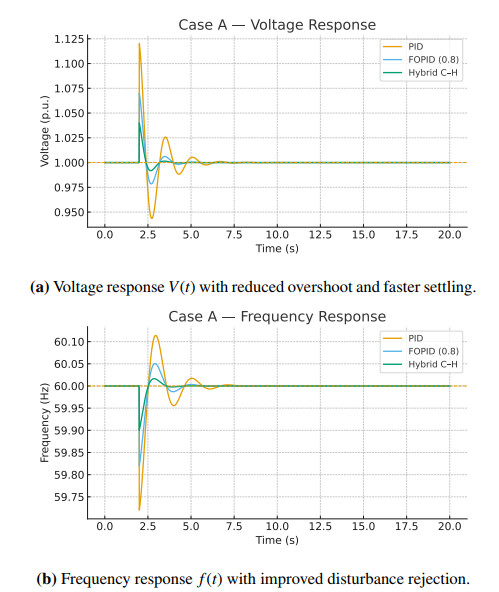
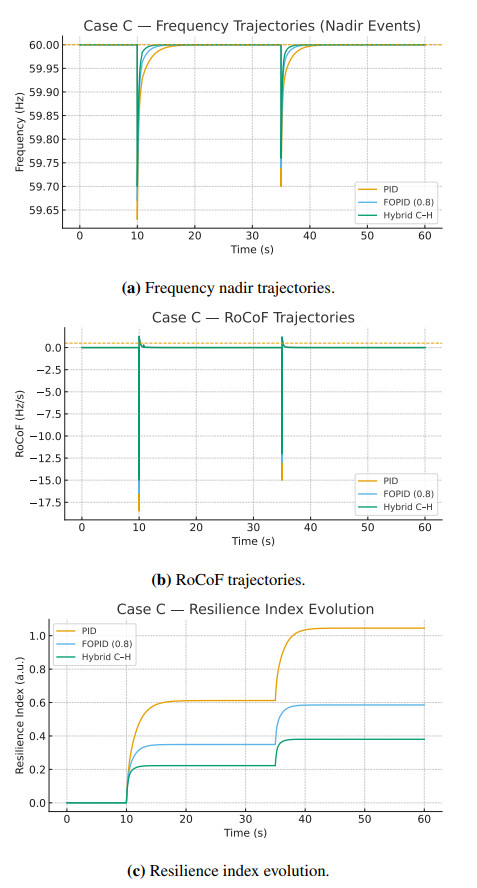
The rapid integration of inverter-based renewable resources poses significant challenges to power systems' stability and resilience. This paper presents a data-driven variable-order fractional control framework that enhances grids' resilience through adaptive memory management. The proposed controller employs a hybrid Caputo-Hadamard structure, in which the fractional order $\alpha(t)$ adapts in real time occording to wide-area frequency measurements. The Caputo component captures short-memory transient dynamics associated with power electronic responses, while the Hadamard component represents long-memory logarithmic effects arising from variability in the load and renewable generation. Rigorous stability analysis establishes Mittag-Leffler stability under bounded order variation and Ulam-Hyers practical stability, ensuring robustness against modeling uncertainties and numerical discretization errors. Numerical validation using realistic US power system data from Pennsylvania-New Jersey-Maryland (PJM) Interconnection, California Independent System Operator (CAISO), National Renewable Energy Laboratory (NREL), and Frequency Monitoring Network (FNET/GridEye) demonstrates consistently improved performance compared with integer-order and fixed-order fractional controllers, including up to $67\%$ reduction in voltage overshoot and $72\%$ reduction in the duration of rate of change of frequency violations under compound disturbance scenarios. The proposed framework provides a mathematically rigorous and practically viable approach for adaptive control in renewable-rich power systems, aligning with ongoing grid modernization efforts that seek to balance fast transient response with long-term stability in the system.
Citation: Kinda Abuasbeh, Meraa Arab. Data-driven variable-order fractional control for grid resilience: A hybrid Caputo-Hadamard framework validated with US power system data[J]. AIMS Mathematics, 2026, 11(3): 5492-5531. doi: 10.3934/math.2026227
The rapid integration of inverter-based renewable resources poses significant challenges to power systems' stability and resilience. This paper presents a data-driven variable-order fractional control framework that enhances grids' resilience through adaptive memory management. The proposed controller employs a hybrid Caputo-Hadamard structure, in which the fractional order $\alpha(t)$ adapts in real time occording to wide-area frequency measurements. The Caputo component captures short-memory transient dynamics associated with power electronic responses, while the Hadamard component represents long-memory logarithmic effects arising from variability in the load and renewable generation. Rigorous stability analysis establishes Mittag-Leffler stability under bounded order variation and Ulam-Hyers practical stability, ensuring robustness against modeling uncertainties and numerical discretization errors. Numerical validation using realistic US power system data from Pennsylvania-New Jersey-Maryland (PJM) Interconnection, California Independent System Operator (CAISO), National Renewable Energy Laboratory (NREL), and Frequency Monitoring Network (FNET/GridEye) demonstrates consistently improved performance compared with integer-order and fixed-order fractional controllers, including up to $67\%$ reduction in voltage overshoot and $72\%$ reduction in the duration of rate of change of frequency violations under compound disturbance scenarios. The proposed framework provides a mathematically rigorous and practically viable approach for adaptive control in renewable-rich power systems, aligning with ongoing grid modernization efforts that seek to balance fast transient response with long-term stability in the system.

| [1] |
Kroposki, B. and al. Achieving a 100% renewable grid: Operating electric power systems with extremely high levels of variable renewable energy, IEEE Power Energy M., 15 (2017), 61–73. https://doi.org/10.1109/MPE.2016.2637122 doi: 10.1109/MPE.2016.2637122

|
| [2] | US Department of Energy, Grid Modernization Initiative, 2003. Available at: https://www.energy.gov/gmi/grid-modernization-initiative. |
| [3] | North American Electric Reliability Corporation (NERC), Inverter-Based Resource Performance Issues: Level 2 Alert Assessment Public Report, USA, 2023. |
| [4] | The University of Tennessee Knoxville, FNET/GridEye. Available at: https://poweritlab.utk.edu/fnet/. |
| [5] | National Laboratory of the Rockies, Wind Integration National Dataset Toolkits. Available at: https://www.nrel.gov/grid/wind-toolkit.html. |
| [6] | National Laboratory of the Rockies, NSRDB: National Solar Radiation Database. Available at: https://nsrdb.nrel.gov. |
| [7] | PJM Interconnection LLC, PJM Data Miner 2 Portal. Available at: https://dataminer2.pjm.com. |
| [8] | California Independent System Operator (CAISO), Open Access Same-time Information System (OASIS). Available at: https://oasis.caiso.com/mrioasis/logon.do. |
| [9] | I. Podlubny, Fractional differential equations: An introduction to fractional derivatives, fractional differential equations, to methods of their solution and some of their applications, elsevier, 1998. |
| [10] |
P. Warrier, P. Shah, Fractional order control of power electronic converters in industrial drives and renewable energy systems: a review, IEEE Access, 9 (2021), 58982–59009. https://doi.org/10.1109/ACCESS.2021.3073033 doi: 10.1109/ACCESS.2021.3073033
|
| [11] |
J. Zhao, H. Zhao, Y. Song, Z. Sun, D. Yu, Fast finite-time consensus protocol for high-order nonlinear multi-agent systems based on event-triggered communication scheme, Appl. Math. Comput., 508 (2026), 129631. https://doi.org/10.1016/j.amc.2025.129631 doi: 10.1016/j.amc.2025.129631
|
| [12] |
H. Fu, Y. Kao, Robust sliding mode control of discrete fractional difference chaotic system, Nonlinear Dyn., 113 (2025), 1419–1431. https://doi.org/10.1007/s11071-024-10279-6 doi: 10.1007/s11071-024-10279-6
|
| [13] |
Y. Kao, Y. Li, J. H. Park, X. Chen, Mittag-Leffler synchronization of delayed fractional memristor neural networks via adaptive control, IEEE T. Neur. Net. Lear., 32 (2021), 2279–2284. https://doi.org/10.1109/TNNLS.2020.2995718 doi: 10.1109/TNNLS.2020.2995718
|
| [14] | C. A. Monje, Y. Q. Chen, B. M. Vinagre, D. Xue, V. Feliu, Fractional-order systems and controls: fundamentals and applications, London: Springer, 2010. |
| [15] | A. Oustaloup, La derivation non entiere: Theorie, synthese et applications, Hermes science publications, 1995. |
| [16] | Y. Kao, C. Wang, H. Xia, Y. Cao, Projective synchronization for uncertain fractional reaction-diffusion systems via adaptive sliding mode control based on finite-time scheme, In: Analysis and control for fractional-order systems, Singapore: Springer, 2024. https://doi.org/10.1007/978-981-99-6054-5_8 |
| [17] | V. I. Utkin, Sliding modes in control and optimization, Springer Science and Business Media, 2013. |
| [18] |
Y. Yang, H. H. Zhang, Optimal model reference adaptive fractional-order proportional integral derivative control of idle speed system under varying disturbances, Proc. I. Mech. Eng. Part I J. Sys., 239 (2025), 339–355. https://doi.org/10.1177/09596518241266670 doi: 10.1177/09596518241266670
|
| [19] |
M. A. Hossain, E. M. Gray, J. Lu, M. S. Alam, W. Hassan, M. Negnevitsky, Optimized model-free frequency control for renewable energy integration in islanded power systems, IEEE T. Ind. Appl., 62 (2026), 2084–2096. https://doi.org/10.1109/TIA.2025.3603757 doi: 10.1109/TIA.2025.3603757
|
| [20] |
P. Li, R. Gao, C. Xu, Y. Li, A. Akgül, D. Baleanu, Dynamics exploration for a fractional-order delayed zooplankton-phytoplankton system, Chaos Soliton. Fract., 166 (2023), 112975. https://doi.org/10.1016/j.chaos.2022.112975 doi: 10.1016/j.chaos.2022.112975
|
| [21] |
Y. Zhao, Y. Sun, Z. Liu, Y. Wang, Solvability for boundary value problems of nonlinear fractional differential equations with mixed perturbations of the second type, AIMS Math., 5 (2020), 557–567. https://doi.org/10.3934/math.2020037 doi: 10.3934/math.2020037
|
| [22] |
H. Fu, Y. Kao, Synchronization of uncertain general fractional unified chaotic systems via finite-time adaptive sliding mode control, Chaos, 33 (2023), 043136. https://doi.org/10.1063/5.0130366 doi: 10.1063/5.0130366
|
| [23] |
Y. Kao, Y. Cao, X. Chen, Global Mittag-Leffler synchronization of coupled delayed fractional reaction-diffusion Cohen-Grossberg neural networks via sliding mode control, Chaos, 32 (2022), 113123. https://doi.org/10.1063/5.0102787 doi: 10.1063/5.0102787
|
| [24] | K. Zhou, J. C. Doyle, Essentials of robust control, Upper Saddle River, NJ: Prentice hall, 1998. |
| [25] |
Y. Li, Y. Chen, I. Podlubny, Mittag-Leffler stability of fractional order nonlinear dynamic systems, Automatica, 45 (2009), 1965–1969. https://doi.org/10.1016/j.automatica.2009.04.003 doi: 10.1016/j.automatica.2009.04.003
|
| [26] |
J. Wang, Y. Zhang, Ulam-Hyers-Mittag-Leffler stability of fractional-order delay differential equations, Optimization, 63 (2014), 1181–1190. https://doi.org/10.1080/02331934.2014.906597 doi: 10.1080/02331934.2014.906597
|
| [27] | A. A. Kilbas, H. M. Srivastava, J. J. Trujillo, Theory and applications of fractional differential equations, elsevier, 2006. |
| [28] | K. Diethelm, The analysis of fractional differential equations, Lecture notes in mathematics, 2010. |
Figures(8) / Tables(7)

Kinda Abuasbeh, Meraa Arab. Data-driven variable-order fractional control for grid resilience: A hybrid Caputo-Hadamard framework validated with US power system data[J]. AIMS Mathematics, 2026, 11(3): 5492-5531. doi: 10.3934/math.2026227





 DownLoad: