For a complex square matrix, we proved that every MPBT (MPBT is the abbreviation of Moore-Penrose, Baksalary and Trenkler) invertible matrix was Bott-Duffin $ (A^{\dagger}A_{1}^{\diamond}, A_{1}^{\diamond}A^{\dagger}) $-invertible. We constructed a Gradient Neural Network model $ GNNSYS(A, A_{1}^{\diamond}A^{\dagger}, A, A^{\dagger}A_{1}^{\diamond}) $ for the system $ AX = A_{1}^{\diamond}A^{\dagger} $ and $ XA = A^{\dagger}A_{1}^{\diamond} $, where $ A_{1}^{\diamond} = AA^{\diamond}A $ and the above system satisfied the Mitra compatibility conditions. The state matrix $ V(t) $ in the above system converged to the MPBT-inverse. We verified the main theorem by using numerical examples.
Citation: Sanzhang Xu, Zhengyang Shan, and Can Zha. Existence criteria of the MPBT-inverse and its randomized algorithms[J]. AIMS Mathematics, 2026, 11(11): 39607-39620. doi: 10.3934/math.20261525
For a complex square matrix, we proved that every MPBT (MPBT is the abbreviation of Moore-Penrose, Baksalary and Trenkler) invertible matrix was Bott-Duffin $ (A^{\dagger}A_{1}^{\diamond}, A_{1}^{\diamond}A^{\dagger}) $-invertible. We constructed a Gradient Neural Network model $ GNNSYS(A, A_{1}^{\diamond}A^{\dagger}, A, A^{\dagger}A_{1}^{\diamond}) $ for the system $ AX = A_{1}^{\diamond}A^{\dagger} $ and $ XA = A^{\dagger}A_{1}^{\diamond} $, where $ A_{1}^{\diamond} = AA^{\diamond}A $ and the above system satisfied the Mitra compatibility conditions. The state matrix $ V(t) $ in the above system converged to the MPBT-inverse. We verified the main theorem by using numerical examples.

| [1] |
O. M. Baksalary, G. Trenkler, On a generalized core inverse, Appl. Math. Comput., 236 (2014), 450–457. http://doi.org/10.1016/j.amc.2014.03.048 doi: 10.1016/j.amc.2014.03.048
|
| [2] |
J. Dakić, M. D. Petković, Gradient neural network model for the system of two linear matrix equations and applications, Appl. Math. Comput., 481 (2024), 128930. https://doi.org/10.1016/j.amc.2024.128930 doi: 10.1016/j.amc.2024.128930
|
| [3] |
M. P. Drazin, A class of outer generalized inverses, Linear Algebra Appl., 436 (2012), 1909–1923. https://doi.org/10.1016/j.laa.2011.09.004 doi: 10.1016/j.laa.2011.09.004
|
| [4] |
N. Halko, P. G. Martinsson, J. A. Tropp, Finding structure with randomness: Probabilistic algorithms for constructing approximate matrix decompositions, SIAM Rev., 53 (2011), 217–288. https://doi.org/10.1137/090771806 doi: 10.1137/090771806
|
| [5] |
R. A. Horn, C. R. Johnson, Matrix Analysis, Cambridge: Cambridge University Press, 2012. |
| [6] |
R. E. Hartwig, K. Spindelböck, Matrices for which $A^{\ast}$ and $A^{\dagger}$ commmute, Linear Multilinear A., 14 (1983), 241–256. https://doi.org/10.1080/03081088308817561 doi: 10.1080/03081088308817561
|
| [7] |
H. F. Ma, H. B. Chen, P. S. Stanimirović, Representations and computation of the BT-inverse and its randomized algorithms, Appl. Math. Comput., 515 (2026), 129850. https://doi.org/10.1016/j.amc.2025.129850 doi: 10.1016/j.amc.2025.129850
|
| [8] |
R. Penrose, A generalized inverse for matrices, Proc. Cambridge Philos. Soc., 51 (1955), 406–413. https://doi.org/10.1017/S0305004100030401 doi: 10.1017/S0305004100030401
|
| [9] |
J. S. Respondek, Correction of 'J. Laderman, V. Pan, X. H. Sha, On practical algorithms for accelerated matrix multiplication, Linear Algebra and its Applications, Vol. 162-164 (1992), 557–588', Linear Multilinear Algebra, 73 (2025), 838–848. https://doi.org/10.1080/03081087.2024.2391807 doi: 10.1080/03081087.2024.2391807
|
| [10] |
C. R. Rao, S. K. Mitra, Generalized inverse of a matrix and its applications, In: Proceedings of the Sixth Berkeley Symposium on Mathematical Statistics and Probability, Volume 1: Theory of Statistics, California: University of California Press, 6 (1972), 601–620. https://doi.org/10.1525/9780520325883-032 |
| [11] |
I. Stojanović, P. S. Stanimirović, I. S. Živković, D. Gerontitis, X. Z. Wang, ZNN models for computing matrix inverse based on hyperpower iterative methods, Filomat, 31 (2017), 2999–3014. https://doi.org/10.2298/fil1710999s doi: 10.2298/fil1710999s
|
| [12] |
S. Z. Xu, Q. Y. Xu, N. Zhou, The MPBT inverse of a complex matrix based on the Hartwig-Spindelböck decomposition, Ital. J. Pure Appl. Math., 52 (2024), 205–218. |
Figures(6) / Tables(2)

Sanzhang Xu, Zhengyang Shan, and Can Zha. Existence criteria of the MPBT-inverse and its randomized algorithms[J]. AIMS Mathematics, 2026, 11(11): 39607-39620. doi: 10.3934/math.20261525

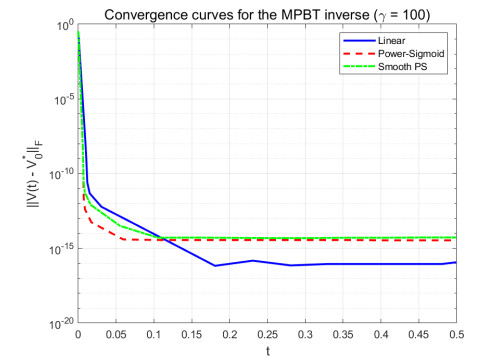
Evolution curves of the MPBT inverse under three activation functions
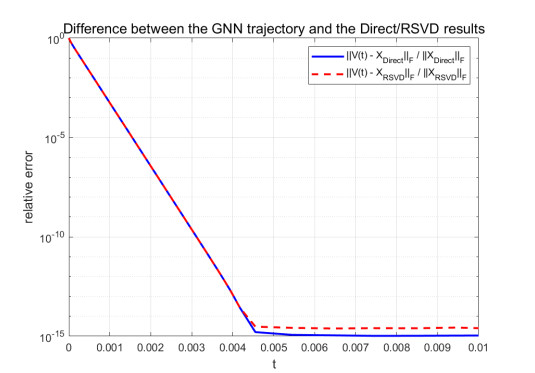
Evolution of the gap between the GNN trajectory and the direct/RSVD results
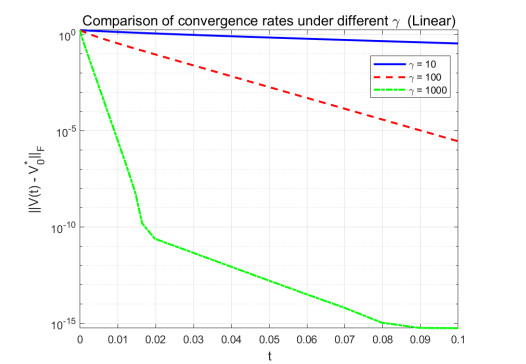
Comparison of convergence speeds of the GNNSYS model
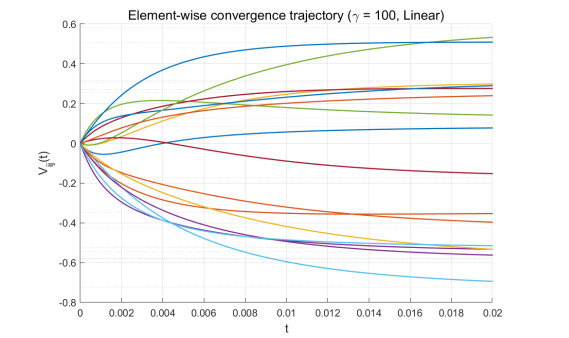
Element-wise convergence trajectories of the MPBT inverse
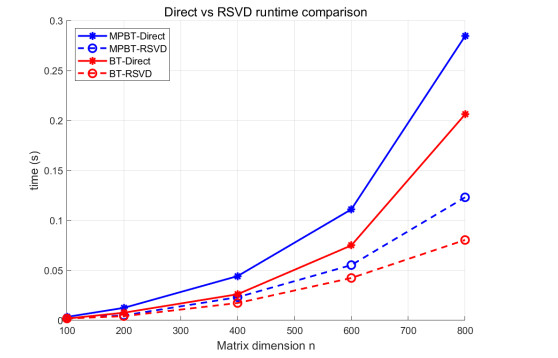
Comparison of running time between the direct method and RSVD for the MPBT-inverse
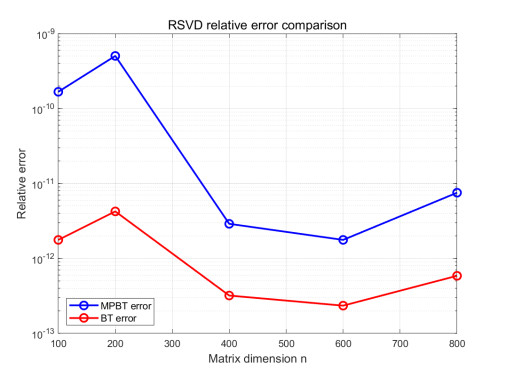
Variation of relative error of RSVD for the MPBT-inverse with matrix dimension




 DownLoad: