This paper investigated resilient consensus control for heterogeneous multi-agent systems subject to inconsistent semi-Markov switching topologies and composite attacks. Inconsistent semi-Markov processes were introduced to characterize the stochastic switching communication topologies among agents with different dynamics. Furthermore, a composite attack model was constructed to capture simultaneous malicious attacks on sensor measurement and actuator control channels. Moreover, to reduce communication frequency and alleviate the adverse effects of instantaneous error fluctuations, a dual accumulative-error-based event-triggered mechanism was introduced. Based on this mechanism, a distributed secure consensus protocol was designed to enable secure cooperative control of all agents. By employing a stochastic analysis technique, Lyapunov stability theory, and some inequality techniques, sufficient conditions were derived to guarantee secure consensus of the closed-loop system. Finally, simulation results demonstrated that the proposed method can maintain consensus under composite attacks while effectively reducing the number of communication updates.
Citation: Dongxiao Hu, Jiwei Gao, Jianwei Ma, and Shaofei Zang. Event-triggered resilient consensus of heterogeneous multi-agent systems under inconsistent semi-Markov switching and composite attacks[J]. AIMS Mathematics, 2026, 11(11): 39498-39522. doi: 10.3934/math.20261521
This paper investigated resilient consensus control for heterogeneous multi-agent systems subject to inconsistent semi-Markov switching topologies and composite attacks. Inconsistent semi-Markov processes were introduced to characterize the stochastic switching communication topologies among agents with different dynamics. Furthermore, a composite attack model was constructed to capture simultaneous malicious attacks on sensor measurement and actuator control channels. Moreover, to reduce communication frequency and alleviate the adverse effects of instantaneous error fluctuations, a dual accumulative-error-based event-triggered mechanism was introduced. Based on this mechanism, a distributed secure consensus protocol was designed to enable secure cooperative control of all agents. By employing a stochastic analysis technique, Lyapunov stability theory, and some inequality techniques, sufficient conditions were derived to guarantee secure consensus of the closed-loop system. Finally, simulation results demonstrated that the proposed method can maintain consensus under composite attacks while effectively reducing the number of communication updates.

| [1] |
Y. H. Su, P. Bhowmick, A. Lanzon, A fixed-time formation-containment control scheme for multi-agent systems with motion planning: Applications to quadcopter UAVs, IEEE T. Veh. Technol., 73 (2024), 9495–9507. http://doi.org/10.1109/TVT.2024.3382489 doi: 10.1109/TVT.2024.3382489
|
| [2] |
X. Wang, J. Wang, Y. Y. Chen, Y. Ma, S. Li, Hierarchical consensus of constrained second-order multi-agent systems with application to formation of multiple mobile robots, IEEE T. Autom. Contr., 71 (2025), 886–901. http://doi.org/10.1109/TAC.2025.3602134 doi: 10.1109/TAC.2025.3602134
|
| [3] |
L. Wang, Z. Wang, K. Gumma, A. Turner, S. Ratchev, Multi-agent cooperative swarm learning for dynamic layout optimisation of reconfigurable robotic assembly cells based on digital twin, J. Intell. Manuf., 36 (2025), 2959–2982. http://doi.org/10.1007/s10845-023-02229-7 doi: 10.1007/s10845-023-02229-7
|
| [4] |
A. A. Okine, N. Adam, F. Naeem, G. Kaddoum, Multi-agent deep reinforcement learning for packet routing in tactical mobile sensor networks, IEEE T. Netw. Serv. Man., 21 (2024), 2155–2169. http://doi.org/10.1109/TNSM.2024.3352014 doi: 10.1109/TNSM.2024.3352014
|
| [5] |
S. Huang, C. Sun, R. Q. Wang, D. Pompili, Toward adaptive and coordinated transportation systems: A multi-personality multi-agent meta-reinforcement learning framework, IEEE T. Intell. Transp., 26 (2025), 12148–12161. http://doi.org/10.1109/TITS.2025.3560227 doi: 10.1109/TITS.2025.3560227
|
| [6] |
Z. Wang, C. Mu, S. Hu, C. Chu, X. Li, Modelling the dynamics of regret minimization in large agent populations: A master equation approach, Proc. Int. Joint Conf. Artif. Intell. (IJCAI), (2022), 534–540. https://doi.org/10.24963/ijcai.2022/76 |
| [7] |
D. Zhang, Y. Hao, Q. Yuan, C. Qin, Dynamic event-triggered approximate optimal consensus control for unknown nonlinear multi-agent systems via adaptive dynamic programming, ISA T., 172 (2026), 21–32. http://doi.org/10.1016/j.isatra.2026.03.010 doi: 10.1016/j.isatra.2026.03.010
|
| [8] |
Y. Zhou, G. Wen, G. Chen, Bipartite consensus tracking of heterogeneous multi-agent systems: A smooth output-feedback control approach, Automatica, 178 (2025), 112363. http://doi.org/10.1016/j.automatica.2025.112363 doi: 10.1016/j.automatica.2025.112363
|
| [9] |
O. S. Oubbati, J. Alotaibi, F. Alromithy, M. Atiquzzaman, M. R. Altimania, A UAV-UGV cooperative system: Patrolling and energy management for urban monitoring, IEEE T. Veh. Technol., 74 (2025), 13524–13536. http://doi.org/10.1109/TVT.2025.3563971 doi: 10.1109/TVT.2025.3563971
|
| [10] |
Y. Zhong, R. Ashfaq, A. Khan, A. U. K. Niazi, T. Saidani, A. B. Rajab, et al., Control protocol design for group consensus in heterogeneous multi-agent systems with communication interruptions and external disturbances, AIMS Math., 10 (2025), 19750–19774. http://doi.org/10.3934/math.2025881 doi: 10.3934/math.2025881
|
| [11] |
X. Li, J. Wu, X. Zhan, L. Cheng, Q. Yang, Robust neuro-adaptive bipartite formation control for nonlinear multi-agent systems subject to Markovian switching topologies and additive noise, Neurocomputing, 648 (2025), 130655. http://doi.org/10.1016/j.neucom.2025.130655 doi: 10.1016/j.neucom.2025.130655
|
| [12] |
M. Meng, K. Xiang, Q. Gan, L. Chang, Event-triggered fixed-time consensus tracking of nonlinear delayed multi-agent systems with disturbances under switching topologies, AIMS Math., 11 (2026), 20473–20501. http://doi.org/10.3934/math.2026833 doi: 10.3934/math.2026833
|
| [13] |
X. Song, J. Man, C. Ki Ahn, S. Song, Finite-time dissipative synchronization for Markovian jump generalized inertial neural networks with reaction–diffusion terms, IEEE Trans. Syst. Man Cybern. Syst., 51 (2021), 3650–3661. http://doi.org/10.1109/TSMC.2019.2958419 doi: 10.1109/TSMC.2019.2958419
|
| [14] |
M. Svishchuk, A. V. Swishchuk, Stochastic optimal control of averaged SDDE with semi-Markov switching and with application in economics, Mathematics, 13 (2025), 1440. http://doi.org/10.3390/math13091440 doi: 10.3390/math13091440
|
| [15] |
S. Tian, H. Shen, H. Tian, Resilient consensus of nonlinear multi-agent systems with semi-Markov switching in unsecure environments under DoS attacks, IEEE T. Signal Inf. Process. Netw., 12 (2026), 529–543. http://doi.org/10.1109/TSIPN.2026.3682187 doi: 10.1109/TSIPN.2026.3682187
|
| [16] |
M. Ban, J. Li, H. Deng, Y. Wang, J. Cheng, Dynamic event-triggered ${H}_{\infty}$ leader-following consensus for nonlinear stochastic multi-agent systems with semi-Markov switching topologies and application, J. Franklin Inst., 362 (2025), 107596. http://doi.org/10.1016/j.jfranklin.2025.107596 doi: 10.1016/j.jfranklin.2025.107596
|
| [17] |
W. Cao, D. Zhang, G. Feng, Resilient semi-global finite-time cooperative output regulation of heterogeneous linear multi-agent systems subject to denial-of-service attacks, Automatica, 173 (2025), 112099. http://doi.org/10.1016/j.automatica.2024.112099 doi: 10.1016/j.automatica.2024.112099
|
| [18] |
G. A. Usmani, M. Rehan, X. Wu, A. ur Rehman, Resilient consensus control for heterogeneous multi-agent systems subject to two-channel stochastic deception attacks, IEEE T. Consum. Electron., 72 (2025), 2049–2060. http://doi.org/10.1109/TCE.2025.3645813 doi: 10.1109/TCE.2025.3645813
|
| [19] |
T. Y. Zhang, G. H. Yang, D. Ye, Asymmetrical vulnerability of heterogeneous multi-agent systems under false-data injection attacks, Automatica, 171 (2025), 111947. http://doi.org/10.1016/j.automatica.2024.111947 doi: 10.1016/j.automatica.2024.111947
|
| [20] |
X. Wang, T. Huang, Optimized adaptive finite-time consensus control for stochastic nonlinear multiagent systems with non-affine nonlinear faults, In: Optimal Adaptive Cooperative Control for Nonlinear Multiagent Systems, Springer Nature Singapore, 2026,159–184. https://doi.org/10.1007/978-981-95-2964-3_8 |
| [21] |
L. Xia, Q. Li, R. Song, L. Liu, Resilient output synchronization dynamic event-triggered control to link faults in heterogeneous multi-agent systems, Int. J. Robust Nonlin., 34 (2024), 4736–4752. http://doi.org/10.1002/rnc.7225 doi: 10.1002/rnc.7225
|
| [22] |
Z. Li, K. He, Z. Yang, L. Lian, Y. Sun, H. Zhao, Two-layer game-based consensus security control for stochastic multiagent systems over sensor attacks, AIMS Math., 11 (2026), 31185–31213. http://doi.org/10.3934/math.20261232 doi: 10.3934/math.20261232
|
| [23] |
K. Li, C. Hua, X. You, Z. Xu, Distributed consensus of feedforward nonlinear stochastic multiagent systems subject to actuator attacks, IEEE T. Cybern., 55 (2025), 4842–4851. http://doi.org/10.1109/TCYB.2025.3597979 doi: 10.1109/TCYB.2025.3597979
|
| [24] |
Z. Chen, Z. Yu, S. Li, Output feedback adaptive inverse optimal security control for stochastic nonlinear cyber-physical systems under sensor and actuator attacks, Nonlinear Dyn., 112 (2024), 19243–19259. http://doi.org/10.1007/s11071-024-10043-w doi: 10.1007/s11071-024-10043-w
|
| [25] |
V. S. Dolk, K. J. A. Scheres, R. Postoyan, W. P. M. H. Heemels, Time- and event-triggered communication for multi-agent systems–Part I: General framework, IEEE T. Autom. Contr., 70 (2024), 447–462. http://doi.org/10.1109/TAC.2024.3427908 doi: 10.1109/TAC.2024.3427908
|
| [26] |
X. Wang, N. Pang, Y. Xu, T. Huang, J. Kurths, On state-constrained containment control for nonlinear multiagent systems using event-triggered input, IEEE Trans. Syst. Man Cybern. Syst., 54 (2024), 2530–2538. http://doi.org/10.1109/TSMC.2023.3345365 doi: 10.1109/TSMC.2023.3345365
|
| [27] |
D. Wang, Z. Yuan, A. Liu, Q. Hu, J. Qiao, Static and dynamic event-triggered control for disturbed interconnected systems through adaptive critic designs, IEEE T. Syst. Man Cybern. Syst., 56 (2025), 878–892. http://doi.org/10.1109/TSMC.2025.3638702 doi: 10.1109/TSMC.2025.3638702
|
| [28] |
Y. Ma, Z. Hu, X. Qi, S. Hu, X. Xie, Y. Zhao, et al., Dynamic event-triggered fuzzy control of networked unmanned surface vehicles under hybrid cyber attacks, IEEE T. Ind. Electron., 72 (2024), 6422–6431. http://doi.org/10.1109/TIE.2024.3497323 doi: 10.1109/TIE.2024.3497323
|
| [29] |
M. Long, H. Su, W. X. Zheng, Y. Wang, R. Su, Adaptive event-triggered distributed observer for unknown-input LTI systems, IEEE T. Autom. Contr., 70 (2025), 8274–8281. http://doi.org/10.1109/TAC.2025.3581142 doi: 10.1109/TAC.2025.3581142
|
| [30] |
X. M. Zhang, Q. L. Han, B. L. Zhang, X. Ge, D. Zhang, Accumulated-state-error-based event-triggered sampling scheme and its application to ${H}_{\infty}$ control of sampled-data systems, Sci. China Inf. Sci., 67 (2024), 162206. http://doi.org/10.1007/s11432-023-4038-3 doi: 10.1007/s11432-023-4038-3
|
| [31] |
J. Zhao, H. Zhao, Y. Song, Z. Y. Sun, D. Yu, Fast finite-time consensus protocol for high-order nonlinear multi-agent systems based on event-triggered communication scheme, Appl. Math. Comput., 508 (2026), 129631. http://doi.org/10.1016/j.amc.2025.129631 doi: 10.1016/j.amc.2025.129631
|
| [32] |
Z. Shen, L. Zhang, N. Zhao, Reachable set synthesis of nonlinear heterogeneous multi-agent systems with Markov switching topologies, J. Franklin Inst., 362 (2025), 107770. http://doi.org/10.1016/j.jfranklin.2025.107770 doi: 10.1016/j.jfranklin.2025.107770
|
| [33] |
G. Liu, Q. Sun, H. Su, Z. Hu, Adaptive tracking control for uncertain nonlinear multi-agent systems with partially sensor attack, IEEE T. Autom. Sci. Eng., 22 (2024), 6270–6279. http://doi.org/10.1109/TASE.2024.3440394 doi: 10.1109/TASE.2024.3440394
|
| [34] |
X. Li, G. Wen, Y. Lv, C. Sun, M. M. Polycarpou, Output consensus tracking of heterogeneous open multi-agent systems under actuator attacks, IEEE T. Control Netw. Syst., 13 (2025), 423–435. http://doi.org/10.1109/TCNS.2025.3648473 doi: 10.1109/TCNS.2025.3648473
|
| [35] |
C. Fan, L. Su, K. Wang, X. Fei, Event-triggered synchronization control for Markov jump neural networks with partially unknown transition probabilities, Int. J. Robust Nonlin., 35 (2025), 2091–2100. http://doi.org/10.1002/rnc.7781 doi: 10.1002/rnc.7781
|
| [36] |
S. Vong, X. Ma, Y. Zhang, X. Han, Improved reciprocally convex cubic matrix inequalities for neural networks with time-varying delay, J. Franklin Inst., 362 (2025), 107930. http://doi.org/10.1016/j.jfranklin.2025.107930 doi: 10.1016/j.jfranklin.2025.107930
|
| [37] |
S. Jenhani, H. Gritli, An LMI-based robust state-feedback controller design for the position control of a knee rehabilitation exoskeleton robot: Comparative analysis, Meas. Control, 57 (2024), 1326–1346. http://doi.org/10.1177/00202940241236295 doi: 10.1177/00202940241236295
|
| [38] |
J. Yang, J. Wang, D. Shen, Observer-based sampled-data event-triggered tracking for nonlinear multi-agent systems with semi-Markovian switching topologies, Inf. Sci., 676 (2024), 120803. http://doi.org/10.1016/j.ins.2024.120803 doi: 10.1016/j.ins.2024.120803
|
| [39] |
X. Yin, D. Yue, S. Hu, Adaptive periodic event-triggered consensus for multi-agent systems subject to input saturation, Int. J. Control, 89 (2016), 653–667. http://doi.org/10.1080/00207179.2015.1088967 doi: 10.1080/00207179.2015.1088967
|
Figures(11) / Tables(2)

Dongxiao Hu, Jiwei Gao, Jianwei Ma, and Shaofei Zang. Event-triggered resilient consensus of heterogeneous multi-agent systems under inconsistent semi-Markov switching and composite attacks[J]. AIMS Mathematics, 2026, 11(11): 39498-39522. doi: 10.3934/math.20261521

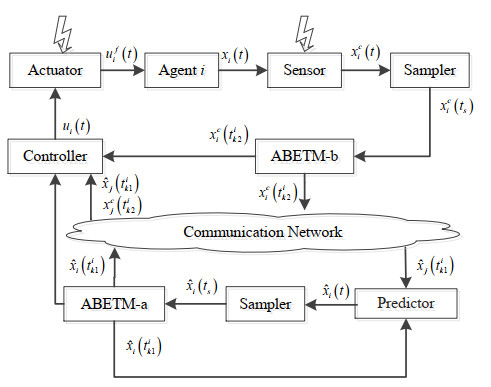
Framework for the overall design scheme
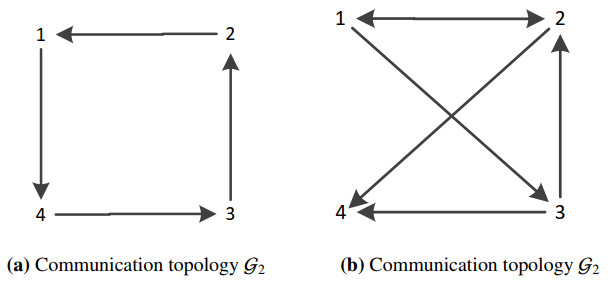
The communication topology $ {\cal G} $ of HMASs
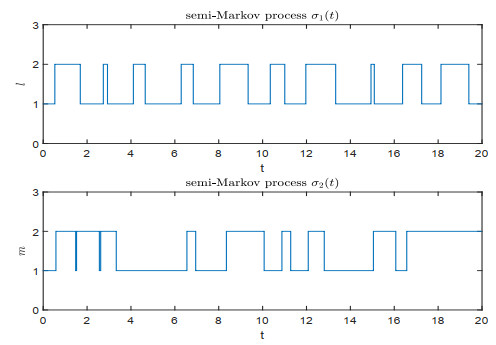
The considered semi-Markov processes in the HMASs
Evolution curves of the position in the HMASs
Evolution curves of velocity in the HMASs
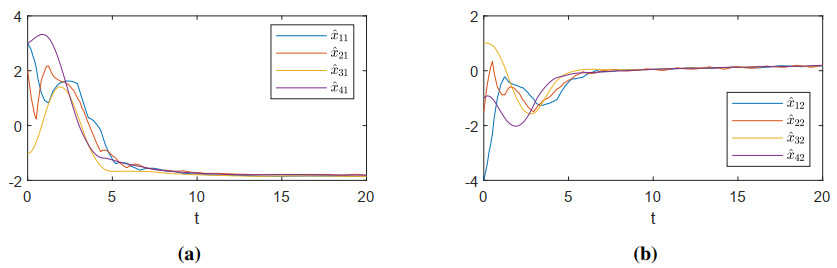
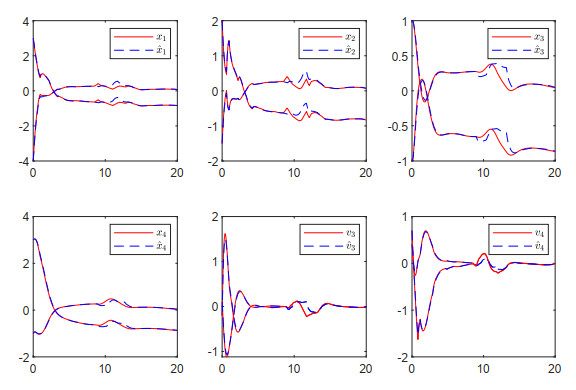
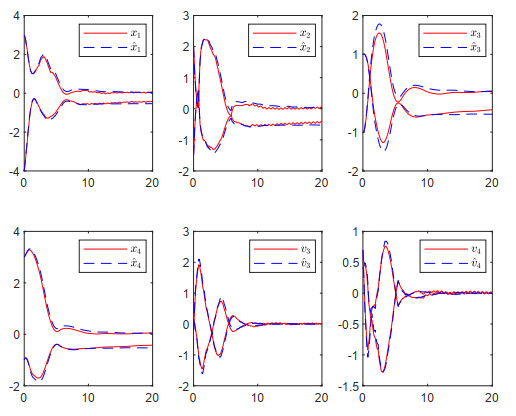
The estimation curve of the state (with attack compensation)
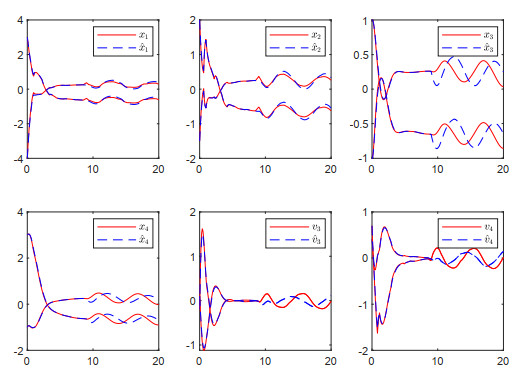
The estimation curve of the state (without attack compensation)
Trigger moments of the ABETM
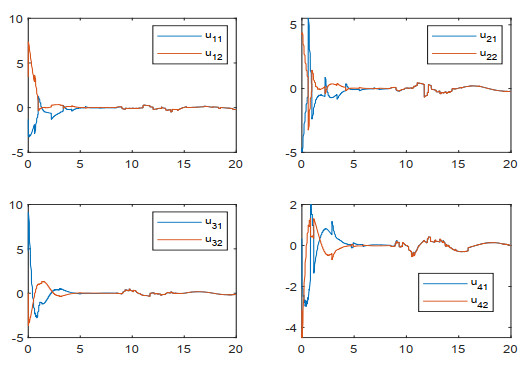
Control inputs
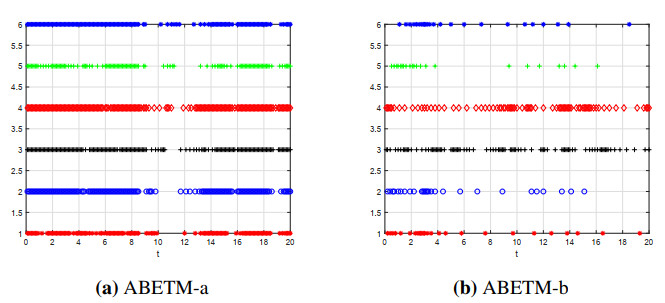
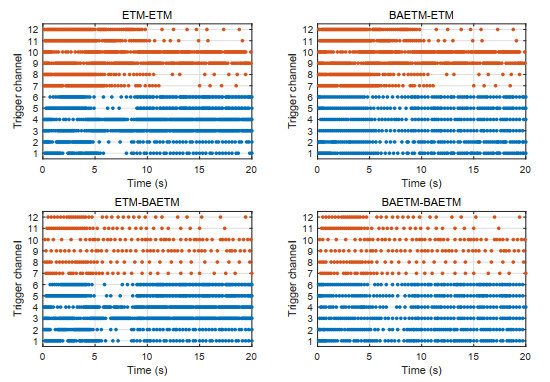
The triggering instants under different strategies
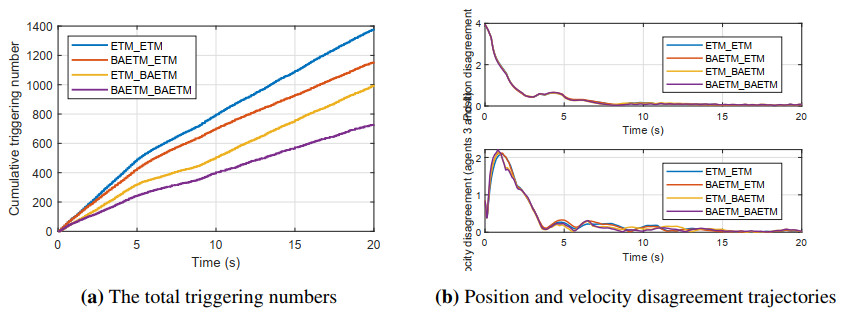
Performance comparison of different strategies




 DownLoad: