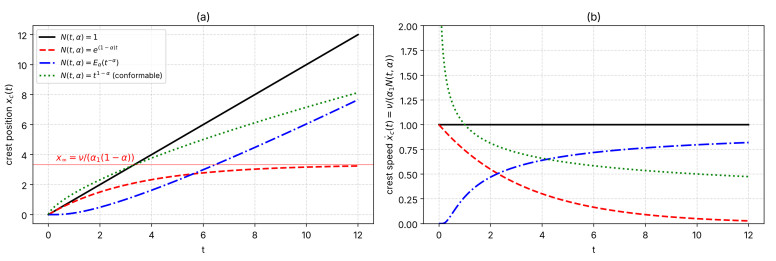
This work investigates the propagation of nonlinear waves in the (3+1)-dimensional Jimbo–Miwa (JM) equation in which the time derivative is replaced by the local generalized derivative (LGD), $ D_N^{\sigma} = N(t, \sigma)\partial_t $. Initially, we emphasize that the explicit LGD is a local operator: on any interval where $ N > 0, $ it is equivalent to an ordinary derivative with respect to the reparametrized time $ \tau(t) = {\int}_0^t ds/N(s, \sigma) $, so it represents no hereditary (memory) effects. Within this theoretical formulation, we derive a traveling-wave reduction that maintains the integration constant, substantiate the algebraic compatibility condition that the coefficients are required to fulfill, and obtain, with explicit parameter restrictions, bright (and dark) pulses with their bounded kink potentials, cnoidal periodic waves, and singular periodic, hyperbolic, and rational solutions. The kernel does not alter the spatial profiles; it governs the kinematics of the front. We show that exponential kernels arrest the front at a finite position, conformable kernels give sublinear propagation, and Mittag-Leffler kernel functions generate a propagating front that starts from rest and approaches the classical speed with a power-law lag. We show that the energy and Shannon entropy of the profiles are invariant for every kernel. Finally, we prove existence and uniqueness for Cauchy problems driven by the LGD via a contraction argument in a weighted Banach space, and derive explicit Lipschitz estimates for the dependence of solutions on the kernel parameter as process innovation.
Citation: Juan E. Nápoles V, Hadeel Bin Amer, Aziz Khan, Aiman Mukheimer, Shahneela Pitafi. Soliton dynamics and continuous dependence on the kernel in the (3+1)-dimensional Jimbo-Miwa equation via local generalized derivative operators[J]. AIMS Mathematics, 2026, 11(11): 39459-39476. doi: 10.3934/math.20261519
This work investigates the propagation of nonlinear waves in the (3+1)-dimensional Jimbo–Miwa (JM) equation in which the time derivative is replaced by the local generalized derivative (LGD), $ D_N^{\sigma} = N(t, \sigma)\partial_t $. Initially, we emphasize that the explicit LGD is a local operator: on any interval where $ N > 0, $ it is equivalent to an ordinary derivative with respect to the reparametrized time $ \tau(t) = {\int}_0^t ds/N(s, \sigma) $, so it represents no hereditary (memory) effects. Within this theoretical formulation, we derive a traveling-wave reduction that maintains the integration constant, substantiate the algebraic compatibility condition that the coefficients are required to fulfill, and obtain, with explicit parameter restrictions, bright (and dark) pulses with their bounded kink potentials, cnoidal periodic waves, and singular periodic, hyperbolic, and rational solutions. The kernel does not alter the spatial profiles; it governs the kinematics of the front. We show that exponential kernels arrest the front at a finite position, conformable kernels give sublinear propagation, and Mittag-Leffler kernel functions generate a propagating front that starts from rest and approaches the classical speed with a power-law lag. We show that the energy and Shannon entropy of the profiles are invariant for every kernel. Finally, we prove existence and uniqueness for Cauchy problems driven by the LGD via a contraction argument in a weighted Banach space, and derive explicit Lipschitz estimates for the dependence of solutions on the kernel parameter as process innovation.

| [1] |
I. Podlubny, Fractional differential equations, Vol. 198, New York: Academic Press, 1999. https://doi.org/10.1016/S0076-5392(99)X8001-5 |
| [2] |
R. Gorenflo, A. A. Kilbas, F. Mainardi, S. V. Rogosin, Mittag-Leffler functions, related topics and applications, 2 Eds., Springer Monographs in Mathematics, Berlin: Springer, 2020. https://doi.org/10.1007/978-3-662-61550-8 |
| [3] |
J. E. Nápoles Valdes, P. M. Guzmán, L. M. Lugo, A. Kashuri, The local generalized derivative and Mittag-Leffler function, Sigma J. Eng. Nat. Sci., 38 (2020), 1007–1017. |
| [4] |
A. Fleitas, J. E. Nápoles Valdes, J. M. Rodríguez, J. M. Sigarreta, Note on the generalized conformable derivative, Rev. Unión Mat. Argent., 62 (2021), 443–457. https://doi.org/10.33044/revuma.1930 doi: 10.33044/revuma.1930
|
| [5] |
D. Zhao, M. Luo, General conformable fractional derivative and its physical interpretation, Calcolo, 54 (2017), 903–917. https://doi.org/10.1007/s10092-017-0213-8 doi: 10.1007/s10092-017-0213-8
|
| [6] |
M. Ahmad, P. A. Naik, M. Yavuz, A. Zada, Analyzing the soliton waves' behavior in the (3+1)-dimensional time-fractional Jimbo–Miwa equation, Mod. Phys. Lett. B, 40 (2026), 2650070. https://doi.org/10.1142/S0217984926500703 doi: 10.1142/S0217984926500703
|
| [7] |
R. E. Castillo, J. E. Nápoles Valdes, H. Chaparro, Omega derivative, Gulf J. Math., 16 (2024), 55–67. https://doi.org/10.56947/gjom.v16i1.1430 |
| [8] |
N. Yogeesh, S. I. Mohammad, J. Divyashree, N. Raja, A. Vasudevan, H. Long, Pesticide residue induced hepatotoxicity: determination for animal studies based on fuzzy logic, Appl. Math. Inf. Sci., 19 (2025), 365–378. https://doi.org/10.18576/amis/190212 doi: 10.18576/amis/190212
|
| [9] |
M. Farman, A. Talib, K. S. Nisar, A. Sambas, M. Bayram, M. Hafez, Investigation of ABPV predict dynamics infection in honeybee colony production: soft patterns multiscale modeling with fractional approach, Ain Shams Eng. J., 16 (2025), 103626. https://doi.org/10.1016/j.asej.2025.103626 doi: 10.1016/j.asej.2025.103626
|
| [10] |
R. Khalil, M. Al Horani, A. Yousef, M. Sababheh, A new definition of fractional derivative, J. Comput. Appl. Math., 264 (2014), 65–70. https://doi.org/10.1016/j.cam.2014.01.002 doi: 10.1016/j.cam.2014.01.002
|
| [11] |
P. M. Guzmán, G. E. Langton, L. M. Lugo Motta Bittencourt, J. Medina, J. E. Nápoles Valdes, A new definition of a fractional derivative of local type, J. Math. Anal., 9 (2018), 88–98. |
| [12] |
F. Martínez, J. E. Nápoles Valdes, Towards a non-conformable fractional calculus of $n$-variables, J. Math. Appl., 43 (2020), 87–98. https://doi.org/10.7862/rf.2020.6 doi: 10.7862/rf.2020.6
|
| [13] |
H. Khan, H. B. Amer, W. F. Alfwzan, J. Alzabut, R. Thinakaran, Green energy generation dynamical system: fractal-fractional mathematical modeling with AI-driven data analysis, Contemp. Math., 7 (2026), 3327–3349. https://doi.org/10.37256/cm.7320269372 doi: 10.37256/cm.7320269372
|
| [14] |
H. Khan, H. B. Amer, R. Latif, W. F. Alfwzan, R. Thinakaran, Investigation of radioisotopes population dynamics by the help of modeling and artificial intelligence, Fractals, 34 (2026), 2640035. https://doi.org/10.1142/S0218348X26400359 doi: 10.1142/S0218348X26400359
|
| [15] |
H. Khan, H. B. Amer, W. F. Alfwzan, J. Alzabut, R. Thinakaran, AI-based data analysis of a fractal-fractional order contamination transportation and sedimentation model for rivers, Fractals, 34 (2026), 2640037. https://doi.org/10.1142/S0218348X26400372 doi: 10.1142/S0218348X26400372
|
| [16] |
L. M. Lugo, J. E. Nápoles Valdes, M. Vivas-Cortez, On the generalized Laplace's equation, Appl. Math. Inf. Sci., 16 (2022), 169–176. https://doi.org/10.18576/amis/160204 doi: 10.18576/amis/160204
|
| [17] |
M. Jimbo, T. Miwa, Solitons and infinite dimensional Lie algebras, Publ. Res. Inst. Math. Sci., 19 (1983), 943–1001. https://doi.org/10.2977/prims/1195182017 doi: 10.2977/prims/1195182017
|
| [18] |
T. Ling, H. Wang, Y. Wang, The (2+1)-dimensional time-fractional Kundu–Mukherjee–Naskar equation: Lie point symmetries, exact solutions and conservation laws, Chinese J. Phys., 96 (2025), 700–715. https://doi.org/10.1016/j.cjph.2025.05.004 doi: 10.1016/j.cjph.2025.05.004
|
| [19] |
T. Ling, H. Wang, Y. H. Wang, The (2+1)-dimensional generalized fifth-order KdV equation in its time-fractional form: Lie point symmetries, exact solutions and conservation laws, Mod. Phys. Lett. B, 40 (2026), 2650007. https://doi.org/10.1142/S0217984926500077 doi: 10.1142/S0217984926500077
|
| [20] |
H. Wang, T. Ling, Y. Wang, Symmetry analysis and fractional effects of the (2+1)-dimensional time-fractional Bogoyavlensky–Konoplechenko equation, Phys. Lett. A, 585 (2026), 131671. https://doi.org/10.1016/j.physleta.2026.131671 doi: 10.1016/j.physleta.2026.131671
|
| [21] |
P. M. Guzmán, J. E. Nápoles Valdes, M. Vivas-Cortez, A new generalized derivative and related properties, Appl. Math. Inf. Sci., 18 (2024), 923–932. https://doi.org/10.18576/amis/180501 doi: 10.18576/amis/180501
|
| [22] |
M. Vivas-Cortez, L. M. Lugo, J. E. Nápoles Valdes, M. E. Samei, A multi-index generalized derivative: Some introductory notes, Appl. Math. Inf. Sci., 16 (2022), 883–890. https://doi.org/10.18576/amis/160604 doi: 10.18576/amis/160604
|
Figures(6)

Juan E. Nápoles V, Hadeel Bin Amer, Aziz Khan, Aiman Mukheimer, Shahneela Pitafi. Soliton dynamics and continuous dependence on the kernel in the (3+1)-dimensional Jimbo-Miwa equation via local generalized derivative operators[J]. AIMS Mathematics, 2026, 11(11): 39459-39476. doi: 10.3934/math.20261519

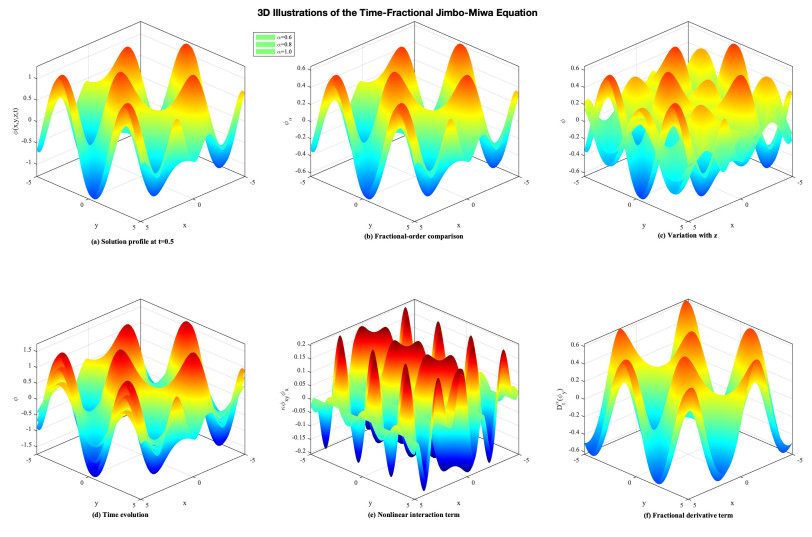
Three-dimensional visualization of the trial solution and its associated terms for the time-fractional JM equation
Three-dimensional visualization of the trial solution and its associated terms for the time-fractional JM equation
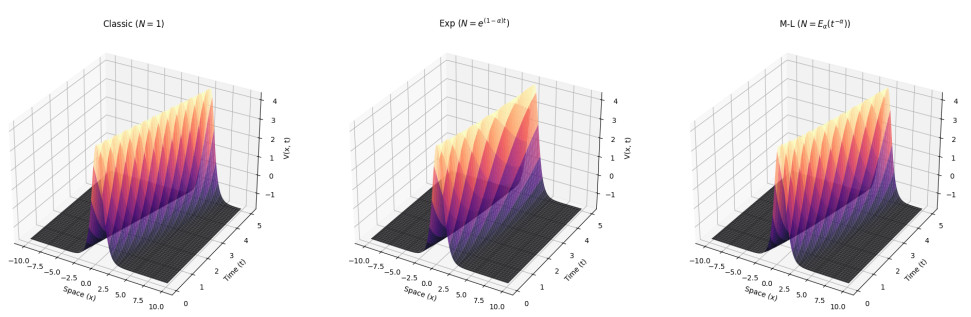
Bounded kink potential $ \varphi(x, 0, 0, t) = U(\varsigma) = 2\tanh\varsigma $, $ \varsigma = x-\nu\tau(t) $, at $ t = 0, 2, 4, 6, 8 $ for the three kernels. Parameters: $ \sigma_1 = \beta = \lambda = \nu = r = 1 $, $ \kappa = \omega = \mu = 3 $ ($ A = 1 $, $ B = 3 $, $ C = 4 $, $ k = 1 $, $ K = 0 $), $ \sigma = 0.7 $
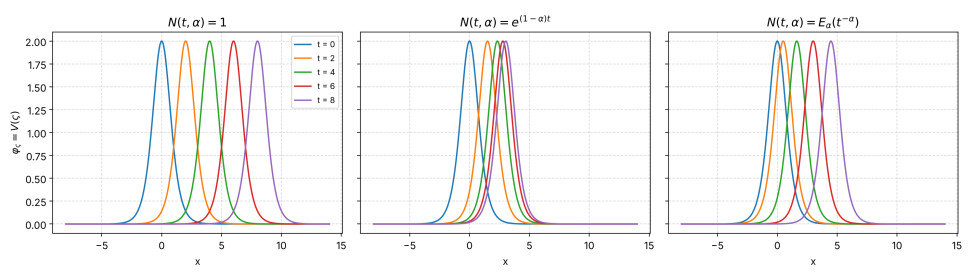
Bright pulse $ V = \varphi_\varsigma = 2 \operatorname{sech}^2\varsigma $, $ \varsigma = x-\nu\tau(t) $, at $ t = 0, 2, 4, 6, 8 $ for the three kernels. Parameters as in Figure 3
(a) Crest position $ x_c(t) = \nu\tau(t)/\sigma_1 $ and (b) crest speed $ \dot x_c = \nu/(\sigma_1N(t, \sigma)) $ for $ N = 1 $, $ e^{(1-\sigma)t} $, $ E_\sigma(t^{-\sigma}) $ and the conformable weight $ t^{1-\sigma} $ of [6]; $ \sigma = 0.7 $, $ \sigma_1 = \nu = 1 $. The thin horizontal line in (a) is the arrest position $ x_\infty = 1/(1-\sigma) $ of the exponential kernel
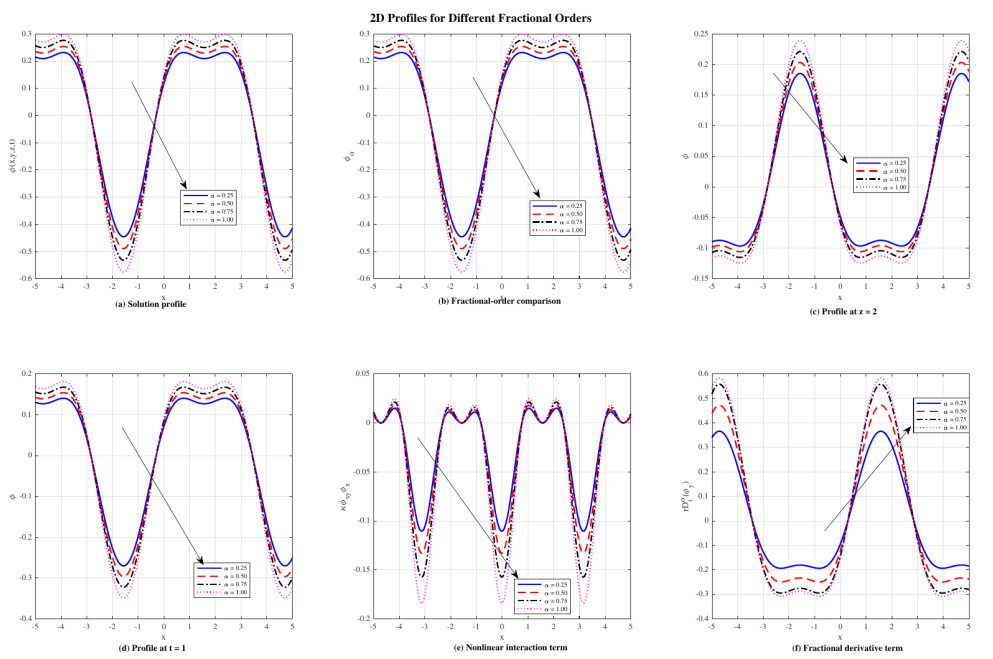
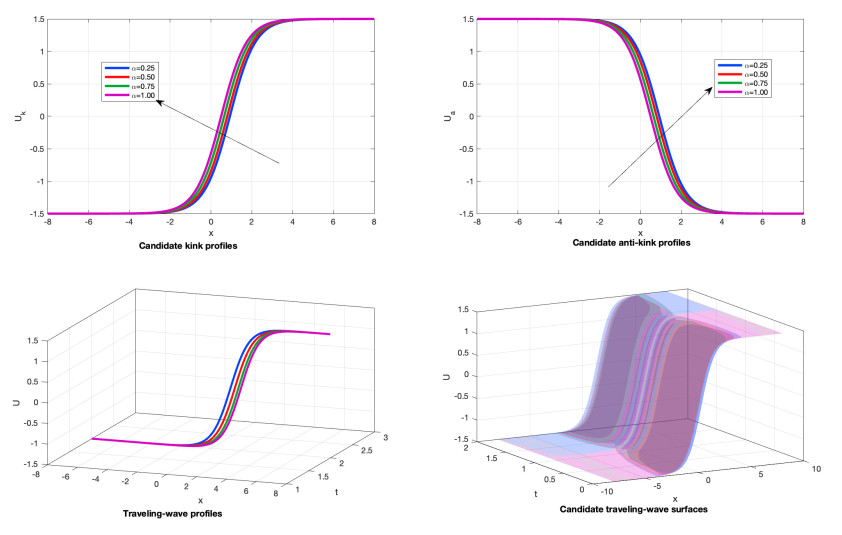
Candidate kink, anti-kink, and traveling-wave profiles for different fractional orders of the time-fractional JM equation




 DownLoad: