The Nondominated Sorting Genetic Algorithm Ⅱ (NSGA-Ⅱ) suffers from weakened selection pressure, limited population-state awareness, and local aggregation of solutions in many-objective optimization. This paper proposes DES-NSGA-Ⅱ, a dynamic environmental selection that recasts environmental selection as a population-state-driven feedback process. A robust distribution-disturbance signal $ S_1 $, based on the median and interquartile range of the perpendicular distances within the truncation front, and a convergence-discrepancy signal $ S_2 $, derived from the first and last nondominated fronts, jointly drive a selection pressure $ \beta_t $, whose mapping is bounded by construction ($ 1\le\beta_t < 2 $) and smoothed across generations. A two-stage hierarchical niching mechanism then exploits this pressure: the first stage builds a convergence-oriented skeleton, and the second rewards directional novelty relative to it. On the DTLZ, WFG and MaF suites ($ M\in\{3, 5, 10, 15\} $, 30 independent runs), DES-NSGA-Ⅱ attains the best average IGD rank over 84 instance–dimension blocks (1.929) and the best rank on each suite (1.607, 1.821 and 2.357), with the largest margins on the regular DTLZ and WFG fronts and at $ M\ge10 $. On MaF, it outperforms FDV on 23 of the 28 instances, while FDV remains the stronger method on the disconnected MaF3 front. Ablation shows that the benefit of adaptive pressure and hierarchical niching is problem- and dimension-dependent, and the limitations that remain on irregular and disconnected fronts motivate further work on geometric representation.
Citation: Renyun Liu, Siyi Gong, Du Cheng, Rui Bao, and Yifei Yao. DES-NSGA-Ⅱ: Dynamic environmental selection with robust adaptive pressure and hierarchical niching[J]. AIMS Mathematics, 2026, 11(11): 39355-39385. doi: 10.3934/math.20261515
The Nondominated Sorting Genetic Algorithm Ⅱ (NSGA-Ⅱ) suffers from weakened selection pressure, limited population-state awareness, and local aggregation of solutions in many-objective optimization. This paper proposes DES-NSGA-Ⅱ, a dynamic environmental selection that recasts environmental selection as a population-state-driven feedback process. A robust distribution-disturbance signal $ S_1 $, based on the median and interquartile range of the perpendicular distances within the truncation front, and a convergence-discrepancy signal $ S_2 $, derived from the first and last nondominated fronts, jointly drive a selection pressure $ \beta_t $, whose mapping is bounded by construction ($ 1\le\beta_t < 2 $) and smoothed across generations. A two-stage hierarchical niching mechanism then exploits this pressure: the first stage builds a convergence-oriented skeleton, and the second rewards directional novelty relative to it. On the DTLZ, WFG and MaF suites ($ M\in\{3, 5, 10, 15\} $, 30 independent runs), DES-NSGA-Ⅱ attains the best average IGD rank over 84 instance–dimension blocks (1.929) and the best rank on each suite (1.607, 1.821 and 2.357), with the largest margins on the regular DTLZ and WFG fronts and at $ M\ge10 $. On MaF, it outperforms FDV on 23 of the 28 instances, while FDV remains the stronger method on the disconnected MaF3 front. Ablation shows that the benefit of adaptive pressure and hierarchical niching is problem- and dimension-dependent, and the limitations that remain on irregular and disconnected fronts motivate further work on geometric representation.

| [1] |
B. Li, J. Li, K. Tang, X. Yao, Many-objective evolutionary algorithms: A survey, ACM Comput. Surv., 48 (2015), A10. https://doi.org/10.1145/2792984 doi: 10.1145/2792984
|
| [2] |
K. Li, R. Wang, T. Zhang, H. Ishibuchi, Evolutionary many-objective optimization: A comparative study of the state-of-the-art, IEEE Access, 6 (2018), 26194–26214. https://doi.org/10.1109/ACCESS.2018.2832181 doi: 10.1109/ACCESS.2018.2832181
|
| [3] |
C. von Lücken, B. Barán, C. Brizuela, A survey on multi-objective evolutionary algorithms for many-objective problems, Comput. Optim. Appl., 58 (2014), 707–756. https://doi.org/10.1007/s10589-014-9644-1 doi: 10.1007/s10589-014-9644-1
|
| [4] |
K. Deb, A. Pratap, S. Agarwal, T. Meyarivan, A fast and elitist multiobjective genetic algorithm: NSGA-Ⅱ, IEEE Trans. Evol. Comput., 6 (2002), 182–197. https://doi.org/10.1109/4235.996017 doi: 10.1109/4235.996017
|
| [5] |
K. Deb, H. Jain, An evolutionary many-objective optimization algorithm using reference-point-based nondominated sorting approach, Part Ⅰ: Solving problems with box constraints, IEEE Trans. Evol. Comput., 18 (2014), 577–601. https://doi.org/10.1109/TEVC.2013.2281535 doi: 10.1109/TEVC.2013.2281535
|
| [6] |
K. Deb, H. Jain, An evolutionary many-objective optimization algorithm using reference-point-based nondominated sorting approach, Part Ⅱ: Handling constraints and extending to an adaptive approach, IEEE Trans. Evol. Comput., 18 (2014), 602–622. https://doi.org/10.1109/TEVC.2013.2281534 doi: 10.1109/TEVC.2013.2281534
|
| [7] |
R. Cheng, Y. Jin, M. Olhofer, B. Sendhoff, A reference vector guided evolutionary algorithm for many-objective optimization, IEEE Trans. Evol. Comput., 20 (2016), 773–791. https://doi.org/10.1109/TEVC.2016.2519378 doi: 10.1109/TEVC.2016.2519378
|
| [8] |
Q. Zhang, H. Li, MOEA/D: A multiobjective evolutionary algorithm based on decomposition, IEEE Trans. Evol. Comput., 11 (2007), 712–731. https://doi.org/10.1109/TEVC.2007.892759 doi: 10.1109/TEVC.2007.892759
|
| [9] |
K. Li, K. Deb, Q. Zhang, S. Kwong, An evolutionary many-objective optimization algorithm based on dominance and decomposition, IEEE Trans. Evol. Comput., 19 (2015), 694–716. https://doi.org/10.1109/TEVC.2014.2373386 doi: 10.1109/TEVC.2014.2373386
|
| [10] |
H. Chen, Y. Tian, W. Pedrycz, G. Wu, R. Wang, L. Wang, Hyperplane assisted evolutionary algorithm for many-objective optimization problems, IEEE Trans. Cybern., 50 (2020), 3367–3380. https://doi.org/10.1109/TCYB.2019.2899225 doi: 10.1109/TCYB.2019.2899225
|
| [11] |
Y. Liu, H. Ishibuchi, N. Masuyama, Y. Nojima, Adapting reference vectors and scalarizing functions by growing neural gas to handle irregular Pareto fronts, IEEE Trans. Evol. Comput., 24 (2020), 439–453. https://doi.org/10.1109/TEVC.2019.2926151 doi: 10.1109/TEVC.2019.2926151
|
| [12] |
Q. Liu, Y. Jin, M. Heiderich, T. Rodemann, G. Yu, An adaptive reference vector-guided evolutionary algorithm using growing neural gas for many-objective optimization of irregular problems, IEEE Trans. Cybern., 52 (2022), 2698–2711. https://doi.org/10.1109/TCYB.2020.3020630 doi: 10.1109/TCYB.2020.3020630
|
| [13] |
Q. Liu, Y. Jin, M. Heiderich, T. Rodemann, Coordinated adaptation of reference vectors and scalarizing functions in evolutionary many-objective optimization, IEEE Trans. Syst. Man Cybern.: Syst., 53 (2023), 763–775. https://doi.org/10.1109/TSMC.2022.3187370 doi: 10.1109/TSMC.2022.3187370
|
| [14] |
Y. Hua, Q. Liu, K. Hao, Y. Jin, A survey of evolutionary algorithms for multi-objective optimization problems with irregular Pareto fronts, IEEE/CAA J. Autom. Sinica, 8 (2021), 303–318. https://doi.org/10.1109/JAS.2021.1003817 doi: 10.1109/JAS.2021.1003817
|
| [15] |
X. Wang, Z. Xie, X. Zhou, X. Gu, A two-stage adaptive reference direction guided evolutionary algorithm with modified dominance relation for many-objective optimization, Swarm Evol. Comput., 78 (2023), 101272. https://doi.org/10.1016/j.swevo.2023.101272 doi: 10.1016/j.swevo.2023.101272
|
| [16] |
Y. Xu, F. Li, H. Zhang, W. Li, An adaptive reference vector guided many-objective optimization algorithm based on the Pareto front density estimation, Swarm Evol. Comput., 88 (2024), 101601. https://doi.org/10.1016/j.swevo.2024.101601 doi: 10.1016/j.swevo.2024.101601
|
| [17] |
Y. Sun, B. Xue, M. Zhang, G. G. Yen, A new two-stage evolutionary algorithm for many-objective optimization, IEEE Trans. Evol. Comput., 23 (2019), 748–761. https://doi.org/10.1109/TEVC.2018.2882166 doi: 10.1109/TEVC.2018.2882166
|
| [18] |
W. Li, Q. Niliang, L. Wang, Q. Jiang, Two-stage many-objective evolutionary algorithm: enhanced dominance relations and control mechanisms for separated balance, Complex Intell. Syst., 10 (2024), 6509–6543. https://doi.org/10.1007/s40747-024-01505-0 doi: 10.1007/s40747-024-01505-0
|
| [19] |
Z. Wei, H. Wang, S. Wang, Z. Zhang, Z. Cui, F. Wang, et al., Many-objective evolutionary algorithm based on parallel distance for handling irregular Pareto fronts, Swarm Evol. Comput., 86 (2024), 101539. https://doi.org/10.1016/j.swevo.2024.101539 doi: 10.1016/j.swevo.2024.101539
|
| [20] |
M. He, H. Zheng, H. Chen, Z. Wang, X. Liu, Y. Xia, et al., A clustering and vector angle-based adaptive evolutionary algorithm for multi-objective optimization with irregular Pareto fronts, J. Supercomput., 81 (2025), 98. https://doi.org/10.1007/s11227-024-06496-w doi: 10.1007/s11227-024-06496-w
|
| [21] |
M. He, X. Wang, H. Chen, X. Li, A knee point-driven many-objective evolutionary algorithm with adaptive switching mechanism, J. Appl. Math., 2024 (2024), 4737604. https://doi.org/10.1155/2024/4737604 doi: 10.1155/2024/4737604
|
| [22] |
Z. Liu, F. Han, Q. Ling, H. Han, J. Jiang, Constraint-Pareto dominance and diversity enhancement strategy-based evolutionary algorithm for solving constrained multiobjective optimization problems, IEEE Trans. Evol. Comput., 29 (2025), 2771–2784. https://doi.org/10.1109/TEVC.2024.3525153 doi: 10.1109/TEVC.2024.3525153
|
| [23] |
Y. Tian, R. Cheng, X. Zhang, Y. Jin, PlatEMO: A MATLAB platform for evolutionary multi-objective optimization, IEEE Comput. Intell. Mag., 12 (2017), 73–87. https://doi.org/10.1109/MCI.2017.2742868 doi: 10.1109/MCI.2017.2742868
|
| [24] |
L. R. C. de Farias, A. F. R. Araújo, IM-MOEA/D: An inverse modeling multi-objective evolutionary algorithm based on decomposition, In: 2021 IEEE International Conference on Systems, Man, and Cybernetics (SMC), (2021), 462–467. https://doi.org/10.1109/SMC52423.2021.9658650 |
| [25] |
C. He, R. Cheng, L. Li, K. C. Tan, Y. Jin, Large-scale multiobjective optimization via reformulated decision variable analysis, IEEE Trans. Evol. Comput., 28 (2024), 47–61. https://doi.org/10.1109/TEVC.2022.3213006 doi: 10.1109/TEVC.2022.3213006
|
| [26] |
Y. Hua, Q. Liu, K. Hao, Adaptive normal vector guided evolutionary multi- and many-objective optimization, Complex Intell. Syst., 10 (2024), 3709–3726. https://doi.org/10.1007/s40747-024-01353-y doi: 10.1007/s40747-024-01353-y
|
| [27] |
X. Yang, J. Zou, S. Yang, J. Zheng, Y. Liu, A fuzzy decision variables framework for large-scale multiobjective optimization, IEEE Trans. Evol. Comput., 27 (2023), 445–459. https://doi.org/10.1109/TEVC.2021.3118593 doi: 10.1109/TEVC.2021.3118593
|
| [28] |
Z. Liu, F. Han, Q. Ling, H. Han, J. Jiang, A many-objective optimization evolutionary algorithm based on hyper-dominance degree, Swarm Evol. Comput., 83 (2023), 101411. https://doi.org/10.1016/j.swevo.2023.101411 doi: 10.1016/j.swevo.2023.101411
|
| [29] |
Y. Tian, L. Si, X. Zhang, K. C. Tan, Y. Jin, Local model based Pareto front estimation for multi-objective optimization, IEEE Trans. Syst., Man, Cybern.: Syst., 53 (2023), 623–634. https://doi.org/10.1109/TSMC.2022.3186546 doi: 10.1109/TSMC.2022.3186546
|
| [30] |
C. He, R. Cheng, D. Yazdani, Adaptive offspring generation for evolutionary large-scale multiobjective optimization, IEEE Trans. Syst., Man, Cybern.: Syst., 52 (2022), 786–798. https://doi.org/10.1109/TSMC.2020.3003926 doi: 10.1109/TSMC.2020.3003926
|
| [31] |
L. Pan, W. Xu, L. Li, C. He, R. Cheng, Adaptive simulated binary crossover for rotated multi-objective optimization, Swarm Evol. Comput., 60 (2021), 100759. https://doi.org/10.1016/j.swevo.2020.100759 doi: 10.1016/j.swevo.2020.100759
|
| [32] |
K. Deb, R. B. Agrawal, Simulated binary crossover for continuous search space, Complex Syst., 9 (1995), 115–148. |
| [33] |
K. Deb, M. Goyal, A combined genetic adaptive search (GeneAS) for engineering design, Comput. Sci. Inform., 26 (1996), 30–45. |
| [34] |
E. Zitzler, L. Thiele, M. Laumanns, C. M. Fonseca, V. Grunert da Fonseca, Performance assessment of multiobjective optimizers: An analysis and review, IEEE Trans. Evol. Comput., 7 (2003), 117–132. https://doi.org/10.1109/TEVC.2003.810758 doi: 10.1109/TEVC.2003.810758
|
| [35] |
H. Ishibuchi, H. Masuda, Y. Tanigaki, Y. Nojima, Modified distance calculation in generational distance and inverted generational distance, In: Evolutionary Multi-Criterion Optimization (EMO 2015, LNCS 9018), (2015), 110–125. https://doi.org/10.1007/978-3-319-15892-1_8 |
| [36] |
J. Demšar, Statistical comparisons of classifiers over multiple data sets, J. Mach. Learn. Res., 7 (2006), 1–30. |
| [37] |
L. L. Peng, T. Li, G. F. Fan, X. Y. Yang, W. C. Hong, Short-term electric load forecasting by cross-feature analysis and multimodal selection, Comput. Model. Eng. Sci., 149 (2026), 1–10. https://doi.org/10.32604/cmes.2026.087031 doi: 10.32604/cmes.2026.087031
|
| [38] |
L. L. Peng, X. Y. Yang, X. X. Hua, G. F. Fan, Y. J. Wang, A. J. Umbarkar, et al., Short-term electric load forecasting based on deep learning and multi-modal fusion, Electr. Power Syst. Res., 254 (2026), 112593. https://doi.org/10.1016/j.epsr.2025.112593 doi: 10.1016/j.epsr.2025.112593
|
Figures(4) / Tables(10)

Renyun Liu, Siyi Gong, Du Cheng, Rui Bao, and Yifei Yao. DES-NSGA-Ⅱ: Dynamic environmental selection with robust adaptive pressure and hierarchical niching[J]. AIMS Mathematics, 2026, 11(11): 39355-39385. doi: 10.3934/math.20261515

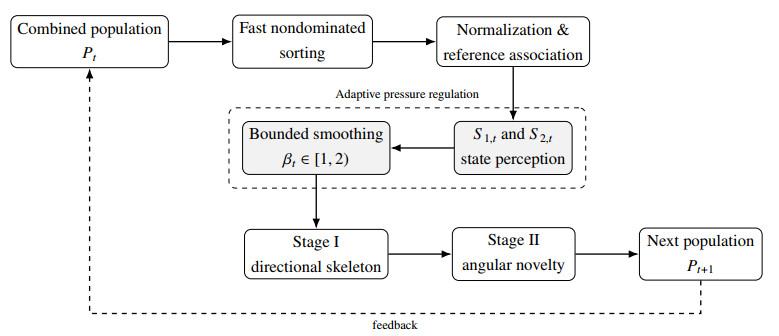
Closed-loop framework of DES-NSGA-Ⅱ. The population state is perceived through two robust signals, transformed into a bounded and smoothed selection pressure, and applied within a two-stage hierarchical niching procedure
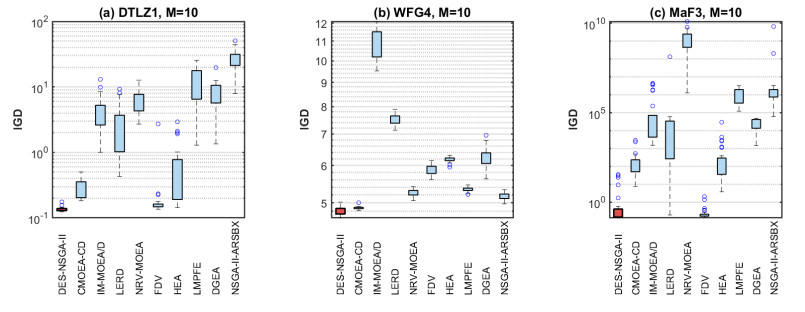
Run-to-run convergence stability on representative instances. Boxplots summarize the IGD values of 30 independent runs on (a) DTLZ1 with $ M = 10 $, (b) WFG4 with $ M = 10 $, and (c) MaF3 with $ M = 10 $. The central line, box, and whiskers denote the median, interquartile range (25th–75th percentiles), and $ 1.5\times $IQR, respectively; points denote outliers. Lower IGD is better. The $ y $-axis is shown on a logarithmic scale
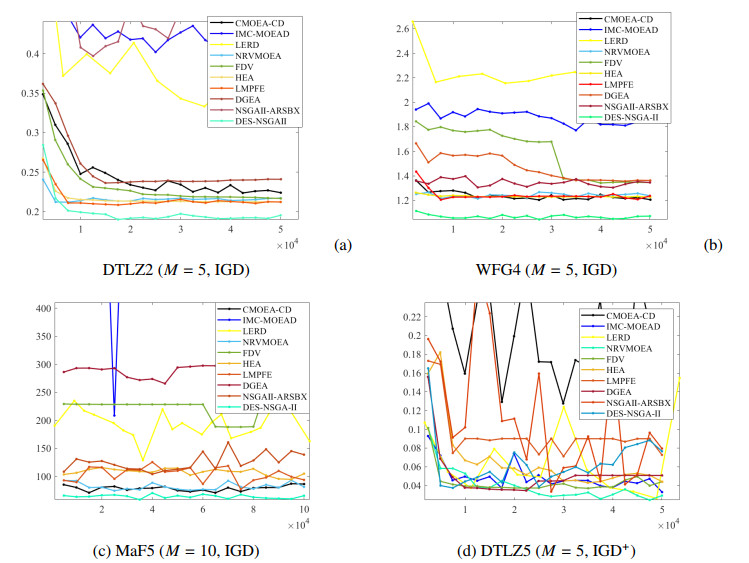
Convergence trajectories of the IGD and IGD$^+$ indicators on representative test problems. The horizontal axis denotes the number of function evaluations, and the vertical axis denotes the indicator value
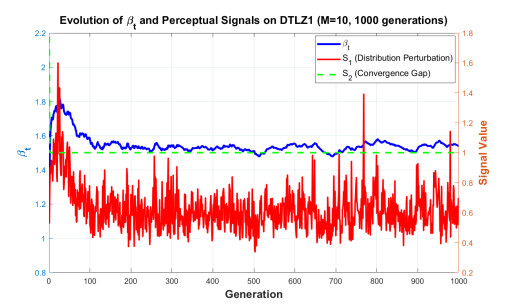
Evolutionary trajectories of $ \beta_t $ and the population-state signals on DTLZ1 ($ M = 10 $)




 DownLoad: