Time series data constrained within the unit interval are commonly modeled using the beta autoregressive moving average ($ \beta $ARMA) class to accommodate skewness and heteroscedasticity. Existing dynamic precision extensions allow the precision parameter $ \phi_t $ to vary only through its own lags, a lagged variance proxy, or seasonal terms, not through exogenous covariates. This paper proposes a dual-exogenous $ \beta $ARMA framework where independent covariate vectors enter both submodels through a recursive, observation-driven structure. We derive the conditional likelihood, a recursive score function, and the Fisher information matrix, and establish the asymptotic normality of the conditional maximum likelihood estimator, which yields Wald and likelihood ratio tests for the precision covariates. We show that the mean and precision parameter blocks are generally not orthogonal, and that misspecification of the precision submodel can make the mean submodel estimator inconsistent when it induces a nonzero bias in the mean score equations. An extensive Monte Carlo study confirms the finite-sample validity and directly quantifies the theoretical bias transmitted to the mean submodel coefficients under misspecification. Applications to the Malaysian unemployment rate and the US capacity utilization rate show that with the mean submodel held fixed, exogenous precision covariates substantially improve the fit relative to constant precision and lagged variance proxy specifications. Forecasting performance is evaluated with both realized and forecast covariates.
Citation: Elsidieg I. Belhaj, Majid Khan Majahar Ali. Exogenous information in the precision submodel: A dual-covariate $ \beta $ARMA framework for bounded time series[J]. AIMS Mathematics, 2026, 11(11): 39102-39147. doi: 10.3934/math.20261506
Time series data constrained within the unit interval are commonly modeled using the beta autoregressive moving average ($ \beta $ARMA) class to accommodate skewness and heteroscedasticity. Existing dynamic precision extensions allow the precision parameter $ \phi_t $ to vary only through its own lags, a lagged variance proxy, or seasonal terms, not through exogenous covariates. This paper proposes a dual-exogenous $ \beta $ARMA framework where independent covariate vectors enter both submodels through a recursive, observation-driven structure. We derive the conditional likelihood, a recursive score function, and the Fisher information matrix, and establish the asymptotic normality of the conditional maximum likelihood estimator, which yields Wald and likelihood ratio tests for the precision covariates. We show that the mean and precision parameter blocks are generally not orthogonal, and that misspecification of the precision submodel can make the mean submodel estimator inconsistent when it induces a nonzero bias in the mean score equations. An extensive Monte Carlo study confirms the finite-sample validity and directly quantifies the theoretical bias transmitted to the mean submodel coefficients under misspecification. Applications to the Malaysian unemployment rate and the US capacity utilization rate show that with the mean submodel held fixed, exogenous precision covariates substantially improve the fit relative to constant precision and lagged variance proxy specifications. Forecasting performance is evaluated with both realized and forecast covariates.

| [1] |
F. M. Bayer, R. J. Cintra, F. Cribari-Neto, Beta seasonal autoregressive moving average models, Commun. Stat.-Simul. Comput., 47 (2018), 1314–1337. https://doi.org/10.1080/00949655.2018.1491974 doi: 10.1080/00949655.2018.1491974
|
| [2] |
V. T. Scher, F. Cribari-Neto, F. M. Bayer, Generalized barma model for double bounded time series forecasting, Int. J. Forecasting, 40 (2024), 721–734. https://doi.org/10.1016/j.ijforecast.2023.05.005 doi: 10.1016/j.ijforecast.2023.05.005
|
| [3] |
G. E. Box, G. M. Jenkins, G. C. Reinsel, G. M. Ljung, Time series analysis: Forecasting and control, John Wiley & Sons, 2015. |
| [4] |
A. V. Rocha, F. Cribari-Neto, Beta autoregressive moving average models, Test, 18 (2009), 529–545. https://doi.org/10.1007/s11749-008-0112-z doi: 10.1007/s11749-008-0112-z
|
| [5] |
S. L. Ferrari, F. Cribari-Neto, Beta regression for modelling rates and proportions, J. Appl. Stat., 31 (2004), 799–815. https://doi.org/10.1080/0266476042000214501 doi: 10.1080/0266476042000214501
|
| [6] |
V. T. Scher, F. Cribari-Neto, G. Pumi, F. M. Bayer, Goodness-of-fit tests for $\beta$ARMA hydrological time series modeling, Environmetrics, 31 (2020), e2607. https://doi.org/10.1002/env.2607 doi: 10.1002/env.2607
|
| [7] |
A. B. Simas, W. Barreto-Souza, A. V. Rocha, Improved estimators for a general class of beta regression models, Comput. Stat. Data Anal., 54 (2010), 348–366. https://doi.org/10.1016/j.csda.2009.08.017 doi: 10.1016/j.csda.2009.08.017
|
| [8] |
R. H. Byrd, P. Lu, J. Nocedal, C. Zhu, A limited memory algorithm for bound constrained optimization, SIAM J. Sci. Comput., 16 (1995), 1190–1208. https://doi.org/10.1137/0916069 doi: 10.1137/0916069
|
| [9] |
A. V. Rocha, F. Cribari-Neto, Erratum to: Beta autoregressive moving average models, Test, 26 (2017), 451–459. https://doi.org/10.1007/s11749-017-0528-4 doi: 10.1007/s11749-017-0528-4
|
| [10] |
P. McCullagh, Generalized linear models, Chapman and Hall, London, 1989. |
| [11] |
F. Zhang, The Schur complement and its applications, Springer Science & Business Media, 2006. |
| [12] |
P. J. Bickel, C. A. Klaassen, P. J. Bickel, Y. Ritov, J. Klaassen, J. A. Wellner, et al., Efficient and adaptive estimation for semiparametric models, vol. 4, Johns Hopkins University Press Baltimore, 1993. |
| [13] |
E. B. Andersen, Asymptotic properties of conditional maximum-likelihood estimators, J. Roy. Stat. Soc. B, 32 (1970), 283–301. https://doi.org/10.1111/j.2517-6161.1970.tb00842.x doi: 10.1111/j.2517-6161.1970.tb00842.x
|
| [14] |
Y. Pawitan, In all likelihood: Statistical modelling and inference using likelihood, Oxford University Press, 2001. https://doi.org/10.1093/oso/9780198507659.001.0001 |
| [15] |
P. J. Bickel, K. A. Doksum, Mathematical statistics: Basic ideas and selected topics, volumes I-II package, Chapman and Hall/CRC, 2015. https://doi.org/10.1201/9781315369266 |
| [16] |
G. Casella, R. Berger, Statistical inference, Chapman and Hall/CRC, 2024. https://doi.org/10.1201/9781003456285 |
| [17] |
H. Akaike, A new look at the statistical model identification, IEEE T. Automat. Control, 19 (1974), 716–723. https://doi.org/10.1109/TAC.1974.1100705 doi: 10.1109/TAC.1974.1100705
|
| [18] |
G. Schwarz, Estimating the dimension of a model, Ann. Stat., 6 (1978), 461–464. https://doi.org/10.1214/aos/1176344136 doi: 10.1214/aos/1176344136
|
| [19] |
R. J. Hyndman, G. Athanasopoulos, Forecasting: Principles and practice, OTexts, 2018. |
| [20] |
R. J. Hyndman, Y. Khandakar, Automatic time series forecasting: The forecast package for R, J. Stat. Softw., 27 (2008), 1–22. https://doi.org/10.18637/jss.v027.i03 doi: 10.18637/jss.v027.i03
|
| [21] |
D. Koutsandreas, E. Spiliotis, F. Petropoulos, V. Assimakopoulos, On the selection of forecasting accuracy measures, J. Oper. Res. Soc., 73 (2022), 937–954. https://doi.org/10.1080/01605682.2021.1892464 doi: 10.1080/01605682.2021.1892464
|
| [22] |
T. Gneiting, F. Balabdaoui, A. E. Raftery, Probabilistic forecasts, calibration and sharpness, J. Roy. Stat. Soc. B, 69 (2007), 243–268. https://doi.org/10.1111/j.1467-9868.2007.00587.x |
| [23] |
J. Bracher, E. L. Ray, T. Gneiting, N. G. Reich, Evaluating epidemic forecasts in an interval format, PLoS Comput. Biol., 17 (2021), e1008618. https://doi.org/10.1371/journal.pcbi.1008618 doi: 10.1371/journal.pcbi.1008618
|
| [24] |
A. Gelman, J. B. Carlin, H. S. Stern, D. B. Rubin, Bayesian data analysis, Chapman and Hall/CRC, 1995. https://doi.org/10.1201/9780429258411 |
| [25] |
T. Gneiting, A. E. Raftery, A. H. Westveld III, T. Goldman, Calibrated probabilistic forecasting using ensemble model output statistics and minimum crps estimation, Mon. Weather Rev., 133 (2005), 1098–1118. https://doi.org/10.1175/MWR2904.1 doi: 10.1175/MWR2904.1
|
| [26] |
C. Czado, T. Gneiting, L. Held, Predictive model assessment for count data, Biometrics, 65 (2009), 1254–1261. https://doi.org/10.1111/j.1541-0420.2009.01191.x doi: 10.1111/j.1541-0420.2009.01191.x
|
| [27] |
J. Berkowitz, Testing density forecasts, with applications to risk management, J. Bus. Econ. Stat., 19 (2001), 465–474. https://doi.org/10.1198/07350010152596718 doi: 10.1198/07350010152596718
|
| [28] |
P. Good, Permutation, parametric and bootstrap tests of hypotheses, Springer, 2005. |
| [29] |
F. X. Diebold, R. S. Mariano, Comparing predictive accuracy, J. Bus. Econ. Stat., 20 (2002), 134–144. https://doi.org/10.1198/073500102753410444 doi: 10.1198/073500102753410444
|
| [30] |
D. Harvey, S. Leybourne, P. Newbold, Testing the equality of prediction mean squared errors, Int. J. Forecasting, 13 (1997), 281–291. https://doi.org/10.1016/S0169-2070(96)00719-4 doi: 10.1016/S0169-2070(96)00719-4
|
| [31] |
D. I. Harvey, S. J. Leybourne, Y. Zu, Tests for equal forecast accuracy under heteroskedasticity, J. Appl. Econ., 39 (2024), 850–869. https://doi.org/10.1002/jae.3050 doi: 10.1002/jae.3050
|
| [32] |
K. H. D. Tang, Movement control as an effective measure against Covid-19 spread in Malaysia: An overview, J. Public Health, 30 (2022), 583–586. https://doi.org/10.1007/s10389-020-01316-w doi: 10.1007/s10389-020-01316-w
|
| [33] |
J. Bai, P. Perron, Estimating and testing linear models with multiple structural changes, Econometrica, 47–78. https://doi.org/10.2307/2998540 |
| [34] |
J. Bai, P. Perron, Computation and analysis of multiple structural change models, J. Appl. Econ., 18 (2003), 1–22. https://doi.org/10.1002/jae.659 doi: 10.1002/jae.659
|
| [35] |
A. Zeileis, F. Leisch, K. Hornik, C. Kleiber, B. Hansen, E. C. Merkle, et al., Package 'strucchange', R package version, 1–5. |
| [36] |
S. M. Abd Gani, M. Alied, N. T. Huy, Pandemic to endemic: A successful transition in Malaysia, J. Global Health, 13 (2023), 03063. https://doi.org/10.7189/jogh.13.03063 doi: 10.7189/jogh.13.03063
|
| [37] |
G. E. Box, G. C. Tiao, Intervention analysis with applications to economic and environmental problems, J. Am. Stat. Assoc., 70 (1975), 70–79. https://doi.org/10.1080/01621459.1975.10480264 doi: 10.1080/01621459.1975.10480264
|
| [38] |
C. Chen, L. M. Liu, Joint estimation of model parameters and outlier effects in time series, J. Am. Stat. Assoc., 88 (1993), 284–297. https://doi.org/10.1080/01621459.1993.10594321 doi: 10.1080/01621459.1993.10594321
|
| [39] |
P. L. Espinheira, S. L. Ferrari, F. Cribari-Neto, Influence diagnostics in beta regression, Comput. Stat. Data Anal., 52 (2008), 4417–4431. https://doi.org/10.1016/j.csda.2008.02.028 doi: 10.1016/j.csda.2008.02.028
|
| [40] |
G. M. Ljung, G. E. Box, On a measure of lack of fit in time series models, Biometrika, 65 (1978), 297–303. https://doi.org/10.1093/biomet/65.2.297 doi: 10.1093/biomet/65.2.297
|
Figures(4) / Tables(36)

Elsidieg I. Belhaj, Majid Khan Majahar Ali. Exogenous information in the precision submodel: A dual-covariate $ \beta $ARMA framework for bounded time series[J]. AIMS Mathematics, 2026, 11(11): 39102-39147. doi: 10.3934/math.20261506

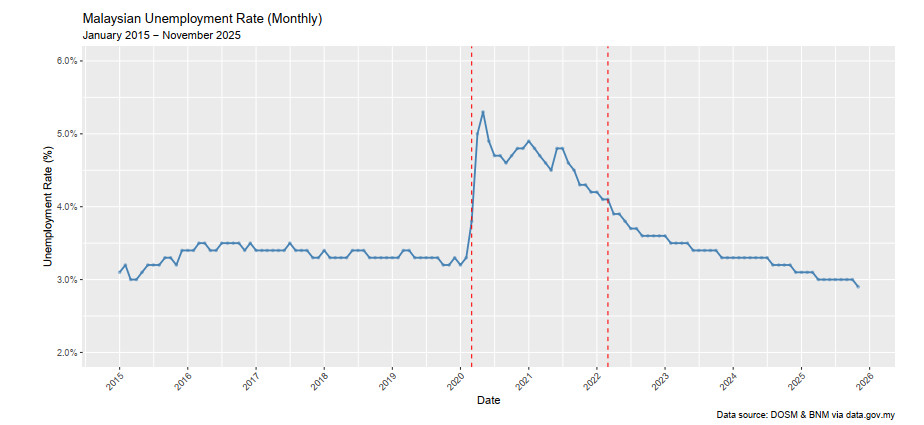
Monthly Malaysian unemployment rate (January 2015–November 2025) with dashed lines indicating the start and end of the break window
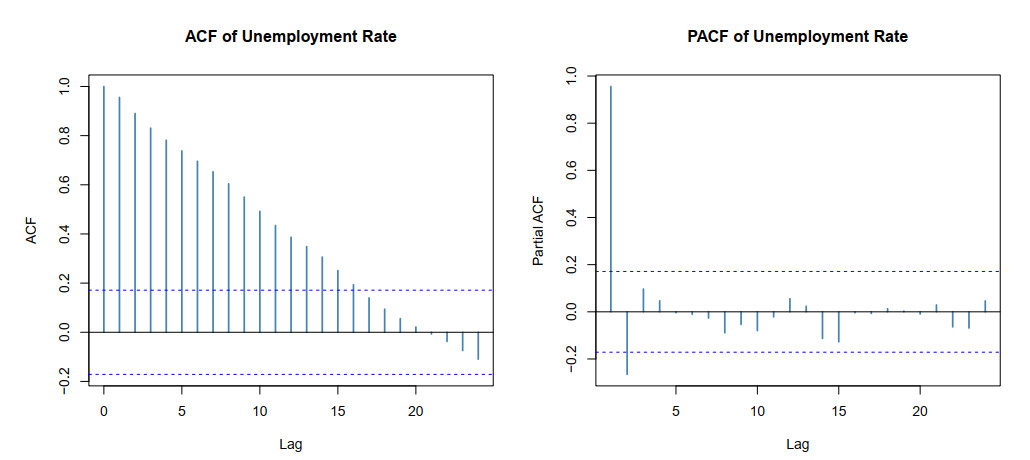
Sample autocorrelation function (ACF) and partial autocorrelation function (PACF) of the monthly Malaysian unemployment rate. The slow decay in the ACF confirms strong serial dependence; the PACF suggests a low-order autoregressive structure
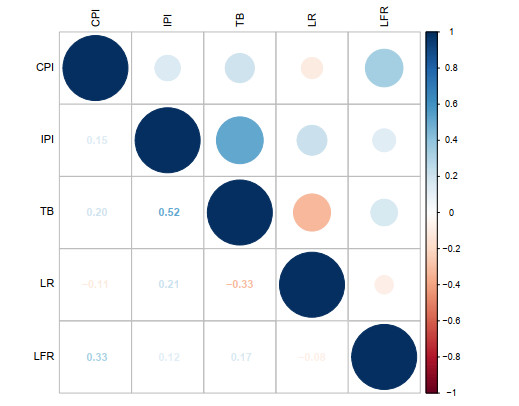
Correlation matrix of the macroeconomic covariates and the unemployment rate. Pairwise correlations range from $ -0.33 $ to $ 0.52 $; all VIF values are below 2, confirming the absence of multicollinearity
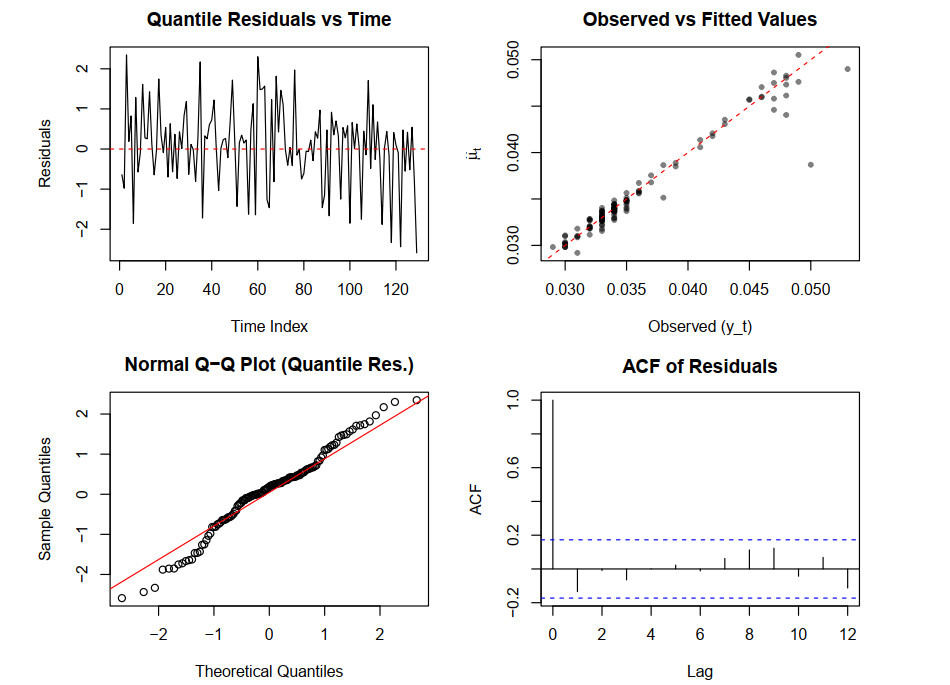
Diagnostic plots for the proposed $ \beta $ARMA model. Clockwise from top left: quantile residuals versus time index; observed versus fitted conditional means; ACF of the residuals; normal Q–Q plot of quantile residuals




 DownLoad: