Lumpy skin disease is a vector-borne viral disease of cattle that causes substantial economic losses through reduced milk production, reproductive problems, treatment costs, and death. In this study, we develop a novel integrated susceptible–exposed–infectious–quarantined–treated–recovered (SEIQTR)–deep neural network (DNN) framework to explore the transmission and control of lumpy skin disease. Cattle are divided into susceptible, exposed, infectious, quarantined, treated, and recovered compartments. The model separates the quarantine of exposed cattle from the isolation and treatment of infectious cattle, allowing the two interventions to be compared. Existence, uniqueness, non-negativity, and boundedness of the solutions are established. The disease-free and endemic equilibria are determined, and the basic reproduction number $ \mathcal{R}_0 $ is derived by the next-generation matrix method. When $ \mathcal{R}_0 < 1 $, the disease-free equilibrium is locally and globally asymptotically stable; when $ \mathcal{R}_0 > 1 $, there exists a unique biologically feasible endemic equilibrium. A sensitivity analysis shows that the transmission rate and the quarantine and isolation rates are the parameters that most strongly affect the persistence of the disease. Numerical experiments show that strengthening quarantine and isolation together reduces the prevalence of infection and $ \mathcal{R}_0 $ more than either measure alone. In addition, a feed-forward deep neural network trained on fourth-order Runge–Kutta solutions reproduces the nonlinear temporal behavior of all six compartments with coefficients of determination above $ 0.998 $ and relative $ L^{2} $ errors below $ 3.2\times10^{-2} $ on held-out test data. The proposed framework is a computationally efficient tool for assessing control strategies and highlights the importance of prompt quarantine and isolation in reducing lumpy skin disease outbreaks.
Citation: Ebraheem Alzahrani, Rubiqa Zulfiqar, Abdul Mannan, Muhammad Farhan Hanif. Modeling quarantine and isolation strategies for lumpy skin disease using an SEIQTR deep neural network framework[J]. AIMS Mathematics, 2026, 11(11): 39040-39074. doi: 10.3934/math.20261504
Lumpy skin disease is a vector-borne viral disease of cattle that causes substantial economic losses through reduced milk production, reproductive problems, treatment costs, and death. In this study, we develop a novel integrated susceptible–exposed–infectious–quarantined–treated–recovered (SEIQTR)–deep neural network (DNN) framework to explore the transmission and control of lumpy skin disease. Cattle are divided into susceptible, exposed, infectious, quarantined, treated, and recovered compartments. The model separates the quarantine of exposed cattle from the isolation and treatment of infectious cattle, allowing the two interventions to be compared. Existence, uniqueness, non-negativity, and boundedness of the solutions are established. The disease-free and endemic equilibria are determined, and the basic reproduction number $ \mathcal{R}_0 $ is derived by the next-generation matrix method. When $ \mathcal{R}_0 < 1 $, the disease-free equilibrium is locally and globally asymptotically stable; when $ \mathcal{R}_0 > 1 $, there exists a unique biologically feasible endemic equilibrium. A sensitivity analysis shows that the transmission rate and the quarantine and isolation rates are the parameters that most strongly affect the persistence of the disease. Numerical experiments show that strengthening quarantine and isolation together reduces the prevalence of infection and $ \mathcal{R}_0 $ more than either measure alone. In addition, a feed-forward deep neural network trained on fourth-order Runge–Kutta solutions reproduces the nonlinear temporal behavior of all six compartments with coefficients of determination above $ 0.998 $ and relative $ L^{2} $ errors below $ 3.2\times10^{-2} $ on held-out test data. The proposed framework is a computationally efficient tool for assessing control strategies and highlights the importance of prompt quarantine and isolation in reducing lumpy skin disease outbreaks.

| [1] |
S. Babiuk, T. R. Bowden, D. B. Boyle, D. B. Wallace, R. P. Kitching, Capripoxviruses: an emerging worldwide threat to sheep, goats and cattle, Transbound. Emerg. Dis., 55 (2008), 263–272. https://doi.org/10.1111/j.1865-1682.2008.01043.x doi: 10.1111/j.1865-1682.2008.01043.x
|
| [2] |
C. J. McInnes, I. K. Damon, G. L. Smith, G. McFadden, S. N. Isaacs, R. L. Roper, et al., ICTV virus taxonomy profile: Poxviridae 2023, J. Gen. Virol., 104 (2023), 001849. https://doi.org/10.1099/jgv.0.001849 doi: 10.1099/jgv.0.001849
|
| [3] |
F. Namazi, A. K. Tafti, Lumpy skin disease, an emerging transboundary viral disease: a review, Vet. Med. Sci., 7 (2021), 888–896. https://doi.org/10.1002/vms3.434 doi: 10.1002/vms3.434
|
| [4] |
E. S. M. Tuppurainen, E. H. Venter, J. L. Shisler, G. Gari, G. A. Mekonnen, N. Juleff, et al., Review: capripoxvirus diseases: current status and opportunities for control, Transbound. Emerg. Dis., 64 (2017), 729–745. https://doi.org/10.1111/tbed.12444 doi: 10.1111/tbed.12444
|
| [5] |
C. M. Chihota, L. F. Rennie, R. P. Kitching, P. S. Mellor, Attempted mechanical transmission of lumpy skin disease virus by biting insects, Med. Vet. Entomol., 17 (2003), 294–300. https://doi.org/10.1046/j.1365-2915.2003.00445.x doi: 10.1046/j.1365-2915.2003.00445.x
|
| [6] |
B. Kaur, S. S. Dhillon, A. S. Pannu, C. S. Mukhopadhyay, Lumpy skin disease: a systematic review of mode of transmission, risk of emergence, and risk entry pathways, Virus Genes, 61 (2025), 1–8. https://doi.org/10.1007/s11262-024-02117-z doi: 10.1007/s11262-024-02117-z
|
| [7] |
J. C. Lubinga, E. S. M. Tuppurainen, W. H. Stoltsz, K. Ebersohn, J. A. W. Coetzer, E. H. Venter, Detection of lumpy skin disease virus in saliva of ticks fed on lumpy skin disease virus-infected cattle, Exp. Appl. Acarol., 61 (2013), 129–138. https://doi.org/10.1007/s10493-013-9679-5 doi: 10.1007/s10493-013-9679-5
|
| [8] |
Food and Agriculture Organization of the United Nations, FAOSTAT statistical database, FAO, 2018. Available from: https://www.fao.org/faostat/en/. |
| [9] |
Z. Abera, H. Degefu, G. Gari, Z. Ayana, Review on epidemiology and economic importance of lumpy skin disease, Int. J. Basic Appl. Virol., 4 (2015), 8–21. |
| [10] |
B. Molina-Flores, P. Manzano-Baena, M. D. Coulibaly, The role of livestock in food security, poverty reduction and wealth creation in West Africa, Accra: FAO, 2020. https://doi.org/10.4060/ca8385en |
| [11] |
R. G. Alders, A. Campbell, R. Costa, E. F. Guèye, M. A. Hoque, R. P. Garza, et al., Livestock across the world: diverse animal species with complex roles in human societies and ecosystem services, Anim. Front., 11 (2021), 20–29. https://doi.org/10.1093/af/vfab047 doi: 10.1093/af/vfab047
|
| [12] |
M. H. Tageldin, D. B. Wallace, G. H. Gerdes, J. F. Putterill, R. R. Greyling, M. N. Phosiwa, Lumpy skin disease of cattle: an emerging problem in the Sultanate of Oman, Trop. Anim. Health Prod., 46 (2014), 241–246. https://doi.org/10.1007/s11250-013-0483-3 doi: 10.1007/s11250-013-0483-3
|
| [13] |
H. Rgbe, Lumpy skin disease (LSD): outbreak investigation, isolation and molecular detection in selected areas of east Shewa Zone, Ethiopia, Addis Ababa: Addis Ababa University, 2012. Available from: https://etd.aau.edu.et/handle/123456789/8791. |
| [14] |
H. J. Eom, E. S. Lee, H. S. Yoo, Lumpy skin disease as an emerging infectious disease, J. Vet. Sci., 24 (2023), e42. https://doi.org/10.4142/jvs.23016 doi: 10.4142/jvs.23016
|
| [15] |
E. Renald, J. Buza, J. M. Tchuenche, V. G. Masanja, The role of modeling in the epidemiology and control of lumpy skin disease: a systematic review, Bull. Natl. Res. Cent., 47 (2023), 141. https://doi.org/10.1186/s42269-023-01111-z doi: 10.1186/s42269-023-01111-z
|
| [16] |
A. I. K. Butt, H. Aftab, M. Imran, T. Ismaeel, Mathematical study of lumpy skin disease with optimal control analysis through vaccination, Alex. Eng. J., 72 (2023), 247–259. https://doi.org/10.1016/j.aej.2023.03.073 doi: 10.1016/j.aej.2023.03.073
|
| [17] |
W. F. Alfwzan, M. H. DarAssi, F. M. Allehiany, M. A. Khan, M. Y. Alshahrani, E. M. Tag-eldin, A novel mathematical study to understand the lumpy skin disease (LSD) using modified parameterized approach, Results Phys., 51 (2023), 106626. https://doi.org/10.1016/j.rinp.2023.106626 doi: 10.1016/j.rinp.2023.106626
|
| [18] |
C. I. Siettos, L. Russo, Mathematical modeling of infectious disease dynamics, Virulence, 4 (2013), 295–306. https://doi.org/10.4161/viru.24041 doi: 10.4161/viru.24041
|
| [19] |
M. Y. Li, An introduction to mathematical modeling of infectious diseases, Cham: Springer, 2018. https://doi.org/10.1007/978-3-319-72122-4 |
| [20] |
N. Mustafa, J. Ul Rahman, A. Omame, Modelling of Marburg virus transmission dynamics: a deep learning-driven approach with the effect of quarantine and health awareness interventions, Model. Earth Syst. Environ., 10 (2024), 7337–7357. https://doi.org/10.1007/s40808-024-02169-y doi: 10.1007/s40808-024-02169-y
|
| [21] |
F. Arif, Z. Majeed, J. Ul Rahman, N. Iqbal, J. Kafle, Mathematical modeling and numerical simulation for the outbreak of COVID-19 involving loss of immunity and quarantined class, Comput. Math. Methods Med., 2022 (2022), 3816492. https://doi.org/10.1155/2022/3816492 doi: 10.1155/2022/3816492
|
| [22] |
D. Baleanu, M. Hasanabadi, A. M. Vaziri, A. Jajarmi, A new intervention strategy for an HIV/AIDS transmission by a general fractional modeling and an optimal control approach, Chaos Solitons Fract., 167 (2023), 113078. https://doi.org/10.1016/j.chaos.2022.113078 doi: 10.1016/j.chaos.2022.113078
|
| [23] |
F. B. Agusto, Optimal chemoprophylaxis and treatment control strategies of a tuberculosis transmission model, World J. Model. Simul., 5 (2009), 163–173. Available from: https://api.semanticscholar.org/CorpusID: 716789. |
| [24] |
W. Ahmad, M. Abbas, Effect of quarantine on transmission dynamics of Ebola virus epidemic: a mathematical analysis, Eur. Phys. J. Plus, 136 (2021), 355. https://doi.org/10.1140/epjp/s13360-021-01360-9 doi: 10.1140/epjp/s13360-021-01360-9
|
| [25] |
A. Mannan, N. Shoket, J. Ul Rahman, R. Uwitije, Dynamic analysis of Ebola virus disease with non-linear incidence rate using morlet wavelet neural networks and hybrid optimization techniques, Model. Earth Syst. Environ., 11 (2025), 79. https://doi.org/10.1007/s40808-024-02256-0 doi: 10.1007/s40808-024-02256-0
|
| [26] |
D. Baleanu, F. A. Ghassabzade, J. J. Nieto, A. Jajarmi, On a new and generalized fractional model for a real cholera outbreak, Alex. Eng. J., 61 (2022), 9175–9186. https://doi.org/10.1016/j.aej.2022.02.054 doi: 10.1016/j.aej.2022.02.054
|
| [27] |
A. I. K. Butt, M. Imran, S. Batool, M. A. Nuwairan, Theoretical analysis of a COVID-19 CF-fractional model to optimally control the spread of pandemic, Symmetry, 15 (2023), 380. https://doi.org/10.3390/sym15020380 doi: 10.3390/sym15020380
|
| [28] |
N. Shoket, J. Ul Rahman, N. Zafar, Mathematical modeling and computational investigation of the COVID-19 epidemic using wavelet neural networks and coupled optimization, Soft Comput., 29 (2025), 5859–5876. https://doi.org/10.1007/s00500-025-10916-1 doi: 10.1007/s00500-025-10916-1
|
| [29] |
Y. Li, M. Feng, L. J. Deng, M. Perc, J. Kurths, Digital epidemiology with awareness-based event-triggered migration in networked cyber-physical systems, IEEE Trans. Netw., 34 (2026), 4885–4898. https://doi.org/10.1109/TON.2026.3688173 doi: 10.1109/TON.2026.3688173
|
| [30] |
M. Feng, Y. Li, J. Kurths, Epidemic transmission modelling on the birth-death evolving network with indirect contacts, Appl. Math. Model., 158 (2026), 116905. https://doi.org/10.1016/j.apm.2026.116905 doi: 10.1016/j.apm.2026.116905
|
| [31] |
S. Peng, M. Feng, L. J. Deng, M. Perc, J. Kurths, Information-epidemic dynamics in cyber-physical systems: a hypergraph framework with interpersonal relationships, IEEE Internet Things J., 13 (2026), 39595–39609. https://doi.org/10.1109/JIOT.2026.3707111 doi: 10.1109/JIOT.2026.3707111
|
| [32] |
O. D. Falowo, J. A. Owolabi, R. Akingbade, Mathematical modelling of lumpy skin disease in dairy cow, IOP Conf. Ser. Earth Environ. Sci., 1219 (2023), 012007. https://doi.org/10.1088/1755-1315/1219/1/012007 doi: 10.1088/1755-1315/1219/1/012007
|
| [33] |
R. Magori-Cohen, Y. Louzoun, Y. Herziger, E. Oron, A. Arazi, E. Tuppurainen, et al., Mathematical modelling and evaluation of the different routes of transmission of lumpy skin disease virus, Vet. Res., 43 (2012), 1. https://doi.org/10.1186/1297-9716-43-1 doi: 10.1186/1297-9716-43-1
|
| [34] |
B. Mat, M. S. Arikan, A. C. Akin, M. B. Çevrimli, H. Yonar, M. A. Tekindal, Determination of production losses related to lumpy skin disease among cattle in Turkey and analysis using SEIR epidemic model, BMC Vet. Res., 17 (2021), 300. https://doi.org/10.1186/s12917-021-02983-x doi: 10.1186/s12917-021-02983-x
|
| [35] |
N. H. Sweilam, W. A. Kareem, S. M. Al-Mekhlafi, M. M. A. Hasan, T. H. El-Ghareeb, T. M. Soliman, New crossover lumpy skin disease: numerical treatments, Partial Differ. Equ. Appl. Math., 12 (2024), 100986. https://doi.org/10.1016/j.padiff.2024.100986 doi: 10.1016/j.padiff.2024.100986
|
| [36] |
M. M. A. Hasan, A. M. Alghanmi, H. Al Ali, Z. Mukandavire, Improved numerical schemes to solve general fractional diabetes models, Alex. Eng. J., 109 (2024), 29–40. https://doi.org/10.1016/j.aej.2024.08.095 doi: 10.1016/j.aej.2024.08.095
|
| [37] |
M. M. A. Hasan, An efficient discretization scheme for a time-delay variable-order fractional diabetes model, Math. Methods Appl. Sci., 49 (2026), 960–976. https://doi.org/10.1002/mma.70202 doi: 10.1002/mma.70202
|
| [38] |
Y. LeCun, Y. Bengio, G. Hinton, Deep learning, Nature, 521 (2015), 436–444. https://doi.org/10.1038/nature14539 doi: 10.1038/nature14539
|
| [39] |
B. Yegnanarayana, Artificial neural networks, New Delhi: PHI Learning, 2009. |
| [40] |
M. I. Jordan, T. M. Mitchell, Machine learning: trends, perspectives and prospects, Science, 349 (2015), 255–260. https://doi.org/10.1126/science.aaa8415 doi: 10.1126/science.aaa8415
|
| [41] |
I. Goodfellow, Y. Bengio, A. Courville, Deep learning, Cambridge: MIT Press, 2016. |
| [42] |
R. Szeliski, Computer vision: algorithms and applications, Cham: Springer, 2022. https://doi.org/10.1007/978-3-030-34372-9 |
| [43] |
O. I. Abiodun, A. Jantan, A. E. Omolara, K. V. Dada, N. A. Mohamed, H. Arshad, State-of-the-art in artificial neural network applications: a survey, Heliyon, 4 (2018), e00938. https://doi.org/10.1016/j.heliyon.2018.e00938 doi: 10.1016/j.heliyon.2018.e00938
|
| [44] |
I. E. Lagaris, A. Likas, D. I. Fotiadis, Artificial neural networks for solving ordinary and partial differential equations, IEEE Trans. Neural Netw., 9 (1998), 987–1000. https://doi.org/10.1109/72.712178 doi: 10.1109/72.712178
|
| [45] |
N. Yadav, A. Yadav, M. Kumar, An introduction to neural network methods for differential equations, Berlin: Springer, 2015. https://doi.org/10.1007/978-94-017-9816-7 |
| [46] |
D. R. Parisi, M. C. Mariani, M. A. Laborde, Solving differential equations with unsupervised neural networks, Chem. Eng. Process., 42 (2003), 715–721. https://doi.org/10.1016/S0255-2701(02)00207-6 doi: 10.1016/S0255-2701(02)00207-6
|
| [47] |
S. Mall, S. Chakraverty, Application of Legendre Neural Network for solving ordinary differential equations, Appl. Soft Comput., 43 (2016), 347–356. https://doi.org/10.1016/j.asoc.2015.10.069 doi: 10.1016/j.asoc.2015.10.069
|
| [48] |
C. Michoski, M. Milosavljević, T. Oliver, D. R. Hatch, Solving differential equations using deep neural networks, Neurocomputing, 399 (2020), 193–212. https://doi.org/10.1016/j.neucom.2020.02.015 doi: 10.1016/j.neucom.2020.02.015
|
| [49] |
H. Kumar, N. Yadav, Deep learning algorithms for solving differential equations: a survey, J. Exp. Theor. Artif. Intell., 37 (2023), 609–648. https://doi.org/10.1080/0952813X.2023.2242356 doi: 10.1080/0952813X.2023.2242356
|
| [50] |
J. Wang, X. Peng, F. Yin, J. Yao, A deep neural network method for solving partial differential equations with complex boundary in groundwater seepage, J. Pet. Sci. Eng., 209 (2022), 109880. https://doi.org/10.1016/j.petrol.2021.109880 doi: 10.1016/j.petrol.2021.109880
|
| [51] |
J. Jin, J. Zhu, L. Zhou, C. Chen, L. Wu, M. Lu, A complex-valued variant-parameter robust zeroing neural network model and its applications, IEEE Trans. Emerg. Top. Comput. Intell., 8 (2024), 1303–1321. https://doi.org/10.1109/TETCI.2024.3356163 doi: 10.1109/TETCI.2024.3356163
|
| [52] |
J. Jin, W. Chen, A. Ouyang, F. Yu, H. Liu, A time-varying fuzzy parameter zeroing neural network for the synchronization of chaotic systems, IEEE Trans. Emerg. Top. Comput. Intell., 8 (2024), 364–376. https://doi.org/10.1109/TETCI.2023.3301793 doi: 10.1109/TETCI.2023.3301793
|
| [53] |
Y. Wu, Y. Yang, H. Nishiura, M. Saitoh, Deep learning for epidemiological predictions, New York: Association for Computing Machinery, 2018, 1085–1088. https://doi.org/10.1145/3209978.3210077 |
| [54] |
J. Ul Rahman, F. Makhdoom, U. Rashid, D. Lu, A. Akgul, M. K. Hassani, An oscillatory deep neural network for coupled electrical circuits, 2024. https://doi.org/10.21203/rs.3.rs-3936653/v1 |
| [55] |
J. Ul Rahman, S. Danish, D. Lu, Deep neural network-based simulation of Sel'kov model in glycolysis: a comprehensive analysis, Mathematics, 11 (2023), 3216. https://doi.org/10.3390/math11143216 doi: 10.3390/math11143216
|
| [56] |
M. Farhan, Waseem, A. Thaljaoui, M. U. Rahman, Data-driven investigation of an epidemic model under saturated incidence rate using deep neural networks, J. Appl. Math. Comput., 11 (2025), 7983–8017. https://doi.org/10.1007/s12190-025-02639-1 doi: 10.1007/s12190-025-02639-1
|
| [57] |
M. Z. Meetei, R. Shafqat, A. H. Msmali, W. Hamali, Deep neural network applications in mathematical epidemiology: case of rabies virus, AIMS Math., 10 (2025), 23261–23291. https://doi.org/10.3934/math.20251032 doi: 10.3934/math.20251032
|
| [58] |
N. Mustafa, J. Ul Rahman, U. Ishtiaq, I. L. Popa, Artificial neural network-based approach for dynamic analysis and modeling of Marburg virus epidemics for health care, Symmetry, 17 (2025), 578. https://doi.org/10.3390/sym17040578 doi: 10.3390/sym17040578
|
| [59] |
J. Ul Rahman, I. Noureen, A. Mannan, R. Uwitije, PhyFold: environment-aware physics-informed neural network for protein folding dynamics, 2025. https://doi.org/10.21203/rs.3.rs-8066072/v1 |
| [60] |
K. Janocha, W. M. Czarnecki, On loss functions for deep neural networks in classification, Schedae Inform., 25 (2016), 49–59. https://doi.org/10.4467/20838476SI.16.004.6185 doi: 10.4467/20838476SI.16.004.6185
|
| [61] |
Q. Wang, Y. Ma, K. Zhao, Y. Tian, A comprehensive survey of loss functions in machine learning, Ann. Data Sci., 9 (2022), 187–212. https://doi.org/10.1007/s40745-020-00253-5 doi: 10.1007/s40745-020-00253-5
|
| [62] |
J. Qi, J. Du, S. M. Siniscalchi, X. Ma, C. H. Lee, On mean absolute error for deep neural network-based vector-to-vector regression, IEEE Signal Process. Lett., 27 (2020), 1485–1489. https://doi.org/10.1109/LSP.2020.3016837 doi: 10.1109/LSP.2020.3016837
|
| [63] |
L. Liu, P. Li, M. Chu, Z. Zhai, L2-loss nonparallel bounded support vector machine for robust classification and its DCD-type solver, Appl. Soft Comput., 126 (2022), 109125. https://doi.org/10.1016/j.asoc.2022.109125 doi: 10.1016/j.asoc.2022.109125
|
| [64] |
J. Ul Rahman, A. Ali, M. Ur Rehman, R. Kazmi, A unit softmax with Laplacian smoothing stochastic gradient descent for deep convolutional neural networks, In: I. S. Bajwa, T. Sibalija, D. N. A. Jawawi, Intelligent technologies and applications, Singapore: Springer, 2020,162–174. https://doi.org/10.1007/978-981-15-5232-8_14 |
| [65] |
I. R. P. Selvam, S. C. Inunganbi, K. B. Anusha, G. Balakrishna, Mohebbanaaz, D. S. Rani, A deep learning framework for automated lumpy skin disease detection in cattle, Adv. Anim. Vet. Sci., 14 (2026), 1231–1244. https://doi.org/10.17582/journal.aavs/2026/14.6.1231.1244 doi: 10.17582/journal.aavs/2026/14.6.1231.1244
|
| [66] |
Z. Wang, Y. Li, X. Wang, W. Zhang, Y. Chen, X. Lu, et al., Precision strike strategy for liver diseases trilogy with Xiao-Chai-Hu decoction: a meta-analysis with machine learning, Phytomedicine, 142 (2025), 156796. https://doi.org/10.1016/j.phymed.2025.156796 doi: 10.1016/j.phymed.2025.156796
|
| [67] |
H. Liu, P. Bing, M. Zhang, G. Tian, J. Ma, H. Li, et al., MNNMDA: predicting human microbe-disease association via a method to minimize matrix nuclear norm, Comput. Struct. Biotechnol. J., 21 (2023), 1414–1423. https://doi.org/10.1016/j.csbj.2022.12.053 doi: 10.1016/j.csbj.2022.12.053
|
| [68] |
Z. Du, Y. Zeng, Z. Zhao, Y. Xu, M. Xu, M. Zhao, et al., Integrative approaches to uncover the therapeutic action of Huaiqihuang in myocarditis: network pharmacology, molecular docking, and molecular dynamics, Curr. Pharm. Des., 32 (2026), 2932–2952. https://doi.org/10.2174/0113816128393399251021101651 doi: 10.2174/0113816128393399251021101651
|
| [69] |
W. Wang, Z. Liu, M. Li, J. Zheng, R. Zhang, K. Liu, et al., AIEgen-based proactive early warning system and precise treatment strategy for monkeypox prevention and control, Adv. Sci., 13 (2026), e15865. https://doi.org/10.1002/advs.202515865 doi: 10.1002/advs.202515865
|
| [70] |
J. Qian, C. Wang, H. Wu, Q. Chen, C. Zuo, Ensemble deep learning-enabled single-shot composite structured illumination microscopy (eDL-cSIM), PhotoniX, 6 (2025), 13. https://doi.org/10.1186/s43074-025-00171-w doi: 10.1186/s43074-025-00171-w
|
| [71] |
J. Pan, Z. Liu, X. Li, X. Luo, F. Huang, M. He, et al., An end-to-end dual backbone framework for UAV fish disease detection using optimized GateHCO feature fusion mechanism, Neural Netw., 203 (2026), 109140. https://doi.org/10.1016/j.neunet.2026.109140 doi: 10.1016/j.neunet.2026.109140
|
| [72] |
Y. Chi, H. Xiao, S. Wei, Y. Wang, Z. Zhang, M. M. Nadakatti, MAGSE-ResNet50: a deep learning approach for railway sandy ballast fouling detection, Measurement, 282 (2026), 122023. https://doi.org/10.1016/j.measurement.2026.122023 doi: 10.1016/j.measurement.2026.122023
|
| [73] |
Food and Agriculture Organization of the United Nations, Appendix 18. Smallholder dairy production parameters, as used in LDPS2 modelling, FAO, Available from: https://www.fao.org/4/y4176e/y4176e0u.htm. |
| [74] |
G. Mani, A. J. Gnanaprakasam, S. Ramalingam, A. S. A. Omer, I. Khan, Mathematical model of the lumpy skin disease using Caputo fractional-order derivative via invariant point technique, Sci. Rep., 15 (2025), 9112. https://doi.org/10.1038/s41598-025-92884-y doi: 10.1038/s41598-025-92884-y
|
| [75] |
A. I. K. Butt, H. Aftab, M. Imran, T. Ismaeel, M. Arab, M. Gohar, et al., Dynamical study of lumpy skin disease model with optimal control analysis through pharmaceutical and non-pharmaceutical controls, Eur. Phys. J. Plus, 138 (2023), 1048. https://doi.org/10.1140/epjp/s13360-023-04690-y doi: 10.1140/epjp/s13360-023-04690-y
|
| [76] |
P. van den Driessche, Reproduction numbers of infectious disease models, Infect. Dis. Model., 2 (2017), 288–303. https://doi.org/10.1016/j.idm.2017.06.002 doi: 10.1016/j.idm.2017.06.002
|
| [77] |
W. Liu, X. Chen, D. Miao, H. Zhang, X. Qin, S. Du, et al., SEAD-MGFE-Net: Schrödinger equation-based adaptive dropout multi-granular feature enhancement network for conversational aspect-based sentiment quadruple analysis, Inf. Sci., 723 (2026), 122684. https://doi.org/10.1016/j.ins.2025.122684 doi: 10.1016/j.ins.2025.122684
|
Figures(10) / Tables(8)

Ebraheem Alzahrani, Rubiqa Zulfiqar, Abdul Mannan, Muhammad Farhan Hanif. Modeling quarantine and isolation strategies for lumpy skin disease using an SEIQTR deep neural network framework[J]. AIMS Mathematics, 2026, 11(11): 39040-39074. doi: 10.3934/math.20261504

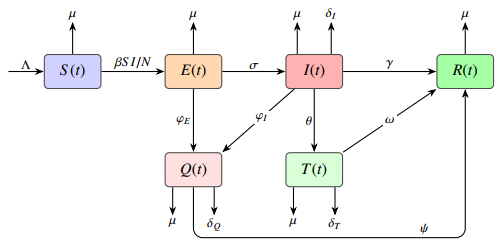
Transfer diagram of the SEIQTR model (2.2)–(2.7). Exposed cattle are quarantined at rate $ \varphi_E $, and infectious cattle are isolated at rate $ \varphi_I $; both flows feed the same class $ Q $ but act at different stages of the infection
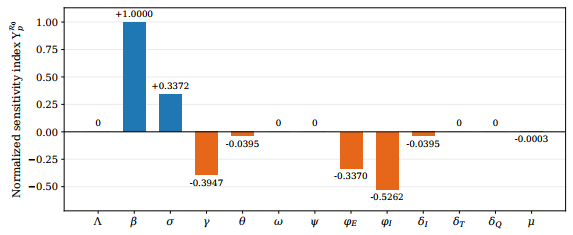
Normalized sensitivity indices of $ \mathcal{R}_{0} $ with respect to each model parameter, evaluated at the baseline calibration
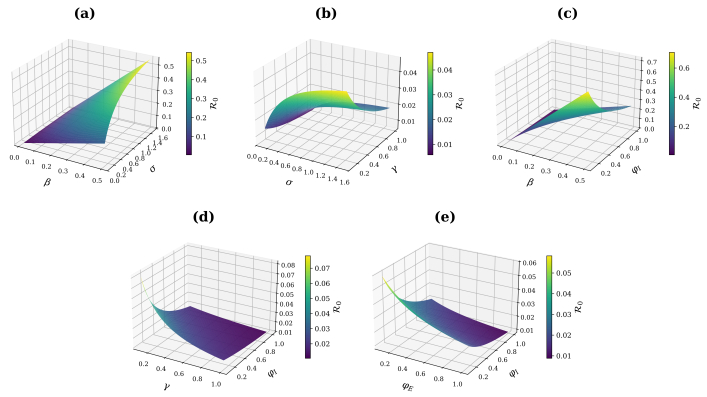
Response surfaces of $ \mathcal{R}_{0} $: (a) $ \beta $ and $ \sigma $; (b) $ \sigma $ and $ \gamma $; (c) $ \beta $ and $ \varphi_I $; (d) $ \gamma $ and $ \varphi_I $; (e) $ \varphi_E $ and $ \varphi_I $. All remaining parameters are held at their revised baseline values
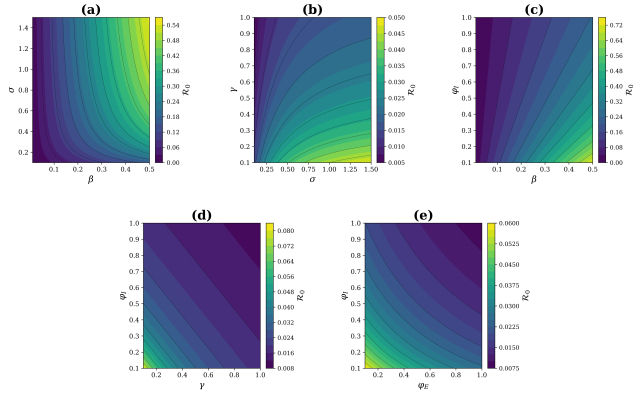
Contour maps of $ \mathcal{R}_{0} $: (a) $ \beta $ and $ \sigma $; (b) $ \sigma $ and $ \gamma $; (c) $ \beta $ and $ \varphi_I $; (d) $ \gamma $ and $ \varphi_I $; (e) $ \varphi_E $ and $ \varphi_I $. All remaining parameters are held at their revised baseline values
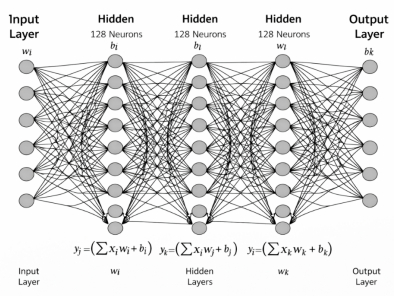
Architecture of the feed-forward network: One input node ($ \hat{t} $), three hidden layers of $ 128 $ neurons, and six output nodes, one per compartment
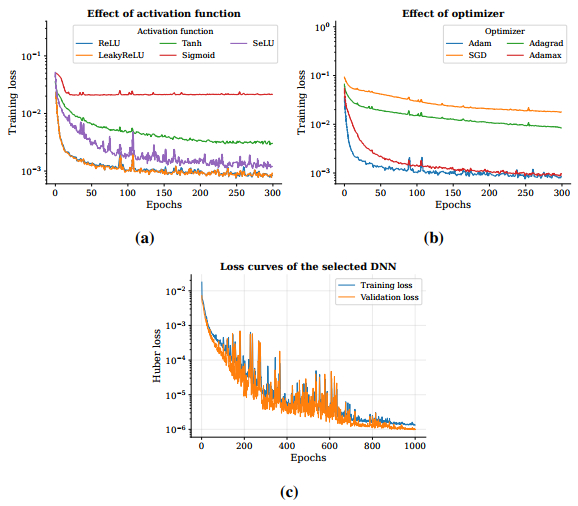
Training-loss histories used for hyperparameter selection: (a) activation functions, (b) optimization algorithms, (c) training and validation loss curves of the selected DNN configuration
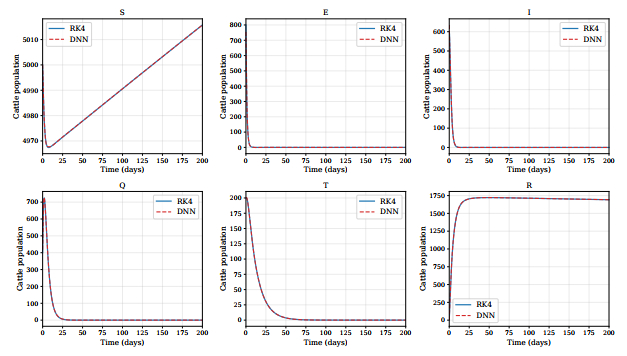
Neural-network predictions (dashed) against RK4 reference solutions (solid) for each compartment over $ t\in[0,200] $, at the baseline calibration of Table 1 and the initial conditions (7.2)
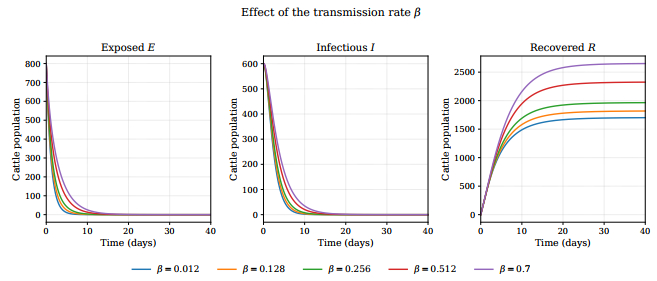
Effect of the transmission coefficient $ \beta $ on the exposed, infectious, and recovered classes
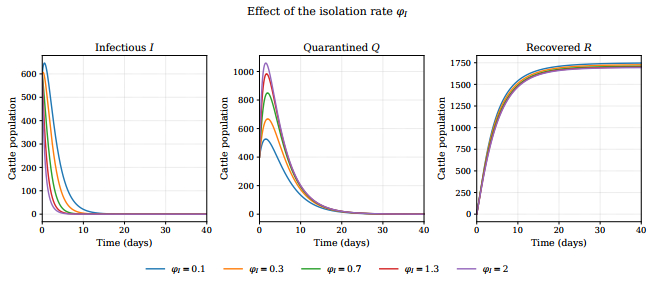
Effect of the isolation rate of infectious cattle on the infectious, quarantined, and recovered classes
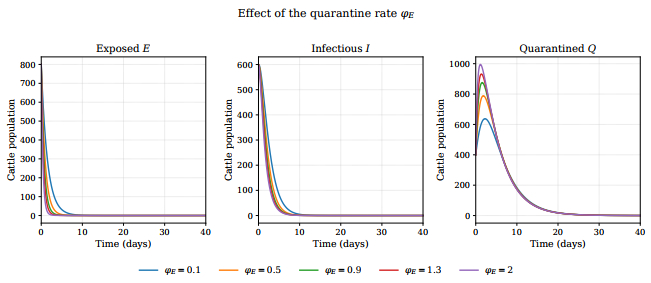
Effect of the quarantine rate of exposed cattle on the exposed, infectious, and quarantined classes




 DownLoad: