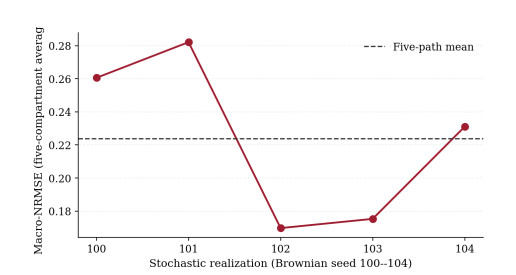
Breast cancer remains one of major global public health threats, imposing a significant burden on human health and contributing potentially to cancer-related morbidity and mortality worldwide. Quantum neural networks are emerging as promising nonlinear learning frameworks for approximating complex biological dynamic systems, offering potential advantages in representing intricate nonlinear relationships. In the present study, we investigate a hybrid quantum classical neural network for approximating deterministic and stochastic trajectories of a five-compartments breast cancer mathematical model. The quantum component contains five qubits and three temporal data re-uploading layers. Fifteen Pauli expectation features are transferred to a classical network with two hidden layers of 24 neurons and five outputs. In the deterministic regime, the hybrid quantum neural network (HQNN) achieves coefficient of determination values ranging from $ 0.999367 $ to $ 0.999836 $, normalized mean absolute errors below $ 0.46\% $, and normalized root mean square errors below $ 0.70\% $. For the selected stochastic realization, the corresponding $ R^2 $ values range from $ 0.986659 $ to $ 0.996558 $, while the normalized mean absolute errors and normalized root-mean-square errors remain below $ 1.89\% $ and $ 2.48\% $, respectively. An additional architecture investigation comprised 48 training runs, while five independently simulated stochastic trajectories were each fitted using three network initializations. Across the five paths, the mean held-out normalized root mean square error was $ 0.2238 $, with a $ 95\% $ confidence interval of $ [0.1614, 0.2861] $. The corresponding mean held-out coefficient of determination was $ -26.64 $, indicating limited accuracy on the withheld temporal intervals despite the favorable original reconstruction results. The findings illustrate the approximation behavior and current limitations of a simulated hybrid quantum-classical surrogate.
Citation: Azizah Alrajhi, Misbah Ullah. A novel quantum neural network approach for analyzing deterministic and stochastic breast cancer cardiotoxicity model[J]. AIMS Mathematics, 2026, 11(11): 38850-38894. doi: 10.3934/math.20261499
Breast cancer remains one of major global public health threats, imposing a significant burden on human health and contributing potentially to cancer-related morbidity and mortality worldwide. Quantum neural networks are emerging as promising nonlinear learning frameworks for approximating complex biological dynamic systems, offering potential advantages in representing intricate nonlinear relationships. In the present study, we investigate a hybrid quantum classical neural network for approximating deterministic and stochastic trajectories of a five-compartments breast cancer mathematical model. The quantum component contains five qubits and three temporal data re-uploading layers. Fifteen Pauli expectation features are transferred to a classical network with two hidden layers of 24 neurons and five outputs. In the deterministic regime, the hybrid quantum neural network (HQNN) achieves coefficient of determination values ranging from $ 0.999367 $ to $ 0.999836 $, normalized mean absolute errors below $ 0.46\% $, and normalized root mean square errors below $ 0.70\% $. For the selected stochastic realization, the corresponding $ R^2 $ values range from $ 0.986659 $ to $ 0.996558 $, while the normalized mean absolute errors and normalized root-mean-square errors remain below $ 1.89\% $ and $ 2.48\% $, respectively. An additional architecture investigation comprised 48 training runs, while five independently simulated stochastic trajectories were each fitted using three network initializations. Across the five paths, the mean held-out normalized root mean square error was $ 0.2238 $, with a $ 95\% $ confidence interval of $ [0.1614, 0.2861] $. The corresponding mean held-out coefficient of determination was $ -26.64 $, indicating limited accuracy on the withheld temporal intervals despite the favorable original reconstruction results. The findings illustrate the approximation behavior and current limitations of a simulated hybrid quantum-classical surrogate.

| [1] |
I. Jahan, M. E. Chowdhury, S. Vranic, R. M. Al Saady, S. Kabir, Z. H. Pranto, et al., Deep learning and vision transformers-based framework for breast cancer and subtype identification, Neural Comput. Appl., 37 (2025), 9311–9330. https://doi.org/10.1007/s00521-025-10984-2 doi: 10.1007/s00521-025-10984-2
|
| [2] |
O. Freihat, D. Sipos, A. Kovacs, Global burden and projections of breast cancer incidence and mortality to 2050: A comprehensive analysis of GLOBOCAN data, Front. Public Health, 13 (2025), 1622954. https://doi.org/10.3389/fpubh.2025.1622954 doi: 10.3389/fpubh.2025.1622954
|
| [3] |
H. Gu, R. Wang, N. M. Beeraka, P. Lu, X. Zhao, L. Li, et al., Global burden and trends of breast cancer: GLOBOCAN 2022 estimates of incidence and mortality in 185 countries, Chin. Med. J., 139 (2026), 404–414. https://doi.org/10.1097/CM9.0000000000003921 doi: 10.1097/CM9.0000000000003921
|
| [4] |
Y. Chen, R. Wang, L. Wu, J. Li, M. Yang, X. Qi, et al., Fertility preservation in breast cancer patients: A systematic review and summary of current evidence and recommendations, Breast Cancer Res. Treat., 215 (2026), 68. https://doi.org/10.1007/s10549-026-07901-z doi: 10.1007/s10549-026-07901-z
|
| [5] |
A Hawazie, M Druce, Breast cancer risk and management in the endocrine clinic: A comprehensive review, Clin. Endocrinol., 2026. https://doi.org/10.1111/cen.15209 |
| [6] |
A. Elengoe, A short review on breast cancer, Int. J. Biotechnol. Biomed., 1 (2024), 1–11. https://doi.org/10.31674/ijbb.2024.v01i01.001 doi: 10.31674/ijbb.2024.v01i01.001
|
| [7] |
A. Husain, H. Khan, J. E. Fatima, S. A. Siddiqui, A. D. Singh, A. Husain, et al., Recent advancements in breast cancer therapies and biomarkers: Mechanisms and clinical significance, Curr. Pharm. Biotechnol., 26 (2025), 2381–2402. https://doi.org/10.2174/0113892010343901250204054241 doi: 10.2174/0113892010343901250204054241
|
| [8] |
V. Velmurugan, B. Shanthakumar, M. K. Kathiravan, T. Sundarrajan, D. Priya, G. V. Anjana, Breast cancer epidemiology, risk factors, pathogenesis and advances in diagnosis and treatment: A review, In: An Overview of Disease and Health Research, 11 (2026), 54–81. https://doi.org/10.9734/bpi/aodhr/v11/7335 |
| [9] |
J. Kim, A. Harper, V. McCormack, H. Sung, N. Houssami, E. Morgan, et al., Global patterns and trends in breast cancer incidence and mortality across 185 countries, Nat. Med., 31 (2025), 1154–1162. https://doi.org/10.1038/s41591-025-03502-3 doi: 10.1038/s41591-025-03502-3
|
| [10] |
World Health Organization, Breast cancer, World Health Organization, 2026. Available from: https://www.who.int/news-room/fact-sheets/detail/breast-cancer. |
| [11] |
Z. Tao, A. Shi, C. Lu, T. Song, Z. Zhang, J. Zhao, Breast cancer: Epidemiology and etiology, Cell Biochem. Biophys., 72 (2015), 333–338. https://doi.org/10.1007/s12013-014-0459-6 doi: 10.1007/s12013-014-0459-6
|
| [12] |
A. Din, Y. Li, Optimizing HIV/AIDS dynamics: Stochastic control strategies with education and treatment, Eur. Phys. J. Plus, 139 (2024), 812. https://doi.org/10.1140/epjp/s13360-024-05605-1 doi: 10.1140/epjp/s13360-024-05605-1
|
| [13] |
S. Kumar, R. Kumar, S. Momani, S. Hadid, A study on fractional COVID-19 disease model by using Hermite wavelets, Math. Methods Appl. Sci., 46 (2023), 7671–7687. https://doi.org/10.1002/mma.7065 doi: 10.1002/mma.7065
|
| [14] |
A. Din, Bifurcation analysis of a delayed stochastic HBV epidemic model: Cell-to-cell transmission, Chaos Solitons Fract., 181 (2024), 114714. https://doi.org/10.1016/j.chaos.2024.114714 doi: 10.1016/j.chaos.2024.114714
|
| [15] |
B. Ghanbari, S. Kumar, A study on fractional predator-prey-pathogen model with Mittag–Leffler kernel-based operators, Numer. Meth. Part. D. E., 40 (2024), e22689. https://doi.org/10.1002/num.22689 doi: 10.1002/num.22689
|
| [16] |
P. J. Cook, R. Doll, S. A. Fellingham, A mathematical model for the age distribution of cancer in man, Int. J. Cancer, 4 (1969), 93–112. https://doi.org/10.1002/ijc.2910040113 doi: 10.1002/ijc.2910040113
|
| [17] |
A. M. Jarrett, E. A. Lima, D. A. Hormuth, M. T. McKenna, X. Feng, D. A. Ekrut, et al., Mathematical models of tumor cell proliferation: A review of the literature, Expert Rev. Anticancer Ther., 18 (2018), 1271–1286. https://doi.org/10.1080/14737140.2018.1527689 doi: 10.1080/14737140.2018.1527689
|
| [18] |
P. M. Altrock, L. L. Liu, F. Michor, The mathematics of cancer: Integrating quantitative models, Nat. Rev. Cancer, 15 (2015), 730–745. https://doi.org/10.1038/nrc4029 doi: 10.1038/nrc4029
|
| [19] |
R. P. Araujo, D. S. McElwain, A history of the study of solid tumour growth: The contribution of mathematical modelling, Bull. Math. Biol., 66 (2004), 1039–1091. https://doi.org/10.1016/j.bulm.2003.11.002 doi: 10.1016/j.bulm.2003.11.002
|
| [20] |
D. S. Dixit, D. Kumar, S. Kumar, R. Johri, A mathematical model of chemotherapy for tumor treatment, Adv. Appl. Math. Biosci., 3 (2012), 1–10. |
| [21] |
G. Jordao, J. N. Tavares, Mathematical models in cancer therapy, Biosystems, 162 (2017), 12–23. https://doi.org/10.1016/j.biosystems.2017.08.007 doi: 10.1016/j.biosystems.2017.08.007
|
| [22] |
G. Mahlbacher, L. T. Curtis, J. Lowengrub, H. B. Frieboes, Mathematical modeling of tumor-associated macrophage interactions with the cancer microenvironment, J. Immunother. Cancer, 6 (2018), 10. https://doi.org/10.1186/s40425-017-0313-7 doi: 10.1186/s40425-017-0313-7
|
| [23] |
N. Beerenwinkel, R. F. Schwarz, M. Gerstung, F. Markowetz, Cancer evolution: Mathematical models and computational inference, Syst. Biol., 64 (2015), e1–e25. https://doi.org/10.1093/sysbio/syu081 doi: 10.1093/sysbio/syu081
|
| [24] |
M. Farhan, Z. Ling, J. Ding, Z. Shah, R. D. Dobrotă, A novel fractional computational neural framework for analyzing cancer model under chemotherapy drug, Comput. Methods Biomech. Biomed. Eng., 29 (2026), 3192–3210. https://doi.org/10.1080/10255842.2025.2508227 doi: 10.1080/10255842.2025.2508227
|
| [25] |
A. Yin, D. J. A. Moes, J. G. van Hasselt, J. J. Swen, H. J. Guchelaar, A review of mathematical models for tumor dynamics and treatment resistance evolution of solid tumors, CPT Pharmacometrics Syst. Pharmacol., 8 (2019), 720–737. https://doi.org/10.1002/psp4.12450 doi: 10.1002/psp4.12450
|
| [26] |
V. Gopakumar, A review on surrogate modelling and uncertainty quantification of neural differential equations, PhD Upgrade Viva Report, Centre for Artificial Intelligence, Department of Computer Science University College London, 2025. |
| [27] |
M. A. Ullah, S. U. Saqib, Y. T. Shih, N. Abdullah, N. Becheikh, L. Kolsi, et al., A data-driven mathematical modeling framework for predicting HIV/HBV coinfection dynamics using machine learning approaches, AIMS Math., 11 (2026), 22688–22723. http://doi.org/10.3934/math.2026916 doi: 10.3934/math.2026916
|
| [28] |
S. U. Saqib, S. H. Fang, M. A. Z. Raja, K. S. Nisar, M. Shoaib, Design of intelligent neuro-supervised deep learning networks to analyze brain electrical activity rhythms of Parkinson's disease model, Cogn. Neurodyn., 20 (2026), 32. https://doi.org/10.1007/s11571-025-10404-0 doi: 10.1007/s11571-025-10404-0
|
| [29] |
L. Monbroussou, M. Periyasamy, V. Kuzmin, P. Sekatski, V. Patapovich, A. Sagingalieva, et al., Hybrid quantum neural networks: Theory, implementations, and applications, arXiv preprint arXiv: 2608.01194, 2026. https://doi.org/10.48550/arXiv.2608.01194 |
| [30] |
S. Kumar, S. Kumar, S. Momani, A deep neural network with optimization approach for a nonlinear fractional bird flu model with vaccination and treatment via spectral method, Knowl.-Based Syst., 336 (2026), 115259. https://doi.org/10.1016/j.knosys.2026.115259 doi: 10.1016/j.knosys.2026.115259
|
| [31] |
A. Din, Neural network assisted stability exploration of a stochastic Hepatitis B model incorporating dual transmission routes and immune response, J. Appl. Math. Comput., 72 (2026), 116. https://doi.org/10.1007/s12190-026-02770-7 doi: 10.1007/s12190-026-02770-7
|
| [32] |
C. Banerjee, S. Kumar, S. Momani, A neural network optimization scheme for fractional economic and environmental mathematical model, Int. J. Comput. Math., 2026, 1–39. https://doi.org/10.1080/00207160.2026.2637677 |
| [33] |
A. Din, Stochastic analysis and ANN-based approximation of measles transmission dynamics under Lévy noise, AIMS Math., 11 (2026), 18715–18745. https://doi.org/10.3934/math.2026761 doi: 10.3934/math.2026761
|
| [34] |
Y. Xu, Z. Shao, X. Liu, Y. Li, Z. An, C. Fu, et al., AI for science: Progress, challenges, and perspectives, Innovation, 7 (2026), 101530. https://doi.org/10.1016/j.xinn.2026.101530 |
| [35] |
S. U. Saqib, S. H. Fang, Y. T. Shih, N. Abdullah, N. Becheikh, L. Kolsi, et al., A novel hybrid neuro-stochastic framework for human immunodeficiency virus and Hepatitis B virus co-infection dynamics with vaccination: Computational aspects and dynamical analysis, with artificial neural network-based solutions, Eng. Appl. Artif. Intell., 183 (2026), 116110. https://doi.org/10.1016/j.engappai.2026.116110 doi: 10.1016/j.engappai.2026.116110
|
| [36] |
A. Muhamad, Quantum neural network in architectures, learning mechanisms, and emerging applications across domains: A review, J. Multiscale Mater. Inform., 2 (2025), 30–39. https://doi.org/10.62411/jimat.v2i2.14929 doi: 10.62411/jimat.v2i2.14929
|
| [37] |
A. K. Srivastava, S. Hussain, S. Sharma, A. Verma, N. Sharma, Quantum kernel-driven hybrid neural network for brain tumor classification, IEEE Access, 14 (2026), 47340–47354. https://doi.org/10.1109/ACCESS.2026.3677204 doi: 10.1109/ACCESS.2026.3677204
|
| [38] |
C. S. Chen, E. J. Kuo, Quantum adaptive self-attention for quantum transformer models, Quantum Sci. Technol., 11 (2026), 035051. https://doi.org/10.1088/2058-9565/ae8b21 doi: 10.1088/2058-9565/ae8b21
|
| [39] |
E. Alzahrani, M. M. El-Dessoky, M. A. Khan, Mathematical model to understand the dynamics of cancer, prevention diagnosis and therapy, Mathematics, 11 (2023), 1975. https://doi.org/10.3390/math11091975 doi: 10.3390/math11091975
|
| [40] |
X. Mao, Stochastic Differential Equations and Applications, 2 Eds, Horwood: Horwood Publishing, 2007. |
| [41] |
F. Yu, M. Ullah, S. Ullah, M. Asiri, S. U. Khan, M. Qeshta, A multi-layer computational neural network approach for solving stochastic within-host Chikungunya model with an adaptive immune response, Int. J. Biomath., 2025, 2550047. https://doi.org/10.1142/S1793524525500470 |
| [42] |
S. Li, M. Ullah, S. Ullah, T. Muhammad, Q. Iqbal, A novel stochastic neural network framework for modeling and simulation of within-host Chikungunya virus transmission with latency, Knowl.-Based Syst., 329 (2025), 114412. https://doi.org/10.1016/j.knosys.2025.114412 doi: 10.1016/j.knosys.2025.114412
|
| [43] |
J. Zhu, M. Ullah, S. Ullah, M. B. Riaz, A. B. Saqib, A. M. Alamri, et al., A novel numerical solution of nonlinear stochastic model for the propagation of malicious codes in wireless sensor networks using a high order spectral collocation technique, Sci. Rep., 15 (2025), 228. https://doi.org/10.1038/s41598-024-82033-2 doi: 10.1038/s41598-024-82033-2
|


Figures(25) / Tables(11)

Azizah Alrajhi, Misbah Ullah. A novel quantum neural network approach for analyzing deterministic and stochastic breast cancer cardiotoxicity model[J]. AIMS Mathematics, 2026, 11(11): 38850-38894. doi: 10.3934/math.20261499

Workflow of the supervised hybrid quantum classical surrogate
Architecture of the implemented five-qubit parameterized quantum circuit. Each of the three data reuploading layers comprises qubit-dependent temporal encoding through the $ R_Y $ and $ R_Z $ rotations; trainable $ R_X $, $ R_Y $; and $ R_Z $ rotations, and a circular CNOT entangling block. After the final layer, the expectation values of the Pauli-$ X $, Pauli-$ Y $, and Pauli-$ Z $ observables are evaluated on all five qubits, producing 15 real-valued quantum features. These features are supplied to a $ 15 $-$ 24 $-$ 24 $-$ 5 $ classical regression network to obtain the five normalized state predictions
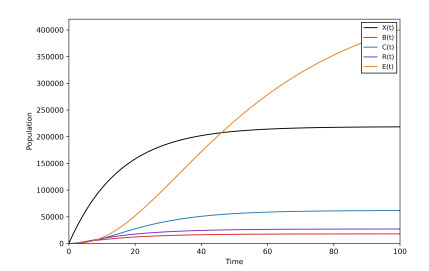
Deterministic reference trajectories for the five model compartments over $ 0\leq t\leq100 $
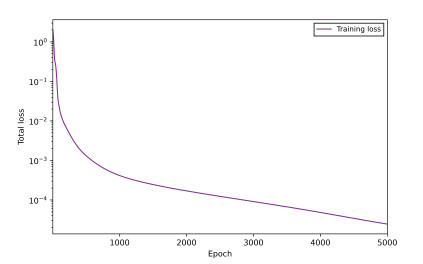
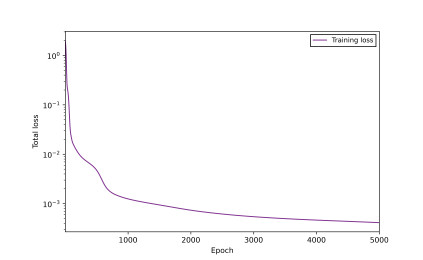
Training loss over 5000 iterations for the original deterministic HQNN reconstruction
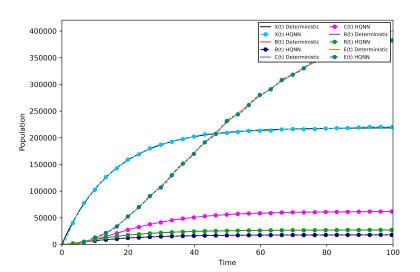
Original full-grid deterministic trajectory comparison between the numerical reference and the corresponding hybrid network reconstruction for $ X $, $ B $, $ C $, $ R $, and $ E $
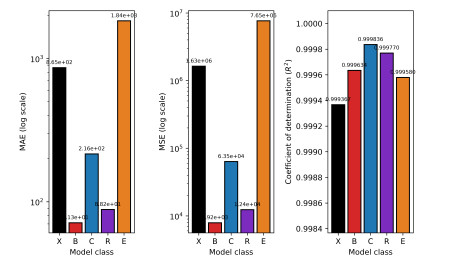
Compartment-wise mean absolute error, mean squared error, and coefficient of determination for the original deterministic full-grid reconstruction
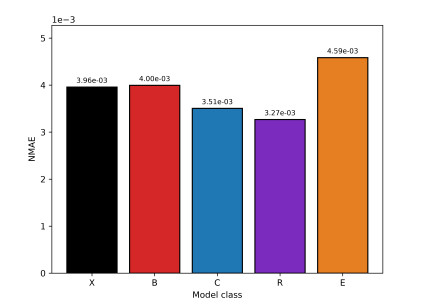
Deterministic normalized mean absolute errors for the five states
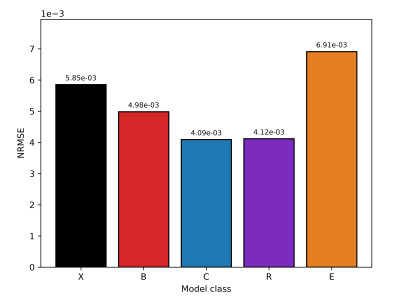
Deterministic normalized root mean squared errors for the five states
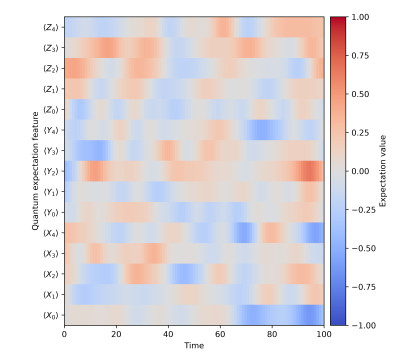
Heatmap of the 15 deterministic Pauli expectation features. Rows denote the measured qubit–observable channels, columns denote time, and the color scale spans $ [-1, 1] $
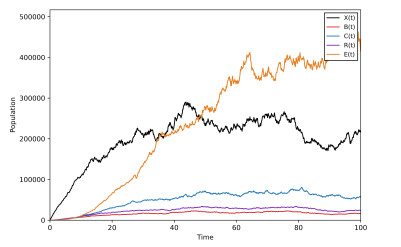
Stochastic numerical reference trajectory for the five cancer cardiotoxicity compartments
Training loss of the stochastic HQNN fitted to the selected sample path
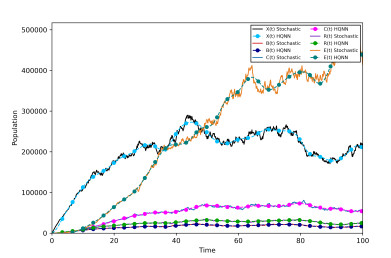
Numerical reference and hybrid network reconstruction for one selected stochastic sample path in the five compartments
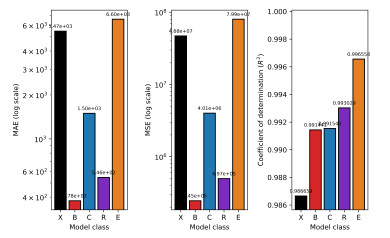
Stochastic sample path MAE, MSE, and $ R^2 $ for the five compartments
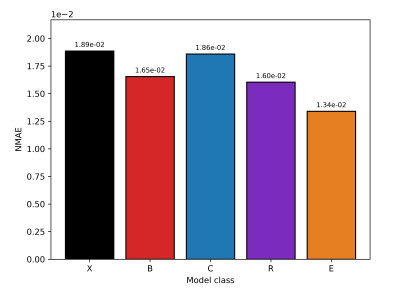
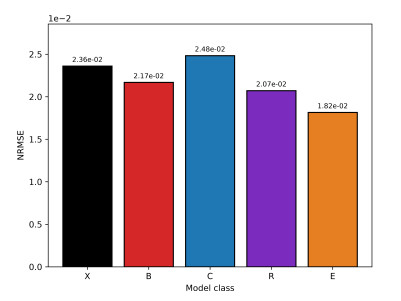
Stochastic range normalized mean absolute errors for the selected sample path
Stochastic range normalized root mean squared errors for the selected sample path
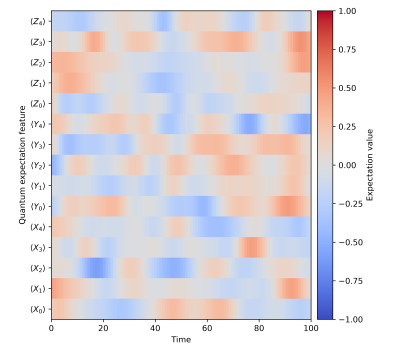
Heatmap of the 15 trained Pauli expectation features for the stochastic HQNN
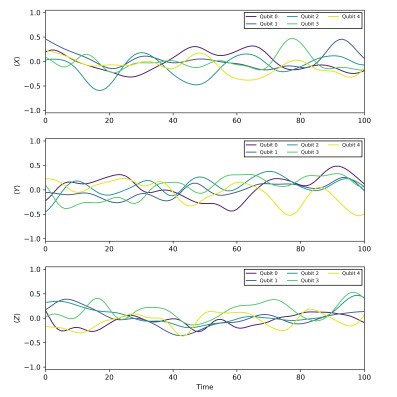
Pauli-$ X $, Pauli-$ Y $, and Pauli-$ Z $ expectation trajectories of the trained stochastic circuit
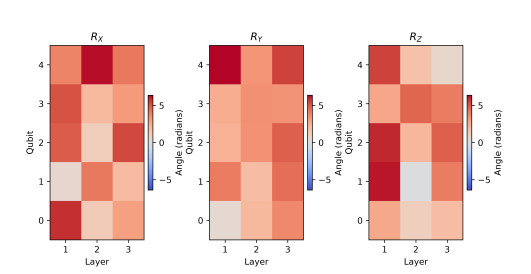
Optimized stochastic HQNN rotation angles by layer, qubit, and rotation axis
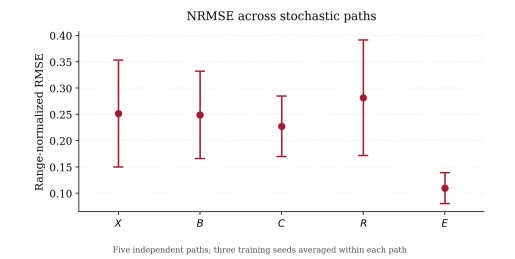
Compartment-wise mean NRMSE and $ 95\% $ confidence intervals across five independent stochastic paths. Three HQNN initialization results were averaged within each path
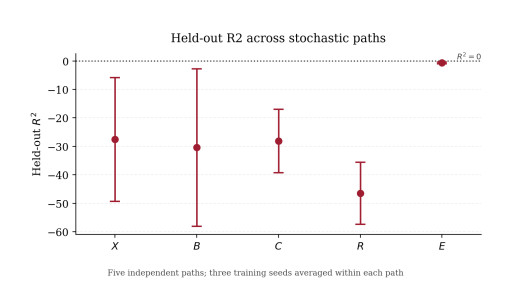
Mean held-out $ R^2 $ values with $ 95\% $ confidence intervals across independent stochastic realizations. The horizontal dotted line marks $ R^2 = 0 $
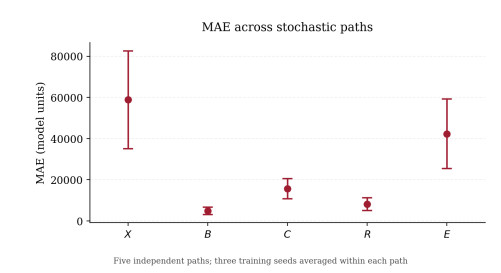
Mean absolute errors in model population units with $ 95\% $ confidence intervals over five independently fitted stochastic trajectories
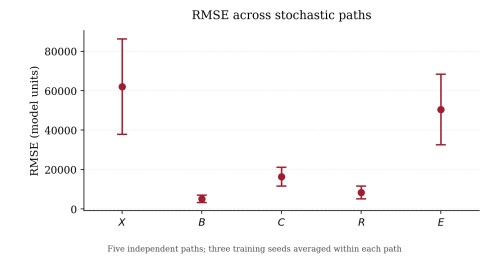
RMSEs in model population units with $ 95\% $ confidence intervals over five independently fitted stochastic trajectories
Variation in macro-NRMSE across the five stochastic reference paths. Each point is the average of three separate HQNN initializations
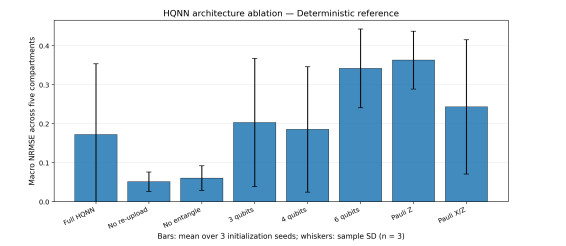
Mean macro-NRMSE over three initialization seeds for the eight HQNN variants, using the deterministic reference trajectory. Error bars represent sample standard deviation
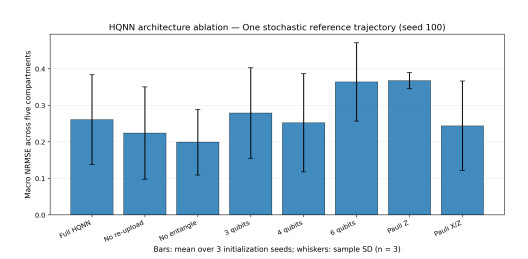
Mean macro-NRMSE over three initialization seeds for the eight HQNN variants, evaluated against one stochastic reference trajectory (seed = 100). Error bars measure variation across initialization seeds, not across independent stochastic paths




 DownLoad: