Fractional physics-informed neural networks (fPINNs) combine neural approximation with numerical or analytical treatments of fractional operators, making their reliability dependent on both network training and operator construction. This Preferred Reporting Items for Systematic Reviews and Meta-Analyses (PRISMA) 2020-adapted review synthesizes 37 primary studies and classifies them by their dominant residual-construction mechanism: discretization, quadrature or integral, spectral or basis, Monte Carlo, analytical-prior, variable- or distributed-order, and operator-learning methods. The audit identifies formal convergence theory in seven studies, direct classical-solver comparisons in 11, operator-level ablations in 10, detailed cost reporting in eight, and full reproducibility packages in nine. Evidence is strongest for L1/L2 Caputo formulations, whereas Monte Carlo, variable- and distributed-order, and operator-learning approaches require stronger analyses of uncertainty, identifiability, and generalization. Across classes, operator accuracy, stability, boundary treatment, computational cost, and reproducibility remain decisive. Current evidence therefore supports fPINNs primarily as complementary hybrid solvers for inverse, data-constrained, high-dimensional, and repeated-query fractional partial differential equation problems rather than universal replacements for classical methods.
Citation: Muhammad Asim Khan, Ayesha Ayub, Naglaa F. Soliman, Abeer D. Algarni. Fractional physics-informed neural networks for fractional PDEs: an operator-aware review of error, stability, cost, and reliability[J]. AIMS Mathematics, 2026, 11(11): 38771-38817. doi: 10.3934/math.20261496
Fractional physics-informed neural networks (fPINNs) combine neural approximation with numerical or analytical treatments of fractional operators, making their reliability dependent on both network training and operator construction. This Preferred Reporting Items for Systematic Reviews and Meta-Analyses (PRISMA) 2020-adapted review synthesizes 37 primary studies and classifies them by their dominant residual-construction mechanism: discretization, quadrature or integral, spectral or basis, Monte Carlo, analytical-prior, variable- or distributed-order, and operator-learning methods. The audit identifies formal convergence theory in seven studies, direct classical-solver comparisons in 11, operator-level ablations in 10, detailed cost reporting in eight, and full reproducibility packages in nine. Evidence is strongest for L1/L2 Caputo formulations, whereas Monte Carlo, variable- and distributed-order, and operator-learning approaches require stronger analyses of uncertainty, identifiability, and generalization. Across classes, operator accuracy, stability, boundary treatment, computational cost, and reproducibility remain decisive. Current evidence therefore supports fPINNs primarily as complementary hybrid solvers for inverse, data-constrained, high-dimensional, and repeated-query fractional partial differential equation problems rather than universal replacements for classical methods.

| [1] |
H. Sun, Y. Zhang, D. Baleanu, W. Chen, Y. Chen, A new collection of real world applications of fractional calculus in science and engineering, Commun. Nonlinear Sci. Numer. Simul., 64 (2018), 213–231. https://doi.org/10.1016/j.cnsns.2018.04.019 doi: 10.1016/j.cnsns.2018.04.019
|
| [2] |
M. Stynes, E. O'Riordan, J. L. Gracia, Error analysis of a finite difference method on graded meshes for a time-fractional diffusion equation, SIAM J. Numer. Anal., 55 (2017), 1057–1079. https://doi.org/10.1137/16M1082329 doi: 10.1137/16M1082329
|
| [3] |
G. Acosta, J. P. Borthagaray, A fractional Laplace equation: regularity of solutions and finite element approximations, SIAM J. Numer. Anal., 55 (2017), 472–495. https://doi.org/10.1137/15M1033952 doi: 10.1137/15M1033952
|
| [4] |
S. Jiang, J. Zhang, Q. Zhang, Z. Zhang, Fast evaluation of the Caputo fractional derivative and its applications to fractional diffusion equations, Commun. Comput. Phys., 21 (2017), 650–678. https://doi.org/10.4208/cicp.OA-2016-0136 doi: 10.4208/cicp.OA-2016-0136
|
| [5] |
J. G. Liu, K. L. Tian, Formulation, symmetry analysis and solutions for the time fractional thin film-type equation, J. Geom. Phys., 228 (2026), 105923. https://doi.org/10.1016/j.geomphys.2026.105923 doi: 10.1016/j.geomphys.2026.105923
|
| [6] |
J. G. Liu, Y. F. Zhang, J. Q. Wang, Investigation of nonlinear dynamics and group analysis for fractional linear KdV-type models, Commun. Nonlinear Sci. Numer. Simul., 152 (2026), 109449. https://doi.org/10.1016/j.cnsns.2025.109449 doi: 10.1016/j.cnsns.2025.109449
|
| [7] |
M. Raissi, P. Perdikaris, G. E. Karniadakis, Physics-informed neural networks: a deep learning framework for solving forward and inverse problems involving nonlinear partial differential equations, J. Comput. Phys., 378 (2019), 686–707. https://doi.org/10.1016/j.jcp.2018.10.045 doi: 10.1016/j.jcp.2018.10.045
|
| [8] |
G. Pang, L. Lu, G. E. Karniadakis, fPINNs: Fractional physics-informed neural networks, SIAM J. Sci. Comput., 41 (2019), A2603–A2626. https://doi.org/10.1137/18M1229845 doi: 10.1137/18M1229845
|
| [9] |
S. Wang, H. Zhang, X. Jiang, Fractional physics-informed neural networks for time-fractional phase field models, Nonlinear Dyn., 110 (2022), 2715–2739. https://doi.org/10.1007/s11071-022-07746-3 doi: 10.1007/s11071-022-07746-3
|
| [10] |
L. Guo, H. Wu, X. Yu, T. Zhou, Monte Carlo fPINNs: deep learning method for forward and inverse problems involving high dimensional fractional partial differential equations, Comput. Methods Appl. Mech. Eng., 400 (2022), 115523. https://doi.org/10.1016/j.cma.2022.115523 doi: 10.1016/j.cma.2022.115523
|
| [11] |
S. Wang, H. Zhang, X. Jiang, Physics-informed neural network algorithm for solving forward and inverse problems of variable-order space-fractional advection-diffusion equations, Neurocomputing, 535 (2023), 64–82. https://doi.org/10.1016/j.neucom.2023.03.032 doi: 10.1016/j.neucom.2023.03.032
|
| [12] |
X. B. Yan, Z. Q. J. Xu, Z. Ma, Laplace-fPINNs: Laplace-based fractional physics-informed neural networks for solving forward and inverse problems of a time fractional equation, East Asian J. Appl. Math., 14 (2024), 657–674. https://doi.org/10.4208/eajam.2023-197.171223 doi: 10.4208/eajam.2023-197.171223
|
| [13] |
Z. Hu, K. Kawaguchi, Z. Zhang, G. E. Karniadakis, Tackling the curse of dimensionality in fractional and tempered fractional PDEs with physics-informed neural networks, Comput. Methods Appl. Mech. Eng., 432 (2024), 117448. https://doi.org/10.1016/j.cma.2024.117448 doi: 10.1016/j.cma.2024.117448
|
| [14] |
B. Lu, Z. Hao, C. Moya, G. Lin, FPINN-deeponet: a physics-informed operator learning framework for multi-term time-fractional mixed diffusion-wave equations, J. Comput. Phys., 538 (2025), 114184. https://doi.org/10.1016/j.jcp.2025.114184 doi: 10.1016/j.jcp.2025.114184
|
| [15] |
D. Dabiri, J. DaRosa, M. Saadat, D. Mangal, S. Jamali, A detailed and comprehensive account of fractional physics-informed neural networks: from implementation to efficiency, Artif. Intell. Eng., 2 (2026), 251–264. https://doi.org/10.1049/aie2.70024 doi: 10.1049/aie2.70024
|
| [16] |
I. Podlubny, Fractional differential equations, San Diego: Academic Press, 1999. |
| [17] |
A. A. Kilbas, H. M. Srivastava, J. J. Trujillo, Theory and applications of fractional differential equations, Amsterdam: Elsevier, 2006. |
| [18] |
K. Diethelm, The analysis of fractional differential equations, Berlin: Springer-Verlag, 2010. https://doi.org/10.1007/978-3-642-14574-2 |
| [19] |
R. Gorenflo, A. A. Kilbas, F. Mainardi, S. V. Rogosin, Mittag-Leffler functions, related topics and applications, Berlin: Springer-Verlag, 2014. https://doi.org/10.1007/978-3-662-61550-8 |
| [20] |
R. Metzler, J. Klafter, The random walk's guide to anomalous diffusion: a fractional dynamics approach, Phys. Rep., 339 (2000), 1–77. https://doi.org/10.1016/S0370-1573(00)00070-3 doi: 10.1016/S0370-1573(00)00070-3
|
| [21] |
F. Mainardi, Fractional calculus and waves in linear viscoelasticity, London: Imperial College Press, 2010. |
| [22] |
C. Lubich, Discretized fractional calculus, SIAM J. Math. Anal., 17 (1986), 704–719. https://doi.org/10.1137/0517050 doi: 10.1137/0517050
|
| [23] |
C. Lubich, Convolution quadrature and discretized operational calculus. I, Numer. Math., 52 (1988), 129–145. https://doi.org/10.1007/BF01398686 doi: 10.1007/BF01398686
|
| [24] |
B. Jin, R. Lazarov, Z. Zhou, Error estimates for a semidiscrete finite element method for fractional order parabolic equations, SIAM J. Numer. Anal., 51 (2013), 445–466. https://doi.org/10.1137/120873984 doi: 10.1137/120873984
|
| [25] |
A. Bonito, J. E. Pasciak, Numerical approximation of fractional powers of elliptic operators, Math. Comp., 84 (2015), 2083–2110. https://doi.org/10.1090/S0025-5718-2015-02937-8 doi: 10.1090/S0025-5718-2015-02937-8
|
| [26] |
B. Jin, R. Lazarov, Z. Zhou, Numerical methods for time-fractional evolution equations with nonsmooth data: a concise overview, Comput. Methods Appl. Mech. Eng., 346 (2019), 332–358. https://doi.org/10.1016/j.cma.2018.12.011 doi: 10.1016/j.cma.2018.12.011
|
| [27] |
C. Ran, X. Xu, C. Hou, X. Zhang, Numerical approximation of fourth-order fractional diffusion-wave systems using finite difference and discontinuous Galerkin method, Netw. Heterog. Media, 20 (2025), 1346–1366. https://doi.org/10.3934/nhm.2025058 doi: 10.3934/nhm.2025058
|
| [28] |
F. Safari, M. A. Zaky, M. Fardi, C. Hong, Fast and accurate high-order discretization of nonlinear fractional integro-differential equations in multi-dimensional settings, Int. Commun. Heat Mass Transf., 175 (2026), 111204. https://doi.org/10.1016/j.icheatmasstransfer.2026.111204 doi: 10.1016/j.icheatmasstransfer.2026.111204
|
| [29] |
X. Zhang, Y. Feng, L. Wei, High-precision numerical simulation for fractional convection-diffusion-reaction equations, Math. Methods Appl. Sci., 49 (2026), 13928–13945. https://doi.org/10.1002/mma.70756 doi: 10.1002/mma.70756
|
| [30] |
G. E. Karniadakis, I. G. Kevrekidis, L. Lu, P. Perdikaris, S. Wang, L. Yang, Physics-informed machine learning, Nat. Rev. Phys., 3 (2021), 422–440. https://doi.org/10.1038/s42254-021-00314-5 doi: 10.1038/s42254-021-00314-5
|
| [31] |
S. Cuomo, V. Schiano Di Cola, F. Giampaolo, G. Rozza, M. Raissi, F. Piccialli, Scientific machine learning through physics-informed neural networks: where we are and what's next, J. Sci. Comput., 92 (2022), 88. https://doi.org/10.1007/s10915-022-01939-z doi: 10.1007/s10915-022-01939-z
|
| [32] |
C. Meng, S. Griesemer, D. Cao, S. Seo, Y. Liu, When physics meets machine learning: a survey of physics-informed machine learning, Mach. Learn. Comput. Sci. Eng., 1 (2025), 20. https://doi.org/10.1007/s44379-025-00016-0 doi: 10.1007/s44379-025-00016-0
|
| [33] |
A. A. Sophiya, A. K. Nair, S. Maleki, S. K. Krishnababu, A comprehensive analysis of PINNs: variants, applications, and challenges, arXiv, 2025. https://doi.org/10.48550/arXiv.2505.22761 |
| [34] |
L. Lu, X. Meng, Z. Mao, G. E. Karniadakis, DeepXDE: a deep learning library for solving differential equations, SIAM Rev., 63 (2021), 208–228. https://doi.org/10.1137/19M1274067 doi: 10.1137/19M1274067
|
| [35] |
D. Wang, Y. Ning, C. Xiang, A. Chen, A two-stage network framework for topology optimization incorporating deep learning and physical information, Eng. Appl. Artif. Intell., 133 (2024), 108185. https://doi.org/10.1016/j.engappai.2024.108185 doi: 10.1016/j.engappai.2024.108185
|
| [36] |
Y. Liu, Z. Li, P. Wei, W. Wang, Parameterized level-set based topology optimization method considering symmetry and pattern repetition constraints, Comput. Methods Appl. Mech. Eng., 340 (2018), 1079–1101. https://doi.org/10.1016/j.cma.2018.04.034 doi: 10.1016/j.cma.2018.04.034
|
| [37] |
M. Cui, W. Li, G. Li, X. Wang, The asymptotic concentration approach combined with isogeometric analysis for topology optimization of two-dimensional linear elasticity structures, Electron. Res. Arch., 31 (2023), 3848–3878. https://doi.org/10.3934/era.2023196 doi: 10.3934/era.2023196
|
| [38] |
E. Abdo, L. Chai, R. Hu, X. Yang, Convergence analysis of PINNs for fractional diffusion equations in bounded domains, arXiv, 2026. https://doi.org/10.48550/arXiv.2601.01462 |
| [39] |
J. Shi, X. Yang, X. Liu, A novel fractional physics-informed neural networks method for solving the time-fractional Huxley equation, Neural Comput. Appl., 36 (2024), 19097–19119. https://doi.org/10.1007/s00521-024-10177-3 doi: 10.1007/s00521-024-10177-3
|
| [40] |
M. Mohammadi, R. Mokhtari, M. Ramezani, RBF-fPINNs: radial basis function-enhanced fractional physics-informed neural networks, Eng. Comput., 42 (2026), 42. https://doi.org/10.1007/s00366-025-02258-1 doi: 10.1007/s00366-025-02258-1
|
| [41] |
H. Li, Z. Tan, DSC-PINN: a decomposed singularity-capturing PINN for time-fractional PDEs involving initial singularities, J. Comput. Phys., 561 (2026), 114965. https://doi.org/10.1016/j.jcp.2026.114965 doi: 10.1016/j.jcp.2026.114965
|
| [42] |
M. Ramezani, M. Mohammadi, R. Mokhtari, dPINNs: a physics-informed framework for forward and inverse problems governed by distributed-order derivatives, Eng. Anal. Bound. Elem., 179 (2025), 106418. https://doi.org/10.1016/j.enganabound.2025.106418 doi: 10.1016/j.enganabound.2025.106418
|
| [43] |
Z. Hao, M. Park, Z. Cai, Neural network method for integral fractional Laplace equations, East Asian J. Appl. Math., 13 (2023), 95–118. https://doi.org/10.4208/eajam.010122.210722 doi: 10.4208/eajam.010122.210722
|
| [44] |
Z. Hao, M. Park, Z. Cai, HNS: an efficient Hermite neural solver for solving time-fractional partial differential equations, Chaos Solitons Fract., 181 (2024), 114637. https://doi.org/10.1016/j.chaos.2024.114637 doi: 10.1016/j.chaos.2024.114637
|
| [45] |
J. Shi, X. Liu, X. Yang, Data-driven solutions and parameter estimation of the high-dimensional time-fractional reaction-diffusion equations using an improved fPINN method, Nonlinear Dyn., 113 (2025), 9577–9604. https://doi.org/10.1007/s11071-024-10786-6 doi: 10.1007/s11071-024-10786-6
|
| [46] |
R. Zhang, F. Li, J. Liu, LT-PINNs: physics-informed neural networks based on Laplace transform for solving Caputo-type fractional partial differential equations, Chin. Phys. B, 35 (2026), 030201. https://doi.org/10.1088/1674-1056/adf827 doi: 10.1088/1674-1056/adf827
|
| [47] |
S. M. Nuugulu, K. C. Patidar, D. T. Tarla, An efficient physics-informed neural network solution to the time-space fractional Black-Scholes equation, Oper. Res. Forum, 6 (2025), 172. https://doi.org/10.1007/s43069-025-00570-6 doi: 10.1007/s43069-025-00570-6
|
| [48] |
S. Jiang, X. Li, Solving the non-local Fokker-Planck equations by deep learning, Chaos, 33 (2023), 043107. https://doi.org/10.1063/5.0128935 doi: 10.1063/5.0128935
|
| [49] |
W. Liu, Y. Liu, H. Li, Y. Yang, Multi-output physics-informed neural network for one- and two-dimensional nonlinear time distributed-order models, Netw. Heterog. Media, 18 (2023), 1899–1918. https://doi.org/10.3934/nhm.2023080 doi: 10.3934/nhm.2023080
|
| [50] |
H. Momeni, A. Yazdani Cherati, A. Valinejad, AFP-PINN: adaptive fractional polynomial-based physics-informed neural network for solving distributed-order time-fractional diffusion equations and its error analysis, Phys. Scr., 100 (2025), 076026. https://doi.org/10.1088/1402-4896/adeaf8 doi: 10.1088/1402-4896/adeaf8
|
| [51] |
Y. Ye, H. Fan, Y. Li, X. Liu, H. Zhang, Deep neural network methods for solving forward and inverse problems of time fractional diffusion equations with conformable derivative, Neurocomputing, 509 (2022), 177–192. https://doi.org/10.1016/j.neucom.2022.08.030 doi: 10.1016/j.neucom.2022.08.030
|
| [52] |
T. Zhang, D. Zhang, S. Shi, Z. Guo, Spectral-fPINNs: spectral method based fractional physics-informed neural networks for solving fractional partial differential equations, Nonlinear Dyn., 113 (2025), 12565–12588. https://doi.org/10.1007/s11071-025-11067-6 doi: 10.1007/s11071-025-11067-6
|
| [53] |
Q. Wu, F. Ma, W. Wo, FS-PINNs: fractional spectrally adapted physics-informed neural networks for fractional partial differential equations, Math. Methods Appl. Sci., 48 (2025), 13882–13889. https://doi.org/10.1002/mma.11149 doi: 10.1002/mma.11149
|
| [54] |
R. H. Nochetto, E. Otárola, A. J. Salgado, A PDE approach to fractional diffusion in general domains: a priori error analysis, Found. Comput. Math., 15 (2015), 733–791. https://doi.org/10.1007/s10208-014-9208-x doi: 10.1007/s10208-014-9208-x
|
| [55] |
X. Kang, Y. Li, Y. Li, J. Hu, K. Zheng, Solving the fractional Allen-Cahn equation and the fractional Cahn-Hilliard equation with the fractional physics-informed neural networks, Fractal Fract., 9 (2025), 773. https://doi.org/10.3390/fractalfract9120773 doi: 10.3390/fractalfract9120773
|
| [56] |
T. Taheri, A. Afzal Aghaei, K. Parand, Accelerating fractional PINNs using operational matrices of derivative, arXiv, 2024. https://doi.org/10.48550/arXiv.2401.14081 |
| [57] |
J. Zhang, Y. Zhao, Y. Tang, Adaptive loss weighting auxiliary output fPINNs for solving fractional partial integro-differential equations, Physica D, 460 (2024), 134066. https://doi.org/10.1016/j.physd.2024.134066 doi: 10.1016/j.physd.2024.134066
|
| [58] |
T. Ahmad, M. Sulaiman, D. Bassir, F. S. Alshammari, G. Laouini, Enhanced numerical solutions for fractional PDEs using Monte Carlo PINNs coupled with cuckoo search optimization, Fractal Fract., 9 (2025), 225. https://doi.org/10.3390/fractalfract9040225 doi: 10.3390/fractalfract9040225
|
| [59] |
L. Lu, P. Jin, G. Pang, Z. Zhang, G. E. Karniadakis, Learning nonlinear operators via DeepONet based on the universal approximation theorem of operators, Nat. Mach. Intell., 3 (2021), 218–229. https://doi.org/10.1038/s42256-021-00302-5 doi: 10.1038/s42256-021-00302-5
|
| [60] |
H. Ren, X. Meng, R. Liu, J. Hou, Y. Yu, A class of improved fractional physics informed neural networks, Neurocomputing, 562 (2023), 126890. https://doi.org/10.1016/j.neucom.2023.126890 doi: 10.1016/j.neucom.2023.126890
|
| [61] |
A. D. Jagtap, K. Kawaguchi, G. E. Karniadakis, Adaptive activation functions accelerate convergence in deep and physics-informed neural networks, J. Comput. Phys., 404 (2020), 109136. https://doi.org/10.1016/j.jcp.2019.109136 doi: 10.1016/j.jcp.2019.109136
|
| [62] |
S. Wang, Y. Teng, P. Perdikaris, Understanding and mitigating gradient flow pathologies in physics-informed neural networks, SIAM J. Sci. Comput., 43 (2021), A3055–A3081. https://doi.org/10.1137/20M1318043 doi: 10.1137/20M1318043
|
| [63] |
N. Xue, M. Chen, Multiprecision computing for multistage fractional physics-informed neural networks, Chaos, 35 (2025), 113109. https://doi.org/10.1063/5.0287809 doi: 10.1063/5.0287809
|
| [64] |
S. Wang, X. Yu, P. Perdikaris, When and why PINNs fail to train: a neural tangent kernel perspective, J. Comput. Phys., 449 (2022), 110768. https://doi.org/10.1016/j.jcp.2021.110768 doi: 10.1016/j.jcp.2021.110768
|
| [65] |
M. A. Nabian, R. J. Gladstone, H. Meidani, Efficient training of physics-informed neural networks via importance sampling, Comput. Aided Civ. Infrastruct. Eng., 36 (2021), 962–977. https://doi.org/10.1111/mice.12685 doi: 10.1111/mice.12685
|
| [66] |
L. D. McClenny, U. M. Braga-Neto, Self-adaptive physics-informed neural networks, J. Comput. Phys., 474 (2023), 111722. https://doi.org/10.1016/j.jcp.2022.111722 doi: 10.1016/j.jcp.2022.111722
|
| [67] |
E. Kharazmi, Z. Zhang, G. E. Karniadakis, hp-VPINNs: variational physics-informed neural networks with domain decomposition, Comput. Methods Appl. Mech. Eng., 374 (2021), 113547. https://doi.org/10.1016/j.cma.2020.113547 doi: 10.1016/j.cma.2020.113547
|
| [68] |
C. Li, F. Zeng, Numerical methods for fractional calculus, Boca Raton: CRC Press, Taylor & Francis Group, 2015. |
| [69] |
Z. Li, N. Kovachki, K. Azizzadenesheli, B. Liu, K. Bhattacharya, A. Stuart, A. Anandkumar, Fourier neural operator for parametric partial differential equations, International Conference on Learning Representations, 2021. |
| [70] |
N. Kovachki, Z. Li, B. Liu, K. Azizzadenesheli, K. Bhattacharya, A. Stuart, et al., Neural operator: learning maps between function spaces with applications to PDEs, J. Mach. Learn. Res., 24 (2023), 1–97. |
 math-11-11-1496-s001.zip |
 |
Figures(5) / Tables(18)

Muhammad Asim Khan, Ayesha Ayub, Naglaa F. Soliman, Abeer D. Algarni. Fractional physics-informed neural networks for fractional PDEs: an operator-aware review of error, stability, cost, and reliability[J]. AIMS Mathematics, 2026, 11(11): 38771-38817. doi: 10.3934/math.20261496

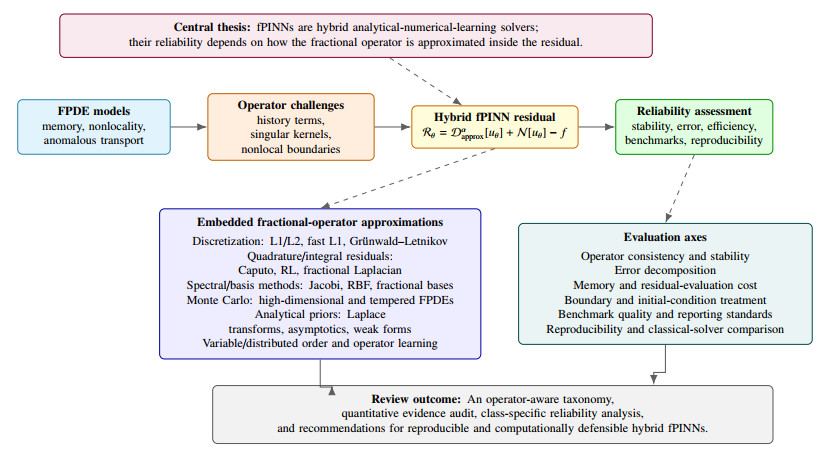
Operator-aware roadmap of the review. An fPINN residual combines neural approximation with an embedded numerical, stochastic, spectral, or analytical approximation of a fractional operator. The review therefore evaluates method families through operator consistency, stability, error, cost, boundary treatment, benchmark quality, and reproducibility
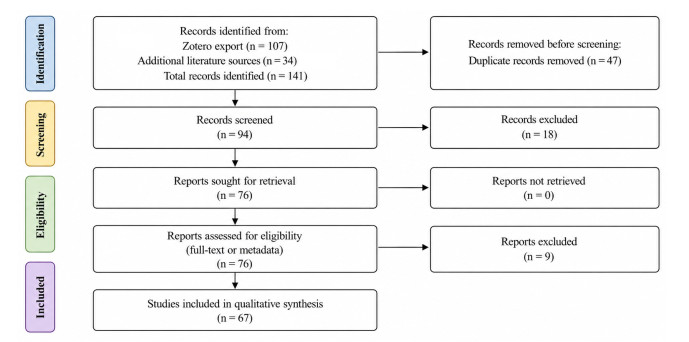
PRISMA 2020-adapted literature-selection flow. A total of 67 records were retained after eligibility assessment. Of these, 38 formed the core evidence set, comprising 37 primary fractional neural-solver studies and one fPINN-focused positioning review. The remaining 29 records formed a contextual supporting layer and were not included in the quantitative evidence-frequency calculations
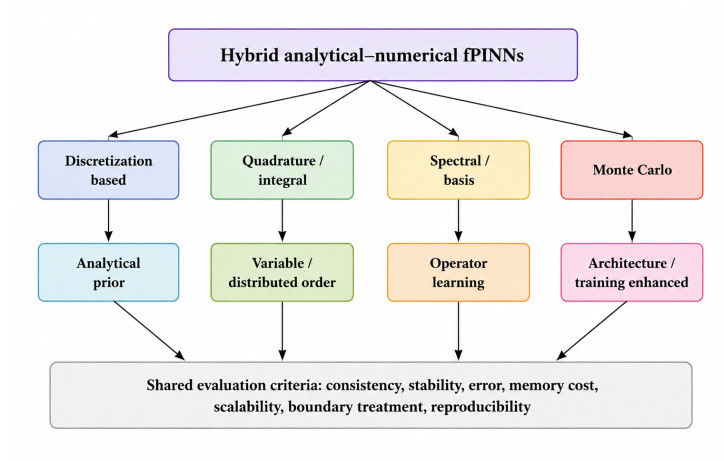
Compact taxonomy of hybrid analytical-numerical fPINNs according to the dominant fractional-operator approximation embedded in the residual
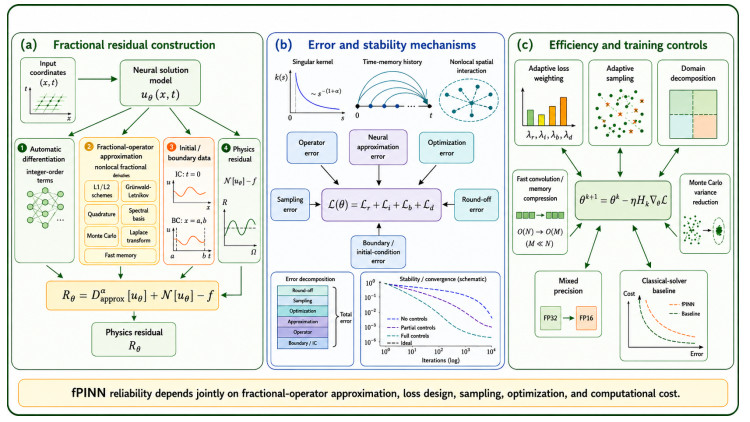
Reliability pipeline for hybrid fPINNs, showing how fractional residual construction, error mechanisms, sampling, optimization, and efficiency controls jointly affect robustness and reproducibility
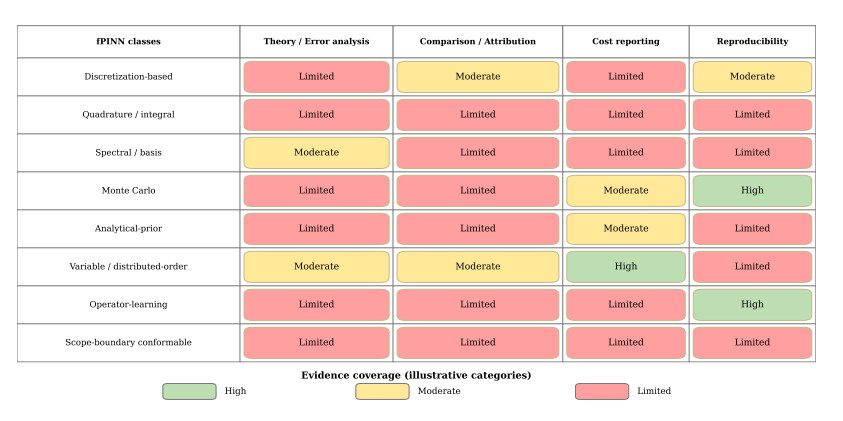
Class-level evidence coverage calculated from the study-level audit ($ N = 37 $). Theory/error-analysis coverage is $ T_c/N_c $, where $ T_c $ is the number of studies reporting formal convergence theory. Comparison-and-attribution coverage is the equally weighted mean of direct-classical-baseline and fractional-operator-ablation coverage, $ (B_c+A_c)/(2N_c) $, where $ B_c $ and $ A_c $ denote the corresponding numbers of studies. Cost-reporting coverage is $ D_c/N_c $, where $ D_c $ is the number of studies providing detailed computational-cost evidence, and reproducibility coverage is $ R_c/N_c $, where $ R_c $ is the number meeting the full-reproducibility criteria. Each cell reports the percentage and its underlying count or counts. The continuous color scale is descriptive and does not represent categorical maturity levels or comparative method performance




 DownLoad: