This work studied single-point image-space regulation for robotic manipulators with unknown camera parameters and asymmetric actuator backlash. Unequal branch gains introduce direction-dependent compensation errors into the visual feedback loop. A smooth asymmetric inverse was incorporated into the torque controller, with the branch-slope ratio assumed known. Its compensation error was separated into a linearly parameterized component and a bounded residual. An adaptive inverse and a robust adaptive term addressed these components in parallel, while the camera parameters were updated online. The Lyapunov analysis established boundedness and the vanishing joint velocity on the stated operating domain. The joint configuration and image error had finite limits, with zero image error following under the specified feedback-rank and net-residual conditions. Simulations on a three-joint model based on the PUMA 560 parameterization illustrated the regulation performance. Supplementary tests assessed sampled visual feedback, delay, noise, camera estimation, and the effects of the compensation modules.
Citation: Rong Lu, Jianlan Guo, Guanyu Lai, Haoxu Shi, Xiaohang Su. Inversion-based adaptive control for uncalibrated visual servoing of robotic manipulators with actuator backlash[J]. AIMS Mathematics, 2026, 11(11): 38109-38140. doi: 10.3934/math.20261472
This work studied single-point image-space regulation for robotic manipulators with unknown camera parameters and asymmetric actuator backlash. Unequal branch gains introduce direction-dependent compensation errors into the visual feedback loop. A smooth asymmetric inverse was incorporated into the torque controller, with the branch-slope ratio assumed known. Its compensation error was separated into a linearly parameterized component and a bounded residual. An adaptive inverse and a robust adaptive term addressed these components in parallel, while the camera parameters were updated online. The Lyapunov analysis established boundedness and the vanishing joint velocity on the stated operating domain. The joint configuration and image error had finite limits, with zero image error following under the specified feedback-rank and net-residual conditions. Simulations on a three-joint model based on the PUMA 560 parameterization illustrated the regulation performance. Supplementary tests assessed sampled visual feedback, delay, noise, camera estimation, and the effects of the compensation modules.

| [1] |
M. Kharrat, M. Krichen, L. Alkhalifa, K. Gasmi, Neural networks-based adaptive command filter control for nonlinear systems with unknown backlash-like hysteresis and its application to single link robot manipulator, AIMS Math., 9 (2024), 959–973. https://doi.org/10.3934/math.2024048 doi: 10.3934/math.2024048
|
| [2] |
M. Staniak, C. Zieliński, Structures of visual servos, Robot. Auton. Syst., 58 (2010), 940–954. https://doi.org/10.1016/j.robot.2010.04.004 doi: 10.1016/j.robot.2010.04.004
|
| [3] |
H. Zhong, W. Wen, J. Fan, W. Yang, Reinforcement learning-based adaptive tracking control for flexible-joint robotic manipulators, AIMS Math., 9 (2024), 27330–27360. https://doi.org/10.3934/math.20241328 doi: 10.3934/math.20241328
|
| [4] |
Y. Wang, W. Zhang, H. Wen, Position-based visual servo control for robotic manipulation of space structures, In: International Conference on Mechanical System Dynamics, Springer, 2023, 2435–2443. https://doi.org/10.1007/978-981-99-8048-2_167 |
| [5] |
S. Zhou, C. Shen, F. Pang, Z. Chen, J. Gu, S. Zhu, Position-based visual servoing control for multi-joint hydraulic manipulator, J. Intell. Robot. Syst., 105 (2022), 33. https://doi.org/10.1007/s10846-022-01628-x doi: 10.1007/s10846-022-01628-x
|
| [6] |
J. Li, H. Xie, K. H. Low, J. Yong, B. Li, Image-based visual servoing of rotorcrafts to planar visual targets of arbitrary orientation, IEEE Robot. Autom. Lett., 6 (2021), 7861–7868. https://doi.org/10.1109/LRA.2021.3101878 doi: 10.1109/LRA.2021.3101878
|
| [7] |
X. Zhang, Y. Fang, X. Zhang, J. Jiang, X. Chen, Dynamic image-based output feedback control for visual servoing of multirotors, IEEE T. Indu. Inform., 16 (2020), 7624–7636. https://doi.org/10.1109/tii.2020.2974485 doi: 10.1109/tii.2020.2974485
|
| [8] |
Y. Chen, Y. Wu, Z. Zhang, Z. Miao, H. Zhong, H. Zhang, et al., Image-based visual servoing of unmanned aerial manipulators for tracking and grasping a moving target, IEEE T. Indu. Inform., 19 (2022), 8889–8899. https://doi.org/10.1109/TII.2022.3222688 doi: 10.1109/TII.2022.3222688
|
| [9] |
Q. Song, R. Lu, Y. Long, X. Zheng, A calibration-free visual control approach for table tennis training robots using a positional monocular camera, AIMS Math., 10 (2025), 27364–27380. https://doi.org/10.3934/math.20251203 doi: 10.3934/math.20251203
|
| [10] |
X. Yang, J. Wang, S. Song, M. Q. H. Meng, Model-free and uncalibrated eye-in-hand visual servoing approach for concentric-tube robots, IEEE T. Instrum. Meas., 71 (2022), 1–11. https://doi.org/10.1109/TIM.2022.3147867 doi: 10.1109/TIM.2022.3147867
|
| [11] |
X. Ren, H. Li, Uncalibrated image-based visual servoing control with maximum correntropy Kalman filter, IFAC-PapersOnLine, 53 (2020), 560–565. https://doi.org/10.1016/j.ifacol.2021.04.200 doi: 10.1016/j.ifacol.2021.04.200
|
| [12] |
N. Tan, P. Yu, W. Zheng, Uncalibrated and unmodeled image-based visual servoing of robot manipulators using zeroing neural networks, IEEE T. Cybernetics, 54 (2022), 2446–2459. https://doi.org/10.1109/TCYB.2022.3227470 doi: 10.1109/TCYB.2022.3227470
|
| [13] |
Y. H. Liu, H. Wang, W. Chen, D. Zhou, Adaptive visual servoing using common image features with unknown geometric parameters, Automatica, 49 (2013), 2453–2460. https://doi.org/10.1016/j.automatica.2013.04.018 doi: 10.1016/j.automatica.2013.04.018
|
| [14] |
C. C. Cheah, C. Liu, J. J. E. Slotine, Adaptive vision based tracking control of robots with uncertainty in depth information, In: Proceedings of the 2007 IEEE International Conference on Robotics and Automation, 2007, 2817–2822. https://doi.org/10.1109/ROBOT.2007.363898 |
| [15] |
Y. H. Liu, H. Wang, C. Wang, K. K. Lam, Uncalibrated visual servoing of robots using a depth-independent interaction matrix, IEEE T. Robot., 22 (2006), 804–817. https://doi.org/10.1109/TRO.2006.878788 doi: 10.1109/TRO.2006.878788
|
| [16] |
G. Lai, A. Liu, W. Yang, Y. Chen, L. Zhao, Uncalibrated adaptive visual servoing of robotic manipulators with uncertainties in kinematics and dynamics, Actuators, 12 (2023), 143. https://doi.org/10.3390/act12040143 doi: 10.3390/act12040143
|
| [17] |
C. Cai, E. Dean-León, D. Mendoza, N. Somani, A. Knoll, Uncalibrated 3d stereo image-based dynamic visual servoing for robot manipulators, In: 2013 IEEE/RSJ International Conference on Intelligent Robots and Systems, 2013, 63–70. https://doi.org/10.1109/IROS.2013.6696333 |
| [18] |
Z. Zhao, Z. Tan, Z. Liu, M. O. Efe, C. K. Ahn, Adaptive inverse compensation fault-tolerant control for a flexible manipulator with unknown dead-zone and actuator faults, IEEE T. Indu. Electron., 70 (2023), 12698–12707. https://doi.org/10.1109/TIE.2023.3239926 doi: 10.1109/TIE.2023.3239926
|
| [19] |
G. Shao, X. F. Wang, R. Wang, A distributed strategy for games in Euler–Lagrange systems with actuator dead zone, Neurocomputing, 560 (2023), 126844. https://doi.org/10.1016/j.neucom.2023.126844 doi: 10.1016/j.neucom.2023.126844
|
| [20] |
R. Zhang, H. Ji, Robust adaptive trajectory tracking control for uncertain quadrotor unmanned aerial vehicles in the presence of actuator saturation, In: 2020 5th International Conference on Control and Robotics Engineering, 2020,104–108. https://doi.org/10.1145/3424311.3424325 |
| [21] |
J. H. An, H. S. Kim, Interval type-2 fuzzy-model-based sampled-data control of an AUV depth system with input saturation, Actuators, 13 (2024), 71. https://doi.org/10.3390/act13020071 doi: 10.3390/act13020071
|
| [22] |
Z. Shi, Z. Zuo, Backstepping control for gear transmission servo systems with backlash nonlinearity, IEEE T. Automat. Sci. Eng., 12 (2015), 752–757. https://doi.org/10.1109/TASE.2014.2369430 doi: 10.1109/TASE.2014.2369430
|
| [23] |
H. Yonezawa, A. Yonezawa, I. Kajiwara, Efficient tuning scheme of mode-switching-based powertrain oscillation controller considering nonlinear backlash, IEEE Access, 11 (2023), 93935–93947. https://doi.org/10.1109/ACCESS.2023.3310540 doi: 10.1109/ACCESS.2023.3310540
|
| [24] |
X. He, Z. Zhao, J. Su, Q. Yang, D. Zhu, Adaptive inverse control of a vibrating coupled vessel-riser system with input backlash, IEEE T. Syst Man Cyb.-S., 51 (2021), 4706–4715. https://doi.org/10.1109/TSMC.2019.2944999 doi: 10.1109/TSMC.2019.2944999
|
| [25] |
L. Kong, Q. Lai, Y. Ouyang, Q. Li, S. Zhang, Neural learning control of a robotic manipulator with finite-time convergence in the presence of unknown backlash-like hysteresis, IEEE T. Syst. Man Cy.-S., 52 (2022), 1916–1927. https://doi.org/10.1007/s40278-022-19511-1 doi: 10.1007/s40278-022-19511-1
|
| [26] |
Z. Yin, W. He, O. Kaynak, C. Yang, L. Cheng, Y. Wang, Uncertainty and disturbance estimator-based control of a flapping-wing aerial vehicle with unknown backlash-like hysteresis, IEEE T. Indu. Electron., 67 (2020), 4826–4835. https://doi.org/10.1109/TIE.2019.2926055 doi: 10.1109/TIE.2019.2926055
|
| [27] |
J. Zhao, Y. Li, Y. Cao, F. Zhang, M. Cui, R. Xu, High-precision position tracking control with a hysteresis observer based on the Bouc–Wen model for smart material-actuated systems, Actuators, 13 (2024), 105. https://doi.org/10.3390/act13030105 doi: 10.3390/act13030105
|
| [28] |
N. Xu, S. Yue, N. Zhao, B. Niu, X. Zhao, SMS-based optimal control of completely unknown nonlinear systems with unknown actuator saturation, Int. J. Adapt. Control., 40 (2026), 1956–1971. https://doi.org/10.1002/acs.70109 doi: 10.1002/acs.70109
|
| [29] |
Z. Wu, N. Zhao, A. A. Albeshri, Deferred actuator replacement-based performance recovery consensus control for nonlinear multi-agent systems under DoS attacks, Nonlinear Dynam., 114 (2026), 865. https://doi.org/10.1007/s11071-026-12682-7 doi: 10.1007/s11071-026-12682-7
|
| [30] |
X. Chen, L. Ma, X. Zhao, G. Zong, Predefined-time sliding-mode formation control for second-order nonlinear multi-agent systems under deception attacks, Eur. J. Control, 91 (2026), 101534. https://doi.org/10.1016/j.ejcon.2026.101534 doi: 10.1016/j.ejcon.2026.101534
|
| [31] |
G. Tao, Adaptive backlash compensation for robot control, IFAC Proc. Volumes, 29 (1996), 5244–5249. https://doi.org/10.1016/S1474-6670(17)58514-6 doi: 10.1016/S1474-6670(17)58514-6
|
| [32] |
J. Zhou, C. Zhang, C. Wen, Robust adaptive output control of uncertain nonlinear plants with unknown backlash nonlinearity, IEEE T. Automat. Control, 52 (2007), 503–509. https://doi.org/10.1109/TAC.2006.890473 doi: 10.1109/TAC.2006.890473
|
| [33] |
F. Wang, L. Song, Z. Liu, Image-based visual servoing control for robot manipulator with actuator backlash, In: 2016 3rd International Conference on Informative and Cybernetics for Computational Social Systems, 2016,272–276. https://doi.org/10.1109/iccss.2016.7586464 |
| [34] |
S. Mirshahzadeh, H. Khodadadi, Feedback linearization controller design for a geared transmission system considering asymmetric backlash and friction, J. Simul. Anal. Novel Technol. Mech. Eng., 15 (2023), 15–26. https://doi.org/10.1002/citp.202370709 doi: 10.1002/citp.202370709
|
| [35] |
J. Liu, Y. Sun, Z. Liu, Y. Gao, L. Wu, J. I. Leon, et al., Predefined-time reliable control for robotic systems with prescribed performance, IEEE T. Ind. Electron., 72 (2025), 11695–11703. https://doi.org/10.1109/TIE.2025.3558003 doi: 10.1109/TIE.2025.3558003
|
| [36] |
Z. Liu, O. Zhang, Y. Zhao, Q. Zhu, J. Liu, Adaptive neural network-based fixed-time control for robots with input saturation and prescribed performance, Nonlinear Dynam., 113 (2025), 18229–18241. https://doi.org/10.1007/s11071-025-11103-5 doi: 10.1007/s11071-025-11103-5
|
Figures(15) / Tables(5)

Rong Lu, Jianlan Guo, Guanyu Lai, Haoxu Shi, Xiaohang Su. Inversion-based adaptive control for uncalibrated visual servoing of robotic manipulators with actuator backlash[J]. AIMS Mathematics, 2026, 11(11): 38109-38140. doi: 10.3934/math.20261472

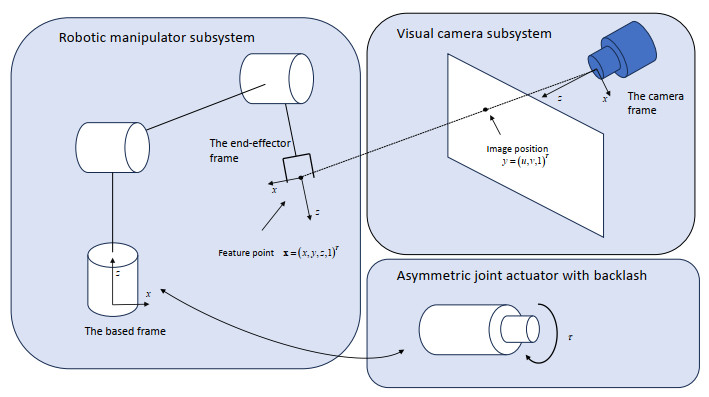
The basic structure of the visual servoing system
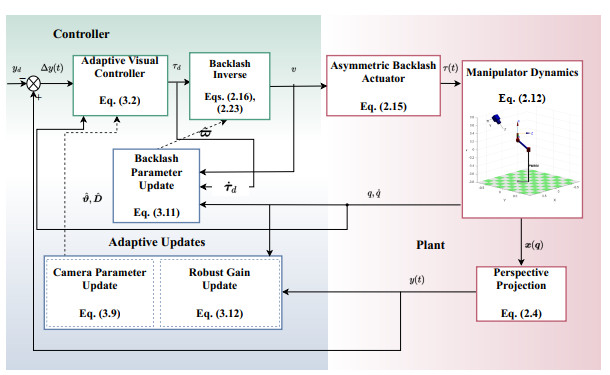
Control architecture for visual servoing with asymmetric actuator backlash
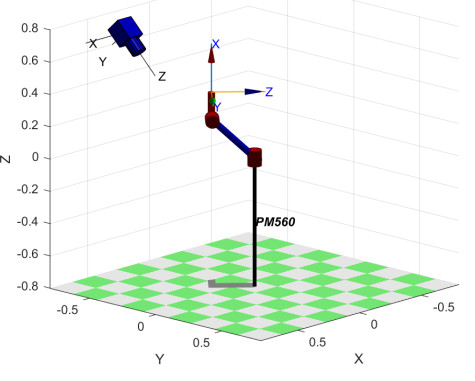
The robotic manipulator system with the fixed camera
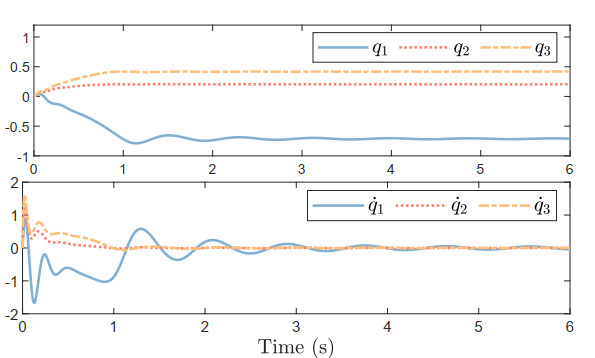
The robotic joint angle $ q $ and joint velocity $ \dot q $ versus time
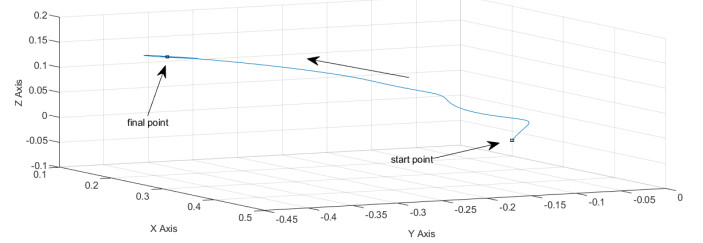
3-D trajectory of feature points in three-dimensional space
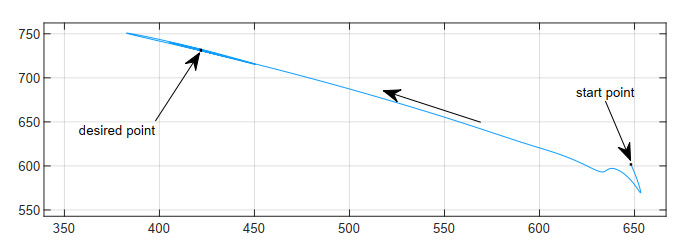
Image trajectory of feature points
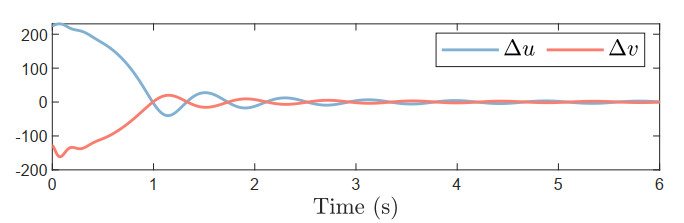
The image error $ \Delta \boldsymbol y $ versus time
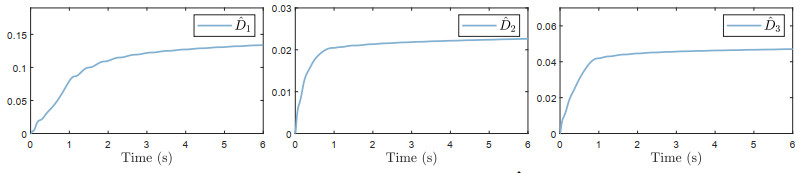
The adaptive robust parameters $ \hat {\boldsymbol{D}} $ versus time
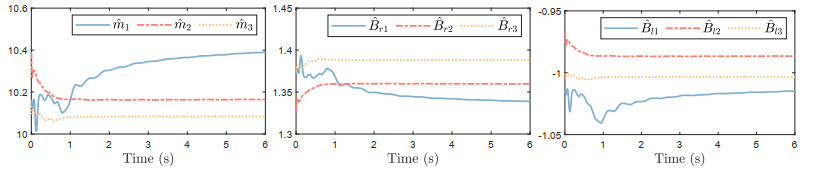
The adaptive parameters $ \hat m, \hat B_r, \hat B_l $ versus time
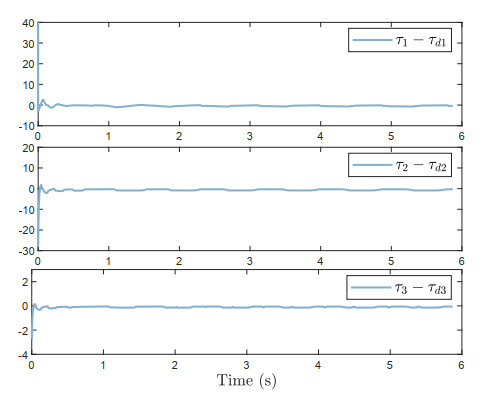
The torque tracking error $ \boldsymbol{\tau}-\boldsymbol{\tau}_d $ of each joint versus time
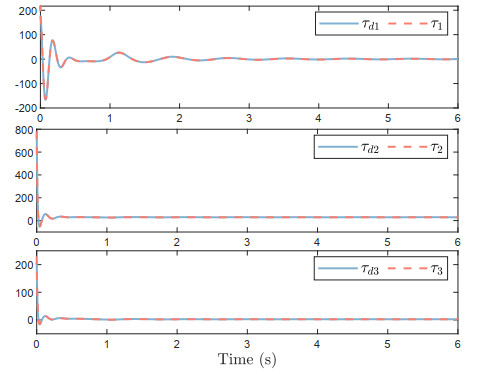
Actual torque output $ \boldsymbol{\tau} $ and desired torque $ \boldsymbol{\tau}_d $ of each joint versus time
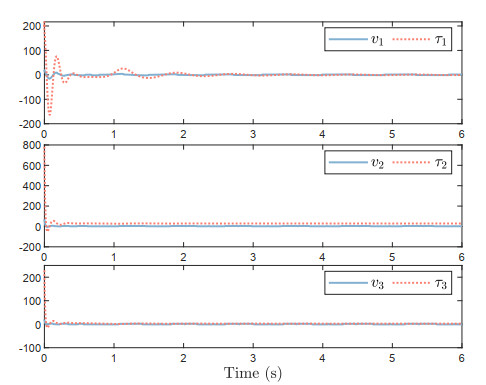
The input and output of the asymmetric backlash actuator versus time
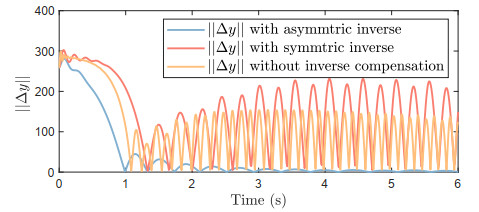
Comparison in terms of image error and convergence time
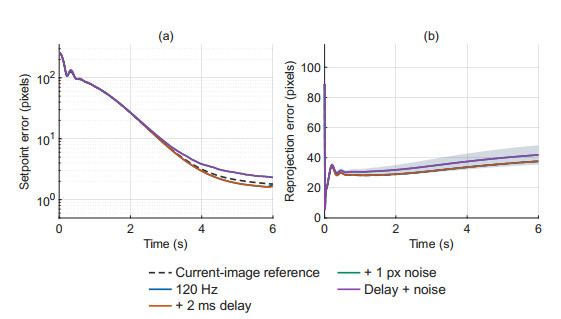
Effect of finite-rate feedback, delay, and pixel noise on (a) image-space regulation and (b) reprojection along the controlled trajectory. Noisy curves show the pointwise mean over three runs, with one standard deviation shaded. Statistics use the full-resolution records
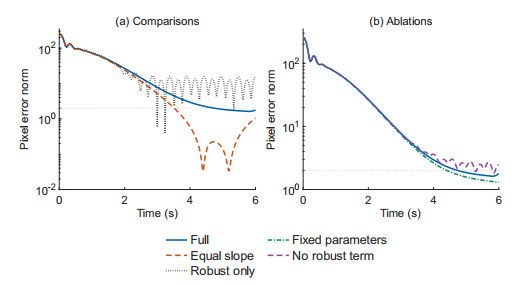
Supplementary sampled-data comparisons: (a) full controller, equal-slope inverse, and robust compensation only; (b) module ablations. The initial estimates and common settings are specified in this subsection; the horizontal dotted line denotes two pixels




 DownLoad: