Frailty models are widely used in survival analysis to account for unobserved heterogeneity among individuals. Although the gamma distribution is the most commonly adopted frailty model because of its analytical tractability, alternative distributions may provide greater modeling flexibility while preserving convenient inferential properties. In this paper, we introduce a frailty model based on the exponentiated exponential distribution as an alternative to the classical gamma frailty. The proposed frailty is reparameterized to have unit mean, ensuring model identifiability and a common population interpretation. Closed-form expressions are derived for the frailty variance, Laplace transform, and population-level survival, density, cumulative distribution, and hazard functions. A unified likelihood-based inference framework is developed, including maximum likelihood estimation, asymptotic inference, confidence intervals, likelihood ratio tests for the presence of frailty, and empirical Bayes prediction of individual frailty effects. The methodology is presented for general survival-model specifications and illustrated for Weibull and log-normal survival models. The finite-sample performance of the proposed estimators is evaluated through an extensive Monte Carlo simulation study under different sample sizes, censoring proportions, survival-model specifications, and heterogeneity levels. The simulation results show generally satisfactory estimation of the regression effects under low and moderate censoring, while also highlighting the greater sensitivity of frailty-variance estimation and individual frailty prediction to severe censoring and distributional misspecification. Overall, the proposed model provides a flexible and analytically tractable alternative to the classical gamma frailty model, without implying systematic superiority of either frailty specification.
Citation: Guillermo Martinez-Florez, Javier Ramirez-Montoya, Rodrigo M. R. de Medeiros. Exponential exponentiated modeling of unobserved heterogeneity: An alternative to gamma frailty[J]. AIMS Mathematics, 2026, 11(11): 38044-38082. doi: 10.3934/math.20261470
Frailty models are widely used in survival analysis to account for unobserved heterogeneity among individuals. Although the gamma distribution is the most commonly adopted frailty model because of its analytical tractability, alternative distributions may provide greater modeling flexibility while preserving convenient inferential properties. In this paper, we introduce a frailty model based on the exponentiated exponential distribution as an alternative to the classical gamma frailty. The proposed frailty is reparameterized to have unit mean, ensuring model identifiability and a common population interpretation. Closed-form expressions are derived for the frailty variance, Laplace transform, and population-level survival, density, cumulative distribution, and hazard functions. A unified likelihood-based inference framework is developed, including maximum likelihood estimation, asymptotic inference, confidence intervals, likelihood ratio tests for the presence of frailty, and empirical Bayes prediction of individual frailty effects. The methodology is presented for general survival-model specifications and illustrated for Weibull and log-normal survival models. The finite-sample performance of the proposed estimators is evaluated through an extensive Monte Carlo simulation study under different sample sizes, censoring proportions, survival-model specifications, and heterogeneity levels. The simulation results show generally satisfactory estimation of the regression effects under low and moderate censoring, while also highlighting the greater sensitivity of frailty-variance estimation and individual frailty prediction to severe censoring and distributional misspecification. Overall, the proposed model provides a flexible and analytically tractable alternative to the classical gamma frailty model, without implying systematic superiority of either frailty specification.

| [1] |
J. W. Vaupel, K. G. Manton, E. Stallard, The impact of heterogeneity in individual frailty on the dynamics of mortality, Demography, 16 (1979), 439–454. https://doi.org/10.2307/2061224 doi: 10.2307/2061224
|
| [2] |
P. Hougaard, Analysis of multivariate survival data, New York: Springer, 2000. https://doi.org/10.1007/978-1-4612-1304-8 |
| [3] |
A. Wienke, Frailty models in survival analysis, New York: Chapman & Hall/CRC, 2011. https://doi.org/10.1201/9781420073911 |
| [4] |
L. Duchateau, P. Janssen, The frailty model, New York: Springer, 2008. https://doi.org/10.1007/978-0-387-72835-3 |
| [5] |
P. Hougaard, Survival models for heterogeneous populations derived from stable distributions, Biometrika, 73 (1986), 387–396. https://doi.org/10.1093/biomet/73.2.387 doi: 10.1093/biomet/73.2.387
|
| [6] |
P. Hougaard, Frailty models for survival data, Lifetime Data Anal., 1 (1995), 255–273. https://doi.org/10.1007/BF00985760 doi: 10.1007/BF00985760
|
| [7] |
A. Wienke, K. G. Arbeev, I. Locatelli, A. I. Yashin, A simulation study of different correlated frailty models and estimation strategies, MPIDR Working Paper, WP-2003-018. https://doi.org/10.4054/MPIDR-WP-2003-018 |
| [8] |
H. Loubna, H. Goual, F. M. Alghamdi, M. S. Mustafa, G. Tekle Mekiso, M. M. Ali, et al., The quasi-xgamma frailty model with survival analysis under heterogeneity problem, validation testing, and risk analysis for emergency care data, Sci. Rep., 14 (2024), 8973. https://doi.org/10.1038/s41598-024-59137-w doi: 10.1038/s41598-024-59137-w
|
| [9] |
M. Xie, J. Zhou, L. Liu, A double exponential gamma-frailty model for clustered survival data, J. Nonparametr. Stat., 37 (2025), 772–795. https://doi.org/10.1080/10485252.2024.2304115 doi: 10.1080/10485252.2024.2304115
|
| [10] |
M. Rahmouni, A logarithmic gamma frailty model for first-failure times with heavy-tailed risk, AIMS Mathematics, 11 (2026), 8945–8965. https://doi.org/10.3934/math.2026369 doi: 10.3934/math.2026369
|
| [11] |
G. Kiprotich, D. I. Gallardo, P. L. Ramos, T. Augustin, A shared frailty regression model for clustered survival data, Stat. Methods Med. Res., 34 (2025), 1385–1412. https://doi.org/10.1177/09622802251338984 doi: 10.1177/09622802251338984
|
| [12] |
G. Kiprotich, D. I. Gallardo, P. L. Ramos, T. Augustin, On a new class of frailty regression models for clustered survival data, J. Stat. Comput. Sim., 96 (2026), 1273–1302. https://doi.org/10.1080/00949655.2025.2584734 doi: 10.1080/00949655.2025.2584734
|
| [13] |
M. Ishag, I. Elbatal, A. Wanjoya, A. Adem, E. Almetwally, A. Afify, A new parametric Yang-Prentice regression model with applications to real-life survival medical data with crossing survival curves, IEEE Access, 13 (2025), 155462–155473. https://doi.org/10.1109/ACCESS.2025.3601730 doi: 10.1109/ACCESS.2025.3601730
|
| [14] |
E. Elsherpieny, A. Abdel-Hakim, Statistical analysis of alpha-power exponential distribution using unified hybrid censored data and its applications, Computational Journal of Mathematical and Statistical Sciences, 4 (2025), 283–315. https://doi.org/10.21608/cjmss.2025.346134.1094 doi: 10.21608/cjmss.2025.346134.1094
|
| [15] |
R. Gupta, D. Kundu, Exponentiated exponential family: an alternative to gamma and Weibull distributions, Biometrical J., 43 (2001), 117–130. https://doi.org/10.1002/1521-4036(200102)43:1<117::AID-BIMJ117>3.0.CO;2-R doi: 10.1002/1521-4036(200102)43:1<117::AID-BIMJ117>3.0.CO;2-R
|
| [16] |
S. Self, K. Liang, Asymptotic properties of maximum likelihood estimators and likelihood ratio tests under nonstandard conditions, J. Am. Stat. Assoc., 82 (1987), 605–610. https://doi.org/10.2307/2289471 doi: 10.2307/2289471
|
| [17] |
Instituto Nacional de Salud, Sistema Nacional de Vigilancia en Salud Pública (SIVIGILA), Instituto Nacional de Salud of Colombia, 2024. Available at: https://www.ins.gov.co/Direcciones/Vigilancia/Paginas/SIVIGILA.aspx. |
Figures(5) / Tables(10)

Guillermo Martinez-Florez, Javier Ramirez-Montoya, Rodrigo M. R. de Medeiros. Exponential exponentiated modeling of unobserved heterogeneity: An alternative to gamma frailty[J]. AIMS Mathematics, 2026, 11(11): 38044-38082. doi: 10.3934/math.20261470

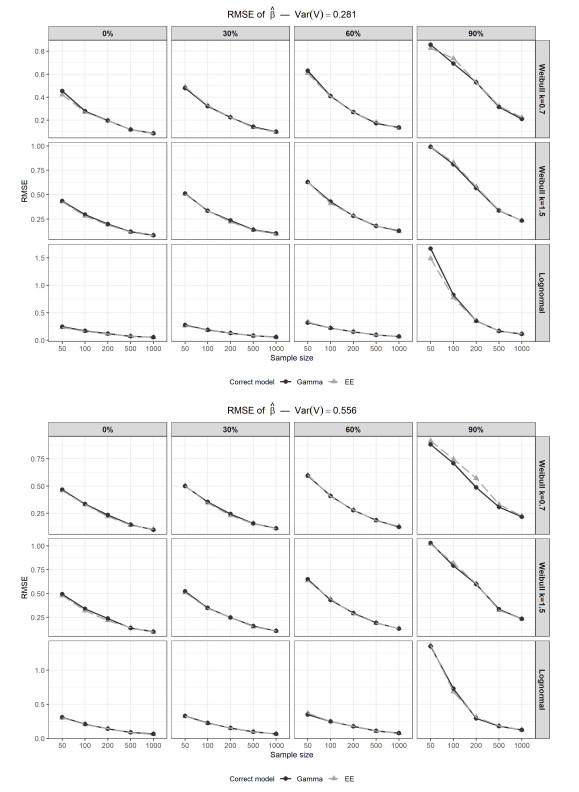
RMSE of the regression parameter estimates
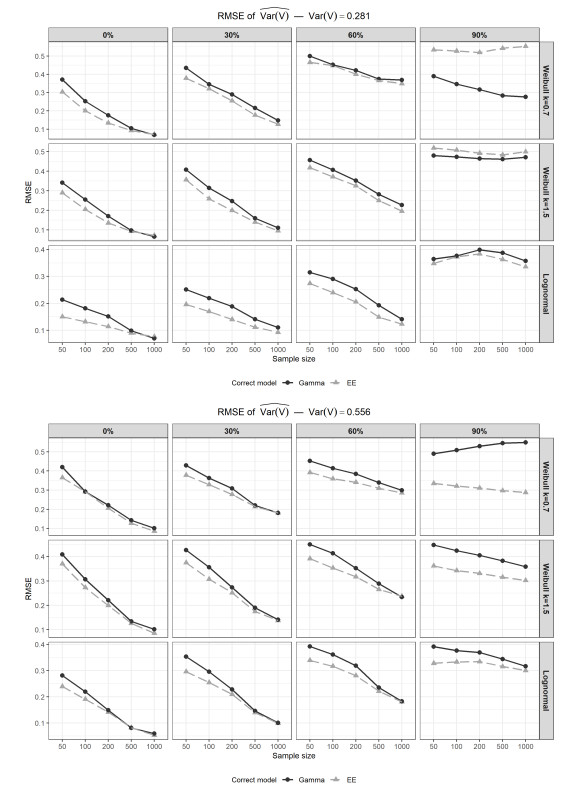
RMSE of the frailty variance estimates
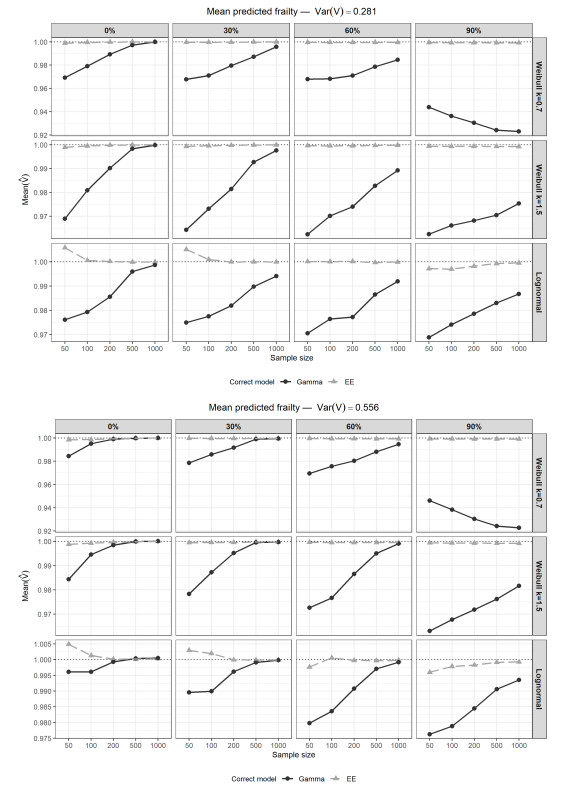
Individual frailty predictions
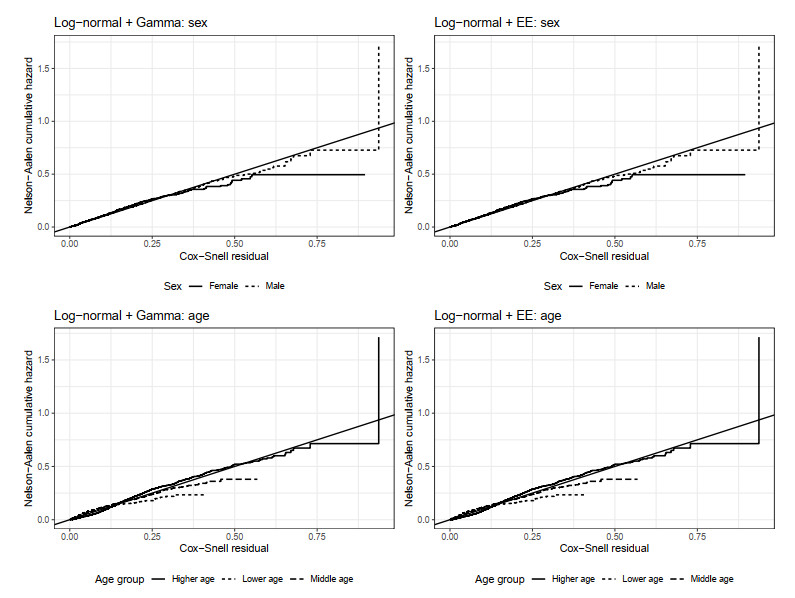
Cox-Snell residual diagnostics for the log-normal gamma and EE frailty models, stratified by sex and age groups. The straight reference line represents the cumulative hazard expected under a unit exponential distribution
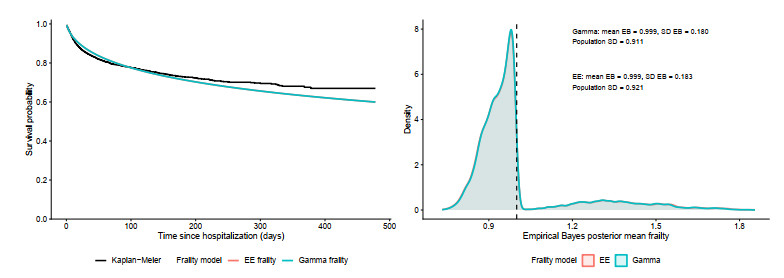
Model adequacy and empirical Bayes frailty predictions for the pulmonary tuberculosis data. Left: fitted marginal survival functions compared with the Kaplan-Meier estimator. Right: distributions of the empirical Bayes posterior mean frailty predictions under the gamma and EE specifications. The concentration of the posterior means around $ V = 1 $, relative to the substantially larger dispersion implied by the fitted population frailty distributions, illustrates the shrinkage associated with limited subject-specific survival information




 DownLoad: