The transition from steady convection to turbulent dynamics in the two-dimensional Rayleigh–Bénard problem with an infinite Prandtl number was investigated by means of high-resolution numerical simulations. The computations were performed using an implicit overlapping Schwarz domain decomposition method combined with Legendre collocation discretizations, allowing accurate resolution of both stationary and strongly unsteady flow regimes. The numerical results revealed the existence of a subcritical transition near $ Ra\approx2.5\times10^5 $, where the classical steady three-roll solution loses stability and gives rise to an intermittent regime. The post-critical dynamics are characterized by the coexistence of two competing flow states: a quasi-laminar four-roll configuration and a plume-dominated three-roll configuration exhibiting small-scale vortical structures and enhanced fluctuation levels. This coexistence generates complex dynamics involving intermittency, multi-stability, and hysteresis over a broad range of Rayleigh numbers. The transition was analyzed through flow visualizations, fluctuation diagnostics, and statistical characterization of the temperature field. Space–time representations and point-wise fluctuation signals revealed alternating episodes associated with the two flow organizations. Statistical analyses showed that Gaussian behavior is recovered only over restricted temporal intervals, whereas longer datasets exhibit non-Gaussian features that are accurately described by Gaussian-mixture models, providing quantitative evidence of the coexistence of multiple dynamical states. The influence of the transition on heat transport was quantified through the Nusselt number. The bifurcation diagrams obtained by forward and backward continuation revealed several hysteresis loops and distinct heat-transfer branches. Interestingly, the quasi-laminar four-roll state systematically produces larger Nusselt numbers than the turbulent state, indicating a more efficient heat-transfer mechanism despite its lower level of flow complexity. Power-law regressions for both branches yielded scaling exponents close to the classical $ Nu\sim Ra^{1/3} $ law. The computed transition thresholds, the hysteresis structure, flow patterns, and scaling laws are in good agreement with previous numerical and experimental studies, supporting both the reliability of the proposed methodology and the physical interpretation of the observed intermittent dynamics.
Citation: Darío Martínez, Henar Herrero, Francisco Pla. Transition to turbulence in an infinite-Prandtl Rayleigh-Bénard problem[J]. AIMS Mathematics, 2026, 11(11): 37024-37049. doi: 10.3934/math.20261431
The transition from steady convection to turbulent dynamics in the two-dimensional Rayleigh–Bénard problem with an infinite Prandtl number was investigated by means of high-resolution numerical simulations. The computations were performed using an implicit overlapping Schwarz domain decomposition method combined with Legendre collocation discretizations, allowing accurate resolution of both stationary and strongly unsteady flow regimes. The numerical results revealed the existence of a subcritical transition near $ Ra\approx2.5\times10^5 $, where the classical steady three-roll solution loses stability and gives rise to an intermittent regime. The post-critical dynamics are characterized by the coexistence of two competing flow states: a quasi-laminar four-roll configuration and a plume-dominated three-roll configuration exhibiting small-scale vortical structures and enhanced fluctuation levels. This coexistence generates complex dynamics involving intermittency, multi-stability, and hysteresis over a broad range of Rayleigh numbers. The transition was analyzed through flow visualizations, fluctuation diagnostics, and statistical characterization of the temperature field. Space–time representations and point-wise fluctuation signals revealed alternating episodes associated with the two flow organizations. Statistical analyses showed that Gaussian behavior is recovered only over restricted temporal intervals, whereas longer datasets exhibit non-Gaussian features that are accurately described by Gaussian-mixture models, providing quantitative evidence of the coexistence of multiple dynamical states. The influence of the transition on heat transport was quantified through the Nusselt number. The bifurcation diagrams obtained by forward and backward continuation revealed several hysteresis loops and distinct heat-transfer branches. Interestingly, the quasi-laminar four-roll state systematically produces larger Nusselt numbers than the turbulent state, indicating a more efficient heat-transfer mechanism despite its lower level of flow complexity. Power-law regressions for both branches yielded scaling exponents close to the classical $ Nu\sim Ra^{1/3} $ law. The computed transition thresholds, the hysteresis structure, flow patterns, and scaling laws are in good agreement with previous numerical and experimental studies, supporting both the reliability of the proposed methodology and the physical interpretation of the observed intermittent dynamics.

| [1] |
G. Ahlers, E. Bodenschatz, D. Funfschilling, J. Hogg, Turbulent Rayleigh-Bénard convection for a Prandtl number of 0.67, J. Fluid. Mech. 641 (2009), 157–167. https://doi.org/10.1017/S0022112009991959 |
| [2] |
F. Alcántara-Ávila, S. Hoyas, Direct numerical simulation of thermal channel flow for medium-high Prandtl numbers up to Re = 2000, Int. J. Heat and Mass Transfer, 176 (2021), 121412. https://doi.org/10.1016/j.ijheatmasstransfer.2021.121412 doi: 10.1016/j.ijheatmasstransfer.2021.121412
|
| [3] |
A. Baïri a, E. Zarco-Pernia, J. M. García de María, A review on natural convection in enclosures for engineering applications, The particular case of the parallelogrammic diode cavity, Appl. Therm. Eng., 63 (2014), 304–322. https://doi.org/10.1016/j.applthermaleng.2013.10.065 doi: 10.1016/j.applthermaleng.2013.10.065
|
| [4] |
H. Bénard, Les tourbillons cellulaires dans une nappe liquide, Rev. Gen. Sci. Pures Appl., 11 (1900), 1261–1271. |
| [5] |
C. Bernardi, Y. Maday, Approximations spectrales des problemes aux limites elliptiques, Berlin: Springer-Verlag, 1992. |
| [6] |
S. Bhattacharya, M. K. Verma, R. Samtaney, Revisiting Reynolds and Nusselt numbers in turbulent thermal convection, Phys. Fluids, 33 (2021), 015113. https://doi.org/10.1063/5.0032498 doi: 10.1063/5.0032498
|
| [7] |
G. Boffetta, R. Ecke, Two-Dimensional Turbulence, Annu. Rev. Fluid Mech., 44 (2012), 427–451. https://doi.org/10.1146/annurev-fluid-120710-101240 |
| [8] |
J. Boussinesq, Theorie analytique de la chaleur, Vol. 2, Gauthier-Villars, 1903. |
| [9] |
C. Canuto, M. Hussaini, A. Quarteroni, T. Zang, Spectral methods in fluid dynamics, Berlin: Springer-Verlag, 1988. https://doi.org/10.1007/978-3-642-84108-8 |
| [10] |
X. Chavanne, F. Chilla, B. Chabaud, B. Castaing, B. Hebral, Turbulent Rayleigh-Bénard convection in gaseous and liquid He, Phys. Fluids, 13 (2001), 1300–1320. https://doi.org/10.1063/1.1355683 doi: 10.1063/1.1355683
|
| [11] |
E. S. C. Ching, C. K. Leung, X. L. Qiu, P. Tong, Intermittency of velocity fluctuations in turbulent thermal convection, Phys. Rev. E, 68 (2003), 026307. https://doi.org/10.1103/PhysRevE.68.026307 doi: 10.1103/PhysRevE.68.026307
|
| [12] |
G. Chini, Exact coherent structures at extreme Reynolds number, J. Fluid Mech., 791 (2016), 97–121. https://doi.org/10.1017/jfm.2016.154 doi: 10.1017/jfm.2016.154
|
| [13] |
M. Caponeri, S. Ciliberto, Thermodynamics aspects of the transition to spatiotemporal chaos, Physica D, 58 (1992), 365–383. |
| [14] |
S. Ciliberto, Several aspects of the transition to spatiotemporal chaos, Ann. Phys., 19 (1994), 715–720. |
| [15] |
P. Constantin, C. Doering, Infinite Prandlt number convection, J. Stat. Phys., 94 (1999), 159–172. https://doi.org/10.1023/A:1004511312885 doi: 10.1023/A:1004511312885
|
| [16] |
G. F. Davies, Dynamic Earth– Plates, Plumes and Mantle Convection, Cambridge: Cambridge University Press, 2000. https://doi.org/10.1017/CBO9780511605802 |
| [17] |
M. Dubois, Experimental aspects of the transition to turbulence in Rayleigh–Bénard convection, Lecture Notes Phys., 164 (2005), 177–191. https://doi.org/10.1007/3-540-11581-1_6 doi: 10.1007/3-540-11581-1_6
|
| [18] |
P. F. Fisher, An overlaping Schwarz method for spectral element solution of the incompressible Navier-Stokes equations, J. Comput. Phys., 133 (1997), 84–101. https://doi.org/10.1006/jcph.1997.5651 doi: 10.1006/jcph.1997.5651
|
| [19] |
S. R. Ghias, G. T. Jarvis, Mantle convetion models with temperature and depth-dependent thermal expansivity, J. Geophys. Res. Solid Earth, 113 (2008), 1–15. https://doi.org/10.1029/2007JB005355 doi: 10.1029/2007JB005355
|
| [20] |
S. Grossmann, D. Lohse, Thermal convection for large Prandtl numbers, Phys. Rev. Lett., 86 (2001), 3316. https://doi.org/10.1103/PhysRevLett.86.3316 doi: 10.1103/PhysRevLett.86.3316
|
| [21] |
H. Herrero, A. M. Mancho, On presssure boundary conditions for thermoconvective problems, Int. J. Numer. Meth. Fluids, 39 (2002), 391–402. https://doi.org/10.1002/fld.317 doi: 10.1002/fld.317
|
| [22] |
H. Herrero, S. Hoyas, A. Donoso, A. M. Mancho, J. M. Chacón, R. F. Portugués, et al., Chebyshev collocation for a convective problem in primitive variable formulation, J. Sci. Comput., 8 (2003), 312–328. https://doi.org/10.1023/A:1022678124929 doi: 10.1023/A:1022678124929
|
| [23] |
H. Herrero, F. Pla, M. Ruiz-Ferrández, A Schwarz Method for a Rayleigh-Bénard Problem, J. Sci. Comput., 78 (2018), 376–392. https://doi.org/10.1007/s10915-018-0771-1 doi: 10.1007/s10915-018-0771-1
|
| [24] |
H. Herrero, Y. Maday, F. Pla. RB (Reduced basis) for RB (Rayleigh-Bénard), Comput. Methods Appl. Mech. Engrg., 261-262 (2013), 132–141. https://doi.org/10.1016/j.cma.2013.02.018 doi: 10.1016/j.cma.2013.02.018
|
| [25] |
X. He, Y. Wang, P. Tong, Dynamic heterogeneity and conditional statistics of non-Gaussian temperature fluctuations in turbulent thermal convection, Phys. Rev. Fluids, 3 (2018), 052401(R). https://doi.org/10.1103/PhysRevFluids.3.052401 doi: 10.1103/PhysRevFluids.3.052401
|
| [26] |
B. Holmedal, Stability of squares and rolls in Rayleigh-Bénard convection in an infinite-Prantl-number fluid between slabs, J. Fluid Mech., 537 (2005), 271–284. https://doi.org/10.1017/S0022112005005240 doi: 10.1017/S0022112005005240
|
| [27] |
S. D. King, C. Lee, P. E. van Keken, W. Leng, S. J. Zhong, E. Tan, et al., A community benchmark for 2-D Cartesian compressible convection in the Earth's mantle, Geophysical J. Int., (2010), 73–87. https://doi.org/10.1111/j.1365-246X.2009.04413.x |
| [28] |
G. L. Kooij, M. A. Botchev, E. M. A. Frederix, B. J. Geurts, S. Horn, D. Lohse, et al., Comparison of computational codes for direct numerical simulations of turbulent Rayleigh-Bénard convection, Comput. Fluids, 166 (2018), 1–8. https://doi.org/10.1016/j.compfluid.2018.01.010 doi: 10.1016/j.compfluid.2018.01.010
|
| [29] |
P. Kooloth, D. Sondak, L. M. Smith, Coherent solutions and transition to turbulence in two-dimensional Rayleigh-Bénard convection, Phys. Rev. Fluids, 6 (2021), 013501. https://doi.org/10.1103/PhysRevFluids.6.013501 doi: 10.1103/PhysRevFluids.6.013501
|
| [30] |
D. Krug, X. Zhu, D. Chung, I. Marusic, R. Verzicco, D. Lohse, Transition to ultimate Rayleigh-Bénard turbulence revealed through extended self-similarity scaling analysis of the temperature structure functions, J. Fluid Mech., (2018), 024502. https://doi.org/10.1017/jfm.2018.561 |
| [31] |
M. Lappa, Thermal convection: patterns, evolution and stability, New York: John Wiley & Sons, 2009. |
| [32] |
H. W. Lilliefros, On the Kolmogorov-Smirnov Test for Normality with Mean and Variance, J. Am. Stat. Assoc., 62 (1967), 399–402. |
| [33] |
A. V. Malevsky, Patterns of convective turbulence- an effect of Prandtl number, Phys. Earth Planet. In., 88 (1995), 31–41. https://doi.org/10.1016/0031-9201(94)05074-8 doi: 10.1016/0031-9201(94)05074-8
|
| [34] |
P. Manneville, Rayleigh-Bénard convection: Thirty years of experimental, theoretical, and modeling work, Centenary Review, 207 (2006), 41–65. https://doi.org/10.1007/978-0-387-25111-0_3 doi: 10.1007/978-0-387-25111-0_3
|
| [35] |
D. Martínez, H. Herrero, F. Pla, 2D Newton Schwarz Legendre collocation method for a convection problem, Mathematics, 10 (2022), 3718. https://doi.org/10.3390/math10193718 doi: 10.3390/math10193718
|
| [36] |
D. Martínez, F. Pla, H. Herrero, A. Fernández-Pérez, A Schwarz alternating method for an evolution convection problem, Appl. Num. Math., 192 (2023), 179–196. https://doi.org/10.1016/j.apnum.2023.06.007 doi: 10.1016/j.apnum.2023.06.007
|
| [37] |
D. Martínez, H. Herrero, F. Pla, Implicit Schwarz domain decomposition method for a Rayleigh-Bénard problem, J. Comput. Appl. Math., 470 (2025), 116718. https://doi.org/10.1016/j.cam.2025.116718 doi: 10.1016/j.cam.2025.116718
|
| [38] |
L. N. Moresi, V. S. Solomatov, Numerical investigation of 2D convection with extremely large viscosity variations, Phys. Fluids, 7 (1995), 2154–2162. https://doi.org/10.1063/1.868465 doi: 10.1063/1.868465
|
| [39] |
M. C. Navarro, D. Castaño, H. Herrero, Thermoconvective instabilities to explain the main characteristics of a dust devil-like vortex, Physica D, 308 (2015), 109–115. https://doi.org/10.1016/j.physd.2015.06.010 doi: 10.1016/j.physd.2015.06.010
|
| [40] |
J. Niemela, L. Skrbek, K. Sreenivasan, R. Donnelly, Turbulent convection at very high Rayleigh numbers, Nature, 404 (2000), 837–840. https://doi.org/10.1038/35009036 doi: 10.1038/35009036
|
| [41] |
A. Nikolaenko, G. Ahlers, Nusselt number measurements for turbulent Rayleigh-Bénard convection, Phys. Rev. Lett., 91 (2003), 084501. https://doi.org/10.1103/PhysRevLett.91.084501 doi: 10.1103/PhysRevLett.91.084501
|
| [42] |
F. Otto, C. Seis, Rayleigh-Bénard convection: Improved bounds on the Nusselt number, J. Math. Phys., 52 (2011), 083702. https://doi.org/10.1063/1.3623417 doi: 10.1063/1.3623417
|
| [43] |
A. Pandey, M. K. Verma, A. G. Chatterjee, B. Dutta, Similarities between 2D and 3D convection for large Prandtl number, Pramana-J. Phys., 87 (2016), 1–10. https://doi.org/10.1007/s12043-016-1204-z doi: 10.1007/s12043-016-1204-z
|
| [44] |
F. Pla, A. M. Mancho, H. Herrero, Bifurcation phenomena in a convection problem with temperature dependent viscosity at low aspect ratio, Physica D, 238 (2009), 572–280. https://doi.org/10.1016/j.physd.2008.12.015 doi: 10.1016/j.physd.2008.12.015
|
| [45] |
E. P. van der Poel, R. J. A. M. Stevens, D. Lohse, Comparison between two- and three-dimensional Rayleigh-Bénard convection, J. Fluid Mech., 736 (2013), 177–194. https://doi.org/10.1017/jfm.2013.488 doi: 10.1017/jfm.2013.488
|
| [46] |
J. D. M. Rademacher, R. Welter, Energetic consistency and heat transport in Fourier-Galerkin truncations of free slip 3D rotating convection, Nonlinearity, 39 (2025), 075010. https://doi.org/10.48550/arXiv.2505.07678 doi: 10.48550/arXiv.2505.07678
|
| [47] |
P. Ho-Liu, B. H. Hager, A. Raefsky, An improved method of Nusselt number calculation, Geophys. J. Int., 88 (1987), 205–215. https://doi.org/10.1111/j.1365-246X.1987.tb01375.x doi: 10.1111/j.1365-246X.1987.tb01375.x
|
| [48] |
K. R. Rajagopal, M. Ruzicka, A. R. Srinivasa, On the Oberbeck-Boussinesq approximation, Math. Mod. Meth. Appl. Sci., 6 (1996), 1157–1167. https://doi.org/10.1142/S0218202596000481 doi: 10.1142/S0218202596000481
|
| [49] |
J. D. Scheel, M. S. Emran, J. Schumaker, Resolving the fine-scale structure in turbulent Rayleigh-Bénard convection, New J. Phys., 15 (2013), 113063. https://doi.org/10.1088/1367-2630/15/11/113063 doi: 10.1088/1367-2630/15/11/113063
|
| [50] |
J. Schmalzl, M. Breuer, U. Hansen, On the validity of two-dimensional numerical approaches to time-dependent thermal convection, Europhys. Lett., 67 (2004), 390–396. https://doi.org/10.1209/epl/i2003-10298-4 doi: 10.1209/epl/i2003-10298-4
|
| [51] |
G. Schubert, D. L. Turcotte, P. Olson, Mantle Convection in the Earth and Planets, Cambridge: Cambridge University Press, 2009. |
| [52] |
O. Shishkina, S. Horn, S. Wagner, E. S. C. Ching, Thermal boundary layer equation for turbulent Rayleigh-Bénard convection, Phys. Rev. Lett., 114 (2015), 114302. https://doi.org/10.1103/PhysRevLett.114.114302 doi: 10.1103/PhysRevLett.114.114302
|
| [53] |
E. D. Siggia, High Rayleigh number convection, Annu. Rev. Fluid Mech., 26 (1994), 137–168. https://doi.org/10.1146/annurev.fl.26.010194.001033 doi: 10.1146/annurev.fl.26.010194.001033
|
| [54] |
J. C. Strikwerda, Finite Difference Schemes for Partial Differential Equations, Philadelphia: SIAM, 1989. |
| [55] |
D. L. Turcotte, Convection, Reviews of Geophysics, 17 (1979), 1090–1098. |
| [56] |
R. Verzicco, P. Orlandi, A finite-difference scheme for three-dimensional incompressible flow in cylindrical coordinates, J. Comput. Phys., 123 (1996), 402–414. https://doi.org/10.1006/jcph.1996.0033 doi: 10.1006/jcph.1996.0033
|
| [57] |
Y. Wang, X. Z. He, P. E. Tong, Turbulent temperature fluctuations in a closed Rayleigh-Bénard convection cell, J. Fluid Mech., 874 (2019), 263–284. https://doi.org/10.1017/jfm.2019.405 doi: 10.1017/jfm.2019.405
|
| [58] |
H. G. Weller, G. Tabor, H. Jasak, C. Fureby, A tensorial approach to computational continuum mechanics using object.oriented techniques, Comput. Phys., 12 (1998), 620–631. https://doi.org/10.1063/1.168744 doi: 10.1063/1.168744
|
| [59] |
Y. C. Xie, G. Y. Ding, K. Q. Xia, Flow Topology Transition via Global Bifurcation in Thermally Driven Turbulence, Phys. Rev. Lett., 120 (2018), 214501. https://doi.org/10.1103/PhysRevLett.120.214501 doi: 10.1103/PhysRevLett.120.214501
|
| [60] |
V. Yakhot, 4/5 Kolmogorov law for statistically stationary turbulence- Application to high Rayleigh number Bénard convection, Phys. Rev. Lett., 69 (1992), 769–771. https://doi.org/10.1103/PhysRevLett.69.769 doi: 10.1103/PhysRevLett.69.769
|
| [61] |
T. Yanagita, K. Kaneko, Rayleigh-Bénard convection-patterns, chaos, spatiotemporal chaos and turbulence, Physica D, 82 (1995), 288–313. https://doi.org/10.1016/0167-2789(94)00233-G doi: 10.1016/0167-2789(94)00233-G
|
| [62] |
S. Zaleski, P. Lallemand, Scaling laws and intermittency in phase turbulence, J. Physique Lett., 46 (1985), 793–797. https://doi.org/10.1051/jphyslet:019850046017079300 doi: 10.1051/jphyslet:019850046017079300
|
| [63] |
Q. Zhou, C. Sun, K. Q. Xia, Experimental investigation of homogeneity, isotropy, and circulation of the velocity field in buoyancy-driven turbulence, J. Fluid Mech., 598 (2008), 361–372. https://doi.org/10.1017/S0022112008000189 doi: 10.1017/S0022112008000189
|
Figures(19) / Tables(1)

Darío Martínez, Henar Herrero, Francisco Pla. Transition to turbulence in an infinite-Prandtl Rayleigh-Bénard problem[J]. AIMS Mathematics, 2026, 11(11): 37024-37049. doi: 10.3934/math.20261431

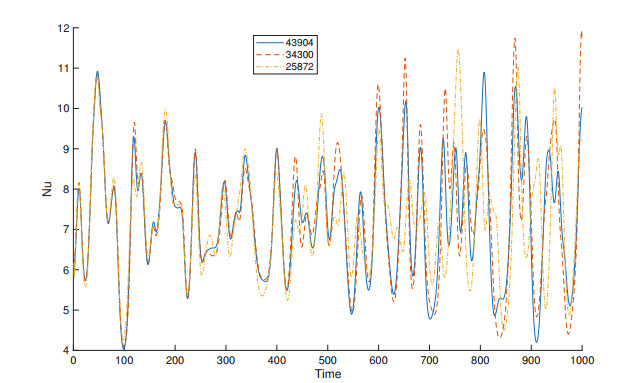
$ Nu(t) $ defined by Eq (4.3), for $ Ra = 2.5 \times 10^5 $, at different numbers of mesh points
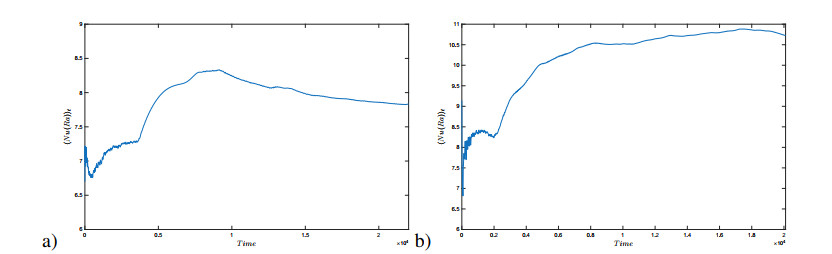
Mean value of the Nusselt number depending on time. a) $ Ra = 2.5 \times 10^5 $, b) $ Ra = 4.0 \times 10^5 $
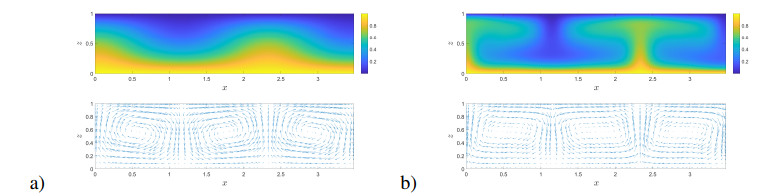
Color maps of the numerical temperature (top) and numerical velocity fields (bottom) at a) $ Ra = 1300 $; b) $ Ra = 2.49 \times 10^5 $
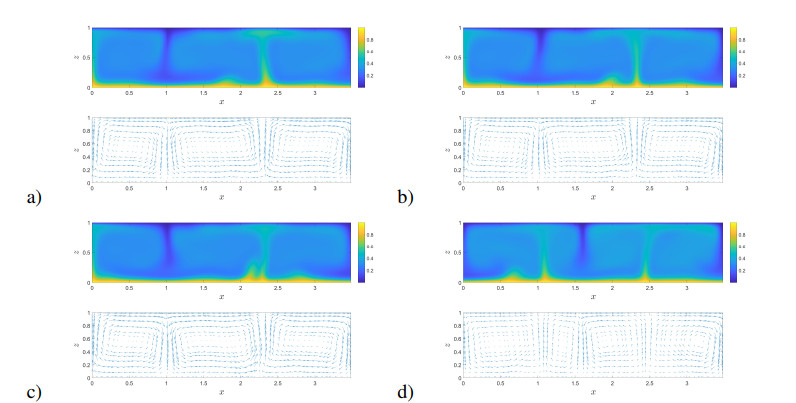
Color maps of the numerical temperature (top) and numerical velocity fields (bottom) at $ Ra = 2.5 \times 10^5 $ and successive times. The process depicted is the generation of eddies and plumes at the bottom
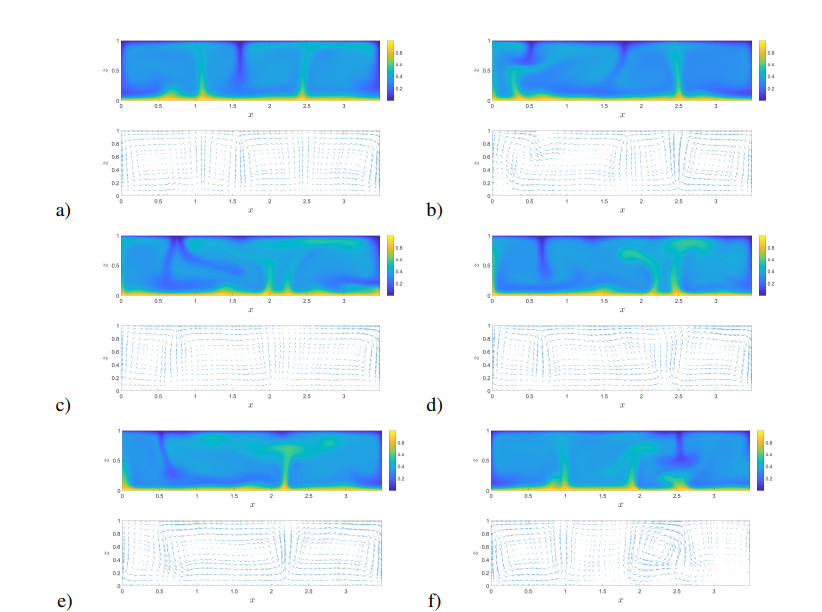
Color maps of the numerical temperature (top) and numerical velocity field (bottom) at $ t = 5 \times 10^5 $ for a) $ Ra = 3.0 \times 10^5 $; b) $ Ra = 3.5 \times 10^5 $; c) $ Ra = 4.0 \times 10^5 $; d) $ Ra = 4.5 \times 10^5 $; e) $ Ra = 5 \times 10^5 $; f) $ Ra = 5.5 \times 10^5 $
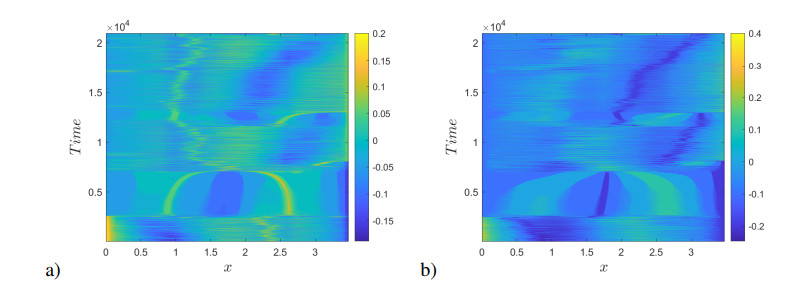
Temperature fluctuations on a horizontal axis over time for $ Ra = 2.5 \times 10^5 $ at a) $ z = 0.0259 $, b) $ z = 0.9741 $
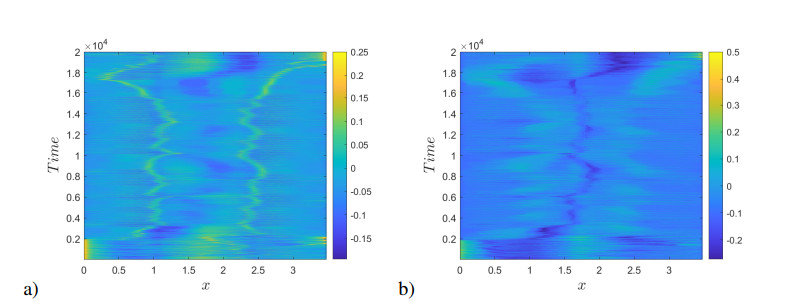
Temperature fluctuations on a horizontal axis over time for $ Ra = 4 \times 10^5 $ at a) $ z = 0.0259 $, b) $ z = 0.9741 $
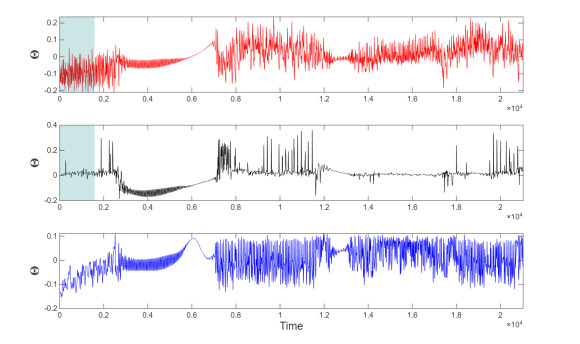
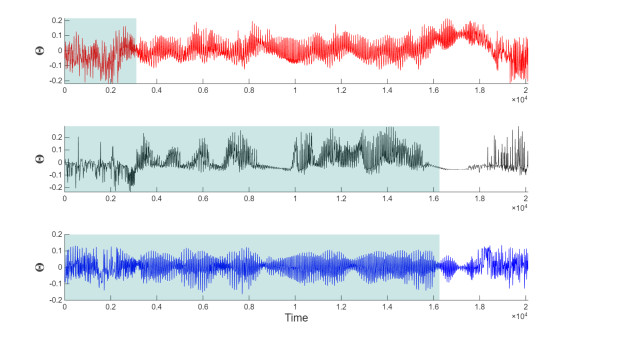
Temperature fluctuations at three representative locations in the computational domain for $ Ra = 2.5\times 10^{5} $. The red curve corresponds to the point $ (x, z) = (1.3374, 0.9741) $, located near the upper boundary; the black curve corresponds to $ (x, z) = (1.7278, 0.4772) $, located in the central region of the domain; and the blue curve corresponds to $ (x, z) = (1.052, 0.0259) $, located near the lower boundary
Temperature fluctuations at three representative locations in the computational domain for $ Ra = 4 \times 10^{5} $. The red curve corresponds to the point $ (x, z) = (2.7413, 0.9741) $, located near the upper boundary; the black curve corresponds to $ (x, z) = (2.3668, 0.4772) $, located in the central region of the domain; and the blue curve corresponds to $ (x, z) = (2.8996, 0.0259) $, located near the lower boundary
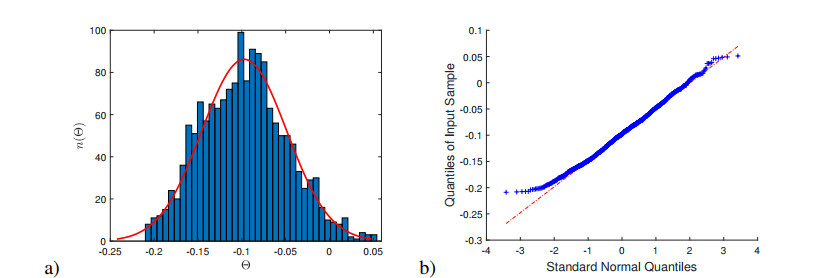
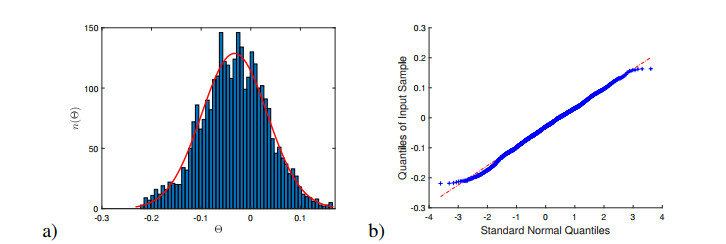
a) Histogram of the temperature fluctuation at $ (x, z) = (1.3374, 0.9741) $ over the time interval $ 0 \le t \le1586\, h $, b) Q–Q plot of the same data
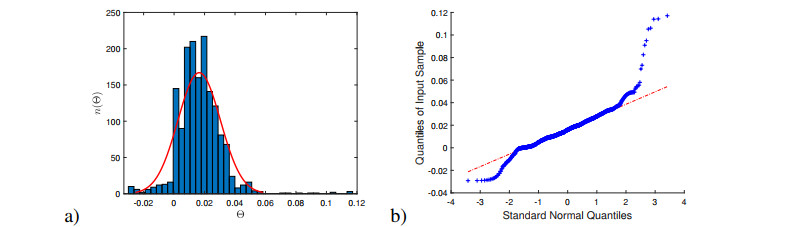
a) Histogram of the temperature fluctuation at $ (x, z) = (1.7278, 0.4772) $ over the time interval $ 0 \le t \le1586\, h $, b) Q–Q plot of the same data. $ Ra = 2.5 \times 10^5 $
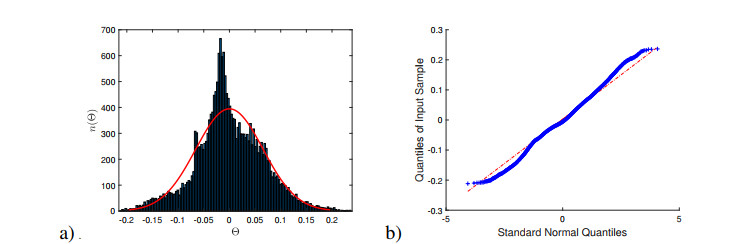
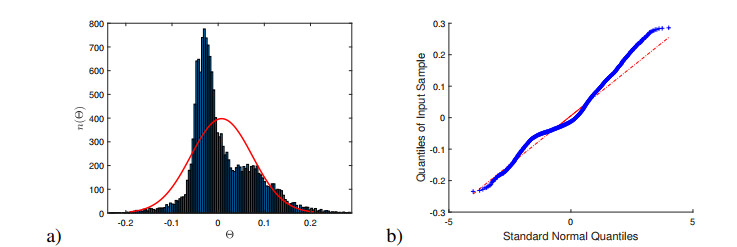
a) Histogram of the temperature fluctuation at $ (x, z) = (1.3374, 0.9741) $ over the time interval $ 0 \le t \le 21033\, h $, b) Q–Q plot of the same data. $ Ra = 2.5 \times 10^5 $
a) Histogram of the temperature fluctuation at $ (x, z) = (2.7413, 0.9741) $ over the time interval $ 0 \le t \le3111\, h $, b) Q–Q plot of the same data. $ Ra = 4.0 \times 10^5 $
a) Histogram of the temperature fluctuation at $ (x, z) = (2.3668, 0.4772) $ over the time interval $ 0 \le t \le16260\, h $, b) Q–Q plot of the same data. $ Ra = 4.0 \times 10^5 $
a) Histogram of the temperature fluctuation at $ (x, z) = (2.8996, 0.0259) $ over the time interval $ 0 \le t \le16260\, h $, b) Q–Q plot of the same data. $ Ra = 4.0 \times 10^5 $
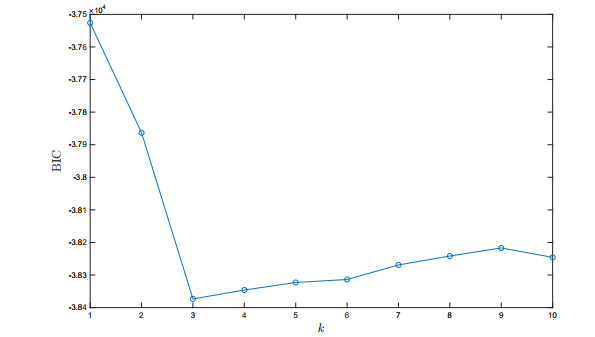
BIC depending on the number of clusters $ k $ for the data of the temperature fluctuation at $ (x, z) = (1.3374, 0.9741) $ over the time interval $ 8000\, h\le t\le21033\, h $ at $ Ra = 2.5 \times 10^5 $
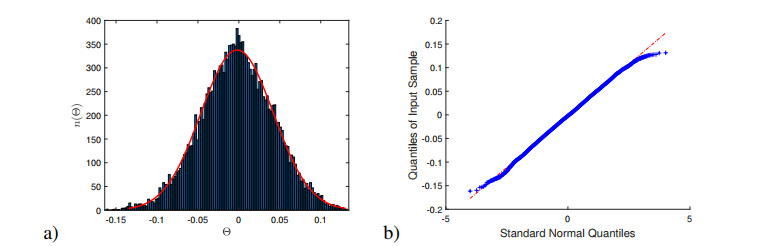
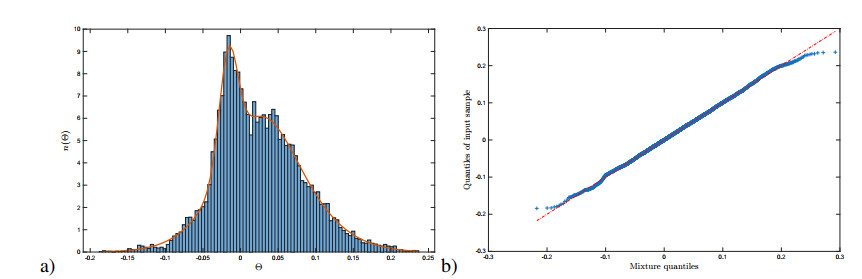
a) Histogram for data of the temperature fluctuation at $ (x, z) = (1.3374, 0.9741) $ over the time interval $ 8000\, h\le t\le21033\, h $ at $ Ra = 2.5 \times 10^5 $ and the best fit of a 3-Gaussian mixture, b) Q–Q plot of the same data
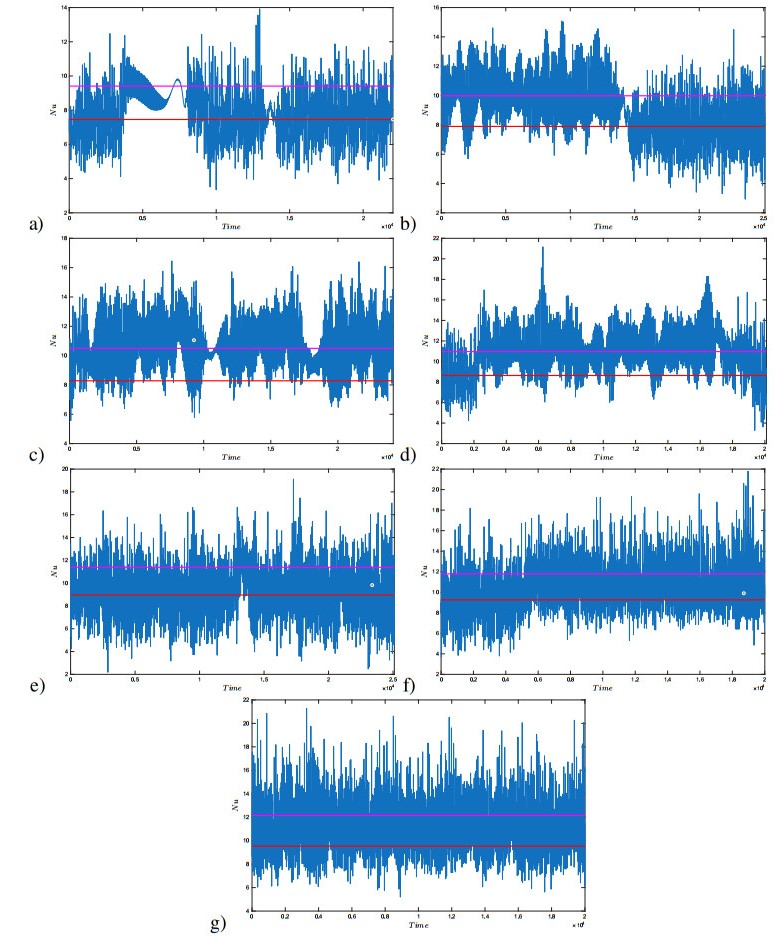
Time series of the Nusselt number $ Nu(t) $ for increasing values of the Rayleigh number. The horizontal lines represent the mean heat-transfer rates associated with the quasi-laminar four-roll regime and the plume-dominated turbulent regime. The alternation between both levels reflects the intermittent character of the solutions and the coexistence of competing dynamical states. a) $ Ra = 2.5\times10^5 $; b) $ Ra = 3.0\times10^5 $; c) $ Ra = 3.5\times10^5 $; d) $ Ra = 4.0\times10^5 $; e) $ Ra = 4.5\times10^5 $; f) $ Ra = 5.0\times10^5 $; g) $ Ra = 5.5\times10^5 $
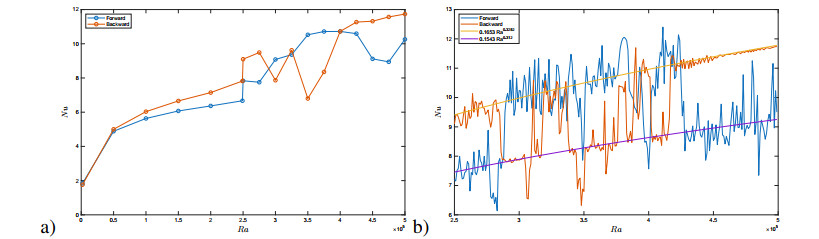
Bifurcation diagrams of the time-averaged Nusselt number $ Nu(Ra) $ defined by Eq (4.4). Blue curves correspond to forward continuation (increasing $ Ra $), whereas red curves correspond to backward continuation (decreasing $ Ra $). a) Global bifurcation diagram in the interval $ 0\le Ra\le5\times10^5 $ using continuation steps of $ 0.5\times10^5 $. b) Enlarged view of the interval $ 2.5\times10^5\le Ra\le5\times10^5 $ obtained with continuation steps of $ 10^3 $. The divergence between forward and backward branches reveals the presence of hysteresis and multistability, associated with the coexistence of quasi-laminar and turbulent flow regimes




 DownLoad: