A singularity-regularized radial basis function extreme learning machine (RBF-ELM) is proposed for second-order singular initial and boundary value problems of Lane-Emden-Fowler type. The trial solution is constructed so that the prescribed initial or boundary conditions hold exactly, and the collocation residual extends continuously to the origin, for every weight vector. The classical limiting form of the equation at the singular point therefore enters the least-squares problem as an ordinary collocation equation, with no penalty term and no offset parameter. The centers are fixed before training, and only the output weights are determined. The shape parameter is selected from a small candidate set by an off-node residual criterion. Linear problems reduce to a minimum-norm least-squares computation, and nonlinear problems reduce to a damped Newton iteration with an analytic Jacobian. A conditional convergence result is established for linear initial value problems under a residual-regularity hypothesis, for which a sufficient condition on the coefficient norm is given. For nonlinear problems, no convergence guarantee is available, and the results are empirical. Gaussian, multiquadric, and inverse multiquadric kernels are compared on six benchmark problems spanning linear and nonlinear, homogeneous and nonhomogeneous, initial value and boundary value formulations. Across the 18 kernel-problem combinations, the maximum error at 20 centers is of order $ 10^{-11} $ to $ 10^{-8} $, and the limiting residual at the origin remains small at every refinement level. Under refinement, the error decreases rapidly and then levels off close to the rounding level of the computed coefficients. This plateau is consistent with a finite-precision floor set by rank truncation and rounding. The effective numerical rank never exceeds 11 of 20.
Citation: Neslișah İmamoğlu Karabaș. A physics-informed singularity-regularized radial basis function extreme learning machine for Lane-Emden-Fowler equations[J]. AIMS Mathematics, 2026, 11(11): 36904-36947. doi: 10.3934/math.20261426
A singularity-regularized radial basis function extreme learning machine (RBF-ELM) is proposed for second-order singular initial and boundary value problems of Lane-Emden-Fowler type. The trial solution is constructed so that the prescribed initial or boundary conditions hold exactly, and the collocation residual extends continuously to the origin, for every weight vector. The classical limiting form of the equation at the singular point therefore enters the least-squares problem as an ordinary collocation equation, with no penalty term and no offset parameter. The centers are fixed before training, and only the output weights are determined. The shape parameter is selected from a small candidate set by an off-node residual criterion. Linear problems reduce to a minimum-norm least-squares computation, and nonlinear problems reduce to a damped Newton iteration with an analytic Jacobian. A conditional convergence result is established for linear initial value problems under a residual-regularity hypothesis, for which a sufficient condition on the coefficient norm is given. For nonlinear problems, no convergence guarantee is available, and the results are empirical. Gaussian, multiquadric, and inverse multiquadric kernels are compared on six benchmark problems spanning linear and nonlinear, homogeneous and nonhomogeneous, initial value and boundary value formulations. Across the 18 kernel-problem combinations, the maximum error at 20 centers is of order $ 10^{-11} $ to $ 10^{-8} $, and the limiting residual at the origin remains small at every refinement level. Under refinement, the error decreases rapidly and then levels off close to the rounding level of the computed coefficients. This plateau is consistent with a finite-precision floor set by rank truncation and rounding. The effective numerical rank never exceeds 11 of 20.

| [1] |
J. H. Lane, On the theoretical temperature of the sun, Am. J. Sci. Arts, 50 (1870), 57–74. https://doi.org/10.2475/ajs.s2-50.148.57 doi: 10.2475/ajs.s2-50.148.57
|
| [2] |
R. Emden, Gaskugeln: Anwendungen der mechanischen Wärmetheorie auf kosmologische und meteorologische Probleme, Leipzig und Berlin: B. G. Teubner, 1907. https://doi.org/10.1007/BF01736734 |
| [3] |
S. Chandrasekhar, An introduction to the study of stellar structure, New York: Dover Publications, 1957. |
| [4] |
H. T. Davis, Introduction to nonlinear differential and integral equations, Washington: US Government Printing Office, 1961. https://doi.org/10.1017/S0008439500027120 |
| [5] |
S. H. Lin, Oxygen diffusion in a spherical cell with nonlinear oxygen uptake kinetics, J. Theor. Biol., 60 (1976), 449–457. https://doi.org/10.1016/0022-5193(76)90071-0 doi: 10.1016/0022-5193(76)90071-0
|
| [6] |
R. D. Russell, L. F. Shampine, Numerical methods for singular boundary value problems, SIAM J. Numer. Anal., 12 (1975), 13–36. https://doi.org/10.1137/0712002 doi: 10.1137/0712002
|
| [7] |
F. R. de Hoog, R. Weiss, Collocation methods for singular boundary value problems, SIAM J. Numer. Anal., 15 (1978), 198–217. https://doi.org/10.1137/0715013 doi: 10.1137/0715013
|
| [8] |
L. F. Shampine, Singular boundary value problems for ODEs, Appl. Math. Comput., 138 (2003), 99–112. https://doi.org/10.1016/S0096-3003(02)00111-X doi: 10.1016/S0096-3003(02)00111-X
|
| [9] |
J. P. Boyd, Chebyshev spectral methods and the Lane-Emden problem, Numer. Math. Theory Methods Appl., 4 (2011), 142–157. https://doi.org/10.4208/nmtma.2011.42s.2 doi: 10.4208/nmtma.2011.42s.2
|
| [10] |
A. M. Wazwaz, A new algorithm for solving differential equations of Lane-Emden type, Appl. Math. Comput., 118 (2001), 287–310. https://doi.org/10.1016/S0096-3003(99)00223-4 doi: 10.1016/S0096-3003(99)00223-4
|
| [11] |
A. M. Wazwaz, Adomian decomposition method for a reliable treatment of the Emden-Fowler equation, Appl. Math. Comput., 161 (2005), 543–560. https://doi.org/10.1016/j.amc.2003.12.048 doi: 10.1016/j.amc.2003.12.048
|
| [12] |
A. M. Wazwaz, R. Rach, J. S. Duan, A study on the systems of the Volterra integral forms of the Lane-Emden equations by the Adomian decomposition method, Math. Methods Appl. Sci., 37 (2014), 10–19. https://doi.org/10.1002/mma.2776 doi: 10.1002/mma.2776
|
| [13] |
M. S. H. Chowdhury, I. Hashim, Solutions of a class of singular second-order IVPs by homotopy-perturbation method, Phys. Lett. A, 365 (2007), 439–447. https://doi.org/10.1016/j.physleta.2007.02.002 doi: 10.1016/j.physleta.2007.02.002
|
| [14] |
M. S. H. Chowdhury, I. Hashim, Solutions of Emden-Fowler equations by homotopy-perturbation method, Nonlinear Anal. Real World Appl., 10 (2009), 104–115. https://doi.org/10.1016/j.nonrwa.2007.08.017 doi: 10.1016/j.nonrwa.2007.08.017
|
| [15] |
A. S. Bataineh, M. S. M. Noorani, I. Hashim, Homotopy analysis method for singular IVPs of Emden-Fowler type, Commun. Nonlinear Sci. Numer. Simul., 14 (2009), 1121–1131. https://doi.org/10.1016/j.cnsns.2008.02.004 doi: 10.1016/j.cnsns.2008.02.004
|
| [16] |
H. Demir, İ. Ç. Süngü, Numerical solution of a class of nonlinear Emden-Fowler equations by using differential transform method, Çankaya Univ. J. Sci. Eng., 12 (2009), 75–82. |
| [17] |
A. H. Bhrawy, A. S. Alofi, A Jacobi-Gauss collocation method for solving nonlinear Lane-Emden type equations, Commun. Nonlinear Sci. Numer. Simul., 17 (2012), 62–70. https://doi.org/10.1016/j.cnsns.2011.04.025 doi: 10.1016/j.cnsns.2011.04.025
|
| [18] |
R. Singh, V. Guleria, M. Singh, Haar wavelet quasilinearization method for numerical solution of Emden-Fowler type equations, Math. Comput. Simul., 174 (2020), 123–133. https://doi.org/10.1016/j.matcom.2020.02.004 doi: 10.1016/j.matcom.2020.02.004
|
| [19] |
S. Gümgüm, Taylor wavelet solution of linear and nonlinear Lane-Emden equations, Appl. Numer. Math., 158 (2020), 44–53. https://doi.org/10.1016/j.apnum.2020.07.019 doi: 10.1016/j.apnum.2020.07.019
|
| [20] |
C. S. Liu, E. R. El-Zahar, C. W. Chang, A boundary shape function iterative method for solving nonlinear singular boundary value problems, Math. Comput. Simul., 187 (2021), 614–629. https://doi.org/10.1016/j.matcom.2021.03.030 doi: 10.1016/j.matcom.2021.03.030
|
| [21] |
I. E. Lagaris, A. Likas, D. I. Fotiadis, Artificial neural networks for solving ordinary and partial differential equations, IEEE Trans. Neural Netw., 9 (1998), 987–1000. https://doi.org/10.1109/72.712178 doi: 10.1109/72.712178
|
| [22] |
M. Raissi, P. Perdikaris, G. E. Karniadakis, Physics-informed neural networks: a deep learning framework for solving forward and inverse problems involving nonlinear partial differential equations, J. Comput. Phys., 378 (2019), 686–707. https://doi.org/10.1016/j.jcp.2018.10.045 doi: 10.1016/j.jcp.2018.10.045
|
| [23] |
B. Zhang, G. Wu, Y. Gu, X. Wang, F. Wang, Multi-domain physics-informed neural network for solving forward and inverse problems of steady-state heat conduction in multilayer media, Phys. Fluids, 34 (2022), 116116. https://doi.org/10.1063/5.0116038 doi: 10.1063/5.0116038
|
| [24] |
X. Huang, F. Wang, B. Zhang, H. Liu, Enriched physics-informed neural networks for dynamic Poisson-Nernst-Planck systems, Math. Comput. Simul., 237 (2025), 231–246. https://doi.org/10.1016/j.matcom.2025.04.037 doi: 10.1016/j.matcom.2025.04.037
|
| [25] |
F. Wang, X. Li, H. Liu, L. Qiu, X. Yue, An adaptive method of fundamental solutions using physics-informed neural networks, Eng. Anal. Bound. Elem., 178 (2025), 106295. https://doi.org/10.1016/j.enganabound.2025.106295 doi: 10.1016/j.enganabound.2025.106295
|
| [26] |
G. B. Huang, Q. Y. Zhu, C. K. Siew, Extreme learning machine: theory and applications, Neurocomputing, 70 (2006), 489–501. https://doi.org/10.1016/j.neucom.2005.12.126 doi: 10.1016/j.neucom.2005.12.126
|
| [27] |
V. Dwivedi, B. Srinivasan, Physics informed extreme learning machine (PIELM)–-a rapid method for the numerical solution of partial differential equations, Neurocomputing, 391 (2020), 96–118. https://doi.org/10.1016/j.neucom.2019.12.099 doi: 10.1016/j.neucom.2019.12.099
|
| [28] |
F. Calabrò, G. Fabiani, C. Siettos, Extreme learning machine collocation for the numerical solution of elliptic PDEs with sharp gradients, Comput. Methods Appl. Mech. Eng., 387 (2021), 114188. https://doi.org/10.1016/j.cma.2021.114188 doi: 10.1016/j.cma.2021.114188
|
| [29] |
S. Dong, Z. Li, Local extreme learning machines and domain decomposition for solving linear and nonlinear partial differential equations, Comput. Methods Appl. Mech. Eng., 387 (2021), 114129. https://doi.org/10.1016/j.cma.2021.114129 doi: 10.1016/j.cma.2021.114129
|
| [30] |
S. Dong, J. Yang, On computing the hyperparameter of extreme learning machines: algorithm and application to computational PDEs, and comparison with classical and high-order finite elements, J. Comput. Phys., 463 (2022), 111290. https://doi.org/10.1016/j.jcp.2022.111290 doi: 10.1016/j.jcp.2022.111290
|
| [31] |
E. Schiassi, R. Furfaro, C. Leake, M. De Florio, H. Johnston, D. Mortari, Extreme theory of functional connections: a fast physics-informed neural network method for solving ordinary and partial differential equations, Neurocomputing, 457 (2021), 334–356. https://doi.org/10.1016/j.neucom.2021.06.015 doi: 10.1016/j.neucom.2021.06.015
|
| [32] |
G. Fabiani, F. Calabrò, L. Russo, C. Siettos, Numerical solution and bifurcation analysis of nonlinear partial differential equations with extreme learning machines, J. Sci. Comput., 89 (2021), 44. https://doi.org/10.1007/s10915-021-01650-5 doi: 10.1007/s10915-021-01650-5
|
| [33] |
G. Fabiani, E. Galaris, L. Russo, C. Siettos, Parsimonious physics-informed random projection neural networks for initial value problems of ODEs and index-1 DAEs, Chaos, 33 (2023), 043128. https://doi.org/10.1063/5.0135903 doi: 10.1063/5.0135903
|
| [34] |
M. Liu, W. Peng, M. Hou, Z. Tian, Radial basis function neural network with extreme learning machine algorithm for solving ordinary differential equations, Soft Comput., 27 (2023), 3955–3964. https://doi.org/10.1007/s00500-022-07529-3 doi: 10.1007/s00500-022-07529-3
|
| [35] |
S. Mall, S. Chakraverty, Chebyshev neural network based model for solving Lane-Emden type equations, Appl. Math. Comput., 247 (2014), 100–114. https://doi.org/10.1016/j.amc.2014.08.085 doi: 10.1016/j.amc.2014.08.085
|
| [36] |
S. Mall, S. Chakraverty, Numerical solution of nonlinear singular initial value problems of Emden-Fowler type using Chebyshev neural network method, Neurocomputing, 149 (2015), 975–982. https://doi.org/10.1016/j.neucom.2014.07.036 doi: 10.1016/j.neucom.2014.07.036
|
| [37] |
S. Chakraverty, S. Mall, Single layer Chebyshev neural network model with regression-based weights for solving nonlinear ordinary differential equations, Evol. Intell., 13 (2020), 687–694. https://doi.org/10.1007/s12065-020-00383-y doi: 10.1007/s12065-020-00383-y
|
| [38] |
S. Mall, S. Chakraverty, Application of Legendre neural network for solving ordinary differential equations, Appl. Soft Comput., 43 (2016), 347–356. https://doi.org/10.1016/j.asoc.2015.10.069 doi: 10.1016/j.asoc.2015.10.069
|
| [39] |
Y. Yang, M. Hou, J. Luo, A novel improved extreme learning machine algorithm in solving ordinary differential equations by Legendre neural network methods, Adv. Differ. Equ., 2018 (2018), 469. https://doi.org/10.1186/s13662-018-1927-x doi: 10.1186/s13662-018-1927-x
|
| [40] |
Y. Yang, Y. Wu, M. Hou, J. Luo, X. Xie, Solving Emden-Fowler equations using improved extreme learning machine algorithm based on block Legendre basis neural network, Neural Process. Lett., 55 (2023), 7135–7154. https://doi.org/10.1007/s11063-023-11254-9 doi: 10.1007/s11063-023-11254-9
|
| [41] |
A. H. Hadian-Rasanan, D. Rahmati, S. Gorgin, K. Parand, A single layer fractional orthogonal neural network for solving various types of Lane-Emden equation, New Astron., 75 (2020), 101307. https://doi.org/10.1016/j.newast.2019.101307 doi: 10.1016/j.newast.2019.101307
|
| [42] |
A. Verma, M. Kumar, Numerical solution of Lane-Emden type equations using multilayer perceptron neural network method, Int. J. Appl. Comput. Math., 5 (2019), 141. https://doi.org/10.1007/s40819-019-0728-6 doi: 10.1007/s40819-019-0728-6
|
| [43] |
S. N. Kurmanç, M. Özavşar, Single-layer Laguerre neural network model for solving Lane-Emden-Fowler type equations, Math. Commun., 30 (2025), 243–258. https://doi.org/10.64785/mc.30.2.8 doi: 10.64785/mc.30.2.8
|
| [44] |
Z. Zheng, H. Yuan, J. He, A physics-informed neural network model combined Pell-Lucas polynomials for solving the Lane-Emden type equation, Eur. Phys. J. Plus, 139 (2024), 223. https://doi.org/10.1140/epjp/s13360-024-04999-2 doi: 10.1140/epjp/s13360-024-04999-2
|
| [45] |
M. Babaei, H. Dana Mazraeh, K. Parand, MB-PIRNN: matrix-based physics-informed recurrent neural network for solving Lane-Emden type equation, Soft Comput., 30 (2026), 4427–4446. https://doi.org/10.1007/s00500-025-10966-5 doi: 10.1007/s00500-025-10966-5
|
| [46] |
H. Baty, Modelling Lane-Emden type equations using physics-informed neural networks, Astron. Comput., 44 (2023), 100734. https://doi.org/10.1016/j.ascom.2023.100734 doi: 10.1016/j.ascom.2023.100734
|
| [47] |
N. Mai-Duy, T. Tran-Cong, Numerical solution of differential equations using multiquadric radial basis function networks, Neural Netw., 14 (2001), 185–199. https://doi.org/10.1016/S0893-6080(00)00095-2 doi: 10.1016/S0893-6080(00)00095-2
|
| [48] |
K. Parand, S. Hashemi, RBF-DQ method for solving non-linear differential equations of Lane-Emden type, Ain Shams Eng. J., 9 (2018), 615–629. https://doi.org/10.1016/j.asej.2016.03.010 doi: 10.1016/j.asej.2016.03.010
|
| [49] |
H. Wendland, Scattered data approximation, Cambridge: Cambridge University Press, 2005. https://doi.org/10.1017/CBO9780511617539 |
| [50] |
R. L. Hardy, Multiquadric equations of topography and other irregular surfaces, J. Geophys. Res., 76 (1971), 1905–1915. https://doi.org/10.1029/JB076i008p01905 doi: 10.1029/JB076i008p01905
|
| [51] |
C. A. Micchelli, Interpolation of scattered data: distance matrices and conditionally positive definite functions, Constr. Approx., 2 (1986), 11–22. https://doi.org/10.1007/BF01893414 doi: 10.1007/BF01893414
|
| [52] |
F. J. Narcowich, J. D. Ward, H. Wendland, Sobolev error estimates and a Bernstein inequality for scattered data interpolation via radial basis functions, Constr. Approx., 24 (2006), 175–186. https://doi.org/10.1007/s00365-005-0624-7 doi: 10.1007/s00365-005-0624-7
|
| [53] |
R. A. Adams, J. J. F. Fournier, Sobolev spaces, Amsterdam: Academic Press / Elsevier, 2003. |
| [54] |
A. M. Wazwaz, The variational iteration method for solving nonlinear singular boundary value problems arising in various physical models, Commun. Nonlinear Sci. Numer. Simul., 16 (2011), 3881–3886. https://doi.org/10.1016/j.cnsns.2011.02.026 doi: 10.1016/j.cnsns.2011.02.026
|
| [55] |
R. Schaback, Error estimates and condition numbers for radial basis function interpolation, Adv. Comput. Math., 3 (1995), 251–264. https://doi.org/10.1007/BF02432002 doi: 10.1007/BF02432002
|
| [56] |
S. Rippa, An algorithm for selecting a good value for the parameter $c$ in radial basis function interpolation, Adv. Comput. Math., 11 (1999), 193–210. https://doi.org/10.1023/A:1018975909870 doi: 10.1023/A:1018975909870
|
| [57] |
G. E. Fasshauer, J. G. Zhang, On choosing "optimal" shape parameters for RBF approximation, Numer. Algorithms, 45 (2007), 345–368. https://doi.org/10.1007/s11075-007-9072-8 doi: 10.1007/s11075-007-9072-8
|
| [58] |
B. Fornberg, E. Larsson, N. Flyer, Stable computations with Gaussian radial basis functions, SIAM J. Sci. Comput., 33 (2011), 869–892. https://doi.org/10.1137/09076756X doi: 10.1137/09076756X
|


Figures(13) / Tables(12)

Neslișah İmamoğlu Karabaș. A physics-informed singularity-regularized radial basis function extreme learning machine for Lane-Emden-Fowler equations[J]. AIMS Mathematics, 2026, 11(11): 36904-36947. doi: 10.3934/math.20261426

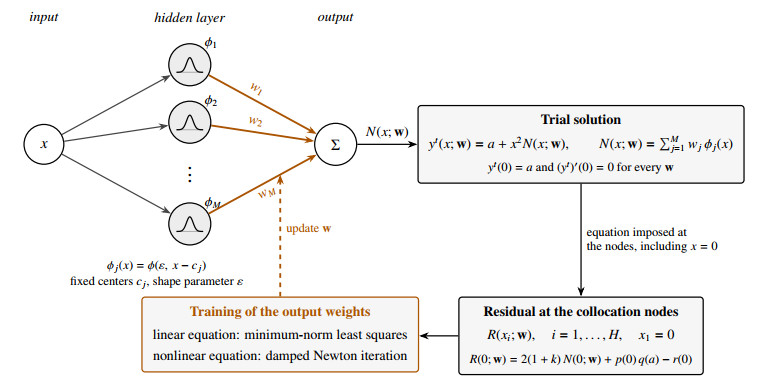
Structure of the radial basis function neural network
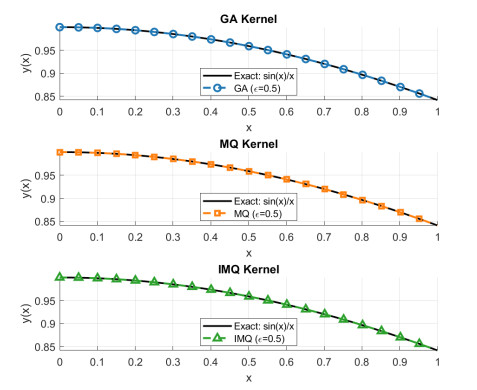
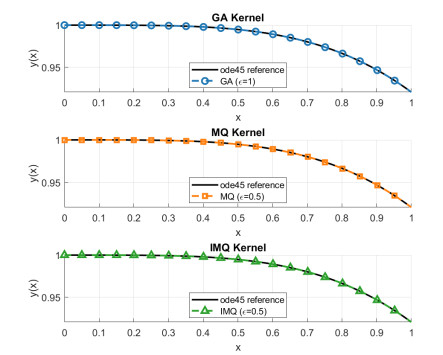
Approximate solutions obtained by the GA (top), MQ (middle), and IMQ (bottom) kernels compared with the exact solution for Example 1
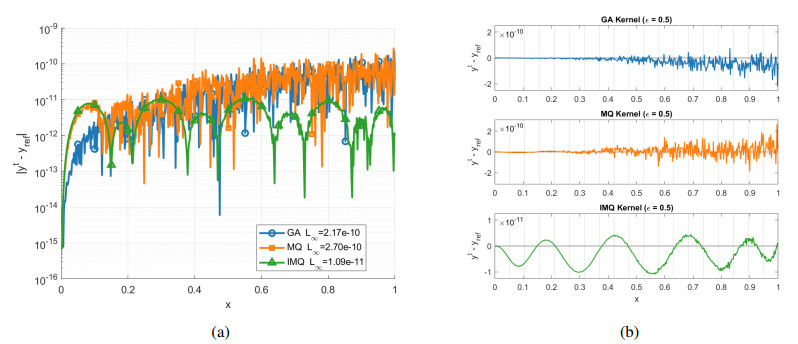
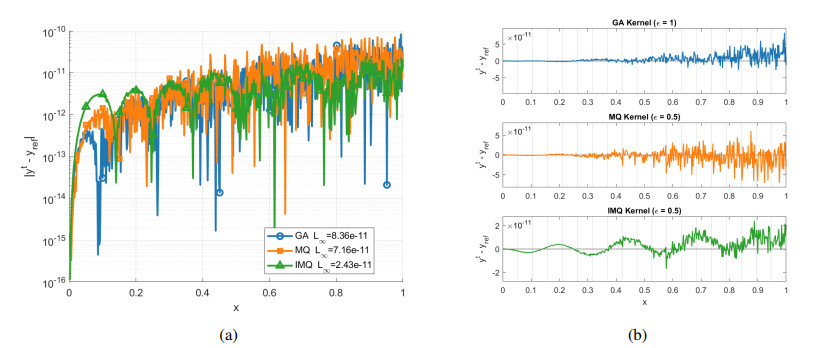
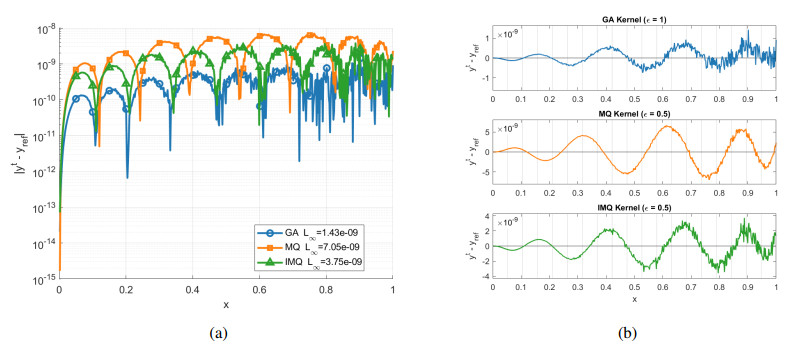
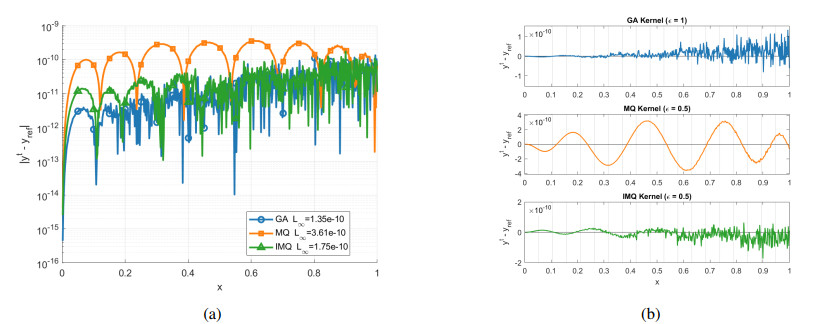
Pointwise error for the GA, MQ, and IMQ kernels applied to Example 1. Panel (a) shows $ |y^{t}-y_{\mathrm{ref}}| $ on a logarithmic scale, and panel (b) shows the signed error $ y^{t}-y_{\mathrm{ref}} $ on a linear scale, in units of the factor shown in each panel, with grey lines at the collocation nodes. The error at $ x = 0 $ is exactly zero, since the initial value is built into the trial solution, and is not shown in (a)
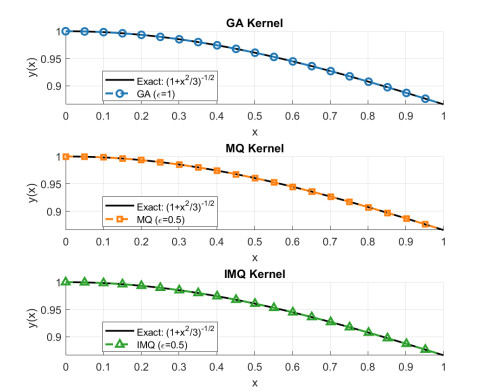
Approximate solutions obtained by the GA, MQ, and IMQ kernels compared with the exact solution (5.6) for Example 2
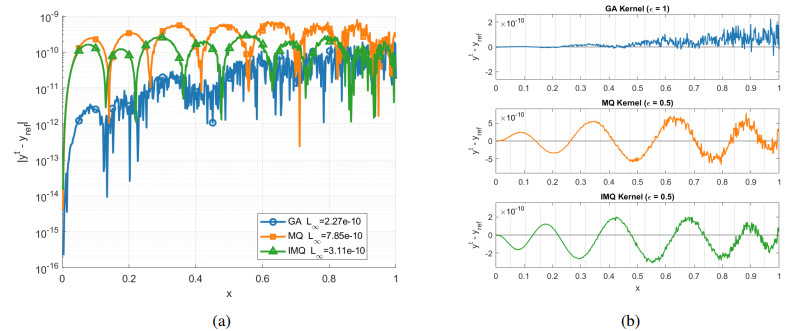
Pointwise error for the GA, MQ, and IMQ kernels applied to Example 2. Panel (a) shows $ |y^{t}-y_{\mathrm{ref}}| $ on a logarithmic scale, and panel (b) shows the signed error $ y^{t}-y_{\mathrm{ref}} $ on a linear scale, in units of the factor shown in each panel, with grey lines at the collocation nodes. The error at $ x = 0 $ is exactly zero, since the initial value is built into the trial solution, and is not shown in (a)
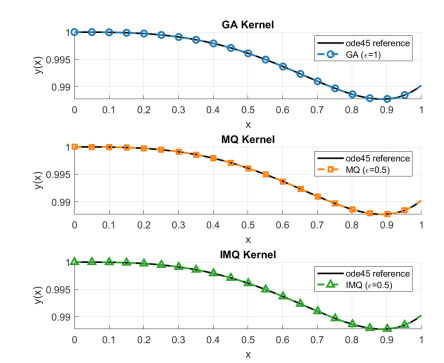
Approximate solutions obtained by the GA, MQ, and IMQ kernels compared with the ode45] reference solution for Example 3
Pointwise error for the GA, MQ, and IMQ kernels applied to Example 3. Panel (a) shows $ |y^{t}-y_{\mathrm{ref}}| $ on a logarithmic scale, and panel (b) shows the signed error $ y^{t}-y_{\mathrm{ref}} $ on a linear scale, in units of the factor shown in each panel, with grey lines at the collocation nodes. The error at $ x = 0 $ is exactly zero, since the initial value is built into the trial solution, and is not shown in (a)
Approximate solutions obtained by the GA, MQ, and IMQ kernels compared with the ode45 reference solution for Example 4
Pointwise error for the GA, MQ, and IMQ kernels applied to Example 4. Panel (a) shows $ |y^{t}-y_{\mathrm{ref}}| $ on a logarithmic scale, and panel (b) shows the signed error $ y^{t}-y_{\mathrm{ref}} $ on a linear scale, in units of the factor shown in each panel, with grey lines at the collocation nodes. The error at $ x = 0 $ is exactly zero, since the initial value is built into the trial solution, and is not shown in (a)
Approximate solutions obtained by the GA, MQ, and IMQ kernels compared with the exact solution for Example 5
Pointwise error for the GA, MQ, and IMQ kernels applied to Example 5. Panel (a) shows $ |y^{t}-y_{\mathrm{ref}}| $ on a logarithmic scale, and panel (b) shows the signed error $ y^{t}-y_{\mathrm{ref}} $ on a linear scale, in units of the factor shown in each panel, with grey lines at the collocation nodes. The error at $ x = 0 $ is exactly zero, since the initial value is built into the trial solution, and is not shown in (a)
Approximate solutions obtained by the GA, MQ, and IMQ kernels compared with the bvp4c reference solution for Example 6
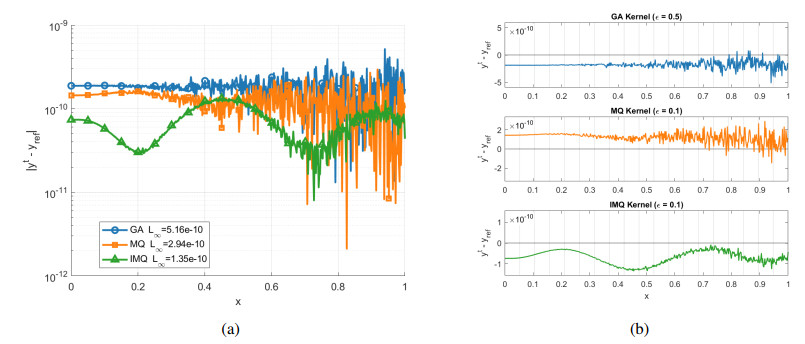
Pointwise error for the GA, MQ, and IMQ kernels applied to Example 6. Panel (a) shows $ |y^{t}-y_{\mathrm{ref}}| $ on a logarithmic scale, and panel (b) shows the signed error $ y^{t}-y_{\mathrm{ref}} $ on a linear scale, in units of the factor shown in each panel, with grey lines at the collocation nodes




 DownLoad: