Pricing strategies are critical to a business's success. Still, their effects are hard to study because many factors influence a product's price, including customer behavior, promotions, demand, inventory, and market diversity. This research presents a new approach to distribution-aware causal pricing optimization (DCPO) that moves beyond evaluating pricing strategies by averages. The new approach integrates the diversity of pricing strategies and their effects on different levels of business performance into one unified framework. The new approach provides four new methods for research. First, it models pricing strategies and their effects at the treatment level using response and propensity models, along with doubly robust and orthogonal estimation, to reduce confounding and modeling error. Second, the new approach models pricing strategy effects at lower and higher levels of business performance, including the mean and median. Third, a new approach to causal pricing DCPO, is presented. The new objective function evaluates pricing strategies by rewarding average causal business improvement and penalizing variability in treatment across quantiles of business performance. The new approach to pricing strategy evaluation is integrated into a unified framework and assessed along with other methods on the Dunnhumby and Rossmann retail datasets. The new framework yields average treatment-effect estimation errors of 0.084 and 0.089 for the Dunnhumby and Rossmann datasets, respectively. Additionally, the new framework achieves $ R^2 $ values of 0.958 and 0.953 for the Dunnhumby and Rossmann datasets, respectively. Cross-dataset evaluation increases treatment-effect estimation error by only 9.12% and decreases $ R^2 $ by 0.96%. On Dunnhumby, the framework yields an 11.48% revenue improvement, an 11.82% profit improvement, and an 8.54% conversion-rate improvement, with a DCPO of 0.931. Ablation, robustness, and statistical analyses corroborate the importance of the framework's main components.
Citation: Masad A. Alrasheedi. Causal inference and quantile regression for measuring the impact of pricing strategies on business performance[J]. AIMS Mathematics, 2026, 11(10): 35268-35312. doi: 10.3934/math.20261370
Pricing strategies are critical to a business's success. Still, their effects are hard to study because many factors influence a product's price, including customer behavior, promotions, demand, inventory, and market diversity. This research presents a new approach to distribution-aware causal pricing optimization (DCPO) that moves beyond evaluating pricing strategies by averages. The new approach integrates the diversity of pricing strategies and their effects on different levels of business performance into one unified framework. The new approach provides four new methods for research. First, it models pricing strategies and their effects at the treatment level using response and propensity models, along with doubly robust and orthogonal estimation, to reduce confounding and modeling error. Second, the new approach models pricing strategy effects at lower and higher levels of business performance, including the mean and median. Third, a new approach to causal pricing DCPO, is presented. The new objective function evaluates pricing strategies by rewarding average causal business improvement and penalizing variability in treatment across quantiles of business performance. The new approach to pricing strategy evaluation is integrated into a unified framework and assessed along with other methods on the Dunnhumby and Rossmann retail datasets. The new framework yields average treatment-effect estimation errors of 0.084 and 0.089 for the Dunnhumby and Rossmann datasets, respectively. Additionally, the new framework achieves $ R^2 $ values of 0.958 and 0.953 for the Dunnhumby and Rossmann datasets, respectively. Cross-dataset evaluation increases treatment-effect estimation error by only 9.12% and decreases $ R^2 $ by 0.96%. On Dunnhumby, the framework yields an 11.48% revenue improvement, an 11.82% profit improvement, and an 8.54% conversion-rate improvement, with a DCPO of 0.931. Ablation, robustness, and statistical analyses corroborate the importance of the framework's main components.

| [1] |
D. Schultz, J. Stephan, J. Sieber, T. Yeh, M. Kunz, P. Doupe, et al., Causal forecasting for pricing, arXiv, 2023. https://doi.org/10.48550/arXiv.2312.15282 |
| [2] |
D. Simchi-Levi, C. Wang, Pricing experimental design: Causal effect, expected revenue and tail risk, Manag. Sci., 72 (2026), 1157–1174. https://doi.org/10.1287/mnsc.2023.03209 doi: 10.1287/mnsc.2023.03209
|
| [3] |
J. Tang, Z. Qi, E. Fang, C. Shi, Offline feature-based pricing under censored demand: A causal inference approach, Manuf. Serv. Oper. Manag., 27 (2025), 535–553. https://doi.org/10.1287/msom.2024.1061 doi: 10.1287/msom.2024.1061
|
| [4] |
P. Aschersleben, W. J. Steiner, Dynamic pricing using flexible heterogeneous sales response models, OR Spectr., 46 (2024), 29–72. https://doi.org/10.1007/s00291-024-00756-0 doi: 10.1007/s00291-024-00756-0
|
| [5] |
G. Uma Maheswari, S. Sethuraman, S. Ramanan, Contextual bandits for online markdown pricing for e-commerce, In: Proceedings of the 7th joint international conference on data science & management of data (11th ACM IKDD CODS and 29th COMAD), 2024,393–402. https://doi.org/10.1145/3632410.3632448 |
| [6] |
R. Miao, Z. Qi, C. Shi, L. Lin, Personalized pricing with invalid instrumental variables: Identification, estimation, and policy learning, arXiv, 2023. https://doi.org/10.48550/arXiv.2302.12670 |
| [7] |
A. Vomberg, C. Homburg, P. Sarantopoulos, Algorithmic pricing: Effects on consumer trust and price search, Int. J. Res. Mark., 42 (2025), 1166–1186. https://doi.org/10.1016/j.ijresmar.2024.10.006 doi: 10.1016/j.ijresmar.2024.10.006
|
| [8] |
Y. C. Hsu, M. Huber, Y. M. Yen, Doubly robust estimation of direct and indirect quantile treatment-effects with machine learning, arXiv, 2023. https://doi.org/10.48550/arXiv.2307.01049 |
| [9] |
Z. Chen, S. Chen, Z. Qi, X. Chen, Z. Yang, Quantile-optimal policy learning under unmeasured confounding, arXiv, 2025. https://doi.org/10.48550/arXiv.2506.07140 |
| [10] |
Z. Ye, Z. Zhang, D. J. Zhang, H. Zhang, R. Zhang, Deep learning-based causal inference for large-scale combinatorial experiments: Theory and empirical evidence, Manag. Sci., 72 (2026), 5611–5634. https://doi.org/10.1287/mnsc.2024.04625 doi: 10.1287/mnsc.2024.04625
|
| [11] |
Y. Xia, S. Narayanamoorthy, Z. Zhou, J. Mabry, Simulation-based benchmarking of reinforcement learning agents for personalized retail promotions, arXiv, 2024. https://doi.org/10.48550/arXiv.2405.10469 |
| [12] |
D. Aparicio, Z. Metzman, R. Rigobon, The pricing strategies of online grocery retailers, Quant. Mark. Econ., 22 (2024), 1–21. https://doi.org/10.1007/s11129-023-09273-w doi: 10.1007/s11129-023-09273-w
|
| [13] |
C. Glaeser, O. Yapar, Strategic consumer behavior and personalized pricing: A contextual bandit approach for retailers, Kelley Sch. Bus. Res. Pap., 2025. https://doi.org/10.2139/ssrn.5313650 doi: 10.2139/ssrn.5313650
|
| [14] |
R. Koenker, G. Bassett Jr., Regression quantiles, Econometrica, 46 (1978), 33–50. https://doi.org/10.2307/1913643 doi: 10.2307/1913643
|
| [15] |
S. Firpo, C. Pinto, Identification and estimation of distributional impacts of interventions using changes in inequality measures, J. Appl. Econom., 31 (2016), 457–486. https://doi.org/10.1002/jae.2448 doi: 10.1002/jae.2448
|
| [16] |
Y. Zhang, H. Li, G. Ren, Estimating heterogeneous treatment-effects in road safety analysis using generalized random forests, Accid. Anal. Prev., 165 (2022), 106507. https://doi.org/10.1016/j.aap.2021.106507 doi: 10.1016/j.aap.2021.106507
|
| [17] |
S. N. Yousafzai, H. Shahbaz, A. Ali, A. Qamar, I. M. Nasir, S. Tehsin, et al., X-News dataset for online news categorization, Int. J. Intell. Comput. Cybern., 17 (2024), 737–758. https://doi.org/10.1108/IJICC-04-2024-0184 doi: 10.1108/IJICC-04-2024-0184
|
| [18] |
S. N. Yousafzai, I. M. Nasir, S. Tehsin, D. S. Malik, I. Keshta, N. L. Fitriyani, et al., Multi-stage neural network-based ensemble learning approach for wheat leaf disease classification, IEEE Access, 13 (2025), 30101–30116. https://doi.org/10.1109/ACCESS.2025.3541347 doi: 10.1109/ACCESS.2025.3541347
|
| [19] |
S. N. Yousafzai, I. M. Nasir, S. Tehsin, N. L. Fitriyani, M. Syafrudin, FLTrans-Net: Transformer-based feature learning network for wheat head detection, Comput. Electron. Agric., 229 (2025), 109706. https://doi.org/10.1016/j.compag.2024.109706 doi: 10.1016/j.compag.2024.109706
|
| [20] |
S. N. Yousafzai, I. M. Nasir, O. Saidani, R. Ghodhbani, Y. Gu, M. Syafrudin, et al., A multi-scale simplicial transformer with graph attention for facial emotion recognition, Ain Shams Eng. J., 16 (2025), 103584. https://doi.org/10.1016/j.asej.2025.103584 doi: 10.1016/j.asej.2025.103584
|
| [21] |
S. Tehsin, A. Hassan, F. Riaz, I. M. Nasir, DaGAM-Trans: Dual graph attention module-based transformer for offline signature forgery detection, Results Eng., 27 (2025), 106425. https://doi.org/10.1016/j.rineng.2025.106425 doi: 10.1016/j.rineng.2025.106425
|
| [22] |
S. N. Yousafzai, F. N. Al-Wesabi, H. Alsolai, S. A. Ebad, I. M. Nasir, E. Fadhal, et al., Advanced clustering and transfer learning based approach for rice leaf disease segmentation and classification, PeerJ Comput. Sci., 11 (2025), e3018. https://doi.org/10.7717/peerj-cs.3018 doi: 10.7717/peerj-cs.3018
|
| [23] |
S. N. Yousafzai, I. M. Nasir, S. Tehsin, M. A. Khan, J. Ahmad, W. Boulila, A fusion framework of transformer and CNN for non-small cell lung cancer classification, Int. Conf. Smart Syst. Emerg. Technol., 2025,162–173. https://doi.org/10.1007/978-3-031-91235-1_15 |
| [24] |
A. Ahrens, V. Chernozhukov, C. Hansen, D. Kozbur, M. Schaffer, T. Wiemann, An introduction to double/debiased machine learning, arXiv, 2025. https://doi.org/10.48550/arXiv.2504.08324 |
| [25] |
S. Wager, S. Athey, Estimation and inference of heterogeneous treatment-effects using random forests, J. Am. Stat. Assoc., 113 (2018), 1228–1242. https://doi.org/10.1080/01621459.2017.1319839 doi: 10.1080/01621459.2017.1319839
|
| [26] |
E. H. Kennedy, Z. Ma, M. D. McHugh, D. S. Small, Non-parametric methods for doubly robust estimation of continuous treatment effects, J. R. Stat. Soc. Ser. B Stat. Methodol., 79 (2017), 1229–1245. https://doi.org/10.1111/rssb.12212 doi: 10.1111/rssb.12212
|
| [27] |
S. Tang, Y. Fan, X. Liu, Doubly robust estimation for quantile treatment effect, Statistics, 60 (2026), 422–448. https://doi.org/10.1080/02331888.2025.2560504 doi: 10.1080/02331888.2025.2560504
|
| [28] |
S. R. Künzel, J. S. Sekhon, P. J. Bickel, B. Yu, Metalearners for estimating heterogeneous treatment effects using machine learning, Proc. Natl. Acad. Sci. USA, 116 (2019), 4156–4165. https://doi.org/10.1073/pnas.1804597116 doi: 10.1073/pnas.1804597116
|
| [29] |
M. Oprescu, V. Syrgkanis, Z. S. Wu, Orthogonal random forest for causal inference, arXiv, 2019. https://doi.org/10.48550/arXiv.1806.03467 |
| [30] |
N. B. Bhavikatta, N. V. R. Goluguri, Multi dataset LSTM analysis for accurate and sustainable supply chain forecasting, Discov. Sustain., 7 (2026), 508. https://doi.org/10.1007/s43621-026-02828-3 doi: 10.1007/s43621-026-02828-3
|
| [31] |
J. Pearl, Causal inference in statistics: An overview, Stat. Surv., 3 (2009), 96–146. https://doi.org/10.1214/09-SS057 doi: 10.1214/09-SS057
|
Figures(8) / Tables(25)

Masad A. Alrasheedi. Causal inference and quantile regression for measuring the impact of pricing strategies on business performance[J]. AIMS Mathematics, 2026, 11(10): 35268-35312. doi: 10.3934/math.20261370

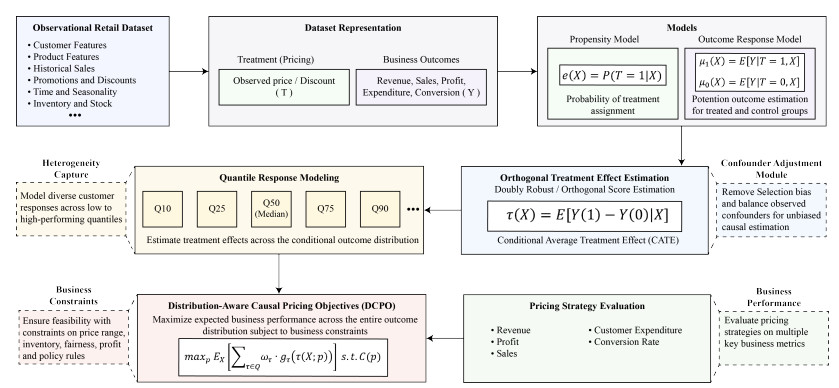
Overall architecture of the proposed DCPO framework
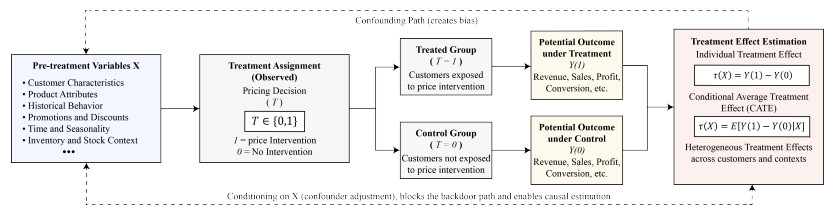
Causal inference workflow for pricing intervention analysis
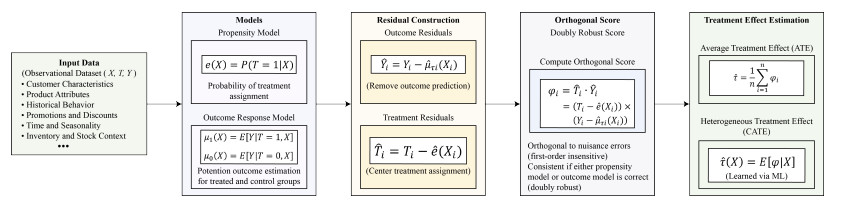
Orthogonal treatment-effect estimation process
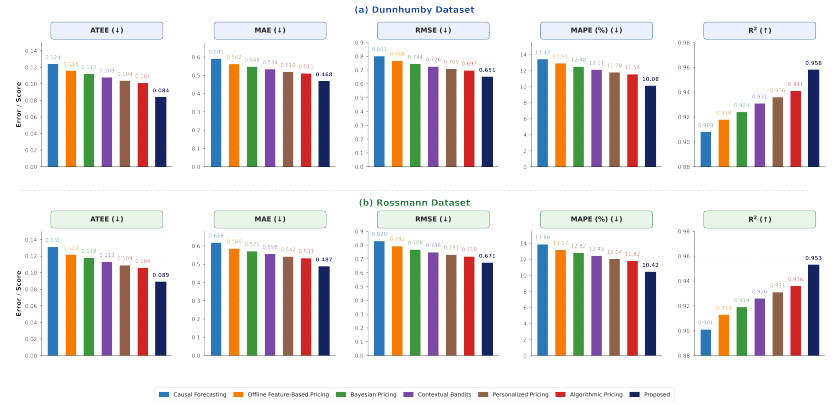
Causal treatment-effect estimation comparison on the benchmark datasets. (a) Performance comparison on the Dunnhumby dataset across ATEE, MAE, RMSE, MAPE, and $ R^2 $. (b) Corresponding performance comparison on the Rossmann dataset using the same evaluation metrics
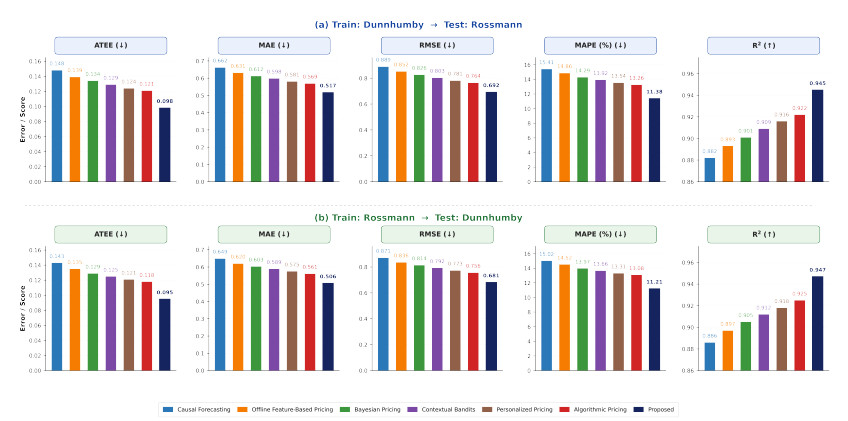
Cross-dataset generalization analysis under dataset transfer evaluation. (a) Performance when trained on the Dunnhumby dataset and tested on the Rossmann dataset across ATEE, MAE, RMSE, MAPE, and $ R^2 $. (b) Performance under the reverse transfer setting, with training on the Rossmann dataset and testing on the Dunnhumby dataset using the same evaluation metrics
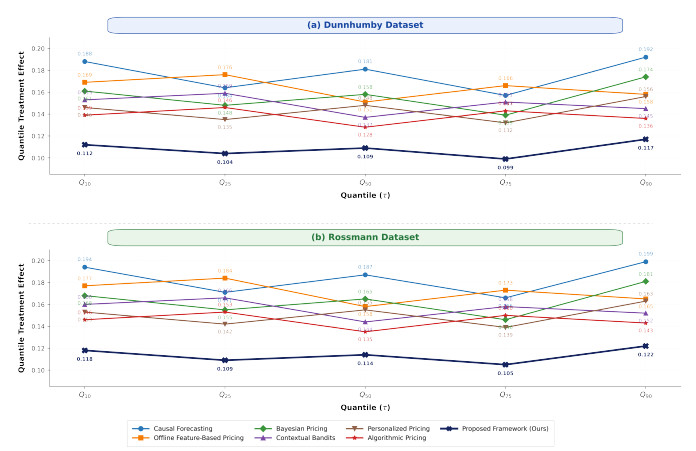
Quantile treatment-effect distribution across business-performance segments. (a) Quantile-specific treatment-effect estimates on the Dunnhumby dataset across Q10, Q25, Q50, Q75, and Q90 for the evaluated pricing methods. (b) Corresponding QTEE on the Rossmann dataset, illustrating method performance across different regions of the business-performance distribution
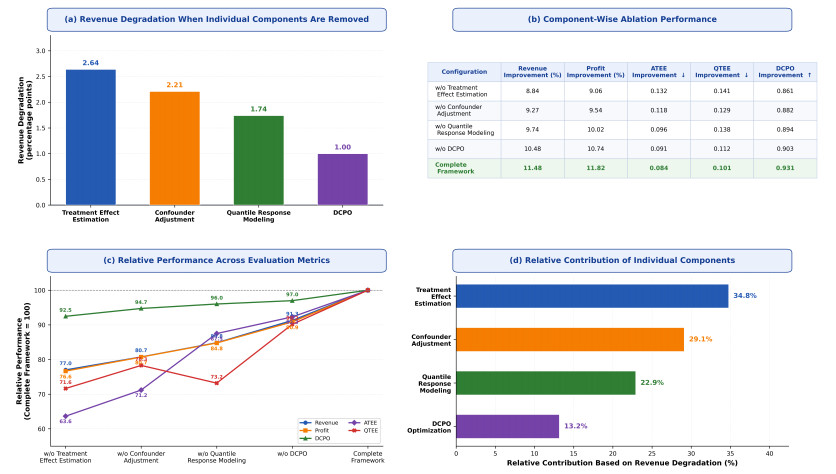
Ablation contribution analysis of the proposed framework. (a) Revenue degradation from removing individual components of the framework, illustrating the contribution of treatment-effect estimation, confounder adjustment, quantile response modeling, and DCPO optimization to performance. (b) Component-wise ablation performance for revenue, profit, ATEE, QTEE, and DCPO metrics. (c) Relative ablation performance across the evaluation metrics with respect to the complete framework. (d) Relative contribution from each component based on the observed revenue degradation
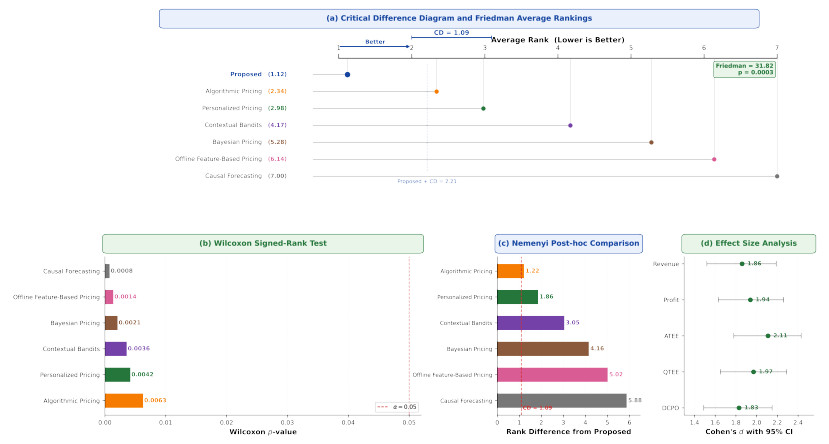
Statistical significance analysis of the proposed framework against competing pricing methods. (a) Critical difference (CD) diagram showing the Friedman average rankings of all evaluated methods, with the proposed framework achieving the best average rank. (b) Wilcoxon signed-rank test results comparing the proposed framework with each competing method based on the corresponding $ p $-values. (c) Nemenyi post-hoc comparison showing the average-rank differences between the proposed framework and competing methods relative to the critical difference threshold. (d) Effect-size analysis using Cohen's $ d $ with 95% confidence intervals across revenue, profit, ATEE, QTEE, and DCPO




 DownLoad: