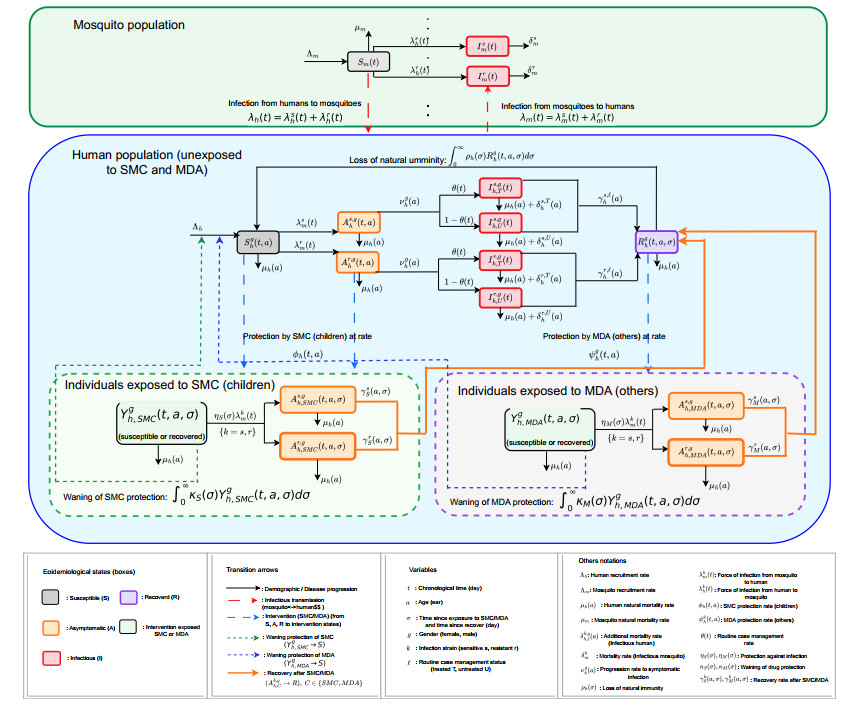
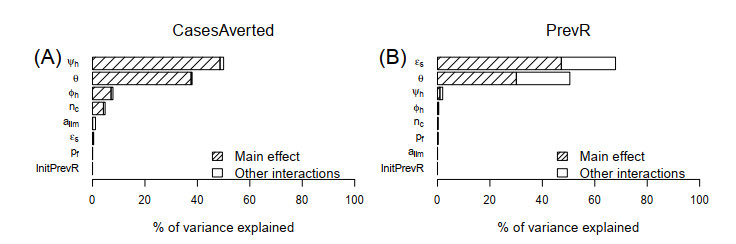
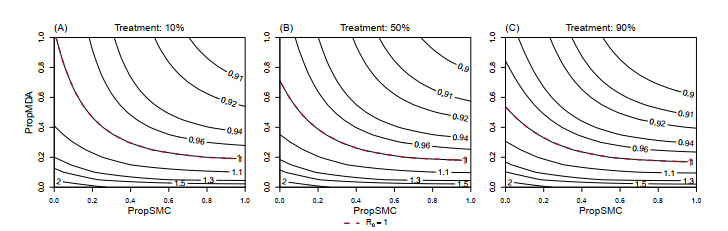
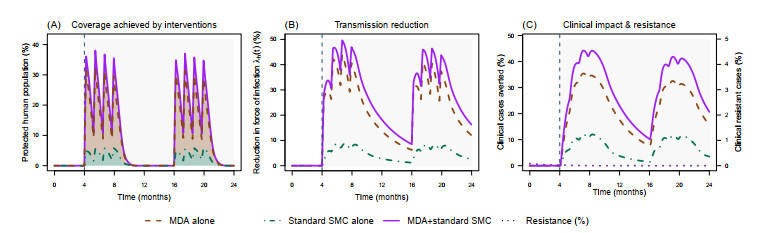
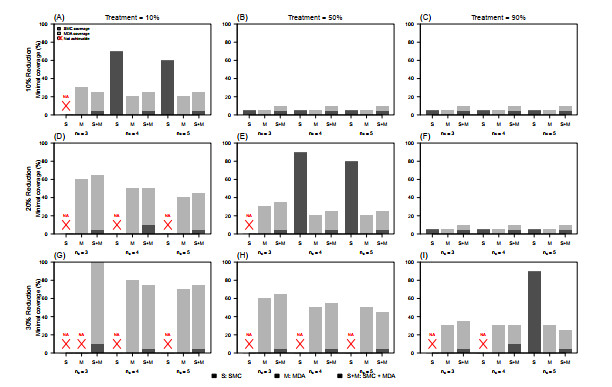
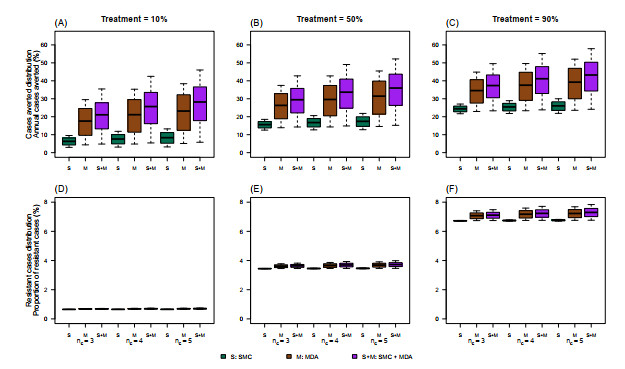
Malaria control is increasingly threatened by antimalarial drug resistance. We develop an age- and sex-structured malaria transmission model integrating drug-sensitive and drug-resistant parasites, routine case management, seasonal malaria chemoprevention (SMC), and mass drug administration (MDA). The main novelty is the joint representation of demographic heterogeneity and time since recovery and intervention exposure, allowing waning immunity and drug efficacy to interact with the interventions' deployment and resistance dynamics. We establish the well-posedness of the model and derive the basic reproduction number $\mathcal{R}_0$ using a next-generation operator. Global sensitivity analysis and scenario-based simulations are used to identify the key drivers of clinical burden and resistance and to compare intervention strategies. Under the constant intervention assumption used for the $\mathcal{R}_0$ analysis, neither SMC nor MDA alone reduces $\mathcal{R}_0$ below unity over the coverage ranges considered, whereas their combination can reduce $\mathcal{R}_0$ below unity. Time-dependent simulations further show that the interventions' coverage, timing, and repeated cycles shape both the clinical impact and resistance dynamics. An optimization framework determines the minimal intervention coverage required to achieve predefined reductions in clinical cases. Overall, the framework provides a mechanistic basis for investigating the epidemiological-evolutionary trade-offs of integrated malaria control strategies.
Citation: Manuela M. Nimpa, Franck J. Dongmo, Charles S. Wondji, Ramsès Djidjou-Demasse. Integrated malaria control and drug resistance in an age- and sex-structured model with seasonal malaria chemoprevention, mass drug administration, and routine case management[J]. AIMS Mathematics, 2026, 11(10): 34907-34945. doi: 10.3934/math.20261359
Malaria control is increasingly threatened by antimalarial drug resistance. We develop an age- and sex-structured malaria transmission model integrating drug-sensitive and drug-resistant parasites, routine case management, seasonal malaria chemoprevention (SMC), and mass drug administration (MDA). The main novelty is the joint representation of demographic heterogeneity and time since recovery and intervention exposure, allowing waning immunity and drug efficacy to interact with the interventions' deployment and resistance dynamics. We establish the well-posedness of the model and derive the basic reproduction number $\mathcal{R}_0$ using a next-generation operator. Global sensitivity analysis and scenario-based simulations are used to identify the key drivers of clinical burden and resistance and to compare intervention strategies. Under the constant intervention assumption used for the $\mathcal{R}_0$ analysis, neither SMC nor MDA alone reduces $\mathcal{R}_0$ below unity over the coverage ranges considered, whereas their combination can reduce $\mathcal{R}_0$ below unity. Time-dependent simulations further show that the interventions' coverage, timing, and repeated cycles shape both the clinical impact and resistance dynamics. An optimization framework determines the minimal intervention coverage required to achieve predefined reductions in clinical cases. Overall, the framework provides a mechanistic basis for investigating the epidemiological-evolutionary trade-offs of integrated malaria control strategies.

| [1] | World Health Organization, Global Malaria Programme operational strategy 2024–2030, Geneva: World Health Organization, 2024. |
| [2] |
M. U. Ferreira, T. Nobrega de Sousa, G. W. Rangel, I. C. Johansen, R. M. Corder, S. Ladeia-Andrade, et al., Monitoring Plasmodium vivax resistance to antimalarials: persisting challenges and future directions, Int. J. Parasitol. Drugs Drug Resist., 15 (2021), 9–24. https://doi.org/10.1016/j.ijpddr.2020.12.001 doi: 10.1016/j.ijpddr.2020.12.001

|
| [3] |
W. Prudhomme O'Meara, D. L. Smith, F. E. McKenzie, Potential impact of intermittent preventive treatment (IPT) on spread of drug-resistant malaria, PLoS Med., 3 (2006), e141. https://doi.org/10.1371/journal.pmed.0030141 doi: 10.1371/journal.pmed.0030141
|
| [4] |
W. Pongtavornpinyo, I. M. Hastings, A. Dondorp, L. J. White, R. J. Maude, S. Saralamba, et al., Probability of emergence of antimalarial resistance in different stages of the parasite life cycle, Evol. Appl., 2 (2009), 52–61. https://doi.org/10.1111/j.1752-4571.2008.00067.x doi: 10.1111/j.1752-4571.2008.00067.x
|
| [5] |
G. G. Mwanga, Mathematical modelling and optimal control of malaria transmission with antimalarial drug and insecticide resistance, J. Biol. Dyn., 19 (2025), 2522345. https://doi.org/10.1080/17513758.2025.2522345 doi: 10.1080/17513758.2025.2522345
|
| [6] |
A. T. Roux, L. Maharaj, O. Oyegoke, O. P. Akoniyon, M. A. Adeleke, R. Maharaj, et al., Chloroquine and sulfadoxine-pyrimethamine resistance in sub-Saharan Africa—a review, Front. Genet., 12 (2021), 668574. https://doi.org/10.3389/fgene.2021.668574 doi: 10.3389/fgene.2021.668574
|
| [7] |
J. L. Small-Saunders, L. M. Hagenah, K. J. Wicht, S. K. Dhingra, I. Deni, J. Kim, et al., Evidence for the early emergence of piperaquine-resistant Plasmodium falciparum malaria and modeling strategies to mitigate resistance, PLoS Pathog., 18 (2022), e1010278. https://doi.org/10.1371/journal.ppat.1010278 doi: 10.1371/journal.ppat.1010278
|
| [8] | World Health Organization, Seasonal malaria chemoprevention with sulfadoxine-pyrimethamine plus amodiaquine in children: a field guide, Geneva: World Health Organization, 2023. |
| [9] |
T. D. Nguyen, T. N. A. Tran, D. M. Parker, N. J. White, M. F. Boni, Antimalarial mass drug administration in large populations and the evolution of drug resistance, PLOS Glob. Public Health, 3 (2023), e0002200. https://doi.org/10.1371/journal.pgph.0002200 doi: 10.1371/journal.pgph.0002200
|
| [10] |
E. Baba, P. Hamade, H. Kivumbi, M. Marasciulo, K. Maxwell, D. Moroso, et al., Effectiveness of seasonal malaria chemoprevention at scale in west and central Africa: an observational study, Lancet, 396 (2020), 1829–1840. https://doi.org/10.1016/S0140-6736(20)32227-3 doi: 10.1016/S0140-6736(20)32227-3
|
| [11] |
P. L. Alonso, The role of mass drug administration of antimalarials, Am. J. Trop. Med. Hyg., 103 (2020), 1–2. https://doi.org/10.4269/ajtmh.20-0729 doi: 10.4269/ajtmh.20-0729
|
| [12] |
G. Newby, J. Hwang, K. Koita, I. Chen, B. Greenwood, L. von Seidlein, et al., Review of mass drug administration for malaria and its operational challenges, Am. J. Trop. Med. Hyg., 93 (2015), 125–134. https://doi.org/10.4269/ajtmh.14-0254 doi: 10.4269/ajtmh.14-0254
|
| [13] |
Z. D. Schneider, M. P. Shah, M. C. Boily, A. L. Busbee, J. Hwang, K. A. Lindblade, et al., Mass drug administration to reduce malaria transmission: a systematic review and meta-analysis, Am. J. Trop. Med. Hyg., 110 (2024), 17–29. https://doi.org/10.4269/ajtmh.22-0766 doi: 10.4269/ajtmh.22-0766
|
| [14] |
T. O. Orwa, R. W. Mbogo, L. S. Luboobi, Multiple-strain malaria infection and its impacts on Plasmodium falciparum resistance to antimalarial therapy: a mathematical modelling perspective, Comput. Math. Methods Med., 2019 (2019), 9783986. https://doi.org/10.1155/2019/9783986 doi: 10.1155/2019/9783986
|
| [15] |
J. M. Tchuenche, C. Chiyaka, D. Chan, A. Matthews, G. Mayer, A mathematical model for antimalarial drug resistance, Math. Med. Biol., 28 (2011), 335–355. https://doi.org/10.1093/imammb/dqq017 doi: 10.1093/imammb/dqq017
|
| [16] |
G. G. Mwanga, H. Haario, B. K. Nannyonga, Optimal control of malaria model with drug resistance in presence of parameter uncertainty, Appl. Math. Sci., 8 (2014), 2701–2730. https://doi.org/10.12988/ams.2014.43197 doi: 10.12988/ams.2014.43197
|
| [17] |
M. M. Nimpa, H. N. Teytsa, J. Mbang, C. S. Wondji, R. Djidjou-Demasse, Optimizing MDA and antimalarial treatment in the presence of drug resistance for effective malaria control, Math. Biosci. Eng., 22 (2025), 1898–1930. https://doi.org/10.3934/mbe.2025069 doi: 10.3934/mbe.2025069
|
| [18] |
K. Ndiaye, E. H. S. Diop, H. C. Slater, M. A. Loum, J. L. A. Ndiaye, I. Diallo, et al., Mathematical modeling for analyzing mass drug administration operational factors for efficient malaria incidence reduction in southern Senegal, Infect. Dis. Model., 11 (2026), 1046–1069. https://doi.org/10.1016/j.idm.2026.01.004 doi: 10.1016/j.idm.2026.01.004
|
| [19] |
M. T. Sofonea, B. Reyné, B. Elie, R. Djidjou-Demasse, C. Selinger, Y. Michalakis, et al., Memory is key in capturing COVID-19 epidemiological dynamics, Epidemics, 35 (2021), 100459. https://doi.org/10.1016/j.epidem.2021.100459 doi: 10.1016/j.epidem.2021.100459
|
| [20] |
R. Djidjou-Demasse, A. Ducrot, N. Mideo, G. Texier, Understanding dynamics of Plasmodium falciparum gametocytes production: insights from an age-structured model, J. Theor. Biol., 539 (2022), 111056. https://doi.org/10.1016/j.jtbi.2022.111056 doi: 10.1016/j.jtbi.2022.111056
|
| [21] |
F. J. Dongmo, A. Porciani, N. Moiroux, H. S. Pooda, R. K. Dabiré, S. Beneteau, et al., Modelling the impact of ivermectin-based optimal strategies on malaria control: the role of formulation, coverage, and mosquitocidal efficacy timing, eBioMedicine, 127 (2026), 106278. https://doi.org/10.1016/j.ebiom.2026.106278 doi: 10.1016/j.ebiom.2026.106278
|
| [22] |
Q. Richard, M. Choisy, T. Lefèvre, R. Djidjou-Demasse, On the necessity of accounting for age structure in human malaria transmission modeling, Math. Biosci., 378 (2024), 109319. https://doi.org/10.1016/j.mbs.2024.109319 doi: 10.1016/j.mbs.2024.109319
|
| [23] |
J. E. Coalson, L. M. Cohee, A. G. Buchwald, A. Nyambalo, J. Kubale, K. B. Seydel, et al., Simulation models predict that school-age children are responsible for most human-to-mosquito Plasmodium falciparum transmission in southern Malawi, Malar. J., 17 (2018), 147. https://doi.org/10.1186/s12936-018-2295-4 doi: 10.1186/s12936-018-2295-4
|
| [24] |
I. Felger, M. Maire, M. T. Bretscher, N. Falk, A. Tiaden, W. Sama, et al., The dynamics of natural Plasmodium falciparum infections, PLoS ONE, 7 (2012), e45542. https://doi.org/10.1371/journal.pone.0045542 doi: 10.1371/journal.pone.0045542
|
| [25] |
M. Desai, F. O. ter Kuile, F. Nosten, R. McGready, K. Asamoa, B. Brabin, et al., Epidemiology and burden of malaria in pregnancy, Lancet Infect. Dis., 7 (2007), 93–104. https://doi.org/10.1016/S1473-3099(07)70021-X doi: 10.1016/S1473-3099(07)70021-X
|
| [26] |
B. Ma, C. Li, J. Warner, Structured mathematical models to investigate the interactions between Plasmodium falciparum malaria parasites and host immune response, Math. Biosci., 310 (2019), 65–75. https://doi.org/10.1016/j.mbs.2019.02.005 doi: 10.1016/j.mbs.2019.02.005
|
| [27] |
Q. Richard, M. Choisy, T. Lefèvre, R. Djidjou-Demasse, Human-vector malaria transmission model structured by age, time since infection and waning immunity, Nonlinear Anal. Real World Appl., 63 (2022), 103393. https://doi.org/10.1016/j.nonrwa.2021.103393 doi: 10.1016/j.nonrwa.2021.103393
|
| [28] |
R. Águas, L. J. White, R. W. Snow, M. G. M. Gomes, Prospects for malaria eradication in sub-Saharan Africa, PLoS ONE, 3 (2008), e1767. https://doi.org/10.1371/journal.pone.0001767 doi: 10.1371/journal.pone.0001767
|
| [29] |
G. M. Kassa, A. O. Arowojolu, A. A. Odukogbe, A. W. Yalew, Prevalence and determinants of adolescent pregnancy in Africa: a systematic review and meta-analysis, Reprod. Health, 15 (2018), 195. https://doi.org/10.1186/s12978-018-0640-2 doi: 10.1186/s12978-018-0640-2
|
| [30] |
B. Cissé, E. H. Ba, C. Sokhna, J. L. NDiaye, J. F. Gomis, Y. Dial, et al., Effectiveness of seasonal malaria chemoprevention in children under ten years of age in Senegal: a stepped-wedge cluster-randomised trial, PLoS Med., 13 (2016), e1002175. https://doi.org/10.1371/journal.pmed.1002175 doi: 10.1371/journal.pmed.1002175
|
| [31] | World Health Organization, Mass drug administration for falciparum malaria: a practical field manual, Geneva: World Health Organization, 2017. |
| [32] |
N. Chitnis, J. M. Hyman, J. M. Cushing, Determining important parameters in the spread of malaria through the sensitivity analysis of a mathematical model, Bull. Math. Biol., 70 (2008), 1272–1296. https://doi.org/10.1007/s11538-008-9299-0 doi: 10.1007/s11538-008-9299-0
|
| [33] |
P. O. Sumba, S. L. Wong, H. K. Kanzaria, K. A. Johnson, C. C. John, Malaria treatment-seeking behaviour and recovery from malaria in a highland area of Kenya, Malar. J., 7 (2008), 245. https://doi.org/10.1186/1475-2875-7-245 doi: 10.1186/1475-2875-7-245
|
| [34] | P. Magal, S. Ruan, Theory and applications of abstract semilinear Cauchy problems, Cham: Springer International Publishing, 2018. https://doi.org/10.1007/978-3-030-01506-0 |
| [35] |
H. L. Smith, H. R. Thieme, Monotone semiflows in scalar non-quasi-monotone functional differential equations, J. Math. Anal. Appl., 150 (1990), 289–306. https://doi.org/10.1016/0022-247X(90)90105-O doi: 10.1016/0022-247X(90)90105-O
|
| [36] |
A. Barry, J. Bradley, W. Stone, M. W. Guelbeogo, K. Lanke, A. Ouedraogo, et al., Higher gametocyte production and mosquito infectivity in chronic compared to incident Plasmodium falciparum infections, Nat. Commun., 12 (2021), 2443. https://doi.org/10.1038/s41467-021-22573-7 doi: 10.1038/s41467-021-22573-7
|
| [37] |
C. N. Ngonghala, S. Y. Del Valle, R. Zhao, J. Mohammed-Awel, Quantifying the impact of decay in bed-net efficacy on malaria transmission, J. Theor. Biol., 363 (2014), 247–261. https://doi.org/10.1016/j.jtbi.2014.08.018 doi: 10.1016/j.jtbi.2014.08.018
|
| [38] |
P. Fall, I. Diouf, A. Deme, D. Sene, Assessment of climate-driven variations in malaria transmission in Senegal using the VECTRI model, Atmosphere, 13 (2022), 418. https://doi.org/10.3390/atmos13030418 doi: 10.3390/atmos13030418
|
| [39] |
M. Cairns, S. J. Ceesay, I. Sagara, I. Zongo, H. Kessely, K. Gamougam, et al., Effectiveness of seasonal malaria chemoprevention (SMC) treatments when SMC is implemented at scale: case-control studies in 5 countries, PLoS Med., 18 (2021), e1003727. https://doi.org/10.1371/journal.pmed.1003727 doi: 10.1371/journal.pmed.1003727
|
| [40] |
M. E. Roh, Y. Tong, G. Barratt Heitmann, J. Jia, E. h. K. C. Ba, J. L. Ndiaye, et al., Mapping the local effectiveness of mass drug administration for malaria using transportability methods, Nat. Health, 1 (2026), 697–708. https://doi.org/10.1038/s44360-026-00094-1 doi: 10.1038/s44360-026-00094-1
|
| [41] |
A. Ruisch, M. Iodice, I. Mathur, S. Harris, D. G. Walker, R. Owusu, et al., Systematic review on the cost of seasonal malaria chemoprevention (SMC), Malar. J., 23 (2024), 384. https://doi.org/10.1186/s12936-024-05217-1 doi: 10.1186/s12936-024-05217-1
|
| [42] |
H. C. Slater, B. D. Foy, K. Kobylinski, C. Chaccour, O. J. Watson, J. Hellewell, et al., Ivermectin as a novel complementary malaria control tool to reduce incidence and prevalence: a modelling study, Lancet Infect. Dis., 20 (2020), 498–508. https://doi.org/10.1016/S1473-3099(19)30633-4 doi: 10.1016/S1473-3099(19)30633-4
|
| [43] |
B. P. Gonçalves, P. G. Walker, M. Cairns, A. B. Tiono, T. Bousema, C. Drakeley, Pregnant women: an overlooked asset to Plasmodium falciparum malaria elimination campaigns?, Trends Parasitol., 33 (2017), 510–518. https://doi.org/10.1016/j.pt.2017.03.001 doi: 10.1016/j.pt.2017.03.001
|
| [44] |
L. C. Okell, M. Cairns, J. T. Griffin, N. M. Ferguson, J. Tarning, G. Jagoe, et al., Contrasting benefits of different artemisinin combination therapies as first-line malaria treatments using model-based cost-effectiveness analysis, Nat. Commun., 5 (2014), 5606. https://doi.org/10.1038/ncomms6606 doi: 10.1038/ncomms6606
|
| [45] | C. Bonnington, A. Nuwa, K. Theiss-Nyland, R. Kajubi, M. R. Kamya, J. Nankabirwa, et al., Pharmacometric evaluation of amodiaquine-sulfadoxine-pyrimethamine and dihydroartemisinin-piperaquine seasonal malaria chemoprevention in northern Uganda, medRxiv, 2025. https://doi.org/10.1101/2025.06.24.25330200 |
| [46] |
J. Ding, M. E. Coldiron, B. Assao, O. Guindo, D. Blessborn, M. Winterberg, et al., Adherence and population pharmacokinetic properties of amodiaquine when used for seasonal malaria chemoprevention in African children, Clin. Pharmacol. Ther., 107 (2020), 1179–1188. https://doi.org/10.1002/cpt.1707 doi: 10.1002/cpt.1707
|
| [47] |
M. T. Bretscher, J. T. Griffin, P. Hugo, M. Baker, A. Ghani, L. Okell, A comparison of the duration of post-treatment protection of artemether-lumefantrine, dihydroartemisinin-piperaquine and artesunate-amodiaquine for the treatment of uncomplicated malaria, Malar. J., 13 (2014), P19. https://doi.org/10.1186/1475-2875-13-S1-P19 doi: 10.1186/1475-2875-13-S1-P19
|
| [48] |
F. J. Dongmo, C. S. Wondji, B. Tsanou, R. Djidjou-Demasse, Quantifying ivermectin's optimal strategy impacts on malaria transmission: a dual-structured mathematical model, Appl. Anal., 104 (2025), 1526–1564. https://doi.org/10.1080/00036811.2024.2429103 doi: 10.1080/00036811.2024.2429103
|
| [49] |
E. Hughes, E. Wallender, A. Mohamed Ali, P. Jagannathan, R. M. Savic, Malaria PK/PD and the role pharmacometrics can play in the global health arena: malaria treatment regimens for vulnerable populations, Clin. Pharmacol. Ther., 110 (2021), 926–940. https://doi.org/10.1002/cpt.2238 doi: 10.1002/cpt.2238
|
| [50] |
H. C. Slater, L. C. Okell, A. C. Ghani, Mathematical modelling to guide drug development for malaria elimination, Trends Parasitol., 33 (2017), 175–184. https://doi.org/10.1016/j.pt.2016.09.004 doi: 10.1016/j.pt.2016.09.004
|
| [51] | E. K. C. Ba, M. E. Roh, A. Diallo, T. Gadiaga, A. Seck, S. Thiam, et al., Mass drug administration to reduce malaria incidence in a low-to-moderate endemic setting: short-term impact results from a cluster randomised controlled trial in Senegal, medRxiv, 2024. https://doi.org/10.1101/2024.07.17.24310593 |
| [52] |
N. Kaehler, B. Adhikari, P. Y. Cheah, N. P. J. Day, D. H. Paris, M. Tanner, et al., The promise, problems and pitfalls of mass drug administration for malaria elimination: a qualitative study with scientists and policymakers, Int. Health, 11 (2019), 166–176. https://doi.org/10.1093/inthealth/ihy079 doi: 10.1093/inthealth/ihy079
|
| [53] |
H. Inaba, On a new perspective of the basic reproduction number in heterogeneous environments, J. Math. Biol., 65 (2012), 309–348. https://doi.org/10.1007/s00285-011-0463-z doi: 10.1007/s00285-011-0463-z
|
| [54] |
F. B. Agusto, R. Djidjou-Demasse, O. Seydi, Mathematical model of Ehrlichia chaffeensis transmission dynamics in dogs, J. Biol. Dyn., 17 (2023), 2287082. https://doi.org/10.1080/17513758.2023.2287082 doi: 10.1080/17513758.2023.2287082
|
| [55] |
B. Gao, S. Saralamba, Y. Lubell, L. J. White, A. M. Dondorp, R. Aguas, Determinants of MDA impact and designing MDAs towards malaria elimination, eLife, 9 (2020), e51773. https://doi.org/10.7554/eLife.51773 doi: 10.7554/eLife.51773
|
| [56] |
E. K. C. Ba, M. E. Roh, A. Diallo, T. Gadiaga, A. Seck, S. Thiam, et al., Effect of mass drug administration on malaria incidence in southeast Senegal during 2020–22: a two-arm, open-label, cluster-randomised controlled trial, Lancet Infect. Dis., 25 (2025), 656–667. https://doi.org/10.1016/S1473-3099(24)00741-2 doi: 10.1016/S1473-3099(24)00741-2
|
| [57] | M. M. Nimpa, F. J. Dongmo, C. S. Wondji, R. Djidjou-Demasse, RDjidjouDemasse/Age-sex-structured-malaria-control-and-drug-resistance: the main code, Zenodo, 2026. https://doi.org/10.5281/zenodo.21175621 |
Figures(10) / Tables(2)

Manuela M. Nimpa, Franck J. Dongmo, Charles S. Wondji, Ramsès Djidjou-Demasse. Integrated malaria control and drug resistance in an age- and sex-structured model with seasonal malaria chemoprevention, mass drug administration, and routine case management[J]. AIMS Mathematics, 2026, 11(10): 34907-34945. doi: 10.3934/math.20261359





 DownLoad: