Efficient thermal management in compact engineering systems requires enhanced heat transfer with minimal hydraulic penalties. This study investigates the magnetohydrodynamics (MHD) of forced convection of a Cu–CuO–Al2O3/water ternary hybrid nanofluid in a corrugated channel equipped with porous baffles. Unlike previous studies primarily using impermeable baffles, the present work combines corrugated heated walls, permeability-controlled porous baffles, ternary hybrid nanofluid transport, and artificial neural network (ANN)-based surrogate modeling within a unified framework. The governing equations are discretized and solved using the finite element method (FEM), where the clear fluid region is modeled using the Navier–Stokes equations and the porous baffle's region is modeled using the Darcy–Brinkman–Forchheimer formulation under local thermal equilibrium (LTE). The effects of the Reynolds number (Re), Darcy number (Da), Hartmann number (Ha), and nanoparticle volume fraction ($ \varphi $) are analyzed in terms of streamlines, isotherms' contours, Nusselt numbers, pressure drop, and the thermo-hydraulic performance index. The results show that replacing solid baffles with porous baffles increases the mean Nusselt number by approximately 5.55% while reducing the pressure drop by 13.22%. Furthermore, increasing the Da from 10–6 to 10–2 enhance the mean Nusselt number by approximately 13.14% and decrease the pressure drop by 9.36%, demonstrating the importance of permeability-controlled flow penetration. The performance index remains above unity, conforming a favorable balance between thermal enhancement and hydraulic resistance. To complement the mathematical simulations, feedforward ANNs using hyperbolic tangent sigmoid function and Levenberg–Marquart taring are developed to predict the U-velocity, V-velocity, temperature, and Nusselt number from the FEM-generated datasets. Regression, error, residual, and FEM-ANN comparisons demonstrate strong predictive agreement, conforming the capability of the ANN models to reproduce the nonlinear thermo-hydrodynamic responses. The combined FEM-ANN framework provides an effective approach for analyzing and predicting coupled MHD transport in porous flow systems.
Citation: Talal Ali Alzahrani, Saleh Mousa Alzahrani. Mathematical and machine learning analysis of MHD ternary hybrid nanofluid flow through a porous-baffled corrugated channel[J]. AIMS Mathematics, 2026, 11(10): 34730-34762. doi: 10.3934/math.20261353
Efficient thermal management in compact engineering systems requires enhanced heat transfer with minimal hydraulic penalties. This study investigates the magnetohydrodynamics (MHD) of forced convection of a Cu–CuO–Al2O3/water ternary hybrid nanofluid in a corrugated channel equipped with porous baffles. Unlike previous studies primarily using impermeable baffles, the present work combines corrugated heated walls, permeability-controlled porous baffles, ternary hybrid nanofluid transport, and artificial neural network (ANN)-based surrogate modeling within a unified framework. The governing equations are discretized and solved using the finite element method (FEM), where the clear fluid region is modeled using the Navier–Stokes equations and the porous baffle's region is modeled using the Darcy–Brinkman–Forchheimer formulation under local thermal equilibrium (LTE). The effects of the Reynolds number (Re), Darcy number (Da), Hartmann number (Ha), and nanoparticle volume fraction ($ \varphi $) are analyzed in terms of streamlines, isotherms' contours, Nusselt numbers, pressure drop, and the thermo-hydraulic performance index. The results show that replacing solid baffles with porous baffles increases the mean Nusselt number by approximately 5.55% while reducing the pressure drop by 13.22%. Furthermore, increasing the Da from 10–6 to 10–2 enhance the mean Nusselt number by approximately 13.14% and decrease the pressure drop by 9.36%, demonstrating the importance of permeability-controlled flow penetration. The performance index remains above unity, conforming a favorable balance between thermal enhancement and hydraulic resistance. To complement the mathematical simulations, feedforward ANNs using hyperbolic tangent sigmoid function and Levenberg–Marquart taring are developed to predict the U-velocity, V-velocity, temperature, and Nusselt number from the FEM-generated datasets. Regression, error, residual, and FEM-ANN comparisons demonstrate strong predictive agreement, conforming the capability of the ANN models to reproduce the nonlinear thermo-hydrodynamic responses. The combined FEM-ANN framework provides an effective approach for analyzing and predicting coupled MHD transport in porous flow systems.

| [1] |
I. Pishkar, B. Ghasemi, Cooling enhancement of two fins in a horizontal channel by nanofluid mixed convection, Int. J. Therm. Sci., 59 (2012), 141–151. https://doi.org/10.1016/j.ijthermalsci.2012.04.015 doi: 10.1016/j.ijthermalsci.2012.04.015
|
| [2] |
M. Khentoul, R. Bessaïh, Numerical study on entropy generation in a horizontal channel with fins using hybrid nanofluid, Int. J. Heat Technol., 42 (2024), 501–510. https://doi.org/10.18280/ijht.420216 doi: 10.18280/ijht.420216
|
| [3] |
S. Y. Kim, J. W. Paek, B. H. Kang, Flow and heat transfer correlations for porous fin in a plate-fin heat exchanger, J. Heat Transfer, 122 (2000), 572–578. https://doi.org/10.1115/1.1287170 doi: 10.1115/1.1287170
|
| [4] |
K. S. Arjun, K. Rakesh, Heat transfer by porous pin fins and nanofluid in rectangular minichannels, Mechanika, 24 (2018), 50–55. https://doi.org/10.5755/j01.mech.24.1.17284 doi: 10.5755/j01.mech.24.1.17284
|
| [5] |
T. Deshamukhya, D. Bhanja, S. Nath, Heat transfer enhancement through porous fins: A comprehensive review of recent developments and innovations, Proc. Inst. Mech. Eng. Part C: J. Mech. Eng. Sci., 235 (2021), 946–960. https://doi.org/10.1177/0954406220939600 doi: 10.1177/0954406220939600
|
| [6] |
S. U. S. Choi, J. A. Eastman, Enhancing thermal conductivity of fluids with nanoparticles, In Proceedings of the ASME 1995 International Mechanical Engineering Congress and Exposition, San Francisco, CA, USA, 1995, 99–105. https://doi.org/10.1115/IMECE1995-0926 |
| [7] |
A. M. A. Smrity, P. Yin, Bridging computational and experimental boundaries: A review of theoretical modeling and experimental validation of hybrid nanofluids in heat transfer applications, Int. J. Heat Fluid Flow, 115 (2025), 109873. https://doi.org/10.1016/j.ijheatfluidflow.2025.109873 doi: 10.1016/j.ijheatfluidflow.2025.109873
|
| [8] |
F. L. Rashid, N. M. L. Al Maimuri, K. A. Hammoodi, M. A. Eleiwi, I. Omle, A. M. M. Alsayyad, et al., Application of nanofluids for performance improvement of plate heat exchangers: A comprehensive review, iScience, 28 (2025), 113532. https://doi.org/10.1016/j.isci.2025.113532 doi: 10.1016/j.isci.2025.113532
|
| [9] |
F. L. Rashid, Z. A. K. Alkhekany, M. A. Eleiwi, A. Bouabidi, S. Ahmad, A. Chibani, et al., A comprehensive review on natural convection in trapezoidal cavities with mono and hybrid nanofluids, Int. J. Thermofluids, 27 (2025), 101226. https://doi.org/10.1016/j.ijft.2025.101226 doi: 10.1016/j.ijft.2025.101226
|
| [10] |
A. Hafeez, D. Liu, A. Khalid, MHD flow of radiative hybrid nanofluid across a wedge influenced by melting heat transfer: Engineering application, Alex. Eng. J., 122 (2025), 18–27. https://doi.org/10.1016/j.aej.2025.03.018 doi: 10.1016/j.aej.2025.03.018
|
| [11] |
S. Khalid, M. Hussain, H. Waqas, D. Liu, Enhancing thermal energy storage efficiency with nano-integrated phase change materials: Machine learning-driven optimization via computational fluid dynamics, Int. Commun. Heat Mass Transfer, 167 (2025), 109221. https://doi.org/10.1016/j.icheatmasstransfer.2025.109221 doi: 10.1016/j.icheatmasstransfer.2025.109221
|
| [12] |
B. Jalili, P. M. Zar, D. Liu, C. H. Ji, P. Jalili, M. A. H. Abdelmohimen, et al., Thermal study of MHD hybrid nano fluids confined between two parallel sheets: Shape factors analysis, Case Stud. Therm. Eng., 63 (2024), 105229. https://doi.org/10.1016/j.csite.2024.105229 doi: 10.1016/j.csite.2024.105229
|
| [13] |
R. Mahmood, S. Bilal, A. H. Majeed, I. Khan, K. S. Nisar, CFD analysis for characterization of non-linear power law material in a channel driven cavity with a square cylinder by measuring variation in drag and lift forces, J. Mater. Res. Technol., 9 (2020), 3838–3846. https://doi.org/10.1016/j.jmrt.2020.02.010 doi: 10.1016/j.jmrt.2020.02.010
|
| [14] |
S. Bilal, M. Haseeb, N. Z. Khan, Thermal and mass diffusive mixed convective power law fluid flow in a lid-driven corrugated rectangular chamber with FEM simulations, Therm. Adv., 8 (2026), 100173. https://doi.org/10.1016/j.thradv.2026.100173 doi: 10.1016/j.thradv.2026.100173
|
| [15] |
H. Adun, D. Kavaz, M. Dagbasi, Review of ternary hybrid nanofluid: Synthesis, stability, thermophysical properties, heat transfer applications, and environmental effects, J. Cleaner Prod., 328 (2021), 129525. https://doi.org/10.1016/j.jclepro.2021.129525 doi: 10.1016/j.jclepro.2021.129525
|
| [16] |
M. M. Alqarni, A. A. Memon, M. A. Memon, E. E. Mahmoud, A. Fenta, Numerical investigation of heat transfer and fluid flow characteristics of ternary nanofluids through convergent and divergent channels, Nanoscale Adv., 5 (2023), 6897–6912. https://doi.org/10.1039/D3NA00818E doi: 10.1039/D3NA00818E
|
| [17] |
M. I. I. Rabby, M. W. Uddin, N. M. S. Hassan, M. Al Nur, R. Uddin, S. Istiaque, et al., Recent progresses in tri-hybrid nanofluids: A comprehensive review on preparation, stability, thermo-hydraulic properties, and applications, J. Mol. Liq., 408 (2024), 125257. https://doi.org/10.1016/j.molliq.2024.125257 doi: 10.1016/j.molliq.2024.125257
|
| [18] |
M. K. Nayak, A. A. Pasha, B. S. Kamilla, D. N. Thatoi, K. Juhany, M. Kouki, et al., Synthesis, stability, and heat transfer applications of ternary composite nanofluids—A review over the last decade, Results Eng., 25 (2025), 104284. https://doi.org/10.1016/j.rineng.2025.104284. doi: 10.1016/j.rineng.2025.104284
|
| [19] |
A. Pandian, C. Boobalan, Ternary hybrid nanofluids: Synthesis, thermal properties, machine learning insights, and emerging applications, Multiscale Multidiscip. Model. Exp. Des., 9 (2026), 6. https://doi.org/10.1007/s41939-025-01072-y doi: 10.1007/s41939-025-01072-y
|
| [20] |
A. F. Khalaf, A. Basem, H. Q. Hussein, A. K. Jasim, K. A. Hammoodi, A. M. Al-Tajer, et al., Improvement of heat transfer by using porous media, nanofluid, and fins: A review, Int. J. Heat Technol., 40 (2022), 497–521. https://doi.org/10.18280/ijht.400218 doi: 10.18280/ijht.400218
|
| [21] |
A. Jarray, Z. Mehrez, A. El Cafsi, Mixed convection Ag–MgO/water hybrid nanofluid flow in a porous horizontal channel, Eur. Phys. J. Spec. Top., 228 (2019), 2677–2693. https://doi.org/10.1140/epjst/e2019-900068-8 doi: 10.1140/epjst/e2019-900068-8
|
| [22] |
A. I. Alsabery, A. S. Abosinee, New forced convection flow of nanofluid within a partially filled porous straight channel, NJF Intell. Eng. J., 1 (2024), 77–88. https://doi.org/10.64179/3080-7549.1006 doi: 10.64179/3080-7549.1006
|
| [23] |
M. S. Rahomey, I. M. Abed, N. M. Said, Review of laminar forced convection in different shape channel with nanofluid superimposed in porous media, Iraqi J. Mech. Mater. Eng., 24 (2025), 101–126. https://doi.org/10.32852/n34ncs25 doi: 10.32852/n34ncs25
|
| [24] |
G. B. Asbagh, S. Yarahmadi, M. Jafari, Heat transfer enhancement in multiphase systems: A systematic review of nanofluids, microchannels, and porous media, Int. Commun. Heat Mass Transfer, 170 (2026), 109998. https://doi.org/10.1016/j.icheatmasstransfer.2025.109998 doi: 10.1016/j.icheatmasstransfer.2025.109998
|
| [25] |
Z. Min, S. Shaheen, M. B. Arain, A. Zeeshan, H. S. Hussein, AI-based analysis of heat transfer in Williamson nanofluids over a vertically stretching sheet, Int. J. Hydrogen Energy, 208 (2026), 153383. https://doi.org/10.1016/j.ijhydene.2026.153383 doi: 10.1016/j.ijhydene.2026.153383
|
| [26] |
M. B. Arain, T. Mahmood, F. A. M. Al-Yarimi, M. A. Ali, S. Shaheen, J. Hu, On the study of acoustic-driven bubble dynamics in Williamson fluids with NARX neural networks, Eng. Appl. Artif. Intell., 165 (2026), 113276. https://doi.org/10.1016/j.engappai.2025.113276 doi: 10.1016/j.engappai.2025.113276
|
| [27] |
M. Zulfiqar, M. B. Arain, M. Zubair, Usman, H. Alhazmi, A numerical investigation of heat and mass transfer in the bioconvective Oldroyd B nanofluid flow through the porous stretching Riga surface with gyrotactic microorganism, Case Stud. Therm. Eng., 72 (2025), 106431. https://doi.org/10.1016/j.csite.2025.106431 doi: 10.1016/j.csite.2025.106431
|
| [28] |
G. Sobamowo, Finite element thermal analysis of a moving porous fin with temperature-variant thermal conductivity and internal heat generation, Rep. Mech. Eng., 1 (2020), 110–127. https://doi.org/10.31181/rme200101110s doi: 10.31181/rme200101110s
|
| [29] |
S. E. Ahmed, Z. A. S. Raizah, M. A. Mansour, Z. Morsy, Impacts of multi-heat-generating porous fins on the flow structures and thermal fields of nanofluids within inclined U-shaped enclosures: Finite element method simulations, J. Porous Media, 25 (2022), 13–27. https://doi.org/10.1615/JPorMedia.2021039051 doi: 10.1615/JPorMedia.2021039051
|
| [30] |
S. Rashidi, M. Bovand, I. Pop, M. S. Valipour, Numerical simulation of forced convective heat transfer past a square diamond-shaped porous cylinder, Transp. Porous Media, 102 (2014), 207–225. https://doi.org/10.1007/s11242-014-0272-0 doi: 10.1007/s11242-014-0272-0
|
| [31] |
K. H. Ko, N. K. Anand, Use of porous baffles to enhance heat transfer in a rectangular channel, Int. J. Heat Mass Transfer, 46 (2003), 4191–4199. https://doi.org/10.1016/S0017-9310(03)00251-5 doi: 10.1016/S0017-9310(03)00251-5
|
| [32] |
N. B. Santos, M. J. S. de Lemos, Flow and heat transfer in a parallel-plate channel with porous and solid baffles, Numer. Heat Transfer A, 49 (2006), 471–494. https://doi.org/10.1080/10407780500325001 doi: 10.1080/10407780500325001
|
| [33] |
U. N. Hussein, N. S. Khashi'ie, N. M. Arifin, I. Pop, Heat transfer and flow dynamics of ternary hybrid nanofluid over a permeable disk under magnetic field and Joule heating effects, Front. Heat Mass Transfer, 23 (2025), 383–395. https://doi.org/10.32604/fhmt.2025.063023 doi: 10.32604/fhmt.2025.063023
|
| [34] |
R. Kundu, S. Islam, R. Aktary, S. Khatun, M. S. Islam, ANN and RSM-based comparison on a natural convective octagonal cavity containing ternary hybrid nanofluid including external magnetic field, Eng. Rep., 7 (2025), e70348. https://doi.org/10.1002/eng2.70348 doi: 10.1002/eng2.70348
|
| [35] |
A. Haider, A. Ayub, Z. Yuan, Y. Nie, M. S. Anwar, T. Saidani, et al., Machine learning based modeling of pollutant and heat transfer in ternary nanofluid flow through porous media, Chaos Soliton. Fract., 199 (2025), 116890. https://doi.org/10.1016/j.chaos.2025.116890 doi: 10.1016/j.chaos.2025.116890
|
| [36] |
N. H. Hamza, F. Q. Al-Daamee, R. N. Kumar, R. Ghodhbani, F. Benabdallah, M. I. Khan, et al., Parametric study of magnetohydrodynamic-assisted heat transfer in nanofluid-filled corrugated channels with obstacles, J. Inorg. Organomet. Polym. Mater., 35 (2025), 7565–7592. https://doi.org/10.1007/s10904-025-03748-x doi: 10.1007/s10904-025-03748-x
|
| [37] |
S. Pati, A. Borah, M. P. Boruah, P. R. Randive, Critical review on local thermal equilibrium and local thermal non-equilibrium approaches for the analysis of forced convective flow through porous media, Int. Commun. Heat Mass Transfer, 132 (2022), 105889. https://doi.org/10.1016/j.icheatmasstransfer.2022.105889 doi: 10.1016/j.icheatmasstransfer.2022.105889
|
| [38] |
V. Rajesh, M. Sheremet, Free convection in a square ternary hybrid nanoliquid chamber with linearly heating adjacent walls, Nanomaterials, 13 (2023), 2860. https://doi.org/10.3390/nano13212860 doi: 10.3390/nano13212860
|
| [39] |
A. S. Mahdy, T. H. Al-Arabi, A. M. Rashad, W. Saad, MHD mixed convective heat transfer of Cu–Al2O3 water hybrid nanofluid over a stretching wedge with ohmic heating, Int. J. Heat Technol., 40 (2022), 475–481. https://doi.org/10.18280/ijht.400215 doi: 10.18280/ijht.400215
|
| [40] |
P. Warrier, A. Teja, Effect of particle size on the thermal conductivity of nanofluids containing metallic nanoparticles, Nanoscale Res. Lett., 6 (2011), 247. https://doi.org/10.1186/1556-276X-6-247 doi: 10.1186/1556-276X-6-247
|
| [41] |
M. Turkyilmazoglu, Unsteady convection flow of some nanofluids past a moving vertical flat plate with heat transfer, J. Heat Transfer, 136 (2014), 031704. https://doi.org/10.1115/1.4025730 doi: 10.1115/1.4025730
|
Figures(20) / Tables(2)

Talal Ali Alzahrani, Saleh Mousa Alzahrani. Mathematical and machine learning analysis of MHD ternary hybrid nanofluid flow through a porous-baffled corrugated channel[J]. AIMS Mathematics, 2026, 11(10): 34730-34762. doi: 10.3934/math.20261353

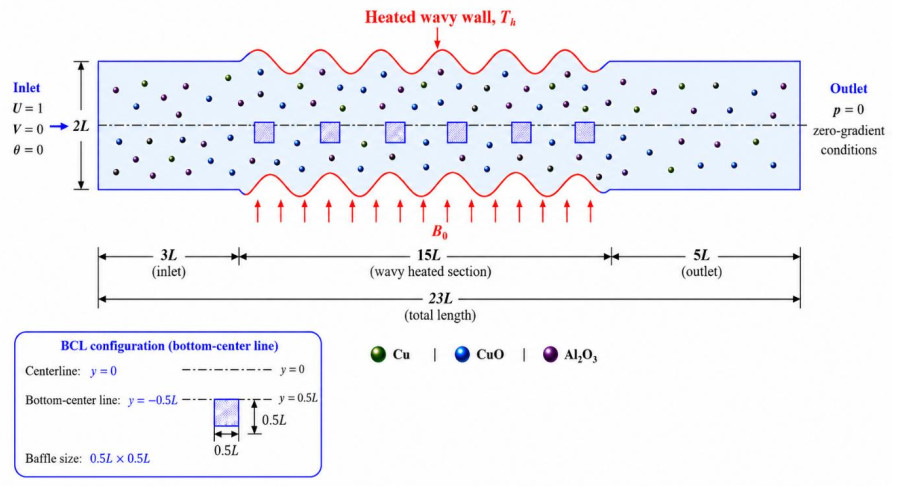
Schematic of a corrugated channel with porous baffles arranged in the BCL configuration
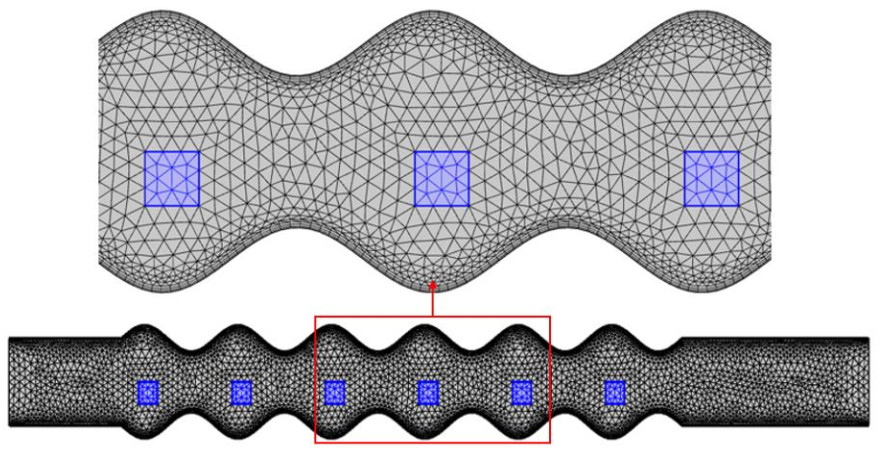
Finite element mesh with 98,272 elements
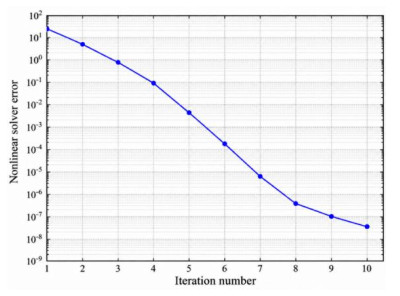
Convergence history of the fully coupled nonlinear FEM solver
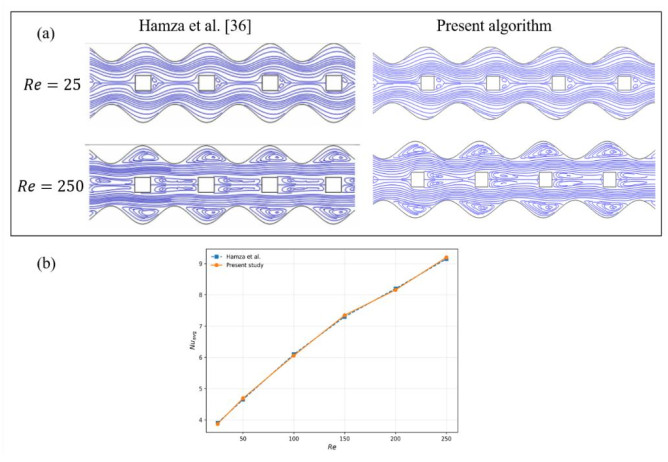
(a) Comparison of the streamlines' contours predicted by the present numerical model with the refernce results of Hamza et al. [36] for a corrugated channel with solid obstacles at $ Ha = 0 $ and $ \phi = 0.03. $ (b) Comparison of the average Nusselt number obtained from the present FEM model with the numerical results of Hamza et al. [36] for the MCL configuration at $ Ha = 0 $ and $ \phi = 0 $
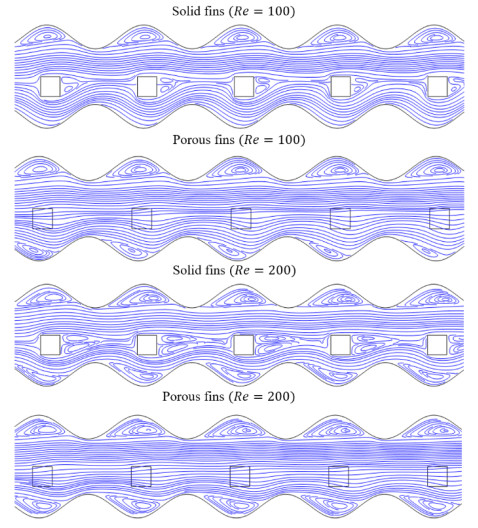
Streamlines for the solid baffle channel (top row) and the porous baffle channel (bottom row) for $ Re\ \mathrm{a}\mathrm{t}, \phi = 0.03\ \mathrm{a}\mathrm{n}\mathrm{d}\ Ha = 0.0. $ For the porous fin case, $ Da = {10}^{-3}\ \mathrm{and}\ ϵ = 0.6 $
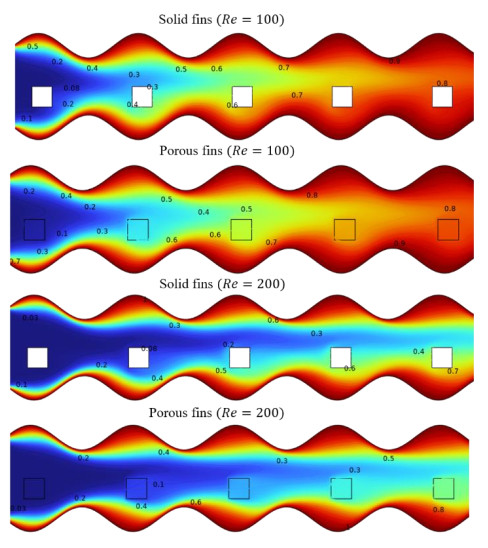
Isotherms contours for the solid baffle channel (top row) and the porous baffle channel (bottom row) for $ Re\ \mathrm{at}, \phi = 0.03\ \mathrm{and}\ Ha = 0.0.\mathrm{For}\ \ \mathrm{the}\ \ \mathrm{porous}\ \ \mathrm{fin}\ \ \mathrm{case}, Da = {10}^{-3}\ \mathrm{and}\ ϵ = 0.6 $
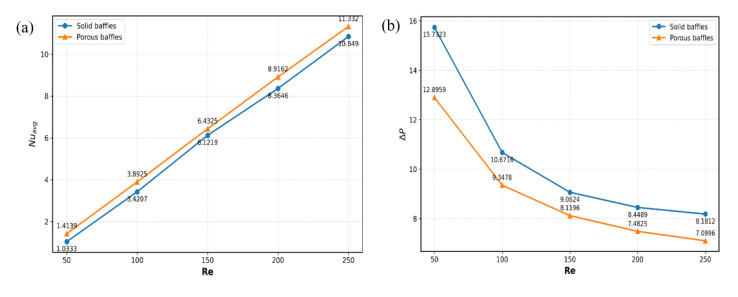
Variation of (a) $ {Nu}_{avg} $ and (b) $ \mathrm{\Delta }\mathrm{P} $ with Re for the solid baffle channel and the porous baffle channel
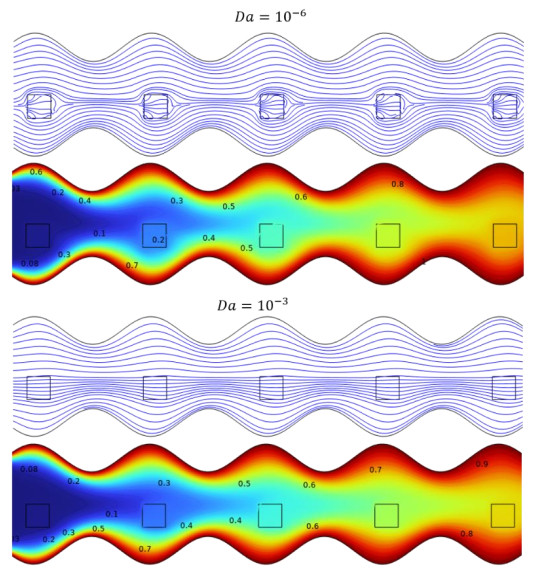
Streamlines (top row) and isotherm contours (bottom row) for selected Da values in the porous baffle channel at $ Re = 100, \phi = 0.03, Ha = 10, \ \mathrm{a}\mathrm{n}\mathrm{d}\ ϵ = 0.6 $
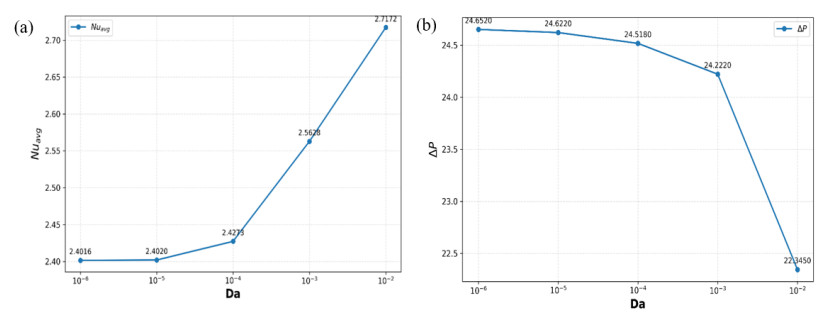
Variation in (a) $ {Nu}_{avg} $ and (b) $ \mathrm{\Delta }\mathrm{P} $ with Da for the porous baffled channel
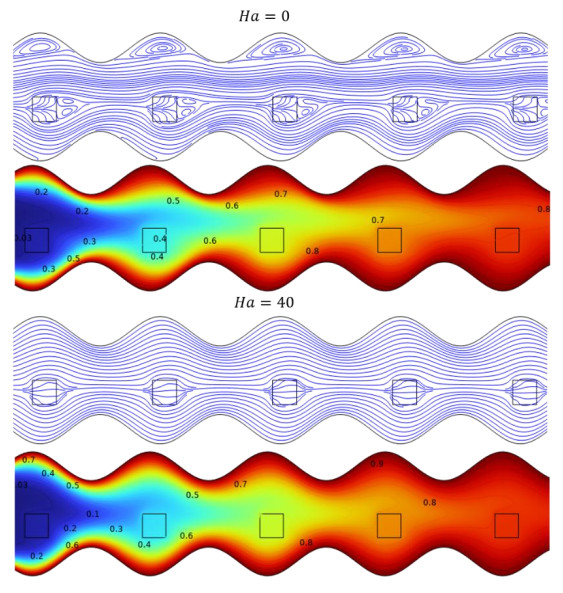
Streamlines (top row) and isotherms contours (bottom row) for selected Ha values in the porous baffle channel at $ Re = 100, \phi = 0.03, Da = {10}^{-3}, \ \mathrm{a}\mathrm{n}\mathrm{d}\ ϵ = 0.6 $
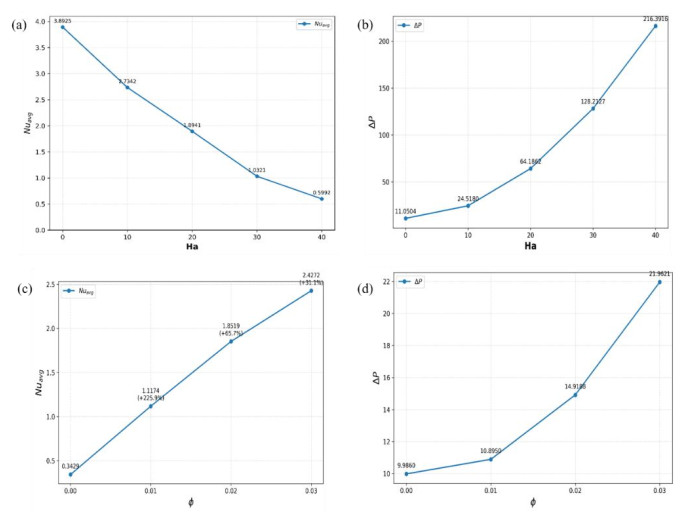
Variation in (a) $ {Nu}_{avg} $ and (b) $ \mathrm{\Delta }\mathrm{P} $ with Ha and $ \phi $ for the porous baffle channel
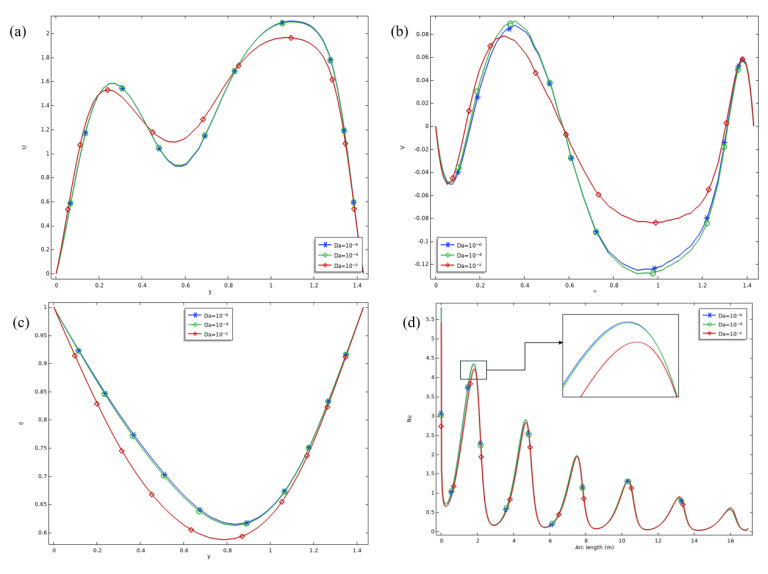
Vertical cutline profiles of (a) $ U $-velocity, (b) $ V $-velocity, (c) temperature $ \left(\theta \right) $, and (d) variation in the local Nusselt number (Nu) along the upper wavy heated wall for different values of $ Da $ at $ Re = 100, ϵ = 0.6 $, and $ \phi = 0.03 $
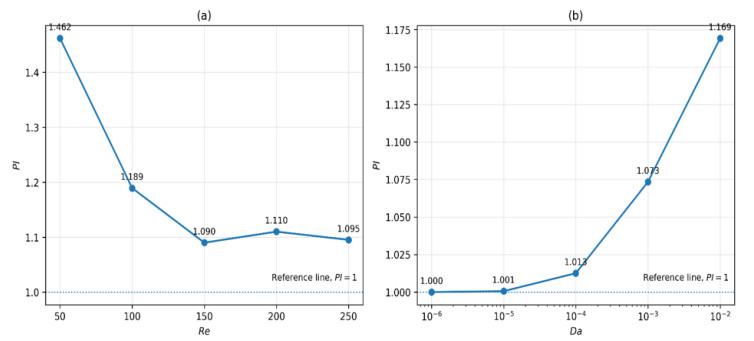
Thermo-hydraulic performance index (PI) for (a) porous fins relative to solid fins at different values of $ Re $, and (b) the porous baffle $ Da $ using $ Da = {10}^{-6} $ as the reference case
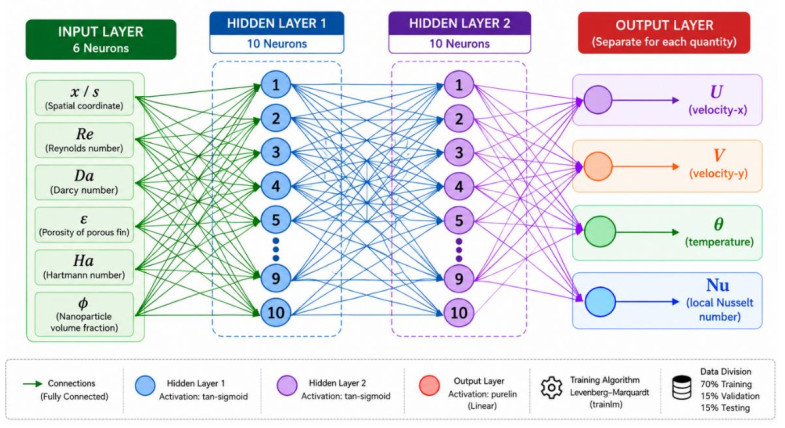
Architecture of the feedforward ANN used separately used for predicting the U-velocity, V-velocity, temperature, and local Nusselt number
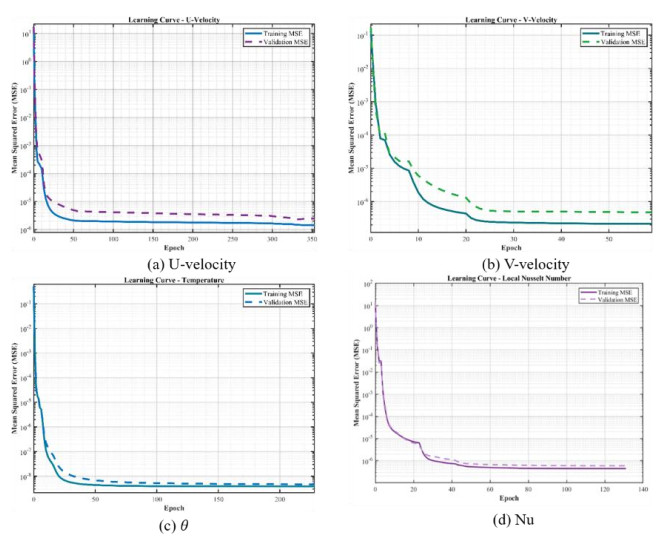
Training and validation MSE learning curves for (a) U, (b) V, (c) $ \theta $, and (d) Nusselt number
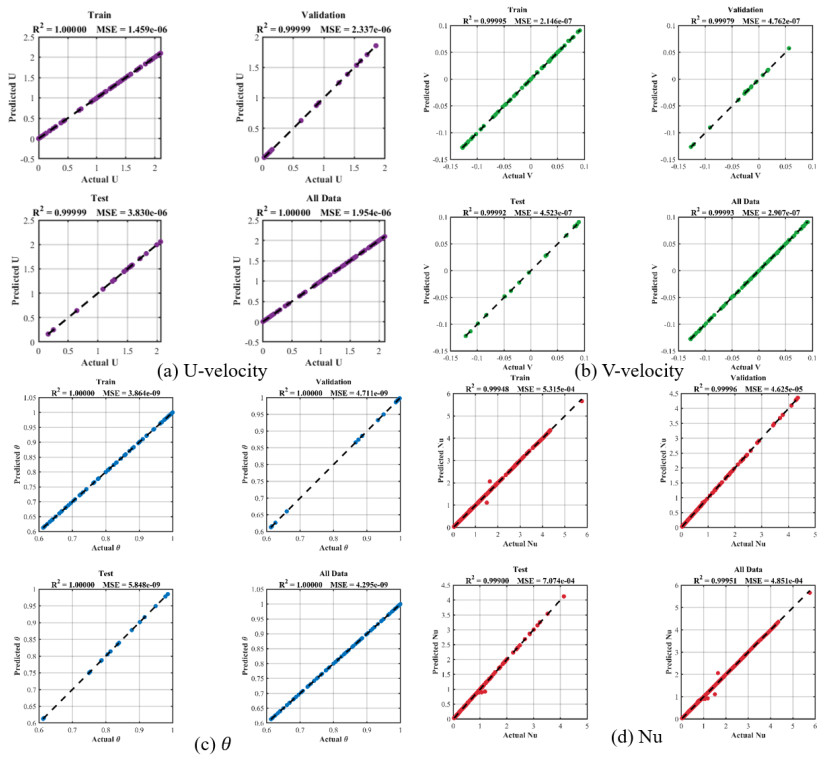
Regression analysis between numerical and ANN-predicted values for (a) U, (b) V, (c) $ \theta $ and (d) Nusselt number
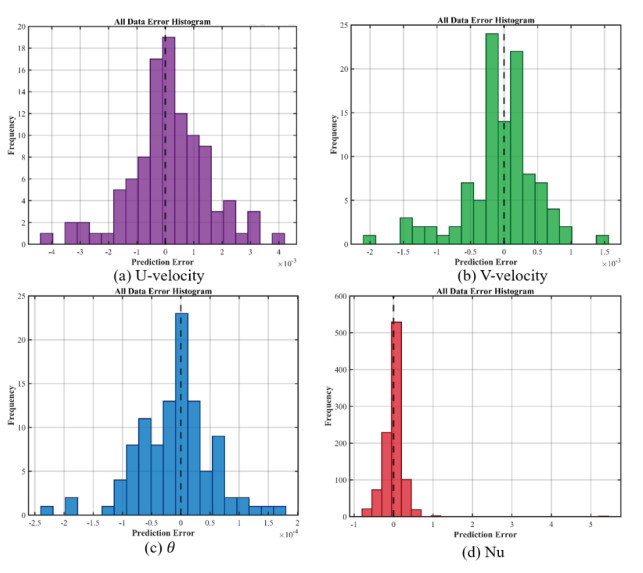
Prediction error histogram for (a) U, (b) V, (c) $ \theta $, and (d) Nusselt number (Nu)
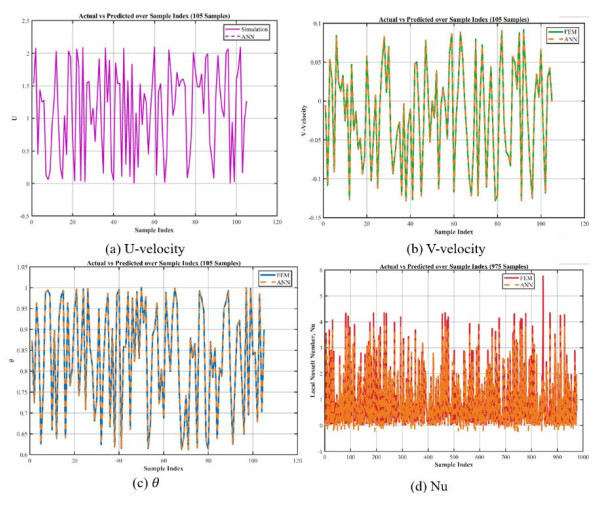
Actual and ANN predicted values over the sample index for (a) U, (b) V, (c) $ \theta $, and (d) Nusselt number (Nu)
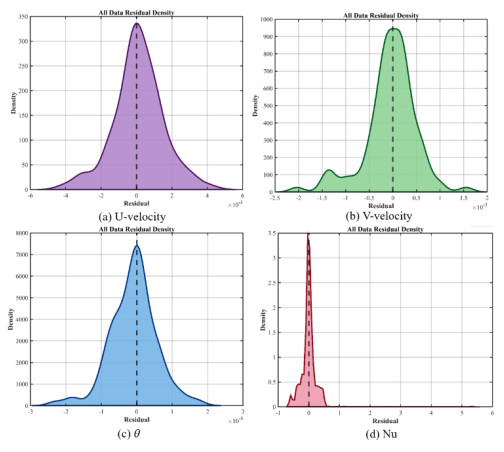
Residual probability density distribution for ANN-based predictions of (a) U, (b) V, (c) $ \theta $, and (d) Nusselt number (Nu)
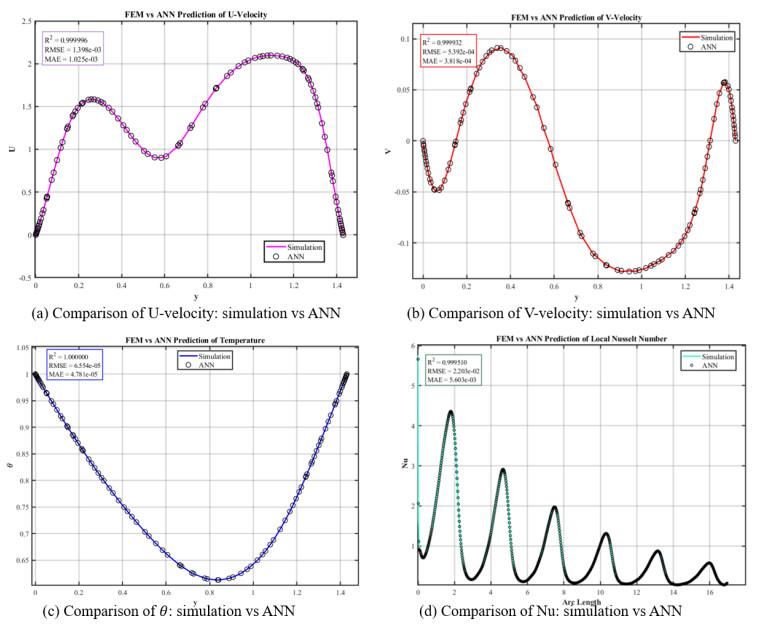
Comparison between the numerical simulation and ANN predictions for (a) U, (b) V, (c) $ \theta $ and (d) Nusselt number (Nu)




 DownLoad: