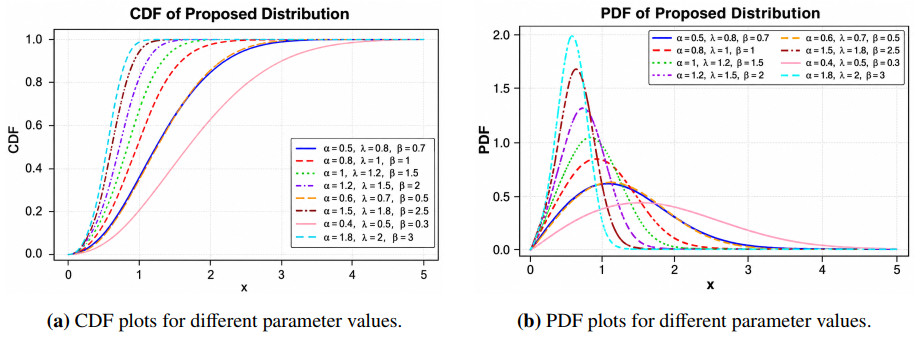
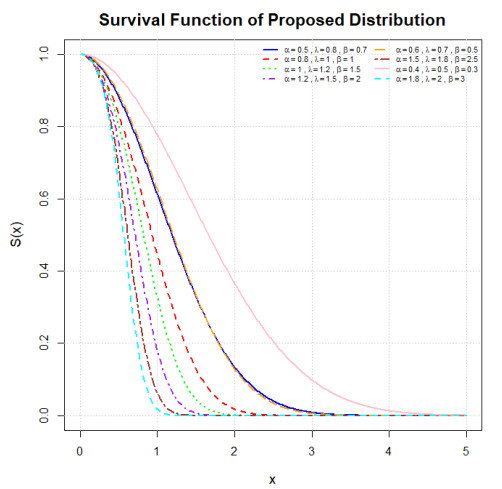
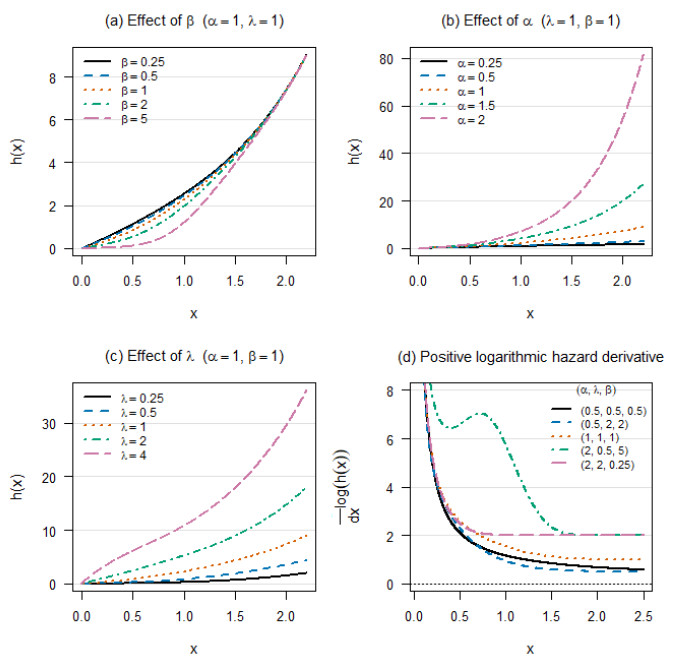
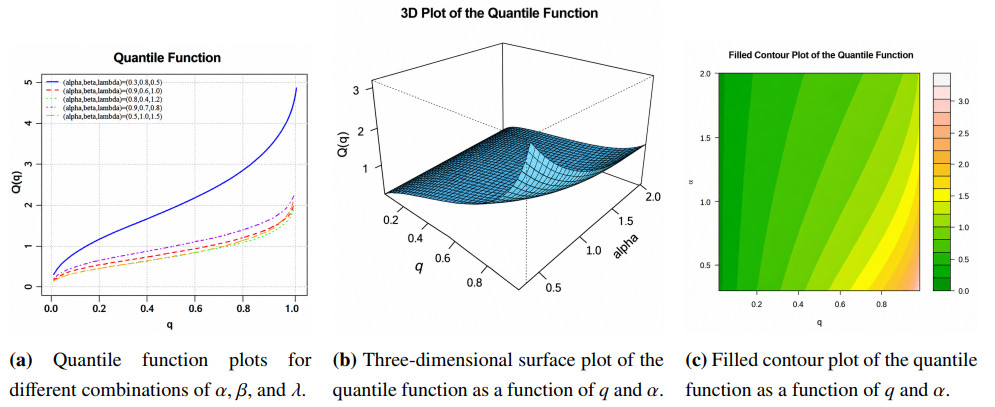
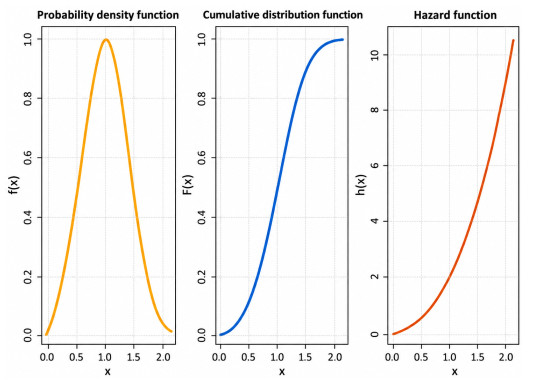
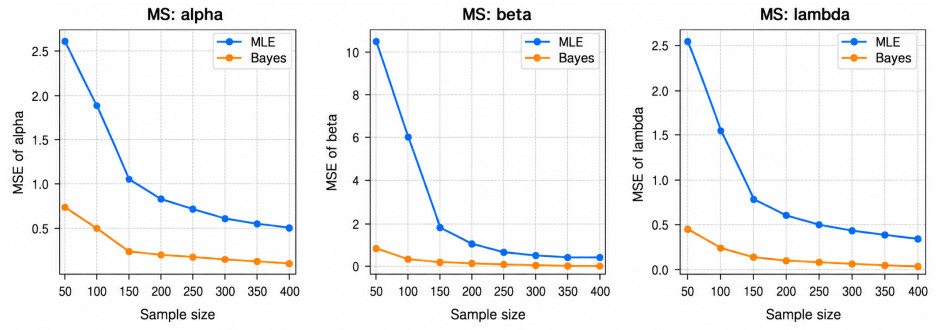
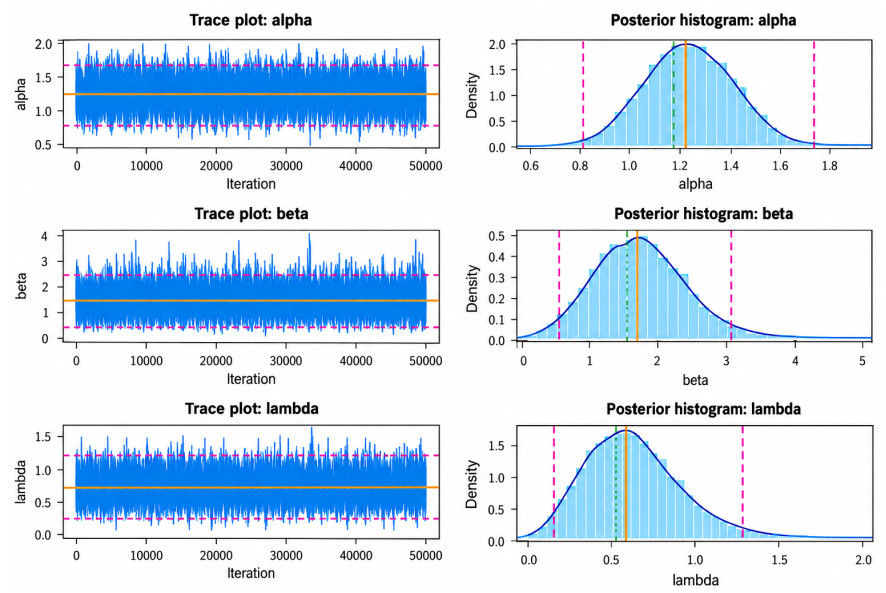
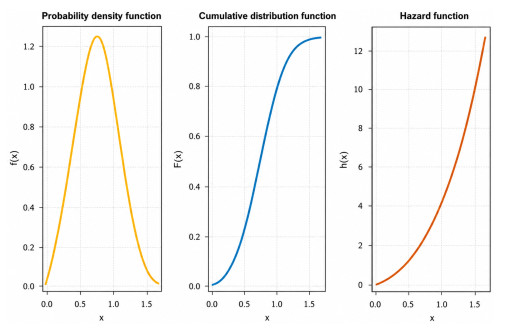
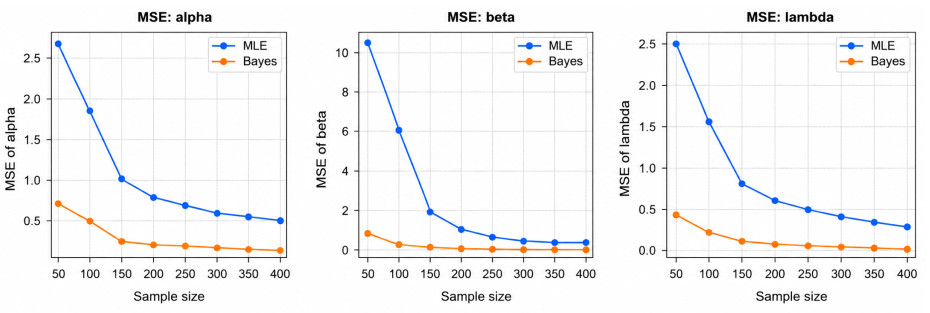
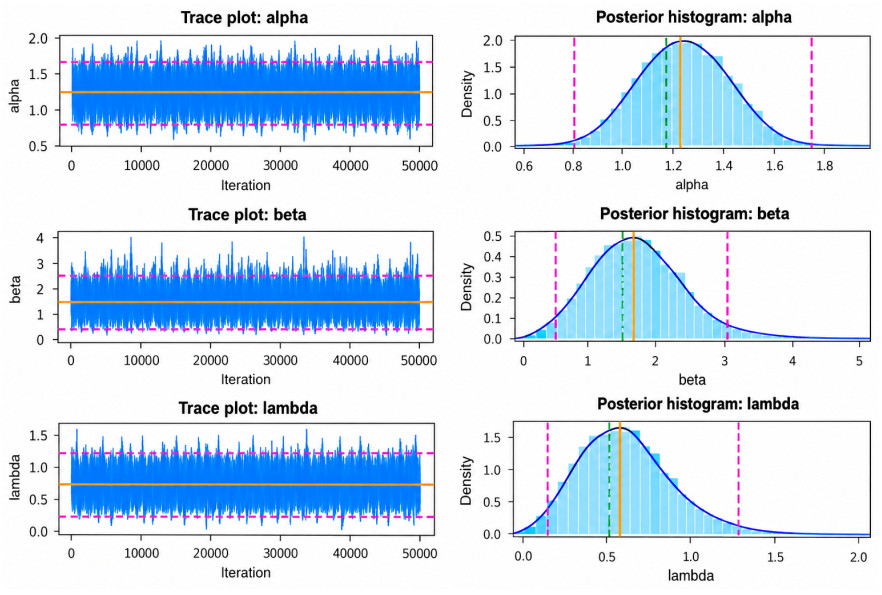
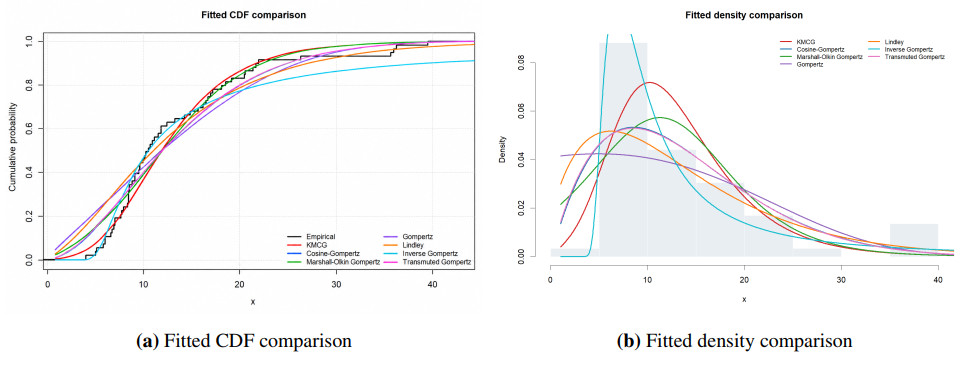
This study introduces the Kavya–Manoharan Cosine–Gompertz (KMCG) distribution, a parsimonious three-parameter Gompertz-type model. Its main mathematical properties, including the distribution, density, survival, hazard-rate, quantile, moment, and order-statistic functions, are derived. The KMCG hazard rate is strictly increasing for all admissible parameter values, restricting its use to settings where an increasing hazard structure is appropriate. Parameters are estimated by maximum likelihood and Bayesian methods using Markov chain Monte Carlo (MCMC) sampling. Monte Carlo results generally show improved estimation accuracy with increasing sample size. Applications to Egyptian monthly real tax revenue and bank-client waiting-time data are used to compare KMCG with several Gompertz-type models. For the first dataset, KMCG provides favorable information criteria, although the Inverse Gompertz model performs slightly better on some goodness-of-fit measures. For the second dataset, KMCG yields the smallest information criteria and goodness-of-fit statistics, with bootstrap $ p $-values of $ 0.940 $, $ 0.976 $, and $ 0.952 $ for the Kolmogorov–Smirnov, Anderson–Darling, and Cramér–von Mises statistics, respectively. However, its AIC differs from that of the Transmuted Gompertz model by only about $ 0.129 $, indicating comparable performance. Bayesian estimates are broadly consistent with maximum likelihood results, while near-boundary estimates require cautious interpretation. Overall, KMCG provides a competitive alternative for positive-valued data with an increasing hazard structure, although its performance is data dependent.
Citation: Ayşe Metin KARAKAŞ, Fatma BULUT, Murat KARAKAŞ. A new Gompertz-type model with classical and Bayesian inference: applications to tax revenue and bank waiting-time data[J]. AIMS Mathematics, 2026, 11(10): 33105-33160. doi: 10.3934/math.20261298
This study introduces the Kavya–Manoharan Cosine–Gompertz (KMCG) distribution, a parsimonious three-parameter Gompertz-type model. Its main mathematical properties, including the distribution, density, survival, hazard-rate, quantile, moment, and order-statistic functions, are derived. The KMCG hazard rate is strictly increasing for all admissible parameter values, restricting its use to settings where an increasing hazard structure is appropriate. Parameters are estimated by maximum likelihood and Bayesian methods using Markov chain Monte Carlo (MCMC) sampling. Monte Carlo results generally show improved estimation accuracy with increasing sample size. Applications to Egyptian monthly real tax revenue and bank-client waiting-time data are used to compare KMCG with several Gompertz-type models. For the first dataset, KMCG provides favorable information criteria, although the Inverse Gompertz model performs slightly better on some goodness-of-fit measures. For the second dataset, KMCG yields the smallest information criteria and goodness-of-fit statistics, with bootstrap $ p $-values of $ 0.940 $, $ 0.976 $, and $ 0.952 $ for the Kolmogorov–Smirnov, Anderson–Darling, and Cramér–von Mises statistics, respectively. However, its AIC differs from that of the Transmuted Gompertz model by only about $ 0.129 $, indicating comparable performance. Bayesian estimates are broadly consistent with maximum likelihood results, while near-boundary estimates require cautious interpretation. Overall, KMCG provides a competitive alternative for positive-valued data with an increasing hazard structure, although its performance is data dependent.

| [1] |
A. M. T. A. El-Bar, I. E. Ragab, On weighted exponential-Gompertz distribution: properties and application, J. Taibah Univ. Sci., 13 (2019), 616–627. https://doi.org/10.1080/16583655.2019.1600277 doi: 10.1080/16583655.2019.1600277

|
| [2] |
M. M. Abdelwahab, A. B. Ghorbal, A. S. Hassan, M. Elgarhy, E. M. Almetwally, A. F. Hashem, Classical and Bayesian inference for the Kavya-Manoharan generalized exponential distribution under generalized progressively hybrid censored data, Symmetry, 15 (2023), 1193. https://doi.org/10.3390/sym15061193 doi: 10.3390/sym15061193
|
| [3] |
F. M. A. Alam, On m X-Ray diffraction intensity using heavy-tailed probability distributions: a comparative study, Crystals, 15 (2025), 188. https://doi.org/10.3390/cryst15020188 doi: 10.3390/cryst15020188
|
| [4] | S. Azam, M. Iqbal, M. Ali, M. Tabassum, B. Khalil, Semi modified alpha power rayleigh distribution: its properties and applications, Res. Consort. Arch., 3 (2025), 706–721. Available from: https://rcresearcharchive.com/index.php/Journal/article/view/234. |
| [5] |
D. Basalamah, T. Alballa, N. A. Noori, M. H. Jumaa, S. G. Nassr, Two-parameter Kavya–Manoharan cosine inverse Rayleigh distribution: statistical properties and application on radiation data, J. Radiat. Res. Appl. Sci., 19 (2026), 102411. https://doi.org/10.1016/j.jrras.2026.102411 doi: 10.1016/j.jrras.2026.102411
|
| [6] |
D. H. Castañeda, I. Cortés, Y. A. Iriarte, A Lambert-type Lindley distribution as an alternative for skewed unimodal positive data, Mathematics, 13 (2025), 3480. https://doi.org/10.3390/math13213480 doi: 10.3390/math13213480
|
| [7] |
J. T. Eghwerido, L. Nzei, I. J. David, O. D. Adubisi, The Gompertz extended generalized exponential distribution: properties and applications, Commun. Fac. Sci. Univ. Ankara Ser. A1 Math. Stat., 69 (2020), 739–753. https://doi.org/10.31801/cfsuasmas.602930 doi: 10.31801/cfsuasmas.602930
|
| [8] |
J. T. Eghwerido, L. C. Nzei, F. I. Agu, The alpha power Gompertz distribution: characterization, properties, and applications, Sankhya A, 83 (2021), 449–475. https://doi.org/10.1007/s13171-020-00198-0 doi: 10.1007/s13171-020-00198-0
|
| [9] |
J. T. Eghwerido, F. I. Agu, The shifted Gompertz-G family of distributions: properties and applications, Math. Slovaca, 71 (2021), 1291–1308. https://doi.org/10.1515/ms-2021-0053 doi: 10.1515/ms-2021-0053
|
| [10] |
M. E. Ghitany, B. Atieh, S. Nadarajah, Lindley distribution and its application, Math. Comput. Simul., 78 (2008), 493–506. https://doi.org/10.1016/j.matcom.2007.06.007 doi: 10.1016/j.matcom.2007.06.007
|
| [11] |
B. Gompertz, On the nature of the function expressive of the law of human mortality, and on a new mode of determining the value of life contingencies, Phil. Trans. R. Soc. Lond., 115 (1825), 513–583. https://doi.org/10.1098/rstl.1825.0026 doi: 10.1098/rstl.1825.0026
|
| [12] |
A. Hassan, A. M. Abdelghaffar, Bayesian and E-Bayesian estimation of Gompertz distribution in stress-strength reliability model under partially accelerated life testing, Comput. J. Math. Stat. Sci., 4 (2025), 348–378. https://doi.org/10.21608/cjmss.2025.353923.1107 doi: 10.21608/cjmss.2025.353923.1107
|
| [13] |
A. Hassan, A. Khalil, H. Nagy, Versatile extension of the unit Gompertz: efficient estimation and application, Gazi Univ. J. Sci., 38 (2025), 1540–1564. https://doi.org/10.35378/gujs.1541941 doi: 10.35378/gujs.1541941
|
| [14] |
A. M. Karakaş, F. Bulut, The New Gompertz distribution model and applications, Symmetry, 17 (2025), 843. https://doi.org/10.3390/sym17060843 doi: 10.3390/sym17060843
|
| [15] |
A. M. Karakaş, F. Bulut, S. Çalık, A new Gompertz distribution for modeling tensile strength of carbon fibers and single carbon fibers data, Mathematics, 14 (2026), 2159. https://doi.org/10.3390/math14122159 doi: 10.3390/math14122159
|
| [16] |
A. M. Karakaş, F. Bulut, S. Şahin Bal, A novel Gompertz-type distribution with applications to radiological dose and pharmacokinetic data, Mathematics, 14 (2026), 702. https://doi.org/10.3390/math14040702 doi: 10.3390/math14040702
|
| [17] |
M. S. Khan, R. King, I. L. Hudson, Transmuted generalized Gompertz distribution with application, J. Stat. Theory Appl., 16 (2017), 65–80. https://doi.org/10.2991/jsta.2017.16.1.6 doi: 10.2991/jsta.2017.16.1.6
|
Figures(20) / Tables(38)

Ayşe Metin KARAKAŞ, Fatma BULUT, Murat KARAKAŞ. A new Gompertz-type model with classical and Bayesian inference: applications to tax revenue and bank waiting-time data[J]. AIMS Mathematics, 2026, 11(10): 33105-33160. doi: 10.3934/math.20261298





 DownLoad: