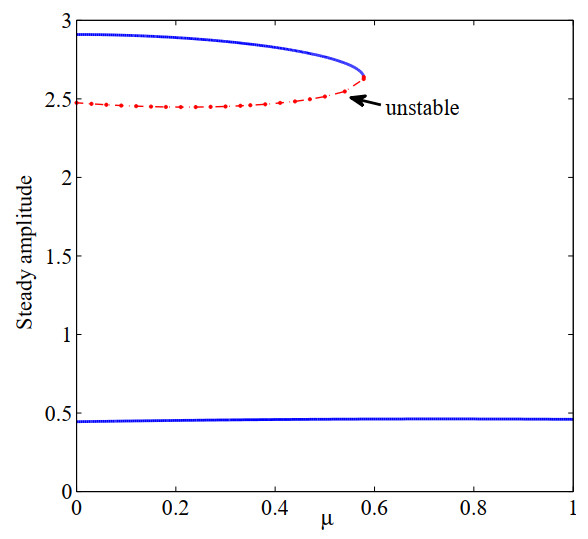
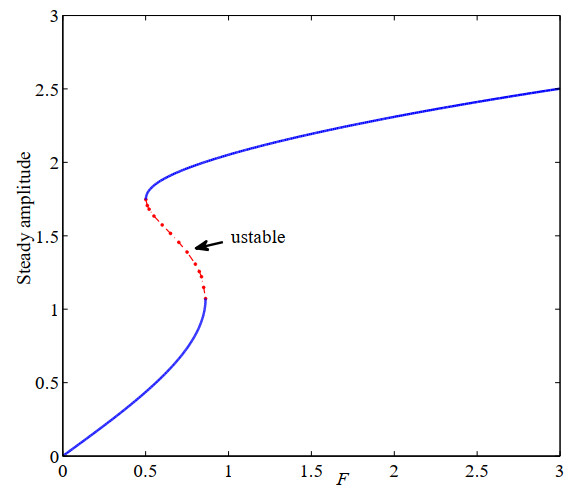
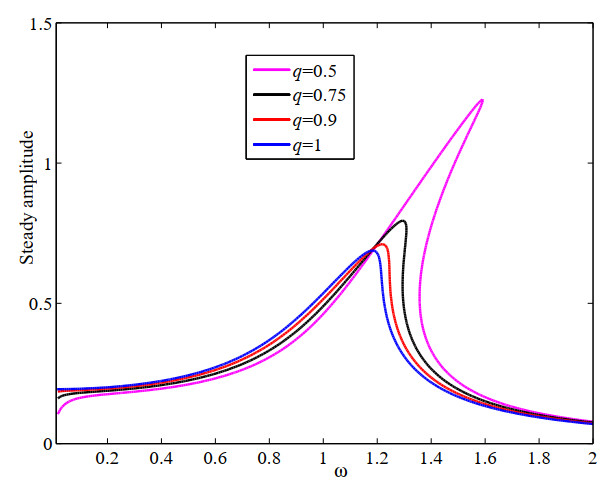
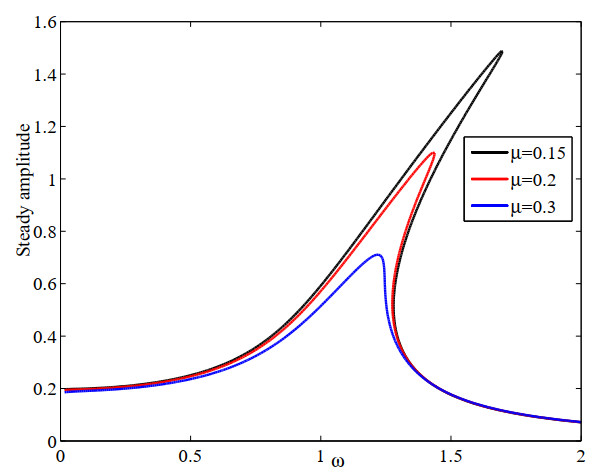
This paper analyzed the primary resonance of a novel fractional-order coronary artery model, exploring cardiovascular diseases related to vascular behavior from the nonlinear dynamics perspective. By applying the averaging method, approximate analytical solutions and the amplitude-frequency equation were derived, whereas Lyapunov stability theory was utilized to analyze the steady-state behavior. Numerical simulations validated the accuracy of the analytical approach, demonstrating close agreement between theoretical predictions and computational results. Key findings include the identification of parameter-driven bifurcations that modulate resonance amplitude and stability. Specifically, a lower fractional order $ q $ and reduced damping $ \mu $ amplify resonant responses, while increased pulse pressure $ F $ correlates with elevated spasm risk. These results provide a theoretical framework for understanding how blood vessel viscoelasticity and external stimuli influence cardiovascular dynamics, offering insights for developing diagnostic tools and therapeutic strategies to mitigate coronary artery spasm and related cardiovascular diseases.
Citation: Guanghua Wei, Xiaorong Zhang, Zhoujin Cui. Primary resonance analysis of a novel fractional-order coronary artery model[J]. AIMS Mathematics, 2025, 10(6): 14996-15011. doi: 10.3934/math.2025672
This paper analyzed the primary resonance of a novel fractional-order coronary artery model, exploring cardiovascular diseases related to vascular behavior from the nonlinear dynamics perspective. By applying the averaging method, approximate analytical solutions and the amplitude-frequency equation were derived, whereas Lyapunov stability theory was utilized to analyze the steady-state behavior. Numerical simulations validated the accuracy of the analytical approach, demonstrating close agreement between theoretical predictions and computational results. Key findings include the identification of parameter-driven bifurcations that modulate resonance amplitude and stability. Specifically, a lower fractional order $ q $ and reduced damping $ \mu $ amplify resonant responses, while increased pulse pressure $ F $ correlates with elevated spasm risk. These results provide a theoretical framework for understanding how blood vessel viscoelasticity and external stimuli influence cardiovascular dynamics, offering insights for developing diagnostic tools and therapeutic strategies to mitigate coronary artery spasm and related cardiovascular diseases.

| [1] | Cardiovascular diseases (CVDs), Available from: https://www.who.int/en/news-room/fact-sheets/detail/cardiovascular-diseases-(cvds). |
| [2] |
D. M. Wootton, D. N. Ku, Fluid mechanics of vascular systems, diseases, and thrombosis, Annu. Rev. Biomed. Eng., 1 (1999), 299–329. https://doi.org/10.1146/annurev.bioeng.1.1.299 doi: 10.1146/annurev.bioeng.1.1.299

|
| [3] |
A. El-Gohary, Chaos and optimal control of cancer self-remission and tumor system steady states, Chaos Soliton. Fract., 37 (2008), 1305–1316. https://doi.org/10.1016/j.chaos.2006.10.060 doi: 10.1016/j.chaos.2006.10.060
|
| [4] |
W. Zhang, L. Pei, Bifurcation and chaos in N-type and S-type muscular blood vessel models, Electro. Res. Arch., 33 (2025), 1285–1305. https://doi.org/10.3934/era.2025057 doi: 10.3934/era.2025057
|
| [5] |
G. Meng, X. Zong, Periodic solution of mathematical model of muscular blood vessel, J. Yangzhou Univ. Nat. Sci., 3 (2000), 15–19. https://doi.org/10.3969/j.issn.1007-824X.2000.02.004 doi: 10.3969/j.issn.1007-824X.2000.02.004
|
| [6] |
C. Lin, S. Yang, H. Yau, Chaos suppression control of a coronary artery system with uncertainties by using variable structure control, Comput. Appl. Math., 64 (2012), 988–995. https://doi.org/10.1016/j.camwa.2012.03.007 doi: 10.1016/j.camwa.2012.03.007
|
| [7] |
A. Karimi, R. Razaghi, M. Koyama, A patient-specific numerical modeling of the spontaneous coronary artery dissection in relation to atherosclerosis, Comput. Meth. Prog. Bio., 182 (2019), 105060. https://doi.org/10.1016/j.cmpb.2019.105060 doi: 10.1016/j.cmpb.2019.105060
|
| [8] |
V. Carvalho, D. Pinho, R. A. Lima, J. C. Teixeira, S. Teixeira, Blood flow modeling in coronary arteries: A review, Fluids, 6 (2021), 53. https://doi.org/10.3390/fluids6020053 doi: 10.3390/fluids6020053
|
| [9] |
H. Ding, D. Qian, S. Lee, L. Zhu, Sliding-mode-based chaos suppression of coronary artery systems, Meas. Control, 56 (2023), 1684–1693. https://doi.org/10.1177/00202940231180842 doi: 10.1177/00202940231180842
|
| [10] |
G. El Khaloufi, N. Chaibi, S. B. Alaoui, I. Boumhidi, Generalized dissipativity dynamic output feedback control for coronary artery system, T. I. Meas. Control, 46 (2024), 716–728. https://doi.org/10.1177/01423312231182177 doi: 10.1177/01423312231182177
|
| [11] |
D. Craiem, F. Rojo, J. Atienza, G. Guinea, R. L. Armentano, Fractional calculus applied to model arterial viscoelasticity, Lat. Am. Appl. Res., 38 (2008), 141–145. https://doi.org/10.1016/j.supflu.2007.12.004 doi: 10.1016/j.supflu.2007.12.004
|
| [12] |
D. Craiem, F. J. Rojo, J. M. Atienza, R. L. Armentano, G. V. Guinea, Fractional-order viscoelasticity applied to describe uniaxial stress relaxation of human arteries, Phy. Med. Biol., 53 (2008), 4543. https://doi.org/10.1088/0031-9155/53/17/006 doi: 10.1088/0031-9155/53/17/006
|
| [13] |
Y. Yu, P. Perdikaris, G. E. Karniadakis, Fractional modeling of viscoelasticity in 3D cerebral arteries and aneurysms, J. Comput. Phys., 323 (2016), 219–242. https://doi.org/10.1016/j.jcp.2016.06.038 doi: 10.1016/j.jcp.2016.06.038
|
| [14] |
C. Ionescu, A. Lopes, D. Copot, J. A. T. Machado, J. H. T. Bates, The role of fractional calculus in modeling biological phenomena: A review, Commun. Nonlinear Sci., 51 (2017), 141–159. https://doi.org/10.1016/j.cnsns.2017.04.001 doi: 10.1016/j.cnsns.2017.04.001
|
| [15] |
Z. Cui, Z. Wang, Primary resonance of a nonlinear fractional model for cerebral aneurysm at the circle of Willis, Nonlinear Dynam., 108 (2022), 4301–4314. http://dx.doi.org/10.1007/s11071-022-07445-z doi: 10.1007/s11071-022-07445-z
|
| [16] |
A. Ranjbar, A. Madady, M. Ramezani, A. Khosravi, Synchronization of stochastic fractional-order model of muscular blood vessels, J. Vib. Control, 30 (2024), 3775–3783. https://doi.org/10.1177/10775463231201732 doi: 10.1177/10775463231201732
|
| [17] |
M. P. Aghababa, M. Borjkhani, Chaotic fractional-order model for muscular blood vessel and its control via fractional control scheme, Complexity, 20 (2015), 37–46. https://doi.org/10.1002/cplx.21502 doi: 10.1002/cplx.21502
|
| [18] |
Z. Wang, M. Du, symptotical behavior of the solution of a SDOF linear fractionally damped vibration system, Shock Vib., 18 (2011), 257–268. https://doi.org/10.3233/SAV-2010-0566 doi: 10.3233/SAV-2010-0566
|
| [19] |
Y. Shen, S. Yang, H. Xing, G. Gao, Primary resonance of Duffing oscillator with fractional-order derivative, Commun. Nonlinear Sci., 17 (2012), 3092–3100. https://doi.org/10.1016/j.cnsns.2011.11.024 doi: 10.1016/j.cnsns.2011.11.024
|
| [20] |
Y. Shen, S. Wen, X. Li, S. Yang, H. Xing, Dynamical analysis of fractional-order nonlinear oscillator by incremental harmonic balance method, Nonlinear Dynam., 85 (2016), 1457–1467. https://doi.org/10.1007/s11071-016-2771-8 doi: 10.1007/s11071-016-2771-8
|
| [21] |
S. Li, J. Niu, X. Li, Primary resonance of fractional-order Duffing-van der Pol oscillator by harmonic balance method, Chinese Phys. B, 27 (2018), 120502. https://doi.org/10.1088/1674-1056/27/12/120502 doi: 10.1088/1674-1056/27/12/120502
|
| [22] |
Z. Cui, G. Wei, T. Lu, Simultaneous resonance analysis of a fractional cerebral aneurysm model with double-frequency excitation, J. Vib. Eng. Technol., 13 (2025), 23. https://doi.org/10.1007/s42417-024-01566-y doi: 10.1007/s42417-024-01566-y
|
| [23] |
G. Alotta, M. D. Paola, F. P. Pinnola, An unified formulation of strong non-local elasticity with fractional order calculus, Meccanica, 57 (2022), 793–805. https://doi.org/10.1007/s11012-021-01428-x doi: 10.1007/s11012-021-01428-x
|
| [24] |
R. L. Magin, Fractional calculus models of complex dynamics in biological tissues, Comput. Math. Appl., 59 (2010), 1586–1593. https://doi.org/10.1016/j.camwa.2009.08.039 doi: 10.1016/j.camwa.2009.08.039
|
| [25] | A. H. Nayfeh, D. T. Mook, Nonlinear oscillations, New York: Wiley-Interscience, 1995. https://doi.org/10.1002/9783527617586 |
| [26] | J. A. Sanders, F. Verhulst, J. Murdock, Averaging methods in nonlinear dynamical systems, New York: Springer, 2007. https://doi.org/10.1007/978-0-387-48918-6 |
| [27] | V. Burd, Method of averaging for differential equations on an infinite interval: Theory and applications, New York: Taylor & Francis Group, 2007. https://doi.org/10.1201/9781584888758 |
| [28] |
Z. Zhao, J. Zhang, G. Ding, D. Zhang, Chaos synchronization of coronary artery system based on higher order sliding mode adaptive control, Acta Phys. Sin., 64 (2015), 1–8. https://doi.org/10.7498/aps.64.210508 doi: 10.7498/aps.64.210508
|
| [29] |
C. Gong, Y. Li, X. Sun, Backstepping control of synchronization for biomathematical model of muscular blood vessel, J. Appl. Sci., 24 (2006), 604–607. https://doi.org/10.3969/j.issn.0255-8297.2006.06.012 doi: 10.3969/j.issn.0255-8297.2006.06.012
|
| [30] | P. Roy, S. Ray, S. Bhattacharya, Synchronization of two chaotic coronary artery systems using modified feedback method, In: International Conference on Control, Instrumentation, Energy and Communication, IEEE, 2016,145–148. https://doi.org/10.1109/CIEC.2016.7513819 |
| [31] | J. P. Lasalle, The stability of dynamical systems, Phila: Society for Industrial and Applied Mathematics, 1976. https://doi.org/10.1137/1.9781611970432 |
| [32] |
G. Meng, Approximation solutions in the biomathematical model of muscular blood vessel (ⅱ), J. Yangzhou Univ. Nat. Sci., 5 (2002), 18–20. https://doi.org/10.3969/j.issn.1007-824X.2002.01.005 doi: 10.3969/j.issn.1007-824X.2002.01.005
|
| [33] | K. H. Kim, C. C. Adnan, D. J. Schaller, Nitroglycerin, StatPearls Publishing, 2023. |
| [34] | R. Caponetto, G. Dongola, L. Fortuna, I. Petras, Fractional order systems: Modeling and control applications, World Scientific, 2010. https://doi.org/10.1142/7709 |
| [35] | I. Petras, Fractional-order nonlinear systems: Modeling, analysis and simulation, Heidelberg: Springer Berlin, 2011. http://dx.doi.org/10.1007/978-3-642-18101-6 |
Figures(6)

Guanghua Wei, Xiaorong Zhang, Zhoujin Cui. Primary resonance analysis of a novel fractional-order coronary artery model[J]. AIMS Mathematics, 2025, 10(6): 14996-15011. doi: 10.3934/math.2025672





 DownLoad: