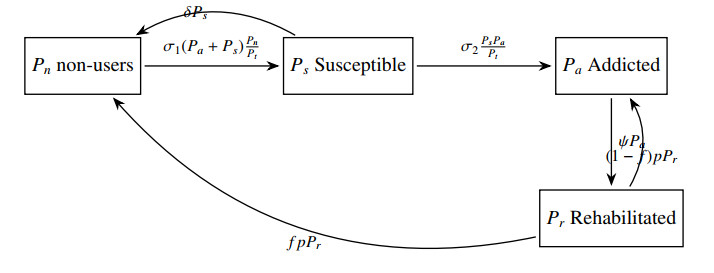
This paper presents a comprehensive mathematical model for analyzing the dynamics of illicit drug consumption within a population. Building upon and extending classical epidemiological models such as the susceptible, infected, and recovered (SIR) framework, the proposed model categorizes individuals into four compartments: Non-susceptible, susceptible, addicted, and rehabilitated. The model incorporates key social factors such as peer influence, intervention efforts, and the probability of relapse. A nonlinear system of differential equations was developed to describe the transitions between these states. The basic reproduction number $ R_0 $ was derived to assess the potential spread of addiction and stability analysis of the equilibrium points was carried out. Numerical simulations explore the impact of various intervention levels, highlighting how increased societal and family involvement can reduce the prevalence of addiction. Furthermore, an optimal control problem was formulated and solved using Pontryagin's maximum principle to determine the most cost-effective intervention strategy over time. The results demonstrate that adaptive, well-balanced policies can significantly reduce both susceptibility and addiction rates while minimizing social and economic costs.
Citation: Abdulaziz H. Alharbi, M. S. J. Alzahrani, Fadhel Jday, Aref Alsehaimi. Mathematical analysis for a dynamic model of illicit drug consumption[J]. AIMS Mathematics, 2025, 10(6): 14784-14803. doi: 10.3934/math.2025665
This paper presents a comprehensive mathematical model for analyzing the dynamics of illicit drug consumption within a population. Building upon and extending classical epidemiological models such as the susceptible, infected, and recovered (SIR) framework, the proposed model categorizes individuals into four compartments: Non-susceptible, susceptible, addicted, and rehabilitated. The model incorporates key social factors such as peer influence, intervention efforts, and the probability of relapse. A nonlinear system of differential equations was developed to describe the transitions between these states. The basic reproduction number $ R_0 $ was derived to assess the potential spread of addiction and stability analysis of the equilibrium points was carried out. Numerical simulations explore the impact of various intervention levels, highlighting how increased societal and family involvement can reduce the prevalence of addiction. Furthermore, an optimal control problem was formulated and solved using Pontryagin's maximum principle to determine the most cost-effective intervention strategy over time. The results demonstrate that adaptive, well-balanced policies can significantly reduce both susceptibility and addiction rates while minimizing social and economic costs.

| [1] | D. A. Behrens, J. P. Caulkins, G. Tragler, G. Feichtinger, Optimal control of drug epidemics: Prevent and treat-but not at the same time? Manage. Sci., 45 (1999), 627–636. |
| [2] |
N. S. Barlow, S. J. Weinstein, Accurate closed-form solution of the SIR epidemic model, Physica D, 408 (2020), 132540. https://doi.org/10.1016/j.physd.2020.132540 doi: 10.1016/j.physd.2020.132540

|
| [3] |
N. A. Kudryashov, M. Chmykhov, M. Vigdorowitsch, An estimative (warning) model for recognition of pandemic nature of virus infections, Int. J. Nonlin. Sci. Num., 24 (2023), 213–226. https://doi.org/10.1515/ijnsns-2020-0154 doi: 10.1515/ijnsns-2020-0154
|
| [4] |
B. X. Li, L. H. Zhu, Turing instability analysis of a reaction–diffusion system for rumor propagation in continuous space and complex networks, Inform. Process. Manag., 61 (2024), 103621. https://doi.org/10.1016/j.ipm.2023.103621 doi: 10.1016/j.ipm.2023.103621
|
| [5] |
L. H. Zhu, Y. Ding, S. L. Shen, Green behavior propagation analysis based on statistical theory and intelligent algorithm in data-driven environment, Math. Biosci., 379 (2025), 109340. https://doi.org/10.1016/j.mbs.2024.109340 doi: 10.1016/j.mbs.2024.109340
|
| [6] |
H. Y. Sha, L. H. Zhu, Dynamic analysis of pattern and optimal control research of rumor propagation model on different networks, Inform. Process. Manag., 62 (2025), 104016. https://doi.org/10.1016/j.ipm.2024.104016 doi: 10.1016/j.ipm.2024.104016
|
| [7] |
N. Grassly, C. Fraser, Mathematical models of infectious disease transmission, Nat. Rev. Microbiol., 6 (2008), 477–487. https://doi.org/10.1038/nrmicro1845 doi: 10.1038/nrmicro1845
|
| [8] |
W. L. White, Addiction recovery: Its definition and conceptual boundaries, J. Subst. Abuse Treat., 33 (2007), 229–241. https://doi.org/10.1016/j.jsat.2007.04.015 doi: 10.1016/j.jsat.2007.04.015
|
| [9] | J. P. Caulkins, The effectiveness of drug control policies, J. Policy Anal. Manag., 15 (1996), 330–352. |
| [10] | P. Reuter, The unintended consequences of drug policies, Santa Monica: RAND Corporation, 2009. |
| [11] | S. S. Everingham, C. P. Rydell, Modeling the demand for cocaine, Santa Monica: RAND Corporation, 1994. |
| [12] | A. Baveja, E. H. Kaplan, E. R. Becker, Economic and epidemiological models of drug markets, J. Drug Issues, 47 (2017), 176–195. |
| [13] |
M. R. D'Orsogna, M. Perc, Statistical physics of crime: A review, Phys. Life Rev., 12 (2015), 1–21. https://doi.org/10.1016/j.plrev.2014.11.001 doi: 10.1016/j.plrev.2014.11.001
|
| [14] |
G. Tragler, J. P. Caulkins, G. Feichtinger, Optimal dynamic allocation of treatment and enforcement in illicit drug control, Oper. Res., 49 (2001), 352–362. https://doi.org/10.1287/opre.49.3.352.11215 doi: 10.1287/opre.49.3.352.11215
|
| [15] |
S. S. Negus, An economon model of drug addiction, Psychopharmacology, 241 (2024), 417–425. https://doi.org/10.1007/s00213-024-06535-7 doi: 10.1007/s00213-024-06535-7
|
| [16] | C. F. Manski, J. V. Pepper, C. V. Petrie, Informing America's policy on illegal drugs: What we don't know keeps hurting us, National Academies Press, 2001. |
| [17] |
J. P. Caulkins, P. Reuter, How drug enforcement affects drug prices, Crime Justice, 39 (2010), 213–271. https://doi.org/10.1086/652386 doi: 10.1086/652386
|
| [18] | M. Sharma, S. Lancelot, C. Arellano, N. Scott, Machine learning applications in substance abuse research: A review, J. Substance Use Addiction Treat., 2017,267–281. |
| [19] | European Monitoring Centre for Drugs and Drug Addiction (EMCDDA), European drug report 2023: Trends and developments, Lisbon: EMCDDA, 2023. Available from: https://www.emcdda.europa.eu/publications/edr/trends-developments/2023_en. |
| [20] | National Institute on Drug Abuse, Drugs, brains, and behavior: The science of addiction, NIH, 2022. Available from: https://nida.nih.gov. |
| [21] |
N. A. Christakis, J. H. Fowler, The Collective dynamics of smoking in a large social network, New Engl. J. Med., 39 (2008). https://doi.org/10.1056/NEJMsa0706154 doi: 10.1056/NEJMsa0706154
|
| [22] | S. Lenhart, J. T. Workman, Optimal control applied to biological models, Chapman and Hall: Boca Raton, FL, USA, 2007. |
| [23] | United Nations Office on Drugs, World drug report 2023, United Nations publication, 2023. |
| [24] | L. S. Pontryagin, V. G. Boltyanskii, R. V. Gamkrelidze, E. F. Mishchenko, The mathematical theory of optimal processes, Interscience Publishers, 1962. https://doi.org/10.1201/9780203749319 |
| [25] | D. Liberzon, Calculus of variations and optimal control theory: A concise introduction, Princeton University Press, 2012. |
| [26] | W. Fleming, R. Rishel, Deterministic and stochastic optimal control, New York: Springer, 1975. |
| [27] | L. S. Pontryagin, V. G. Boltyanskii, R. V. Gamkrelidze, E. F. Mishchenko, K. N. Trirogoff, L. W. Neustadt, The Mathematical theory of optimal processes, Boca Raton: CRC Press, 2000. |
Figures(8)

Abdulaziz H. Alharbi, M. S. J. Alzahrani, Fadhel Jday, Aref Alsehaimi. Mathematical analysis for a dynamic model of illicit drug consumption[J]. AIMS Mathematics, 2025, 10(6): 14784-14803. doi: 10.3934/math.2025665





 DownLoad: